

Introduction
Income share agreements (ISAs) offer a promising option for financing tertiary education in low- and lower-middle-income countries, where structural financial barriers limit educational access (see, e.g., UBS Optimus Foundation, 2021). In ISAs, investors cover the educational costs of a student in exchange for receiving a specified percentage of their future income for a set period. Unlike most conventional loans, ISAs do not require collateral, which makes them accessible for financially constrained youth. Nevertheless, formal ISA enforcement is challenging. Their contractual structure leaves room for opportunism among funding recipients, such as hiding, understating, or postponing earnings to minimize education costs (Palacios Lleras, Reference Palacios Lleras2004). This raises questions about how ISAs can be successfully implemented in low-income country contexts, in which weak external capacities further constrain effective contract enforcement.
Current research provides limited insights into this matter. While related work has considered questions of education financing, student debt, and repayment in different geographies (e.g., Baum, Reference Baum2017; Oketch, Reference Oketch2016), no empirical studies have examined the institutional determinants of the behavioural choices of ISA-takers in low-income country contexts. ISA-specific literature mostly infers the potential behavioural implications of ISAs from theoretical considerations on their formal incentive structure. Existing empirical work has focused on other areas, such as the funding of poker tournament fees to assess productive efforts in ISAs (Madonia and Smith, Reference Madonia and Smith2019) and education financing in the USA to evaluate public opinions on ISAs (Delaney et al., Reference Delaney, Bell and Soler2019) and potential adverse selection into ISAs (Mumford, Reference Mumford2020).
Understanding the behavioural choices of ISA-takers requires context-specific research. This is because the governance structure of ISA programmes is not only influenced by their broader institutional environment but also likely to create its own informal mechanisms of governance. Ostrom (Reference Ostrom1990, Reference Ostrom2000) emphasizes that economic behaviour is embedded within broader social and cultural contexts, in which groups can successfully solve collective action problems by establishing informal self-governance systems. Especially when asymmetric information results in contractual incompleteness and institutionally deficient framework conditions challenge external enforcement, actors may establish supportive institutions to govern behaviour relationally (see Fafchamps, Reference Fafchamps, Aoki and Hayami2001a; Greif, Reference Greif1993).
Particularly, ISA providers may seek to establish supportive informal institutions within financing programmes. Nevertheless, they will compete with pre-existing institutions, and eventually, actors may accept, reject, or modify new institutions (Mamadouh et al., Reference Mamadouh, De Jong, Lalenis, De Jong, Lalenis and Mamadouh2002). Consequently, the governance structure of ISA programmes in low-income country contexts may involve several formal and informal elements, but it remains unclear which elements determine graduates’ behavioural choices.
This paper takes an exploratory first step towards understanding ISA governance in low-income country contexts. Drawing on the Rwandan ISA programme of the non-profit organization CHANCEN International (CI), the first independently operated ISA student-financing initiative in Africa, it examines the following research question: What is the governance structure, composed of formal and informal institutional elements, of an ISA education-financing programme in a low-income country context? Interviews with 26 graduates of the programme reveal that in this context, ISA governance relies on a coupling of bilateral formal rules with shared, reciprocity-oriented behavioural norms, which operate both in bilateral relationships and the wider programme community. Compliance with these norms is promoted through informal enforcement mechanisms.
This paper contributes to the literature by providing a comprehensive account of a real-world governance structure, which facilitates cooperation and contractual compliance under conditions of incomplete contracting, limited formal enforceability, and collective action problems. Its findings not only underline the relevance of informal institutional elements for ISA governance in low-income country contexts, where ISA contracting problems coincide with limited external enforcement capacities, but also suggest that effective ISA enforcement may rely on complex governance structures, which combine consistent formal and informal institutional elements. Future studies could evaluate the transferability of these findings to comparable programmes.
Theoretical framework
The fundamentals of ISAs
ISAs differ fundamentally from conventional bank loans, in which repayments are typically calculated from a fixed principal amount and interest. ISA repayments are contingent on the borrower’s income, so that high earners will repay more than low earners under identical contractual terms. Establishing the theoretical framework for the subsequent empirical analysis, this section presents the institutional characteristics of ISAs.
Institutions can be defined as systems of rules that structure social interactions (Hodgson, Reference Hodgson2025). ISAs are best conceived as bilateral contracts, which formalize the economic relationship between the funder and the funding recipient by stipulating their rights, obligations, and the terms and conditions governing their transaction. By specifying rules that are ‘constituted or maintained through legally decreed procedures’, ISAs meet Hodgson’s (Reference Hodgson2025: 14) definition of formal institutions.
This study focuses on ISAs as education-financing tools, which represent their original and most prominent application (see Friedman, Reference Friedman and Solo1955; Palacios et al., Reference Palacios, DeSorrento and Kelly2014). Nevertheless, similar arrangements have been used in other contexts, such as financing poker tournament fees (see Madonia and Smith, Reference Madonia and Smith2019). The term ‘ISA’ typically refers to education-financing contracts offered by private for-profit or non-profit actors (see Palacios et al., Reference Palacios, DeSorrento and Kelly2014). In contrast, publicly financed adaptations are generally referred to as ‘income-contingent loans’ or ‘income-based repayments’ (see Mueller and Yannelis, Reference Mueller and Yannelis2017; Palacios Lleras, Reference Palacios Lleras2004). Unlike ISAs, they usually retain a predefined nominal repayment amount consisting of principal and accrued interest (see Chapman, Reference Chapman, Hanushek and Welch2006).
ISA providers first emerged in the USA and Germany (see Palacios Lleras, Reference Palacios Lleras2004; StudierendenGesellschaft, n.d.). Around the early 2000s, organizations such as Lumni (South America) and CI (Africa) introduced ISAs to the Global South. Nevertheless, the number of providers in this region remains comparatively low. They often articulate a focus on expanding educational access for low-income groups but may operate as non-profits or for-profit social enterprises.Footnote 1
Every ISA defines a repayment percentage and period. The repayment obligation usually starts after graduation, once employment is secured. Most ISAs temporarily exempt graduates from repayment if their income falls below a set minimum income threshold. Conversely, providers benefit whenever total repayments exceed the initial funding amount. To limit this overpayment risk for high-earning graduates, some ISAs set a cap on total payments (Palacios Lleras, Reference Palacios Lleras2004).
Relevant contracting problems
The structure of ISAs introduces several contracting problems, which create scope for ex post contracting opportunism among funding recipients. First, future uncertainty and the long duration of ISAs make it impossible to anticipate all relevant factors determining contract fulfilment ex ante. Consequently, ISAs are contractually incomplete. This allows parties to later exploit contractual ambiguities by interpreting their obligations opportunistically, which may lead to negotiation costs and mutual losses (Williamson, Reference Williamson1971: 115–117). For example, during repayment, graduates could exploit remaining ambiguities about what constitutes income under an ISA to their own advantages (see Palacios Lleras, Reference Palacios Lleras2004).Footnote 2
Second, ISAs entail both a time lag in contract fulfilment and asymmetrical information. While providers perform their contractual obligation upfront, graduates’ repayment obligation is deferred, which creates future uncertainty regarding their repayment outcomes. Graduates hold superior knowledge on repayment-relevant information, such as their incomes. The provider cannot access this information or verify it only at high cost, which makes it difficult to objectively evaluate graduates’ contractual performance ex post. These conditions enable strategic misrepresentation and introduce moral hazard: graduates may exploit information asymmetries in contract fulfilment by intentionally misrepresenting or manipulating relevant information (see Williamson, Reference Williamson1971: 117). In particular, they may under-report or hide their earnings to minimize educational costs (see Palacios Lleras, Reference Palacios Lleras2004).
Graduates’ repayments not only serve the provider’s economic interest but also sustain a fund, which is used to finance current and future students in ISAs. While repayment-related opportunism may be individually beneficial, it depletes this finite collective resource, hence reduces the amount of funding that can be made available to other community members. This corresponds to a collective action problem as described by Ostrom (Reference Ostrom2000).Footnote 3
Enforcement mechanisms
The contracting problems of ISAs inherently complicate their formal enforceability. In low-income country contexts, effective formal enforcement tends to be further challenged by factors such as limited public information systems, weak legal institutions, and inefficient courts. For example, without reliable external income verification sources such as tax records, enforcement costs may rise even further. Moreover, legal action is rarely justified in such settings, as a lack of seizable assets makes judgement recovery unlikely (Fafchamps, Reference Fafchamps2001b).
This raises the question of how ISAs in such contexts can be effectively enforced. Mike and Kiss (Reference Mike and Kiss2019: 521) generally distinguish between formal enforcement, which refers to the ‘reliance on legally valid contracts and adjudication by courts’ and informal enforcement, which ‘is understood as the use of sanctions based on non-legal, informal social rules’. Inasmuch, the latter relies on informal institutions, whose rules are mostly ‘not constituted by lawmaking institutions’, including socially shared norms, practices, or conventions (Hodgson, Reference Hodgson2025: 14). Building on Ellickson’s (Reference Ellickson1991) typology of social control mechanisms, Mike and Kiss (Reference Mike and Kiss2019: 523–524) identify the following four informal enforcement mechanisms, which may operate alongside legal rules:
-
– Morality (first-party enforcement) based on self-sanctioning, where the person in breach of contract develops a bad conscience.
-
– Self-enforcement in repeated transactions (second-party enforcement), which occurs when the harmed party may sanction the other by ending their ongoing relationship. In long-term relationships with repeated transactions, parties comply because the value of future cooperation within this relationship exceeds the short-term gains from cheating.
-
– Community norms (third-party enforcement), where members of a community expect other members to act in accordance with shared norms and sanction those who fail to adhere to them. Sanctions may include disapproval, unfriending, ostracism, or exclusion.
-
– Reputation (third-party enforcement), where the sanctioned party experiences a loss of reputation, resulting in fewer future opportunities within or beyond the community. Just like community norms, this mechanism extends beyond bilateral relationships, as potential future contracting partners impose the sanction.
Mike and Kiss (Reference Mike and Kiss2019) further show that multiple governance structures may coexist within a single economy, which rely on context-specific combinations of formal and informal enforcement mechanisms. This reinforces the need to examine how ISA programmes in low- and lower-middle-income countries are institutionalized. Because various enforcement mechanisms may exist as more or less coherent components of a governance structure, transactions within such programmes may be governed by a distinct combination of several informal rules and enforcement mechanisms that operate alongside the ISA. Because graduates’ potential contractual non-compliance poses a substantial financial threat to such programmes, it is important to understand which elements of this structure they recognize in practice.
Methodology
Research objective
To answer the central research question of what the governance structure, composed of formal and informal institutional elements, of an ISA education financing programme in a low-income country context is, this qualitative case study explored graduates’ perceptions and evaluations of their ISA programme to provide a comprehensive account of all relevant institutional elements of its governance structure.
Research approach
The study followed a two-step analytical strategy. First, graduates’ perceptions and evaluations of their ISA programme were analysed based on a grounded theory research approach. Grounded theory, which explicitly aims to develop theory from the study of cases, is especially appropriate in new research areas (Savin-Baden and Howell Major, Reference Savin-Baden and Howell Major2013). Within this approach, researchers will inductively develop categories from the data in a systematic process of iterative data collection and simultaneous analysis (see Glaser and Strauss, Reference Glaser and Strauss1967; Goulding, Reference Goulding2005).
Second, the empirically derived categories were interpreted from an institutional perspective, drawing on the previously provided theoretical framework. This integration of empirical findings into existing institutional theory is presented in the Discussion section.
Case introduction
The first ISA programme of CI was selected as a case for this study. Launched in Rwanda in 2018, it provided a unique access to a population of 827 graduates in the ISA repayment phase. Rwanda is classified as a low-income country (World Bank, n.d.a) and shares typical challenges of developing economies. Its gross national income per capita was USD 1,000 in 2023 (World Bank, n.d.b). Job creation remains insufficient and unemployment has always exceeded 10% (World Bank, n.d.c). Consequently, the labour market shows characteristics such as high competition, low salaries, and volatile employment conditions (NISR, 2023). Educational participation remains low, with only 6.5% of adults older than 25 years having completed at least post-secondary education by 2024 (World Bank, n.d.d).
As in many low- and lower-middle-income countries, limited public educational spending causes both public and private universities to raise tuition fees, which most households cannot afford. Yet external financing options remain scarce and difficult to access. Due to high borrowing costs and collateralization requirements, bank loans are rarely used for student financing, so even wealthier families prefer self-financing. Public student loans are limited, subject to strict eligibility requirements and external subject assignments. Few private actors, such as international foundations, provide scholarships to the very poorest. Public scholarships are reserved for academically outstanding bachelor’s degree holders (CI, 2025).
Against this background, CI introduced ISAs to Rwanda, which are structured as follows; each contract specifies a repayment percentage and period, with the former not exceeding 20% and the latter translating into a target number of monthly instalments. Repayment is required only if graduates earn at least RWF 80,000Footnote 4 per month. Payments continue until the required number of instalments or a predefined maximum of 1.2–2.6 times the initial financing amount is reached. Graduates cannot adjust repayment percentages but may request grace periods in cases of hardship. They may also terminate the repayment period early by paying the maximum repayment amount. All ISAs expire after 15 years.
Applicants aged 18–35 must have been admitted to one of CI’s 21 educational partners in Rwanda (CI, n.d.). CI applies means-based eligibility criteria to identify applicants without alternative education financing options. When this study’s population was selected, CI considered indicators of applicants’ socioeconomic background, such as their household income and health insurance coverage. While CI currently aims for 60% women among ISA participants, earlier cohorts prioritized female applicants more strongly (CI, 2025).
Public information systems cannot provide CI with graduates’ income data. Hence, income and employment tracking largely depend on graduates’ cooperation. CI promotes cooperative behaviour through three central practices: conducting regular email communication and personal check-ins with students during campus visits, encouraging personal interaction by offering social events and career services to both students and graduates, and promoting community values (equality, solidarity, communication, honesty, commitment, responsibility) through a merit system for active students. If community values are violated, e.g., by missing workshops, students receive demerit points. Reaching 30 points leads to ISA termination (CI, 2025).
While the programme offers a rich case for understanding ISA governance, the findings of this study are context-specific, and caution should be exercised in assuming that similar governance structures exist in other ISA programmes and countries. Pre-existing institutional environments across countries can vary, even when they share economic characteristics. Differences in the quality of legal institutions, judicial effectiveness, public administrations, and information systems may create more or less pronounced challenges for ISA enforcement. One must also consider differences in informal institutions across geographies. For example, Ojong (Reference Ojong2018) has shown that in Cameroon, prevalent cultural beliefs influenced trust-building processes between financial institutions and their clients.
Moreover, the non-profit orientation, relationship-building and value conveyance efforts of CI are not necessarily representative, so that observations made in this context may not replicate elsewhere.Footnote 5 For example, while relationship building represents a fairly common practice in the microfinance sector, other providers may pursue less comprehensive approaches.
Data sampling
Data were collected through semi-structured interviews with graduates who had financed their tertiary education with an ISA from CI. Participants were sampled from a population of 827 graduates of CI’s Rwandan partner universities who had entered, but not yet completed, their repayment period.Footnote 6 In the population, 355 individuals were employed and 472 were unemployed (CI, 2023). CI largely attributed this 57% unemployment rate to the Covid-19 pandemic, which caused job losses among graduates and delayed their (re)entry into the labour market (CI, 2025).Footnote 7 In 2024, the unemployment rate among Rwandan graduates had decreased to 42%, indicating a significant improvement within roughly one year (CI, 2024).
Grounded theory typically uses theoretical sampling to select study participants (see Eisenhardt, Reference Eisenhardt1989). In this study, however, theoretical sampling was not applied because the limited timeframe of data collection required sending out interview invitations well in advance. Moreover, available population data were restricted to technical variables, e.g., graduates’ employment information and partner universities, which were found unsuitable to fill theoretical categories that could have guided targeted participant selection.
Eventually, two random samples of 70 graduates each were drawn and combined, as delays in graduates’ responses created uncertainty about whether the initial sample alone would yield enough participants. All 140 graduates received an email interview invitation. Although in-person interviews were preferred, online interviews were offered to accommodate participants living in rural areas, facing tight work schedules, or travel restrictions.
Data collection
Twenty-six interviews were conducted between November 17 and December 8, 2023. This corresponds to an 18.5% participation rate among invited graduates, which was influenced by the following factors: graduates took a long time to respond to interview invitations; three participants had to cancel their interviews; one was aborted because the internet connection failed. Prior to the interviews, all participants had the opportunity to ask questions and signed an ‘Informed Consent Form’ containing information on the study and the researcher. Study participation was voluntary and unpaid. However, all participants received an expense allowance to compensate for their travel or internet costs. All interviews were conducted one-on-one by the same researcher. Eleven interviews were conducted online, and 15 in person at the CI office in Kigali. Interviews lasted between 35 and 60 minutes, were audio-recorded, and were transcribed verbatim. They covered two thematic areas: while the first pertains to this paper, the second relates to a separate study on participants’ career motivation.
This study’s interview questions were designed to gain a deep insight into the categories that shape graduates’ perceptions and evaluations of the ISA programme. Participants were asked closed, open, and additional follow-up questions. Most closed questions requested them to evaluate their individual stances towards their ISAs, contractual rights and obligations, the ISA provider and other community members, by providing binary responses (yes/no), or by using a Likert scale. To obtain information on the institutional elements that shaped their reasoning, open questions then invited participants to justify their responses. The main questions asked related to graduates’ perception of their monthly repayments, their normative alignment with the ISA community, and their satisfaction with their ISA.Footnote 8
Participants further completed a short questionnaire capturing their demographic and economic characteristics. They were 22–33 years old. Six resided in rural areas and 20 lived in Kigali. Thirteen participants were currently unemployed with no income, while the average monthly net income among the 13 employed was RWF 226,077. Twenty-four participants identified as female and two as male. This gender distribution closely reflects both the study’s sample and population, where the proportion of women consistently exceeds 90%. To date, however, female participation in the overall programme (including current students) has declined to 63% (CI, 2025).
All interviews were conducted in English, with varying proficiency among participants. To mitigate adverse effects from this on the data, whenever applicable, the interviewer repeated questions and validated answers through follow-up questions. To counteract social desirability bias, where participants may have concealed their true opinions according to what they believed was expected of them, prior to the interview, all participants were informed about the confidentiality measures taken in this study. They were further reassured that the interviewer was not an employee of CI, and that the interview remained a safe space to share their honest perspectives. Eventually, participants also used the interviews to offer constructive criticism and suggestions for improvement. Information on CI that was not publicly available was collected through written email communication with programme managers.
Data analysis
Data were analysed using the constant comparison method of grounded theory. Data collection and analysis were performed simultaneously. Each interview was followed by a preliminary analysis to identify emerging categories that also informed iterative adjustments to the interview guide. Determining the sample size, the recruiting of additional participants was stopped after theoretical saturation was reached, i.e., when additional data no longer yielded new insights and could no longer enrich established categories.
After completing all interviews, the final data analysis was conducted using open, axial, and selective coding (see Goulding, Reference Goulding2005). During open coding, collected data were broken down into meaningful segments, wherby similar segments were assigned a label. Through comparison and contrast, these labels were further grouped into categories and subcategories. Axial coding then examined relationships between categories and subcategories, such as causal links between them. Finally, during selective coding, the core category was established.
Limitations
Participants were not theoretically sampled to maximize diversity or include outlier cases, and the low response rate among invited graduates introduces potential self-selection bias, where certain types of graduates may have been more likely to participate. While theoretical saturation was reached among recruited participants, certain perspectives may therefore be under-represented in the data. Four participants held bachelor’s degrees and 22 held shorter-cycle diplomas, which may have affected the institutions they considered relevant. Moreover, given that experimental evidence suggests gender differences in reciprocity and trust (see, e.g., Croson and Buchan, Reference Croson and Buchan1999), the possibility of such differences should be considered when extrapolating the findings to future, more gender-balanced cohorts of graduates.
Findings
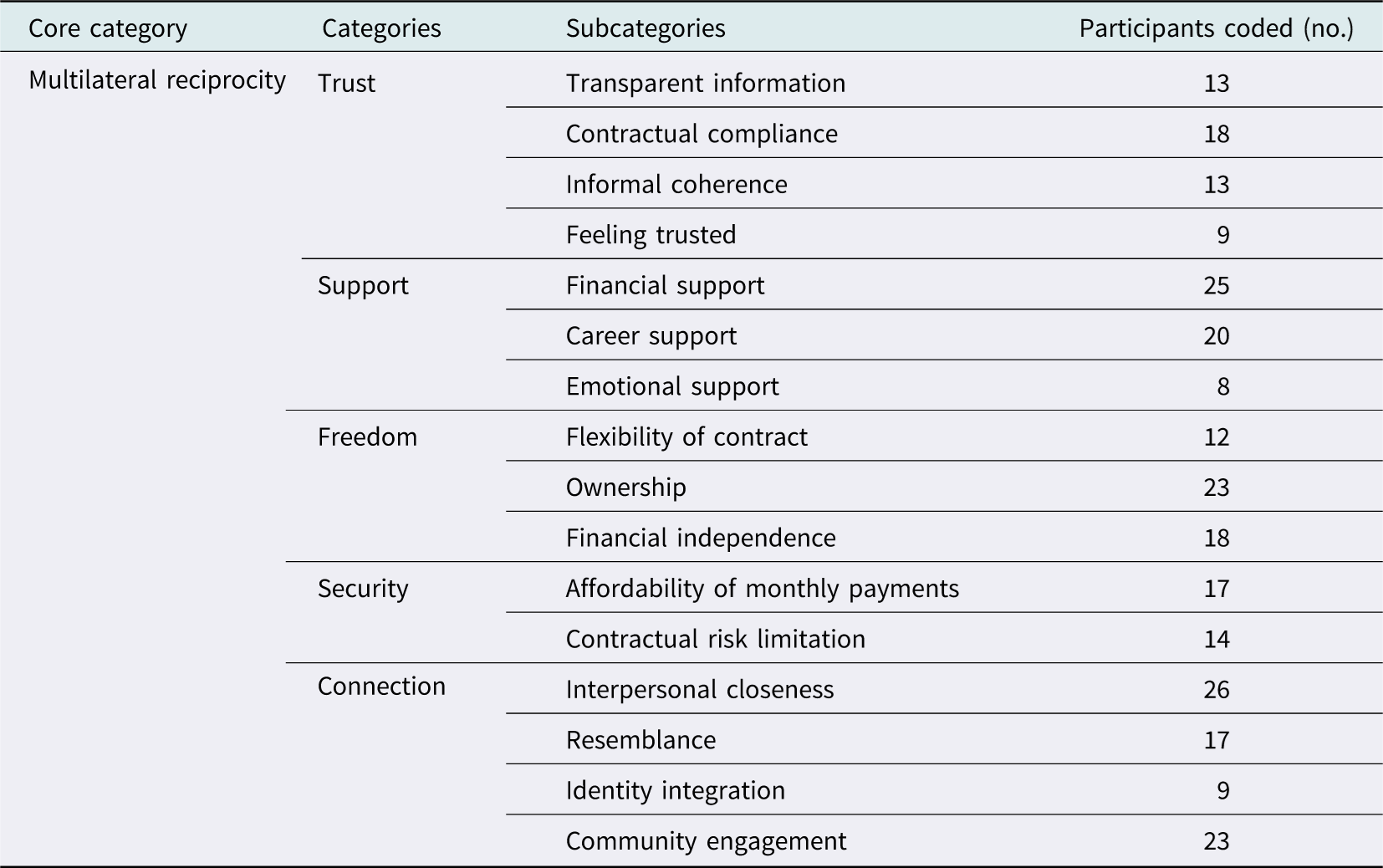
From participants’ evaluative statements, a core category emerged that reflects the governance structure of the Rwandan ISA programme: ‘Multilateral reciprocity’. It was developed from five interrelated categories: (i) ‘Trust’, (ii) ‘Support’, (iii) ‘Freedom’, (iv) ‘Security’, and (v) ‘Connection’. These five categories were generated from 16 subcategories (Table 1).
Categories based on participants’ evaluations of the ISA programme

Table 1. Long description
A table categorizing participants’ evaluations of the ISA programme. The table has four columns: Core category, Categories, Subcategories, and Participants coded (no.). It contains one core category: Multilateral reciprocity. This core category is divided into five categories: Trust, Support, Freedom, Security, and Connection. Each category is divided into subcategories with the number of participants coded for each subcategory. Row 1: Multilateral reciprocity, Trust, Transparent information, 13. Row 2: Multilateral reciprocity, Trust, Contractual compliance, 18. Row 3: Multilateral reciprocity, Trust, Informal coherence, 13. Row 4: Multilateral reciprocity, Trust, Feeling trusted, 9. Row 5: Multilateral reciprocity, Support, Financial support, 25. Row 6: Multilateral reciprocity, Support, Career support, 20. Row 7: Multilateral reciprocity, Support, Emotional support, 8. Row 8: Multilateral reciprocity, Freedom, Flexibility of contract, 12. Row 9: Multilateral reciprocity, Freedom, Ownership, 23. Row 10: Multilateral reciprocity, Freedom, Financial independence, 18. Row 11: Multilateral reciprocity, Security, Affordability of monthly payments, 17. Row 12: Multilateral reciprocity, Security, Contractual risk limitation, 14. Row 13: Multilateral reciprocity, Connection, Interpersonal closeness, 26. Row 14: Multilateral reciprocity, Connection, Resemblance, 17. Row 15: Multilateral reciprocity, Connection, Identity integration, 9. Row 16: Multilateral reciprocity, Connection, Community engagement, 23.
Multilateral reciprocity
‘Multilateral reciprocity’ captures the governance structure of the ISA programme. Its core values (embodied in the categories ‘trust’, ‘support’, ‘freedom’, and ‘security’) become institutionalized in shared behavioural norms (represented by their subcategories) that emerge both in bilateral and multilateral relations. The category ‘connection’ further captures the quality of these relationships (Table 1).
Accordingly, as will be outlined in the following subsections, participants described that being part of the programme means engaging in give-and-take relationships with other members, in which reciprocal expressions of ‘trust’ and ‘support’ are exchanged, while the provider’s unilateral provision of graduates with ‘freedom’ and ‘security’ can further support this reciprocity. Participants related such value expressions to different behavioural contexts and subjects, including themselves, other graduates and students in ISAs, the provider, the broader community, their ISAs, and monthly repayments. All categories were found to be interrelated. In the following, the notation of X → Y will be used to represent interconnections between them.
(i) Trust
The category ‘trust’ emerged from participants’ statements on their interactions in both bilateral relationships with the provider and multilateral relations within the broader community. While the former were described as being shaped by the norms of providing ‘transparent information’, ensuring ‘contractual compliance’, and expressing confidence (‘Feeling trusted’), the norm of ‘informal coherence’ also extended to multilateral relationships.
‘Transparent information’ firstly relates to clear and comprehensible contractual obligations. Participants (Part.) assessed the provider’s efforts to establish contractual transparency, including whether the ISA was explained to them in detail before signing, so they could fully understand the implications of entering it (Part. 11, 20, 26), and whether the provider subsequently remained committed to explaining individual repayment amounts (e.g., Part. 2). One participant further underlined the importance of being updated on individual repayment progress and suggested quarterly debt statements to improve graduates’ understanding of their outstanding obligations (Part. 20) (Trust → Freedom).
‘Transparent information’ also relates to the perceived credibility of the provider as a non-profit organization. Graduates assessed whether the use of their repayments was transparent to them (Part. 2, 4, 20). When positively evaluated, they expressed trust that the provider would not profit from their payments: ‘It’s not for their benefit, it’s just for the benefit of others who want also to study’ (Part. 4). When negatively evaluated, particularly high-earning graduates criticized that the use of their repayments was insufficiently disclosed and seemed too high for a non-profit organization.
Participants further articulated a perceived obligation to share honest information with the ISA provider, including proof of their monthly payments and updates on their employment and salary (e.g., Part. 5, 11, 12, 19, 21, 24). In this context, they reported that some graduates may try hiding income details for specific reasons; individuals earning near the minimum income threshold, especially in entry-level jobs, face greater financial pressure and may feel unable to meet both their ISA repayments and basic needs. Some may also underestimate the significance of their own payments (Part. 24) or misinterpret the maximum repayment amount as their nominal outstanding debt, which may appear insurmountable from their current economic position (e.g., Part. 24, 25). In such cases, graduates may not reciprocate the norm of providing transparent information, leading to a decline in financial support for others (Trust → Support).
‘Contractual compliance’ refers to the provider being valued for always paying tuition fees on time, so participants were never approached for missing payments and were able to study without interruptions (Part. 1, 11, 23). They further appreciated that the provider kept the terms of their ISA unchanged and that their current repayments met this agreement (Part. 1, 5, 8, 18, 19, 20, 23). Conversely, they described their monthly repayments as their formal obligation within a reciprocal agreement: repaying means upholding their part of the agreement after the provider has fulfilled its part (e.g., Part. 2, 3, 6, 7, 10, 11, 12, 13, 17, 18, 19, 25) (Trust → Support).
‘Informal coherence’ means acting in line with community values and norms. Participants evaluated whether the provider’s behaviour aligned with these norms (e.g., Part. 1, 17), where some reported perceived norm violations (Part. 9, 15, 16, 24). Based on these norms, participants moreover evaluated the behaviour of other graduates as unfair or fair (e.g., Part. 20, 26). Participants also expressed their own intention to act in accordance with community values, either because they believed this would be personally beneficial or because they perceived it as their social obligation towards others (e.g., Part. 11, 12, 15). Some even reported feeling self-pressure to adhere to community values (e.g., Part. 25). One participant further linked adherence to shared values to trust creation and greater freedom of action: ‘we have to use truth in everything because it helps people to trust you. […] The more people trust you, the more they allow you to do different things’ (Part. 8) (Trust → Freedom).
‘Feeling trusted’ captures that participants experienced receiving an ISA as an expression of the provider’s trust in their character and abilities, from which they derive confidence and career motivation (e.g., Part. 1, 26). They further assessed whether they felt the provider trusted their repayment behaviour, emphasizing that the absence of pressure and control was important (e.g., Part. 11, 14, 25, 26). They considered repayment their personal obligation that needed to be fulfilled proactively, and therefore sometimes perceived repayment-tracking as a sign of mistrust: ‘Sometimes they are harsh on the phone, […] I know that some of our colleagues […] don’t want to pay […], but why should we be the victims of those? Because for some of us – it’s true that we didn’t get jobs’ (Part. 15). In this aspect, in which the providers’ conduct was perceived to deviate from community norms, ‘feeling trusted’ closely relates to ‘informal coherence’.
(ii) Support
The category ‘support’ emerged from participants’ evaluations of their monthly repayments, the provider, and the community, which were influenced by the degree to which participants regarded these aspects as financially, professionally, or emotionally supportive.
‘Financial support’ firstly reflects participants’ perceptions of the ISA provider as an organization whose financial support enables young people to study (e.g., Part. 7) (Support → Freedom). Correspondingly, they also viewed their own repayments as an act of financial support towards the younger generation that enables them to study: ‘When I am repaying, […] I am creating another opportunity for someone […] who needs this support’ (Part. 1). Accordingly, they described their monthly repayments as their moral obligation towards the younger generation (e.g., Part. 5, 10) and perceived this social purpose as a motivator to pay (e.g., Part. 24). Unemployed participants expressed feelings of guilt about being unable to repay, fearing they might hinder others from pursuing tertiary education (Part. 7). This feeling also motivated unemployed participants to search for jobs: ‘It makes me feel like I have to do whatever it takes for me to repay, to pay CHANCEN for the next generation’ (Part. 7). Lastly, ‘financial support’ relates to the provider being valued for helping graduates develop financial skills, e.g., through offering budgeting workshops (e.g., Part. 22, 24).
‘Career support’ means that participants evaluated the programme and the provider based on the career benefits they received, which they weighed against their repayment amount: ‘You see the interest is very low because of the other activities they do’ (Part. 18). Participants valued community-wide workshops on entrepreneurship and personal growth, employability training, and networking events, where they could gain knowledge, professional contacts, and motivation (e.g., Part. 4, 5, 14, 23). They further reported benefiting from peer-based career support within the community, such as sharing employment updates, job vacancies, and advice (e.g., Part. 13, 24, 26) (Support → Connection). Participants also assessed whether the provider supported them in securing employment, whereby they appreciated information on job vacancies and ongoing communication during their job searches (e.g., Part. 6, 26). Accordingly, graduates’ evaluations of the provider were influenced by their employment outcomes (e.g., Part. 7, 13, 14, 16), and difficulties in finding employment were attributed to the provider: ‘They say […] when they finish their studies, […] we help them getting jobs, and then once they finish, they don’t even know where CHANCEN is’ (Part. 7). In this aspect, ‘career support’ closely relates to ‘informal coherence’: graduates interpreted securing employment through the provider’s assistance as an informal promise, leading to disappointment when their expectations were not met (Support → Trust).
Participants further evaluated the extent to which they felt the programme provided them with ‘emotional support’. Being part of its community means sharing problems and experiences with others, forming friendships, and feeling safe, welcomed, and loved (e.g., Part. 11, 17). They valued the opportunity to connect with others: ‘When we are together, it increases power, it is empowering us’ (Part. 23). Participants further emphasized that the provider offered more than just financial support: ‘You will always have that feeling that you have someone who is behind you in what you are doing […] they were always there, fully aware of the situation’ (Part. 1) (Support → Connection). One participant noted that access to external mentors or therapists could help graduates manage repayment concerns in times of hardship and reduce fears about the maximum repayment amount (Part. 25) (Support → Trust).
(iii) Freedom
The category ‘freedom’ emerged from participants’ evaluations of the extent to which the provider and the ISA offered them ‘flexibility of contract’, ‘ownership’, and ‘financial independence’.
‘Flexibility of contract’ refers to participants’ evaluations of the accessibility of ISAs and the ease of making payments. Most valued that their limited financial background did not prevent them from accessing their ISA, and that no collateral or extensive paperwork was required (e.g., Part. 1, 15). Yet one participant criticized the means-based eligibility criteria, stating that ISAs should be accessible to everyone (Part. 1). The mobile payment option was appreciated because it removed the need for monthly bank visits (Part. 20). Participants moreover evaluated their perceived ability to influence repayment terms. They appreciated the customized repayment modalities at CI and the option to suspend payments in cases of hardship (e.g., Part. 3, 10, 11, 14, 20). In contrast, the missing option to temporarily reduce their repayment percentage was criticized (Part. 2). However, particularly high-earning graduates valued the early payment option because it allowed them to reduce their anticipated total repayments (e.g., Part. 2, 11, 26) (Freedom → Support).
Participants further evaluated the programme based on the degree of ‘ownership’ it gave them over their educational and professional development. Many stated that the ISA provider enabled them to pursue tertiary education, while allowing them to choose their desired field of study and career path (e.g., Part. 3, 7, 10, 14, 20, 21, 23).Footnote 9 This was reflected in statements such as: ‘I couldn’t have afforded university if it was not for CHANCEN’ (Part. 3). The ISA reportedly transformed the life prospects for women in particular, as it allowed them to pursue alternatives to marriage, motherhood, and domestic work (Part. 20).Footnote 10 Participants further expressed that their personal career aspirations aligned with the provider’s interest: ‘They wanted to change lives, and I wanted to change my life as well’ (Part. 14). In stating that the programme taught them to believe in their ability to actively shape their lives, participants further emphasized the removal of cognitive barriers (Part. 1, 14). From this sense of ‘ownership’, participants also derived repayment motivation: ‘What we achieved from their support, this makes me pay’ (Part. 26) (Freedom → Support). Lastly, ‘ownership’ relates to whether participants perceived entering into their repayment obligation as a deliberate decision. Some expressed contentment with paying what they had signed and understood. Others reported an insufficient understanding of these terms during signing and later felt uncomfortable with the repayment modalities (e.g., Part. 4, 5, 17, 18, 25) (Trust → Freedom).
‘Financial independence’ summarizes evaluations of the programme’s contribution to participants’ financial self-determination. Participants valued the ISA for enabling them to finance their studies independently, which alleviated concerns about burdening their parents (e.g., Part. 1, 4, 17, 25). They further appreciated the programme’s structure for permitting them to work during their studies, thereby allowing them to cover their living costs (e.g., Part. 3). While some emphasized that the programme helped students to escape poverty (Part. 14), others stated that their repayments threatened their financial independence and prolonged reliance on parental support (e.g., Part. 9) (Security → Freedom).
‘Financial independence’ lastly relates to participants’ investing ability. As mentioned earlier, participants viewed their monthly repayments as investments in the younger generation’s education. In addition, they reported reinvesting or planning to reinvest parts of their income in their future studies, or in the education of their own and other children (e.g., Part. 18, 20) (Freedom → Support). After completing repayment, they moreover wanted to use surplus funds to accumulate savings or capital for starting their own businesses (e.g., Part. 9, 18, 20, 24), or to do other investments (e.g., Part. 25).
(iv) Security
The category ‘security’ captures participants’ evaluations of the degree to which they felt the provider and the ISA limited their economic risk and kept monthly repayments affordable.
Within ‘contractual risk limitation’, participants appreciated the ISA’s limited contractual term of 15 years (e.g., Part. 11, 21) and the absence of collateral risk (e.g., Part. 10, 21, 26). They further valued that their ISA protected them from having to make repayments during unemployment (e.g., Part. 6, 10, 20), which reduced economic pressure (Part. 22). These features contributed to positive perceptions of the provider, who was described as fair and patient (Part. 20) (Security → Connection). In contrast, the policies of conventional loans were perceived as less secure: ‘Banks, they even sell the house you are living in, so that you can pay them’ (Part. 11). Participants also discussed the maximum repayment amount. When this feature was accurately understood, some valued it for imposing a cap on total payments (e.g., Part. 3, 21), while others felt it was a high multiple of their actual education costs and a disadvantage compared with conventional loans (e.g., Part. 19, 20). However, evaluations of this feature were often balanced against other benefits they experienced, such as being protected in the event of unemployment, not having to risk collateral, and the programme’s wider social impact (e.g., Part. 19, 25) (Support → Security).
‘Affordability of monthly payments’ concerns participants’ views on whether ISA payments preserved their ability to cover basic needs and support dependent family members.Footnote 11 Most participants emphasized that income-based payments ensured affordability (e.g., Part. 3, 8, 22). However, some reported that inflation-driven increases in living costs, and stagnant salary levels were making it harder to meet basic needs, particularly for young professionals with entry-level salaries (e.g., Part. 4, 24). Participants further stated that graduates who financially support spouses, children, or siblings faced higher monthly fixed costs. One interviewee with a lower income felt unable to meet both family and ISA-related obligations (Part. 2, 12). Moreover, particularly unemployed participants found it difficult to cover the monthly administration fee (RWF 2,000). They proposed it should be reduced or charged only to graduates earning above the minimum income threshold, exempting graduates without income (e.g., Part. 6, 14, 17, 22).
Overall, ‘affordability of monthly payments’ closely relates to graduates’ financial self-reliance (Security → Freedom) and may impair their willingness to report honest employment information (Security → Trust), with corresponding effects on their payments (Trust → Support).
(v) Connection
The category ‘connection’ reflects how participants evaluated the quality of their relationships with the provider and other community members, including current students and graduates in ISAs.
In this context, ‘interpersonal closeness’ captures how participants related to the ISA provider, the broader community, and other ISA takers, indicating different perceptions of interpersonal proximity. Perceptions of the provider ranged from ‘a supportive financial institution’ (e.g., Part. 2) to ‘a parental figure’: ‘CHANCEN was like a parent to many students’ (Part. 16), and ‘where our biological parents could not be able to finance my studies, CI was there’ (Part. 24). Descriptions of the community spanned from ‘a professional network’ to ‘a family’, sometimes including actual relatives (e.g., Part. 5, 14, 19, 22). Relationships with current students in ISAs ranged from ‘the younger generation’ to ‘younger brothers and sisters’ (e.g., Part. 3, 19). One participant explicitly stated that to her, repaying felt similar to buying school material for her younger siblings (Part. 24). Perceptions of other graduates ranged from ‘colleagues’ to ‘friends’ (e.g., Part. 12, 25).
‘Resemblance’ reflects the degree to which participants felt they shared similarities with the programme and its members. Many expressed that the programme reflected their current personal values, or that the programme’s values aligned with their own when they joined it (e.g., Part. 9, 10, 18, 20, 21, 22, 23, 24). Participants further stated that their shared history and experiences, such as comparable financial backgrounds, studying together, and sharing life outside of university, created strong bonds among graduates (e.g., Part. 2, 3, 4, 9, 11, 16, 19, 23, 24, 26). This perceived resemblance also enabled graduates to relate to others in need: they extrapolated their past experiences of hardship to the situation of current students (e.g., Part. 2, 5, 6, 16, 24). Eventually, this motivated participants to make repayments: ‘There is another person who is in your shoes back then, and you really need to do all that is possible to make sure that that person can also get a chance’ (Part. 24) (Connection → Support).
‘Identity integration’ refers to the internalization of programme experiences. Participants expressed their deep gratitude and appreciation for the impact the provider’s presence had on their lives (Part. 4, 15, 18, 21, 26). They further indicated that the programme had shaped and changed their values and behaviour towards others, which also led to a heightened sense of honesty in reporting employment information (Part. 1, 15) (Connection → Trust).
‘Community engagement’ emerged from participants’ statements about their interactions with other community members. They reported maintaining personal contact with others, especially graduates, but noted that after graduation both the number of members they interact with and the frequency of communication had decreased and was now more focused on closer friends (e.g., Part. 11, 23, 25) (Freedom → Connection). Special occasions and community events were used to meet others, but sometimes conflicted with other appointments, participants’ work schedules or location (e.g., Part. 7, 19, 20, 25). Participants also relied on digital communication channels, such as graduate chat groups, to sustain mutual interaction (e.g., Part. 11). They valued that continued communication with the provider ensured a regular exchange of information (e.g., Part. 13, 20) and regarded monthly repayment reminders as helpful in keeping them accountable (e.g., Part. 24, 26). They further underlined the importance of their guardians or parents understanding and morally backing the ISA (e.g., Part. 20). Lastly, they described how parental involvement influenced their repayment behaviour, as non-payment may result in the provider approaching their parents: ‘I hold what I agreed to not put the shame on my parents’ (Part. 25) (Connection → Trust).
Discussion
The findings of this study empirically show that the formal ISA structure is complemented by informal mechanisms that emerge within its complex governance structure. While participants acknowledged the incentive to conceal income and employment information, they pointed to several informal institutional elements, including shared behavioural norms and informal enforcement mechanisms, which may counteract such opportunistic behaviour. Together, they form the governance structure of ‘multilateral reciprocity’.
Accordingly, the study identifies a set of informal institutional elements, which govern interactions among programme members in both bilateral and multilateral relationships. In these relationships, whose quality is reflected in the category ‘connection’, actors express ‘trust’, ‘support’, ‘freedom’, and ‘security’. Participants described such expressions as manifestations of compliance or non-compliance with shared behavioural norms, each represented by subcategories linked to the corresponding value (Table 1). While most norms of ‘trust’ and ‘support’ were described as inherently reciprocal, norms of ‘freedom’ and ‘security’, as well as ‘feeling trusted’, rather served to support reciprocity: by unilaterally adhering to these norms, the provider creates conditions that may further encourage graduates to reciprocate norms of ‘trust’ and ‘support’ towards others.
Illustrating their influence on graduates’ behavioural expectations, participants used these norms to evaluate themselves, other ISA-taking graduates and students, the ISA provider, and community. They described how different programme members can reinforce or violate these norms, which suggests that different actors within the community function as ‘carriers’ of informal institutions (see, e.g., Scott, Reference Scott2001). In their statements, norms of ‘freedom’, ‘security’, and most norms of ‘trust’ related to their interactions with the provider, whereas all norms of ‘support’ and the trust-related maintenance of ‘informal coherence’ also extended to community-wide interactions.
Articulated norms also shaped graduates’ perspectives on their ISAs, which themselves constitute formal institutions that organize the bilateral relationships between the provider and each graduate. For example, norms associated with ‘trust’ and ‘support’ influenced how participants perceived their contractual obligations, allowing them to reframe them as moral imperatives (e.g., contract fulfilment becomes a matter of honesty) and offering them alternative social motives that may override individual interests (e.g., supporting the younger generation rather than hiding income). This illustrates that behavioural norms also emerge within the governance structure of the ISA contract itself, influencing both graduates’ interpretation of and compliance with its formal rules.
Suggesting that a given norm may be reciprocated in the same or a different situation, participants further extended norms to different behavioural contexts. For example, the norm of providing ‘transparent information’ not only shaped participants’ evaluations of the provider’s behaviour during ISA signing but also their own conduct when reporting income information. Moreover, all identified norms were interrelated, suggesting that different norms can reinforce each other. For example, adherence to norms of ‘trust’ encouraged graduates to follow norms of ‘support’, and vice versa. Conversely, violations of ‘trust’ undermined their willingness to follow norms of ‘support’.
These findings show that the transmission of identified norms extends to a variety of interactions among different programme members. Reciprocation is not confined to bilateral relationships but may occur at a multilateral, community-wide level. For example, one actor may support another without expecting direct reciprocation, but with the expectation that an additional community member will reciprocate in turn (see, e.g., Elsner, Reference Elsner2010).
In line with Ostrom (Reference Ostrom1990, Reference Ostrom2000), these shared norms help sustain cooperation among community members, even if formal institutional elements leave opportunities and incentives to behave opportunistically. In particular the norm of providing ‘financial support’, which also extends to participants’ relations with the general groups of current and future ISA students, shapes both the allocation and the maintenance of the programme’s funds within the community.
All norms further related to subcategories of ‘connection’: reinforcing shared norms increased connection, while non-compliance weakened it. Conversely, higher levels of ‘connection’ promoted norm compliance. Only certain expressions of ‘freedom’, which related to graduates focusing on activities outside of the community, were associated with a loss of connection. These findings are relevant for ISA programme design, as they emphasize the importance of cultivating close interpersonal relationships among programme members to strengthen the capacity of social networks to transmit and enforce supportive informal institutions (see, e.g., Dixit, Reference Dixit2003; Fafchamps, Reference Fafchamps, Aoki and Hayami2001a).
In this context, participants reported that shared experiences with other graduates had strengthened the relationships among them and that past interactions with the provider had created closeness and trust. They further noted that CI provides ongoing opportunities for community members to connect, including events and workshops, but mentioned challenges in participating as well as a general decline in interaction with other members after graduation. This illustrates not only that frequent interaction during multi-year study periods naturally fosters relationship-building, but that relationship maintenance becomes harder after graduation and requires compensatory, community-wide interaction opportunities.
Although exploring the origins of the identified norms was beyond the scope of this study, participants reported they had internalized some of them through their involvement in the programme, possibly influenced by the student merit system. This reinforces the idea that actors can induce the individual adaptation of new institutions via learning and socialization processes (see, e.g., Dacin et al., Reference Dacin, Goodstein and Scott2002; Elsner and Schwardt, Reference Elsner and Schwardt2014).
Internalized norms form the basis for first-party enforcement: participants articulated self-pressure to adhere to community norms, and feelings of guilt whenever they failed to do so. The study also identified self-enforcement in repeated interactions, where individuals comply with shared norms because they anticipate future interactions and fear that their counterparty may otherwise withhold reciprocal benefits. For example, CI’s ongoing services after ISA disbursement (e.g., career support) may help to deter repayment-related opportunism, as contractually non-compliant graduates would risk exclusion from these valued benefits.
Participants further articulated community enforcement, evaluating the conduct of other members based on the identified norms and disapproving deviant behaviour. In the programme, non-compliance with these norms means risking exclusion from a supportive social group. The involvement of relatives represents another form of third-party enforcement, as non-compliance with repayment obligations may result in parental disapproval or shame. Reputation-based mechanisms are likely to shape the provision of support in more impersonal relationships. Actors may adhere to shared norms to ensure future access to career and emotional support within the broader ISA community.
Nevertheless, findings indicate that graduates may still choose not to follow or reciprocate a given norm, especially when they perceive their counterparty as non-compliant (e.g., making profit from their payments) or when other motives (e.g., economic pressures) predominate. Such norm violations may occur in bilateral and multilateral relations. Thereby, graduates’ failures to reciprocate the provision of ‘financial support’ to the community, as well as breaches of norms of ‘trust’ towards the community and the provider, directly undermine repayment. This highlights three central aspects. First, situational pressures can limit informal mechanisms. Second, the provider’s normative conduct is essential to reinforcing shared norms, which also relates to its profit orientation. Third, the ISA’s contractual design must align with community norms to sustain graduates’ compliance. Specifically, participants described that the ISA must limit their economic risk and ensure affordable payments.
While this can mitigate economic pressures for graduates and improve normative perceptions of the provider, it also marks a trade-off with the programme’s refinancing requirements. In particular, whenever repayment terms overly emphasize ‘security’, graduates could use this framing to justify even non-compliant behaviour, such as payment evasion. In addition, the risk of multilateral free riding emerges. For example, graduates may decide not to follow the multilaterally shared norm of providing financing support because they expect other graduates to continue repaying.
Overall, the governance structure of ‘multilateral reciprocity’ can be understood as a coupling of bilateral contracts, which combine formal ISA rules and shared behavioural norms, with multilateral norms of reciprocity. These norms, which are sustained through community-wide personal relationships and social sanctioning, can reinforce formal ISA rules and thereby improve the effectiveness of ISA contracting. This suggests that within the programme, these informal mechanisms complement formal ISA contracting rather than substituting it (see Mike and Kiss, Reference Mike and Kiss2019).
Conclusion
This paper took an initial exploratory step towards understanding ISA governance in low-income country contexts. Based on data from semi-structured interviews with 26 graduates of a Rwandan ISA programme, it offered a comprehensive account of the relevant institutional elements of the programme’s governance structure. It found that within this governance structure of ‘multilateral reciprocity’, formal ISA-contracting is complemented by a set of shared behavioural norms, which extend beyond bilateral relationships and operate at a multilateral level. Norms are transmitted via community-wide, interpersonal bonds, and their enforcement relies on first-, second-, and third-party mechanisms. Together, these institutional elements help sustain community-wide cooperation and contractual compliance among participating graduates.
This suggests that sufficiently strong informal institutional elements can complement formal ISA-contracting. Although combinations of formal and informal mechanisms have been observed in a variety of other contexts, the governance structure of the Rwandan ISA programme can be understood as a context-specific response to incomplete contracting, limited formal enforceability, and collective action problems.
This study may inform the design of other ISA programmes in low-income countries, as it may encourage providers to extend their focus beyond formal bilateral contracting towards community-wide informal governance mechanisms. Specifically, it highlights how the long duration of ISAs, despite complicating formal enforcement, creates opportunities to cultivate shared cooperative norms and strong relationships among programme members.
Because the findings are based on reported behaviour, broader follow-up studies should contextualize them within graduates’ actual behaviour. Future research may also include the perspectives of other programme members, examine whether gender differences affect graduates’ recognition of and adherence to prevailing informal institutions, evaluate trade-offs between different institutional and organizational design choices more deeply, and explore tensions between preexisting and newly introduced institutions of the ISA programme. Finally, it remains crucial to investigate ISA education financing in other programmes and geographical contexts.

 Open access

