Introduction
Current legislative and policy developments are removing structural barriers to employment for individuals wishing to extend their working lives. These actions support policy aims of stimulating employment among older workers up to and beyond a ‘traditional’ retirement age (Organisation for Economic Co-operation and Development (OECD), 2006; Department for Work and Pensions, 2014). An example is the enactment in 2011 of the United Kingdom's (UK) age discrimination legislation, making it unlawful for organisations to adopt a contractual retirement age for their employees unless this can be objectively justified. This move weakens the institution of retirement as it has developed in the last 100 years, and is one of several initiatives signalling the ‘death of retirement’ (BBC Online, 2017) and the emergence of temporally flexible work-life policies and arrangements (Boudiny, Reference Boudiny2013). Alongside such regulatory and legislative changes, UK government initiatives such as ‘Age Positive, Retain Retrain Recruit’ and ‘Fuller Working Lives’ (Canduela et al., Reference Canduela, Dutton, Johnson, Lindsay, McQuaid and Raeside2012; Department for Work and Pensions, 2014, 2015) encourage workers to remain in the labour market, whilst also persuading employers to retain them. Changes to the State Pension Age in 2011,Footnote 1 together with media reports of underfunding in the pensions industry (Mooney, Reference Mooney2017), have added a financial dimension to workers’ decisions about retirement.
These and other changes in regulatory and institutional arrangements open up the possibility of older workers extending their working lives. However, it is not inevitable that workers will want to take up these new opportunities. In part, this is because individuals’ agentic responses to exogenous change are to some extent constrained (i.e. structured) by the social norms, attitudes and cultural narratives that guide their actions as members of society. Such social norms indicate age-appropriate behaviour and aspirations, and guide decisions about the timing of life transitions such as retirement. Whilst the content of such social norms varies across different population groups (Radl, Reference Radl2012), the outcome of individual deviance from such norms is generally social sanction and a loss of self-respect if individuals have internalised the legitimacy of these normative guidelines (Elster, Reference Elster1989).
On the other hand, there are limits to normative power. Individuals are not determined by the structuring space of social norms, but have a degree of agency in creating their lives (Archer, Reference Archer2012). An important analytical question is how this agency is enacted. For example, agentic action may include doing/performing social roles in non-traditional ways (thereby ‘queering’ norms; see e.g. Butler, Reference Butler1990), or talking about future actions to create newly imagined ways of being and doing. This paper draws from the literature on narrative identity (Ricoeur, Reference Ricoeur1980; Ibarra and Barbulescu, Reference Ibarra and Barbulescu2010; Andrews, Reference Andrews2014) to posit that individuals use life self-narratives as an agentic mechanism to challenge norms in all aspects of their life, to re-frame the social situations in which particular norms apply (and which therefore apply to themselves). Self-narratives are particularly salient when navigating work-life transitions (Ibarra and Barbulescu, Reference Ibarra and Barbulescu2010). We posit that narratives of the future are generative because they create imagined trajectories of plausible opportunities and actions, albeit constrained by socially constructed assumptions about what is appropriate for ‘someone-like-me’ (Bourdieu, Reference Bourdieu1984). Narratives anticipate future concrete performances and events, and we have therefore called them ‘anticipatory narratives’.
In the paper, we examine the anticipatory narratives of knowledge workers aged 48–58, including how they imagine their work-life options and future selves against a changing labour market context. Differences and similarities are explored, and four dominant anticipatory narratives are presented. Through our analysis of these narratives – and particularly of the way research participants talked about being offered or taking up new work opportunities (or not) – we expose and challenge assumptions that older workers’ employability is a straightforward function of their accumulated human capital/merit. In addition, we show how employers’ evaluations of merit are complicated by cultural understandings of ‘potential’, and how strategies to signal one's potential become more complex for older workers.
The article begins by contextualising the study. First, the focus on the knowledge economy is justified, and potential issues faced by older knowledge workers are raised especially in relation to the complexities of signalling knowledgeability. The second contextualisation addresses public policy developments and socio-cultural norms/attitudes, both of which shape the institutional boundaries within which older workers imagine their future lives. The article then develops arguments in favour of a narrative approach to studying older workers’ responses to the changing labour market and opportunity space. Information about the study design is given, followed by presentation and discussion of findings.
Ageing in the knowledge economy
The term knowledge work denotes activity focused on non-routine problem-solving using information and one's own ‘intellectual assets’ (Hansen et al., Reference Hansen, Norhia and Tierney1999: 106). Often referred to as ‘white-collar work’, knowledge work contrasts with blue-collar manual labour and pink-collar routine service work, and is associated with knowledge worker roles such as lawyer, academic, manager, architect and software engineer.
Reasons for selecting the knowledge economy for our study are twofold. First, the growth of the knowledge economy in the Global North is evidenced in studies which track the decline in the manufacturing sector, and the rise of knowledge-based work (for a review, see Harris, Reference Harris2001). Expansion of the knowledge economy has become aspirational for governments wishing to mitigate problems of structural unemployment created by the offshoring of manufacturing jobs since the 1990s. The Lisbon strategy of the European Union, for example, reflected a conviction that governments should invest in a knowledge-based economy and facilitate workers’ life-long learning and development (Brine, Reference Brine2006).
Second, many of society's assumptions about knowledgeability and ‘knowledge work’ carry contestable assumptions about age-related experience, expertise and merit. The concept of the knowledge worker emerged from scholars such as Drucker (Reference Drucker1994) and Handy (Reference Handy1995), who posited that knowledge workers continually reinvent themselves to align with changing business demands, are prepared to invest in themselves to build human capital, and often possess sophisticated generic and job-specific skills. Although these conceptualisations are more prescriptive than descriptive, they resonate with broader discourses around knowledge workers that tend to presume dynamism and individual agency (e.g. Handy, Reference Handy1995; Davenport and Prusak, Reference Davenport and Prusak1998). In contrast, scholars such as Alvesson (Reference Alvesson2001: 863) emphasise the ‘slipperiness’ and ambiguity of the knowledge label. Indeed, a significant problem for knowledge workers may be that the extent of one's knowledge cannot be seen, because knowing is a mental, social and distributed process (Orlikowski, Reference Orlikowski2002). That which is invisible cannot be objectively valued. This ambiguity and invisibility makes it important for workers not just to ‘be’ appropriately knowledgeable, but to be able to ‘perform’ knowledgeability in a manner which is recognised by those who recruit, manage or potentially dismiss them. The skills of impression management (Goffman, [1959] Reference Goffman1990) become important, as does a reflexive appreciation of how knowledgeability and expertise are assessed by others and in wider society. The literature on the sociology of knowledge has long recognised the socially constructed nature of ‘expertise’ (Feltovich et al., Reference Feltovich, Ford and Hoffman1997).
A dilemma for older workers is that they can no longer assume that their knowledgeability is self-evidently correlated with age or job tenure. This correlation is of course deeply problematic, but so is an alternative narrative that whatever is novel or up-to-date and originating from a younger person is likely to embody ‘progress’. We contend that in the context of a knowledge economy, the invisibility of mental knowledge has specific implications for older knowledge workers whose expertise and knowledgeability may be unrecognised and undervalued.
‘Extending Working Lives’: public policy and social norms
At a policy level, the ‘radical transformation’ of the social nature of work and retirement (Phillipson, Reference Phillipson2019: 629) has prompted policy makers to debate the implications for labour market governance. Regulatory changes in the UK have included the removal of a default retirement age in 2011, and inclusion of age as a protected characteristic in equality and non-discrimination legislation. However, regulatory changes alone do not generate social change, especially in the face of contradictory socio-cultural norms. Governments in developed economies have therefore promoted initiatives to try to facilitate new patterns of (later-life) working, which indirectly challenge social norms around (early) retirement. The OECD's (2006) seminal report Live Longer, Work Longer argued that work needs to be made a more attractive and rewarding proposition for older workers. This was partly a call to the state and employers, but it was also a call for older people to extend their economically productive lives and delay reliance on state pensions. Across Europe, the discourse on extended working lives has been reinforced by policy narratives about ‘active ageing’, and the purported social and health benefits of labour market participation (Walker and Maltby, Reference Walker and Maltby2012; Phillipson, Reference Phillipson2019).
At a practical level, successive UK governments have urged employers to move from a traditionally ‘reactive and piecemeal’ response to age-diversity towards one that is more strategic (Beck and Williams, Reference Beck and Williams2016). Employer forums and policy developers advocate age management policies and practices which recognise variations in workers’ abilities and preferences, and the contributions that older workers can continue to make towards organisational effectiveness and sustainability, e.g. as experienced mentors (e.g. Frerichs et al., Reference Frerichs, Lindley, Aleksandrowicz, Baldauf and Galloway2012). However, age stereotypes continue to influence employment decisions (e.g. Beck, Reference Beck2014). Posthuma and Campion (Reference Posthuma and Campion2009) describe a number of pervasive age stereotypes, which may be positive, negative or contradictory. For example, older workers are stereotyped as having less ‘drive’ and more cognitive impairments (Ng and Feldman, Reference Ng and Feldman2012); more positively, they are stereotyped as more dependable (Taylor, Reference Taylor and Taylor2013). As older workers are confronted with, internalise and become subject to these stereotypes, they in turn may reproduce the underpinning assumptions about ‘older workers’ (Kunze et al., Reference Kunze, Boehm and Bruch2013). However, the older worker category is not homogenous. Occupational and sectoral influences play a role here, as well as individual differences within age groups. As an example, older professionals in the knowledge economy may continue to be marketable as freelance consultants in the role of ‘wise sage’. Alternatively, work done by older people may be less valued, precisely because it is done by older workers (and because a worker's age carries assumptions about the value of work done). What is valued as ‘work’ varies across different cultures because of its socially constructed nature. In a similar and important way, the concepts of merit and potential are also socially constructed, as we discuss next.
According to rationalist (and non-constructivist) meritocratic principles, individual achievement should be the primary criterion in organisational recruitment, development and promotion practices. Ascribed attributes such as social class, ethnic identity or age group are not supposed to be relevant unless pertinent to job performance (Kumra, Reference Kumra, Kumra, Simpson and Burke2014: 270–271). ‘Merit’ is presented in rationalist discourse as ‘an objective measure of individual ability and achievement’ (Kumra, Reference Kumra, Kumra, Simpson and Burke2014: 271), although it is usually assessed with proxy indicators such as educational/professional qualifications and evidence of previous accomplishments in similar tasks. However, the idealisation of ‘objective’ meritocracy has been satirised (see Michael Young's Reference Young1956 influential book, The Rise of the Meritocracy), and its purported objectivity is contested. Whilst the gendered nature of merit has already been established (see Kumra, Reference Kumra, Kumra, Simpson and Burke2014), we contend that the aged dimension has not.
We propose that a reflexive awareness of social attitudes and assumptions about the ideal ‘productive worker’ (Rose, Reference Rose1999) may constrain older workers’ horizon of employment options. Thus, even if labour market policies and regulations make it technically possible to work beyond the traditional retirement age, individual decision-making is also framed by assumptions of what are appropriate work roles for ‘someone like me’, and by the kind of stories people tell themselves about who they are (see also Loretto, Reference Loretto, Manfredi and Vickers2016). A complicating dynamic is that employers are becoming fearful of offering a mid-life career review in case conversations are interpreted as suggestions that employees should retire, which might be received as insensitive or age-discriminatory comments (Department for Work and Pensions, 2017: 35). There is evidence that some organisations are retreating from active management of retirement or ‘older worker’ career transitions (e.g. Wainwright et al., Reference Wainwright, Crawford, Loretto, Phillipson, Robinson, Shepherd, Vickerstaff and Weyman2019). In these circumstances, the onus may be placed on older workers themselves to initiate conversations about their career development, thereby sustaining the ‘individualisation’ of retirement which began in the late 1990s (Phillipson et al., Reference Phillipson, Shepherd, Robinson and Vickerstaff2019). In this complex situation of new public policies, changing organisational practices and potentially dissonant social norms, mid-career workers are having to make sense of the horizon of opportunities and future employment narratives available to them.
Narrative identity
Individuals create narratives for themselves to help sustain a sense of coherent continuity in their choices and actions. Narrative is about plot and temporal sequences, but is more than just a story. This is because while stories are primarily about (re)telling tales, narratives are about constructing connections between events (Gabriel, Reference Gabriel2000). This creative aspect is similar to the way in which historians do not find history as though it objectively exists, but instead emplot events to create one among many possible narratives of the past (Czarniawska, Reference Czarniawska2003: 2). There are no neutral events, nor neutral data, because it is the narrative that emplots them and gives them meaning (MacIntyre, Reference MacIntyre2007: 86).
Ricoeur (Reference Ricoeur1980) argues that the temporality of narrative is particularly important to narrative identity. Temporality is the aspect of plot which enables individuals to justify their present actions in relation to intended future outcomes (Ricoeur, Reference Ricoeur1980: 169–170) and the space of past experience (Koselleck, cited in Pickering, Reference Pickering2010). By emphasising temporality, Ricoeur presents personal narratives as not simply about tales of the past, but also about future orientation – about choices among many possible futures, which are influencing decisions taken now.
Ricoeur's notion of narrative identity resonates with a lifecourse perspective. Both concepts draw attention to continuities across an individual's life, and to some extent also to the effect of discontinuities and disruptive events. A dominant premise of the lifecourse perspective is that individuals’ early experiences and cultural contexts influence their lives and decisions even at much later time periods (Elder, Reference Elder1994; Komp and Johansson, Reference Komp and Johansson2016). These contexts also shape a person's assumptions about what are appropriate social roles, behaviours and aspirations at an older age. Assumptions formed during adolescence and young adulthood tend to be carried into later life, and are not easily surfaced or reflexively questioned despite shifts in cultural norms and narratives. Thus, a hypothetical older woman of 58 – whose school encouraged young women to become secretaries and young men to become managers – may forever carry traces of those assumptions, influencing decisions, judgements and aspirations. Thus, structural inequalities present in a person's early life may have a ripple effect on their decision-making for many decades.
Lifecourse transitions such as marriage, starting work and retirement are fundamental to narrative identity. A change in social role may prompt a re-working of our narrative identity and particularly our anticipatory narrative of what we will do and become in the future. Because lifecourse transitions are embedded in cultural norms, these transitions carry expectations and implications for ‘how one participates and contributes to the world’ (Bateson, Reference Bateson, Lynch and Danely2013: 28). A conflict may arise if transition expectations seem anachronistic in the light of new situations such as greater life expectancy and changes in social institutions such as ‘retirement’. In such situations, it may be appropriate for individuals (and society more generally) to encourage new narratives to flourish so that different options for older working life become normalised (e.g. Gullette, Reference Gullette2004). The difficulty, alluded to earlier, is that early formative experiences may have a strong sustaining hold on current assumptions of what ‘people like us’ can or should do (Bourdieu, Reference Bourdieu1984). An implication is that ‘old-fashioned’ norms dominant 30–40 years ago (e.g. associated with gender, class or ethnicity) may still have a grip on older workers today.
The difficulties of sustaining a personally or socially acceptable narrative may mean that individuals maintain multiple – but separate – narratives. In Telling Tales, Angela Tait (Reference Tait2012) describes how narratives may have different audiences, such as work colleagues, family and non-work friends. The different narratives can be vehicles for keeping separate – and resolving tensions between – one's workplace and family roles, and the conflicting assumptions that those roles carry about who we are (Tait, Reference Tait2012: 145–146). For example, being labelled at 50 as an older worker (and attracting the attributions of decline that the label still carries) may conflict with being a relatively young mother (which carries more positive attributions). Our central point is that for ‘younger’ older workers in their late forties and fifties, a concern is likely to be how to build or maintain a narrative of potential – of plausible futures, possible selves and lives of value (see also Phoenix and Griffin, Reference Phoenix and Griffin2013). As argued by the existentialist philosopher Albert Camus ([1942] Reference Camus1991), a ‘life worth living’ is not so much a description of an idealised life situation, but an existential and never-ending quest for meaning.
Research study
The research was informed by narrative methods (see e.g. Ezzy, Reference Ezzy2001; Czarniawska, Reference Czarniawska2003; Andrews, Reference Andrews2014). Following approval by the Oxford Brookes University's Institutional Research Ethics Committee, participants were recruited by open invitation to the general public including staff and mature students at a British university. Recruitment texts invited those aged 48–58 who work (or were between jobs) in the knowledge sector to participate in an interview-based study to discuss their past and future working lives. One person who responded to the open call was 42, but believed he had relevant experiences to share, and was included in our sample.
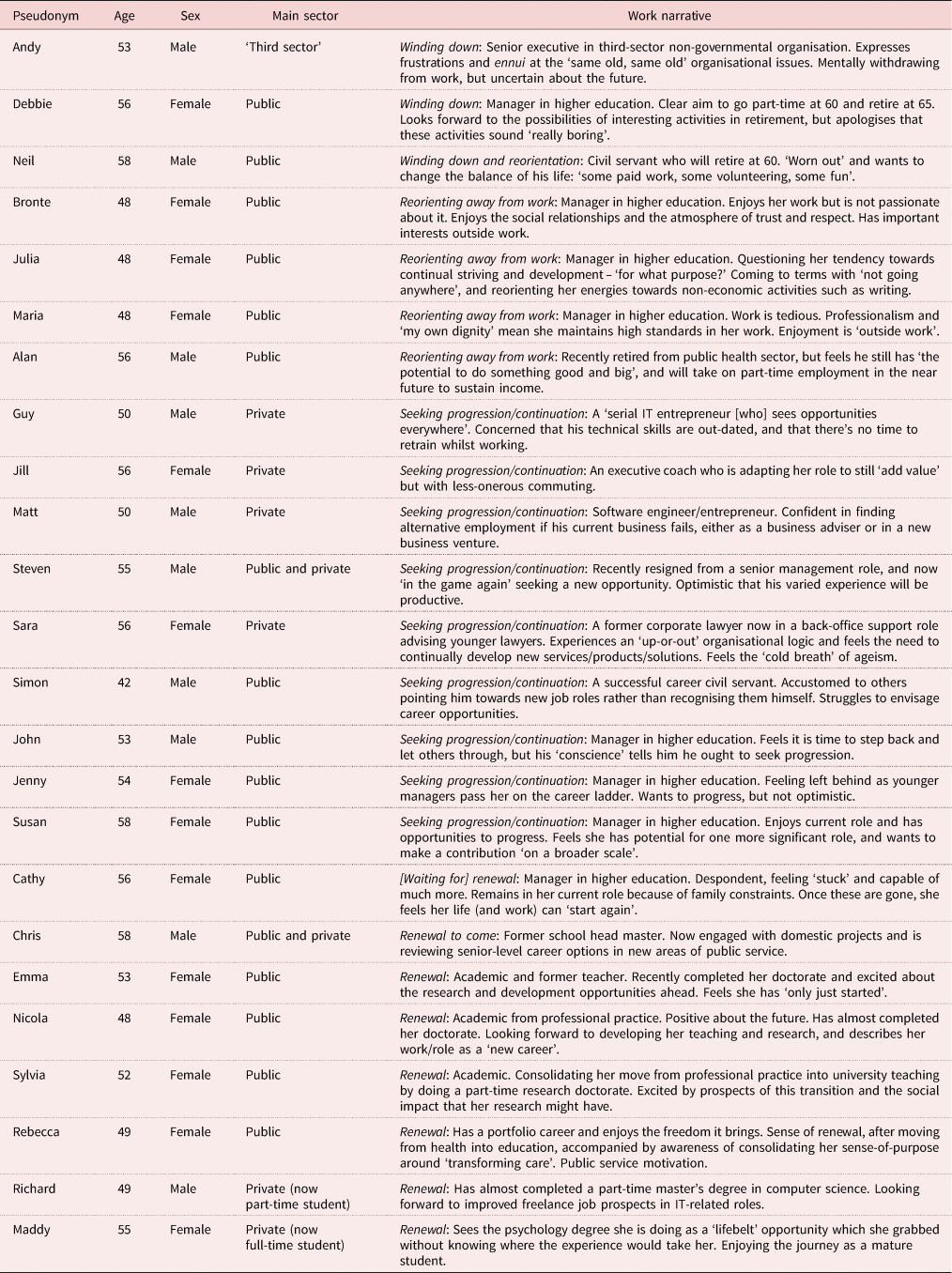
Recruitment was through multiple channels. These included an open invitation to a university email list of people interested in participating in research projects (which led to 14 interviews), invitation ‘posters’ in public settings (eight interviews) and snowballing (two interviews). Twelve of the 24 participants were university employees (four academics, and eight senior administrators or managers) and two were mature students – from the IT software sector and film industry. Four participants were from other public or ‘third’ sectors such as the civil service, public health and not-for-profit organisations. The six participants from the private sector included technology entrepreneurs and professionals such as lawyers. Fourteen were women and ten were men. Table 1 provides profiles of the research participants.
Profile and career narrative of participants

We acknowledge that self-selection following open invitation is likely to attract participants with strong opinions on the study as advertised (i.e. older people's perspectives on future work and career). The study may attract those who have already reflexively engaged with questions about potential changes in their work options as an older person. Those with ‘something to say’ are more likely to have concerns which are personal and/or related to social change. Therefore, the self-selection recruitment may have attracted more positive and negative perspectives than are represented in wider society. Another limitation of the study is that half the participants worked in the higher education sector and one-quarter worked in the private sector. However, it would be inaccurate to say that the higher education participants fully represented public-sector workers, because many had come from the private sector, and indeed many participants had a complex work trajectory encompassing multiple careers. Nevertheless, workers in the public sector tend to have greater security of employment, and so fears about redundancy and financial problems are less likely to be expressed as part of our study. Instead, existential concerns about meaning-of-work may be more prominent.
Participants were invited to talk about their work-life history and, in particular, their future expectations and aspirations. The aim was to explore events and decisions, and how participants narrated and made sense of their careers. We wanted to understand the discursive and cultural resources they drew on as they narratively constructed their imagined futures at work and home. Interviews lasted from one to two-and-a-half hours, and were recorded and fully transcribed. Transcripts, first-order coding and analytical memos were managed with the support of proprietary software, MAXQDA. We also reconstructed and condensed the employment story of each participant in separate documents to facilitate a comparison of the narrative elements of the interviews (Kvale, Reference Kvale1996).
A key aspect of the analysis was its iterative nature. As a research team, we spent considerable time reading transcripts and then discussing our interpretations and impressions. We were interested in how participants used discursive resources and narrative ‘fragments’ (Ibarra and Barbulescu, Reference Ibarra and Barbulescu2010) in order to craft an anticipatory narrative of themselves at work. In the first stage of analysis, we looked for points of similarity and difference, and we developed a categorisation of four anticipatory narratives. In the second stage of analysis, we looked across the personal narratives for apparent contradictions, tensions and ‘sites of silence’ (Clarke, Reference Clarke2005). Contradictions and silences provide insights into processes of narrative construction, and the way culturally available discourses might be drawn upon or adapted. In our study, we identified a dominant tension around struggles to maintain or create a narrative that expressed a positive sense of ‘potential’ as an employable, productive worker and/or as a productively leisured self. The four narrative categories are presented next, followed by a discussion of tensions around ‘potentiality’.
Findings: narratives of future working lives
A central motif in the narratives of past and future career was the creation of stories of purpose. Participants justified decisions made, and narrated a future that was not too ‘fixed’, but which allowed for a range of possibilities. Detailed plans were rare. Instead, the intention seemed to be to create a narrative that made sense right now, in what Nowotny (Reference Nowotny1994) calls the ‘extended present’. Plans burdened with milestones seemed to be resisted, perhaps because they closed down the space of future opportunities – the possibility that ‘things might turn up that are interesting’ (Sylvia). We contend that improvisation within an ‘extended present’ allowed participants to feel in control of crafting their lives, but without having to acknowledge and demarcate the end-point: the dead-end.
Although there were similarities in participants’ tales of their future, there were also points of contrast. Four categories of contrasting narratives were identified: renewal, seeking progress, winding down and reorienting ‘self’ away from work.
Winding down
Among our 24 participants, only three expressed a dominant narrative of ‘winding down’ from work to retirement. Among the three, one participant was shifting towards a ‘reorientation’ narrative. An important variation of directionality was whether narratives were towards retirement or away from work. Debbie illustrates the positive talk moving towards retirement. In her mid-fifties, Debbie had worked in higher education for 15 years, and saw her retirement horizon clearly. She aimed to gradually reduce her contractual hours until retirement at 65. Debbie enthusiastically listed multiple possible retirement activities: helping children to read, doing things in the village, talking to people in hospital and looking after dogs. Later in the interview she apologised when admitting that she might actually spend time just pottering in the garden – ‘it sounds really boring’. What seemed important in this identity work was to convey (to oneself or the interviewer) a positive sense of opportunities and options, creating a positive image of one's future ‘possible self’ (Markus and Nurius, Reference Markus and Nurius1986), presenting a post-work horizon of possibilities rather than a cliff-edge of decline and boredom.
‘Winding down’ could also be about withdrawing away from work, and the incessant pressures associated with demanding roles. This is illustrated by Andy, who worked in strategy and policy roles as a senior executive in global charities:
Work is to be done, forgotten about once you get away from it. Work is to be rested from, particularly if you're very responsible because otherwise the responsibilities crowd in on you, destroy your sleep and rest, and deplete your physical capability.
Andy compared his former youthful excitement to his current weary commitment to his work:
I have a young, meaning 30, manager working with me who's very ambitious and he thinks, as I did at age 30, that work gets more and more interesting. And the great secret that he's got to wake up to one day is that actually, what you do more of is the same old, same old the more senior you get. The more senior you get, frankly, the more of a servant you become because you have to do the things that nobody else wants to do, or are capable of doing, or capable of doing quickly.
Compared with Debbie, his energy was currently too depleted to contemplate future directions, but like others we interviewed, he expressed a fear of emptiness: ‘What I dread is – what does existence mean in the frame of not having employment?’ As identified in previous studies, an existential fear enveloping some interviewees was the issue of loss and ‘nothingness’ in retirement (see also Goodwin and O'Connor, Reference Goodwin and O'Connor2014).
Neil also spoke of being ‘worn out’, but at 58 and within a year of retirement plus a decent pension, he was beginning to see choices and options to ‘change the balance’ of his life. His narrative combined elements from ‘winding down’ and ‘reorientation’, and he imagined the next stage as a combination of elements summarised as ‘a bit of paid employment, a little bit of voluntary stuff and some fun – being available and helpful’.
Reorienting ‘self’ away from work
Whilst Neil and Alan were imagining new configurations of work-life opportunities after retirement, three participants (Bronte, Julia and Maria – all under 50) with years of paid work ahead of them were reorienting their creative energies towards non-work sources of enjoyment and self-worth. Driving the narratives of these non-retiring participants was a combination of limited intrinsic enjoyment in the job, coupled with a perceived absence of possible renewal or growth within that job. All three were in senior administrative roles, and could not envisage a desirable alternative career path. Their work was important, but could be tedious. Workplace pleasures came from the environment and social relationships, but not from intellectual challenge or a role in which their potential could flourish.
In the ‘re-orienting’ narrative, people talked of their professionalism in ensuring that their work and that of their teams were of a high standard. But, as Maria explained: ‘that doesn't mean I find it interesting to do’. She maintained a separation between work and life, saying that she was not defined by her job, and thought it was sad that others identified so strongly with their job role and employer. Nevertheless, she gained a good deal of pleasure from the environment and relationships with colleagues. Progression, she felt, might damage this status quo and would only mean more stress and more reporting. Julia talked of an epiphanous moment when she applied for an internal role for which she was ‘exceptionally qualified’, and saw it given to a young woman who (as her job interviewer later explained) was likely to give the organisation more discretionary effort because she had no family dependants. She realised that she needed to come to terms with ‘not going anywhere’. As a result (and perhaps ironically given her interviewer's comment), she subsequently took up outside interests in local writing groups. In a slightly different narrative, Bronte talked of enjoying her work, but without being passionate about it. She had begun investing in out-of-work activities that rekindled dormant interests in craft and music. What seemed central to these narratives (for the teller, and to tell the hearer) was the creation of a narrative of potential and self-worth in which the narrator still had agency, albeit outside the workplace.
For the two participants nearing retirement (or in early retirement), the reorientation narrative did not need to ‘explain’ workplace stagnation because their main career was legitimately winding down. On their horizon, a portfolio of possibilities were emerging of paid plus voluntary work. For Alan, ‘I still have the potential to do something good and big, but whether I will or not I don't know’. Like many others in our study, Alan and Neil were relatively secure financially, but recognised that their ‘safety net’ could be woven more tightly with the benefit of small paid jobs, for which they kept an open eye.
Seeking continuation or progression
One-third of study participants talked of continuation or progression along current career paths. They narrated their future in terms of remaining in the organisation or professional sector, or of incrementally climbing a fairly clearly defined ladder. Expectations of steady progression, earned through merit and facilitated by loyalty to one's employer, are career assumptions of many knowledge workers in a neoliberal economy. However, our data suggest that the progression principle may be moderated by individual variables such as age (and not just by gender; Kumra, Reference Kumra, Kumra, Simpson and Burke2014). Some participants were aware of organisational decisions apparently moderated by social attitudes about age, which had the effect of supporting some but inhibiting most older workers in their career trajectories. Sara compared the organising principles of the law firm in which she worked in her twenties (‘Whoever works hard, gets on. They don't care whether you're man, woman or a vegetable so long as you do the work’), with her perceptions now, aged 56 and working as a professional support lawyer in a major law firm:
You can't keep doing what you've always done, you've got to produce more, every employer wants more so you've got to find something which is special that only you can do or something that they haven't thought of that they realise that they need, and that gets harder to do.
Sara described an ‘up-or-out’ organising principle which prevails in professional services firms for workers who are no longer cheap entry-level ‘doers’ of the type she was in her twenties. Her narrative also expressed a fear that younger clients of the firm may no longer want to associate with older lawyers. On the other hand, Sara and others (e.g. Jill and Steven) believed that ‘a few grey hairs’ signalled ‘a bit of gravitas’ for those already in senior management and in a position to be invited to Board-level roles.
Enterprising and entrepreneurial individuals continued to ‘see opportunities everywhere’ (e.g. Guy and Matt), and they drew on their experience in business-creation to regenerate their employment. On the other hand, older individuals who were less agentic and more accustomed to being mentored could feel ‘stuck’ and unable to envisage future career steps. Simon, who was articulate in describing his skills, experience and capabilities as a policy implementer in the UK Civil Service, was nevertheless unsure where his human capital might take him:
Do I want to do this until I retire? I don't really. But … I don't have any pull. I think that ties in with my satisfaction of always following somebody else's lead … What I need now is for somebody to say to me ‘I think the place you should be heading towards is this.’
Those who envisaged or hoped for career progression were often sanguine about the barriers they might face as older workers. Organisational recruiters were believed likely to screen out older workers for employment, especially if they were external to the organisation. Several interviewees talked of strategies to signal their employability and potential.
Susan, in her late fifties, felt she had the capacity for ‘another big job’. She talked of signalling her potential by networking and engaging in extra-curricular governance roles in order to demonstrate (when a job opportunity arose) that she still had the energy and motivation to perform well. She feared that after 60, she might otherwise be seen as ‘past it’ and winding down to retirement. Steven talked of ‘the game’:
You have to play a little bit of a game of saying, ‘Yeah, I'm hungry, I'm driven.’ I don't quite use those words, but the way that people deliver that can be clichéd or genuine.
Renewal
One-third of narratives in our study were of new trajectories and new worker identities. These were tales of renewal buoyed by an optimism usually associated with young workers entering a labour market, and is indicative of the agency and sense of ‘productive self’ (Rose, Reference Rose1999) driving these older workers. The narrative drivers varied between participants, but a common thread was the strength of desire to move away from current work towards new horizons, either in the same or in an alternative industry.
Renewal narratives were typically told by those with prolonged exposure to particular ways of working in an organisation or sector, who now felt frustrated or bored with a sense of a career stagnating. Some were studying with an aim of starting afresh in new industry sectors (Maddy) or in the same sector but as a management consultant (Richard). Rebecca was transitioning towards freelance roles in the UK's National Health Service (NHS), as well as part-time university teaching, leaving behind years of NHS employment that had left her frustrated:
I was fed up … being in a [NHS] structure which actually needs reorganising and you can't do anything about it. I would have more freedom as a freelance and could also use different skills with different organisations and not be just channelled in one direction.
For Nicola, Emma and Sylvia, who entered the university sector as lecturers after an earlier professional career, renewal was about embarking on part-time doctorates. They looked forward to the status and enjoyment of becoming ‘academics’ and not just teachers. Participants spoke with cheerful expectation about their future, and were emboldened by new challenges and new ventures. Situational novelty allowed a space for hopeful optimism. As Nicola said of her transition into higher education, ‘this is effectively a new career that's only five years old. I haven't had time to get disillusioned with the place’. The sense of potential in these narratives-of-renewal challenges conventional notions of mid-life being a time of decline. These interviewees saw a positive future. Several commented on having 10–15 career years ahead of them, which meant that the career they were embarking on now might be the longest period of time they had ever spent in the same job.
Creating ‘lives worth living’
In the stories told about imagined futures, one narrative was often dominant for each individual, as represented in Table 1. Core dimensions that differentiated the narratives were work/life orientations linked to the source of one's self-worth, temporality and the spaces where participants saw opportunities to flourish. Narratives were also a vehicle to work through contradictions and tensions. In our study, key tensions revolved around a desire to create a ‘life worth living’ (Camus, [1942] Reference Camus1991); the influence of material enablers/constraints regarding family and financial security; and issues around employability such as differences in evaluations of potential by oneself and others.
For our study participants aged between 48 and 58, a meaningful future involved crafting a narrative within a career space framed more strongly by discourses of decline-towards-retirement (Gullette, Reference Gullette2004) than by discourses of growth and flourishing. Yet the desire to create narratives of potential was palpable in the majority of our research participants. Some expressed disappointment and frustration at being relegated to the position of mentor if this signalled the closing down of other opportunities, as Cathy illustrates:
I'm so tired of him [manager] coming to me and saying, ‘I'd like you to work with her [the younger recruit], because it's an opportunity for her growth’, and I said to him, ‘What about my growth?’
On the other hand, mentoring was seen positively if self-initiated. In the following comment from Chris, what is interesting is his assumption that mentoring is for young people:
I'm [now] more able to mentor people, and I love mentoring people, I like seeing young people come on, help them develop, and young professionals. I really get a thrill out of that. I think when you get to your fifties you should be thinking about legacy stuff in terms of your experience being passed on to the next generation who'll take it, and modify it.
In narratives of renewal and progression/continuation, people talked of strategies and options for maintaining their productive self (Rose, Reference Rose1999). The entrepreneurs saw ‘opportunities everywhere’ and projected a confidence that had invariably come up trumps with investors in the past. Some were aiming to transition into self-employment; others talked of signalling their potential and their energy, or of blurring the visibility of their age by working only online or by ‘governing’ their ageing body (Pack et al., Reference Pack, Hand, Laliberte Rudman and Huot2019). In narratives of reorientation and winding-down, on the other hand, a life worth living was being created outside work. Across almost all narratives, retirement was reframed as a time for freedom, choice, opportunities and being ‘busy bodies’ (Katz, Reference Katz2000), thus escaping the dread of boredom, nothingness and decline. Retirement was pushed into the distant horizon.
Material constraints included the growing desire for financial security – felt to be something that older individuals ought to have – and family contexts. Some talked of the ‘sandwich generation’ experience of caring for children as well as frail parents, and of the need to keep earning. In general, however, the participants in our study were financially comfortable, working in a wealthy area of the UK and having a career in traditionally well-paid knowledge work.
A significant tension in the narratives was the contrast between self-evaluations of one's employability and worth, and the evaluations attributed to others. As ‘older workers’, the participants in our study felt they had much to offer. Their maturity gave them a broader perspective, a willingness to question strategies and not just implement them, communications skills and empathy. However, some expressed disappointment that their human capital – their occupational experience and expertise built up over many years – was barely recognised or appreciated. Cathy reflected on this paradox:
I've learnt in life that people can only see as far as their experience allows them to see; they can only understand the value of something if they know what the value is, anything else will just not be noticed.
Cathy's comment illustrates a paradox that one's potential cannot be imagined by another unless the person already has some experience of the context in which that potential can unfold. Others were frustrated that the potential they thought they had was not recognised by others. Having potential, and being employable, are not sufficient if ‘potential’ is not signalled or performed in a way that is recognisable to others. Signalling is conventionally one of the functions of formal education, such as the signalling performed by getting an MBA (Master of Business Administration) and then moving into management consultancy. What is the equivalent for older workers? Steven reflected on the ‘game’ which needed to be played to project one's candidacy and suitability for employment:
The person who gets the job is normally the one who is best at getting the job, rather than person who is best for the job.
A related issue was discussed by Chris, a former school head teacher who talked paradoxically of the disadvantages to his career of being highly experienced in his role:
I think I probably became too big for this role. When you go in as a head with the governors you're very respectful. He was my second chairman. I'd had three Bursars, three chaplains. I was outliving everybody and I became unteachable. The chairman would say, ‘Well, this is how we're going to so and so.’ I said, ‘That won't work.’ [Chris was shortly afterwards managed-out as head teacher.]
Discussion
Against the context of the ‘Extending Working Lives’ policy agenda, this study examined the anticipatory narratives of knowledge workers aged 48–58 as they talked about their future employment opportunities, expectations, hopes and fears. We argued earlier that narrative identity work enables the narrator to construct an imagined future of self-affirming possibilities (Andrews, Reference Andrews2014), and a ‘life worth living’ (Camus, [1942] Reference Camus1991). Anticipatory narratives can generate a sense of opportunity and the comfort of hope, pushing back against a darker future that seems uninviting. The narratives in this study revealed anxieties that were less about physical and cognitive decline, and more about decline in opportunities and potentialities.
Faced with signals of being attributed a ‘narrative of decline’ at work, some of our participants were re-envisioning their future to create new spaces of possibilities outside work. Even some ‘young’ older workers in late forties and early fifties were re-creating their personal narratives, withdrawing their creative and productive energies away from the workplace and towards other activities that offered growth. Reflecting on their sense of being overlooked and devalued, some offered explanations along the lines that qualities such as ‘discretionary effort’ and ‘fresh blood’ were judged by managers as more relevant and important than experience, and that the former were the preserve of the young and therefore inaccessible to older workers. These qualities can be seen as forms of human capital that workers embody, but which may be differently valorised by themselves and others at work. Some forms of labour or human capital may not even be noticed if not ‘named’ in contemporary discourses of employability. As noted earlier, Cathy – a senior administrator in her mid-fifties – articulated the issue as one of [mis]recognition: we can only notice, understand and evaluate others ‘according to our standards and the highest we can go in those standards’. The administrators in our study who were older than their line managers felt that these young managers were ‘not like us’ and could not fully appreciate what the administrators brought by virtue of their experience and expertise.
What is named is noticed; and what is valued is nurtured. Workers are nurtured if their managers can see and evaluate not only their current abilities, but also their potential for development. If workers’ potential is invisible, their careers may stagnate because they face a ‘grey ceiling’ limited by age. As they search for other growth opportunities, older workers’ productive energies may seep away from the workplace, whilst ‘vampiric organisations’ (Riach and Kelly, Reference Riach and Kelly2015) value only younger blood.
The discourse of ‘potential’ has material consequences in terms of employment. As argued earlier, merit and potential are terms that are powerfully deployed as rationalisations for managerial decisions about recruitment, promotion and redundancy. Both concepts are contestable and therefore political. We contend that whilst ‘merit’ is often attributed to those assumed to deserve promotion on the basis of evidenced achievements, ‘potential’ has a less-tangible quality. Whilst potential implies an extrapolation of past performance (and therefore as the flip-coin to merit), in practice the concept is more problematic. Our research suggests that discourses of employability are inflected by age, with the consequence that the relationship between ‘merit’ and ‘potential’ is becoming inverted as workers become older. To develop this proposition, we briefly contrast the position of younger and then older workers. Whilst young workers such as graduates have limited merit to offer employers apart from elementary work experience and educational qualifications, their young age seems to allow for a labelling of ‘potential’. A benign interpretation might see this as a socialisation process, whereby organisations anticipate moulding graduates’ productive potential, whilst simultaneously enabling the employee to flourish as an individual. A more complex relationship between merit and potential is implicated in our analysis of older worker narratives. With ages between 48 and 58 (average 52.5), many had enough time ahead for another career before reaching the national State Pension Age. Nevertheless, many felt that their potential was no longer noticed or acknowledged as it had been when they were younger. For some, letting go of career aspirations entailed narrative work to avoid the ‘spectre of uselessness’ (Sennett, Reference Sennett2006: 83). Actions were taken, or intentions were formulated, to create a future in arenas outside work, opening up a space of opportunity that resisted a discourse of inevitable decline towards retirement. This pattern was especially evident in managerial and senior administrative work, which in our study was represented mainly by women who had been in-post for some years.
Considering the wider implications of our findings, the invisibility of potential is a theme relevant to other knowledge workers whose jobs have not required a regular display, performance and signalling of the range of their expertise and potentiality. As argued earlier, expertise is objectively invisible. We are socialised into adopting cultural assumptions about what expertise ‘looks like’, and this has implications for all who work in the knowledge economy, and not just to older workers. Nevertheless, we acknowledge that our findings are limited to the extent that they relate to a medium-sized study of 24 self-selecting individuals, whose interest in participating possibly reflects their engagement with the issues of later-life working, in that they felt they had opinions and experiences they wanted to share.
Finally, we would like to comment on the conceptual value of anticipatory narratives, and the policy implications of our findings.
We contend that the power of anticipatory narratives is their performativity (Butler, Reference Butler1990). They bring into existence a narrative resource which is not only personal (‘my story’), but also social. By social, we mean that the story becomes a discursive resource available to others in similar circumstances who want to challenge social conventions, e.g. about hegemonic discourses of decline and role-appropriate behaviour for older people. We further suggest that because anticipatory narratives are a vital resource, the absence of culturally endorsed narratives of potential may curtail older workers’ career trajectories. A future that cannot be imagined as possible, and as socially acceptable, is less likely to materialise.
The problematics of merit and potential raise questions about the likely effectiveness of policy interventions to open up the labour market for older workers. Our study suggests that the removal of structural barriers to extended working lives will be only partially successful unless later-life employment is considered by workers to be a positive choice, and unless employers can fairly judge older workers’ productive potential. Turning first to the positive choice issue, our study showed that for some older workers, the visibility of age and the invisibility of productive potential led to life/career decisions which – in contrast to the hopes of government policy makers – are not focused on extending the ‘productive self’ (Rose, Reference Rose1999). Instead, their creative energies are attracted elsewhere towards fulfilling but less economically relevant activities. Turning to the second issue of employer judgements of potential, if older knowledge workers (and especially long-tenure workers) become less effective at signalling their continued potential, employers may offer fewer work opportunities and productive potential will be lost. The implications of this is that whilst institutional barriers to later-life working are being removed, cultural barriers will remain unless society challenges the dominant discourse around productive potential at work.
Author contributions
KH and BdO contributed to the grant application, undertook fieldwork and developed the analysis. KH wrote the first draft and BdO commented on successive drafts. Both authors approved the final version of the paper.
Financial support
This work was supported by the British Academy.
Conflict of interest
The authors declare no conflicts of interest.
Ethical standards
This study was reviewed and approved by the Oxford Brookes University Research Ethics Committee (reference 140803).