While many individuals contributed to the early development of modern psychiatric nosology, we can best grasp the key themes of this historical tradition by studying the lucid and influential writings of Philippe Pinel (1745–1826). After a biography sketch, the author highlights five themes seen in Pinel's works that have characterized psychiatric nosology over much of its subsequent history: (i) an inductive, enlightenment-informed natural science approach to classification adapted from biology and applied to large samples of mentally ill individuals; (ii) a rejection of metaphysical or highly speculative etiologic theories; (iii) the use of repeated assessments of signs and symptoms over time; (iv) a reliance on philosophical models of the mind and the nature of insanity and (v) the use of faculty psychology to understand and classify mental illness.
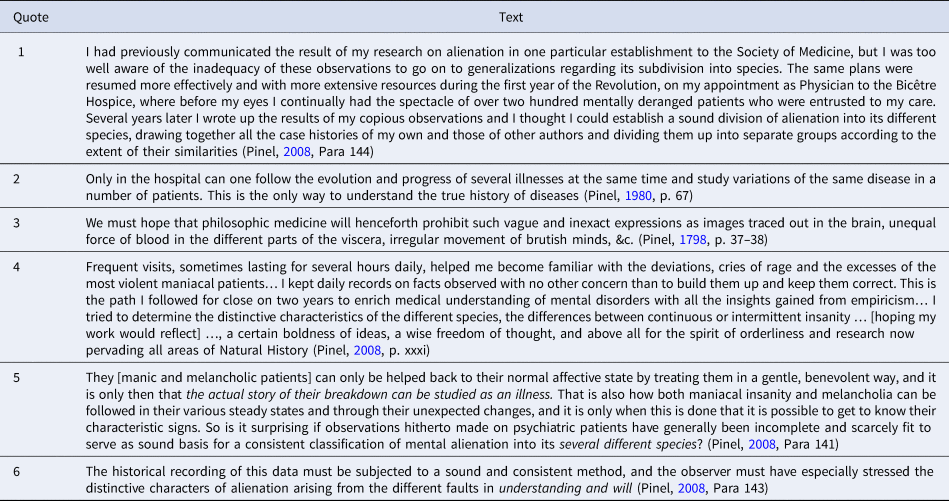
I utilized primarily the second edition of his textbook ‘Traite Médico-Philosophique sur L'aliénation Mentale’ (Medico-Philosophical Treatise on Mental Alienation) published in 1809 (Pinel, Reference Pinel, Hickish G and Charland1809) and recently translated (Pinel, Reference Pinel, Charland, Healy and Hickish2008). This text reflects eight further years of experience and is better translated than the first edition (Pinel, Reference Pinel1801, Reference Pinel1806; Weiner, Reference Weiner2000). I place critical quotations in the text and other informative quotations in Table 1. I italicize parts of quotes for emphasis. After reviewing these themes, I explore Pinel's views on the two key syndromes of his day – mania and melancholia – where he anticipated several themes that arose in the evolution of these disorders over the succeeding century (Kendler, Reference Kendler2020a, Reference Kendler2020c).
Selected quotes on Pinel from relevant texts

Biography
Pinel was born in Southern France, the son and grandson of physicians. After his initial training at a religious college, where he studied philosophy, science, and mathematics, he went on to receive a degree from the Faculty of Medicine in Toulouse. He then studied four additional years at the Faculty of Medicine of Montpellier, focusing on the application of mathematics and statistics to medicine. He arrived as an aspiring physician in Paris in 1778. During the 1780s, Pinel was invited to join a well-known liberal ‘salon’ where he met many individuals who later came to power in the revolution, a cause with which he sympathized. He had worked in a private psychiatric sanatorium but his strong interest in insanity began after a mentally ill close friend died by suicide. Given his expertise in internal medicine, his psychiatric experience and his broad knowledge of medical nosology, in 1793, he was appointed as a ‘physician of the infirmaries’ at Bicêtre Hospital which then housed four thousand men, two hundred of whom were mental patients. Pinel, with the aid of the ‘governor’ Pussin (Schuster, Hoertel, & Limosin, Reference Schuster, Hoertel and Limosin2011), changed the therapeutic approaches to the mentally ill including the introduction of moral therapy and the elimination of inhumane restraint devices. In 1794, he was appointed as a faculty member at the Paris Health school and in 1795 became chief physician of the Hospice de la Salpêtrière, a post he retained for the rest of his life. In addition to his work with the mentally ill and the two editions of his widely read textbook, Pinel published an authoritative classification of all medical diseases in his ‘Nosographie Philosophique’ which went through six editions from 1798 to 1818 (Pinel, Reference Pinel1818) and helped in establishing him as a leading European medical nosologist. As recently described, ‘Pinel was … cast in the mold of such 18th century taxonomists and encyclopedists of nature as Linnaeus and Buffon (Weissmann, Reference Weissmann2008, p. 1291).’ Although a number of biographies of Pinel are available in French (e.g. Pigeaud, Reference Pigeaud1997; Weiner, Reference Weiner1999), none have been translated into English. The literature on him is vast of which this is a small selection: Woods & Carlson, Reference Woods and Carlson1961; Riese, Reference Riese1969; Pinel, Reference Pinel1980; Goldstein, Reference Goldstein1987; Weiner, Reference Weiner1992, Reference Weiner1999; Wallace & John, Reference Wallace and John2008; Wikipedia contributors, 2020. Here are additional references which provide helpful background for Pinel's career and work: Murphy, Reference Murphy1981; de Saint-Maur, Reference de Saint-Maur2012; Staum, Reference Staum2014.
An inductive, natural science approach
In the preface to his second textbook edition, Pinel quickly takes up this issue:
The words derangement, maniacal insanity, melancholia and dementia might be understood as equivalent to common words like madness, delirium, eccentricity, loss of reason etc. used in everyday life. To avoid any ambiguity, I felt I had to identify the physical and mental characteristics that distinguish the first group, looked upon as illnesses, before going on to subsequent considerations. Besides, how can there be common agreement unless, like natural scientists, we designate each object by its manifest signs, thereby enabling us to distinguish it from all others? Mental illness can show countless varieties but many of these have particular similarities that seem to bring them together. This gives rise to special abstract terms embraced in the broader concept of mental illness of which they constitute distinct species (Pinel, Reference Pinel, Charland, Healy and Hickish2008, p. xxi).
Pinel draws an analogy between his approach to psychiatric nosology and the fields of botany and zoology that began in Europe in the sixteenth century. As early botanists selected key features of the organism (e.g. flowering parts) as initial foci for their classificatory efforts (Mayr, Reference Mayr1982; Kendler, Reference Kendler2009), Pinel wants to focus on ‘particular similarities’ in cases of mental illness which will allow him to designate ‘distinct species.’ Pinel refers to both the ‘physical’ features of insanity or ‘signs’ and the ‘mental characteristics’ (i.e. symptoms), reflecting his interests both in objective classification as used by naturalists and his humanist perspective on mental illness influenced by the values of the enlightenment and the subsequent French Revolution.
A central nosologic problem is, among the welter of individual features of all patients, how to pick the key features on which to base a nosology. Pinel understood this problem and began with an a priori belief, as motivated the biological classifiers that underneath this diversity lay a tractable modest number of diseases: ‘The number of species of alienation is limited, but its varieties can be multiplied indefinitely (Pinel, Reference Pinel, Charland, Healy and Hickish2008, p. xxviii).’
Pinel saw psychiatric nosology as part of a long historical tradition and suspected that the correct categories, once found, would be temporally stable:
Why not bring the approach used in all branches of natural history into this field of medicine as it is elsewhere? Are the distinctive traits of mental alienation, at least of some kinds, not the same in all the precise observations collected in different eras? And from this should it not be concluded that all the other facts gathered in the future will fall into the divisions which will have been adopted (Pinel, Reference Pinel, Charland, Healy and Hickish2008, Par 142)?
A more biographical summary of his nosologic efforts is seen in quote # 1 (Table 1). He outlines his inductive strategy first studying a few cases carefully and then following up with a large sample of observations, hoping to confirm his initial impressions:
One has to deplore the fact that the fate of the human race is so often the victim of superficial studies undertaken in medicine, and the slovenliness with which such studies apply the methods of classification adopted by the Naturalists. To establish this classification on a sound basis, should particular objects not be considered with the closest attention first, then a large number of observed facts be gathered together and separated into several bundles depending on their many points of conformity and striking similarities (Pinel, Reference Pinel, Charland, Healy and Hickish2008, Par 138)?
If his nosologic project was to succeed, Pinel knew that he needed large patient samples, only available in public asylums, who could be studied over time (see quote 2):
It is easy to recognize that the division of alienation into its different species has up till now been based on arbitrary collections of small numbers of observations which were often incomplete and imprecise, rather than being founded on counts of large numbers of facts, gathered methodically over a long succession of years in public establishments for insane patients of either sex (Pinel, Reference Pinel, Charland, Healy and Hickish2008, Par 143).
A rejection of metaphysics
As a corollary to his inductive approach to mental illness, Pinel rejected metaphysics. In the introduction to his second edition, Pinel contrasts his commitment to a naturalistic science to the problems of a metaphysical approach to insanity:
It is a bad choice to take mental alienation as the specific subject for research, as this opens one up to vague discussions about the seat of the understanding and the nature of its various faults, and nothing is more obscure or more impenetrable than this. But if one confines oneself within sensible limits, keeping to a study of the distinctive varieties of derangement as shown by outward signs …one then follows the path widely followed in all branches of natural history (Pinel, Reference Pinel, Charland, Healy and Hickish2008, p. xxv).
A few pages later, he adds
I must keep clear of … all metaphysical discussion or hypothesis on the nature, generation, associations, or succession of intellectual or emotional functions. I keep strictly to observation … (Pinel, Reference Pinel, Charland, Healy and Hickish2008, Par 4).
Pinel wished to avoid not only metaphysical problems in his nosologic project but also the highly speculative etiologic theories of mental illness that abounded then and have continued to plague our field. His focus remained a naturalistic one – to carefully observe and record:
In discussing prior theories of blood flow and levels of excitation in the brain, I am far from anxious to go wandering into these uncharted territories and restrict myself to a simple exposition of the results of the most continual and repeated observation (Pinel, Reference Pinel, Charland, Healy and Hickish2008, Par 137).
For further examples of the kind of theories he wished to avoid, see quote 3.
Importance of longitudinal study
While Kahlbaum and Kraepelin are often credited with emphasizing the importance of the course of psychiatric illness, Pinel, decades earlier, emphasized the same point.
So one must settle on a firm objective and proceed carefully, keeping strictly to observing facts, so as to come up with a general and really straightforward account of mental alienation. This is something which can only be achieved by bringing together a great number of individual observations, followed with the greatest care during the course and different stages of the illness from its beginning to its end (Pinel, Reference Pinel, Charland, Healy and Hickish2008, Par 2).
We noted his desire to emulate the biological classifiers. Here he shows an additional aim to apply the lessons of the physical sciences, a key being careful longitudinal assessments:
It is more important for humanity's sake to find out whether in the present state of the physical sciences one can get any closer to the truth in medicine by applying their principles and progress successfully, developing a sounder style … by confining oneself over a long period of years to close observation of the course and features of illnesses (Pinel, Reference Pinel, Charland, Healy and Hickish2008, Par 1).
Pinel described the detailed nature of his longitudinal observations of patients (quote 4) and then notes that another benefit of this approach is the ability to collect needed history which is only possible for some patients after their acute illness had remitted (quote 5).
Importance of philosophy
Goldstein, in her illuminating history of nineteenth-century French psychiatry (Goldstein, Reference Goldstein1987) provides useful background on Pinel's era:
All enlightenment-inspired physicians like to think of themselves as medicines-philosophes. But the psychiatrists were, and throughout the 19th century would remain, the most relentlessly philosophical of the breed (Goldstein, Reference Goldstein1987, p. 240).
Pinel studied philosophy in college and from early on was a disciple of Condillac who, in turn, was a follower of John Locke (Suzuki, Reference Suzuki1992; Falkenstein & Grandi, Reference Falkenstein, Grandi and Zalta2017). Pinel most favored the ‘British empirical approach’ to philosophy and was particularly inspired by Bacon (Pinel, Reference Pinel1980, pp. 9–10). The title of his textbook was ‘A Medico-Philosophical Treatise.’ In the first page of his introduction, he writes about the philosophical training needed for the young alienist:
Will he be able to follow all the variations and distortions in the working of human understanding if he has not meditated deeply over the writings of Locke and Condillac and has not familiarized himself with their teaching (Pinel, Reference Pinel, Charland, Healy and Hickish2008, p. xxiv)?
A few pages later, he again emphasizes the seminal role that philosophy needs to play in the ‘the science of insanity’: ‘There are few subjects in medicine with so many contact points and inescapable associations with moral philosophy and the history of understanding as to the science of insanity (Pinel, Reference Pinel, Charland, Healy and Hickish2008, p. xxix).’
Emphasis on faculty psychology
Early in his textbook, Pinel notes the important need for ‘in-depth’ studies of the disorders of specific mental faculties in his patients, only listing here the faculties of ‘understanding’ and ‘will.’ Note again how he attends to both the physical and mental aspects of insanity.
… the real foundation of the whole edifice is a preliminary and in-depth study of the many disturbances of understanding and the will which are manifest externally by changes in bodily habits, by actions and words likely to reveal the internal state, and by unequivocal abnormal physical signs (Pinel, Reference Pinel, Charland, Healy and Hickish2008, Par 2).
A true understanding of mental illness requires the delineation of the mental faculties whose disordered functioning underlie the disorders:
But what name should one give to the art of splitting up a highly composite subject and carefully considering each of its parts separately? Are not the words human understanding and will generic and abstract terms which comprise between them different intellectual or emotional functions whose separate or combined aberrations produce different species of alienation, and whose true characters it is important to determine carefully (Pinel, Reference Pinel, Charland, Healy and Hickish2008, Par 63)?
Later, after discussing the challenges of the diversity of symptoms and signs seen among the insane, Pinel continues this line of reasoning
Will it be possible to make an annual inventory and reach general conclusions if a systematic method is not followed? It is to ensure this progress and spread some light upon it that I put together here the result of my observations on the diverse disturbances in intellectual or affective functions which can be used to characterize the different species and varieties of mental alienation. I have considered these disturbances separately in order to learn how to appreciate them better and distinguish them by their special characters … (Pinel, Reference Pinel, Charland, Healy and Hickish2008, Par 66).
The ‘systematic method’ he suggests utilized faculty psychology to organize the diversity of dysfunctions in psychiatry. His definitive list of faculties are in the subheadings of Chapter 2: (i) perception, (ii) thought processes, (iii) memory and association, (iv) judgement, (v) emotions and other affective states, and (vi) imagination (Pinel, Reference Pinel, Charland, Healy and Hickish2008). Throughout his writings, he puts the greatest emphasis on intellect (or understanding) and affect (or passions). He believed that the dysfunctions of these faculties were of great use to distinguish between the ‘different species and varieties of mental alienation.’ But this is not always the case as in quote # 6, he emphasizes understanding and will.
A question Pinel was particularly interested in is the frequency with which severe disturbances in affect (i.e. passions) can cause delusions.
… [We] must only speak here of passions whose extreme intensity is likely to upset reason such as joy, pride, love, ecstatic rapture or devotion to religious objects. Similar affections, provided they are confined within certain limits, seem to add renewed impetus to the understanding and make its functions more lively and animated. But taken to the highest degree or frustrated by obstructions they may end up offering nothing but violent lapses, fleeting delusions, a state of stupor or real alienation (Pinel, Reference Pinel, Charland, Healy and Hickish2008, Par 43).
Extreme passions can, according to Pinel, ‘upset reasons’ leading to delusions and ‘alienation’ (i.e. insanity). Elsewhere, he is more succinct: ‘Alienation so often derives its origin from intense or deeply frustrated passions (Pinel, Reference Pinel, Charland, Healy and Hickish2008, par 13).’ He describes this pathway particularly clearly in the origins of ideas and delusions of reference in a male melancholic patient who
is liable to work diligently but on the contrary is liable to grasp false connections between things because of some fixed mental disorder dominating him. What a lot of strong and angry emotions there are to drive him beyond the limit and make him see some things under false and borrowed colours (Pinel, Reference Pinel, Charland, Healy and Hickish2008, Par 168)!
Mania
Mania was, according to Pinel, the pre-eminent psychiatric disorder of his day as reflected by the final phase in the title of his first edition textbook: ‘ou La Manie.’ Likely nosologic influences were the great British medical nosologist Cullen (Cullen, Reference Cullen1780, Reference Cullen1807), whom he translated into French in 1786 (Dyde, Reference Dyde2015), Colombier who, in 1785 issued a French Royal brochure on insanity which included a proposed nosology (Goldstein, Reference Goldstein1987, pp. 44–46) and de Sauvages (King, Reference King1966; Starkstein & Berrios, Reference Starkstein and Berrios2015). All three defined mania in the dominant intellectualist tradition. For Cullen, mania was ‘a total insanity,’ for Colombier, it was furious and continuous delusions without fever (Goldstein, Reference Goldstein1987, p. 46) and for de Sauvages, it was ‘chronic illness without fever which comes from the disturbance of the imagination and of the reason (de Sauvages, Reference de Sauvages1772, p. 389).’ Consistent with most texts before 1820, mood disturbances played little to no role in the definition of mania (Kendler, Reference Kendler2020c).
In one of his clearest descriptions of mania, Pinel departs from the predominant view of his day:
Mania can present, even in its simple state, in very varied forms, depending on its different stages, the faults of one or more functions of understanding, the degree of agitation and violence of the affective state, whether cheerful or sad, calm or hot-tempered, with periodic returns of attacks or a sustained state (Pinel, Reference Pinel, Charland, Healy and Hickish2008, Par 152).
In faculty psychology terms, he is describing disturbances both of ‘understanding’ and ‘affect.’ He goes on to reject the intellectualist model of insanity (which he traces to Locke) as applied to mania. His careful clinical observations revealed to him that some manic patients have affective disturbances without any perturbations of ‘understanding’:
One may rightly admire the writings of Locke yet at the same time agree that his notions about maniacal insanity are very lacking when he looks upon it as inseparable from delirium! I thought along the lines of this author myself when I resumed my research on this illness at Biĉetre, and was not a little surprised to see several patients who never showed any disturbance of understanding, and were dominated by a kind of instinct of fury, as if only their affective faculties had been damaged (Pinel, Reference Pinel, Charland, Healy and Hickish2008, Par 158).
While respecting his philosophical forebears, when their theories contradicted his clinical experience, Pinel was prepared to disagree. Even in the first edition of his textbook, Pinel has separate sections for Mania with and without delusions (Pinel, Reference Pinel1801, Reference Pinel1806). Importantly, he frames this observation in the context of philosophical theory and, more specifically, faculty psychology. He is thereby anticipating developments in the nosology of both mania and melancholy that would not become predominant till decades later (Kendler, Reference Kendler2020a, Reference Kendler2020c) – that is, that insanity need not require lesions of understanding but can arise primarily from affective disturbances. Pinel did not, however, adopt the strong association of mania with euphoria that would be emphasized in the coming decades, stating that mania could be ‘accompanied by emotions of gaiety, of despondence or of fury (Pinel, Reference Pinel, Charland, Healy and Hickish2008, Par 159).’
Melancholia
Typical of most authorities in the late eighteenth and early nineteenth centuries(Kendler, Reference Kendler2020a), Cullen defined melancholia solely as a ‘partial insanity’ while Colombier considered it as delusions limited to a single subject and generally ‘pacific’ in tone (in contrast to the agitation typical of mania). In places, Pinel appears to agree with this definition ‘Melancholia – a delusion limited to one object, or a particular series of objects …whatever its other varieties may be (Pinel, Reference Pinel, Charland, Healy and Hickish2008, p. xxi–xxii).’ He provides a richer description elsewhere:
… the concentration of the mind of melancholic patients, fixated night and day on a specific object. It cannot be deflected, because it is continuously associated with some deep passion such as anger, hatred, wounded pride, wish for revenge, profound chagrin, an extreme distaste for life …(Pinel, Reference Pinel, Charland, Healy and Hickish2008, Para 94).
Pinel observes the strong association between affective disturbances and the delusional objects in melancholia. He provides more clinical details here, noting that the single delusional theme in melancholia is
always associated with a strong concentrated passion and a craving for solitude … Many of these melancholic patients walk about sadly in their courtyards, sunken in deep reverie. Some stay alone, squatting in isolated places, while others suffer inner conflicts between the leanings of the heart and fear of the torments of another life. … (Pinel, Reference Pinel, Charland, Healy and Hickish2008, Par 119).
However, Pinel does not, as authors do later in the nineteenth century (Kendler, Reference Kendler2020a), suggest a specific association between sad mood and melancholia. Rather, he writes:
Nothing is more inexplicable, and at the same time nothing is more striking, than the two opposite forms which melancholia can take. Sometimes there is inflation with pride and the fanciful idea of possessing immense riches or boundless power, while at other times there may be faint-hearted despondency, deep dismay or even despair (Pinel, Reference Pinel, Charland, Healy and Hickish2008, Par 164 2e).
Pinel accepts the mono-delusional framework of melancholia predominant at this time, but regardless of the emotional color of the delusion, suggests that disturbances are often seen in both the spheres of affect and of understanding, suggesting that at least in some cases, the affective disturbances might ‘drive’ the delusional thinking.
Discussion
A careful reading of relevant texts yields five important insights into both Pinel's thinking and more generally into the historical tradition of descriptive psychopathology as it was taking modern form. First, this tradition within psychiatry was a product of the enlightenment generally and the French revolution more specifically in that it was infused from both these sources with the joint enthusiasm for positivism – the power of empirical inquiry – and humanism – the desire to study humans both objectively and subjectively as thinking and feeling beings. This drive toward humanism is centrally involved with another key feature of Pinel's work outside my remit – his emphasis on ‘moral therapy.’ Second, Pinel's background in mathematics, statistics and biology as well as his joint career outside of his psychiatric work as one of the leading medical nosologists of his day, deeply informed his psychiatric nosologic project. Like his forerunners in botany and zoology, as indicated by his frequent references to ‘varieties’ and ‘species’ of mental illness, he emphasized the inductive approach of gathering data carefully at first on small numbers of subjects but then on larger populations to verify initial impressions. Part of this was also a commitment to longitudinal observations all of which was possible for him only because of his access to the large patient populations available in the Parisian hospitals he directed.
Third, like many of his age, he was committed to enlightenment philosophy in particular to Locke and his French disciple Condillac, but also Bacon. He regarded their study as an essential part of the training of young alienists. His devotion to positivism also carried with it a strong aversion to metaphysical speculation which he saw as an unfortunate preoccupation of many of his psychiatric forebears that he would studiously avoid.
Fourth, Pinel's thinking about the nature of the psychiatric illness was substantially influenced by faculty psychology – revealing a subtle but important contradiction in his project. On the one hand, he advocated for a Baconian inductive approach – just examine enough patients carefully and the nosology will emerge. On the other hand, he classified his patients through the ‘lens’ of faculty psychology – seeing them as manifesting disorders of will, understanding, perception and affect. While perhaps he would not admit it, his work suggests that raw induction is not as feasible as he suggests for something as complex as disturbed human behavior. Faculty psychology was an intermediate position that Pinel adopted to give him tractable ‘categories’ into which he could place the disturbances seen in groups of the mentally ill.
Fifth, perhaps as a result of his extensive clinical experience, Pinel rejected the rigid intellectualist view of insanity that he inherited from his alienist progenitors. Instead, again and again, he commented on the important role of emotional disturbances in the insane patients under his care. He also took important first steps at trying to understand how disorders of mood and understanding might inter-relate. In particular, he posited that, at least in some cases, delusions need not be primary manifestations of deficits in understanding and judgment but rather arise secondarily from disturbed affect/passions. Within half a century, a range of other alienists across Europe would follow-up and further develop these tentative insights, in the process developing our modern concepts of mania and depression – dominated by mood disturbances which could produce ‘secondary’ delusions (Kendler, Reference Kendler2020a, Reference Kendler2020c). In the nosologic space left by these two syndromes, there remained psychotic conditions where the delusions were primary and, if present, mood disturbances arose secondarily (Kendler, Reference Kendler2020b). In the last two decades of the nineteenth century, this space was filled by Emil Kraepelin with his categories of paranoia and dementia praecox, essentially completing the project begun by Pinel – a nosologic system for the major, severe forms of psychopathology.
Given that Pinel worked long ago employing diagnostic and therapeutic methods far different from our own, one might question the value of studying his works. As I hope to have demonstrated in this essay, the reward of such efforts is a deepening understanding of the historical and intellectual context out of which the field of modern psychiatry emerged.
Conflict of interest disclosures
The author reports no conflicts of interest.
Financial acknowledgements
The author reports no relevant grant support.