Introduction
Whipworms are soil-transmitted parasites that can parasitize a broad range of hosts, including humans, causing trichuriasis, mainly in developing countries (Bethony et al., Reference Bethony, Cole, Guo, Kamhawi, Lightowlers, Loukas, Petri, Reed, Valenzuela and Hotez2011; Hotez et al., Reference Hotez, Savioli and Fenwick2012). It is estimated that ~600–800 million people worldwide are infected with Trichuris trichiura, and the prevalence of infection is high in early childhood (Bethony et al., Reference Bethony, Brooker, Albonico, Geiger, Loukas, Diemert and Hotez2006; Mbuh et al., Reference Mbuh, Ntonifor and Ojong2012). The majority of light infections with T. trichiura are usually asymptomatic; however, heavy infections, especially in small children, can cause disease (trichuriasis), which is usually associated with clinical symptoms such as dysentery, rectal prolapse, anaemia and poor growth (Stephenson et al., Reference Stephenson, Holland and Cooper2000; reviewed by Nejsum et al., Reference Nejsum, Betson, Bendall, Thamsborg and Stothard2012). Whipworms also infect pigs (Trichuris suis) and can cause obvious clinical symptoms in growing pigs, including anorexia and bloody diarrhoea, resulting in production losses (Stewart & Hale, Reference Stewart and Hale1988).
For many years there has been controversy as to whether T. trichiura and T. suis represent the same species, due to the striking resemblances in their morphology, and many researchers have used different approaches to address this controversy. For example, some researchers considered that the presence of pericloacal papillae in T. trichiura, but not in T. suis, could be used to differentiate T. trichiura and T. suis (Barus et al., Reference Barus, Kotrla and Tenora1977; Zaman, Reference Zaman1984; Ooi et al., Reference Ooi, Tenora, Itoh and Kamiya1993; Mahmoud, Reference Mahmoud2002). However, a recent re-analysis of these structures by Cutillas et al. (Reference Cutillas, Callejon, Rojas, Tewes and Ubeda2009) concluded that these features are insufficient to differentiate T. trichiura and T. suis, and that new criteria should be found to differentiate the two Trichuris taxa (Cutillas et al., Reference Cutillas, Callejon, Rojas, Tewes and Ubeda2009).
The application of molecular tools may overcome some of the major problems and obstacles to resolve the relationship between Trichuris derived from humans and pigs. Sequences of the internal transcribed spacers (ITS) of nuclear ribosomal DNA (rDNA) have proven useful genetic markers for many nematodes (Wickramasinghe et al., Reference Wickramasinghe, Yatawara, Rajapakse and Agatsuma2009; Ceballos-Mendiola et al., Reference Ceballos-Mendiola, Valero, Polo-Vico, Tejada, Abattouy, Karl, De las Heras and Martín-Sánchez2010; Mejía-Madrid & Aguirre-Macedo, Reference Mejía-Madrid and Aguirre-Macedo2011; Lin et al., Reference Lin, Li, Gao, Wang, Ren, Cong, Tan, Chen, Yu and Zhao2012). For whipworms, a molecular study in Spain demonstrated that T. trichiura specimens, derived from non-human primates from a zoo, showed substantial sequence differences in ITS rDNA when compared with T. suis (Cutillas et al., Reference Cutillas, Callejon, Rojas, Tewes and Ubeda2009). Using ITS-2 rDNA as genetic markers, a recent study of Trichuris specimens obtained from humans and pigs in Uganda, as well as a few samples from other countries, suggested that T. trichiura and T. suis are two different species (Nissen et al., Reference Nissen, Al-Jubury, Hansen, Olsen, Christensen, Thamsborg and Nejsum2012).
Trichuris trichiura and T. suis infections in humans and pigs are common and widely distributed geographically in China (Chen et al., Reference Chen, Tang and Xu2008; Lai et al., Reference Lai, Zhou, Huang and Hu2011), but have not yet been characterized using their ITS rDNA sequences. Therefore, the objectives of the present study were to characterize T. trichiura and T. suis from humans and pigs in China by their ITS rDNA sequences and to study sequence variations within and between T. trichiura and T. suis.
Materials and methods
Parasites and isolation of total genomic DNA
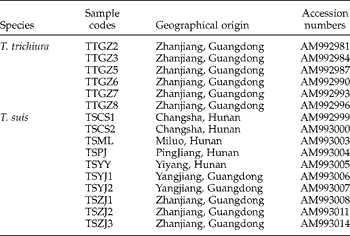
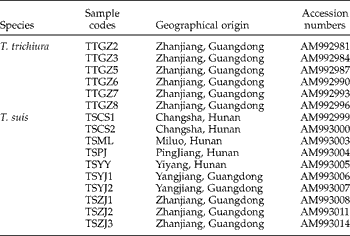
Adult specimens of Trichuris (n= 6) were collected from the caecum of a human patient during surgery in Zhanjiang People's Hospital in Zhanjiang, Guangdong Province, China (Liu et al., Reference Liu, Gasser, Su, Nejsum, Peng, Lin, Li, Xu and Zhu2012). Adult specimens of Trichuris (n= 10) were collected from the caeca of several pigs slaughtered in abattoirs in different geographical locations in China (table 1). Adult worms from each host were washed separately in physiological saline, identified morphologically (Jenkins, Reference Jenkins1970; Ooi et al., Reference Ooi, Tenora, Itoh and Kamiya1993), fixed in 70% (v/v) ethanol and stored at − 20°C until use. Total genomic DNA was extracted from individual samples by sodium dodecyl sulphate/proteinase K treatment, column-purified (Wizard™ DNA Clean-Up, Promega, Madison, Wisconsin, USA) and eluted into 50 μl water according to the manufacturer's recommendations. The sample codes, geographical origins and GenBank accession numbers of ITS rDNA are listed in table 1.
Trichuris samples from different geographical locations in China, and accession numbers of their ITS rDNA sequences. All T. trichiura samples were collected from the same patient, whereas T. suis samples were collected from several pigs.
Enzymatic amplification of the ITS rDNA
The full ITS rDNA region including primer flanking 18S and 28S rDNA sequences was amplified by polymerase chain reaction (PCR) from individual whipworm DNA preparations using universal primers NC5 (forward; 5′-GTAGGTGAACCTGCGGAAGGATCATT-3′) and NC2 (reverse; 5′-TTAGTTTCTTTTCCTCCGCT-3′) described preciously (Gasser et al., Reference Gasser, Chilton, Hoste and Beveridge1993). These primers were synthesized on a Biosearch Model 8700 DNA synthesizer (Shanghai, China). PCR reactions (25 μl) were performed in 10 mm Tris–HCl (pH 8.4), 50 mm KCl, 4 mm MgCl2, 200 μ m each of deoxynucleoside triphosphate (dNTP), 50 pmol of each primer and 2 U Taq polymerase (Takara Biotechnology, Dalian, China) in a thermocycler (Biometra, Göttingen, Germany) under the following conditions: initial denaturation at 94°C for 5 min, then 36 cycles of 94°C for 30 s (denaturation), 55°C for 30 s (annealing), 72°C for 60 s (extension), followed by a final extension at 72°C for 5 min. One microlitre (5–10 ng) of genomic DNA was added to each PCR reaction. Samples without genomic DNA (no-DNA controls) were included in each amplification run, and in no case were amplicons detected in the no-DNA controls (not shown). Five microlitres of each amplicon was examined by 0.8% (w/v) agarose gel electrophoresis to validate amplification efficiency. ITS PCR products were purified using the Wizard™ PCR-Preps DNA Purification System (Promega), and ligated with pGEM-T Easy vector (Promega). Positive clones were identified by colony PCR, confirmed by enzymatic digestion and three clones from each whipworm were sequenced following the protocols reported previously (Huang et al., Reference Huang, He, Wang and Zhu2004).
Sequence analysis
The sequences representing the 5′ end and 3′ end of the ITS-1 and ITS-2 rDNA of T. trichiura were determined by comparison with those of T. trichiura derived from humans in Thailand and Uganda (GenBank accession numbers GQ352554 and JN181860, respectively). The sequences representing the 5′ end and 3′ end of the ITS-1 and ITS-2 rDNA of T. suis were determined by comparison with those of T. suis derived from pigs in Spain (GenBank accession numbers AJ781762 and AJ249966, respectively). Sequences of the ITS-1 and ITS-2 rDNA of different samples were aligned using the computer program Clustal X 1.81 (Thompson et al., Reference Thompson, Gibson, Plewniak, Jeanmougin and Higgins1997) and modified by eye. Sequence differences (D) among and within the two whipworms were determined by pairwise comparisons using the formula D= 1 − (M/L), where M is the number of alignment positions at which the two sequences have a base in common, and L is the total number of alignment positions over which the two sequences are compared (Chilton et al., Reference Chilton, Gasser and Beveridge1995). In addition, the Megalign procedure within DNAStar 5.0 (Burland, Reference Burland2000) was used to analyse sequence similarity of different whipworm species.
Results and discussion
Genomic DNA was isolated from 16 individual Trichuris obtained from humans and pigs in China. The DNA fragment spanning the 3′ end of 18S rDNA, full ITS-1 rDNA, 5.8S rDNA, full ITS-2 rDNA, and the 5′ end of 28S rDNA was amplified from each individual and subjected to agarose gel electrophoresis. One amplicon of all samples appeared as a single band, approximately 1400 bp in length (not shown).
The ITS rDNA sequences obtained from T. trichiura and T. suis samples were 1222–1267 bp and 1339–1353 bp in size, respectively. These sequences contained full-length T. trichiura and T. suis ITS-1 rDNA sequences of 600–627 bp and 655–661 bp, 5.8S rDNA of 154 bp (both species), and ITS-2 sequence of 468–486 bp and 530–538 bp, respectively. The lengths of the ITS-1 and ITS-2 rDNA sequences differed among Trichuris samples as a result of the insertion/deletion of nucleotides within the simple sequence repeats (AGC)n, (CGC)n, (CAG)n, (GGC)n, (GCG)n, (CGG)n, (CGA)n, (CAG)n and (GCT)n. These results were consistent with those of previous studies (Cutillas et al., Reference Cutillas, Callejon, Rojas, Tewes and Ubeda2009; Nissen et al., Reference Nissen, Al-Jubury, Hansen, Olsen, Christensen, Thamsborg and Nejsum2012).
In order to examine sequence variation in ITS-1 and ITS-2 rDNA within and between T. trichiura and T. suis, ITS-1 and ITS-2 rDNA sequences of Trichuris obtained from humans and pigs, available in GenBank, were compared using the Megalign procedure within DNAStar 5.0. Excluding nucleotide variations in the simple sequence repeats, the intra-species sequence variation in the ITS-1 was 0.2–1.7% within T. trichiura, and 0–1.5% within T. suis. For ITS-2 rDNA, the intra-species sequence variation was 0–1.3% within T. trichiura and 0.2–1.7% within T. suis. The inter-species sequence differences between the two whipworms were 60.7–65.3% for ITS-1 and 59.3–61.5% for ITS-2. These results were consistent with those of a previous study in Uganda (Nissen et al., Reference Nissen, Al-Jubury, Hansen, Olsen, Christensen, Thamsborg and Nejsum2012). We have recently determined the mitochondrial genomes of human-derived and pig-derived Trichuris, and detected a substantial nucleotide difference between them (32.9%) (Liu et al., Reference Liu, Gasser, Su, Nejsum, Peng, Lin, Li, Xu and Zhu2012). The present study, using the same samples, has provided additional genetic evidence supporting the position that Trichuris obtained from humans and pigs represent distinct species (Liu et al., Reference Liu, Gasser, Su, Nejsum, Peng, Lin, Li, Xu and Zhu2012). Using ITS rDNA sequences as genetic markers, a previous study (Cutillas et al., Reference Cutillas, Callejon, Rojas, Tewes and Ubeda2009) has demonstrated that Trichuris from non-human primates and pigs were two distinct species, but we have yet to know whether these non-human primates were infected with T. trichiura or a different Trichuris spp. because the ITS rDNA sequences of Trichuris from humans were significantly different from those of Trichuris from non-human primates (Cutillas et al., Reference Cutillas, Callejon, Rojas, Tewes and Ubeda2009; Nissen et al., Reference Nissen, Al-Jubury, Hansen, Olsen, Christensen, Thamsborg and Nejsum2012). Therefore, more Trichuris samples from much broader geographical localities of the world and different non-human primates and humans should be employed in further studies to better illuminate the taxonomy and population genetic structures of Trichuris.
In conclusion, the present study characterized T. trichiura and T. suis from humans and pigs in China by their ITS rDNA sequences. Sequence comparison revealed that the inter-specific sequence differences among the two Trichuris species were significantly higher than intra-specific sequence variations within T. trichiura and T. suis. These results demonstrated that T. trichiura and T. suis from humans and pigs may represent distinct species.
Acknowledgements
This work was supported, in part, by the Program for Outstanding Scientists in Agricultural Research, the Open Funds of the State Key Laboratory of Veterinary Etiological Biology, Lanzhou Veterinary Research Institute, Chinese Academy of Agricultural Sciences (Grant nos SKLVEB2011KFKT011, SKLVEB2011KFKT004, SKLVEB2010KFKT009 and SKLVEB2011KFKT010) and the Yunnan Provincial Program for Introducing High-level Scientists (Grant no. 2009CI125).