Introduction
Chinchilla lanigera is a species in danger of extinction in its natural habitat, so the development of cryopreservation techniques of its gametes is an invaluable tool in conservation programmes and in the study of its reproductive biology. For over 50 years attempts have been made to preserve the genoplasm of different species, including human (Bunge & Sherman, Reference Bunge and Sherman1953), bovine (Foulkes & Stewart, Reference Foulkes and Stewart1977), monkey (Seier et al., Reference Seier, Conredie, Oettle and Fincham1993) and mouse (Nakagata, Reference Nakagata1993).
In Chinchilla, the obtainment of high quality offspring in a natural way is a very slow process. Problems have been reported with fertilization, as a male can fertilize only a few females during each reproductive season. To this problem we should also add the large number of genital diseases that result from poor sanitation conditions in the breeding places (Parkinson, Reference Parkinson1987). Therefore the use of assisted reproduction techniques with a gamete cryobank represents a feasible solution to the problem of low reproductive rate of this species in captivity, as well as facilitating genetic exchange and preventing endogamy.
A critical factor in the cryopreservation of sperm is the composition of the cryoprotectant medium (Curry, Reference Curry2000; Yoshida et al., Reference Yoshida, Forsberg, Greve, Gustafsson, Katila, Kindahl and Ropstad2000). The first cryoprotective agent used in sperm cells was glycerol (Polge et al., Reference Polge, Smith and Parks1949), numerous studies have been carried out to determine the optimum glycerol concentration in the different freezing protocols. Paradoxically, glycerol can induce alterations in the organization of the cytoplasm and in the stability of the plasma membrane (Amann & Pickett, Reference Amann and Pickett1987; Hammerstedt & Graham, Reference Hammerstedt and Graham1992). In addition, Critser et al. (Reference Critser, Huse-Benda, Aaker, Arenson and Bal1988) demonstrated that glycerol at a concentration of 7.5% causes an abrupt decrease (50%) in the motility of human sperm.
Studies have been carried out in the composition of cryoprotectant media in numerous species, by varying the cryoprotectant agent, adding sugars (monosaccharides or disaccharides), or changing the concentrations of the buffers used. The way in which these media affect the physiological parameters during the freezing–thawing process was also analyzed in order to standardize a cryopreservation protocol for each species.
The addition of sugars to the medium provides an energy source for sperm and maintains osmotic pressure. Furthermore, sugars have cryoprotectant effects. In a study carried out in human sperm, Amjad Hossain et al. (Reference Hossain, Islam, Caruso and Madanes2003) showed that sucrose can be used by itself in the cryopreservation of these gametes with excellent results.
Alternatively, egg yolk has also been used in combination with Tris buffers or test-yolk buffer (TYB), in the cryopreservation of sperm, with good levels of recovery after thawing (Prins & Weidel, Reference Prins and Weidel1986; Weidel & Prins, Reference Weidel and Prins1987; Kukis, Reference Kukis1992).
In studies carried out by Holt et al. (Reference Holt, Head and North1992), it was suggested that egg yolk might reduce the damage to the membrane structure that takes place during rapid freezing.
In previous studies in epididymal sperm from Chinchilla, Ponce et al. (Reference Ponce, Aires, Carrascosa, Fiol De Cuneo, Ruiz and Lacuara1998a) proposed a cryoprotective medium composed of sodium citrate, TES, Tris, egg yolk, fructose and glycerol. The same medium was used to evaluate the effect on semen obtained by electroejaculation of Chinchilla and stored at 4°C (Carrascosa et al., Reference Carrascosa, Martin, Ponzio, Busso, Ponce and Lacuara2001) or cryopreserved (Ponce et al., Reference Ponce, Carrascosa, Aires, Fiol De Cuneo, Ruiz, Ponzio and Lacuara1998b), sperm recovery values of 30–60% being obtained. However, the damage that this medium could exert on DNA was not assessed. At present, with the advent of the intracytoplasmic sperm injection (ICSI) and its use as a routine technique for some species, this parameter becomes relevant.
The aim of the present work was the study of three different cryoprotectants (TYB, sucrose and glycerol) and their effect on certain physiological parameters taken into account to evaluate the quality of Chinchilla lanigera sperm obtained from the epididymal tail.
Materials and methods
Medium
Sucrose medium: TES (N-tris(hydroxymethyl)methyl-2 aminoethane sulfonic acid) and Tris (tris(hydroxymethyl)aminomethane), penicillin (15 μg/ml) and sucrose 62.5 mM test-yolk buffer (TYB) medium: TES, Tris, sodium citrate and fructose, gentamycin sulphate (10 μg/ml) and glycerol 12% (v/v). Heat-inactivated egg yolk obtained from specific pathogen-free (SPF) laying flocks 20% (v/v). Glycerol medium: TES, Tris, glycerol 6% (v/v), penicillin (15 μg/ml).
Collection and preparation of spermatozoa
We worked with sexually mature males from 10 to 12 months, with a body mass of 700 to 750 g. All animals were housed under a 12-h light–dark cycle (lights on: 07:00 to 19:00) at a constant temperature of 22 ± 1°C with free access to food and water. Immediately after slaughter, sperm were collected from the cauda epididymis by puncture. The samples were washed twice in Dulbecco's phosphate buffered saline (PBS) and centrifuged at 1000 rpm for 10 min. All material used for sample collection and subsequent trials were under strict temperature control (37 ± 0.5°C).
Counts and sperm motility determinations were performed using a Makler chamber. We used only samples with a viability percentage equal to or greater than 91%, using the eosin test 0.5% (w/v) with inverted microscopy at ×400 magnification.
To study motility we considered progressive motility (PM), non-progressive motility (NP) and immotility (IM). Observations were made on 200 cells (WHO, 2010).
Spermatozoa freezing
The cryoprotective medium was added drop by drop (1:1 dilution), followed by gentle shaking for 10 min to achieve complete sperm–medium mixing. The mixture was then introduced into the vials (500 μl). The samples were equilibrated at 22°C for 30 min and then submerged in a water bath and slowly cooled to 4°C for 2 h. Samples were cooled by exposure to liquid nitrogen gas vapour (10 cm above the liquid nitrogen level) for 10 min, then cryovials were finally immersed in liquid nitrogen and stored for 2 months before thawing.
Thawing procedure
The samples were submerged in a water bath at 37°C for 10 min with moderate agitation. The cryoprotective medium was removed by washing twice with PBS. Centrifugation was performed at 400 g for 10 min at room temperature.
Sperm functional activity evaluation
Response to hypo-osmotic shock (HOS) test
The procedure used was similar to the one described by Jeyendran et al. (Reference Jeyendran, Van der Ven, Perez-Pelaez, Crabo and Zaneveld1984) with some modifications. The samples were thawed and homogenized briefly; 100 μl of each sample was supplemented with 1 ml of sodium citrate and fructose (150 mOs/l) and then incubated at 37°C for 30 min; 10 μl samples were collected and observed with an inverted microscope using a 22 × 22 mm coverslip. Sperm were classified according to the presence or absence of a swollen tail. The test was performed in duplicate for each sample. The observations were made on 100 cells.
Acrosome reaction
The washed sperm (final concentration 3 × 10⁶cells/ml) were incubated with modified human tubal fluid (mHTF) medium supplemented with albumin for 2.5 h at 37°C in an atmosphere containing 5% CO2 for capacitation.
Evaluation of acrosomal status by modified Papanicolaou stain for spermatozoa
All samples were incubated with progesterone (20 μM) to induce the acrosome reaction. The smears were air-dried and fixed in ethanol 96°C for 2 h. The slides were hydrated by passage in 80°, 70° and 50° ethanol for 10 s each. They were left in running water for 1 min, stained with hematoxylin for 3 min, and differentiated in running water for 1 min. Then the slides were dehydrated by consecutive passages in 50°, 70°, 80° and 96° ethanol for 10 s each. Cells were then stained with orange G for 2 min followed by two passages in ethanol 96°C for 10 s. The slides were drained and stained with acid eosin for 2 min followed by two passages in 96° ethanol for 10 s and a passage in 96° ethanol for 4 min. Finally, the slides were passed through xylene for 4 min and mounted.
In total, 200 cells were analyzed by light microscopy at ×1000 magnification, taking as a positive response the absence of acrosome, and as a negative response the presence of the acrosomal vesicle, which is evident in the blackish brown band in the anterior region of the head.
Assessment of the state of DNA by the acridine orange test
Acridine orange staining was performed according to the method of Martins et al. (Reference Martins, Dode, Báo and Rumpf2007), with minor modifications. Briefly, two smears from each sample were prepared on glass slides and air dried. Each smear was fixed overnight in methanol and glacial acetic acid at a 3:1 ratio. The slides were air dried again, and incubated in buffer solution (80 mmol/l citric acid and 15 mmol/l Na2HPO4, pH 2.5) at 75°C for 5 min to test chromatin stability. Subsequently, slides were stained with acridine orange stain (0.2 mg/ml) for 5 min. Slides were washed with water to remove background staining and mounted. The slides were evaluated with an epifluorescence microscope (490/530 nm excitation/barrier filter). One hundred cells were analyzed in each treatment slide. Sperm with normal DNA content presented green fluorescence, whereas sperm with abnormal DNA content showed yellow-green to red fluorescence.
Statistical analyses
Data were expressed as means ± standard error of the mean (SEM). Significant differences among treatments were determined by analysis of variance (ANOVA) test. Results were considered significantly different when the p-value was < 0.05.
Results
All physiological parameters evaluated in samples with different cryoprotectants decreased in relation to the fresh sperm suspension.
Study of viability and motility
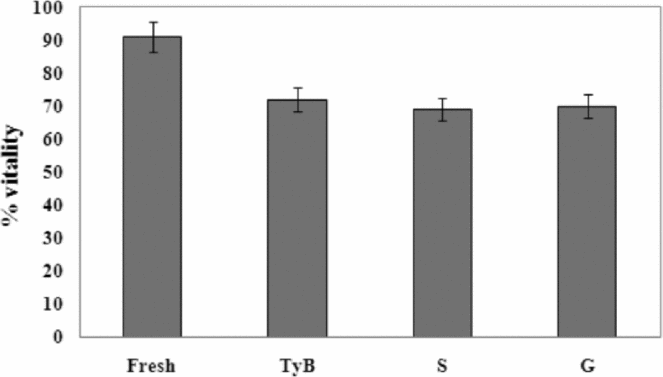
Figure 1 shows the percentages obtained for thawed sperm viability, in all cases a percentage >68% was obtained. These percentages are a good indicator of sperm retrieval.
Effect of different cryoprotectants on sperm viability. TYB (test-yolk buffer), S (sucrose) and G (glycerol 6%). Results represent the means ± standard error of the mean (SEM) of five independent experiments performed in duplicate and 200 cells assayed per sample with eosin test. Determinations were performed immediately after thawing.

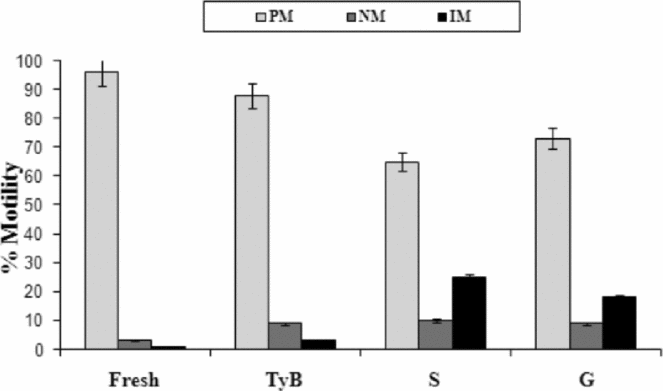
The motility study showed a decrease in progressive motility in all cases tested, but with values of progressive motility above 64%. As shown in Figure 2, in the case of frozen samples with TYB and glycerol, changes were observed in the percentage of non-progressive motile sperm (9%) compared with the fresh sample (3%). However, sperm frozen with sucrose showed a decrease in sperm progressive motility (35%). At the same time, a significant increase in immotile sperm suspensions was recorded in frozen sucrose (25%) and glycerol (18%).
Effect of different cryoprotectants on sperm motility. PM (progressive motility), NM (non-progressive motility), IM (immotility) TYB (test-yolk buffer), S (sucrose) and G (glycerol 6%). Results represent the means ± standard error of the mean (SEM) of five independent experiments performed in duplicate and 200 cells assayed per sample. Determinations were performed immediately after thawing.
Response to hypo-osmotic shock (HOS TEST)
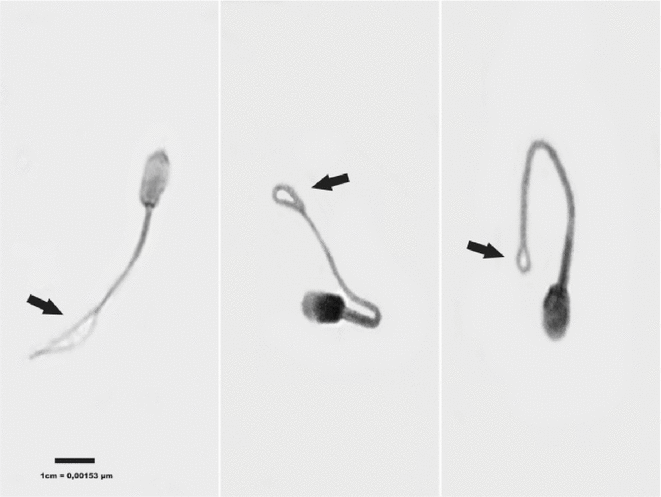
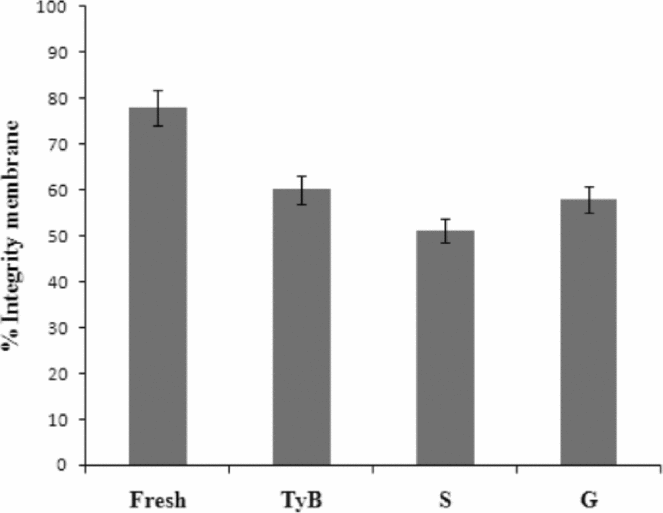
Study of the integrity of the membrane based on the response of the cells when subjected to a HOS (Fig. 3) showed a response according to the percentages of vitality obtained (Fig. 4). Sperm frozen with TYB showed the highest response rate (60%) compared with the values obtained with the control (fresh 78%), while that in sperm frozen with sucrose the response was below 52%.
Swollen sperm after the hypo-osmotic shock (HOS) test. Arrows indicate sites of swelling in the tail. Methylene blue was used to increase contrast. Inverted microscopy ×1000 magnification.
Percentages of positive responses to the hypo-osmotic shock of fresh and frozen–thawed sperm. TYB (test-yolk buffer), S (sucrose) and G (glycerol 6%). Results represent the means ± standard error of the mean (SEM) of seven independent experiments performed in duplicate and 100 cells assayed per sample. Determinations were performed immediately after thawing.
Acrosome reaction
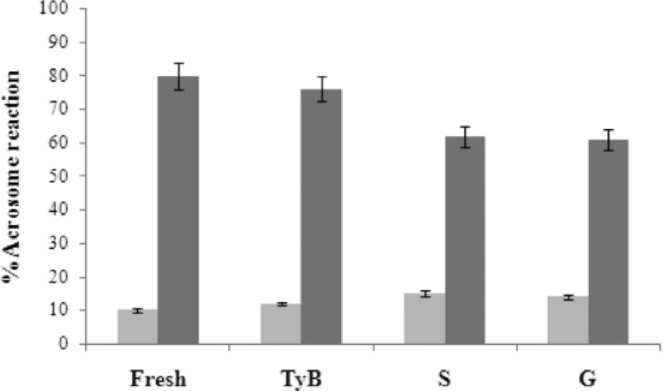
Thawed sperm suspensions were incubated at 37°C for 2.5 h in capacitating medium and incubated with progesterone to induce the acrosome reaction (Fig. 5). In all cases tested, fairly good rates of acrosome reaction induction were obtained (about 60%) (Fig. 6). No evidence of significant differences between TYB-frozen sperm and fresh samples was observed. The values of induction obtained from frozen sperm with sucrose and glycerol were lower than with TYB.
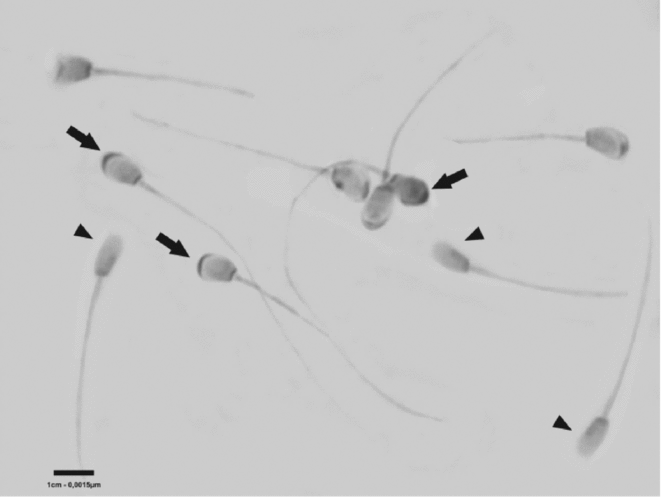
Detection of acrosomal loss in capacitated spermatozoa from the epididymis cauda by modified Papanicolaou staining. Arrows: presence of intact acrosome. Arrowhead: reacted acrosome. Inverted microscopy ×1000 magnification.
Percentages of acrosome reaction-induced with progesterone 20 μM incapacitated sperm. Incubated for 50 min at 37°C. Control (dimethyl sulfoxide) has a percentage of spontaneous acrosome reaction (AR). TYB (test-yolk buffer), S (sucrose) and G (glycerol 6%). Results represent the means ± standard error of the mean (SEM) of five independent experiments performed in duplicate and 200 cells assayed per sample.
In all cases, the spontaneous acrosome reaction scored was between 10 and 12%.
Effect on sperm DNA fragmentation
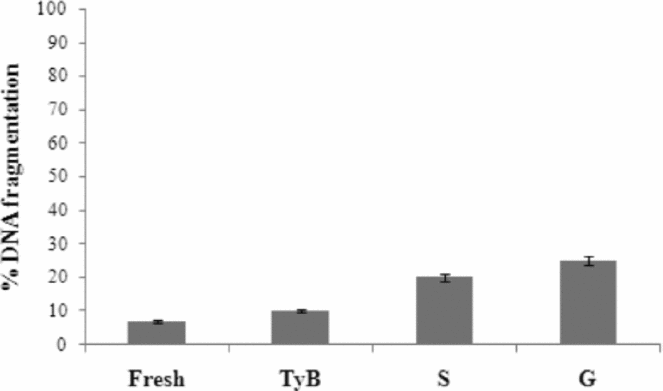
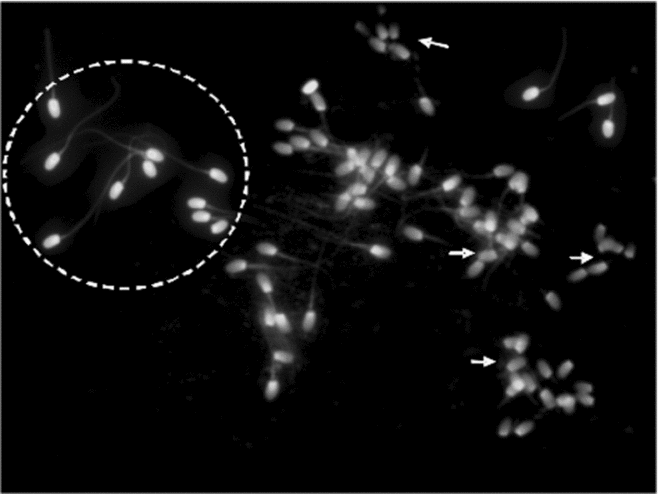
We analyzed the DNA integrity of frozen/thawed sperm with different cryoprotectants, taking as control the fresh sample. Figure 7 shows the values obtained in each case. There was a significant increase in the percentage of DNA fragmentation in cryopreserved sperm fractions with sucrose and glycerol at 20 and 25% respectively compared with 7% obtained with fresh sperm. The percentage obtained in the sperm suspension frozen with TYB was slightly higher than the control. Green fluorescent sperm had no DNA damage, while those that fluoresced yellow-green to red showed different degrees of DNA fragmentation (Fig. 8).
Effect of the cryoprotectants assayed on the integrity of spern DNA. TYB (test-yolk buffer), S (sucrose) and G (glycerol 6%). Results represent the means ± standard error of the mean (SEM) of six independent experiments performed in duplicate and 100 cells assayed per sample.
Sperm stained with acridine orange. (arrows) Green fluorescence: undamaged DNA; (cut line) yellow-red fluorescence: DNA with different degrees of fragmentation. Epifluorescence microscope ×1000 magnification. (See online for a colour version of this figure.)
Discussion
The results of the study indicate that the different cryoprotectants assayed affected the physiological parameters studied to different degrees and had a direct incidence on sperm quality.
The success of the cryopreservation process may be influenced by several factors, among them the concentration of egg yolk or glycerol and the addition of different types of sugars. In our work, we compared the effect of three cryoprotectors: TYB, sucrose and 6% glycerol.
In previous studies with chinchillas (Ponce, Reference Ponce, Aires, Carrascosa, Fiol De Cuneo, Ruiz and Lacuara1998a,Reference Ponce, Carrascosa, Aires, Fiol De Cuneo, Ruiz, Ponzio and Lacuarab), viability and motility values similar to the ones obtained in our laboratory have been reported. However, sperm recovery (viability and motility) of frozen–thawed samples showed significant differences when using a composition medium similar to the one used in this study such as TYB. The percentages of viability and motility registered in these assays were: in semen, 38 and 44% and in epididymal sperm, 66 and 32% respectively, while in our laboratory we obtained a vitality percentage of 72% and a progressive motility percentage of 88%.
At the same time, we observed that in the samples cryopreserved with sucrose and 6% glycerol there was a significant increase in sperm with motility in situ and immotile sperm, which poses a problem if in vitro fertilization (IVF) is to be used as an assisted reproduction technique.
Alternatively, the response of the cells to a HOS is a parameter used to assess the integrity of the plasma membrane. The HOS test was originally designed for use with human sperm, mainly to evaluate the quality of the semen, and was later developed for different mammalian species such as bovine (Correa & Zavos, Reference Correa and Zavos1995; Rota et al., Reference Rota, Penzo, Vincent and Mantovani2000), ovine (Pérez et al., Reference Perez, Valcarcel, de las Hems and Baldassarre1997), equine (Caiza de la Cueva et al., Reference Caiza de la Cueva, Rigau, Bonet, Mire, Briz and Rodriguez-Gil1997; Nie, Reference Nie1998; Neild et al., Reference Neild, Chaves, Flores, Mora, Beconi and Aguero1999), porcine (Gade et al., Reference Gade, Matas and Lucas1998) and canine (Kumi-Diaca, Reference Kumi-Diaca1993).
In the HOS test performed with fresh samples, we obtained percentages similar to the ones described by Ponce et al. (Reference Ponce, Aires, Carrascosa, Fiol De Cuneo, Ruiz and Lacuara1998a,Reference Ponce, Carrascosa, Aires, Fiol De Cuneo, Ruiz, Ponzio and Lacuarab) in electroejaculated and epididymal sperm, but in the frozen–thawed samples significant differences were found.
In the studies carried out by these authors, the values obtained were no higher than 35% when sperm were subjected to a hypo-osmotic medium. However, we found a 60% positive response when using TYB as a cryoprotector, a value similar to the ones reported for humans by Hammadeh (Reference Hammadeh, Greiner, Rosenbaum and Schmidt2001). In the frozen samples with sucrose as a cryoprotector, we obtained the lowest value (51%).
Another property studied in vitro as a marker of sperm quality was the capacity of sperm to undergo the acrosome reaction (AR). Fairly good percentages of induced AR were obtained with the different cryoprotectants assayed. In the case of samples frozen with TYB, 75% of the capacitated sperm underwent AR, this result not being very different from the control (fresh sample 80%). If we analyse the samples cryopreserved with sucrose and 6% glycerol, no differences were found between them with a percentage of reacted sperm of 63% and 60% respectively.
The practice of cryopreservation and storage of sperm of different species in liquid nitrogen is routinely used in assisted reproduction technology (ART) in the laboratory. Despite the success of the cryopreservation of these gametes, the procedure is not free from risks or side effects (Stanic et al., Reference Stanic, Tandara, Sonicki, Simunic, Radakovic and Suchanek2000). One such effect is the damage undergone by the genetic material. In fact, Royere et al. (Reference Royere, Barthelemy, Hamamah and Lansac1996) postulated that abnormal interactions between sperm DNA and nuclear proteins may occur during the cryopreservation process. No data for this species are available in the existing literature. Our work group found greater genetic damage in the samples frozen with sucrose (20%) and glycerol 6% (25%). The lowest values (10%) were found when using TYB as a cryoprotector. Besides finding percentages of DNA fragmentation in 7% of the fresh samples, these values agree with the ones obtained in human sperm (Hammadeh, Reference Hammadeh, Greiner, Rosenbaum and Schmidt2001).This fact could be due to defects in protoamination during the maturation process.
In conclusion, all our studies with epididymal sperm of Chinchilla lanigera showed that the cryoprotectant that caused the least injury to these gametes, especially to DNA, during freezing, storage and later thawing was TYB, which would represent a technological advance in the application of assisted reproduction techniques such as ICSI, in which the number of gametes required for the process is enormously reduced and the integrity of the nucleus is important, as natural selection barriers are overcome.
Acknowledgements
This work was supported by a grant from the Science Council of the National University of Tucumán (CIUNT) and the National Agency for the Promotion of Science and Technology (FONCYT), Argentina.