INTRODUCTION
Interest in the Myxosporea (Myxozoa) as significant fish parasites is still increasing with the growing importance of fish cultures and wild fisheries. The European sea bass, Dicentrarchus labrax (L.), is one of the most important commercial fishes widely cultured in the Mediterranean zone. Parasitic diseases, especially those caused by Enteromyxum leei, Sphaerospora testicularis, S. dicentrarchi, Kudoa iwatai, Ceratomyxa labracis and Ceratomyxa diplodae are responsible for important economical losses in aquaculture (Diamant et al. Reference Diamant, Ucko, Paperna, Colorni and Lipshitz2005; Fioravanti et al. Reference Fioravanti, Caffara, Florio, Gustinelli and Marcer2006). The scombrid fishes Scomberomorus commerson (Lacepède, 1800), S. guttatus (Bloch and Schneider, 1801) and S. koreanus (Kishinouye, 1915) are important commercial and recreational pelagic fish species in the Indo-West Pacific area. To date, only 2 muscle-infecting myxosporeans, Kudoa scomberomori and K. permulticapsula, have been reported in S. commerson (Whipps et al. Reference Whipps, Adlard, Bryant and Kent2003; Adlard et al. Reference Adlard, Bryant, Whipps and Kent2005) and no myxosporean species is known from the other 2 scombrid fishes.
The SSU rDNA sequence data of the aforementioned myxosporean parasites of D. labrax are available in the GenBank, except those of C. diplodae and S. testicularis. Sphaerospora testicularis is an economically important parasite of the seminiferous tubules of European sea bass testes which greatly reduces reproductive efficiency of males (Sitjà-Bobadilla and Alvarez-Pellitero, Reference Sitjà-Bobadilla and Alvarez-Pellitero1990). It often occurs in co-infections with Sphaerospora dicentrarchi, a serious systemic parasite of this fish host (Fioravanti et al. Reference Fioravanti, Caffara, Florio, Gustinelli and Marcer2004; Sitjà-Bobadilla, Reference Sitjà-Bobadilla2009). The rDNA-based phylogenetic analyses have shown that S. dicentrarchi clusters within the Kudoa clade away from the true basal sphaerosporids (Sphaerospora sensu stricto) supporting the strong polyphyly of the genus Sphaerospora (Kent et al. Reference Kent, Andree, Bartholomew, El-Matbouli, Desser, Devlin, Feist, Hedrick, Hoffmann, Khattra, Hallett, Lester, Longshaw, Palenzuela, Siddall and Xiao2001; Bartošová et al. Reference Bartošová, Fiala and Hypša2009). Despite many studies performed on S. testicularis, no sequence data on this myxosporean are available to date. Therefore, the primary objective of this study was to provide the SSU rDNA data for S. testicularis in order to evaluate its phylogenetic affinities with other myxosporean species.
During a survey of the myxosporean fauna in scombrid fishes, a new species was reported here from the Indo-pacific mackerel, S. guttatus (Bloch and Schneider, 1801). Therefore the second objective of the present study was to describe the new myxosporean genus Latyspora n. gen. with its type species Latyspora scomberomori n. gen. n. sp. from the renal tubules of the Indo-pacific mackerel S. guttatus using a ‘whole evidence’ approach. We combine morphological, biological and molecular characteristics for the new species description. Besides performing the phylogenetic analyses, we compared the base-pair lengths of the variable SSU rRNA regions of L. scomberomori n. gen. n. sp. to other myxosporeans and studied the evolutionary patterns within myxosporeans by investigating the evolutionary history of curved sutural line, a feature typical for L. scomberomori n. gen. n. sp.
MATERIALS AND METHODS
Parasite origin and microscopic examination
Samples of European sea bass testes infected with S. testicularis were obtained from fish farmed in floating cages located in the Ligurian Sea, Italy. Fish specimens of Scomberomorus spp. were collected from the central fish market in Kuala Lumpur, Malaysia and stored on ice until dissected in the laboratory. Wet-mount preparations of kidney tissues were examined by light microscopy and digital images of L. scomberomori n. gen. n. sp. spores were taken on an Olympus BX41 compound microscope. Descriptions and spore measurements were made according to the guidelines of Lom and Arthur (Reference Lom and Arthur1989).
Amplification and sequencing of SSU rDNA
The total DNA of S. testicularis and L. scomberomori n. gen. n. sp. was isolated from the infected samples using the Jetquick Tissue DNA Spin Kit (Genomed, Germany) after previous 0·5 mm-glass-bead homogenization and disruption of spores using the FastPrep®-24 Instrument (M.P. Biomedicals, CA, USA). SSU rDNA sequence of S. testicularis was obtained by assembly of 2 overlapping parts amplified with the use of ERIB1-ERIB10 primers (Barta et al. Reference Barta, Martin, Liberator, Dashkevicz, Anderson, Feighner, Elbrecht, Perkins-Barrow, Jenkins, Danforth, Ruff and Profous-Juchelka1997) in the primary PCR then ERIB1-ACT1R (Hallett and Diamant, Reference Hallett and Diamant2001) and MyxGen4F-ERIB10 primer sets (Diamant et al. Reference Diamant, Whipps and Kent2004) in subsequent semi-nested PCRs. The SSU rDNA sequence of L. scomberomori n. gen. n. sp. was amplified with primers described by Freeman et al. (Reference Freeman, Yokoyama and Ogawa2008). PCRs were carried out in a 25 μl volume using 10 pmol of each primer, 250 μ m of each dNTP, 1× Buffer and 1 U of Taq-Purple polymerase (Top-Bio, Czech Republic). PCR cycling parameters used for the amplification of S. testicularis and L. scomberomori n. gen. n. sp. sequences can be found in papers by Bartošová et al. (Reference Bartošová, Fiala and Hypša2009) and Freeman et al. (Reference Freeman, Yokoyama and Ogawa2008), respectively. Amplified products of the expected size were cut out of the gel and purified using the Jetquick Gel Extraction Spin Kit (Genomed, Germany). PCR products were sequenced on an automated sequencer ABI 3130xl. The contigs were assembled in the DNA Star SeqMan II program ver. 5.05 (DNASTAR Inc., Madison, Wisconsin).
Sequence alignments and phylogenetic analyses
The SSU rDNA sequences of S. testicularis and L. scomberomori n. gen. n. sp. were aligned in Clustal X ver. 1.83 (Thompson et al. Reference Thompson, Gibson, Plewniak, Jeanmougin and Higgins1997) using default parameters with 62 myxosporean sequences retrieved from GenBank. Malacosporeans Tetracapsuloides bryosalmonae and Buddenbrockia plumatellae were set as outgroups. The first 450 bp at the 5´end of Sinuolinea sp. SSU rDNA sequence (AF378346) were excluded from the alignment as this part corresponds to the host SSU rDNA sequence (Psetta maxima) as reported by Holzer et al. (Reference Holzer, Wootten and Sommerville2010). The resulting alignment was manually edited and ambiguous regions (especially the long insertions in basal Sphaerospora sensu stricto species) of the final alignment were identified by eye and excluded manually using BioEdit 7.0.5.2 (Hall, Reference Hall1999).
Variable SSU rRNA regions of selected myxosporeans were delimited by comparison with Sphaerospora truttae, for which the variable regions have been defined (Holzer et al. Reference Holzer, Wooten and Sommerville2007).
Phylogenetic analyses were performed using maximum parsimony (MP) and maximum likelihood (ML) methods in PAUP* ver. 4.0b10 (Swofford, Reference Swofford2001). Heuristic search with random taxa addition, the ACCTRAN option, and the TBR swapping algorithm were used for MP analysis. All characters were treated as unordered, Ts/Tv ratio was set to 1:2 and gaps were treated as missing data in the final alignment. GTR + G model (assumed nucleotide frequencies: A=0·25340 C=0·21790 G=0·24550 T=0·28320; gamma shape=0·479) was selected by Akaike Information Criterion implemented in jModelTest ver. 0.1.1 (Posada, Reference Posada2008) for ML analysis. Clade supports were assessed with bootstrapping of 500/1000 replicates for ML/MP with random sequence additions. Bayesian inference (BI) was conducted in MrBayes ver. 3.0 (Ronquist and Huelsenbeck, Reference Ronquist and Huelsenbeck2003) employing the GTR+G model of evolution (6 rates of substitution; gamma rate variation across sites; 8 categories used to approximate gamma distribution; covariotide model). Posterior probabilities were estimated over 2 000 000 generations via 2 independent runs of 4 simultaneous Markov Chain Monte Carlo chains with every 100th tree saved. The length of burn-in period was 20 000 generations.
Tracing character evolution
The resulting SSU rDNA-based tree constructed using ML criterion with the aforementioned parameters was chosen as the basis for reconstruction of ancestral states. Malacosporeans Tetracapsuloides bryosalmonae and Buddenbrockia plumatellae were set as outgroups. The evolution of one morphological character (sutural line) was reconstructed on this tree using Mesquite ver. 2.72 (Maddison and Maddison, Reference Maddison and Maddison2009). Two character states were assigned to the shape of sutural line: straight (state 0) and curved (state 1). The curved sutural line is defined as non-straight from at least one of the views (apical, lateral). In the cases when the character state was not possible to determine (missing morphological characteristics of the species with an available SSU rDNA GenBank sequence), this state was defined as missing data (?) in the matrix. Reconstruction of character states at ancestral nodes was done by the likelihood method. We used Markov k-state 1 parameter model with the single parameter (the rate of change) (Schluter et al. Reference Schluter, Price, Mooers and Ludwig1997). Any particular change from one state to another is equally probable within this model.
RESULTS
The examination of fish specimens
Three species of Scomberomorus were sampled. Scomberomorus guttatus (12 fish) between 33·5–75 cm fork length, S. commerson (4 fish) between 44–150 cm fork length and S. koreanus (2 fish) 34 and 36 cm fork length. Only S. guttatus was found to be infected with L. scomberomori n. gen. n. sp., with a prevalence of 58% (7 out of 12 fish). The prevalence of infection was higher in larger fish, all fish >42 cm fork length were positive (4/4=100%), whereas relatively fewer fish <42 cm fork length were positive (3/8=38%). Spores of L. scomberomori n. gen. n. sp. were more abundant in the hind kidney.
Amendment of the family Sinuolineidae Shulman, 1959
Spores spherical, inversely pyramidal, bean-shaped or trapezoidal, may have caudal or lateral projections. Two spherical or subspherical polar capsules are anteriorly located or set apart, sometimes even at opposite sides of the spore; the plane connecting them is perpendicular to the mostly sinuous or meandering sutural line which often appears as a figure ‘8’. Plasmodia mono- to poly-sporic, located in the urinary system of marine fishes.
Description
Latyspora n. gen.
Diagnosis: Spores bean-shaped or trapezoidal having a flat or slightly concave posterior surface depending on the angle of view. Two valves with rounded ends, slightly different in size. Two equal spherical polar capsules located anteriorly but positioned obliquely to the sutural line. Polar filaments are coiled in opposite directions and discharging sideways. Sutural line sinuous and conspicuous, running between the two polar capsules, forming a conspicuous anterior and posterior protuberance. Additional protuberances formed at the posterior margin of each shell valve present. Single distinct sporoplasm with two nuclei almost filling the spore cavity. The spore surface smooth, without a mucous envelope. Disporic globular plasmodia in the kidney of marine fish.
Type species: Latyspora scomberomori n. gen. n. sp.
Etymology: The generic name refers to the pronounced width of myxospore.
Taxonomic affinities: The new genus is placed in the family Sinuolineidae.
Latyspora scomberomori n. gen. n. sp. (Fig. 1 and Fig. 2)
Type-host (vertebrate): Scomberomorus guttatus (Bloch and Schneider, 1801), Indo-Pacific king mackerel.
Invertebrate host: Unknown.
Type-locality: Waters off Peninsular Malaysia.
Site of infection: Coelozoic in the kidney tubules (mostly posterior part of kidney).
Prevalence of infection: 58% (7/12).
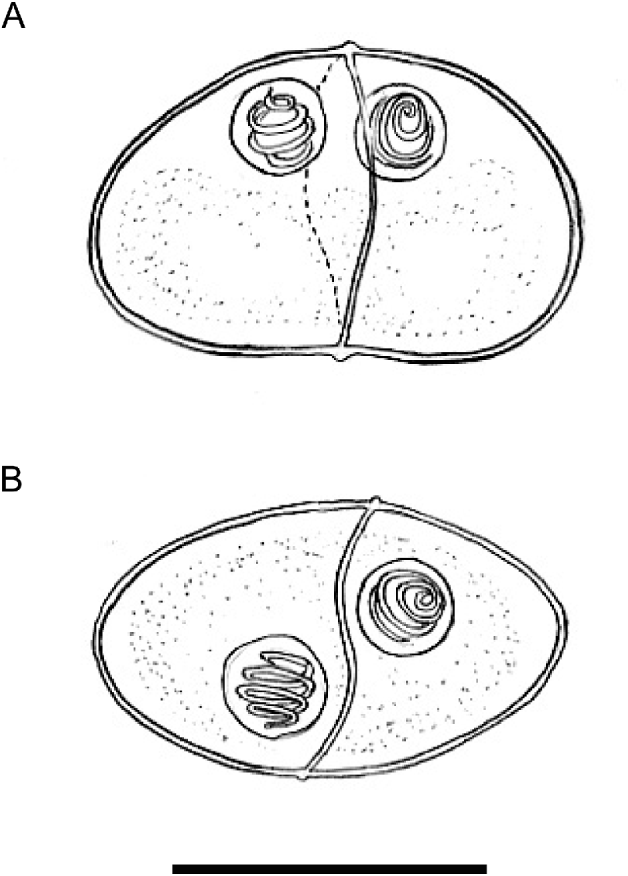
Diagnosis: With characters of the genus. Mature spores bean-shaped (Figs 1A and 2A) or trapezoidal (Fig. 1B) having an apparently flat or slightly concave posterior surface (Fig. 1B, C) depending on the angle of view. Two valves with rounded ends, slightly different in size. Two equal spherical polar capsules located anteriorly but positioned obliquely to the sutural line. Polar filaments coiled in opposite directions and discharging sideways. Sutural line sinuous and conspicuous, running between the 2 polar capsules, forming a conspicuous anterior and posterior protuberance (Figs 1D and 2B). Additional protuberances formed at the posterior margin of each shell valve present (Fig. 1C, D). Length of spore 9·2 (8·1–10·4) μm; thickness of spore 16·1 (14·8–17·0) μm; width of spore 9·6 (7·9–12·9) μm; diameter of polar capsule 3·0 (2·7–3·4) μm. Four turns of polar filament in each polar capsule. Sporoplasm with 2 nuclei almost filling the spore cavity. Spore surface smooth, without a mucous envelope. Plasmodia globular in shape containing numerous refractile granules. Disporic plasmodia 38–46 μm in diameter (Fig. 1E).
(A–E) Fresh spores of Latyspora scomberomori n. gen. n. sp. (A–C) Sutural view of mature spores with anterior and posterior sutural protuberances (arrows) and posterior valve protuberances (arrowheads). (D and E) Apical view of spores revealing a sinuous sutural line (open arrows) and oblique position of polar capsules. (E) Disporic plasmodium. All scale bars=5 μm.

Type-material: Syntype specimen deposited in the collection of National Museum of Nature and Science (Tokyo, Japan), Accession no. NSMT-Pr 280.
SSU rDNA sequence: GenBank Accession number HM230826.
Phylogenetic analyses and tracing character evolution
The length of the complete SSU rDNA sequence of Sphaerospora testicularis (Accession number HM230825) is 1760 bp with a GC content of 44%. Almost complete SSU rDNA sequence (56 bp missing at 5´end) of Latyspora scomberomori n. gen. n. sp. (Accession number HM230826) is 1929 bp long with 42% GC content.
Line drawing of Latyspora scomberomori n. gen. n. sp. (A) Sutural view. (B) Apical view. Scale bar=10 μm.

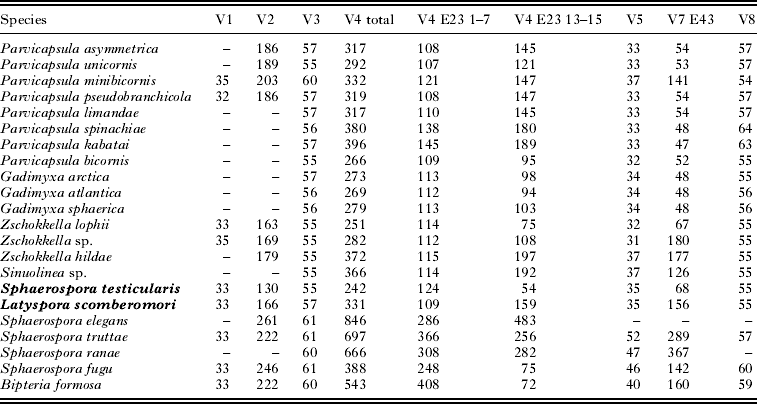
The comparison of obtained sequences with those available in GenBank using the BLAST search revealed the highest sequence similarities of S. testicularis with Parvicapsula minibicornis (query coverage 89%, maximum identities 93%) and L. scomberomori n. gen. n. sp. with Zschokkella lophii (query coverage 87%, maximum identities 88%). The investigation of the lengths of variable regions of S. testicularis and L. scomberomori n. gen. n. sp. SSU rRNA sequences has shown the presence of long inserts in the V4 and V7 regions in the latter species only (Table 1).
Length variation (number of bp) in the variable regions of SSU rRNA sequences of selected myxosporeans

The final alignment consisted of 1437 characters, from which 908 were variable and 711 were parsimony-informative. The SSU-based phylogenetic analyses showed that both newly sequenced species cluster within the marine urinary clade mainly comprising the myxosporeans infecting the urinary system of marine fishes. Sphaerospora testicularis groups with Parvicapsula minibicornis and both species cluster with other Parvicapsula spp. and Gadimyxa spp. within the Parvicapsula subclade. Latyspora scomberomori n. gen. n. sp. has a basal position to the representatives of the Zschokkella subclade. The nodal supports for the whole marine urinary clade as well as both subclades were strong in all performed analyses (Fig. 3).
Maximum likelihood tree (−ln=19346·54788) of the selected representatives of Myxozoa showing the positions of Sphaerospora testicularis and Latyspora scomberomori n. gen. n. sp. based on SSU rDNA data and the reconstruction of the evolution of the spores’ sutural line in myxozoans. Malacosporeans Tetracapsuloides bryosalmonae and Buddenbrockia plumatellae were used as outgroups. Nodal supports are indicated for ML (bootstrap, n=500), MP (bootstrap, Ts: Tv=1:2, n=1000), BI (posterior probabilities), with less that 50% support are not shown. Two discrete character states (legend) of the sutural line were assigned to each terminal taxon and ancestral character states were reconstructed on the ML tree under the ML optimality criterion using Mesquite ver. 2.6. Site specificity of each myxosporean species in the host is shown in the circle of the terminal taxon: C, connective tissue of kidney, gall bladder and gut; Ca, cartilage; F, fin; G, gall bladder and biliary ducts; Gi, gills; Gs, gills and skin; H, heart; I, digestive tract – mainly intestine, also oesophagus, stomach, occasionally gall bladder; K, kidney tubules; Ko, kidney tubules and connective tissue of ovarium; L, liver; M, muscles; P, pseudobranchs, occasionally gills, liver, and kidney; T, lumen of seminiferous tubuli in testes, occasionally intestinal mucosa and swim bladder; U, urinary bladder; Uk, urinary bladder and kidneys tubules; W, gall bladder wall.

Tracing the evolution of the spores’ sutural line on the SSU-based tree showed that the common myxosporean ancestor had a straight sutural line that has been retained in the ancestors of the basal sphaerosporid clade and in both the freshwater and the marine lineages. It is probable that the ancestor of the Kudoa+Enteromyxum clade and the ancestor of the marine lineage excluding the Ceratomyxa clade retained this ancestral state of the sutural line, but this can not be assigned exactly since the posterior probabilities for the straight versus curved state of this character are almost identical (0·51 vs 0·49). The curved sutural line arose in the ancestor of the Enteromyxum clade and in the ancestor of the marine urinary+the marine Myxidium clade. An interesting trend can be seen in the form of the sutural line in the members of the marine urinary clade. The ancestor of this clade possessed a curved sutural line. The Parvicapsula spp. and Zschokkella spp. with a curved spore shape retained this ancestral state whereas the reversal change to the straight sutural line occurred in Parvicapsula minibicornis, Sphaerospora testicularis and Gadimyxa spp., species displaying a non-curved spore shape (Fig. 3).
DISCUSSION
The newly described genus Latyspora, placed within the family Sinuolineidae, represents a new myxosporean morphotype. It differs from all genera of this family (Sinuolinea, Myxodavisia, Myxoproteus, Bipteria, Paramyxoproteus, Neobipteria, Schulmania and Noblea) by the spore shape and additionaly by the lack of spore projections present in several sinuolineid genera. As for the spore shape of Latyspora (bean-shaped or trapezoidal), it is similar to some representatives of the genera Ceratomyxa and Sphaerospora that do not belong to the family Sinuolineidae. However, these genera differ from Latyspora by the form of the sutural line (straight in Ceratomyxa and Sphaerospora vs curved in Latyspora) and the position of polar capsules (perpendicularly to the sutural line in Ceratomyxa and Sphaerospora vs obliquely to the sutural line in Latyspora). Additional morphological differences between Sphaerospora and Latyspora can be found in the shape of their polar capsules (subspherical or pyriform in Sphaerospora vs spherical in Latyspora), the orientation of the polar filament discharge (at one side in Sphaerospora vs sideways in Latyspora) and the number of sporoplams (2 uninucleate in Sphaerospora vs 1 binucleate in Latyspora). The genus Latyspora also shares certain specific features with some members of the genus Zschokkella e.g. the differing orientation of the polar filament coiling in the 2 polar capsules, the sideways discharge of polar filaments and sinuous shape of the sutural line. However, many characters (spore shape, position of polar capsules in the spore) differ between these genera. Despite the clustering of L. scomberomori n. gen. n. sp., the type species of its genus, with Zschokkella spp., a sufficient number of morphological differences exist between Latyspora, Zschokkella and other morphologically similar genera which support the creation of Latyspora as a new genus. The morphological description of the Sinuolinea sp. clustering within the same clade as Latyspora scomberomori n. gen. n. sp. is unfortunately lacking and sequence data of the type species of the genus Sinuolinea are also needed.
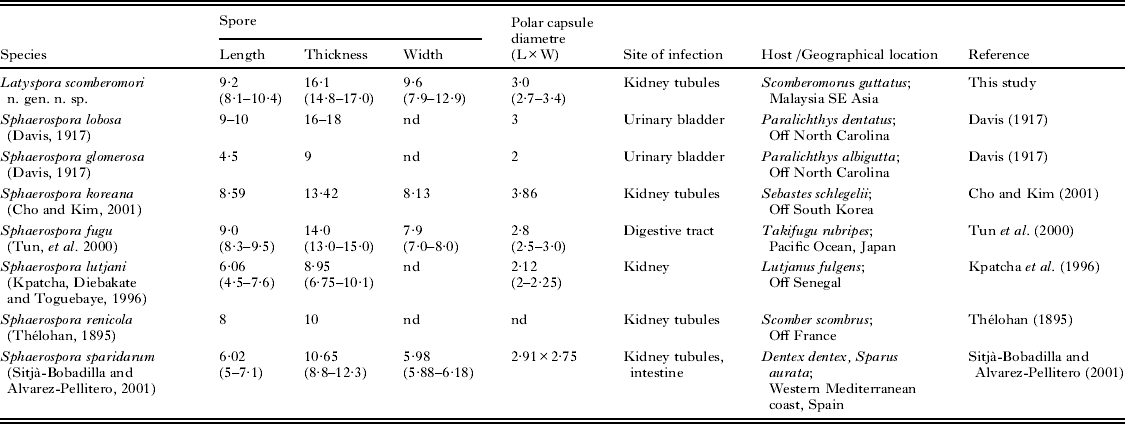
The myxosporean species L. scomberomori n. gen. n. sp. is morphometrically most similar to Sphaerospora lobosa (syn. Leptotheca lobosa), being of similar dimensions, its site specificity to the urinary system, the shape of its polar capsules and its sinuous sutural line. However, both species differ in fish host and geographical location (Table 2). Furthermore, the continued connection of spores at the sutural line after being released from the plasmodia, typical for S. lobosa, was not observed in L. scomberomori n. gen. n. sp. The sideways discharge of the polar filament characteristic for L. scomberomori n. gen. n. sp. was also not mentioned in the original description of S. lobosa. Despite the significant morphological similarity of L. scomberomori n. gen. n. sp. and S. lobosa, the existence of aforementioned differences between these myxosporeans and the lack of the sequence data on S. lobosa do not allow the transfer of this sphaerosporid into the newly erected genus. Such species re-assignment or demise of a genera/species should be based on enough morphological and molecular data, otherwise this may lead to the unjustified transfer of species, such as S. lobosa and other myxosporean species (e.g. Sphaerospora armatura, S. glomerosa, S. koreana, S. schulmani, S. angulata and S. carassii) all previously assigned within the genus Leptotheca and recently transferred to the genus Sphaerospora (Gunter and Adlard, Reference Gunter and Adlard2010). Besides a total lack of molecular data, these species do not even conform to the generic characters of the genus Sphaerospora: S. lobosa by having the sinuous sutural line, Sphaerospora armatura, S. glomerosa, S. koreana, S. schulmani by possessing spherical polar capsules and S. angulata and S. carassii by the presence of 1 binucleate sporoplam. Some of these recently transferred species might be moved to another genus in the future after their sequence data become available.
Comparison of Latyspora scomberomori n. gen. n. sp. with other myxosporeans sharing common features

nd, not determined.
Besides S. lobosa, L. scomberomori n. gen. n. sp. also shares some similarities with other Sphaerospora spp. infecting the kidney or urinary bladder of marine fishes: S. glomerosa (syn. Leptotheca glomerosa), S. koreana (syn. Leptotheca koreana), S. lutjani (syn. Leptotheca lutjani), and S. sparidarum (syn. Leptotheca sparidarum). These sphaerosporids can be distinguished from Latyspora scomberomori n. gen. n. sp. by having smaller spore dimensions and by the presence of a straight sutural line. Sphaerospora fugu (syn. Leptotheca fugu) from Takifugu rubripes also resembles the present species in spore morphology. However, they are clearly distinguishable by their spore dimensions and the site of infection in the host. The only sphaerosporid species described from the kidney tubules of a related host (Scomber scombrus) is Sphaerospora renicola (syn. Leptotheca renicola Thélohan, Reference Thélohan1895). However, this species significantly differs in its globular spore shape from L. scomberomori n. gen. n. sp. (Table 2). There is also a striking feature which unites L. scomberomori n. gen. n. sp. with its phylogenetically closely related species (Zschokkella hildae, Z. lophii). Besides the shared sinuous sutural line, they have a similar orientation of the coiling of the polar filament in the polar capsules (in opposite directions) and the orientation (sideways) of the openings of their discharge channels (Auerbach, Reference Auerbach1909; Freeman et al. Reference Freeman, Yokoyama and Ogawa2008). Zschokkella hildae and Z. lophii clearly differ from L. scomberomori n. gen. n. sp. by their spore shape and the position of polar capsules in the spore.
During this study, the SSU rDNA sequences of L. scomberomori n. gen. n. sp. and S. testicularis were obtained and analysed. The phylogenetic analyses have shown that these myxosporeans are new members of the marine urinary clade. Besides L. scomberomori n. gen. n. sp. and S. testicularis, this group includes species of genera Parvicapsula, Gadimyxa, Zschokkella and Sinuolinea clustering into 2 minor subclades (Zschokkella and Parvicapsula). The Zschokkella subclade includes the type species, Z. hildae. The genus Zschokkella is polyphyletic since its representatives cluster in 3 other clades (marine bile, freshwater urinary and freshwater bile) besides the marine urinary (Zschokkella) subclade (Holzer et al. Reference Holzer, Wootten and Sommerville2010). The second subgroup of the marine urinary clade, the Parvicapsula subclade, is also not monophyletic since it contains the Gadimyxa spp. (Køie et al. Reference Køie, Karlsbakk and Nylund2007). The paraphyly of the Parvicapsula subclade was supported by our analyses since S. testicularis clusters with P. minibicornis to create a basal group.
Performed phylogenetic analyses revealed certain specific trends in the evolution of members of the marine urinary clade such as the shared insertion within their V4 SSU rRNA region and their grouping according to the shape of the spore's sutural line and the similar tissue tropism in the host.
Tracing the evolution of the sutural line supports the finding of Fiala and Bartošová (Reference Fiala and Bartošová2010) that the sutural line is a homoplastic character, the curved form of which occurred several times in the ancestors of several unrelated myxosporean clades. However, certain differences between the results of Fiala and Bartošová (Reference Fiala and Bartošová2010) and this study have been observed. The better taxon sampling of the marine urinary clade (this study) has shown that its ancestor possessed a curved sutural line unlike its straight form in the previous study (Fiala and Bartošová, Reference Fiala and Bartošová2010). The curved form has been retained only in members of the marine urinary clade with a curved spore whereas the straightening of the sutural line has been observed in its representatives with a non-curved shape of spore. This indicates that the evolution of the sutural line has been affected by the spore shape. Despite the majority of myxosporeans clustering within the freshwater lineage possessing a straight sutural line, there are several exceptions of this trend e.g. Zschokkella icterica and Myxidium anatidum with the spindle-shaped or ellipsoidal spores. Although the character of the sutural line is not very helpful for future efforts in solving the discrepancies between the myxozoan taxonomy and phylogeny, its re-investigation shows how important the taxon sampling is for the accuracy of the performed analyses. Therefore, the sequencing of species representing different morphotypes is important for future studies focused on tracing the myxozoan morphological characters on the phylogenetic trees.
The representatives of the marine urinary clade have also been characterized by the presence of the linear expansion of the E23_15 helix within the V4 region of their SSU rRNA sequences, as found in Sphaerospora sensu stricto (Holzer et al. Reference Holzer, Sommerville and Wootten2004, Reference Holzer, Wootten and Sommerville2010). This feature is also present in L. scomberomori n. gen. n. sp. However, these insertions in the marine urinary clade members do not reach such extensive lengths as in mentioned sphaerosporids (sensu stricto). Surprisingly, S. testicularis does not possess an insert within the V4 region and has the shortest length of the E23_15 helix among all representatives of the marine urinary clade. Moreover, another linear expansion (helix E43 of the V7 region) is shared among the members of the Sphaerospora sensu stricto group and the Zschokkella subclade (Holzer et al. Reference Holzer, Sommerville and Wootten2004, Reference Holzer, Wootten and Sommerville2010). Such a feature is also present in the newly sequenced representative of this subclade, L. scomberomori n. gen. n. sp. Parvicapsula minibicornis surprisingly also possesses this insert in the E43 helix and is the only member of the Parvicapsula subclade to do so. Despite S. testicularis grouping with P. minibicornis in the phylogenetic analyses, no expansion of the E43 helix has been found for this sphaerosporid species.
Together with the shared secondary structure characteristics, members of the marine urinary clade cluster according to their vertebrate host tissue tropism rather than to spore morphology which corresponds to the previous findings of Holzer et al. (Reference Holzer, Sommerville and Wootten2004), Fiala (Reference Fiala2006) and Freeman et al. (Reference Freeman, Yokoyama and Ogawa2008). This clade includes coelozoic parasites of the urinary system of fish: the lumen of kidney tubules, Bowman's capsules, and urinary bladder. There are also at least 2 histozoic Parvicapsula species, P. kabatai in the renal interstitium (Jones et al. Reference Jones, Prosperi-Porta and Dawe2006) and P. pseudobranchicola in pseudobranchs and kidney (Nylund et al. Reference Nylund, Karlsbakk, Sæther, Koren, Larsen, Nielsen, Broderud, Hostlund, Fjellsoy, Lervik and Rosnes2005).
The only species of the marine urinary clade that has never been found in the urinary system of fish is S. testicularis infecting the testes of sea bass males (Sitjà-Bobadilla and Alvarez-Pellitero, Reference Sitjà-Bobadilla and Alvarez-Pellitero1990). However, the phylogenetic position of this myxosporean is not so unexpected. Like the urinary myxosporeans, S. testicularis is a coelozoic parasite and the male reproductive organs and ducts have the same ontogenetic origin as the urinary system. They are formed by somites of the nephrogenous strand resulting in the coelozoic system of urinary and male genital ducts (urogenital system; Kardong, Reference Kardong2008). Nevertheless, S. testicularis may be the first sequenced representative of a new subclade of myxosporeans infecting the reproductive tract of fish. Sphaerospora elegans has also been found in the fish reproductive tract (ovary). However, it mainly infects the renal tubules of its host (Feist et al. Reference Feist, Chilmonczyk and Pike1991) and clusters with other kidney sphaerosporids within the basal Sphaerospora sensu stricto clade. It is necessary to obtain molecular data on other sphaerosporids infecting the fish reproductive tract such as ovarian parasites Sphaerospora ovophila, S. plagiognathopsis and S. lucioperca (Sitjà-Bobadilla, Reference Sitjà-Bobadilla2009) to find out if they cluster according to their shared tissue tropism. The phylogenetic position of S. testicularis outwith the basal Sphaerospora sensu stricto clade, the lack of extensive insertions within its variable SSU rDNA regions and its morphology suggest it being a non-typical Sphaerospora. Therefore, S. testicularis should not be regarded as Sphaerospora sensu stricto. The morphological characteristics of S. testicularis unusual for Sphaerospora spp. are a binucleate sporoplasm and a sporogonial sequence resembling the disporic development in the myxosporeans of the freshwater lineage (Morris and Adams, Reference Morris and Adams2008). Moreover, it appears to have purely cytoplasmic valve cells and polar capsules with a burred stopper structure (Sitjà-Bobadilla and Alvarez-Pellitero, Reference Sitjà-Bobadilla and Alvarez-Pellitero1993) like those in malacosporeans.
Our analyses have shown that S. testicularis and S. dicentrarchi, that are often found in a co-infection in the European sea bass testes (Fioravanti et al. Reference Fioravanti, Caffara, Florio, Gustinelli and Marcer2004), cluster within 2 distant clades. Sphaerospora dicentrarchi can be found within the Kudoa clade (Fiala, Reference Fiala2006) including other species with a shared histozoic way of life. Besides its tissue tropism, the morphological and molecular data also suggest that S. dicentrarchi is not a typical Sphaerospora (Diamant et al. Reference Diamant, Ucko, Paperna, Colorni and Lipshitz2005). It produces baglike polysporous plasmodia, has 1 binucleated sporoplasm and its spores are smaller than any other known Sphaerospora spp. (Sitjà-Bobadilla and Alvarez-Pellitero, Reference Sitjà-Bobadilla and Alvarez-Pellitero1992). Moreover, it has overlapping shell valves (Sitjà-Bobadilla and Alvarez-Pellitero, Reference Sitjà-Bobadilla and Alvarez-Pellitero1992), the unique character for all Kudoa and Unicapsula species. It also lacks extensive inserts in its variable rDNA regions as in Sphaerospora sensu stricto (Holzer et al. Reference Holzer, Wooten and Sommerville2007; Bartošová et al. Reference Bartošová, Fiala and Hypša2009). Obtained sequence data may be useful as an effective tool for the differentiation of S. testicularis and S. dicentrarchi present in co-infections in European sea bass and for further development of specific diagnostic PCR assays or as DNA probes for both myxosporean species. Such assays could facilitate the accurate determination of these parasites, especially during their early development in the host.
Many other sphaerosporids sequenced so far do not correspond to the recent definition of Sphaerospora (Jirků et al. Reference Jirků, Fiala and Modrý2007) which impels a future revision of this genus. Sphaerosporids that do not cluster with the group of Sphaerospora sensu stricto in the basal sphaerosporid clade and lack extensive inserts in their V4 variable regions should be transferred to another genus. However, before such radical steps are undertaken, certain sphaerosporids should be re-sequenced. The fact that Sphaerospora spp. may be misidentified with other myxosporean species, that may be present in cryptic mixed infections, is evident for Sphaerospora sp. EE2004 obtained from the kidney tubules of goldfish, Carassius auratus auratus, in Hungary (Eszterbauer and Székely, Reference Eszterbauer and Székely2004). This species clusters within the clade comprising Zschokkella and Myxidium spp. and its SSU rDNA sequence is identical with Zschokkella sp. SA2005 later obtained from the afferent bile duct of the same host by other authors (GenBank Accession number DQ118776). The mis-sequencing of Sphaerospora sp. EE2004 with Zschokkella sp. SA2005 was possibly caused by the preferential amplification of Zschokkella DNA which young developmental, hardly identifiable stages could have been co-present with Sphaerospora sp. EE2004 spores observed in the goldfish sample. Spores of Sphaerospora sp. EE2004 were morphologically indistinguishable from Sphaerospora dykovae (syn. Sphaerospora renicola Dyková and Lom, 1892) found in the kidney of common carp Cyprinus carpio (Esterbauer and Székely, Reference Eszterbauer and Székely2004). This suggests that their spores could belong to an identical myxosporean species. Although, the sequences of both sphaerosporids were found to be different (Esterbauer and Székely, Reference Eszterbauer and Székely2004), this could be caused by their mis-sequencing with other species present in cryptic co-infections as aforementioned for Sphaerospora sp. EE2004. As mentioned by Morris and Adams (Reference Morris and Adams2008), several contamination issues during the amplification of S. dykovae were encountered by Eszterbauer and Székely (Reference Eszterbauer and Székely2004). This kidney parasite clusters with another sphaerosporid (S. molnari) obtained from the same fish host (carp) within the histozoic Myxobolus clade. However, S. dykovae substantially differs from S. molnari and all other representatives of the Myxobolus clade by the site of infection in their fish host (coelozoic vs histozoic). It is known that the kidney of cyprinids may be an accumulation centre of myxosporeans which develop in different organs of fish and may reach the kidney via blood system as has been demonstrated, for example, for Myxobolus pseudodispar from the muscle tissue (Baska, Reference Baska1987). Therefore, the possible explanation of the mis-sequencing of S. dykovae could be the cryptic presence of some Myxobolus spp. that could have been amplified preferentially instead of S. dykovae. The SSU rDNA sequence of S. molnari should also be re-examined since the deposited sequence was derived from goldfish obtained in Japan and the type host for this myxosporean is common carp from central Europe. Moreover, both S. dykovae and S. molnari produce spores with 2 mononucleated sporoplasms which correspond to those of the basal Sphaerospora sensu stricto clade in contrast to the binucleated sporoplasm of the freshwater clade (Morris and Adams, Reference Morris and Adams2008) where they currently cluster. The validity of S. dicentrarchi SSU rDNA sequence has also been disputed (Morris and Adams, Reference Morris and Adams2008) because no information on its amplification was provided in GenBank or in any publication. The recent phylogenetic analysis based on new LSU rDNA data, where S. dicentrarchi again clusters within the Kudoa clade, has confirmed the validity of its SSU rDNA sequence (Bartošová et al. Reference Bartošová, Fiala and Hypša2009). Moreover, another unidentified histozoic Sphaerospora sp. from the gall bladder wall of a different fish clusters with S. dicentrarchi (Fiala, Reference Fiala2006) providing additional support for the authenticity of the SSU rDNA sequence data of both species.
Besides the re-sequencing of some sphaerosporids, it is necessary to obtain molecular data on other representatives of this genus. Moreover, molecular data on Polysporoplasma spp., especially on the type species P. sparis, are warranted to shed more light on the evolution of sphaerosporids and polysporoplasmids. These taxa could potentially be related since the morphology of the members of the genus Polysporoplasma is almost identical with Sphaerospora spp. and the only morphological difference is the number of sporoplasms (Sitjà-Bobadilla and Alvarez-Pellitero, Reference Sitjà-Bobadilla and Alvarez-Pellitero1995).
The knowledge of the phylogenetic relationships within the Myxozoa provides the basic information for future taxonomic revisions that are essential for solving the persisting taxonomic and phylogenetic discrepancies. The results of this study even strengthen the polyphyly of the genus Sphaerospora. In the future, there is a need to sequence more sphaerosporid species as we predict that many of them may not cluster with the type species, S. elegans. Extended taxon sampling is the base for future revisions of the genus Sphaerospora that will require the erection of new genera for such sphaerosporids clustering outwith the basal sphaerosporid clade.
ACKNOWLEDGEMENTS
We would like to thank Dr Iva Dyková for her helpful suggestions on the earlier version of this manuscript. We are also very grateful to three anonymous reviewers and Dr Astrid Holzer for their interesting and stimulating comments that substantially helped to improve the manuscript.
FINANCIAL SUPPORT
The present study was supported by the Grant Agency of the Academy of Sciences of the Czech Republic (grant number KJB600960701), the Grant Agency of the University of South Bohemia (grant number 04-GAJU-43), the research project of the Faculty of Science, University of South Bohemia (grant number MSM 6007665801), the Grant Agency of the Czech Republic (grant number 524/03/H133), and research projects of the Institute of Parasitology, Biology Centre of the Czech Academy of Sciences (grant number Z60220518 and grant number LC 522). Work in Malaysia was funded by a University of Malaya PJP grant (grant number FS385 2008C).