Background
In recent years, contaminated environmental surfaces have been recognized as playing an important role in transmission of healthcare-associated pathogens.Reference Otter, Yezli, Salkeld and French1 Contaminated surfaces can act as a source of healthcare personnel hand contamination and may represent a risk to newly admitted patients whose rooms have not been adequately disinfected following discharge of previous patients who were colonized or infected with pathogens.Reference Mitchell, Dancer, Anderson and Dehn2–Reference Chen, Knelson and Gergen4 In many healthcare facilities, only 50% of surfaces in patient rooms are routinely disinfected by environmental services personnel.Reference Carling5 As a result, additional strategies may be needed, such as the use of mobile ultraviolet light (UV) devices to minimize contamination of environmental surfaces in hospitals.Reference Weber, Rutala and Anderson6, Reference Nerandzic, Fisher and Donskey7 A multicenter, randomized controlled trial of a mobile UV device and other smaller studies have shown that UV devices can decrease surface contamination and reduce healthcare-associated infections (HAIs); effect size is dependent upon the type of microorganisms and the type of disinfectant used in the comparator groups.Reference Anderson, Chen and Weber8–Reference Haas, Menz, Dusza and Montecalvo14 A recent systematic review and meta-analysis of no-touch disinfection technologies evaluated 13 studies that used UV devices.Reference Marra, Schweizer and Edmond15 When the results of the studies were pooled, statistically significant reductions in the rates of infections caused by Clostridioides difficile. and vancomycin-resistant enterococci (VRE) were observed.
However, the marketing of a variety of UV devices with different designs, capabilities, and costs has made selection of such devices problematic for healthcare institutions.Reference Nerandzic, Fisher and Donskey7, Reference Spencer, Vignari and Bryce16 Determining the effectiveness of devices is complicated by lack of standard methods for testing UV-C devices, limited published data on the doses of UV delivered to various surfaces in patient rooms, and conflicting data on the UV dose (fluence) necessary to achieve desired reductions of various healthcare pathogens, including C. difficile.Reference Boyce, Farrel, Towle, Fekieta and Aniskiewicz12, Reference Cadnum, Tomas and Sankar17–Reference Mitchell, Sifuentes, Wissler, Abd-Elmaksoud and Gerba24 Healthcare personnel would benefit from a basic understanding of the characteristics of UV-C, the availability of more evidence on the UV-C doses delivered to surfaces in patient rooms, and knowledge of the UV-C doses required to reduce specific healthcare pathogens.
Unfortunately, most laboratory studies dealing with UV doses required to yield 3 log10 reductions of pathogens have focused on the use of UV for disinfection of drinking water or wastewater. Microorganisms were exposed to UV when suspended in water or phosphate-buffered saline.Reference Malayeri, Mohseni, Cairns and Bolton20 However, doses that inactivate pathogens in liquids cannot be assumed to be equally effective against the same pathogens on surfaces.Reference Mitchell, Sifuentes, Wissler, Abd-Elmaksoud and Gerba24, Reference Hijnen, Beerendonk and Medema25 In response to the increasing use of UV devices for disinfection of surfaces in hospitals, this article briefly reviews the physics of UV-C light, the variables that affect laboratory testing of the impact of UV-C on pathogens, and existing data on UV-C doses required to achieve desired log10 reductions of healthcare pathogens on environmental surfaces. We do not discuss the use of UV-C for water or air disinfection. Related articles published between 1939 and February 2019 were retrieved by searching PubMed and the Internet using the following search terms:ultraviolet light, UV light, dose, dosage, C. difficile. A review of bibliographies of pertinent articles was also conducted. Relevant articles were included in this review.
Basics of UV light
Wavelengths of UV light, a form of electromagnetic radiation from the sun, are divided into 3 categories: UV-C (100–280 nm), UV-B (280–315 nm), and UV-A (315–400 nm). UV-C light is absorbed by the earth’s atmosphere and does not reach the earth. UV can be generated from artificial sources including low-pressure mercury lamps and pulsed xenon lamps. Some mobile devices use low-pressure mercury lamps to produce continuous UV-C with a peak wavelength of 254 nm,Reference Rutala, Gergen and Weber10 while others use pulsed-xenon lamps that produce light with a much broader spectrum (200–320 nm).26, Reference Cadnum, Jencson and Gestrich27
UV irradiance (also called fluence rate) is often expressed as microwatts per square centimeter (uW/cm2). The dose of UV received at a surface during a specific time (fluence) is calculated by multiplying the irradiance times the number of seconds of exposure at a surface and is expressed as Joules/m2, mJ/cm2, or uWsec/cm2. For example, 1 J/m2 equals 0.1 mJ/cm2 or 100 uWsec/cm2. Variables that affect the amount of UV delivered to surfaces and the resulting log10 reductions of pathogens achieved include the amount of irradiance generated by the UV lamp(s), the distance from the lamp to the exposed surface, the angle at which the UV strikes the surface, and whether the surface is in direct line of sight of the lamp or receives light that has been reflected off other objects (ie, surfaces in shaded areas).Reference Nerandzic, Fisher and Donskey7, Reference Boyce, Farrel, Towle, Fekieta and Aniskiewicz12, Reference Cadnum, Tomas and Sankar17, Reference Tande, Pringle, Rutala, Gergen and Weber23 The intensity of UV irradiance is inversely proportional to the square of the distance between the lamp and the exposed surface, based on the “inverse square law.”Reference Simmons, Dale, Holt, Velasquez and Stibich28 Therefore, the UV intensity received by a surface decreases exponentially the further the surface is from the lamp. As the distance between the lamp and the exposed surface increases, the log10 reduction of pathogens achieved decreases significantly.Reference Nerandzic, Fisher and Donskey7, Reference Boyce, Farrel, Towle, Fekieta and Aniskiewicz12, Reference Cadnum, Tomas and Sankar17 One practical implication of the marked effect of distance on UV irradiance is that short cycles of 1–2 minutes or less may be sufficent for devices that place bulbs in close proximity to the item to be decontaminated (eg, computer tablet decontamination devices), whereas longer cycles are required for room decontamination devices.
UV-C irradiance and doses delivered to various surfaces in patient rooms
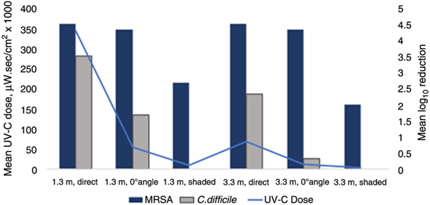
Figure 1 shows the UV-C doses delivered by a 5-minute cycle with a mobile UV-C device to various locations in a patient room based on measurements taken with a radiometer and the corresponding log10 reductions in methicillin-resistant Staphylococcus aureus (MRSA) and C. difficile spores. The results demonstrate the dramatic impact of distance, orientation of surfaces, and shading (ie, indirect exposure to UV-C) on the UV-C dose delivered. Irradiance levels of ∼1,000 uW/cm2 were achieved on vertical surfaces located in the direct line of sight of the device at distances in the range of 1.3 m (4 feet), whereas irradiance of only 3–10 uW/cm2 were achieved on horizontal surfaces located in shaded areas at distances in the range of 3.3 m (10 feet) from the device.Reference Boyce, Farrel, Towle, Fekieta and Aniskiewicz12, Reference Rutala, Gergen, Tande and Weber22, Reference Tande, Pringle, Rutala, Gergen and Weber23 Despite the marked dropoff in UV-C dose in shaded areas, 2 log10 reductions were achieved for MRSA at both 1.3 and 3.3 m. In contrast, C. difficile spores are relatively resistant to UV-C. Minimal reductions in C. difficile spores were achieved in shaded areas, and both distance and orientation of the carriers had a more marked impact on the efficacy of UV-C. Tande et alReference Tande, Pringle, Rutala, Gergen and Weber23 reported similar findings for the UV-C doses delivered to various locations in a room, and other studies have also demonstrated that UV-C doses are lowest when the surface is not in the direct line of sight of the lamp.Reference Boyce, Farrel, Towle, Fekieta and Aniskiewicz12, Reference Cadnum, Tomas and Sankar17
Fig. 1.

Facilities using UV-C room decontamination devices can consider several strategies to reduce the impact of distance and shadowing on UV-C delivery to surfaces in patient rooms. Some manufacturers of UV-C devices recommend that 2 cycles be run with device placement in different room locations. A device with 3 vertical towers positioned in 3 locations in the room to reduce shadowed areas and distance from the UV bulbs is also available. A different device has 3 adjustable bulbs that can be oriented to provide closer proximity to the surface of interest. Another option is to run longer cycles to increase the UV-C dose delivered to shadowed areas. One study reported that on horizontal surfaces in shaded areas at a distance of 3.3 m, increasing the cycle time from 5 to 15 minutes increased the mean UV-C dose from 3,395 and 8,880 uWsec/cm2.Reference Boyce, Farrel, Towle, Fekieta and Aniskiewicz12 Finally, coating room walls with nanostructured UV-reflective paint increased UV doses delivered to shaded areas, resulting in greater log10 reductions than with standard wall paint.Reference Tande, Pringle, Rutala, Gergen and Weber23, Reference Rutala, Gergen, Tande and Weber29
Practical methods to measure UV-C doses delivered to surfaces in patient rooms
One limitation of current UV-C technologies is that practical tools are not available to monitor the efficacy of the devices. Such tools would be useful to provide comparative data for different devices, to assess delivery of UV to different sites in patient rooms, and to confirm that devices are operating correctly. The intensity of UV-C irradiance and the dose received at a point in the room can be measured quantitatively using calibrated radiometric UV-C sensors, which range in price from several hundred dollars to >$1,000 each. However, measurement of irradiance is not practical for routine monitoring. Inexpensive, commercially available, qualitative photochromic UV-C test cards placed at different points in the room can provide rough estimates of the UV-C doses delivered to surfaces.Reference Boyce, Farrel, Towle, Fekieta and Aniskiewicz12, Reference Masse, Hartley, Edmond and Diekema30 However, additional validation of the accuracy of UV test cards and more detailed instructions on their use are needed. Measuring irradiance and UV doses from pulsed-xenon devices requires the use of a spectrometer.Reference Cadnum, Jencson and Gestrich27
Studies of UV-C doses yielding significant reduction of pathogens on surfaces
Because the extent to which pathogens must be reduced to prevent transmission is unknown, there are no widely accepted criteria regarding the level of pathogen reduction that UV-C devices should achieve. Because high-touch surfaces in patient rooms are often contaminated with <100 colony-forming units (CFU) per replicate organism detecting and counting (RODAC) plate (∼25 cm2) or per swab sample,Reference Rutala, Gergen and Weber10, Reference Nernandzic, Cadnum, Pultz and Donskey11, Reference Wong, Woznow and Petrie31–Reference Boyce, Havill and Dumigan33 we elected to assess the UV-C doses needed to produce a 99.9% (3 log10) reduction of microorganisms on surfaces, a criterion for effectiveness used by others.Reference Nerandzic, Fisher and Donskey7, Reference Rutala, Gergen and Weber10
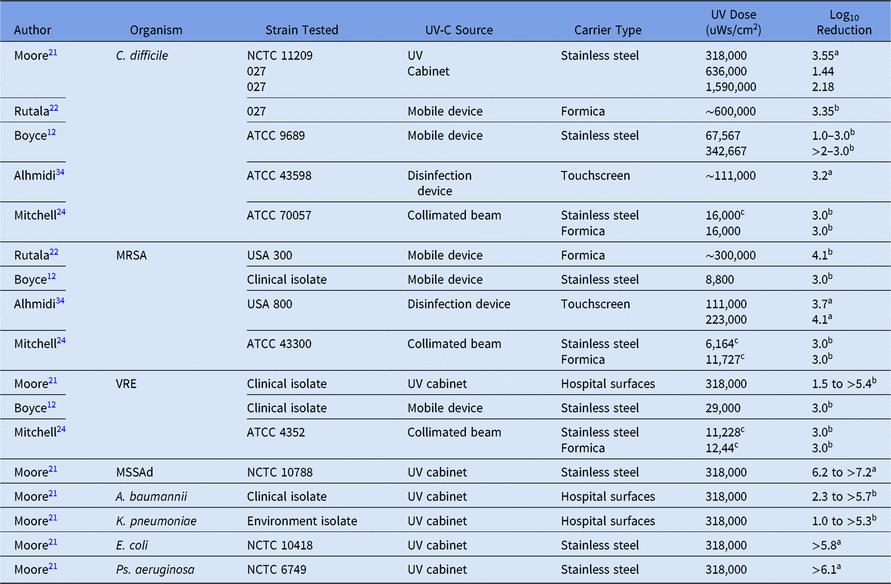
A literature review revealed few data regarding the doses of UV-C that yield specific log10 reductions of pathogens on dry surfaces. Studies varied substantially in the methods used, and not surprisingly, UV-C doses yielding ≥3 log10 reductions varied considerably (Table 1). For example, in a study in which C. difficile was exposed to a collimated beam of UV, a dose of 16,000 uWs/cm2 yielded a 3 log10 reduction.Reference Mitchell, Sifuentes, Wissler, Abd-Elmaksoud and Gerba24 However, in other studies utilizing mobile devices, doses ranging from 67,567 to > 300,000 uWs/cm2 produced ≥3 log10 reductions (Table 1).Reference Boyce, Farrel, Towle, Fekieta and Aniskiewicz12, Reference Alhmidi, Cadnum, Piedrahita, John and Donskey34 The variability may have been due to differences in test methods used, including the strains tested and the presence or absence of an organic soil load (Table 1).
Log10 Reductions of Different Strains of Clostridium difficile, Methicillin-Resistant Staphylococcus aureus (MRSA), and Vancomycin-Resistant Enterococcus (VRE) Achieved Following Exposure to Various Ultraviolet (UV) Doses (uWs/cm2) Under Varying Conditions

a Organic load.
b No organic load.
c Personal communication with J.B. Mitchell.
d Methicillin-susceptible S. aureus.
Laboratory variables affecting reduction of pathogens achieved with UV-C
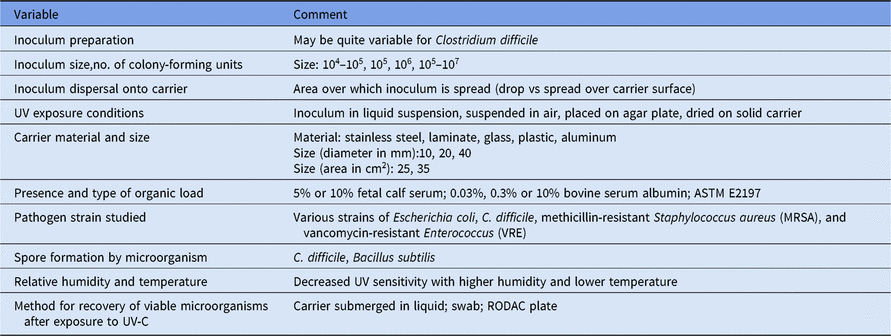
UV-C doses that yield a 3 log10 reduction of a specific pathogen vary considerably, due in large part to differences in the in vitro laboratory techniques used by investigators (Table 2). For example, methods for preparing the bacterial inoculum differ, particularly with respect to preparing C. difficile spores for testing.Reference Rutala, Gergen and Weber10–Reference Boyce, Farrel, Towle, Fekieta and Aniskiewicz12, Reference Mitchell, Sifuentes, Wissler, Abd-Elmaksoud and Gerba24 Also, to achieve a given log10 reduction, using a higher inoculum (eg, 106) may require greater UV-C doses than a lower inoculum (eg, 104).Reference Moore, Ali and Cloutman-Green21 Spreading the inoculum over the entire surface of a carrier may yield greater log10 reductions than if the inoculum is applied as droplet without spreading,Reference Cadnum, Tomas and Sankar17 and applying test microorganisms onto a carrier 40 mm or 20 mm in diameter may yield greater log10 reductions than using a carrier 10 mm in diameter.Reference Cadnum, Shaikh and Piedrahita35 These issues are likely due in part to clumping or “stacking” of organisms (especially spore-forming organisms) on carriers, which can vary with the method of applying the inoculum to carrier.Reference Raguse, Fiebrandt and Stapelmann36 For a given UV-C dose, placing an inoculum onto glass slides and onto stainless steel disks may yield different log10 reductions if the inoculum is not spread over the surface of the carriers.Reference Cadnum, Tomas and Sankar17 In at least 1 study, UV-C doses required to achieve a 3 log10 reduction were not the same when stainless steel and Formica carriers were used.Reference Mitchell, Sifuentes, Wissler, Abd-Elmaksoud and Gerba24 The presence of an organic load on carriers results in lower log10 reductions than if no organic load is used.Reference Nerandzic, Fisher and Donskey7, Reference Cadnum, Tomas and Sankar17, Reference Moore, Ali and Cloutman-Green21
Variables Affecting Ultraviolet C (UV-C)Doses Required to Reduce Microorganism Counts

Strain-specific susceptibility to UV-C may also affect the doses necessary to achieve a given log10 reduction. For example, in studies that exposed microorganisms suspended in liquid, the UV-C doses needed to yield a 3 log10 reduction of different strains of Escherichia coli reported by the same investigator varied from 1 mJ/cm2 to 5.5 mJ/cm2 (1,000 to 5,500 uWsec/cm2).Reference Sommer, Lhotsky, Haider and Cabaj37 However, investigators who exposed different ATCC strains of E. coli under similar conditions reported that higher UV-C doses of 7 mJ/cm2 to 9 mJ/cm2 were needed to yield 3 log10 reductions.Reference Malayeri, Mohseni, Cairns and Bolton20 Strain-related differences in the susceptibility of C. difficile to UV-C have also been reported.Reference Nernandzic, Cadnum, Pultz and Donskey11, Reference Moore, Ali and Cloutman-Green21, Reference Rutala, Gergen, Tande and Weber22, Reference Mitchell, Sifuentes, Wissler, Abd-Elmaksoud and Gerba24
Humidity levels also affect the impact of a given UV-C dose on the survival of microorganisms. For example, FletcherReference Fletcher38 reported that with a dose of 5 J/m2, only 9% of Burkholderia cepacia survived at a low humidity, whereas 50% survived at higher humidity levels. UV-C is generally less effective at low temperatures.Reference Chen, Chu, Liu and Hu39 The method of recovering viable microorganisms from exposed carriers (eg, carrier submerged in liquid with vortexing, recovery using a swab, or by using a RODAC plate) may also have affected the apparent log10 reductions achieved.
Other factors affecting UV-C efficacy
Jelden et alReference Jelden, Gibbs and Smith40 inoculated MRSA or VRE onto carriers made of stainless steel, chrome, and plastic from a bedrail and placed the carriers in 5 sites in a hospital room with standard paint, resulting in carriers receiving direct (ie, line of sight) UV-C doses ranging from 9 to 688 mJ/cm2 (9,000– 688,000 uWs/cm2). Carriers placed in a room with UV-reflective paint received doses ranging from 2 to 553 mJ/cm2. Because data on log10 reductions were aggregated for the 5 sites and reported for each type of carrier, it was not possible to determine log10 reductions achieved by specific UV-C doses. Greater log10 reductions were achieved when carriers were located in the room with UV-reflective paint, as reported by others.Reference Rutala, Gergen, Tande and Weber29, Reference Jelden, Gibbs and Smith40 Notably, log10 reductions were lower on carriers made of plastic from a bedrail. Tande et alReference Tande, Pringle, Rutala, Gergen and Weber23 also studied the impact of UV-reflective paint on log10 reductions achieved on 10 different surfaces by a mobile UV-C device. Although their report suggests that overall average UV-C doses required to achieve mean log10 reductions of 4.1 for MRSA and 3.4 for C. difficile on the 10 directly exposed surfaces were very high,Reference Tande, Pringle, Rutala, Gergen and Weber23 the investigators found that 3.0 log10 reductions were consistently achieved with doses >10,000 uWs/cm2 for MRSA and >50,000 uWs/cm2 for C. difficile (B.M. Tande, personal communication).Moore et alReference Moore, Ali and Cloutman-Green21 exposed 8 types of medical equipment to UV-C in an enclosed cabinet and found that log10 reductions varied with the type of surface. Also, tympanic thermometers and blood pressure cuffs yielded lower log10 reductions than other objects.
The impact of UV-C on pathogens on solid surfaces has also been studied utilizing a mobile device with 8 sensors. The device automatically turns off when the sensor facing the least reflected area of the room has received a reflective dose of 12,000 uWsec/cm2 (for vegetative bacteria) or 22,000 uWs/cm2 (for spores).Reference Rutala, Gergen and Weber10 Importantly, these programmed reflected doses detected by device sensors (a) are not the same as much higher doses (not specified) received by some surfaces in patient rooms that receive high-intensity UV-C from the deviceReference Tande, Pringle, Rutala, Gergen and Weber23, Reference Rutala, Weber, Gergen, Tande and Sickbert-Bennett41 and (b) should not be confused with doses needed to reduce specific pathogens by 3 log10.Reference Masse, Hartley, Edmond and Diekema30 Notably, one study that utilized the device found that a reflected dose of 20,000 uWs/cm2 yielded a 3 log10 reduction of the NAP1/BI (027) strain of C. difficile.Reference Nerandzic and Donskey42
A few articles have reported the susceptibility of pathogens exposed to UV-C under conditions other than inocula dried onto solid carriers or suspended in liquid.
For example, SharpReference Sharp43 and Cairns et alReference Cairns, Kerr and Beggs44 irradiated bacteria inoculated onto solid agar in Petri plates, but it is not clear whether this approach yields the same log10 reductions as irradiating dried pathogens on hard surfaces.
A mobile device that utilizes pulsed-xenon technology instead of UV-C has been used in a number of facilities to reduce environmental contamination and/or HAIs.Reference Haas, Menz, Dusza and Montecalvo14, Reference Stibich, Stachowiak and Tanner45, Reference Zeber, Pfeiffer and Baddley46 However, published data regarding spectrophotometrically determined doses of 200–320 nm light that yield 3 log10 reductions of specific pathogens are lacking.
Attempts to standardize methods for evaluation of mobile UV devices
A standard method (ASTM E2839-11) for preparing spores of C. difficile strain ATCC 43598 for use in evaluating the efficacy of antimicrobial agents has been endorsed by the Environmental Protection Agency (EPA).47, 48 This method could be used as part of a protocol for evaluating log10 reductions achieved by mobile UV devices. However, only 1 of the studies cited in Table 1 prepared spores from that strain of C. difficile, and not all other aspects of spore preparation mirrored the ASTM method.Reference Alhmidi, Cadnum, Piedrahita, John and Donskey34 An ASTM standard method (ASTM E 3135-18) for testing the efficacy of UV (UV-C or pulsed-xenon) against microorganisms on carriers with simulated soil has been published recently.49 However, this standard does not specify the pathogens, type of carrier, or culture media that are to be used. The EPA has recommended a different quantitative method for testing antimicrobial products against spores of C. difficile on hard, nonporous surfaces.48 However, challenges in obtaining standardized uniform preparations of C. difficile spores raise the question of whether Bacillus subtilis, a nonpathogenic aerobic spore former also relatively resistant to UV-C, could serve as a surrogate when testing the efficacy of UV devices.Reference Raguse, Fiebrandt and Stapelmann36, Reference Lindsley, McClelland and Neu50 Unfortunately, currently recommended protocols do not provide a standardized method for evaluating the microbiological efficacy of mobile UV devices, a need previously expressed by investigators.Reference Cowan18, Reference Nerandzic and Donskey19 Notably, a subcommittee of the International Ultraviolet Association (IUVA) is currently in the process of developing proposed standard protocols for testing mobile UV devices.Reference Martinello51–Reference Miller and Jillavenkatesa54
In conclusion, information about the doses of UV needed to achieve 3 log10 reductions of healthcare-associated pathogens that frequently contaminate environmental surfaces in healthcare facilities is scarce, and the available data are inconsistent. Healthcare facilities that are considering the use of mobile UV devices as an adjunct to standard manual disinfection of inanimate surfaces would benefit from knowing the UV doses required to achieve desired log10 reductions of pathogens and from having accurate and inexpensive means of determining whether those doses have been achieved on various surfaces in patient rooms.
Author ORCIDs
John M Boyce, 0000-0002-4626-1471
Acknowledgments
None.
Financial support
No financial support was provided relevant to this article.
Conflicts of interest
J.M.B. is a consultant to Diversey and GOJO Industries and has received an honorarium from Sodexo. C.J.D. has received research funding from GOJO Industries, Pfizer, Clorox, Avery Dennison, and Boehringer Laboratories.