

Introduction
Efficient conversion of herbage intake to beef output is critical to sustainable beef production where feed costs account for over 75% of direct costs (Finneran et al., Reference Finneran, Crosson, O’kiely, Shalloo, Forristal and Wallace2010). In a pasture-based system, suckler cows can consume 85% of total feed (McGee, Reference McGee2009), with two-thirds of this energy required for maintenance. Therefore, cow efficiency can be improved through the conversion of energy intake to milk production, which has the potential of increasing farm profit.
Genetic indexes are one potential strategy available to producers to identify the appropriate cow. Genetic indexes provide information to aid breeding decisions that improve the performance of the cow and her progeny. Previous research has highlighted that breeding values can improve maternal efficiency of the beef sector by selecting superior cows for maternal traits (Dodenhoff et al., Reference Dodenhoff, Van Vleck and Gregory1999; Minick et al., Reference Minick, Buchanan and Rupert2001; McHugh et al., Reference McHugh, Cromie, Evans and Berry2014). However, such studies have tended to focus on the genetic merit (GM) of the animal for individual traits rather than an overall index level, which is the selection tool utilised by most producers in Ireland (Amer et al., Reference Amer, Simm, Keane, Diskin and Wickham2001) and abroad (Enns and Nicoll, Reference Enns and Nicoll2008; Garrick and Golden, Reference Garrick and Golden2009). Cow efficiency is measured in the national maternal genetic index through maternal weaning weight (i.e. milk yield of the dam) and feed intake. However, differences in cow efficiency has not been quantified to date, therefore the objective of this study was to determine estimates of grass dry matter intake (GDMI) and production efficiency among primiparous suckler cows of diverse GM for maternal traits.
Material and methods
The study was carried out at Teagasc, Grange Beef Research Centre, County Meath, Ireland. Animal procedures undertaken in this experiment were approved by the Teagasc Animal Ethics Committee and were licensed by the Health Products Regulatory Authority in accordance with the protection of animals used for scientific purposes (Directive 2010/63/EU).
Heifers of diverse GM for maternal traits generated from Aberdeen Angus and Limousin sires of high reliability (>70%), within the Irish national maternal genetic index, were selected for the study at ca. 8 months of age. The Irish national maternal index is one of two indexes published by the Irish Cattle Breeding Federation, the national body responsible for beef genetic evaluations in Ireland. The maternal index is composed of a suite of traits: calving performance, beef performance, live-animal linear scores, docility, milkability and cow fertility based on a multi-breed population.
Heifers were sourced across the two replacement strategies available; from the dairy herd (F1) and from within the suckler herd (S). The F1 heifers were produced from Holstein-Friesian cows and the dams of S heifers were representative of the national commercial crossbred cow population. The experimental design consisted of two genetic merits for the maternal index (high or low) by two cow origins (CO; F1 or S); 41 high and 41 low GM; 43 dairy F1 and 39 S primiparous cows, respectively. A maternal index value for the high and low groups was €112 and €57, respectively. The mean predicted transmitting ability (PTA), across breed, for high and low maternal index cows were 0.06 and −0.03 kg/day for feed intake, 12.44 and 2.08 kg/day for milk and 13.64 and 25.38 kg for BW, respectively. Mean calving date was 21 March 2014 and heifers calved at 24 months of age. All primiparous cows and their calves were turned out to pasture in early April in four grazing groups; two F1 and two S, comprising of high and low merit cows. The groups were managed under a rotational grazing system on a predominantly perennial ryegrass (Lolium perenne) sward. Throughout the grazing season (April to November 2014), pre- and post-grazing sward heights were recorded with a rising plate meter (Filip’s Manual Plate Meter; Grasstec, Cork, Ireland), and pre- and post-grazing heights were 11.4 (SD=1.56) cm and 4.4 (SD=0.74) cm, respectively. The chemical analysis of herbage offered to the cows (>4 cm) presented as mean±SD was; 198.2±24.39, 264.1±79.41, 657.1±262.87 and 717.9±34.62 for CP, ADF, NDF and DM digestibility (g/kg DM), respectively, while organic matter (OM) digestibility (g/kg OM) was 708.1±34.50.
Animal measurements
Cow BW was recorded every 3 weeks using a calibrated ‘Titan Weigh Crate’ (O’Donovan’s Engineering, Cork, Ireland) combined with Tru-Test software (New Zealand). Body weight change (ΔBW) was calculated for each cow as forward differencing (i.e. the difference in BW between two consecutive weigh dates). Body condition score (BCS) was measured concurrently to BW by a single evaluator on a scale of 0 to 5 (Lowman et al., Reference Lowman, Scott and Somerville1976).
Milk yield measurements were determined twice on all cows in mid (120 days SD 23.5) and late (156 days SD 23.5) lactation using the weigh-suckle-weigh technique similar to that described by McGee et al. (Reference McGee, Drennan and Caffrey2005a). A wire basket dog muzzle (www.fordogtrainers.com) was used to prevent the calf from suckling the cow. Milk yield was determined on 3 consecutive days for each cow during the measurement periods. Milk yield data on a day where a cow was not fully suckled out or a calf lost a muzzle were excluded from the analysis.
Feed efficiency
Estimates of individual GDMI were determined on all cows twice during lactation, in conjunction with milk yield estimates at 126 (SD 23.5) and 162 (SD 23.5) days post-partum, using the n-alkane technique (Dillon, Reference Dillon1993).
The measures of gross efficiency calculated were: milk yield per 100 kg BW and milk yield per unit intake (kg GDMI), while intake capacity was expressed as GDMI per 100 kg BW. Energetic efficiency of residual feed intake (RFI) was estimated by regressing energy intake on its assumed components:
 $$Y{\rm \,{\equals}\,}\beta 0{\plus}\beta 1{\rm }\left( {{\rm BW}^{{0.75}} } \right){\plus}\beta 2{\rm }\left( {\Delta {\rm BW}} \right){\plus}\beta 3{\rm }\left( {{\rm Milk}} \right){\plus}\beta 4{\rm }\left( {{\rm BCS}} \right){\plus}{\varepsilon}$$
where Y=GDMI, β0 is the intercept and β1, β2, β3 and β4 are the partial regression coefficients of GDMI on BW0.75, ΔBW, milk yield and BCS, respectively, and ε is the residual term which represents RFI. Energy requirement for maintenance (NEM) accounted for energy demand while at pasture, and the requirement for milk production (NEL) is assumed at 0.45 UFL/kg (O’Mara, Reference O’Mara2000).
Statistical analysis
The association between cow genetic index (high or low), CO (F1 or S) and their interaction on milk yield, BW, feed intake and RFI were undertaken using a linear mixed model in PROC HPMIXED (SAS Institute Inc., Cary, NC, USA). Cow genetic index, CO, the interaction between cow GM and CO, heterosis coefficient of the cow and recombination loss coefficient of the cow were included as fixed effects in all models. Where GDMI, milk yield, milk yield per 100 kg BW, milk yield per unit intake and GDMI per 100 kg BW were the traits under investigation calf sex and stage in lactation were also included as a fixed effect in the model. For BW and BCS measurement date was included as a fixed effect in the model. For all remaining variables – ΔBW, RFI, NEM and NEL, stage in lactation was also included as a fixed effect. For all traits investigated sire of the cow was included as a random effect.
Results
Cow milk yield, body weight and body condition score
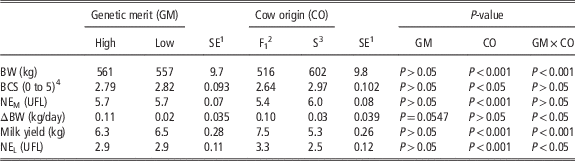
The effect of GM and CO on milk yield, BW and BCS across mid- and late-lactation is presented in Table 1. Genetic merit had no significant effect on the variables investigated. The S cows were 86 kg heavier in BW (P<0.001) and had a 0.33 greater BCS (P<0.05) than F1. An interaction between cow GM and CO was observed for BW, with a 12 kg heavier BW recorded for F1 low genetic index compared with F1 high genetic index cows (P<0.05). The inverse, however, was observed for S; where S low were 20 kg lighter than S high (P<0.001). Body weight change did not differ across GM or CO; however low merit cows tended to maintain BW between weight measurements (P=0.05). A GM by CO interaction for S was observed for ΔBW, with a 0.08 kg loss in BW recorded for S low between weighing compared with a 0.11 kg increase in weight gain for S high cows (P<0.01). The S cows had a 0.6 UFL greater NEM requirement compared with the F1 cows (P<0.001).
Effect of cow genetic merit, origin and their interaction on BW, body condition score (BCS), energy required for maintenance (NEM), ΔBW, milk yield and corresponding energy intake (NEL)

NEM=net energy for maintenance; NEL=net energy for lactation.
1 Weighted standard error of the mean.
2 Dairy sourced cows.
3 Suckler sourced cows.
4 BCS range: 0=emaciated, 5=extremely fat.
The F1 cows produced 2.2 kg/day more milk (P<0.001) than S. A GM by CO interaction was observed where F1 high produced 1 kg more milk than F1 low (P<0.05). Conversely, high merit S produced 1.5 kg less milk than S low (P<0.01). Corresponding NEL requirements were similar for GM, but differed by CO (P<0.001); with F1 having a greater energy requirement (0.8 UFL) than S. A GM by CO interaction was also observed for NEL, where S low required an additional 0.5 UFL for milk production than S high (P<0.05).
Grass dry matter intake and efficiency parameters
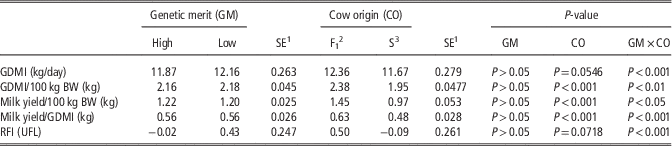
Grass dry matter intake did not differ by GM or CO (Table 2). The F1 tended (P=0.05) to consume an additional 0.69 kg/day of grass than S. The F1 low merit cows consumed 1 kg DM more than F1 high (P<0.01).
Effect of cow genetic merit, origin and their interaction on grass dry matter intake (GDMI), gross efficiency measures and residual feed intake (RFI)

1 Weighted standard error of the mean.
2 Dairy sourced cows.
3 Suckler sourced cows.
Cow origin and the interaction between GM and CO had a significant effect on all gross efficiency parameters investigated (Table 2). Although non-significant, there was a tendency (P=0.05) for F1 high to produce 0.18 kg more milk per unit BW than F1 low. The F1 high produced 0.12 kg more milk per unit intake than F1 low (P<0.01), whereas S low produced 0.12 kg less milk per unit intake than S high (P<0.01). A tendency (P=0.08) existed for S high to consume 0.13 kg more DM per unit BW compared with S low, whereas F1 low consumed 0.17 kg more DM per unit BW than F1 high (P<0.05).
Residual feed intake did not differ by GM or CO, although there was a tendency for S to have a more favourable RFI than F1 (P=0.07). However, within the GM by CO interaction F1 high had a more favourable RFI (−0.25 UFL) than F1 low (P<0.001).
Discussion
The objective of this study was to quantify the effect of GM for a recently developed economically weighted genetic selection index, on the production efficiency of primiparous cows at pasture, whilst also examining the implication of CO on production efficiency. The national maternal index for Ireland comprises of a multitude of traits including: production performance, cow survival, feed intake and maternal weaning weight which are all weighted by their economic importance at farm level (McHugh et al., Reference McHugh, Cromie, Evans and Berry2014). Within the genetic index the relative emphasis placed on the traits investigated was 18% for feed intake and 18% for cow milk yield. Although a large number of other traits are included within the current index and in most instances have a greater emphasis than the traits investigated in the current study, it is anticipated that selecting females based on the overall index would result favourably in phenotypic performance. Results from this study suggested that this did not follow expectations and in some cases differed by CO. However, the authors acknowledge the limited nature of their study with regard to drawing strong conclusions on production efficiency of primiparous beef cows diverse in GM, yet it is important that the potential impact of these findings are highlighted.
An animal’s PTA indicates the amount of a particular trait that animal is expected to pass on to its progeny, equating to half of its own breeding value (Mrode and Thompson, Reference Mrode and Thompson2005). The expected PTA difference between GM groups were 0.04 kg/day, 5.18 kg/day and −5.87 kg for feed intake, milk and BW, respectively, in favour of the high GM group. The lighter BW observed for F1 high was as expected due to the negative weighting for BW within the index but the inverse was however seen for S. For every increase in PTA for feed intake high GM cows were expected to consume 0.03 kg/day, whereas the low GM group had a negative PTA of −0.01, which counters what was observed in this study. High GM cows were expected to have an ~5 kg increase in milk production per unit increase in PTA, the inverse of the trend observed in the first year of this study for S. The trend however is consistent with what was observed for F1 although numerically smaller, with F1 high expected to produce 1.8 kg/day compared with the observed 1 kg/day.
Expected phenotypic differences between F1 and S were confirmed in this study. Consistent with the findings of McGee et al. (Reference McGee, Drennan and Caffrey2005b), F1 cows in the present study were lighter and had a lower BCS and consequently lower maintenance requirement than S. The 29% greater milk yield of F1 compared with S was similar to that reported by Wright et al. (Reference Wright, Jones, Maxwell, Russel and Hunter1994) and McGee et al. (Reference McGee, Drennan and Caffrey2005a); 27% and 31%, respectively. Although current dairy genetic evaluations incorporate functional traits in breeding policies, milk production still constitutes 33% of the weighting (Berry et al., Reference Berry, Ring, Twomey, Hurley, O’Sullivan and McParland2016). This also is likely to influence milk yield of F1 cows. Milk yield of S was lower than that reported by Estermann et al. (Reference Estermann, Sutter, Schlegel, Erdin, Wettstein and Kreuzer2002) and Jenkins and Ferrell (Reference Jenkins and Ferrell2002). The difference is largely attributed to the use of multiparous cows in those studies compared with primiparous cows in this study. The milk yields observed in the present study corroborates the milk yields found for Limousin bred suckler cows (Murphy et al., Reference Murphy, Drennan, O’Mara and McGee2008).
Detailed studies quantifying variation in GDMI between F1 and S cows at pasture are limited. However, consistent with the findings of the present study, Murphy et al. (Reference Murphy, Drennan, O’Mara and McGee2008) reported a 1 kg decrease in GDMI as the proportion of Limousin ancestry increased, which was attributed to lactation energy demands. However, Murphy et al. (Reference Murphy, Drennan, O’Mara and McGee2008) also attributes the greater intake of F1 to the high intake capacity of dairy cows in agreement with Coleman et al. (Reference Coleman, Berry, Pierce, Brennan and Horan2010). Lawrence et al. (Reference Lawrence, Kenny, Earley and McGee2013) found numerically smaller levels of GDMI for purebred suckler beef cows of first and second parity compared with the values found in this study, however GDMI presented here are consistent with those reported by Marshall et al. (Reference Marshall, Campbell and Buchanan-Smith1998) for year 1. Measures of gross efficiency were more favourable for F1 due to their ability to produce greater milk yield per unit intake and BW than S. This however reflects the issues highlighted by Berry et al. (Reference Berry, O’Donovan and Dillon2009) with ratio measures as F1 due to their smaller maintenance requirement and lighter BW inevitably appear more efficient.
In conclusion, results from this study showed that genetic selection for maternal traits had no influence on production efficiency phenotypic performance for primiparous cows diverse in GM and was confounded by CO. However, the authors acknowledge the limited dataset available and the need for further measurements to see if these results hold true. The phenotypic performance generated from the current study can also be included in future genetic evaluations to improve the reliability of genetic values.