INTRODUCTION
Livestock grazing restrictions in national parks and wildlife reserves are common throughout the world (Lewis Reference Lewis2003; Dong et al. Reference Dong, Gao, Xu, Hou, Long and Kang2007). In developing countries, where many households depend on agriculture and livestock, these restrictions impact people's livelihoods by limiting use of an available resource. Agriculture, livestock and forests are inextricably intertwined with rural livelihoods. Farmers depend on livestock manure for fertilizer, livestock power for tilling, and meat and milk as important protein sources (Duncan et al. Reference Duncan, Rahman, Miller, Frutos, Gordon, Rehman, Baig, Ali and Wright2006). In turn, livestock feed off forests and agricultural lands (Bjonness Reference Bjonness1980; Brower Reference Brower1990; Mishra et al. Reference Mishra, Prins and Van Wieren2003) and this degrades habitat for biodiversity. Therefore, it is critical to understand grazing restrictions in the context of resource availability and livestock husbandry practices.
Ancient concepts of protecting areas for hunting and animal preservation (Henneberger Reference Henneberger1996) gave way to the national park concept, stressing biodiversity conservation and preservation in their natural condition, developed over the past century in the USA (Nash Reference Nash1970). Numerous protected areas (PAs) with a wide range of forms have now been established throughout the world. However, in South Asia, national parks were not established until the 1970s, by which time, forests and the large animals that inhabit them had already substantially declined or disappeared owing to intensive agricultural expansion (Reed Reference Reed1970). By the mid-1980s, conservation policies had become integrated with development plans that addressed local people's resource needs and conflicts (Brandon & Wells Reference Brandon and Wells1992; Spiteri & Nepal Reference Spiteri and Nepal2008). While these programmes were successful in terms of conservation, they have been less successful in improving the socioeconomic conditions of most local people (World Conservation Union 1980; McNeely Reference McNeely1988; Kremen et al. Reference Kremen, Merenhender and Murphy1994; Bookbinder et al. Reference Bookbinder, Dinerstein, Rijal, Cauley and Rajouria1998; Marcus Reference Marcus2001). In particular, the loss of traditional usufruct rights (Heinen & Mehta Reference Heinen and Mehta2000), human casualties, livestock depredation and crop raids by wild animals have all impacted the livelihoods of households living in and around these PAs (Prins Reference Prins1992; Oli et al. Reference Oli, Taylor and Rogers1994; Mishra Reference Mishra1997; Wang & Macdonald Reference Wang and Macdonald2006).
Nepal has been a leader in the integration of biodiversity conservation and local development, as exemplified by the Annapurna Conservation Area Project (Baral et al. Reference Baral, Stern and Heinen2007). Initially, strict command and control rules were implemented in Nepal, and PAs prohibited traditional resource use such as harvesting grasses and livestock grazing. Since 1976, however, PA officials have allowed the removal of important thatch grasses from the PAs for two weeks per year (Mishra Reference Mishra, McNeely and Miller1984; Lehmkuhl et al. Reference Lehmkuhl, Upretti and Sharma1988) in response to local needs. In 1993, the Department of National Parks and Wildlife Conservation (DNPWC) was given the power to establish buffer zones surrounding the PAs (HMGN [His Majesty's Government of Nepal] 1996). These zones involve local people in policy making, planning and managing resources (Nepal & Weber Reference Nepal and Weber1995a; Hackel Reference Hackel1998), and allow them to manage the buffer zone community forests (BZCFs) and share in PA revenues for local development. BZCFs also provide livestock fodder, fuelwood and other non-timber forest products to villagers on a regular basis (Budhathoki Reference Budhathoki2003), although livestock grazing is restricted.
In Nepal, three different livestock husbandry systems are practised. Generally, in high altitude or semi-arid regions, agro-pastoralist societies engage in a ‘transhumance grazing system’, where families and livestock herds are seasonally moved from villages to pasture areas (Bjonness Reference Bjonness1980; Brower Reference Brower1990). This seasonal movement for forage complements the ‘sedentary grazing system’ practised in rural agricultural societies such as Nepal's Middle Hills and lowland (terai). In the latter, livestock are kept in villages and grazed in surrounding communal pasturelands or open rangelands (Tulachan Reference Tulachan2001). Additionally, in peri-urban or intensively cultivated areas a ‘stall feeding system’ is practised, in which livestock are kept in a shed and fed crop by-products or commercial feed. These different husbandry practices have all resulted from limited access to pastureland (Saberwal Reference Saberwal1996; Nautiyal et al. Reference Nautiyal, Rao, Maikhuri and Saxena2003) or the development of urban areas within rural landscapes.
In addition to grazing restrictions in terai PAs, people rearing livestock near PAs often have conflicts with wildlife (Sharma Reference Sharma1990; Heinen Reference Heinen1993; Nepal & Weber Reference Nepal and Weber1995b; Studsrod & Wegge Reference Studsrod and Wegge1995). Among these are livestock losses owing to predators and human casualties incurred while using forest resources for herding livestock or cutting fodder (Gurung et al. Reference Gurung, Smith, McDougal, Karki and Barlow2008). Limited information is available on how people change their livestock rearing behaviour in response to grazing restrictions and livestock losses on public lands (Saberwal Reference Saberwal1996; Nautiyal et al. Reference Nautiyal, Rao, Maikhuri and Saxena2003). The Madi Valley, on which this study is focused, is completely surrounded by Chitwan National Park (CNP) to the north-east and BZCF to the south-west; in both of these forested areas, livestock which once freely grazed are now restricted. Conflicts exist in Madi Valley between people and wildlife, resulting in human casualties (Gurung et al. Reference Gurung, Smith, McDougal, Karki and Barlow2008). Livestock husbandry practices are an integral part of the daily lives of people in the Valley. The purpose of this study is to determine livestock pressure on available resources, identify local people's resource use practices and survey opinions about limited grazing policies that deny traditional livestock grazing rights. Our research sought to address three principal questions. What are the changes in livestock composition, ownership structure and husbandry practices after implementation of grazing restrictions? After a decade of grazing restrictions and intensive community forestry activity, how has use of available forage resources changed? What are the opinions of local people about the livestock grazing restriction policy? We also sought to evaluate the answers to these questions in the context of improving buffer zone management around CNP.
METHODS
Study site
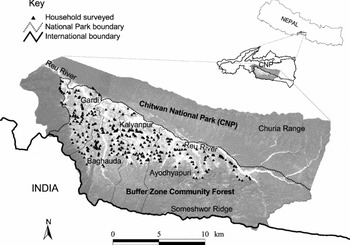
The Madi Valley (c. 150–900 m above sea level) is a complex of deep ravines, steep slopes and a valley floor nestled on the southern boundary of CNP near the border of India (Fig. 1). The BZCFs in the Madi Valley watershed encompass 45% of all community forests surrounding CNP (DNPWC & PPP [Park People Programme] 2000). These BZCFs lie south of cultivation lands and encompass 114 km2 of forest, dissected by deeply eroded streams. The Reu River and its tributaries provide a critical water source for ungulates, as well as human populations.
Map of Madi Valley and its surrounding landscape, Nepal, 2006.

This area is also known as home to the Tharu, a diverse group of people believed to share a common identity through their aboriginal settlement of the terai, an area historically regarded as inhospitable swamp and forest land plagued by malaria (Guneratne Reference Guneratne2002). Until 1941, the Tharu were the only inhabitants of the Chitwan District, sparsely occupying the middle of the valley, with an estimated population of 26 000 (DDC [District Development Committee] Chitwan 2002). However, when the Nepalese government opened the terai region, under the Special Settlement Policy of 1957, the situation changed drastically (Gurung Reference Gurung1983). Under this policy, poor hill immigrants were encouraged to settle in the terai; over the next 60 years the Chitwan population grew at a rate of 4.8% per year to 470 000, an 18-fold increase. In 1981, the Madi Valley alone contained c. 29 000 residents. By 2001 (the most recent census data available), that number had increased by 30% to over 40 000 (DDC Chitwan 2002).
There are four village development committees (VDCs) in the Madi Valley; VDCs are the smallest government units in Nepal (Fig. 1). Among the VDCs, there is a clear separation of Tharu and hill immigrant settlements, with the former remaining in the lower western end of the Valley, mainly in Gardi and Baghauda, and the latter settling in the east and at the base of the hills (Fig. 1). Kalyanpur is largely inhabited by hill immigrants and Ayodhyapuri is completely occupied by hill immigrants.
The settlement programme across the terai, particularly in the Chitwan District, has led to forested habitat loss which, in turn, has resulted in declining wildlife populations including those of tigers (Panthera tigris) and the greater one-horned rhinoceros (Rhinoceros unicornis). Two wildlife species, swamp deer (Cervus duvanceli) and water buffalo (Bubalus bubalis), were locally extirpated from Chitwan District (Gurung Reference Gurung1983). In response to the precipitous decline in wildlife, in 1973, the National Parks and Wildlife Conservation Act established CNP as Nepal's first national park (Heinen & Shrestha Reference Heinen and Shrestha2006). Initially the Park was 544 km2, but it was later expanded to its current size of 932 km2. To increase the land base for wildlife and reduce human dependency on the Park and its resources (Budhathoki Reference Budhathoki2004), a 750 km2 area surrounding CNP, including the entire Madi Valley and its watershed, was declared a buffer zone in 1996 (Heinen & Mehta Reference Heinen and Mehta2000).
Restriction of livestock grazing is one of the conservation policies implemented in CNP in 1973 and in the BZCFs in 1996. Resource use by local people inside the Park is prohibited, with the exception of annual grass harvesting (Lehmkuhl et al. Reference Lehmkuhl, Upretti and Sharma1988). However, the BZCFs provide livestock fodder, fuelwood and non-timber forest products to local people on a regular basis, although livestock grazing is restricted. The Buffer Zone Act requires 30–50% of CNP income (for example entrance, concession, elephant rental and grass-cutting fees) to be distributed to local communities for development programmes and BZCF management (Heinen & Mehta Reference Heinen and Mehta2000; Budhathoki Reference Budhathoki2003). Compensating households for livestock loss owing to wildlife depredation in the buffer zone is one use of the fund.
Household survey
To study the impact of grazing restrictions, we used a quantitative household survey and secondary data sources. A questionnaire was used to obtain information on livestock holdings, seasonal husbandry practices, fodder cuttings and perceptions of policies. Grazing pressure on available fodder resources was estimated using published secondary data.
Approximately 7700 households are listed in the four VDCs of the Madi Valley (DDC Chitwan 2002). This excludes roughly 400 households outside the Valley who are listed in Ayodhyapuri VDC. We sampled evenly from the four VDCs, taking into account the relative numbers of reported households (Ayodhyapuri: 100 households; Kalyanpur: 80 households; Baghauda: 116 households; and Gardi: 104 households), for a total of 400 households. We interviewed the first family member we encountered in each household over the age of 16; interviews lasted 1–3 hours. Two-hundred and eighteen interviewees (54%) were male, 182 (46%) were female. Twenty-one per cent of the interviewees were indigenous Tharu with the remaining 79% from other ethnic backgrounds. Forty-three per cent were high castes, 43% were middle castes and 14% were lower castes. Approximately 42% had no formal education, 34% had a primary education, 8% had achieved a lower secondary education and 16% a higher education. Ages of interviewees ranged from 16–92 years, with a mean age of 45 (SD = 15). Agriculture was the principal livelihood for 91% of the interviewees, with the remaining 9% engaging in business or other occupations.
The questionnaire (Appendix 1, see supplementary material at URL http://www.ncl.ac.uk/icef/EC_Supplement.htm) was developed from our research themes, and field tested in November 2005. Questions were designed to assess livestock holdings, seasonal grazing practices, weekly fodder cutting, opinions on current grazing restriction policies and suggestions to solve livestock grazing problems. The grazing seasons were divided into winter (October–January), summer (February–May) and monsoon (June–September).
After spending > 6 months conducting biological research and becoming familiar with the residents, B. Gurung personally oversaw household interviews conducted during April–June 2006. We hired and trained eight local survey assistants with undergraduate degrees to conduct the interviews. All had previous survey experience and were actively involved in community service. Gurung accompanied each survey assistant during their initial interviews conducted in the Nepali and Tharu languages. Thereafter, he accompanied each assistant on a rotating basis. The global positioning system (GPS) location of each household was recorded for mapping using Arc View 3.3 (ESRI Inc., Redlands, California, USA) (Fig. 1).
After the interviews, responses were coded and entered into a database, checked for entry errors and analysed. We compared livestock numbers and ownership structure during early and late grazing restriction periods in the Madi Valley. We obtained the household and livestock data of Joshi (Reference Joshi1999) from 1997, because prior to this time community forestry and livestock grazing restrictions were not strictly implemented. From 1998 until 2006, forest restoration was widespread in the buffer forests owing to stringent grazing restrictions monitored by the community forestry user groups around CNP (Gurung et al. Reference Gurung, Smith, McDougal, Karki and Barlow2008).
Livestock holdings, which include cattle, buffalo and goats, are presented as units per household. We used two-sample t-tests to compare mean numbers of livestock per household between 1997 and 2006. We similarly compared the proportion of households that had cattle, buffalo and goats in 1997 with that in 2006.
Calculation of livestock fodder demand and availability
To understand the livestock grazing pressure on available resources in 1997 and 2006, we calculated the available fodder per livestock standard unit (LSU) per year. First, we estimated total numbers of livestock of different types, using the average number of animals per sampled household multiplied by the total number of households. Livestock thus estimated were converted into LSU by commonly used Nepal conversion factors: adult buffalo = 1 LSU, cattle = 0.7 LSU and goat = 0.2 LSU (Thapa & Paudel Reference Thapa and Paudel2000; Agrawal & Gupta Reference Agrawal and Gupta2005). Pigs were excluded from the analysis as they were rare and only kept by <2% of households. We used z-tests to test for differences in total LSU for buffalo, cattle and goat between 1997 and 2006 estimates.
Fodder supply and demand were calculated in terms of total digestive nutrient (TDN) contents in forage (Thapa & Paudel Reference Thapa and Paudel2000) rather than fodder dry matter (Silori & Mishra Reference Silori and Mishra2001) because TDN contents vary with fodder type and crop residue, and, to our knowledge, dry matter estimates of crop residue were not available.
One LSU requires 1083 kg (c. 1.1 t) of TDN per annum to maintain body weight and performance (Thapa & Paudel Reference Thapa and Paudel2000). This rate was applied to the Madi Valley livestock because livestock types such as cattle, buffalo and goats, the main grazing animals, are similar in the types of fodder they require. Total TDN demand was estimated by multiplying total LSU by the LSU/TDN requirement.
TDN available was estimated for agricultural land, buffer zone communal lands and BZCF for 1997 and 2006. The buffer zone communal land consisted of shrub land, open meadows, flood plains and land along streams available for livestock grazing and foraging. We estimated total agricultural land in hectares (ha) using average land holding per household multiplied by the total number of households. The total communal land and BZCF was obtained from DNPWC and PPP (2000). The TDN yield per ha of agricultural land, communal land and community forest was obtained from Thapa and Paudel (Reference Thapa and Paudel2000). These rates were derived from the middle hills of Nepal, which are composed of narrow river valleys, have a subtropical climate and contain dense sub-tropical forest, similar to the Madi Valley. The rate obtained is assumed to be applicable to this study as forest types, farm types and crops grown were similar. In both areas, the major crops include rice, wheat, and maize. In 1997, the estimated TDN yields from agricultural land, communal land and BZCF were 3.1 t ha−1 yr−1, 0.9 t ha−1 yr−1 and 1.7 t ha−1 yr−1, respectively; and in 2006, the TDN yields were 4.6 t ha−1 yr−1, 2.6 t ha−1 yr−1 and 1.4 t ha−1 yr−1, respectively (HMGN 1988, cited in Thapa & Paudel Reference Thapa and Paudel2000). The TDN estimate for BZCF also assumed fodder was collected from the entire area. Total TDN supply was calculated using these rates multiplied by total land areas.
RESULTS
Livestock and ownership structure
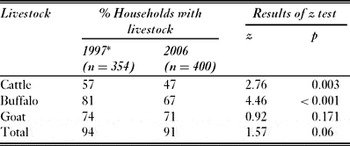
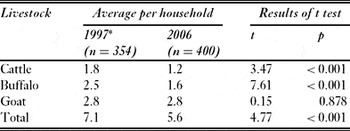
In the Madi Valley, the number of livestock per household and number of households with livestock changed between 1997 and 2006. There were fewer households with cattle and buffalo in 2006 than in 1997 (Table 1). The mean number of cattle and buffalo per household was smaller in 2006 (Table 2). However, the number of households with goats and mean number of goats per household remained the same between the years (Tables 1 and 2).
Percentages of households with livestock in the Madi Valley in 1997 (from Joshi Reference Joshi1999) and 2006.

Livestock ownership per household in the Madi Valley in 1997 (Joshi Reference Joshi1999) and 2006.

In 1997, 94% of the sampled households owned livestock. The most common animals were buffalo, owned by 81% of the households (Table 1). In 2006, 91% of households owned livestock; however, goats were the most common animals, owned by 71% of households. The average livestock holding decreased from 7.1 animals per household in 1997 to 5.6 animals in 2006 (Table 2).
Total livestock in the Madi Valley increased slightly from 1997 to 2006, mainly owing to an increase in the domestic goat population from c. 16 000 to >21 000, along with an increase in the human population. Total goat LSUs in 2006 were higher than in 1997 in the Madi Valley (z = −3.957, p < 0.001; Table 3). However, total buffalo LSUs decreased significantly from 1997 to 2006 (z = 2.74, p = 0.003; Table 3).
Comparison of total (± SE) buffalo, cattle and goat LSUs between 1997 and 2006 and total digestive nutrients (TDN) amounts required annually in Madi Valley.

Livestock pressure on available fodder resources
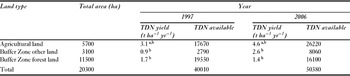
Despite slightly increased total livestock numbers from 1997 to 2006, there was a small decrease in LSUs from 1997 (24 500) to 2006 (23 000). Assuming an average TDN consumption rate of 1.1 t LSU−1 yr−1, the total forage demand for these livestock was c. > 25 000 t yr−1 in 2006 and 27 000 t yr−1 in 1997. The total TDN available from all sources exceeded 50 000 t yr−1 in 2006 and 40 000 t yr−1 in 1997 (Table 4). The increase in TDN in 2006 compared to 1997 is due to increased yields from agricultural lands and buffer zone communal lands. After the implementation of grazing restrictions, residents intensively planted and managed vegetation for fodder in the agricultural lands and communal lands including along streams and road sides. However, the TDN availability from BZCF was lower in 2006 than in 1997 because livestock grazing was restricted. Thus, on the surface, resource availability appeared to be adequate to support the livestock population of the Madi Valley in both years, assuming the population numbers are correct. However, in 1997, TDN available from agricultural lands was only adequate to sustain two-thirds of the the Madi Valley livestock population, compared to 2006, when agricultural TDN was sustainable (Tables 3 and 4). TDN measurements reported in this paper provide a general estimate.
Estimated amounts of total digestive nutrients (TDN) available from various land use types in Madi Valley in 1997 and 2006. Sources: aThapa and Paudel (Reference Thapa and Paudel2000), bHMGN (1988).

At the household level, agricultural land was inadequate to support the livestock owned in 1997. The average household owned 4.3 LSU that required a TDN of 4.7 t yr−1, but the average TDN available per land holding (average 1 ha per household) was only 3.1 t yr−1. However, in 2006, agricultural land was adequate to sustain the livestock owned by household. The average household owned 3.1 LSUs that required a TDN of 3.3 t yr−1, while the average TDN available per land holding (average 0.74 ha per household) was 3.4 t yr−1. Despite a decline in average land holding between the two periods, the increase in TDN yield ha−1 yr−1 contributed to the increase in average TDN availability.
Grazing patterns and fodder collection
According to the household survey, prior to the establishment of the CNP and buffer zone, the majority of the Madi Valley households practised a ‘sedentary grazing system’ where livestock was kept in the village at night but during the day grazed freely in the surrounding forests. A quarter of sampled households also practised the ‘transhumance grazing system’ in which livestock were seasonally moved deep inside the forest, and temporary cattle camps were established, primarily during the winter months. The Madi Valley's temporary cattle camps were approximately 5–8 km away from the villages, near the base of the hills where water and forage is abundant. However, these camps were gradually discontinued between the mid-1980s and 1990s, concurrent with the establishment of the CNP and buffer zone. Livestock grazing restriction was the most common reason given by more than half the households that had used cattle camps but terminated such activity. Other reasons for discontinuing use of camps included declining stock size, lack of labour, depredation threats and occupational changes.
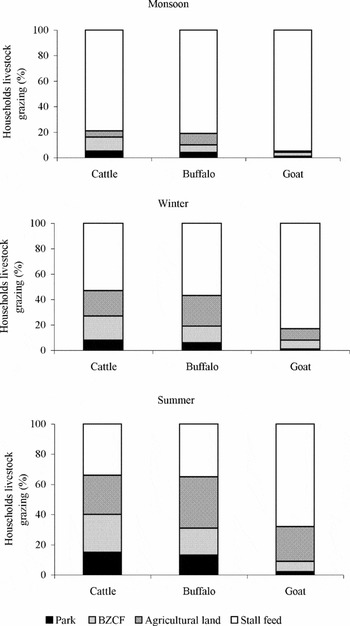
The 2006 survey data show that livestock were currently stall fed or grazed in the agricultural lands, or illegally grazed in BZCFs and the Park (Fig. 2). ‘Stall feeding’ was more common during the monsoon and winter for all livestock, but continued to be important for goats in the summer because grazing goats required a herder for the entire day. In 2006, grazing of other animals was relatively high in summer in all three zones.
Per cent cattle, buffalo and goat seasonal grazing in Chitwan National Park, buffer zone community forests (BZCF), agricultural land or stall feeding practised by households owning such stocks in the Madi Valley in 2006 (n = 365).

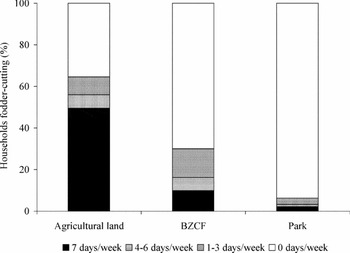
Grazing restrictions in the Park and BZCFs have resulted in increased stall feeding and grazing on agricultural land. Increased stall feeding requires increased fodder cutting or an adequate supply of crop by-products. The vast majority of sampled households depended more on agricultural land than BZCFs and the Park for fodder cutting; approximately 50% of households collected fodder every day throughout the year (Fig. 3). In addition to agricultural lands, approximately 30% of the sampled households collect fodder from the BZCFs; slightly > 5% of the households collected fodder from the Park (Fig. 3).
Percentage of households (HHs) that collect fodder on a weekly basis from agricultural lands, buffer zone community forests (BZCF), and Chitwan National Park during a year in Madi Valley, 2006 (n = 400).

Household perceptions of grazing policies
Asked open-ended questions about their opinion of BZCF restrictions on livestock grazing, 83% of household members approved of restricted grazing. Interviewees also expressed an appreciation for the economic and lifestyle benefits derived from such policies. For example, restricted grazing resulted in restoration of degraded forest and regular and easy access to fodder, firewood and non-timber forest products. Only 12% expressed dissatisfaction with the policy.
Despite grazing restrictions, 61% of household members preferred grazing to stall feeding. To reduce grazing problems, household members suggested they could maintain fewer livestock (50%), stall feed (38%), add some buffer zone areas for grazing (38%), plant more fodder foliage in the communal lands (13%) or change occupations (7%).
Asked whether they wanted to increase or decrease livestock holdings, 94% of household members did not want to increase their cow numbers 77% did not want to increase buffalo numbers, primarily owing to inadequate grazing land. In contrast, 41% wanted to increase goat numbers because they were easy to maintain and had high economic value.
DISCUSSION
Grazing restriction influence on livestock and ownership structure
A shift in the livestock structure of Madi Valley occurred between 1997 and 2006, primarily owing to changes in conservation policies that restrict grazing in the buffer zones. By decreasing large ruminants, local residents were able to adjust forage needs and decrease demand on grazing land while maintaining economically valuable goats that require less feed and forage. Our findings reflect a pattern that has occurred across Nepal. Since the establishment of the parks in the early 1970s, the response to restricted grazing has altered rural livestock composition. In the early 1970s, this occurred in the northern part of CNP where cattle then outnumbered buffalo (3×) and goats (5×) (Seidensticker Reference Seidensticker1976). By 2000, goats outnumbered both buffalo and cattle in the buffer zone of the CNP (MFSC [Ministry of Forest and Soil Conservation] 2000).
In general, the cattle population in Nepal has been stable or declining since 1996 (FAO [United Nations Food and Agricultural Organization] 2005). Cows are kept mainly for milk production and manure, but not for meat. Because of low productivity and insufficient grazing land, nearly all households sampled in the Madi Valley were uninterested in increasing their cattle stock. As in other parts of Nepal, the cattle population in the Madi Valley is declining but at a lower rate. Sharma and Shaw (Reference Sharma and Shaw1993) reported comparable findings; cattle numbers were growing at a slower rate near CNP compared to the regional growth rate. Similarly, in the Middle Hills of Nepal, the number of cattle per household declined following the establishment of community forests (Adhikari et al. Reference Adhikari, Williams and Lovett2007). Our results agree with the general observation in Nepal that after grazing restrictions were put into place cattle numbers declined.
Throughout South Asia, there has been a mixed trend in buffalo population growth. In South-East Asia there has been an overall decline because fewer people are using them as draft animals. However, in Nepal and elsewhere in Asia, buffalo populations have been increasing due to a greater demand for milk and meat (Nanda & Nakao Reference Nanda and Nakao2003; FAO 2005). Farmers prefer to keep buffalo than cows because their per animal milk production is greater (Sebatian et al. Reference Sebastian, Mudgal and Nair1970; Mandal et al. Reference Mandal, Paul and Pathak2003). In contrast with the rest of Nepal, grazing restrictions and high maintenance costs in the Madi Valley have resulted in a reduction in the total buffalo population and average number of buffalo per household. Similar declines have occurred in villages with community-managed forests in the Middle Hills of Nepal (Adhikari et al. Reference Adhikari, Williams and Lovett2007). Although buffalo milk and meat production are profitable, they require rigorous daily maintenance, and feed and fodder intake increase during milk production (Thomas-Slayter & Bhatt Reference Thomas-Slayter and Bhatt1994). Supplementary feed requires fuelwood to cook and labour collecting it, along with fodder. Thus, buffalo are often sold off for meat consumption, despite the dietary prohibition of some Hindus, while cattle, universally considered sacred by Hindus, are spared a similar fate.
The growing goat population in the Madi Valley implies that grazing restrictions have had less influence on goat rearing. Respondents indicated that goats are easy to keep and are primarily stall fed. Moreover, a goat's economic output is more than nine times its input (Nautiyal et al. Reference Nautiyal, Rao, Maikhuri and Saxena2003). Although goat meat is expensive, compared to buffalo, its popularity throughout the country has resulted in higher demand and quicker economic gain.
Fodder availability, use and practices
The differences we observed in livestock numbers, composition and husbandry practices represent the response to a changing social and political environment. Up to 1990, village livestock were openly grazed throughout the Madi Valley forests. Additionally, some families practised ‘transhumance grazing’. However, in response to conservation policies, and specifically grazing restrictions, the system of temporary cattle camps has completely disappeared. A change from ‘transhumance’ to ‘sedentary’ grazing has also been reported in India wherever grazing restrictions have been implemented (Saberwal Reference Saberwal1996).
In 1997, the overall forage supply from agricultural lands was inadequate to meet livestock demands and supplemental grazing and fodder cutting occurred in the BZCF. However, in 2006, the Madi Valley residents depended more on their agricultural lands for livestock rearing than on the BZCF or the Park. They intensively planted fodder trees and grasses in the agricultural lands and ultimately increased the forage supply. In the monsoon, new rice crops fill most agricultural lands and therefore grazing is not possible. At this time, households obtain fodder by weeding and harvesting abundant grasses on agricultural bunds and along canal banks. Fodder cutting from agricultural lands is lowest in winter compared to other seasons because livestock are mostly fed with crop by-products, such as rice hay and maize residue. Because few crops are grown during the summer, households allow livestock to graze more on the agricultural land during this season.
The high approval rating for BZCF grazing restriction expressed by interviewees may be biased by a desire to please the interviewer. In 2006, few households reported grazing their cattle, buffalo or goats in the Park and/or BZCF. But these practices may be underreported owing to the social stigma of doing something illegal. Illegal grazing practices have been reported in Ranthambhore National Park in India (Berkmuller et al. Reference Berkmuller, Mukherjee and Mishra1990) and in Chitwan National Park (Sharma & Shaw Reference Sharma and Shaw1993). One reason for such illegal grazing is that poorer households with insufficient agricultural lands are pushed to meet their resource needs on protected land. Additionally, proximity influences a household's ability and willingness to use the forests.
A solution to reduce illegal grazing is to minimize livestock numbers and increase stall feeding, which Madi Valley residents are currently doing. Stall feeding works well for households living along the BZCF border because fodder cutting is allowed in the BZCF. However, fodder cutting in the Park is not permitted for people who live along the Park border, thus reducing the viability of stall feeding as an option for them. These households may need to reduce their livestock to sustainable levels based on available agricultural fodder. However, religious taboos on beef consumption would tend to eliminate destocking through sales. Most likely, cattle numbers will decline slowly and continue to be illegally grazed.
Consequences of grazing restrictions for human-tiger interactions
In the Madi Valley, grazing restrictions led to reduced buffalo and cattle numbers, and increased fodder cutting for stall feeding. Gurung et al. (Reference Gurung, Smith, McDougal, Karki and Barlow2008) hypothesized these two conditions may have contributed to increased human killing by tigers in the BZCF. Prior to 1997, there were no reports of humans killed by tigers in the BZCF of the Madi Valley. However, since that time, 19 people have been killed by tigers (Gurung et al. Reference Gurung, Smith, McDougal, Karki and Barlow2008). Tigers in Chitwan are known to kill livestock to supplement wild prey (Sunquist Reference Sunquist1981). Grazing restrictions limited this food source for tigers, but in turn may have allowed numbers of wild prey to increase in the improved quality habitat, thereby supporting a higher density of tigers. In addition, because livestock grazing restrictions increased stall feeding more people visited the forests to cut fodder at greater frequencies. More than one in three households owning livestock now collects fodder from the BZCF and one in ten households collects fodder there on a daily basis. This increased human presence in the community forests increases encounters between fodder cutters and tigers. In recent years, half the people killed by tigers were cutting fodder when killed (Gurung et al. Reference Gurung, Smith, McDougal, Karki and Barlow2008). Fodder cutting requires entering the dense grassland vegetation where tigers may be resting during the day, thereby increasing the probability of human-tiger interactions. Furthermore, people harvesting grasses bend over or sit down. Such positions may resemble wild prey to tigers (Seidensticker & McDougal Reference Seidensticker and McDougal1993), and as such, may encourage tiger attacks.
CONCLUSIONS
In the Madi Valley, livestock rearing practices are changing from ‘transhumance grazing’ to stall feeding. If the current trend in livestock reduction continues, livestock could be sustained on a household level by agricultural and communal lands, families responded in this manner to grazing restrictions in parklands and BZCFs. Park managers should attempt to minimize household dependence on Park and BZCF resources for livestock rearing, and thus reduce wildlife conflict with people. Production linkages between forests and raising livestock are weakening, and the interconnection of livestock with agricultural lands is strengthening among the peasant farming systems, resulting in a potentially sustainable livelihood through technical enhancement. Stall feeding may be sustained with higher quality feed and more forage from crops and their byproducts (Pingali Reference Pingali1997), some of it potentially derived from households that do not own livestock. However, philosophical and sociopolitical debates will continue regarding limits to sustainability within rural communities (Campbell et al. Reference Campbell, Bradley and Carter1997).
If, as in the Madi Valley, residents elsewhere adjust to grazing restriction policies by reducing livestock, changing livestock composition, and increasing stall feeding, the total number of domestic large ruminants is likely to decline around PAs and community forests in South Asia. These changes will decrease forest degradation and increase the ecological services that forests provide. However, shifting from grazing to fodder cutting in BZCFs appears to increase the potential for human-tiger conflicts, and this issue needs to be addressed.
ACKNOWLEDGEMENTS
We thank the late Dr Tirtha Man Maskey and his colleagues (Department of National Parks and Wildlife Conservation, Nepal) for support, encouragement and permission to conduct this research. Funding was provided by the University of Minnesota, WWF-Nepal, The Fund for The Tiger and Steve and Mary Swig. We thank P. O'Neill, F. J. Cuthbert and three anonymous reviewers for helpful comments on earlier drafts of this manuscript. We are grateful to survey assistants and Madi residents for their support and assistance in data collection.