Introduction
The hypothalamic–pituitary–adrenal axis (HPAA) acts as a mediator between individuals and their environment, allowing them to respond and temporarily adapt to internal and external challenges through the modulation of circulating glucocorticoids levels.Reference McEwen 1 – Reference Provencal and Binder 4 This vital axis’ ontogeny appears to be sensitive to developmental exposures.Reference Reynolds, Labad, Buss, Ghaemmaghami and Raikkonen 5 – Reference Karlen, Frostell, Theodorsson, Faresjo and Ludvigsson 7 Indeed, both pre- and early postnatal challenges have been linked to HPAA departures from normative activity defined by traits such as glucocorticoid’s circadian rhythms and stress responsivity, a phenomenon often referred to as ‘HPAA programing’.Reference Karlen, Frostell, Theodorsson, Faresjo and Ludvigsson 7 – Reference Meaney, Szyf and Seckl 21 Importantly, existing evidence suggests that HPAA ontogeny could be more vulnerable to pre- than postnatal exposures.Reference Provencal and Binder 4 , Reference Torche and Kleinhaus 22 – Reference Provencal and Binder 33 In particular, maternal glucocorticoid levels, a marker of HPAA responsivity, during mid- and late-gestation have been linked with offspring’s postnatal HPAA activity.Reference O’Connor, Ben-Shlomo and Heron 6 , Reference Karlen, Frostell, Theodorsson, Faresjo and Ludvigsson 7 , Reference Tobi, Lumey and Talens 34 – Reference Weinstock 36 Weekly patterns of variation in maternal cortisol levels in the weeks immediately following conception have also been hypothesized to modulate fetal HPAA development, which begins shortly after conception.Reference Schoenwolf, Bleyl, Brauer and Francis-West 37 For example, the precursor to the anterior pituitary, Rathke’s pouch, forms by invagination within the fetal brain by week 3 post-conception and becomes a discrete sac by the end of week 8 post-conception, which further differentiates into the anterior pituitary. By the end of week 5 post-conception, the cells that will form the adrenal cortex proliferate from the coelomic epithelium, delaminate and migrate into the underlying mesoderm, while the hypothalamus is a visible swelling within the fetal brain, which will further differentiate into nuclear areas that regulate a variety of physiological functions. Emerging evidence suggests that the links between maternal prenatal HPAA activity and their offsprings’ postnatal HPAA activity could be mediated by stress-related programming of offsprings’ HPAA-related genes,Reference Provencal and Binder 4 , Reference Hochberg, Feil and Constancia 38 – Reference Wei, Schatten and Sun 48 including those associated with corticotrophin releasing hormone (CRH) and the glucocorticoid receptor (NR3C1).Reference Kertes, Kamin and Hughes 49 , Reference Xu, Sun, Gao, Cai and Shi 50
Fertilization and early embryogenesis are critical for the establishment of methylation profiles.Reference Monk, Boubelik and Lehnert 51 , Reference Reik 52 During these processes most parental methylation ‘marks’ are erased, generating an opportunity for modifications to emerge during re-methylation.Reference Wei, Schatten and Sun 48 , Reference Abdalla, Yoshizawa and Hochi 53 – Reference Yuen, Neumann and Fok 56 DNA methylation modifications of an embryo’s first cells can be inherited by all daughter cells in a cell lineage, thus potentially maintaining the effects of environmental exposures across multiple developing tissues and organs.Reference Hales, Grenier, Lalancette and Robaire 54 Therefore, studying the effects of exposures taking place immediately after conception is paramount to understanding the developmental origins of health and disease.
As it is not ethical to use experimental designs to study human development, naturalistic studies represent the only possibility for evaluating the association between early post-conceptional (EPC) challenges and HPAA ontogenesis and postnatal activity in our species. Until recently, most cohort studies recruited women after clinical confirmation of pregnancy, about 8 weeks post-conception, missing the EPC period entirely. To detect the precise time of conception and accurately assess gestational day and the timing and intensity of very early exposures, women must be recruited before they conceive, and bio-specimens must be collected longitudinally and often.
Here we present the first study to include the prospective collection of bio-specimens from mother–child dyads beginning at conception in a real-world setting. We analyzed potential associations between maternal HPAA activity during the understudied 8 weeks post-conception (hereafter, the EPC period) and their children’s HPAA basal activity and responsivity to experimental (Trier Stress Test for Children, TSST-C) and non-experimental (the onset of the school year) stress challenges at ages 10–11. In search for cues as to possible underlying biological mechanisms, we investigated whether children’s DNA methylation patterns in buccal epithelial cells were statistically related to maternal EPC cortisol levels and to their own HPAA activity.
Methods
Participants
Mothers at the time of conception
All analyses are based on data collected from a cohort of 107 parous Kaqchikel Mayan women originally recruited in the year 2000 for the Society, Environment and Reproduction (SER) studyReference Nepomnaschy, Welch, McConnell, Strassmann and England 2 , Reference Nepomnaschy, Welch and McConnell 3 and their children. All participants are Kaqchikel Maya, which likely limits the genetic variability among them relative to that found in groups of women living in cosmopolitan cities. Lifestyles are also relatively more homogenous amongst SER participants than in urban communities, reducing the effects of confounders such as diet, smoking, physical activity, education and socio-economic status. Of the 107 SER mothers, 37 conceived a new pregnancy during the original data collection period (November 2000 to October 2001). Of these 37 women, 22 provided urinary bio-specimens from before conception through the eighth week of gestation (mean age at the time of conception: 26.0 years; s.d.: 1.0; range: 18.8–35.6). As is the custom in these communities, all of the children were delivered vaginally and breast fed. The role of fathers in child rearing, as inferred from answers to social support questionnaires administered during the SER study, was limited.
Mother–child dyads in 2013
In 2013, we re-contacted and recruited 22 mother–child dyads to participate in the Consequences of Peri-conceptional Events study. The mean age of the 22 children (10 male, 12 female) in 2013 was 11.2±0.1 ( mean±s.d.) years; range: 10.5–11.6.
Ethics
Collection and analysis of data and bio-specimens in 2000–2001 and 2013 was approved by the University of Michigan’s Institutional Review Board and SFU and UBC Ethics Review Boards, respectively. Informed consent from the women and assent from their children was obtained orally from illiterate participants and in written form from literate participants. In all cases the consent or assent document was read to each prospective participant in Kakchiquel Mayan, their first language, by a local female research assistant. Participants signed the consent with a cross, finger print or name initials, according to their individual preference. Families received material in-kind compensation for their participation (e.g., household and school supplies).
Procedures
Maternal HPAA and hypothalamic–pituitary–gonadal axis activity during SER
In 2000–2001, SER mothers self-collected first-morning urine (FMU) specimens every-other-day except Sundays for at least 8 weeks following clinical pregnancy detection via a commercial kit.Reference Nepomnaschy, Welch, McConnell, Strassmann and England 2 , Reference Nepomnaschy, Welch and McConnell 3 Every-other-day variation in urinary concentrations of reproductive hormones allowed us to determine the exact day of conception using the ratio of urinary estradiol to progesterone conjugates, estrone-3-glucuronide (E1G) and pregnanediol glucuronide (PdG), respectively, and to confirm pregnancy maintenance by monitoring human chorionic gonadotropin beta-subunit (hCG-β) levels.Reference Baird, Weinberg, Wilcox, McConnaughey and Musey 57 – Reference Wilcox, Weinberg and O’Connor 61 FMU free cortisol levels were used to determine within- and among-individual variation in maternal HPAA activity during the EPC.Reference Nepomnaschy, Altman and Watterson 62 FMU cortisol provides an integrative measure of cortisol excretion overnight, minimizing the influence of diurnal confounders and circadian rhythms. Mothers provided an average of 19.1±4.5 (mean±s.d.) FMU samples, representing a specimen collection compliance rate of 79.7% (i.e., 19.1 of 24 possible samples per woman over the EPC).Reference Nepomnaschy, Lee, Zeng and Dean 63
Children’s basal HPAA activity and reactivity in response to a non-experimental stressor
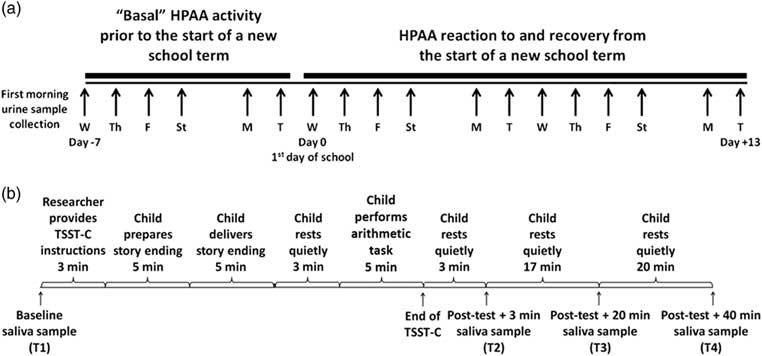
In 2013, the selected 22 children provided daily FMU specimens for 3 weeks excluding Sundays (Fig. 1a). The first week preceded the start of a new school term, a known non-experimental (‘real-life’) stressor, allowing for the evaluation of their ‘basal’ HPAA activity (urinary-free cortisol).Reference Gutteling, de Weerth and Buitelaar 64 The next 2 weeks allowed for the evaluation of the children’s HPAA response to, and recovery from, the start of the new school term. The 22 children provided an average 14.6±1.6 FMU samples, representing a collection compliance rate of 81.3% (i.e., 14.6 of 18 possible samples per child).
Urine and saliva specimen collection protocols to evaluate children’s hypothalamic–pituitary–adrenal axis (a) basal activity and reaction and recovery from the start of a new school term, a non-experimental stressor and (b) reaction to the Trier Social Stress Test for Children (TSST-C), an experimental stressor. (a) First-morning urine samples were collected daily (excluding Sundays), starting a week before the start of a new school term and concluding 2 weeks after the start of school. (b) Saliva samples were collected before the start of the TSST-C (baseline) (T1) and at 3 min (T2), 20 min (T3) and 40 min (T4) following the end of the TSST-C.

Children’s HPAA reactivity to an experimental stressor
To assess each child’s HPAA responsivity to an experimental stressor, we individually administered the TSST-C, a psychosocial stress test adapted for children, which elicits a strong and reliable cortisol response.Reference Buske-Kirschbaum, Jobst and Wustmans 65 – Reference Kudielka, Buske-Kirschbaum, Hellhammer and Kirschbaum 67 As cortisol secretion varies with physical activity and dietary intake, food intake and physical activity were controlled by design. Children had breakfast at their home as usual, between 07:00 am and 08:00 am, and then were asked to sit quietly upon their mid-morning arrival at the test center.
The TSST-C began with a 3-min instruction period, wherein each child was told part of a scary story and asked to complete the story as excitingly as possible in front of two unfamiliar adult confederates, who watched the performance without showing any empathy or encouragement (Fig. 1b). Each child was then given a 5-min preparation period followed by the 5-min public-speaking period and then a 3-min silent period. Immediately afterwards, each child was given a 5-min oral arithmetic task wherein they were asked to subtract the number 17 repeatedly, starting with the number 12,620. The two confederates maintained neutral expressions and did not provide help. This arithmetic task was followed by another 3-min silent period. We collected salivary specimens before the instruction period (T1), after the 3-min silent period following the arithmetic task (T2), 20 min after the arithmetic task (T3) and 40 min after the arithmetic task (T4) (Fig. 1b). Children passively drooled saliva into 5 ml inert tubes. There is a 15–20 min lag between cortisol production and secretion in saliva.Reference Aardal-Eriksson, Karlberg and Holm 68 , Reference Kudielka and Wust 69 Therefore, salivary cortisol at T1 reflects HPAA activity before the TSST-C and is, thus, considered a pre-test measure. Salivary cortisol at T2 reflects HPAA response during the speech portion of the tests (reactivity). Salivary cortisol at T3 is a reflection of HPAA activity at the end of the arithmetic task. Salivary cortisol at T4 represents a post-stress measure of HPAA activity (recovery).Reference Buske-Kirschbaum, Jobst and Wustmans 65 – Reference Kudielka, Buske-Kirschbaum, Hellhammer and Kirschbaum 67
Hormone analyses
Urine and saliva specimens were aliquoted into 2 ml cryo-vials and stored at −10°C in the field. Frozen samples were shipped on dry ice to our laboratory, where we stored them at −80°C until analysis. All hormone analyses were conducted at the Maternal and Child Health Laboratory at Simon Fraser University. FMU cortisol, hCG-β and E1G levels were quantified using a multiplex enzyme immunoassay array (Quansys Biosciences, Logan, UT) that we have previously validated [lower limits of detection (LLD)=0.343, 0.035 and 0.252 ng/ml, respectively].Reference Salvante, Brindle, McConnell, O’Connor and Nepomnaschy 70 We quantified FMU PdG levels using a competitive solid-phase EIA (LLD=21 nmol/l)Reference O’Connor, Brindle and Holman 71 based on the Quidel anti-PdG monoclonal antibody, clone 330, provided by Dr Bill Lasley, University of California at Davis, Davis, CA, USA. To account for variability in hydration state, we corrected all urinary hormone concentrations for specific gravity using refractometry.Reference Miller, Brindle and Holman 72 , Reference White, Jamison and Grieb 73 We quantified salivary cortisol using a high-sensitivity enzyme immunoassay kit (LLD=0.003 μg/dl) (Salimetrics, State College, PA, USA). We ran all hormone assays in duplicate and re-assayed samples with a coefficient of variation between duplicates >13%. All intra- and inter-assay coefficients of variation were below 8 and 12%, respectively.
Evaluation of mothers’ and children’s DNA methylation
DNA isolation and DNA methylation arrays
A buccal epithelial specimen from each participant was collected in 2013 using an SK-1 Isohelix Buccal Swab (i.e., cheek swab) (Cat. No: SK-1S) and stored with an Isohelix Dri-Capsule (Cat. No: SGC-50) at the same time as urine and saliva collection. DNA was isolated using the Isohelix DDK buccal DNA isolation kit (Cell Projects, Kent, UK) and bisulfite conversion was performed with the EZ-DNA methylation kit (Zymo Research, Irvine, CA, USA). We assessed DNA yield and purity using a Nanodrop ND-1000 (Thermo Scientific, Irvine, CA, USA). We applied 160 ng of bisulfite converted DNA to the Illumina Infinium HumanMethylation450 BeadChip array (Illumina Inc., San Diego, CA, USA). The array does not distinguish between methylcytosine and other methyl variants, including hydroxymethylcytosine, formylmethylcytosine and carboxylemethylcytosine. Thus, the results include all DNA methyl variants present in buccal epithelia.
Quality control and normalization of DNA methylation data
We followed previously described quality control procedures.Reference Price, Cotton and Lam 74 – Reference Leek, Johnson, Parker, Jaffe and Storey 76 Briefly, we conducted background subtraction and color correction of the data with Illumina GenomeStudio software. We eliminated all probes with detection P>0.01 in at least one sample as well as probes with fewer than three beads contributing to signal (30,954 probes). Next, we filtered out 65 single nucleotide polymorphism probes, 11,648 X/Y chromosome probes and 28,625 probes previously shown to have poor design features.Reference Price, Cotton and Lam 74 We quantile normalized the remaining 414,350 probes using the lumi R package (R Team, 2008) and performed SWAN normalization to correct for probe type.Reference Maksimovic, Gordon and Oshlack 75 Finally, we performed ComBat twice sequentially to remove any effects of slide and row from the data.Reference Leek, Johnson, Parker, Jaffe and Storey 76
Cell tissue differences are one of the greatest sources of DNA methylation variability and, therefore, traces of blood in buccal tissue present a major confounder for the DNA methylation analysis. To determine whether blood contamination due to gum disease was an issue for the children’s buccal swabs, we compared the DNA methylation profiles of mothers and children with two additional datasets, one containing 16 whole blood samplesReference Farre, Jones and Meaney 77 and another containing 10 buccal samples.Reference Jones, Farre and McEwen 78 By using principal component analysis, we decomposed the data into a basis of independence variance, that is, its principal components (PCs). We identified a PC (PC1) that clearly separated the known blood samples from the known buccal samples (Supplementary Fig. S1). Some of the mothers exhibited signs of gum disease. As expected, some of their buccal samples scored intermediate values between the whole blood samples and the buccal samples, suggesting some blood contamination (Supplementary Fig. S1). Notably, however, the children’s buccal samples had values that aligned with those of the buccal samples (Supplementary Fig. S1), suggesting no blood contamination in the children’s samples, which is consistent with their lack of gum disease symptoms. PC1 accounted for over 70% of the variance of the combined dataset, a typical signature of tissue association. After confirming that PC1 was not strongly associated with other traits of the sample (e.g., age, sex), we subtracted its independent contribution from the data to correct for tissue bias. All remaining analyses were conducted on the resulting tissue-corrected methylation data. This procedure could only be applied to the CpG sites common to all the datasets, thus resulting in a corrected dataset containing 387,374 CpG sites.
Statistical analyses
We log10-transformed FMU and salivary cortisol levels to normalize their distribution.Reference Keene 79 Unless stated otherwise, data were statistically analyzed using linear mixed-effects or linear regression to account for within-subject (random effects) correlations of the longitudinal data. Model diagnostics were checked using Residual Plot, Durbin-Watson and QQ-Plot Shapiro-Wilk to determine if model assumptions were met. Analyses were performed in R (www.r-project.org) using the nmle package, as it allows for specifying and testing variance–covariance structure for random effects, and the leaps package for all subset regression analyses.
Maternal EPC cortisol weekly averages and overall EPC average
EPC embryonic development occurs quickly. Therefore, we used the finest-grain data and analysis possible when evaluating the influence of maternal EPC cortisol on children’s HPAA ontogeny and functioning. Every-other-day EPC cortisol for 22 mother–child dyads does not provide enough statistical power to allow for daily analyses. Consequently, we modeled average maternal FMU cortisol weekly for each of the 8 EPC weeks to evaluate their individual influences on the children’s HPAA activity at 11 years old. We also evaluated the influence of the overall average maternal FMU cortisol across the entire 8-week EPC period on the children’s HPAA activity using the same model structures as the weekly average models described below.
Association between maternal EPC cortisol and children’s FMU cortisol response to new school year: a non-experimental stressor
To assess children’s HPAA reactivity in response to the beginning of a new school term, we standardized the concentration of FMU cortisol on days after school started with respect to each child’s cortisol baseline (CB), which was determined by averaging FMU cortisol levels on the days before the start of school:
 $${\rm Standardized}\,{\rm cortisol}_{{ij}} {\equals}\left[ {\left( {{\rm observation}_{{ij}} {\minus}{\rm CB}_{i} } \right)\,/\,{\rm SD}_{i} } \right]$$
where observation ij is the value of log10 cortisol for child i on day j after school started, CB i is the average baseline log10 cortisol before the start of school for child i, and SD i is the standard deviation of baseline log10 cortisol before the start of school for child i.
To test for associations between weekly maternal EPC cortisol and children’s FMU cortisol before and after the start of school, we included random effects for intercept and slope. Fixed effects were weekly average maternal EPC cortisol, sex of the child and profile of children’s FMU cortisol over time (linear and quadratic). We added interactions between weekly maternal EPC cortisol and sex and linear and quadratic trajectory variables to models where appropriate. The initial model considered was:
 $$y_{{ij}} {\equals}\beta _{0} {\plus}\beta _{1} \,{\rm Time}_{{ij}} {\plus}\beta _{2} \,{\rm Time}^{2} _{{ij}} {\plus}\beta _{3} {\rm Sex}_{i} {\plus}\alpha _{n} \left( {{\rm week}_{{mn}} } \right){\plus}b_{{i0}} {\plus}b_{{i1}} {\plus}{\varepsilon}_{{ij}} $$
where y ij is the child’s FMU cortisol at each day during the period (1) before or (2) following the start of school for child i and time j. Time ij represents the linear profile of FMU cortisol for child i and time j, Time2 ij represents the quadratic profile of FMU cortisol for child i and time j, Sex i indicates whether the child is female (Sex i =0) or male (Sex i =1), week mn is the sample average of the FMU cortisol of woman m in week n (weeks 1 through 8 post-conception), b i0 and b i1 represent the individual specific random effects for intercept and slope, respectively, and ε ij is the random error due to intra-individual variation.
We selected our model by backward elimination using likelihood ratio tests. Once the initial model was reduced to the significant variables, we checked for interaction terms for the remaining variables one-by-one. When we did not identify significant random effects or time effects using linear mixed-effect models, we reduced the analysis to linear regression modeling.
Children’s HPAA reaction to the TSST-C: an experimental stressor
We evaluated children’s salivary cortisol profiles in response to the TSST-C and examined whether their salivary cortisol at T2 (peak reaction) was significantly different from T1 (baseline), T3 and T4 (recovery). We included children’s sex and time as fixed effects, where time was regarded as a categorical variable with T2 as the reference point. We also included random intercept and slope terms. The initial model considered was:
 $$\eqalign{y_{{ij}} {\equals}\beta _{0} {\plus}\beta _{1} t_{i} \left( {j{\equals}1} \right){\plus}\beta _{3} t_{i} \left( {j{\equals}3} \right){\plus}\beta _{4} t_{i} \left( {j{\equals}4} \right)\cr {\plus}\beta _{5} {\rm Sex}_{i} {\plus}\alpha _{1} {\rm Sex}_{i} t_{i} \left( {j{\equals}1} \right){\plus}\alpha _{3} {\rm Sex}_{i} t_{i} \left( {j{\equals}3} \right){\plus}\alpha _{4} {\rm Sex}_{i} t_{i} \left( {j{\equals}4} \right){\plus}b_{{i0}} {\plus}{\varepsilon}_{{ij}}} $$
where y ij represents the log10 salivary cortisol value of child i at measurement time j (j=1,2,3,4 for each of T1, T2, T3 and T4, respectively), t ij represents the measurement time j (j=1,2,3,4) for child i, Sex i indicates whether the child is female (Sex i =0) or male (Sex i =1), b i0 represents the individual specific random effect for intercept and ε ij is the random error due to intra-individual variation.
We fit an autoregressive correlation structure to the random error term to account for serial correlation and performed likelihood ratio tests to remove insignificant variables from the model.
Association between maternal EPC FMU cortisol and their children’s salivary cortisol response to the TSST-C: an experimental stressor
We evaluated associations between weekly maternal EPC cortisol and (1) children’s salivary cortisol reaction to the TSST-C (T2 minus T1), (2) children’s recovery from the TSST-C (T2 minus T4) and (3) total cortisol secretion in response to the TSST-C (area under the curve, AUC). The initial model considered was:
 $$y_{i} {\equals}\beta _{0} {\plus}\beta _{1} {\rm Sex}_{i} {\plus}\alpha _{n} \left( {{\rm week}_{{mn}} } \right){\plus}b_{{i0}} {\plus}b_{{i1}} {\plus}{\varepsilon}_{{ij}} $$
where y i represents (1) the difference in log10 salivary cortisol of child i from T2 to T1 (reaction to the TSST-C), (2) the difference in log10 salivary cortisol of child i from T2 to T4 (recovery from the TSST-C) or (3) the AUC of log10 salivary cortisol of child i from T1 to T4 (total cortisol secretion in response to the TSST-C); Sex i indicates whether the child is female (Sex i =0) or male (Sex i =1); week mn is the sample average of the log10 FMU cortisol of woman m in week n (weeks 1 through 8 post-conception), b i0 and b i1 represent the individual specific random effects for intercept and slope, respectively, and ε ij is the random error due to intra-individual variation.
We conducted linear regression model selection using a combination of all subset regression (adjusted R2, Mallows’s Cp and Bayesian information criterion) and backward elimination. Once the initial model was reduced to the significant variables, we checked for interaction terms for the remaining variables one-by-one. We further analyzed all significant interactions to determine whether each simple slope was significantly different from zero as outlined by Aiken and West.Reference Aiken and West 80 Where appropriate, we report adjusted R2 values and associated P-values for selected final regression models.
Maternal EPC cortisol and DNA methylation patterns of children’s candidate genes
All statistical analyses using methylation data were performed on normalized and tissue-corrected data (i.e., transformed M-values)Reference Du, Zhang and Huang 81 using R statistical software (version 3.1.1). We report methylation values as β values. We selected six candidate genes with known DNA sequence polymorphisms or epigenetic associations with prenatal stress and postnatal HPAA activity: glucocorticoid receptor (NR3C1), mineralocorticoid receptor (NR3C2), FK506 binding protein 5 (FKBP5), insulin-like growth factor 2 (IGF2), CRH receptor 1 (CRH-R1) and brain-derived neurotrophic factor (BDNF).Reference Xu, Sun, Gao, Cai and Shi 50 , Reference Radtke, Ruf and Gunter 82 – Reference Binder 85 We fit linear models using the R lm package to identify the subset of children’s CpGs from these six genes whose DNA methylation patterns were associated with weekly maternal EPC cortisol. We controlled for children’s sex and average baseline FMU cortisol levels:
 $$y_{i} {\equals}\beta _{0} {\plus}\beta _{1} {\rm Sex}_{i} {\plus}\beta _{2} {\rm BaselineCort}_{i} {\plus}\alpha _{n} ({\rm week}_{{mn}} ){\plus}b_{{i0}} {\plus}b_{{i1}} {\plus}{\varepsilon}_{{ij}} $$
where y i represents the DNA methylation of a CpG site of child i; Sex i indicates whether the child is female (Sex i =0) or male (Sex i =1); BaselineCort i is the average log10 FMU cortisol of child i in the week preceding the start of a new school term; week mn is the average log10 FMU cortisol of woman m in week n (weeks 1 through 8 post-conception); b i0 and b i1 represent the individual specific random effects for intercept and slope, respectively, and ε ij is the random error due to intra-individual variation.
Maternal EPC cortisol and children’s epigenome-wide DNA methylation patterns
The majority of CpG sites represent constitutively methylated and unmethylated sites, unlikely to be associated with gene expression.Reference Ziller, Gu and Muller 86 , Reference Varley, Gertz and Bowling 87 Therefore, to conserve analytic power, we removed all invariable CpG sites (s.d. of methylation β values<5%). Next, we ran models in the same manner and with the same covariates as the candidate gene approach. To account for multiple comparisons, we focused only on CpG sites that were associated with weekly maternal EPC cortisol with a false discovery rate (FDR) <0.05 [high-confidence sites (HCS)] and FDR <0.25 [medium-confidence sites (MCS)]. 41 , Reference Lam, Emberly and Fraser 88 Additionally, as an exploratory analysis, we fit additional models that included sex of the children as an interaction term, controlling for their average baseline FMU cortisol levels:
 $$\eqalign{y_{i} {\equals}\beta _{0} {\plus}\beta _{1} {\rm Sex}_{i} {\plus}\beta _{2} {\rm BaselineCort}_{i} {\plus}\alpha _{n} ({\rm week}_{{mn}} )\cr{\plus}\gamma _{n} \left( {{\rm week}_{{mn}} } \right)^{\asterisk}{\rm Sex}_{i} {\plus}b_{{i0}} {\plus}b_{{i1}} {\plus}{\varepsilon}_{{ij}}} $$
All other parameters were the same as the previous model.
Mediation analysis: do the children’s DNA methylation patterns statistically mediate the associations between maternal EPC cortisol and children’s pre-pubertal HPAA activity?
Statistical associations between methylation profiles, maternal EPC cortisol and children’s pre-pubertal HPAA activity could provide important cues as to biological mechanisms that may explain the statistical associations between the two latter variables. We first conducted epigenome-wide association studies using children’s HPAA activity traits as predictor variables. We ran models in the same manner as the epigenome-wide analyses described above, substituting weekly maternal EPC cortisol levels with the following children’s HPAA variables: average ‘basal’ FMU cortisol before the start of school and salivary cortisol reaction, recovery and total secretion (AUC) in response to the TSST-C.
We conducted statistical mediation analysis for a CpG site if all three of the following conditions were met: (1) the CpG site’s methylation was associated with any of the children’s HPAA activity variables, (2) the CpG site’s methylation was also associated with any weekly maternal EPC cortisol average and (3) the children’s HPAA activity variable from condition #1 was also associated with the weekly maternal EPC cortisol average from condition #2.
RESULTS
Children’s cortisol before and after the start of a new school term: a non-experimental stressor
Children’s FMU cortisol increased approximately 60% when school started (day 0), compared to baseline (day −7 to −1) and then began to decline after day 2 (Supplementary Fig. S2).
Maternal EPC cortisol and children’s cortisol before the start of a new school term
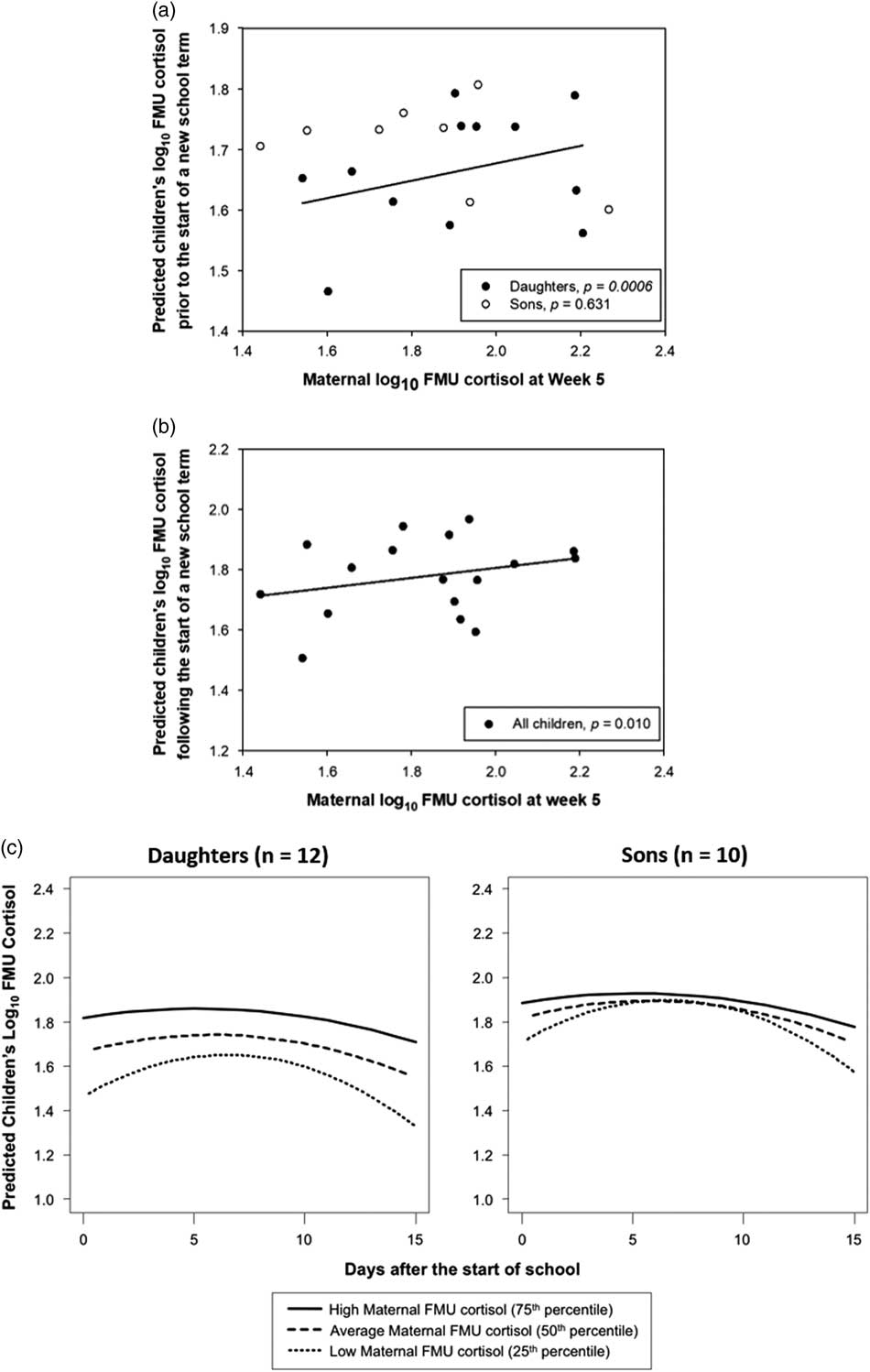
Maternal EPC cortisol was associated with children’s basal cortisol levels (before a new school year started) in a sex-specific and time-dependent manner (overall model P=0.002; sex-specific interaction P=0.002; Table 1). EPC week 5 cortisol was positively associated with daughter’s basal cortisol (avg. increase=0.570 log10 FMU cortisol for each 1 ng/ml increase in maternal log10 FMU cortisol (P=0.00006), but not sons’ (P=0.631) (Table 1; Fig. 2a). Higher cortisol at EPC week 7 was also associated with lower basal cortisol for both daughters and sons with an average decrease of 0.351 log10 FMU cortisol for each 1 ng/ml increase in maternal log10 FMU cortisol (P=0.0265; Table 1). Overall average maternal cortisol across the entire EPC period was not associated with children’s ‘basal’ cortisol levels (P>0.05).
Associations between maternal cortisol during the early post-conception (EPC) period and children’s hypothalamic–pituitary–adrenal axis activity. (a) Maternal cortisol during week 5 post-conception was positively associated with their daughters’ cortisol before the start of school (solid circles and line). On average, daughters’ log10 first-morning urine (FMU) cortisol increased by 0.570 for each 1 ng/ml increase in maternal log10 FMU cortisol (P=0.00006). In contrast, EPC week 5 cortisol was not significantly associated with sons’ log10 FMU cortisol before the start of school (open circles; P=0.631). (b) Higher maternal cortisol at EPC week 5 was positively associated with children’s cortisol after the start of school, with an average increase of 0.374 log10 children’s FMU cortisol for each 1 ng/ml increase in maternal log10 FMU cortisol (P=0.010). (c) Maternal cortisol during EPC week 3 significantly interacted with the quadratic trajectory of their children’s cortisol profiles after the start of a new school year. The association between mother’s and children’s log10 FMU cortisol was strongest (i.e., there was a greater difference between the high (solid) and low (dotted) maternal FMU cortisol lines) immediately following the start of a new school term and near the end of the study period, 2 weeks later.

Final regression model for the association between children’s log10 first morning urinary (FMU) cortisol before the start of school, sex of the child and weekly maternal log10 FMU cortisol during the early post-conception period:
 $$y_{{ij}} {\equals}\beta _{0} {\plus}\beta _{3} {\rm Sex}_{i} {\plus}\alpha _{5} \left( {{\rm week}_{{m5}} } \right){\plus}\gamma _{1} \left( {{\rm week}_{{m5}} } \right)^{\asterisk}{\rm Sex}_{i} {\plus}\alpha _{7} \left( {{\rm week}_{{m7}} } \right){\plus}{\varepsilon}_{{ij}} $$

Overall model adjusted R2=11.1%, P=0.002.
β0: Average log10 FMU cortisol of daughters before the start of school.
β0+β3: Average log10 FMU cortisol of sons before the start of school.
α5+γ1: Average change in sons’ log10 FMU cortisol for each 1 ng/ml increase in maternal log10 FMU cortisol during week 5.
Maternal EPC cortisol and children’s cortisol following the start of a new school term
EPC cortisol was also associated with children’s cortisol after the new school year started in a sex-specific, time-dependent manner (overall model P=0.00005; sex-specific interaction P=0.038; Table 2). For every 1 ng/ml increase in EPC week 2 log10 cortisol, daughters’ log10 FMU cortisol increased by 0.719 (P=0.0002) after school started, while sons’ cortisol increased by 0.292 (P=0.0265; Table 2). Higher EPC week 5 cortisol was positively associated with sons’ and daughters’ cortisol after school started (avg. increase= 0.374 log10 FMU cortisol per 1 ng/ml increase in log10 EPC week 5 cortisol; P=0.010; Table 2; Fig. 2b). Children’s cortisol levels after school started followed a quadratic trajectory that varied according to EPC week 3 cortisol (P=0.040; Table 2). The association between EPC week 3 and children’s cortisol was strongest immediately following the start of the new school term and near the end of the sampling period (Fig. 2c). Furthermore, children exposed to the highest EPC cortisol had the greatest cortisol response immediately following the start of school, which was maintained. In contrast, children exposed to the lowest EPC cortisol showed a much smaller and delayed cortisol response to the start of school. Overall average maternal cortisol across the entire EPC period was not associated with children’s cortisol levels following the start of a new school term (P>0.05).
Final regression model for the association between children’s log10 first-morning urinary (FMU) cortisol following the start of a new school term, sex of the child and weekly maternal log10 FMU cortisol during the early post-conception period:
 $$\eqalignno{ y_{{ij}} {\equals} & \beta _{0} {\plus}\beta _{1} {\rm Time}_{{ij}} {\plus}\beta _{2} {\rm Time}^{2} _{{ij}} {\plus}\beta _{3} {\rm Sex}_{i} {\plus}\alpha _{2} \left( {{\rm week}_{{m2}} } \right){\plus}\alpha _{3} \left( {{\rm week}_{{m3}} } \right){\plus}\alpha _{5} \left( {{\rm week}_{{m5}} } \right){\plus}\alpha _{7} \left( {{\rm week}_{{m7}} } \right) \cr {\plus} & \gamma _{1} \left( {{\rm week}_{{m3}} } \right){\asterisk}{\rm Time}_{{ij}} {\plus}\gamma _{2} \left( {{\rm week}_{{m3}} } \right){\asterisk}{\rm Time}^{2} _{{ij}} {\plus}\gamma _{3} \left( {{\rm week}_{{m2}} } \right){\asterisk}{\rm Sex}_{i} {\plus}b_{{i0}} {\plus}b_{{i1}} {\rm Time}_{{ij}} {\plus}{\varepsilon}_{{ij}} $$

Overall model adjusted R2=37.2%, P=0.00005.
β0: Average log10 FMU cortisol of daughters after the start of school
β0+β3: Average log10 FMU cortisol of sons after the start of school
α2+γ3: Average change in sons’ log10 FMU cortisol for each 1 ng/ml increase in maternal log10 FMU cortisol during week 2
Children’s HPAA reaction to the TSST-C
As expected, children’s salivary cortisol was significantly higher immediately following TSST-C administration (T2) than before it (T1) (P=0.039; Supplementary Fig. S3). Cortisol remained elevated at T3, 20 min following TSST-C’s completion (T2 v. T3, P=0.328; Supplementary Fig. S3), but by T4, 40 min after TSST-C’s completion, cortisol had returned to baseline levels (T2 v. T4, P=0.025; T1 v. T4, P=0.669) (Supplementary Fig. S3). Children’s salivary cortisol responses to the TSST-C were not related to the sex of the children (all sex-related parameters: P>0.05).
Maternal EPC cortisol and children’s HPAA reaction to the TSST-C
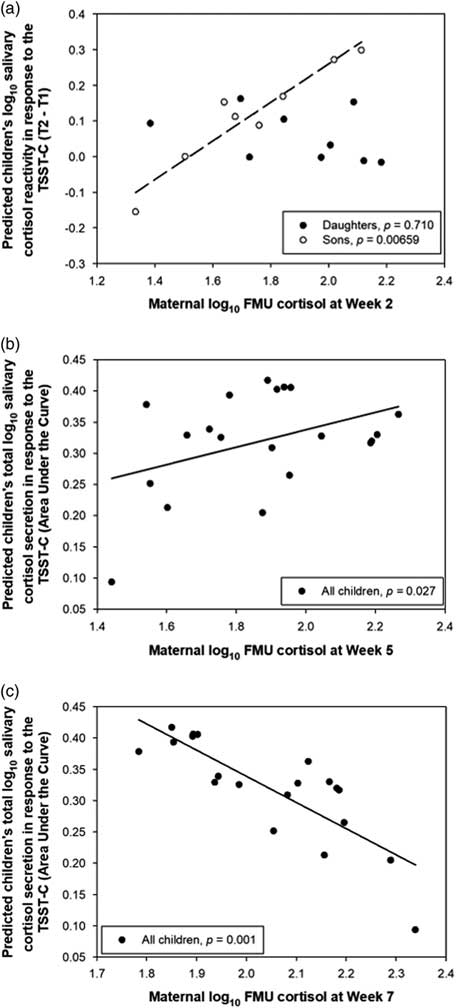
EPC cortisol was associated with children’s HPAA reactions to the TSST-C (i.e., T2 minus T1) in a sex- and time-dependent manner (overall model P=0.032; sex-specific interaction P=0.009; Table 3). EPC week 2 cortisol was positively associated with sons’ reactions to the TSST-C, with an average increase of 0.637 log10 salivary cortisol per 1 ng/ml increase in maternal log10 FMU cortisol (P=0.007; Fig. 3a), but not in daughters’ (P=0.710; Table 3; Fig. 3a). EPC week 4 cortisol was included in the final model despite its lack of significance (Table 3) because its exclusion decreased the model adjusted R2 from 44.1 to 21.1%. The magnitude of children’s recovery from the TSST-C (i.e., T2 cortisol minus T4 cortisol) was not associated with EPC cortisol (overall model, P=0.160). EPC cortisol was associated with children’s total cortisol secretion (AUC) in response to the TSST-C (overall model P=0.002; Table 4). EPC week 5 cortisol was positively associated with AUC (Table 4), with children’s log10 AUC increasing by 0.202 for every 1 ng/ml increase in maternal log10 FMU cortisol (P=0.027; Fig. 3b). In contrast, EPC week 7 cortisol was negatively associated with AUC (Table 4), with children’s log10 AUC values decreasing 0.477 for each 1 ng/ml increase in maternal log10 FMU cortisol (P=0.001; Fig. 3c). Overall average maternal cortisol across the entire EPC period was not associated with children’s cortisol reaction to, recovery from, or total secretion in response to the TSST-C (all P>0.05).
Maternal cortisol during the early post-conception (EPC) period and their children’s salivary cortisol reaction to the Trier Social Stress Test for Children (TSST-C), an experimental stressor. (a) Maternal log10 first-morning urine (FMU) cortisol during EPC week 2 was positively associated with their sons’ log10 salivary cortisol response (T2 – T1) to the TSST-C (open circles and dashed line). On average, sons’ log10 salivary cortisol increased by 0.637 for each 1 ng/ml increase in maternal log10 FMU cortisol (P=0.007). In contrast, maternal EPC week 2 cortisol was not significantly associated with daughters’ log10 salivary cortisol response to the TSST-C (solid circles; P=0.710). (b) Maternal log10 FMU cortisol during EPC week 5 was positively associated with their children’s total salivary cortisol secretion (area under the curve, AUC) in response to the TSST-C. On average, children’s total log10 salivary cortisol secretion increased by 0.202 for each 1 ng/ml increase in maternal FMU cortisol (P=0.027). (c) In contrast, maternal cortisol during EPC week 7 was negatively associated with children’s total salivary cortisol secretion in response to the TSST-C. Children’s total log10 salivary cortisol secretion decreased by 0.477 for each 1 ng/ml increase in maternal log10 FMU cortisol (P=0.001).

Final regression model for the association between children’s log10 salivary cortisol reaction to the Trier Social Stress Test for Children (TSST-C), an experimental stressor, sex of the child and weekly maternal log10 first-morning urinary (FMU) cortisol during the early post-conception period:
 $$y_{i} {\equals}\beta _{0} {\plus}\beta _{1} {\rm Sex}_{i} {\plus}\alpha _{2} \left( {{\rm week}_{{m2}} } \right){\plus}\gamma _{1} \left( {{\rm week}_{{m2}} } \right){\asterisk}{\rm Sex}_{i} {\plus}\alpha _{4} \left( {{\rm week}_{{m4}} } \right){\plus}{\varepsilon}_{{ij}} $$

Overall model adjusted R2=44.1%, P=0.032.
β0: Average log10 salivary cortisol reaction of daughters
β0+β1: Average log10 salivary reaction of sons
α2+γ1: Average change in sons’ log10 salivary cortisol reaction for each 1 ng/ml increase in maternal log10 FMU cortisol during week 2
Final regression model for the association between children’s total salivary log10 cortisol secretion (area under the curve, AUC) in response to the TSST-C, an experimental stressor, and weekly maternal log10 first-morning urinary (FMU) cortisol during the period:
 $$y_{i} {\equals}\beta _{0} {\plus}\alpha _{5} \left( {{\rm week}_{{m5}} } \right){\plus}\alpha _{7} \left( {{\rm week}_{{m7}} } \right){\plus}{\varepsilon}_{{ij}} $$

Overall model adjusted R2=45.0%, P=0.002.
β0: Average log10 cortisol AUC for all children
Maternal EPC cortisol and children’s DNA methylation
Candidate gene DNA methylation patterns
None of the 347 CpG sites associated with children’s candidate genes NR3C1, NR3C2, FKBP5, IGF2, CRH-R1 and BDNF were significantly associated with EPC cortisol levels.
Maternal EPC cortisol and children’s epigenome-wide DNA methylation patterns
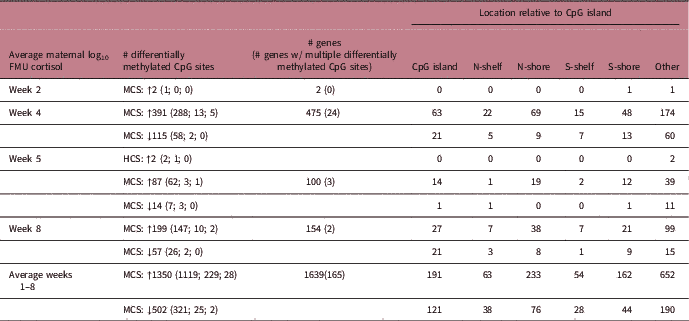
HCS (FDR<5%) and MCS (FDR 5–25%) associated with cortisol in at least one EPC week in our epigenome-wide analysis are summarized in Table 5. Briefly, increased week 2 cortisol was associated with increased methylation of two MCS within two genes. Week 4 EPC cortisol was associated with increased methylation of 391 MCS and decreased methylation of 115 MCS in 475 genes, 24 of which contained multiple differentially methylated sites. EPC week 5 cortisol was associated with increased methylation of two HCS and 87 MCS and decreased methylation of 14 MCS in 100 genes, three of which contained multiple differentially methylated sites. Week 8 cortisol was associated with increased methylation of 199 MCS and decreased methylation of 57 MCS in 154 genes, two of which contained multiple differentially methylated sites. Overall average maternal cortisol across the entire EPC period was significantly associated with increased methylation of 1350 MCS and decreased methylation of 502 MCS in 1639 genes, 165 of which contained multiple differentially methylated sites (Table 5). We did not find any interaction effects between EPC cortisol, children’s sex and their DNA methylation patterns; however, this could be due to insufficient statistical power.
Summary of children’s DNA methylation results for CpG sites related to maternal cortisol in the first 8 weeks post-conception

All sites have false discover rates (FDR)<25% and differential methylation >5%. High-confidence sites (HCS): FDR<5%; medium-confidence sites (MCS): FDR 5–25%; ↑=increased methylation; ↓=decreased methylation. The numbers of HCS and MCS are followed in parentheses by the numbers of these sites where differential methylation >10%, 25% and 30%, respectively.
Do the children’s DNA methylation patterns statistically mediate the associations between maternal EPC cortisol and children’s HPAA activity?
Only one of the children’s five HPAA activity variables was statistically associated with their DNA methylation patterns. Children’s ‘basal’ cortisol before the start of a new school year was associated with increased methylation of three MCS and decreased methylation of two MCS. However, the methylation patterns of these five MCS were not associated with maternal EPC cortisol. Therefore, statistical mediation analysis was not conducted for those methylation patterns.
DISCUSSION
Maternal EPC cortisol and their children’s HPAA activity
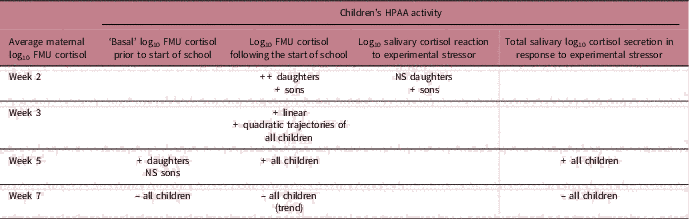
To our knowledge, this is the first study to analyze longitudinal relationships between mothers’ cortisol levels during the first 8 weeks immediately following conception and their children’s HPAA functioning. Maternal cortisol levels in weeks 2, 5 and 7 post-conception were associated with their 10–11-year-old children’s basal HPAA activity and reactivity to, and recovery from, experimental and non-experimental psychosocial challenges (Tables 1–4 and 6; Figs 2 and 3). Some of the observed associations differed by sex (Tables 1–4 and 6; Figs 2 and 3). Specifically, EPC week 5 cortisol was associated with daughters’ ‘basal’ cortisol before the start of a new school term, but not sons’ cortisol. In contrast, maternal cortisol in EPC week 2 was associated with sons’ HPAA reactivity to an experimental stressor, but not daughters’ HPAA reactivity. Using weekly averages for our longitudinal analyses was paramount in detecting these associations, as they were not apparent when maternal cortisol levels were averaged over the entire EPC period. We attribute this effect to the opposing nature of some of these associations (positive for weeks 2 and 5, negative for week 7), which may cancel each other out when maternal cortisol is averaged over the entire EPC period. Importantly, however, the signs of the associations between weekly maternal EPC cortisol levels and children’s HPAA activity were consistent across matrices (urine and saliva) and social contexts (experimental and non-experimental challenges) used to assess outcome variables in children (Table 6), suggesting that our results are robust.
Summary of associations between weekly average maternal log10 first-morning urinary (FMU) cortisol during the early post-conception period and children’s pre-pubertal hypothalamic–pituitary–adrenal axis (HPAA) activity

+=positive association; –=negative association. The numbers of pluses (+) or minuses (–) reflect the magnitude of the association.
In the absence of previous prospective human studies on the links between peri-conceptional maternal cortisol and HPAA programming and postnatal phenotype, we can only draw direct comparisons between our results and those of the few animal studies related to this subject. Consistent with our results, in ewes, elevated maternal cortisol levels during the first month of gestation (of a 146-day gestation period) triggered by nutritional stress were linked with offspring’s postnatal HPAA activity. Compared to controls, exposed offspring showed higher baseline cortisol and more pronounced adrenocorticotropic hormone and cortisol responses to CRH challenges.Reference Chadio, Kotsampasi and Papadomichelakis 89 – Reference Zhang, Rattanatray and LacLaughlin 91 In mice, maternal restraint stress during the pre-implantation period was associated with decreased blastocyst cell counts, and offspring with lower body weight, smaller fat deposits and significantly delayed developmental milestones, as well as altered behavior compared to controls. Unfortunately, offspring’s postnatal HPAA activity was not measured in that study.Reference Burkus, Kacmarova and Kubandova 92 These results are consistent with hypothesis that exposure to maternal EPC stress can affect HPAA ontogeny and other aspects of the postnatal phenotype.
Our results complement previous human studies focused on later gestational periods that show that prenatal maternal stress influences the development of a broad spectrum of biological systems, including the HPAA.Reference Torche and Kleinhaus 22 – Reference Rakers, Frauendorf and Rupprecht 32 , Reference Zijlmans, Riksen-Walraven and de Weerth 93 Martinez-Torteya et al., for example, report that maternal exposure to intimate partner violence during pregnancy was associated with higher basal HPAA activity in their 10-year-old children.Reference Martinez-Torteya, Bogat, Levendosky and von Eye 94 Importantly, the same study reports that children’s postnatal exposure to the same stressor was not linked to the same effects, which is consistent with the hypothesis that the timing of stress exposure is of critical importance.Reference Martinez-Torteya, Bogat, Levendosky and von Eye 94 In contrast, gestational exposure to the Iowa Flood of 2013 was associated with higher HPAA reactivity in toddlers whose mothers were exposed to this traumatic event later during pregnancy than in those whose mothers were exposed earlier.Reference Yong Ping, Laplante and Elgbeili 16 Differences between study outcomes highlight the need to take into consideration the nature of the prenatal challenges faced by mothers (e.g., physiological, psychosocial, energetic, immunological), the timing of the exposure (vis-à-vis HPAA development), the children’s age when postnatal HPAA activity is assessed, and the type of postnatal HPAA activity measured (e.g., basal v. stress reactivity).
Our observations regarding the sex-specific nature of some of the associations between maternal EPC cortisol and children’s HPAA functioning are in line with the results of studies focused on similar exposures later during gestation. For example, during late gestation, subjective prenatal maternal distress attributed to the Iowa Flood was linked to toddler daughters’ HPAA reactivity in response to maternal separation, but not sons’.Reference Yong Ping, Laplante and Elgbeili 16 Other outcomes such as brain morphology, temperament and neuropsychiatric disorders later in life (e.g., depression and anxiety) associated with specific HPAA phenotypesReference Sandman, Glynn and Davis 95 – Reference Glover and Hill 98 have also exhibited similar female-biased associations with mid- and late prenatal exposures.Reference Fernandez-Guasti, Fiedler, Herrera and Handa 96 , Reference Chrousos and Gold 99 – Reference Goldstein, Handa and Tobet 101 Other studies, however, find male-biased associations.Reference Mueller and Bale 23 , Reference van Os and Selten 28 , Reference Brunton 102 For example, sons of mothers exposed during the second trimester to famine resulting from the 1940 invasion of the Netherlands suffered increased risk of schizophrenia as adults, but daughters did not.Reference van Os and Selten 28 Together with our results, these studies suggest that variation observed in HPAA activity among individuals and its associated disease risks may be partially explained by sex interacting with the timing, type and intensity of exposure to maternal stress.
Our data do not allow us to discern whether the link between maternal EPC cortisol and children’s postnatal HPAA activity is causal. These relationships could be the result of a combination of non-mutually exclusive mechanisms, including shared HPAA-related genes between mothers and children and epigenetic modifications of children’s HPAA-related genes in response to early environments that they shared with their mothers. Twin studies show that part of the variance in HPAA basal activity and responsivity is explained by genetic factors (heritability ranges: 31–50%).Reference Bartels, de Geus, Kirschbaum, Sluyter and Boomsma 103 – Reference Van Hulle, Shirtcliff, Lemery-Chalfant and Goldsmith 105 We did not have sufficient amounts of DNA to genotype our participants, nor did we have a large enough sample size to perform quantitative genetic analyses. In follow-up studies we plan to collect bio-specimens to genotype HPAA-related genes in a larger sample of this population so that we can evaluate their contribution to the observed relationships.
Children’s DNA methylation patterns, maternal EPC cortisol and children’s HPAA activity
Animal evidence and a limited number of human studies involving assisted reproductive technology samples suggest a role for DNA methylation as a potential mediator for the relationship between maternal EPC cortisol and children’s postnatal HPAA activity.Reference Hales, Grenier, Lalancette and Robaire 54 , Reference Chadio, Kotsampasi and Papadomichelakis 89 A few animal studies specifically examined DNA methylation profiles and offspring HPAA activity after experimental increases in EPC maternal cortisol. In sheep, maternal HPAA activation resulting from peri-conceptional undernutrition was associated with offspring’s postnatal HPAA basal activity and reactivity, adrenocortical hypertrophy and decreased adrenal methylation and mRNA expression of the IGF2/H19 gene.Reference Hernandez, Matthews, Oliver, Bloomfield and Harding 90 , Reference Zhang, Rattanatray and LacLaughlin 91 , Reference Zhang, Morrison and Gill 106 We did not find significant differences in the methylation of IGF2, one of our candidate genes. Our epigenome-wide association study did, however, uncover an association between increased methylation of an MCS within IGFBP2 and EPC cortisol in weeks 4 and 8 (12 and 13% increase, respectively). IGFBP2 codes for a protein that binds to and decreases the bioavailability of both IGF-1 and IGF-2.Reference Clemmons 107 Both IGF-1 and IGF-2 promote somatic growth and development, with IGF-2 predominating during gestation and IGF-1 postnatally.Reference Kadakia and Josefson 108 – Reference Cohick and Clemmons 110 Thus, this methylation pattern, if conserved across other growth-related tissues, may hint to the existence of a mechanistic link between EPC stress exposure and regulation of pre- and postnatal growth, both of which are influenced by exposure to prenatal maternal stress.Reference Lewis, Austin and Galbally 111
Our epigenome-wide approach also identified 28 genes that contained two or more CpG sites with >5% change in methylation and FDR <25%. Of the 28 genes, 11 were associated with average cortisol in more than one EPC week. One of these genes, POU3F2, is directly involved in HPAA activity as it encodes the POU Class 3 Homeobox 2 protein, which is involved in neuronal differentiation and activation of genes under the control of CRH promoters.Reference Alazard, Blaud and Elbaz 112 POU3F2 contained one MCS whose differential methylation increased 5% in association with EPC cortisol in weeks 4 and 8, one MCS that exhibited 9% increased methylation associated with week 4 cortisol, and another MCS whose 11% increased methylation pattern was associated with average cortisol across the entire 8-weeks EPC period. In addition, EPC cortisol was associated with differential methylation of CpG sites within CRHBP, which codes for a binding protein that inactivates CRH in circulation. One MCS within CRHBP’s enhancer region exhibited 19, 19 and 20% increased differential methylation associated with maternal cortisol in EPC weeks 4 and 8 and the average across the entire 8-week EPC period, respectively. If POU3F2 and CRHBP were to exhibit similar DNA methylation patterns across different CRH-sensitive tissues, then exposure to increased maternal EPC cortisol may influence the subsequent responsivity of children’s CRH-regulated genes, but our data do not allow us to test this hypothesis.
Our epigenome-wide study identified significant associations between EPC maternal cortisol and differential methylation of 867 CpG sites found in 731 genes, 29 of which contained multiple differentially methylated CpG sites (Table 5). These results are consistent with studies focused on early postnatal life challenges and DNA methylation. Essex et al., for example, reported increased methylation of 139 HCS in adolescents, 37 of which had >5% methylation differences between children exposed to low v. high maternal stress during infancy. 41 Interestingly, in Essex’s study, paternal stress, but not maternal, during preschool years was associated with increased methylation of two HCS and 29 MCS, 12 of which had methylation differences >5% between low and high stress exposure groups. 41 Those authors identified PAGM2 and C19orf30 as having robust methylation differences (>5%) at more than one CpG site in association with maternal stress during infancy and paternal stress during the preschool period. We did not find evidence for differential methylation of either gene in relation to maternal EPC cortisol. We did, however, find associations between children’s HPAA activity and differential methylation of five CpG sites. Yet, none of these CpG sites had methylation profiles that were related to any measure of maternal EPC cortisol. Therefore, our results do not provide evidence that the link between EPC maternal cortisol levels and their children’s HPAA activity was statistically mediated by the observed DNA methylation differences.
Limitations
The lack of statistical significance for children’s DNA methylation as a mediator of the associations between EPC cortisol and children’s postnatal HPAA activity could be attributed to a variety of factors. A key one is our limited sample size. Our longitudinal design, with repeated sampling during two key life stages, is a strength of our study and provided sufficient statistical power to detect the association between EPC cortisol and children’s pre-pubertal HPAA activity. Yet, the same sample size may not suffice to identify a putative mediatory role for children’s DNA methylation between those two variables. The tissue used to assess DNA methylation, buccal epithelial cells, represents another limitation. While DNA methylation patterns do vary among different tissues within individuals, some studies, yet not all, report significant correlations among them.Reference Ma, Wilker and Willis-Owen 113 – Reference Lokk, Modhukur and Rajashekar 117 We do not know the extent to which methylation patterns in buccal epithelial cells reflect those of tissues directly associated with HPAA function. Yet, access to HPAA-related tissues such as hypothalamic, hippocampal or adrenal tissue is not possible with live human participants. Another important limitation is our inability to account for the effects that socio-ecological events that took place in the life of the children between gestational week 8 and ages 10–11 could have had on the children’s methylome.Reference Yuen, Neumann and Fok 56 In our study population it is very possible that mothers’ environments during the EPC period and their children’s environments across 11 years of development are very similar in terms of energetic, immunological and socio-economic status.Reference Black, Devereux and Salvanes 118 However, our lack of substantial information over this period prevents us from being able to disentangle the direct effects of EPC cortisol on the children’s pre-pubertal HPAA activity from those of the postnatal socio-ecological environment they share with their mothers.
Despite its limitations, this study circumvents a number of logistical issues to offer the first evaluation of putative links between maternal cortisol levels immediately after conception, a critical developmental stage, and children’s postnatal HPAA activity. We found significant associations between these two traits and between each of them and children’s DNA methylation patterns. None of those DNA methylation patterns, however, were related to both maternal EPC cortisol and children’s postnatal HPAA activity. Therefore, we cannot attribute the associations between maternal EPC cortisol levels and children’s postnatal HPAA activity to epigenetic mechanisms. Nonetheless, it is crucial to note that the observed children’s DNA methylation patterns could constitute molecular footprints or biomarkers left behind by either the maternal environment during the EPC period or its correlates during the children’s postnatal development. Future prospective, large pre-conception cohort studies that monitor children’s development longitudinally and include frequently collected environmental information and bio-specimens are needed to replicate our analyses and evaluate the relative contributions of socio-ecological conditions on HPAA ontogeny and activity, controlling for both genetic and epigenetic factors.
Supplementary material
To view supplementary material for this article, please visit https://doi.org/10.1017/S2040174418000880
Acknowledgments
The authors thank the members of our Guatemalan research team for their assistance during fieldwork, as well as Dr Nestor Carrillo-Poton, Dr Constantino Isaac Sánchez Montoya, Dr Mayron Martinez, and the rest of the personnel of Guatemala’s Ministry of Health for permits and logistical collaboration.
Financial Support
This longitudinal project was funded by a Canadian Institutes of Health Research Post-Doctoral Fellowship to CKB (http://www.cihr-irsc.gc.ca/e/193.html); a CFRI Mining for Miracles Post-Doctoral Fellowship to MJJ; NSERC Discovery Grants to LZ and EE; an SFU President’s Start-up Grant, a CIHR IGH Operating Grant #106705, an SFU Community Trust Endowment Fund Grant through SFU’s Human Evolutionary Studies Program and a Michael Smith Foundation for Health Research Career Investigator Scholar Award to PAN. The funders had no role in study design, data collection and analysis, decision to publish or preparation of the manuscript.
Conflicts of Interest
None.