About 7% of US school children engage in bullying behavior (Limber, Olweus, & Luxenberg, Reference Limber, Olweus and Luxenberg2013). Bullying has negative consequences for children's adjustment in school, such as reduced peer acceptance, increased conflict with teachers (e.g., Gower, Lingras, Mathieson, Kawabata, & Crick, Reference Gower, Lingras, Mathieson, Kawabata and Crick2014), and potentially long-term consequences such as substance use and adult criminal convictions (Farrington, Ttofi, & Lösel, Reference Farrington, Ttofi and Lösel2011; Kretschmer, Veenstra, Deković, & Oldehinkel, Reference Kretschmer, Veenstra, Deković and Oldehinkel2017). Although bullying is also readily engaged in by preschool children, it has been less extensively studied during this developmental period (e.g., Hart, Nelson, Robinson, & McNeilly-Choque, Reference Hart, Nelson, Robinson, Olsen and McNeilly-Choque1998; Vlachou, Andreou, Botsoglou, & Didaskalou, Reference Vlachou, Andreou, Botsoglou and Didaskalou2011; Huitsing & Monks, Reference Huitsing and Monks2018); thus, it is important to investigate factors that may contribute to bullying in young children to inform prevention and intervention efforts targeting parents, bullies, and bully victims (Curtner-Smith, Smith, & Porter, Reference Curtner-Smith, Smith, Porter, Vernberg and Biggs2010; Nelson, Coyne, Swanson, Hart, & Olsen, Reference Nelson, Coyne, Swanson, Hart and Olsen2014).
Bullying is often referred to as a subtype of aggression or a set of behaviors that are enacted with an intent to hurt or harm another weaker or relatively powerless individual physically or psychologically by attacking, humiliating, or excluding repeatedly over time (Monks & Smith, Reference Monks and Smith2006; Salmivalli, Reference Salmivalli2010; van Noorden et al., Reference van Noorden, Haselager, Lansu, Cillessen and Bukowski2016). Features of bullying can include physical aggression such as hitting, kicking, pushing, or threatening thereof; relational aggression involving gossiping, social exclusion, or rumor spreading; and verbal disparagements such as teasing, name-calling, embarrassing others, and making derogatory remarks accompanied by demeaning expressions (Olweus, Reference Olweus and Hart1993; Salmivalli, Peets, & Hodges, Reference Salmivalli, Peets, Hodges, Smith and Hart2011). The bullying features of this construct are less “object oriented” for the instrumental aggressive purposes of acquiring objects, territory, or privileges, and more “person directed” with the aim of repeatedly dominating or intimidating perceived weaker individuals (Hartup, Reference Hartup1974; Price & Dodge, Reference Price and Dodge1989).
Few studies focusing on early childhood have measured bullying aggressive behavior that includes most of these elements simultaneously, but typically have focused more on specific forms of aversive behavior such as verbal, physical, and/or relational aggression (e.g., Casas et al., Reference Casas, Weigel, Crick, Ostrov, Woods, Yeh and Huddleston-Casas2006; Nelson et al., Reference Nelson, Coyne, Swanson, Hart and Olsen2014; Rajendran, Kruszeweski, & Halperin, Reference Rajendran, Kruszewski and Halperin2016). Moreover, much of the broader bullying literature is directed toward older children and centers on victims who are the targets of bullying (e.g., Haynie et al., Reference Haynie, Nansel, Eitel, Crump, Saylor, Yu and Simons-Morton2001; Wolke, Woods, Bloomfield, & Karstadt, Reference Wolke, Woods, Bloomfield and Karstadt2000) or on bully/victims who both bully others and are victims of bullying (e.g., Juvonen, Graham & Schuster, Reference Juvonen, Graham and Schuster2003; Wolke & Samara, Reference Wolke and Samara2004). Given the lack of a systematic examination of bullying features together in research involving young children, we measured different elements of bullying aggression identified in the literature that are highlighted by behaviors that disparage, dominate, and intimidate others in a group of Asian American preschool children.
Parenting and child bullying in early childhood
Several theoretical perspectives can be drawn upon to frame conceptual linkages between parenting and bullying aggressive behavior. Social learning theory, for example, suggests that parents who use psychologically controlling interaction styles model manipulative, aversive behaviors that their children subsequently tend to enact with peers. Specifically, parents who threaten to withdraw love and attention unless a child is compliant with their wishes may mirror relationally aggressive child threats to end a relationship unless a friend is compliant with their wishes (e.g., Nelson et al., Reference Nelson, Yang, Coyne, Olsen and Hart2013). Parenting associations with bullying aggressive behavior may also be mediated by social cognitive variables that include deficits in how children learn to process social information. Parents who model maladaptive processing or engage in aversive parenting that promotes a hostile home environment may facilitate the development of children's hostile intent attributions that are linked to aggressive behavior (e.g., Nelson & Coyne, Reference Nelson and Coyne2009; Nelson, Mitchell, & Yang, Reference Nelson, Mitchell and Yang2008).
Attachment theory also provides a theoretical framework that emphasizes the importance of sensitivity and responsiveness in how parents interact with their young children (Bowlby, Reference Bowlby1988; Michiels, Grietens, Onghena, & Kuppens, Reference Michiels, Grietens, Onghena and Kuppens2008). Parents who engage in aversive, controlling behaviors may weaken the attachment relationship with their child, thus promoting an internal working model in which they expect that others will not be sensitive to their needs. Accordingly, the child's perceived lack of acceptance in the parent-child relationship may lend itself to relational insecurity in associations with others and to generalized expectations for rejection or conditional acceptance by peers, which is contrary to the fundamental human need for close, emotionally secure relationships (Deci & Ryan, Reference Deci and Ryan2000). Aggressive and negative behaviors in which children attempt to preemptively avert rejection and seek to aversively dominate their peers is posited to be how children inappropriately cope with relational insecurity (Soenens, Vansteenkiste, Goossens, Duriez & Niemiec, Reference Soenens, Vansteenkiste, Goosens, Duriez and Niemiec2008). Casas et al. (Reference Casas, Weigel, Crick, Ostrov, Woods, Yeh and Huddleston-Casas2006) provided some support for this notion in a study that linked insecure attachment to higher levels of childhood physical and relational aggression.
With regard to empirical support for the theoretical perspectives noted previously for linkages between parenting and child bullying, Lereya, Samara, and Wolke (Reference Lereya, Samara and Wolke2013) conducted a meta-analysis of 70 studies that explored associations between parenting and child bullying, focusing primarily on peer victimization as well as bully/victims. The meta-analysis revealed that children who were bullies and victims were less likely to experience authoritative, sensitive, and responsive parenting and were more likely to be exposed to authoritarian, rejecting, and inconsistent parenting. Only 1 of the 70 studies examined young children using a longitudinal design, which showed that child bullying since age 5 years retrospectively reported by teachers and parents at age 7 were predicted by earlier child maltreatment (e.g., physical abuse) and low maternal warmth (Bowes, Arseneault, Maughan, & Taylor, Reference Bowes, Arseneault, Maughan, Taylor, Caspi and Moffitt2009). Recently, Rajendran et al. (Reference Rajendran, Kruszewski and Halperin2016) found that parental support for child autonomy at ages 4 to 5 predicted reduced child bullying during the early school years; however, the authors did not find any longitudinal links between parental negative affect, emotionally supportive parenting, or the quality of parent–child interactions and child bullying. Although the trends are not entirely consistent across these limited early childhood studies, extant longitudinal findings suggest that certain parenting practices may predict later child bullying aggressive behavior.
Psychologically controlling parenting and role of culture
The current study focused on longitudinal linkages between psychologically controlling parenting and child bullying aggression, which have not yet been extensively examined. Parental psychological control refers to parents’ indirect control of children's behavior through the manipulation of their thoughts and feelings and includes an array of parenting behaviors such as constraining children's verbal expressions, invalidating their feelings, shaming, and exercising love withdrawal (Barber, Reference Barber1996; Yu, Cheah, Hart, Sun & Olsen, Reference Yu, Cheah, Hart, Sun and Olsen2015). As noted previously, such aversive parenting practices may weaken the parent–child attachment bond by creating a context of insecurity or inconsistency, thereby jeopardizing the child's sense of acceptance and relational security and leading to peer relationship difficulties.
Parental psychological control has been found to predict poorer psychosocial functioning in children from Western cultures, including their aggressive behaviors (e.g., Casas et al., Reference Casas, Weigel, Crick, Ostrov, Woods, Yeh and Huddleston-Casas2006; Nelson, Yang, Coyne, Olsen, & Hart, Reference Nelson, Yang, Coyne, Olsen and Hart2013). Psychologically controlling practices are used more frequently by parents in Asian cultures compared with those in Western cultures (e.g., Wu et al., Reference Wu, Robinson, Yang, Hart, Olsen, Porter and Wu2002). Despite the higher prevalence of such parenting practices in interdependence-oriented cultures, however, psychological control is not consistently associated with problem behaviors in children from these cultures, with some studies reporting associations with more child difficulties (e.g., Nelson, Hart, Yang, Olsen, & Jin, Reference Nelson, Hart, Yang, Olsen and Jin2006; Nelson et al., Reference Nelson, Coyne, Swanson, Hart and Olsen2014) and others revealing no associations or even associations with certain positive child outcomes (e.g., Fung & Lau, Reference Fung and Lau2012; Rudy & Halgunseth, Reference Rudy and Halgunseth2005). Thus, research to date has provided mixed evidence for the implications of psychological control on children from interdependent cultures.
These inconsistent findings may be due, in part, to conceptualization issues. Most previous studies that examined the associations between psychologically controlling practices and child behavior used an overall scale of psychological control (e.g., Aunola, Tolvanen, Viljaranta, & Nurmi, Reference Aunola, Tolvanen, Viljaranta and Nurmi2013; Barber, Reference Barber1996; Nelson et al., Reference Nelson, Coyne, Swanson, Hart and Olsen2014) that combined dimensions such as constraining verbal expressions, invalidating feelings, inducing guilt, and withdrawing love. The effects of psychological control dimensions that appear more aversive (e.g., personal attack) may differ however from other practices whereby parents draw children's attention to how their misbehavior has affected others (Yu, et al., Reference Yu, Cheah, Hart, Sun and Olsen2015). Fung and Lau (Reference Fung and Lau2012) suggested that the latter forms of psychological control (relational induction) may be more socially appropriate and congruent with the socialization goals of interdependent cultures, such as maintaining harmonious interpersonal relationships. These authors combined guilt induction, reciprocity, social comparison, and love withdrawal practices to create an overall index of relational induction and found that it was not associated with Chinese children's behavioral problems (including rule-breaking and aggressive behaviors); however, a more specific examination of the dimensions within relational induction is warranted.
Psychological control dimensions and child bullying aggression
We took a dimensional approach to examine maternal guilt induction and love withdrawal separately in the current study because these two constructs have been found to be statistically distinct (Yu et al., Reference Yu, Cheah, Hart, Sun and Olsen2015) and differentially associated with psychological adjustment indices (Rudy, Carlo, Lambert, & Awong, Reference Rudy, Carlo, Lambert and Awong2014) among individuals of Asian cultural backgrounds. Guilt induction includes elements of inductive reasoning (Hart, Ladd, & Burleson, Reference Hart, Ladd and Burleson1990) that introduces claims with accompanying rationales that support them (e.g., explaining that parents don't allow roller blading in the house because it puts scratches in the floor), but emphasizes claims that emotionally evoke guilt by personalizing stated consequences (e.g., telling children their actions may cause parents to worry). Accordingly, guilt induction has been posited to help children better understand their parents’ perspective (Hoffman & Saltzstein, Reference Hoffman and Saltzstein1967). Inductive practices tend to reflect parents’ child-centered goals to teach children values, societal rules, or important lessons for the child's future benefit and interpersonal connections (Dix, Reference Dix, Sigel, McGillicuddy-DeLisi, Goodnow, Sigel, McGillicuddy-DeLisi and Goodnow1992; Hastings & Grusec, Reference Hastings and Grusec1998); therefore, guilt inductive statements, which appeal to the child's internally motivated guilt potential by seeking to elicit empathy for parental sacrifices and efforts may be a less aversive form of psychological control (Fung & Lau, Reference Fung and Lau2012; Rudy et al., Reference Rudy, Carlo, Lambert and Awong2014). As Fung and Lau (Reference Fung and Lau2012) contend, “evoking guilt or inducing a focus on the parent's perspective helps the child acquire empathy and attunement to others’ thoughts and feelings” (p. 967). Stimulating a reasonable amount of guilt for wrongdoing through inductive means may serve to reduce child conduct problems (e.g., Kochanska, Reference Kochanska1993), which may have implications for curbing bullying since bullies tend to have little empathy for victims (Olweus, Reference Olweus and Hart1993).
In contrast to Fung and Lau (Reference Fung and Lau2012) who included love withdrawal as a form of relational induction, we asserted that love withdrawal is less of an inductive practice and more of an aversive form of psychological control. This is because love withdrawal involves little reasoning and centers on manipulating feelings of parental acceptance by threatening the loss of love and attention, which may undermine the parent–child bond, as posited by the parental acceptance–rejection theory (Rohner, Khaleque, & Cournoyer, Reference Rohner, Khaleque and Cournoyer2005; Rudy et al., Reference Rudy, Carlo, Lambert and Awong2014; Yu et al., Reference Yu, Cheah, Hart, Sun and Olsen2015). Examination of these two dimensions of psychological control and their specific associations with children's bullying outcomes is warranted therefore. Although research on Western children (Casas et al., Reference Casas, Weigel, Crick, Ostrov, Woods, Yeh and Huddleston-Casas2006; Nelson et al., Reference Nelson, Yang, Coyne, Olsen and Hart2013) show similarly detrimental effects of love withdrawal and guilt induction on child aggression, we expected these dimensions to have differential effects on Chinese children based on our conceptual arguments given previously and emerging empirical evidence for the benign nature of guilt induction among individuals influenced by interdependence-oriented cultures (Rudy et al., Reference Rudy, Carlo, Lambert and Awong2014; Yu, Cheah, Hart, & Yang, Reference Yu, Cheah, Hart and Yang2018).
Additional research gaps in the literature
In addition to the issues raised previously, several other gaps exist in the literature. First, little is known about the use and effects of psychological control among Asian immigrant families, which are now the fastest growing ethnic minority group in the United States, with Chinese Americans composing the largest subgroup of Asian Americans (US Census Bureau, 2016). Chinese Americans are unique in that they are potentially influenced by their heritage Chinese culture, which values interdependence and group harmony (Grusec, Reference Grusec, Kerr, Stattin and Engels2008), and the mainstream Western culture that emphasizes autonomy, assertiveness, and independence (Greenfield, Keller, Fuligni, & Maynard, Reference Greenfield, Keller, Fuligni and Maynard2003). Second, most previous research on psychological control used cross-sectional designs, which preclude drawing conclusions regarding directional relations between psychological control and child behavior. Extant longitudinal studies on Western samples provide contradictory evidence for the bidirectional relations between parental psychological control and child adjustment. Some studies found no prospective parenting effects, but child externalizing problems predicted increases in maternal psychological control (e.g., Albrecht, Galambos, & Jansson, Reference Albrecht, Galambos and Jansson2007); however, other studies found reciprocal effects between psychological control and child aggression (e.g., Kuppens, Grietens, Onghena, & Michiels, Reference Kuppens, Grietens, Onghena and Michiels2009). Third, previous studies are limited in that they focused primarily on older children and adolescents with European or European American backgrounds and often relied on the same reporters (e.g., adolescent report) for both the parenting and child behavior. Moreover, previous studies usually focused on hostile forms, rather than the relational induction forms, of psychological control (e.g., Albrecht et al., Reference Albrecht, Galambos and Jansson2007).
The present study
We aimed to advance the field by: (a) examining both a hostile (love withdrawal) and an inductive form of psychological control (guilt induction); (b) using a short-term longitudinal design to reveal bidirectional relations between parental psychological control and young Chinese American children's bullying aggressive behavior; and (c) using different reporters for parenting (i.e., parents) and child bullying (i.e., teachers). We hypothesized that maternal love withdrawal would predict more child bullying 6 months later, whereas maternal guilt induction would predict less child bullying after controlling for the temporal stability of the bullying aggression construct. Because of the lack of relevant previous research, our examination of child effects on parenting practices in the current study was exploratory.
Method
Participants
Participants were 133 first-generation Chinese American mothers (mean age [M age] = 37.82, standard deviation [SD] = 4.55) with young children (M age = 4.48, SD = 0.91, 53% boys). Both parents were identified as first-generation Chinese immigrants, but 92% of the children were born in the United States (i.e., second generation). Mothers had been in the United States for 10.84 years on average (SD = 5.56) and were originally from Mainland China (81%), Taiwan (14%), or Hong Kong (5%). About 6% of the participants had high school or partial college, 25% had a bachelor's degree, and 70% had a graduate or professional degree (e.g., masters degree, doctoral degree).
Procedure
Participants were recruited from various organizations (e.g., Chinese churches, preschools, daycare centers, Chinese language schools, grocery supermarkets) across the Maryland-Washington, DC, region to reach potential participants with diverse socioeconomic backgrounds and maximize the representativeness of the sample. Data collection was conducted in the participants’ homes by bilingual research assistants. Teacher ratings of child bullying behavior were obtained primarily by calling, faxing, or e-mailing. Two waves of longitudinal data were collected spaced approximately 6 months apart. Ethical approval for the study was obtained from the University institutional review board of the University of Maryland, Baltimore County, and parents provided their written consent before data collection.
Measures
The measures that were originally in English were translated to Chinese by bilingual graduate students. An extensive translation and back-translation process was applied to ensure the linguistic equivalence and maintain the original meaning of the measures (Pena, Reference Pena2007). The psychometric properties of the measures in our Chinese American sample were examined through confirmatory factor analysis models described below.
Maternal love withdrawal and guilt induction
Mothers reported on their parenting practices at both Wave 1 (W1) and Wave 2 (W2) using the Psychological Control Measure (Olsen et al., Reference Olsen, Yang, Hart, Robinson, Wu, Nelson, Wo and Barber2002) used in Chinese American samples (Yu et al., Reference Yu, Cheah, Hart, Sun and Olsen2015). Mothers rated how often they exhibit each parenting behavior on a 5-point Likert scale: 1 (never), 2 (once in a while), 3 (half of the time), 4 (very often), and 5 (always). Four items each for love withdrawal (e.g., “Is less friendly with child if child does not see things my way”) and guilt induction (e.g., “Say, if you really care for me, you would not do things that cause me to worry”) were used. The parenting constructs showed modest to good reliability (for love withdrawal, ω = .63 at W1 and ω = .81 at W2; for guilt induction, ω = .81 at W1 and ω = .79 at W2).
Child bullying aggressive behavior
Preschool teachers rated children's social behaviors with peers at both W1 and W2 using the Teachers’ Rating Scales (Hart & Robinson, Reference Hart and Robinson1996) that has been used in Chinese preschool children (e.g., Nelson et al., Reference Nelson, Hart, Yang, Olsen and Jin2006). Verbal, physical, and relational bullying items were used to construct children's bullying behavior (eight items). Similar to other studies of bullying (e.g., Rajendran et al., Reference Rajendran, Kruszewski and Halperin2016), each bullying item was rated on a 3-point Likert scale: 0 (never), 1 (sometimes), and 2 (very often) to estimate the repeated nature and severity of this behavior. Sample items (Table 2) that support our conceptualization of bullying aggressive behavior include, “Hits or kicks others for the sake of doing it,” “Makes fun of peer's possessions (e.g., clothes, projects),” and “Tries to get others to dislike peer (e.g., whispering mean things about the child behind their back).” The bullying construct showed good reliability (ω = .95 at W1 and ω = .93 at W2).
Analytic plan
The rate of missing data was <5% and data were assumed to be missing completely at random based on Little's Missing Completely at Random test χ2 (94, N = 133) = 83.82, p = .765 (Little, Reference Little1988). Because of the ordinal nature of data, the mean- and variance-adjusted weighted least squares estimator in Mplus, version 7 (Muthén & Muthén, Reference Muthén and Muthén1998–2012), was used to conduct confirmatory factor analysis (CFA) and structural equation modeling (SEM), which makes use of all available data for model estimations. CFA was first conducted to determine whether love withdrawal and guilt induction should be examined in one-factor psychological control model or two-factor model with love withdrawal and guilt induction as separate dimensions. CFA was also conducted to test whether a single bullying factor or three factors of verbal, physical, and relational bullying should be used. Measurement equivalence (i.e., metric invariance) of the variables was then tested by comparing the models assuming equal factor loadings across waves to the freely estimated models based on χ2 difference tests. Regarding reliability of the measurement, we calculated ω coefficient, which is considered a better alternative to coefficient α (Revelle & Zinbarg, Reference Revelle and Zinbarg2009; Yu, Sun, & Cheah, Reference Yu, Sun and Cheah2016). Finally, full structural equation modeling was conducted by estimating structural paths among parenting and child bullying constructs in a cross-lagged analysis. Model fit was evaluated by χ2 statistic, root mean square error of approximation (RMSEA), and Comparative Fit Index (CFI). CFI > .90 and RMSEA < .08 are considered adequate model fit (Hu & Bentler, Reference Hu and Bentler1998).
Results
CFA Models for parent and child constructs determined
A correlated two-factor CFA model was first estimated where love withdrawal and guilt induction were considered two correlated but separated dimensions of psychological control. A one-factor CFA model was then specified in which all eight items were loaded on a general construct of psychological control at each wave. The Δχ2 test showed that the two-factor model fit the data significantly better than the one-factor model, ∆χ2 (5, N = 133) = 59.56, p < .0001; therefore, the two-factor model was retained for further analysis. A similar procedure was implemented to test the bullying model. Nonsignificant Δχ2 test indicated that the bullying items were best presented by one-factor bullying rather than the three factors of verbal, physical, and relational bullying, ∆χ2 (14, N = 133) = 22.81, p = .064.
Measurement equivalence established
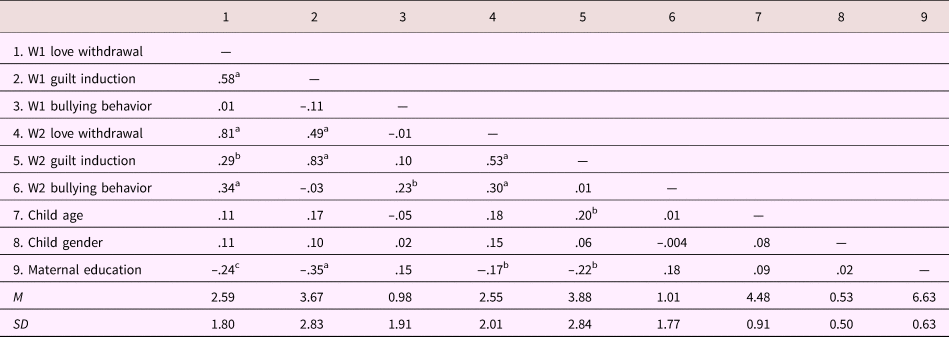
An unconstrained retained model was first specified for data at each wave where factor loadings were freely estimated. A constrained model was run next, which specified the factor loadings from the latent construct to the same indicators to be equal between the two waves. Finally, a Δχ2 test was conducted. For parenting, both the freely estimated (χ2 [86, N = 133] = 134.96, p = .001, CFI = .96, and RMSEA = .07) and constrained (χ2 [92, N = 133] = 135.90, p = .002, CFI = .96, and RMSEA = .06) parenting models achieved adequate model fit. Similarly, for child bullying, both the freely estimated (χ2 [95, N = 133] = 97.07, p = .422, CFI = 1.00, and RMSEA = .01) and constrained (χ2 [102, N = 133] = 100.94, p = .511, CFI = 1.00, and RMSEA = .00) models had adequate absolute model fit. Moreover, for parenting (Δχ2 [6, N = 133] = 6.82, p = .338) and child bullying (Δχ2 [7, N = 133] = 3.82, p = .800), Δχ2 tests were nonsignificant, indicating establishment of measurement invariance of both constructs. Correlations among the latent study constructs are presented in Table 1.
Descriptive statistics and correlations among the latent study constructs and demographic variables
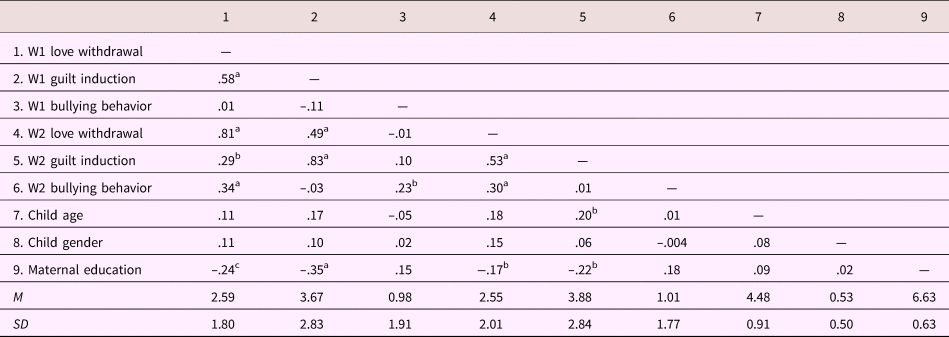
Note: ap < .001; bp < .05; cp < .01.
Relations over time between parenting and child bullying aggression
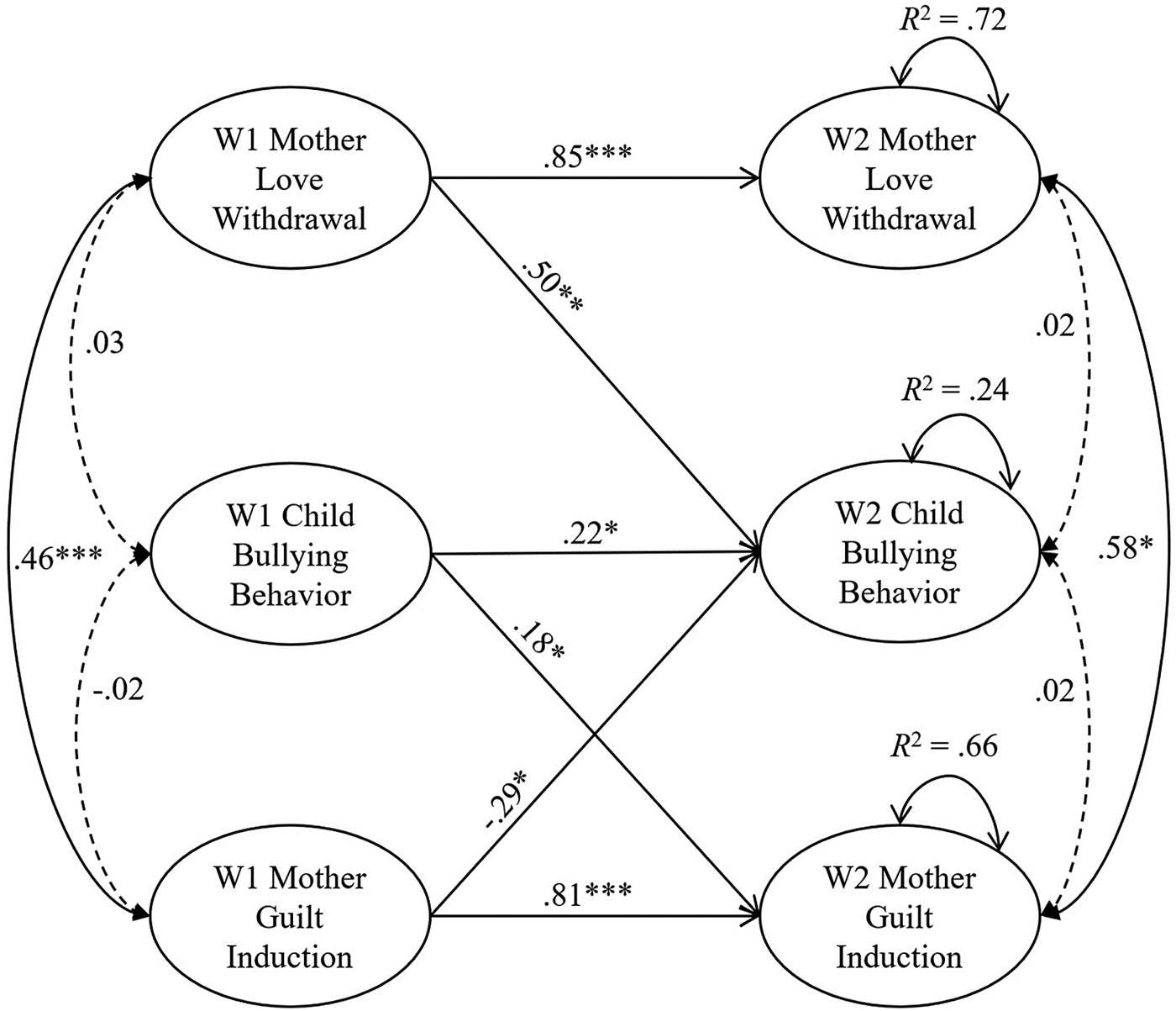
A cross-lagged SEM model was built to examine the reciprocal effects over time between parenting practices and child bullying. The “parenting effect” paths from W1 parenting to W2 child bullying and “child effect” paths from W1 child bullying to W2 parenting practices were of major interests. The autoregressive paths from W1 parenting and child bullying behavior to W2 parenting and child bullying were controlled for temporal stability, and paths from covariates (i.e., child age, child gender, and maternal education) to all constructs were included as demographic controls. Concurrent associations between parenting practices and child functioning were also estimated at each wave.
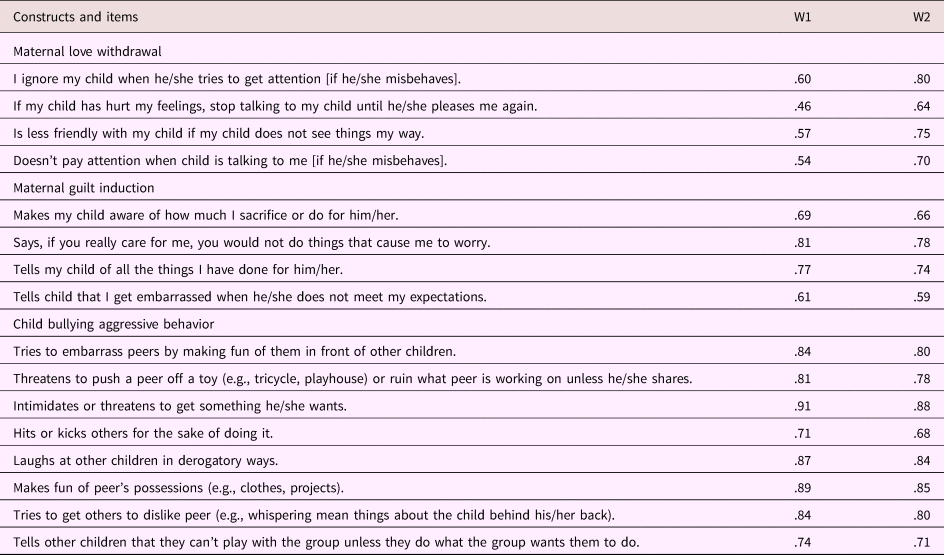
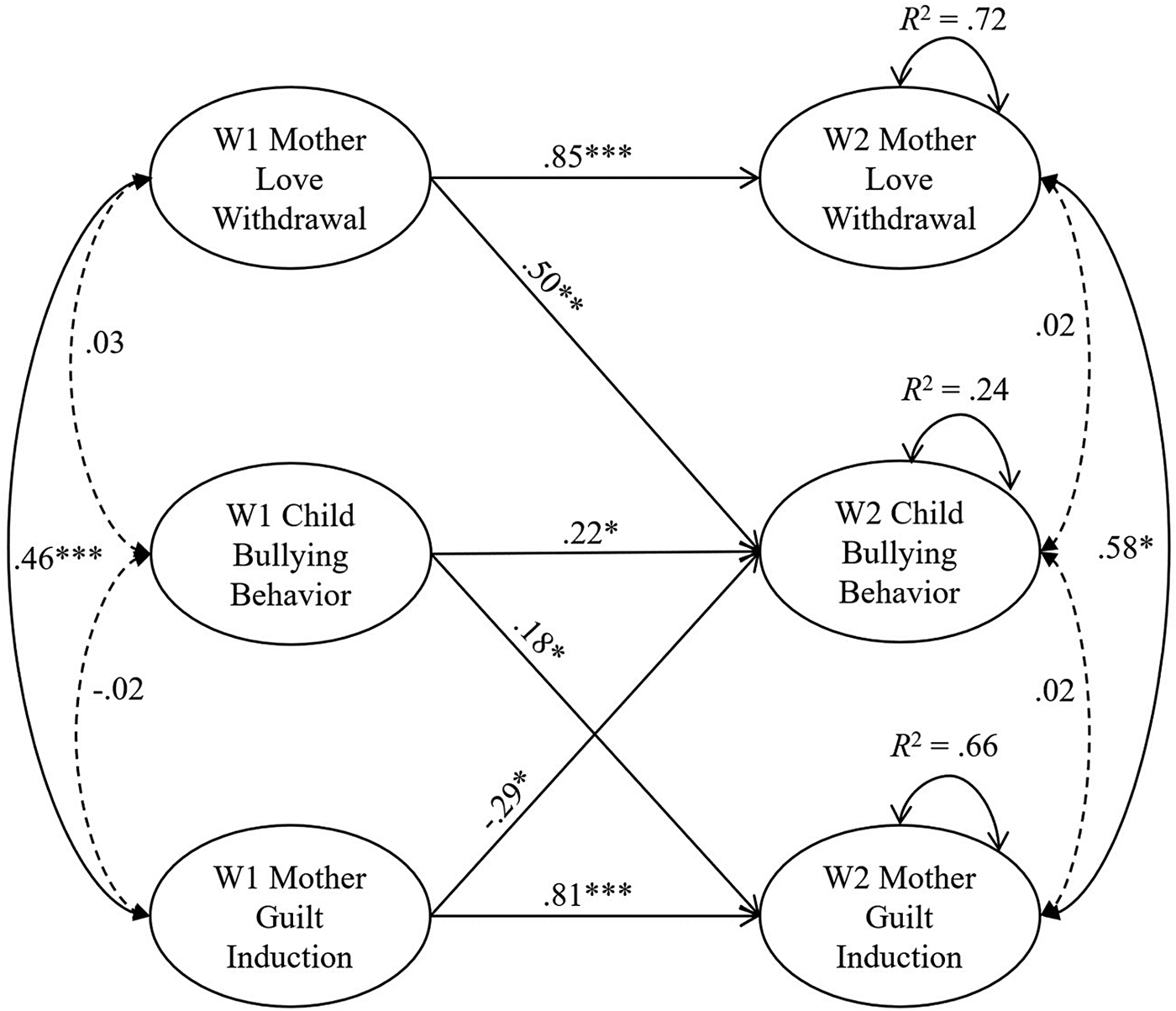
None of the covariates significantly predicted W2 parenting or child bullying aggression. Moreover, W1 child bullying did not predict W2 love withdrawal, and the cross-lagged paths between maternal love withdrawal and guilt induction were not significant. These nonsignificant covariates and predictors of W2 parenting and child constructs were gradually pruned out of the model to avoid overcontrol. The final model achieved acceptable model fit (Figure 1), χ2 (534, N = 133) = 616.85, p = .006, CFI = .93, and RMSEA = .04. Standardized factor loadings of the constructs are shown in Table 2.
The final cross-lagged structural equation model for maternal parenting and child bullying. Note: Items that constructed the latent variables are not drawn in the figure. *p < .05. **p < .01. ***p < .001.
Standardized item factor loadings at both waves
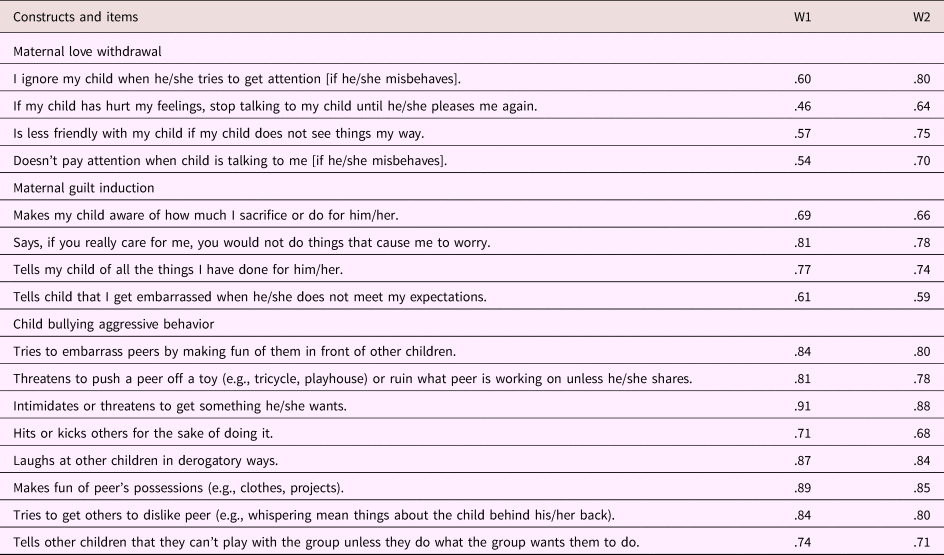
Note: Standardized factor loading of each item at W1 and W2. All factor loadings were significantly different from 0. W1 = Wave 1; W2 = Wave 2.
All observed behavioral indicators of the latent variables had significant standardized factor loadings (>.40). Structural results indicated that W1 maternal love withdrawal predicted more W2 child bullying (β = .50, standard error [SE] = .15, p = .001, 95% confidence interval [95% CI] [0.21, 0.78]) after controlling for the temporal stability of bullying (β = .22, SE = .10, p = .024, 95% CI [0.03, 0.41]), whereas W1 maternal guilt induction predicted less W2 child bullying (β = –.29, SE = .13, p = .032, 95% CI [–0.55, –0.03]). With respect to child effects, more W1 child bullying predicted more W2 maternal guilt induction (β = .18, SE = .09, p = .039, 95% CI [0.01, 0.35]) after controlling for the temporal stability of guilt induction (β = .81, SE = .06, p < .001, 95% CI [0.69, 0.93]), whereas W1 child bullying behavior did not predict W2 maternal love withdrawal after controlling for its temporal stability (β = .85, SE = .07, p < .001, 95% CI [0.70, 0.99]).
Discussion
By using SEM to analyze short-term longitudinal data, this study provided empirical evidence for the reciprocal relations between psychologically controlling parenting and child bullying aggressive behavior at school in a sample of Chinese American mothers with young children. Differential effects of the two psychological control dimensions (i.e., love withdrawal and guilt induction) were revealed. A child effect was found for the prediction of W1 child bullying on W2 maternal guilt induction (not love withdrawal) only.
Parent effects: Love withdrawal versus guilt induction
Supporting previous research on young children in mainland China and Russia, the denial of parental acceptance as reflected in maternal love withdrawal resulted in Chinese American children's bullying aggressive behaviors with peers (Nelson et al., Reference Nelson, Hart, Yang, Olsen and Jin2006, Reference Nelson, Yang, Coyne, Olsen and Hart2013). Love withdrawal may represent a hostile form of psychological control that parents use to manipulate the attachment relationship with the child by implying that love and acceptance will not be restored until the child changes his or her behavior to meet parental expectations (Barber, Reference Barber1996; Hart et al., Reference Hart, Nelson, Robinson, Olsen and McNeilly-Choque1998). Love withdrawal is often included as a component of general psychological control measures used in most studies and may contribute to findings in which psychological control is associated with physical and relational aggression (e.g., Nelson et al., Reference Nelson, Hart, Yang, Olsen and Jin2006, Reference Nelson, Yang, Coyne, Olsen and Hart2013) in both interdependence- and independence-oriented cultures. Our results were consistent with these previous studies and supported the conjecture that love withdrawal denotes parental hostility through an unhealthy manipulation of the parent–child relationship and threatens the basic bond between parent and child and is thus related to child maladjustment (Rohner et al., Reference Rohner, Khaleque and Cournoyer2005). Importantly, our study appears to be the first in extending these findings to child bullying aggression and Chinese immigrant families living in the United States
Our finding on maternal love withdrawal also provided some evidence for the hostile nature of this psychological control dimension because mothers might withdraw their love and attention to express their anger and disappointment (i.e., reflecting parent-centered goals) more than to correct their children's misbehavior. Such displays of hostility and rejection may also lead to felt insecurity as well as undermine children's social competence by serving as behavioral models for their children to imitate and interact in hostile and domineering ways with peers in school (Nelson et al., Reference Nelson, Yang, Coyne, Olsen and Hart2013; Rohner et al., Reference Rohner, Khaleque and Cournoyer2005; Rubin, Coplan, & Bowker, Reference Rubin, Coplan and Bowker2009).
In contrast, we found that maternal guilt induction predicted less child bullying aggression 6 months later. In the United States or other independence-oriented cultures that value individualism, guilt induction may be perceived as reflecting a lack of parental support and more parental rejection and thus impede positive development in children (Rudy et al., Reference Rudy, Carlo, Lambert and Awong2014). In interdependence-oriented cultures, however, children may be more likely to interpret parental guilt induction as parental concern and caring for children's well-being rather than feelings of rejection because of children's more interconnected sense of selves within these cultural contexts. These findings are consistent with previous research in which guilt induction was not associated with problematic child functioning in samples with interdependence-oriented cultural values (Rudy & Halgunseth, Reference Rudy and Halgunseth2005) or was reported to be correlated with positive child adjustment outcomes (Rudy et al., Reference Rudy, Carlo, Lambert and Awong2014). These findings, including ours, are also consistent with research showing that Asian American children experienced more interdependence with their mothers and were more motivated by their mothers’ controlling parenting compared with European American children (Fu & Markus, Reference Fu and Markus2014).
Moreover, guilt inductive practices emphasize children's interpersonal sensitivity and obligations toward their parents. Chinese immigrant mothers may use guilt induction to foster culturally valued qualities and motivate their children to reciprocate parents' sacrifices through proper social conduct. Such practices may help cultivate empathy to enhance children's social competence within the peer group (Fung & Lau, Reference Fung and Lau2012) and lead to fewer bullying problems in young children. We extended cultural-specific effects of guilt induction to a Chinese American sample, implying the retention and value of such cultural processes for first-generation Chinese immigrant mothers of young children. Given that older children and adolescents were found to be less accepting of maternal guilt induction (Rote & Smetana, Reference Rote and Smetana2017), the positive effects of guilt induction may not be generalized to later developmental periods. Future studies should examine the effects of guilt induction in older children and adolescents including those from Chinese American families.
Another note relevant to the interpretation of the effect of guilt induction is that, despite their statistical distinctiveness, both love withdrawal and guilt induction shared to a certain degree the general intrusiveness of psychologically controlling parenting (Yu et al., Reference Yu, Cheah, Hart, Sun and Olsen2015). The negative associations between maternal education and both parenting practices provide some support for this argument given that parents with higher educational levels are less likely to use controlling parenting discipline (Tamis-LeMonda, Briggs, McClowry, & Snow, Reference Tamis-LeMonda, Briggs, McClowry and Snow2009). Our result therefore reflects the unique or remaining positive effect of maternal guilt induction (i.e., being associated with less bullying) after controlling for its negative implications for child development that were shared with love withdrawal. The total relation between T1 guilt induction and T2 child bullying aggression comprised the positive direct effect of guilt induction and the negative unanalyzed effect through its correlation with love withdrawal, which also explained why the zero-order correlation between the two variables was nonsignificant.
Child effects: W1 bullying on W2 guilt induction
The finding that Chinese American children's engagement of bullying aggressive behavior predicted mothers’ greater use of guilt induction but not love withdrawal provided some evidence for the relative beneficial nature of gentle guilt inductive practices. Children's bullying behavior is perceived by Chinese American parents to be moral misconduct or transgressions and evaluate such behaviors negatively (Cheah & Rubin, Reference Cheah and Rubin2004). Accordingly, because bullying behavior and hurts other children, Chinese American mothers may increase their use of guilt induction practices with their children to emphasize the consequences of children's misbehaviors on others (Ho, Fu, & Ng, Reference Ho, Fu and Ng2004), to help children internalize moral values, and to emphasize children's interdependence with parents.
Limitations and future directions
Several limitations in the present study need to be acknowledged. First, our sample was small, and thus not ideal for SEM analysis. Future research should include larger samples to test the identified patterns of associations. In addition, our sample comprised middle-class, educated Chinese Americans. Although this sample was representative of the first-generation Chinese population in the Maryland-Washington, DC, area (McCabe, Reference McCabe2012), the generalization of these findings to other Chinese populations, such as families of different socioeconomic status and those residing in other regions of the United States, should be made cautiously. In addition, although our aim was to understand within-culture effects of psychologically controlling parenting on the development of Chinese American children, the inclusion of comparison groups of mainland Chinese and European American families would allow for a more direct examination of culturally shared vs. culture-specific parenting effects on children's psychosocial development.
The third limitation concerns the measurements of constructs. Mothers’ self-reports of their parenting has the benefit of capturing a global view of parenting but can also suffer from social desirability and recall biases (Winsler, Madigan, & Aquilino, Reference Winsler, Madigan and Aquilino2005). Moreover, both the parenting and child bullying constructs were measured by single informants (i.e., parents and teachers, respectively), which could potentially affect the reliability and validity of their assessment. Although teacher ratings of aggression are considered valid for preschooler children because their engagement of bullying is unlikely to be inhibited by the presence of teachers (Crick, Casas, & Mosher, Reference Crick, Casas and Mosher1997), as a single source may not capture all aggressive scenarios in child interactions with peers. Future studies should consider multiple measurement tools and multiple informants when possible to collect complementary information. Finally, although our two-wave cross-lagged design allows us to make some causal inferences, it does not definitively establish causality or allow for examination of whether the lagged effects would persist over time. Thus, future studies can consider cross-lagged designs with three or more waves to test the persistence of parenting and child effects over time as well as experimental or interventional approaches to replicate our findings.
Implications and conclusions
Our short-term longitudinal study advances knowledge of bidirectional relations between psychologically controlling practices and children's bullying aggressive behaviors. The negative effect of maternal love withdrawal on child development finding was consistent with those from previous studies on Western samples, suggesting the culturally shared negative connotations of such practices even among Chinese children residing in the United States. In contrast, the beneficial effects of guilt induction on Chinese American children's bullying aggressive behavior differed from previous findings on Western children. Our results highlight the importance of construct specificity and cultural context in understanding the effects of parenting on children's social development. Practically, our findings highlight the critical role of parenting as a key area for clinical invention of early bullying aggressive behavior. In particular, this study may inform cultural adaptations of existing prevention and evidence-based family intervention programs that aim to promote healthy child development among ethnic minority families (Kumpfer, Magalhães, & Xie, Reference Kumpfer, Magalhães and Xie2017).
Author ORCIDs
Jing Yu 0000-0002-1219-2391.
Financial support
This research was supported by the Foundation for Child Development and the National Institute of Child Health and Human Development (1R03HD052827-01) awarded to Charissa S. L. Cheah and the Marjorie Pay Hinckley Endowed Chair seed money grant and the Zina Young Williams Card Professorship at Brigham Young University awarded to Craig H. Hart.