Antibiotics are some of the most highly utilized medications in health care, particularly in nursing homes; however, their use is often inappropriate.Reference Daneman, Gruneir and Newman1–Reference Klein, Van Boeckel and Martinez3 An estimated 50%–75% of antibiotics prescribed in nursing homes are potentially inappropriate and should not have been prescribed.Reference Nicolle4,Reference Peron, Hirsch, Jury, Jump and Donskey5 The causes of inappropriate antibiotic prescriptions in nursing homes vary and include lack of diagnostic tools, communication difficulties between residents and levels of staff, high nurse turnover rates, and pressure from residents and advocates.Reference Katz, Beam, Brand and Boyce6–Reference O’Brien-Pallas, Tomblin and Shamian10 Inappropriate antibiotic consumption is an important cause of adverse drug events and a chief driver for the spread of antibiotic resistance.Reference Crnich, Jump, Trautner, Sloane and Mody11,Reference Schwartz, Abiad, DeMarais, Armeanu, Trick, Wang and Weinstein12 Optimizing antibiotic use by improving prescribing practices is essential for reducing the risk of adverse drug events and eliminating the emergence and spread of antimicrobial resistance.Reference Field, Gurwitz and Avorn13
Antimicrobial stewardship programs (ASPs) are initiatives and interventions implemented in healthcare settings to optimize the use of antimicrobials and to reduce adverse drug effects and healthcare expenses.Reference Dellit, Owens and McGowan14 ASPs have been successfully implemented into many healthcare sectors, especially in acute hospital care. Nursing homes are prime candidates for ASP interventions because antibiotic use is prevalent and often inappropriate there.Reference Kaki, Elligsen, Walker, Simor, Palmay and Daneman15,Reference Sloane, Huslage, Kistler and Zimmerman16 Additionally, nursing home administrators have displayed interest in the implementation of such interventions, yet ASP implementation in nursing homes remain mostly underexplored.Reference Malani, Brennan, Collins, Finks, Pogue and Kaye17,Reference Strausbaugh and Joseph18 One likely cause for the lack of ASP implementation in nursing homes may be the lack of resources.Reference Strausbaugh and Joseph18–Reference Jump, Olds and Seifi20 ASPs have been highly recommended in nursing home settings by organizations such as the Infectious Disease Society of America (IDSA), Centers for Disease Control and Prevention (CDC), the Society for Healthcare Epidemiology of America (SHEA); however, ASP research in nursing homes is limited, and guidelines for intervention implementation are lacking.Reference Barlam, Cosgrove and Abbo21–24 Thus, evidence supporting the selection and implementation of appropriate ASP interventions in nursing homes is critical.
Selecting and implementing ASP interventions is often a difficult and resource-intensive task. ASP interventions are vast; many programs have been developed to address the various components of the prescribing process, such as educating patients and their advocates and utilizing behavior modification techniques to improve physician antibiotic prescribing rates.Reference Sloane, Huslage, Kistler and Zimmerman16,Reference Ilić, Bukumirić and Janković25–Reference Fleming, Browne and Byrne30 Moreover, the evidence supporting each ASP intervention is varied.Reference Nicolle29,Reference Schulz, Hoffman, Pothof and Fox31 Communicating the supporting evidence of interventions, therefore, may not be an effective method for implementing ASP interventions in nursing homes. Additionally, extrapolating evidence from other healthcare settings to nursing homes has its limitations. Differences such as length of stay, staff turnover, and access to resources hinder the generalizability of ASP research in hospital settings. Nursing home residents would likely benefit from ASP implementation but ASP interventions need to be evaluated to assist prioritization and implementation in nursing homes.
We utilized the modified Delphi method to support nursing home providers in the selection and adoption of ASP interventions. Our focus was to promote interventions that would most effectively and likely be used in the nursing home environment, and we sought to provide nursing home providers with 2 tools: (1) a prioritized list of ASP interventions deemed appropriate and necessary for nursing homes settings and (2) a description of the resources necessary for implementation.
Methods
Ethics
This research was conducted in accordance with the Declaration of Helsinki, national, and institutional standards. The project received approval from the Sinai Health System Research Ethics Board (REB no. 14-0336-E). Written informed consent was obtained from invited panel members.
Modified Delphi panel to evaluate and prioritize ASP interventions in nursing homes—Overview
The modified Delphi method, based on the RAND Corporation/University of California Los Angeles (RAND/UCLA) appropriateness method,Reference Fink, Kosecoff, Chassin and Brook32 is a structured, interactive consensus tool that applies expert opinion in an in-person panel setting. The method has been used to develop measures and to define quality metrics for ASPs.Reference Morris, Brener, Dresser, Daneman, Dellit, Avdic and Bell33,Reference Dresser, Bell and Steinberg34 Our research group developed a survey to evaluate ASP interventions across 5 criteria: scientific merit, impact, feasibility, accountability, and importance. Such criteria have been successfully used in similar studies.Reference Dresser, Bell and Steinberg34–Reference Zabarsky, Sethi and Donskey36 Panel participants were invited to complete 2 rounds of surveys: the first took place prior to the in-person Delphi meeting and the second took place during the meeting. Participants were provided a literature review of ASP interventions in many divisions of health care, including nursing homes. During the in-person meeting, participants were encouraged to discuss the results from the first survey round, followed by completing the second round of the survey. Consensus was not enforced. Results from the second round were tabulated and presented to the panelists. ASP interventions deemed appropriate and necessary for nursing homes were discussed for resourcing requirements and were ranked by priority. Upon conclusion of the meeting, an additional survey was provided to the panelists to elicit feedback on whether opinions were given honestly, on whether the panel discussion was fair, and on whether intimidation was the cause of revised answers.
Assembly of panel
The panel consisted of 16 individuals with varying professional and geographical representation (see the Acknowledgements). The panel included infectious disease (ID) physicians with expertise in antimicrobial stewardship, nursing home physicians, infection control personnel, hospital physicians, nurses, pharmacists, nursing home administration, nursing home residents and their advocates, family councils, and other stakeholders. All panel members who were healthcare professionals had at least 10 years experience in their roles and had familiarity with diagnostic and therapeutic challenges associated with nursing home antimicrobial use. Moreover, 4 pharmacists were on the panel: 1 with expertise in antimicrobial stewardship, and two with expertise in nursing homes. Potential panel members were identified from the ASP literature, government agencies, and important stakeholder groups.Reference Dresser, Bell and Steinberg34–Reference Zabarsky, Sethi and Donskey36 We also included patient and family representation from specific stakeholder organizations. Members of the research team that were not involved with the identification process then evaluated the candidate participants for their inclusion. Official invitations were sent to the final list of candidate participants.
Background package and survey development
Two weeks prior to the in-person meeting, panel participants were provided a background package and the first round of the survey. The background package consisted of a literature review of ASPs in all healthcare settings including nursing homes, as well as a description of the intentions of the study. Systematic reviews describing ASPs in nursing homes and other healthcare settings were collected and summarized. ASP interventions were tabulated and reported in order of frequency of evidence supporting their implementation. We chose to be as inclusive as possible and to incorporate all identified and relevant ASP interventions in the package.
The first round of the survey consisted of 2 components: (1) introduction to the evaluative criteria and (2) evaluation of interventions. We used 5 criteria to evaluate the interventions: (1) scientific merit, (2) impact, (3) feasibility, (4) accountability, and (5) overall importance of the intervention. These criteria were used successfully in prior ASP modified Delphi studies.Reference Morris, Brener, Dresser, Daneman, Dellit, Avdic and Bell33,Reference Dresser, Bell and Steinberg34 A 9-point Likert scale was utilized to assess agreement with the evaluative criteria: 1 = strong disagreement through 9 = strong agreement. Interventions were evaluated individually, with an opportunity to provide additional comments.
The initial strategy for eliminating ASP interventions involved identifying items with consensus for disagreement, defined as at least 75% of scores falling between 1 and 3 on the Likert scale. No interventions attained consensus for disagreement following this method. The method was then revised: criteria with <50% of scores between 7 and 9 were considered to attain consensus for disagreement, and criteria with 50%–74% of scores between 7 and 9 were considered to attain uncertain agreement (Appendix Table 1 online).
In-person panel
All panel participants met for a 1-day, in-person meeting to discuss the results from the first round of the survey. Interventions that received consensus for rejection were presented for elimination, with an opportunity to discuss or to include in the second round of the survey. After the first round, 4 of 14 ASP interventions were candidates for this discussion. The remaining 10 of 14 ASP interventions were subsequently presented individually, and the facilitator provided an opportunity for discussion. After discussion of all interventions, panel participants were instructed to complete the second round of the survey. Results from the second survey round were tabulated and presented to the panel participants later in the meeting. Interventions that received consensus for rejection were eliminated and interventions receiving consensus for inclusion were retained (ie, determined to be appropriate and relevant to nursing homes). Each intervention that received uncertainty was addressed collectively by the panel and were either eliminated or retained. Panel participants were encouraged to discuss resourcing for the considered interventions.
Tool packages development
After all rounds of discussion, interventions were then listed from highest priority to lowest. Panel participants were instructed to rank the final 6 interventions, and mean scores were calculated. The goal was to consider the scores for each intervention across both surveys and the resources required for implementation in nursing homes. After completion of prioritization, panel participants were provided an end of day survey, which consisted of 2 components: a premeeting section and a meeting section. The premeeting section addressed the background package and the first round of the survey, and the meeting section addressed the in-person discussion.
Results
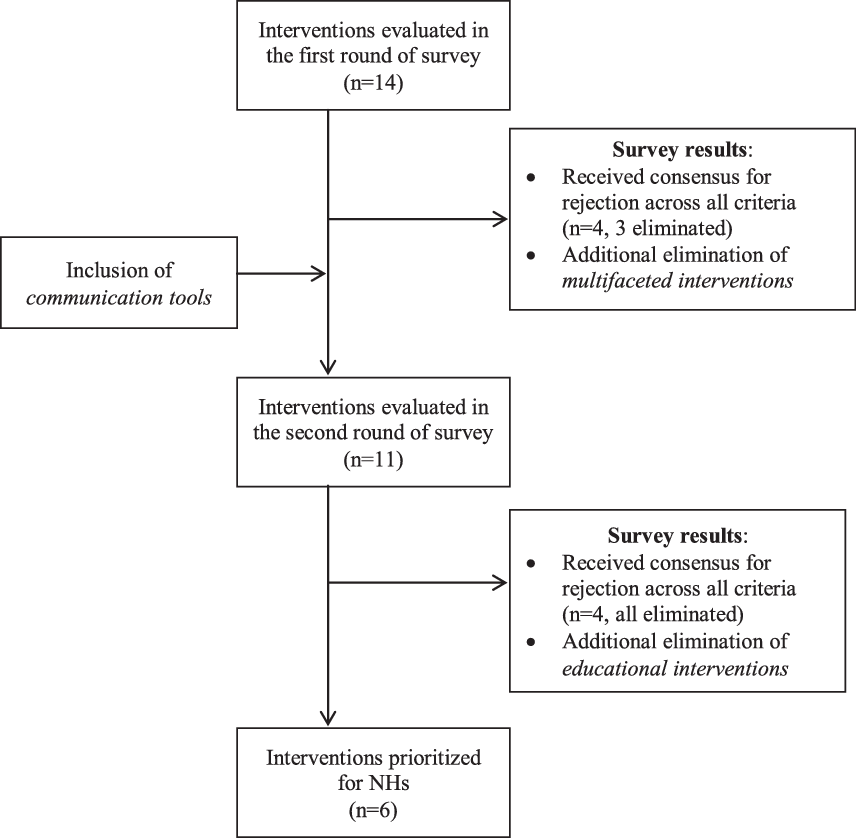
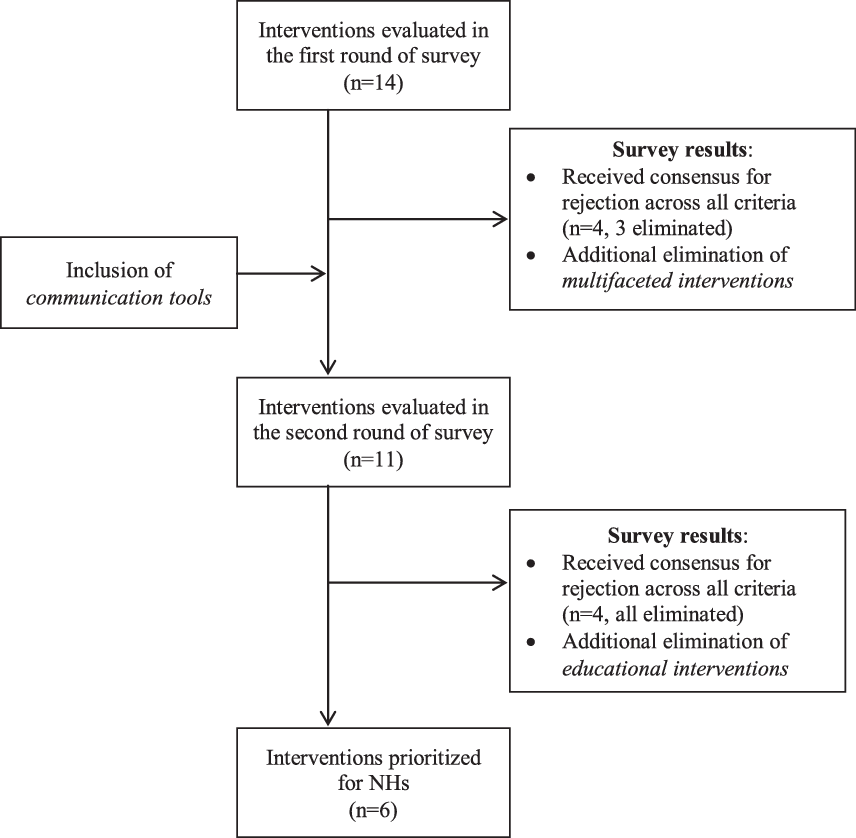
Prior to completion of the first round of the survey, 14 interventions were presented to and evaluated by the panelists. Prior to completion of the second round of the survey, 10 of the original 14 interventions, plus 1 additional intervention, were presented to and evaluated by panelists. The final 11 interventions were narrowed to 6 that were determined to be important for nursing home settings (Fig. 1 and Table 1).
Antimicrobial stewardship program (ASP) intervention evaluation process.
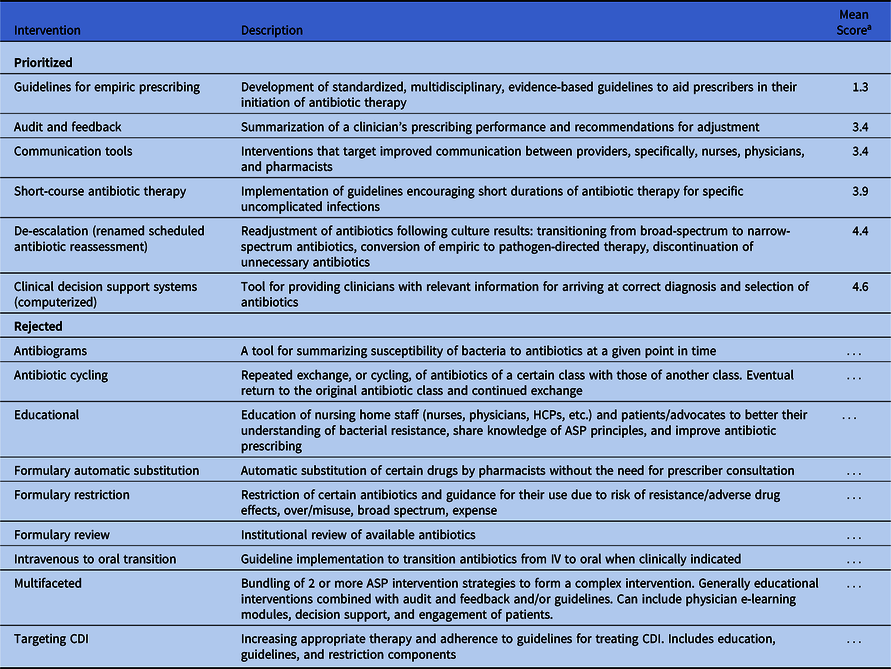
List of ASP Interventions and their Descriptions, by Prioritization and Rejection
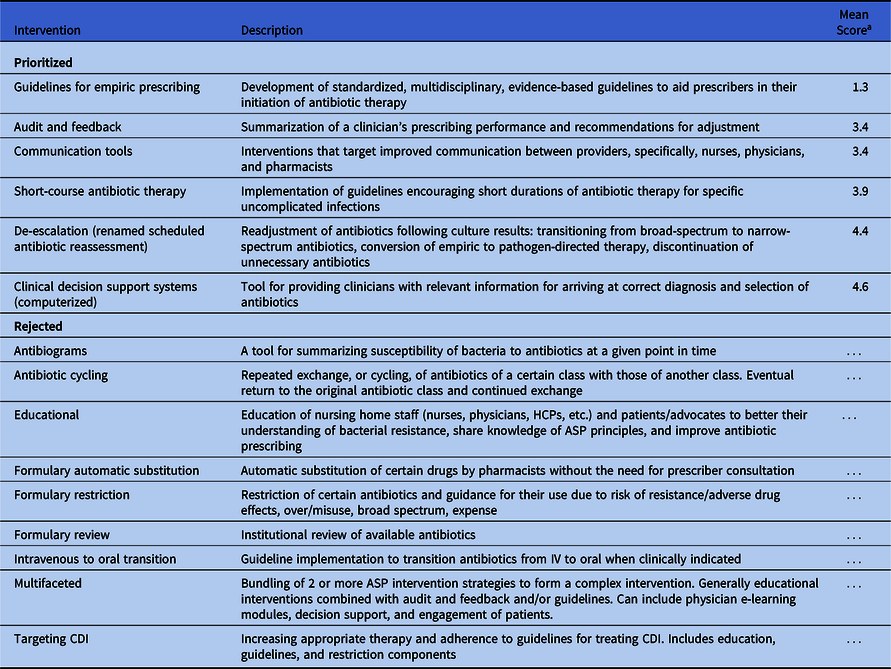
Note. ASP, antimicrobial stewardship program; CDI, Clostridium difficile infection.
a Panelists instructed to rank interventions from 1 to 6.
Following the first round of the survey, no intervention received consensus for inclusion across all 5 evaluative criteria; however, 4 received consensus for rejection for all criteria (i.e., all criteria received <50% for scores of 7–9). Among these interventions, 3 were eliminated with the exception of formulary automatic substitution. Disagreement among panel participants regarding the applicability of formulary automatic substitution in nursing homes led to the decision to include the intervention in the second round of the survey. An additional intervention that was eliminated following the first round was multifaceted interventions; however, its scores from the first round of the survey were largely favorable (receiving consensus for inclusion for scientific merit and impact). Overall, the panel agreed that although multifaceted interventions likely have strong scientific evidence to support their implementation and the intervention is likely to have a high degree of impact, nursing homes in general do not have the available resources to implement such programs.
The panel agreed to include an additional intervention for the second round of the survey that they determined was overlooked in the first round: communication tools, defined as interventions targeted at improved communication between providers, particularly nurses, physicians, and pharmacists.Reference McElligott, Welham, Pop–Vicas, Taylor and Crnich37,Reference Gurwitz, Field, Avorn and McCormick38 Considering the communication difficulties in nursing homes, particularly between on-site nurses and off-site physicians, the panel thought that nursing homes would greatly benefit from structured communication tools that ease the process of accurately describing resident conditions over the telephone.Reference Daneman, Gruneir and Newman1,Reference Moehring, Anderson and Cochran39 Thus, communication tools were included in the second round of the survey with the remaining 10 interventions. The interventions were evaluated through the second round of the survey, and six interventions remained and were considered important for nursing homes.
Implementation considerations
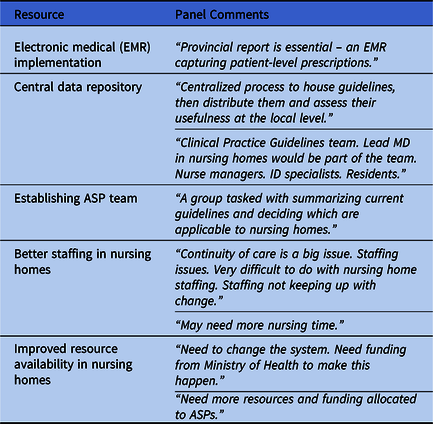
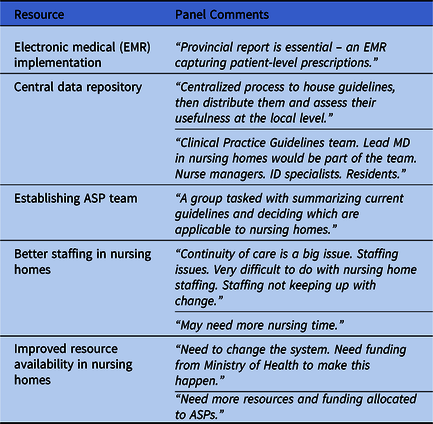
Resourcing requirements for the final list of interventions were then considered. Each intervention was addressed individually and panel participants were provided an opportunity to share their thoughts and opinions. Some resources described for a particular intervention were also applicable to other interventions (Table 2).
Resources Needed for Improved ASP Implementation in Nursing Homes
The panel then prioritized the final list of interventions for nursing homes (Table 1). Guidelines for empiric prescribing received the highest priority rank, with a mean score of 1.3. Tied for second priority were audit and feedback, and communication tool interventions, each with a mean score of 3.4. Short-course antibiotic therapy interventions received third place priority, with a mean score of 3.9. Scheduled antibiotic reassessment (or de-escalation) interventions received fourth place priority, with a mean score of 4.4. Lastly, clinical decision support systems received fifth place priority, with a mean score of 4.6.
The final component of the in-person Delphi meeting was completion of the end-of-day survey. Overall, the results from the end-of-day survey were favorable. All of the premeeting questions received consensus for agreement (defined as percentage of scores of 4 and 5, and 1 and 2 for reversed questions, accounting for at least 75%). However, certain questions received considerable scores for uncertainty (percentage of scores of 3): able to understand and complete questions (23%), background information offering enough support (21%), timing of survey (7%), and easy and unobtrusive formatting (7%). The results from the meeting section of the survey were more heterogeneous, although most questions were responded to favorably. Finally, 2 questions received scores for uncertainty: unfair time allocation between panelists (21%), and retaining answers due to not understanding discussion (7%).
Discussion
Using the modified Delphi method, we were able to successfully evaluate and prioritize interventions for administering antimicrobial stewardship programs (ASPs) in nursing homes. We determined 6 of 15 interventions to be fundamental and necessary for nursing home settings, and were then ranked from highest to lowest in priority after considering resource requirements. From highest to lowest priority, these were guidelines for empiric prescribing, audit and feedback, communication tools, short-course antibiotic therapy, scheduled antibiotic reassessment, and clinical decision support systems.
Guidelines for empiric prescribing received the highest priority, and they were the only intervention to receive consensus for inclusion across all criteria. This prioritization reflects much of the commentary provided by the panel participants. Most respondents perceived guidelines as foundational for effective ASP implementation in nursing homes, and particularly for inappropriate empiric prescribing, which is a highly prevalent practice. Despite the general consensus supporting implementing guidelines for empiric prescribing into nursing homes, its ability to provide meaningful prescribing changes remains unclear. Although the intervention received consensus for inclusion across all criteria, it was designated as necessary but insufficient by several participants. Other interventions, such as educational interventions, also received the necessary but insufficient designation. This finding is consistent with literature describing the ineffectiveness of solely educational interventions.Reference Wu, Langford, Daneman, Friedrich and Garber40 Participants consequently considered the need for multifaceted interventions, or bundling several interventions together, to provide meaningful prescribing changes. Multifaceted interventions were included in the first round of the survey, and although the intervention received favorable scores, the intervention was eliminated from the second round of the survey due to consensus regarding its lack of feasibility in nursing homes. The panel determined that if ASPs are to be implemented into nursing homes, ideally they should be implemented as a bundled intervention; however, since that is likely not feasible for most nursing homes, efforts should target improved guidelines for empiric prescribing.
Findings from a meta-analysis and systematic review of ASPs in nursing homesReference Wu, Langford, Daneman, Friedrich and Garber40 are consistent with our results. They highlight some critical necessities of successful ASP implementation, particularly the importance of behavior change. The study found a variable range of interventions applied across nursing home settings, with some facilities emphasizing education, and others, such as antibiotic reassessment, reflecting a lack of guidance. Interventions that included an enabling component, such as audit and feedback, were associated with increased effect. Including a restrictive component, such as rules to limit prescribing, further increased the effect of the intervention. Educational interventions implemented in isolation were not associated with sustainably improved antibiotic prescriptions. Improving patient education may be an important component of ASPs.
Our evaluation is among the few to examine and prioritize a number of interventions for improving antibiotic utilization in nursing homes.Reference Barlam, Cosgrove and Abbo21,Reference Katz, Gurses, Tamma, Cosgrove, Miller and Jump26,Reference Wu, Langford, Daneman, Friedrich and Garber40,Reference Davey, Marwick and Scott41 As noted, nursing home settings are suitable candidates for ASP implementation; however, research evaluating individual interventions is limited and inconsistent, and research targeting the selection and initial implementation of ASPs is inadequate.
Our panel was professionally diverse. We were careful to include representatives of various roles in the nursing home environment, from nursing home physicians and nurses to residents and family councils. We made a deliberate decision to include nonexperts (ie, residents and resident councils) and to deviate from the traditional modified Delphi method. Indeed, residents and advocates may play a substantial role in the prevalence of inappropriate antibiotic use in nursing homes. Improving communication between residents, nurses, and prescribers is critical for improving antibiotic use, and we believe that diverse professional representation in our panel was essential for optimal intervention evaluation.
Our study has some limitations. Although our panel included nursing home residents and caregivers, of the 6 physicians, we were limited to 1 physician who provides primary care in a nursing home. Several nursing home physicians were invited to participate in our modified Delphi panel; however, only 1 agreed. Nursing home physicians play a leading role in administering ASPs in nursing homes; additional nursing home physicians could have shared further experience with previous attempts at implementing ASPs in nursing homes. Furthermore, the participants were all from Canada. Inclusion of more international participants could have improved the generalizability of this study. Still, many of the participants have national and international stature. Another limitation is the inevitable social influence from certain participants. Because the modified Delphi method utilizes face-to-face interaction, some participants may have felt intimidated, thereby leading to a false consensus. To address this challenge, we included an end-of-day survey to assess the effects of social influence and intimidation and to ensure that the process was conducted in a fair and respectful manner. The results largely negated this contention, thereby reinforcing our findings. Finally, these prioritized interventions were selected solely on consensus opinion and not on solid evidence. Thus, their utility requires future study.
In this study, we prioritized guidance for implementing foundational ASPs to improve inappropriate antibiotic use in nursing homes. We have subsequently engaged nursing home associations, physician groups, and accreditation bodies (many of which were stakeholders in the Delphi panel process) to apprise them of this work. Future efforts should consider improving the evidence base of the interventions. Conjoint work with stakeholder groups should encourage the inclusion of ASP implementation in nursing homes as part of policy and procedure. Further research is needed to assess the feasibility of ASPs in nursing homes, particularly multifaceted interventions, which are likely to be most impactful for producing lasting prescribing changes.
Our research adds to evidence in the understudied area of antibiotic use and ASP implementation in nursing homes. Our consensus approach underscores the lack of evidence contrasting ASP interventions and provides nursing homes with a place to start, particularly, with improved guidelines for empiric prescribing. Nursing homes are primary candidates for ASPs; however, unlike acute-care hospital settings, resources to select and implement such interventions are mostly lacking in nursing home environments. There is insufficient information examining the capacity for specific interventions, both individually and with a bundled approach. Nursing home administrators attempting to implement ASPs often rely on inconclusive literature and extrapolate evidence from other healthcare settings. Our findings may not be generalizable for reasons such as differences in nursing staff, family engagement, and availability of on-site physicians.
Acknowledgments
We thank the panel members and contributors: Andrew Morris (moderator; Mount Sinai Hospital and University Health Network, University of Toronto), Carla Beaton (Medical Pharmacies Group Limited), Anne Bialachowski (St Joseph’s Healthcare Hamilton), Sharron Cooke (Ontario Association of Residents’ Councils), Nick Daneman (Health Science Centre, University of Toronto, and Institute for Clinical Evaluative Sciences), Kamyab Ghatan (Sienna Senior Living), Devora Greenspon (Ontario Association of Residents’ Councils), Lynn Johnston (QEII Health Sciences Centre, Dalhousie University), Louis Kennedy (Queen’s University), Maloree Kubica (Roberta Place LTC), Jonathan Lam (Health Quality Ontario), Bradley Langford (Public Health Ontario), Dee Lender (Ontario Association of Residents’ Councils), Justin Lin (Medical Pharmacies Group Limited), Mark Loeb (McMaster University), Lindsay Nicolle (University of Manitoba), and Lisa Sever (Institute for Safe Medication Practices Canada).
Financial support
This work was supported by the Canadian Frailty Network (formerly Technology Evaluation in the Elderly Network (TVN)) (grant no. SIG2014-M1) and by a 2017–2018 Ontario Student Opportunity Trust Fund Award provided by the Lunenfeld Tanenbaum Research Institute Scholarships at the Sinai Health System.
Conflicts of interest
All authors report no conflicts of interest relevant to this article.

 .
 .
 .