The International Classification of Functioning, Disability, and Health (ICF) is a comprehensive framework developed by the World Health Organization (WHO, 2001a) to systematically classify people with chronic illnesses and disabilities (CID) so that optimal health and functioning can be achieved. The framework has evolved over time, has corresponding standardized assessments for use in practice and research, and has been adopted as the standard global classification system among a range of health professionals (Bruyère, Van Looy, & Peterson, Reference Bruyère, Van Looy and Peterson2005; Falvo, Reference Falvo2013; Mpofu & Oakland, Reference Mpofu and Oakland2010). Researchers in medicine and psychology advocate for implementation of the ICF as an important tool which can help providers better understand clients’ experiences (Reed, Spaulding, & Bufka, Reference Reed, Spaulding and Bufka2009). The ICF model is widely used among professionals in medicine, nursing, occupational therapy, physical therapy, communication therapy, rehabilitation psychology, psychiatric rehabilitation, and less consistently, in rehabilitation counseling education, practice, and research.
We say “less consistently” in rehabilitation counseling contexts because the framework is typically applied when conceptualizing people with physical disabilities but less so for mental health impairments (Reed et al., Reference Reed, Spaulding and Bufka2009). Additionally, the framework is emphasized by the Council for Accreditation in Counseling and Related Professions (CACREP, 2016) standards for the Rehabilitation Counseling specialty under contextual dimensions but not for the Clinical Rehabilitation Counseling specialty, which lists the Diagnostic and Statistical Model of Mental Disorders (DSM) as well as the International Classification of Diseases (ICD) but does not mention the ICF. Cerniauskaite et al. (Reference Cerniauskaite, Quintas, Boldt, Raggi, Cieza, Bickenbach and Leonardi2011) completed a thorough systematic review of 672 papers, spanning 34 countries and 211 different journals. Three electronic databases searched for the following keywords: “ICF,” “international classification functioning disability health,” “classification functioning,” “classification disability,” “classification handicap,” and “classification health.” Inclusion criteria ensured a publication date after ICF’s release, that ICF was included in the title or abstract, and the language of the abstract was English; book chapters and papers only using persons under 18 years were excluded (Cerniauskaite et al., Reference Cerniauskaite, Quintas, Boldt, Raggi, Cieza, Bickenbach and Leonardi2011). The majority of publications were conceptual papers (30.8%) or papers reporting clinical and rehabilitation studies (25.9%). A further inspection of the titles of the analyzed papers reveals that only nine are mental health/mental disorder related; none of them directly address counseling. There is limited research conducted to determine if instruction incorporating the ICF in clinical programs enhances client outcomes; however, the results show that enhanced learning results with expert instructors, which leads to improved clinical outcomes (Reed et al., Reference Reed, Dilfer, Bufka, Scherer, Kotzé, Tshivhase and Stark2008). In an effort to help counselors and counselor educators in all specialty areas utilize the model, we provide an overview of this useful and versatile tool to implement in clinical, research, and pedagogical settings in hopes that broader use will contribute to improved research findings, enhanced training, and better clinical outcomes.
1. Overview of the ICF Model
The ICF was developed as a multipurpose tool to serve different disciplines across countries and cultures (WHO, 2013). The framework also aids the systematic coding of health information. Similar to the Diagnostic and Statistical Manual (DSM-5) from the American Psychological Association (APA, 2013), the ICF model complements and coordinates with the International Classification of Disease (ICD-11) catalogue of etiological information about health conditions (Reed, Reference Reed2010). A significant contribution of the ICF is its focus on functioning and health, regardless of a person’s diagnoses (WHO, 2002). The framework facilitates a focus on accompanying symptoms, limitations, or level of impairment as the core feature of any client conceptualization. The ICF framework uses an ecological perspective of health by including a range of factors known to impact health severity, functioning, and the overall experience of an individual living with CID (WHO, 2001a), rather than focusing exclusively on a diagnosis for the purpose of acute intervention. This was historically appropriate when medical models relied on identification of acute illness or injury to guide intervention (Reed et al., Reference Reed, Spaulding and Bufka2009). The ICF framework is particularly relevant for people living with chronic illnesses because of the long-term functional consequences of living with these conditions, which require different types of interventions and services compared to acute conditions (Reed et al., Reference Reed, Spaulding and Bufka2009). With so many people today living with a range of chronic health conditions, which includes most mental health conditions, the utility of the ICF model is far reaching in clinical, educational, and research settings.
Essentially, the model contains components that guide practitioners in their understanding of how personal and environmental factors contextualize the overall experience of living with a CID (Magasi et al., Reference Magasi, Wong, Gray, Hammel, Baum, Wang and Heineman2015). One key way in which the model achieves this is by highlighting discrepancies between a person’s capacity to do something and one’s actual performance. These discrepancies are sometimes best explained by the contextual factors in a person’s life, rather than by a diagnostic label, or symptom of CID. This understanding gets to the underlying barriers preventing a person from achieving goals, which can often take time to uncover in a counseling context, and may not be uncovered at all in medical or psychiatric settings. Another strength of the model is providing an outline for conceptualizing possible sources of resiliency to leverage against increased stress, acquired disability, or worsening symptoms. The ICF framework expands our understanding of health beyond the physical symptoms and limitations, as well as provides an essential context for understanding how and why individuals experience their health related to other life factors (Magasi et al., Reference Magasi, Wong, Gray, Hammel, Baum, Wang and Heineman2015). The ICF model is comprised of two major parts: the individual and the contextual factors relevant to the individual’s health and functioning. Health conditions are assessed to determine operational functions of an individual. This may include medical and mental health diagnoses, specific body part functioning, and structures impacted by identified diagnoses (WHO, 2001a; WHO 2013).
1.1 Part 1
This first portion outlines the biological components of health, with a focus on the individual’s body structures and functioning and their impact on daily living (Mpofu & Oakland, Reference Mpofu and Oakland2010). Part 1 includes two components that are (1) body structures and functioning, and (2) activities and participation. The first component of Part 1 includes three categorization systems for body function and structure impairment: loss or reduction, addition or excess, and deviation. Body structures refer to anatomical components of the body, such as parts of the brain, heart valves, or parts of the eye. Structures are categorized as impairment, barrier, or limitation. A number system is sometimes used to indicate a change in structure (0 = no change, 7 = qualitative changes to structure). The specific location of the impairment should also be identified – for example, right, left, both sides, proximal, and distal (Peterson & Rosenthal, Reference Peterson and Rosenthal2005). Body functions refer to the physiological, sensory, and mechanical functions of the body, such as nervous system regulation, or pulmonary or limbic system, one’s visual acuity, etc. The severity of body function impairments is typically categorized as: no problem, mild problem, moderate problem, severe problem, or complete problem. One way to further assess for functioning is use of the Functional Independence Measure (FIM), an established screening instrument with strong psychometric properties (Linacre, Heinemann, Wright, Granger, & Hamilton, Reference Linacre, Heinemann, Wright, Granger and Hamilton1994) that addresses a range of tasks, including dressing, eating, toileting, communication, and cognition. The FIM can help a counselor identify limits to functioning that are directly related to health.
Both structure and function are related. For example, an impairment in a structure, such as a detached retina, typically leads to a malfunction in vision, and consequently, a range of barriers depending on the individual and his or her contextual life factors. If the detached retina resulted from vascular problems associated with diabetes in an older person who already has impaired vision in both eyes, the experience of having a detached retina is more complicated, particularly if this person is reluctant or unable to seek medical treatment immediately, resulting in a deterioration that may otherwise have been prevented. If the detached retina resulted due to a sports injury in a young, otherwise healthy individual who has healthcare and can undergo surgery to reattach the retina, the impact in functioning is vastly different due not to differences in the diagnosis, but rather to the personal and environmental factors that impact activity and participation levels, as well as capacity and performance.
The second component of Part 1 guides the provider to consider discrepancies among activity and participation levels, and capacity and performance, incorporating information gathered about body functions and structures. Detecting incongruence among capacity and performance regarding both activity and participation level is a key strength of the model, allowing for opportunities to understand underlying barriers not readily apparent in what may be limited counseling sessions. Ongoing assessment for congruence between activity and participation levels, as well as capacity and performance is one way to measure successful interventions.
Activity level refers to tasks required of daily living (e.g., getting around, eating, reading, and communicating). Participation refers to how these activities translate into broader social roles (e.g., attending school, relationships with important people, community engagement, and employment). Both daily activities and participation roles are specific to individuals and should be assessed accordingly, although many tasks and roles are common to the vast majority of people, such as the daily activity of communicating and the role of employee. Other tasks and roles may be more obscure but highly relevant to individual clients depending on factors. The ICF Research Branch (2015) described the activities and participation levels as being the “most relevant for more fully describing the impact of a health condition on a person’s functioning” (Selb et al., Reference Selb, Kohler, Nicol, Riberto, Stucki, Kennedy and Ustun2015, p. 2). Providers should consider a person’s independence, and/or use of assistive devices or accessible accommodations when determining levels of activity and participation. An individual who is blind and uses the assistance of a service dog, public transportation, cane, and/or technology reaches destinations independently, is more likely to have a job, have social connections with others, and otherwise participate in life more fully. Low levels of activity and participation may require interventions that facilitate assistive technology, or devices/accommodations designed to complete tasks, so that greater participation can be achieved.
Incongruence between activity levels and participation levels is important for counselors to note as likely sources of intervention. For example, an individual who can either independently or with assistance complete daily activities, but continues to report low levels of participation, is likely facing barriers to life participation that are not directly related to diagnosis. Imagine an individual with severely limited vision who has successfully learned to complete most activities of daily life (ADLs), either independently or with a range of assistive devices. This same individual reports very limited social connections, unemployment despite qualifications, and limited participation in any community engagement. In a case such as this, the visual impairment is not likely to explain (at least not fully) the low participation levels, prompting the counselor to further explore contextual factors or other conditions that clue potential intervention. One plausible explanation for such a discrepancy may be symptoms of depression returning or worsening (a personal factor) and acting as a barrier to participation. Use of a brief health screener, such as the Patient Health Questionnaire (PHQ-9), an established screening instrument for depression with strong psychometric properties (Kroenke, Spitzer, & Willians, Reference Kroenke, Spitzer and Williams2001) is recommended. This example illustrates how a presenting or primary condition can become the focus of treatment, often at the expense of emerging symptoms or conditions. Use of the ICF framework can help counselors identify sources for discrepancies, which may uncover otherwise overlooked symptoms or conditions, and place the primary condition in much-needed context. Other contextual factors that may be explaining discrepancies between activity and participation levels are described in more detail as Part 2 below.
Capacity is the ability to complete a task, whereas performance is an individual’s execution in their environment (Peterson & Rosenthal, Reference Peterson and Rosenthal2005). Capacity is closest to ability (with or without assistance), while performance is closest to what can be observed directly. For example, if intelligence quotient (I.Q.) measures a person’s capacity for learning, then one’s observed scores on academic tests represent one’s performance. Discrepancies in capacity and performance are significant factors to help guide client conceptualization and treatment planning. As with the previous example, if a student with above average I.Q. performs below average on achievement tests in school, the discrepancy is likely due to a learning disability or significant instability in the home environment, not the student’s ability (capacity) to learn.
One’s performance can also exceed what would be expected given a person’s capacity. This may be an example of a strength that should be explored in depth in the counseling context. For instance, imagine a student with a below average I.Q., but who maintains above average grades, scores in the average range on achievement tests, and reports a love of learning. This discrepancy is an example of a person over-performing, and in this case, is a positive trait, indicative of work ethic and values, probably supportive teachers and parents, to be leveraged and explored further. It is also possible for clients to over-perform in negative ways, such as a person with a back-injury lifting, bending, or otherwise engaging in physical activities that are required for a job, but should not be performed in order to prevent further injury or worsening of the condition. Incongruences between capacity and performance require attention in order to facilitate optimal health. In order to assess the existence of discrepancies, clinicians utilize intakes, medical reports, session notes, results from standardized assessments, and informal assessments. If discrepancies are found, counselors may recommend follow-up assessments and/or specific accommodations in order to promote optimal well-being, with the goal to reduce or eliminate discrepancies.
1.2 Part 2
This part of the model guides assessment of personal and environmental factors that explain discrepancies among capacity and performance and activities and participation, and in essence, provide the context for conceptualizing how a specific condition is experienced for that individual. Counselors are aware that two individuals with the same diagnosis may have nothing in common other than their diagnosis, leaving counselors in need of more information in order to provide appropriate support and treatment plans. The experience of CID is the outcome of functionality, goals, supports, and many other psychological and social factors (WHO, 2001a; WHO, 2013). According to the ICF, a person’s functioning level is reflected by the dynamic interaction between CID, incongruences among capacity and performance of activities and participation, and contextual factors (WHO, 2002). Part 2 prompts the provider to assess factors that impact health, recovery, and quality of life – all known to moderate the experience of living with CID (Smart, Reference Smart2009; Stucki & Melvin, Reference Stucki and Melvin2007).
Individual traits, including age, education, gender, ethnicity, age of CID onset, work history, education level, relationship status, sexual orientation, nationality, social capital, religious or spiritual identity, developmental stage, past and current life stressors, number and severity of traumatic and adverse exposures, learned coping strategies, salary, temperament, among many others, may be personal factors that contextualize the diagnosis and the experience of living with the CID. Social and environmental conditions, including work and home environments, relationship dynamics, laws and policies, access to transportation and healthcare, workplace culture, economic climate, societal attitudes, natural supports among many others are examples of environmental factors (Rosenbaum & Stewart, Reference Rosenbaum and Stewart2004). These are the micro and macro level factors that interact to impact an individual’s level of performing daily activities and participation in familial, community, work, and other domains.
To revisit the example introduced earlier, imagine if a detached retina event occurred while performing one’s job as a professional athlete, compared to how this same event impacts a non-professional athlete, for instance, a college student playing intermural sports. The personal factors here that diverge include the occupations, salaries, and possibly ages and gender for two people with the same diagnosis. A professional athlete recovering from surgery results in a missed season of play, which likely has a different impact on life participation compared to a college student who receives academic accommodations to complete deferred courses while recovering. The former risks ending a lucrative and fulfilling profession. The latter is likely to be inconvenienced and perhaps experiences minimal setback, but not as drastically impacted as the professional athlete. In the case of the professional athlete, the personal factors in this case are likely to explain discrepancies between activities and participation. The professional athlete likely has financial resources that can facilitate functioning in all areas of daily activities, but the professional athlete is under performing in his or her work life, for obvious reasons. If the professional athlete is near the end of his or her career, and looking to retire, the impact is less compared to the athlete just starting out. Similarly, a college student with accommodating professors and supportive friends and family is likely to be less impacted compared to a student who does not benefit from these resources. The environmental factors in the college student’s life are likely explaining a discrepancy between capacity and performance regarding school. While the student may be capable of achieving high grades, a student enrolled at a university with limited support for students with visual impairments is likely to struggle and under-perform relative to capacity.
These personal and environmental factors help explain the ways in which the same medical diagnosis is experienced in vastly different ways, which should guide counseling interventions. As Reed (Reference Reed2010) points out, a diagnostic code generated from the ICD-11 or DSM-5 provides very limited information and may be over-emphasizing a need to provide medicine as the primary intervention, when in fact, many other supports and strategies are available and appropriate. We are not suggesting that medicine and other medical interventions are not necessary; we only mean to remind counselors the importance of accurately identifying life factors that are barriers for clients so that better interventions are implemented.
While there are existing measures to assess for personal and environmental factors, we do not include here as they are numerous, and not all are directly connected to the ICF framework. For instance, a counselor may realize that a discrepancy between capacity and performance is likely due to turmoil at home or in the work environment, or due to individual factors, such as personality or self-esteem. Rather than recommending specific assessments for these factors, we recommend that counselors use their clinical judgment to determine appropriate ways to assess for these factors depending on a range of individual client factors. Sensitive probing based on clinical judgments is often more effective than formal assessments for many circumstances. In other words, using foundational counseling skills to assess informally is still recommended.
2. General and Specific Assessment Practices Utilizing ICF Model
The ICF framework provides an outline for generic evaluation relevant to all clients and is intended for ongoing and repeated use for best practice. This is important as health and life factors are dynamic and require ongoing assessment to determine if health and well-being are stable, worsening, or improving. Counselors can monitor changes over time so that adaptations to interventions are done based on documented and comprehensive assessment provided by the model’s guiding principles. The WHO developed several formal assessments based on the components of parts 1 and 2 of the model. If further and more specific assessment is needed, or preferred, the following section summarizes instruments that have strong psychometric properties and have been validated in multiple diverse cultures and countries, and across time.
Information gathered from the general outline and specific assessments should guide interventions. For instance, the need for assistive technology or environmental supports may be apparent after comparing capacity and performance in a range of daily activities and participation domains. A follow-up assessment designed to identify these needs can further establish an important point of intervention. To provide another example, a personal factor such as a highly disagreeable personality may reveal more about discrepancies between capacity and performance that perpetuates under-employment. Other assessments, including the FIM and the PHQ-9, were mentioned earlier as being useful in some cases to evaluate possible personal and environmental factors. Follow-up assessments related to personality and career may be warranted to assist with counseling goals. It is beyond the scope of this paper to include all the possible formal and informal methods for assessing relevant client factors; we provide limited information on assessments that are often used in conjunction with ICF conceptualization and may be lesser known to some readers. There are many ICF-based instruments with sound psychometric properties available for clinicians. Five of the most commonly used are outlined below. These instruments are also often tested across different countries (e.g., WHODAS-2) and, therefore, extend the limits of indigenous clinical practice. This feature is especially meaningful in the context of global immigration and migration. Some of the instruments are also available in many languages, which provide a more versatile use cross-culturally and internationally.
2.1 World Health Organization Disability Assessment Schedule 2.0
The World Health Organization Disability Assessment Schedule 2.0 (WHODAS-2) is a 36-item instrument that evaluates disability severity on a 5-point Likert scale (0 = no difficulty, 4 = extreme difficulty or cannot do) (WHO, 2001b). This scale measures seven domains: understanding and communicating (six items), getting around (five items), self-care (four items), getting along with people (five items), life activities: household (four items), life activities: work or school (four items), and participation in society (eight items). A sample item is Taking care of your household responsibilities (WHO, 2001b). This scale demonstrated sound psychometric properties. The Cronbach’s alpha for subscales ranged from .77 (self-care) to .98 (activities: work or school). The Cronbach’s alpha for the overall scale was .95, indicating very good internal reliability (Garin et al., Reference Garin, Ayuso-Mateos, Almansa, Nieto, Chatterji, Vilagut and Ferrer2010). The WHODAS-2 correlated with Short Form-36 Health Survey (Ware & Sherbourne, Reference Ware and Sherbourne1992) significantly and as expected, and discriminated among severity and employment status (Garin et al., Reference Garin, Ayuso-Mateos, Almansa, Nieto, Chatterji, Vilagut and Ferrer2010). The WHODAS-2 also has a 12-item short form version that explains 81% of the variance of the full scale (WHO, 2001b). This instrument is recommended as a common clinical tool across different countries and disciplines (Garin et al., Reference Garin, Ayuso-Mateos, Almansa, Nieto, Chatterji, Vilagut and Ferrer2010).
2.2 ICF Measure of Participation and ACTivities Screener
The ICF Measure of Participation and ACTivities Screener (IMPACT-S) is a 33-item instrument that measures participation and activities (Post et al., Reference Post, de Witte, Reichrath, Verdonschot, Wijlhuizen and Perenboom2008). It has nine subscales: learning and applying knowledge, general tasks/demands, communication, mobility, self-care, domestic life, interpersonal relationships, major life areas, and community and civic life. A sample item is Managing long-term financial situation (Post et al., Reference Post, de Witte, Reichrath, Verdonschot, Wijlhuizen and Perenboom2008). The Cronbach’s alpha for the subscales ranged from .75 to .89, indicating good internal reliability. Participants completed an initial questionnaire and then returned 4 weeks later, which indicated a test–retest reliability ranged from .44 to .72. The validity of this scale is established through strong correlations with the WHODAS-2 (Post et al., Reference Post, de Witte, Reichrath, Verdonschot, Wijlhuizen and Perenboom2008).
2.3 World Health Organization Quality of Life Assessment-BREF
The World Health Organization Quality of Life Assessment-BREF (WHOQOL-BREF) is a 26-item short form version of the World Health Organization Quality of Life Assessment-100 (WHOQOL-100; Szabo, Reference Szabo and Spilker1996). It uses a 5-point Likert scale to measure the quality of life based on four domains: psychological health (six items), physical health (seven items), social relationships (three items), and environment (eight items). Two additional items inquire about an individual’s overall quality of life and general health. A sample item is How safe do you feel in your daily life? (Szabo, Reference Szabo and Spilker1996). The WHOQOL-BREF demonstrated sound psychometric properties (Skevington, Lotfy, & O’Connell, Reference Skevington, Lofty and O’Connell2004). The Cronbach’s alpha for subscales ranged from .68 (social relationships) to .82 (physical health). The Cronbach’s alpha for the overall scale was acceptable (>.70). Discriminant validity was established with significantly different scores among people who were physically well against people who were ill. Construct validity was established with all items, most significantly correlating with its corresponding domain scores. One of the strengths of the WHOQOL-BREF is its availability: the instrument is currently accessible in 20 languages, while the development in further languages is improving.
2.4 Mini-ICF-Rating for Limitations of Activities and Participation in Psychological Disorders
The Mini-ICF-Rating for Limitations of Activities and Participation in Psychological Disorders (Mini-ICF-APP) is a 13-item, 5-point Likert scale (0 = no impairment, 4 = total disability) instrument that measures clients’ limits of capacity due to mental disorders (Molodynski et al., Reference Molodynski, Linden, Juckel, Yeeles, Anderson, Vazquez-Montes and Burns2013). This scale measures 13 domains: adherence to regulations, planning and structuring of tasks, flexibility, competency, endurance, assertiveness, contact with others, group integration, intimate relationships, nonwork activities, self-care, mobility, and competence to judge and decide. Originally developed and widely used in Germany, this scale was translated and validated in English and Italian (Molodynski et al., Reference Molodynski, Linden, Juckel, Yeeles, Anderson, Vazquez-Montes and Burns2013). The total score can range from 0 to 52. The Mini-ICF-APP demonstrated good psychometric properties. The Cronbach’s alpha exceeded .85 for both raters at two time-points for the overall scale, indicating good internal reliability (Molodynski et al., Reference Molodynski, Linden, Juckel, Yeeles, Anderson, Vazquez-Montes and Burns2013). The test–retest reliability was .83, and the inter-rater reliability was .89 (Molodynski et al., Reference Molodynski, Linden, Juckel, Yeeles, Anderson, Vazquez-Montes and Burns2013). The validity of the Mini-ICF-APP was established through significant and proper correlation with other function-related scales (i.e., Endicott Work Productivity Scale, Brief Psychiatric Rating Scale, Social and Occupational Functioning Assessment Scale, and Social Outcomes Index).
2.5 ICF Core-sets
The WHO and the ICF Research Branch (www.icf-research-branch.org) developed a series of ICF core-sets for various health conditions. The goal of this project is to specify a list of concise and scientifically based categories and codes to describe a health condition for clinical practice (Rentsch et al., Reference Rentsch, Bucher, Nyffeler, Wolf, Hefti, Fluri and Boyer2003). There are currently 76 core-sets – including brief version – in six languages (i.e., English, Chinese, Finnish, French, Germany, and Spanish) free for access on the ICF website (icf-core-sets.org). For example, the ICF Core-sets for Depression Brief contains 31 Likert-scale items across 3 categories: body function (9 items), activity and participation (12 items), and environmental factors (10 items). Each item corresponds to an ICF code. The items for activity and participation are rated for both capacities to complete the tasks and actual participation. For instance, a client is rated on his capacity of thinking, as well as his performance of thinking. One strength of the core-sets system is it can generate visualized results, such as mismatches between capacity and performance for different items. The user can also add supplementary items from the pool of core-sets for Depression Comprehensive and the 75 other core-sets. Cieza et al. (Reference Cieza, Chatterji, Anderson, Cantista, Herceg, Melvin and de Bie2004) identified barriers to using the core-sets, citing the example that suicide could not be included in the depression brief version due to lack of proper categorization in the ICF model.
The ICF framework was initially established for use with adults, but the WHO published a Children and Youth version (ICF-CY; WHO, 2007). The ICF-CY’s purpose is to “record the characteristics of the developing child and the influence of its surrounding environment” (WHO, vii, 2007). One of the concerns with the adult ICF was its lack of attention to developmental stages, especially given children and adolescents typically have varying manifestations of a disability or diagnosis. Due to this display of varying intensities and frequencies of symptoms, adults who interact with the child will have varying impacts and vice versa (WHO, 2007). These are all important considerations when working with children, adolescents, and families in developing holistic treatment approaches. With the addition of the ICF-CY, this framework is now feasible to utilize with all populations across the lifespan.
3. Application of ICF Model in Counseling Practice, Education, and Research
An important feature of the ICF model and accompanying assessments is its use of common language and terminology for documentation and measurement of health and functionality for clinical, research, and public health applications (WHO, 2007). The ICF provides this universal language and classification system, which enables cross-discipline, cross-cultural, and cross-professional communication (Allan, Campbell, Guptill, Stephenson, & Campbell, Reference Allan, Campbell, Guptill, Stephenson and Campbell2006). Clinicians in a variety of settings can propose accommodations/assistive technology, counseling goals, and vocational goals to address the discrepancies between activities and participation and capacity and performance in the context of personal and environmental factors. Researchers can use the ICF-based assessments to code, organize, analyze, and report health data and track ICF-related life domains associated with CID over time using standardized language. Standardization of measurement regarding health and related factors enhances research replication, making it easier to compare results across groups and over time. Educators can use the ICF model as a structured format to facilitate student learning of systemic approaches to holistic client conceptualizations that guide treatment planning while emphasizing a dimensional model of health that has been globally accepted in the medical profession for almost two decades.
3.1 Clinical utility
Counselors often work closely with other health professionals to provide comprehensive care to clients. Professionals trained in various modalities use language and terminology that at times is “profession-specific,” creating a barrier to clear communication regarding clients. Use of the ICF model allows for more streamlined client conceptualizations due to its global utility, common language, and comprehensive framework. According to Bruyère et al.’s review of the literature (Reference Bruyère, Van Looy and Peterson2005), the ICF is widely used among health professions (e.g., nursing, occupational therapy, and audiology) across different types of CID (e.g., cognitive disorders, chronic conditions, and mental disorders). Additionally, specific interventions can be linked to the ICF modality. Boldt et al. (Reference Boldt, Brach, Grill, Berthou, Meister, Scheuringer and Stucki2005) examined 118 nursing interventions in a clinical rehabilitation setting, and they found that all of these interventions corresponded to an ICF category. This research supports the ICF’s goal of evaluating and treating individuals in a holistic manner to meet individual needs. Reed, Spaulding, and Bufka (Reference Reed, Spaulding and Bufka2009) advocated for the use of the ICF in clinical practice for people with severe mental illnesses. They also expressed concern for the overuse of diagnosis and pharmacotherapy, and the underuse of psycho-social interventions (Reed et al., Reference Reed, Spaulding and Bufka2009).
3.2 Research utility
The ICF is widely used in research, resulting in common language established via use of research replication across diverse samples. Three major research potentials for the model stood out based on Bruyère et al.’s review of the literature (Reference Bruyère, Van Looy and Peterson2005). First, the ICF provides a theoretical framework to systematically analyze interactions among all possible factors involved in a client’s health status. For example, Sanchez-Moreno et al. (Reference Sanchez-Moreno, Martinez-Aran, Gadelrab, Cabello, Torrent, Bonnin and Vieta2010) used the ICF checklist (WHO, 2001c) and found that contextual factors significantly explained bipolar patients’ functioning above and beyond socio-demographic and clinical factors. The researchers could therefore advocate for more emphasis on clients’ environmental factors, such as social support. This type of research focuses on clinical implications, which is especially meaningful for the applied field of counseling. Second, the ICF framework is designed as a universal tool, so it allows studies of a phenomenon in a global context. For example, the trend of aging workers and its implications for working environment have become a significant topic of concern in many countries, and the ICF can provide the common language to examine this experience (Üstün, Chatterji, Bickenbach, Kostanjsek, & Schneider, Reference Üstün, Chatterji, Bickenbach, Kostanjsek and Schneider2003). Researchers can compare, contrast, and reference studies from other countries with more ease. Third, the ICF expedites the process from clinical and policy research to enacting policy changes. According to Bruyère et al. (Reference Bruyère, Van Looy and Peterson2005), this tool is endorsed in governmental settings in many countries, including the United States, Australia, Netherlands, and France. In Australia, the National Health and Medical Research Council funded a project to examine the effectiveness of a program for the geriatric population. Results indicated that rehabilitation clinics utilized the ICF classifications in choosing assessments and treatment approaches to meet goals of therapy, which provided evidence for continued government-funded research (Bruyère et al., Reference Bruyère, Van Looy and Peterson2005). One way the ICF influences policy changes relates to the global concern for extending work-life and increasing the average retirement age. The ICF allows social policy makers to create specific interventions, strategies, and policies that increase work participation. This can be accomplished through identifying discrepancies among capacity and performance, using appropriate vocational assessments to ascertain strengths and areas for improvement, and developing interventions that encourage individuals to utilize their strengths.
3.3 Pedagogical utility
The ICF framework is a valuable teaching tool in counselor education for the research and clinical utility outlined above. The ICF model is global in its approach, making it an appropriate assessment procedure for all counselors, regardless of specialty. The contextual factors help explain to counselors-in-training how the experience of living with CID requires much more than understanding symptoms and diagnoses. This might make the model a suitable alternative to the DSM, which may be less relevant to some specialties, especially in light of some philosophical and historical limitations of the DSM. The newest edition of the DSM (APA, 2013) replaced the five-axis diagnostic model in favor of a more dimensional model. The 5th edition no longer includes the Global Assessment of Functioning Scale (GAF) and instead recommends that psychiatrists and other practitioners use the WHO’s Disability Assessment Schedule 2.0 (WHODAS 2.0) in place of a numeric GAF score to capture client functioning (Gold, Reference Gold2015). Use of the ICF model and accompanying instruments in classes focused on assessment, conceptualization, and treatment planning may be preferred. Furthermore, whereas the DSM categorizes only psychiatric disabilities (APA, 2013), the ICF framework is designed to be used with any health condition, including psychiatric and physical disorders, as well as impairments not necessarily severe enough to warrant diagnosis (WHO, 2013), providing a broader utility. Additional benefits of this model include its cross-cultural and cross-professional use.
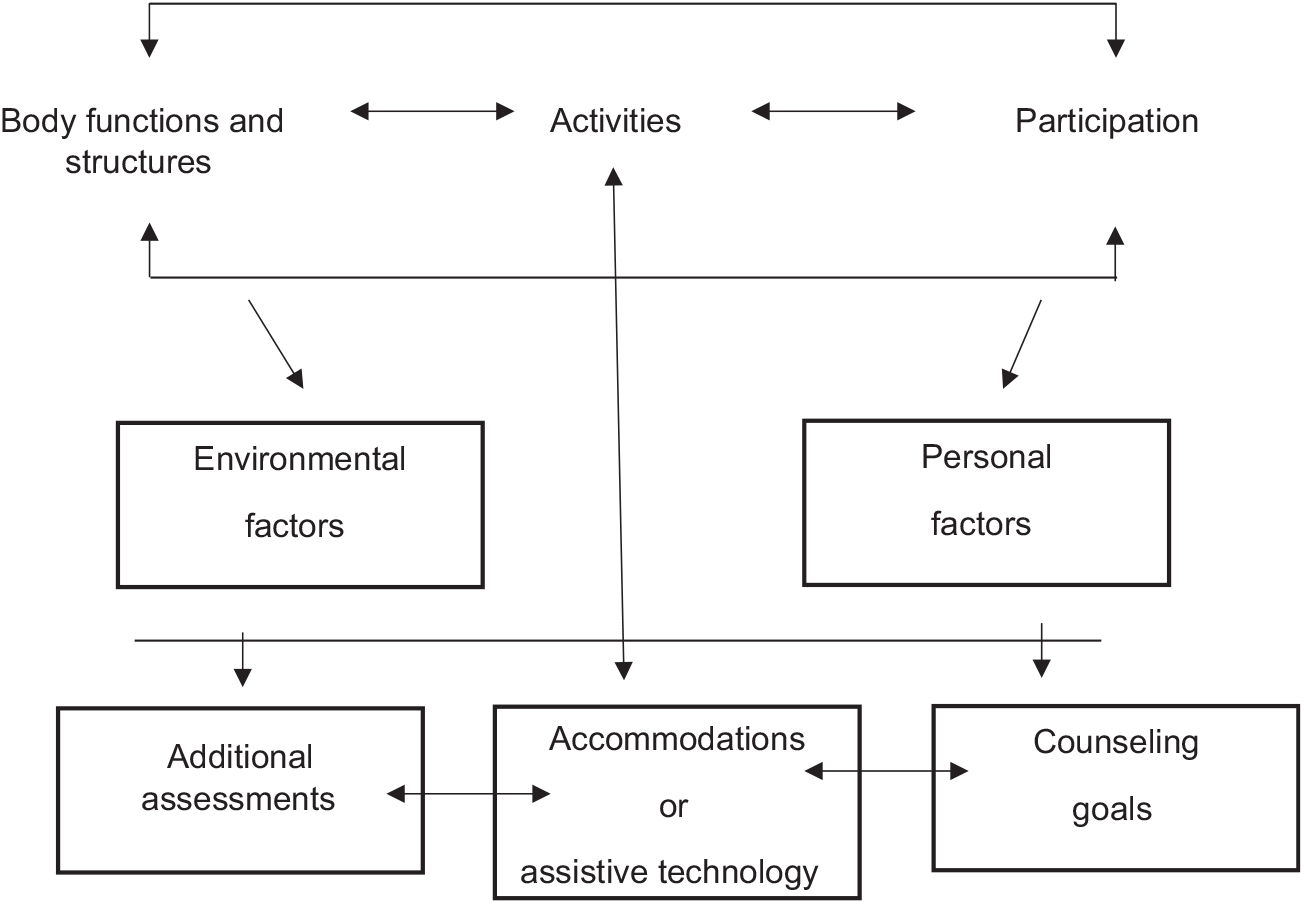
Students and counselors-in-training often struggle to generate appropriate treatment interventions based on accurate and comprehensive client conceptualizations. Use of this framework provides a mechanism to educate students about a systematic and comprehensive method for assessment that is widely used in related fields, including professionals with whom counselors are likely to interact with in their work. Figure 1 illustrates the WHO’s example of a visual representation applied to the ICF framework and includes the counseling specific tasks. For example, students can access open resources published by the WHO, including the assessments outlined in a previous section of this paper. The following case study and subsequent use of the model to organize Mary’s story demonstrates how to effectively use this tool in both teaching and clinical practice. We provide this as an example to illustrate how the framework provides structure to a comprehensive assessment of a client’s presenting problem, as well as all relevant life factors for consideration, including the following: identifying discrepancies; identifying relevant personal and environmental factors; determining additional assessments; identifying appropriate supports, accommodations and counseling goals, and inclusion of other professionals when appropriate. Of note, our example is not necessarily the only or best way to incorporate the model into counselor education courses. We suggest inviting students or counselors-in-training to critically evaluate our example and discuss how to prioritize counseling goals when developing a treatment plan with Mary. Counselor educators may wish to tailor an assignment to focus on theory-guided interventions as part of the case conceptualization, or selection of appropriate follow-up assessments, or connection to providers needed to support Mary’s overall rehabilitation plan.
WHO ICF expanded model (2001a) to include counseling tasks. Printed with permission from the WHO Press Permission Team permissions@who.int.

4. Case Study Example
Mary is a 36-year-old African American mother of a 6-year-old daughter, Lucy. She is a journalist by profession and worked at the local newspaper until she was fired several weeks ago for missing multiple deadlines. In the time since her firing, she was arrested for a Driving While Intoxicated (DUI). Mary was referred for counseling by her probation officer. Mary reports feeling very ashamed about her arrest and being fired. She reports that her drinking led to her being fired; after being fired, her drinking escalated. She reports understanding the decision to fire her, but worries that she may not find a job she likes as much as her previous one and worries about being able to pay her bills on time, which she reported she has done successfully since she was in her early 20s. Lucy, Mary’s daughter, has been staying with her Aunt Josephine (Mary’s sister) since Mary’s arrest.
Mary describes herself as reserved, not very social, but has a few close friends. She says she was “not a party type in college, but a good student” (As and B’s mostly); however, she started to drink and abuse drugs on occasion to cope with stress when she was in college. She reports it was always easy to find someone to buy drinks or supply drugs in her college town. Mary struggled at times to focus on her academic goals while also working part-time jobs to support herself and offset loans. When growing up, her father was addicted to alcohol, and her mother would take care of her father when he was intoxicated or recovering. Her parents divorced when she was 12 years old. Mary has a strained relationship with her mother. Growing up, Mary’s father was an unreliable caretaker, frequently unemployed or under-employed, and Mary’s mother seemed preoccupied with her father. Mary’s father is now deceased, and Mary has limited contact with her mother. Mary is close to her older sister, Josephine, who lives across town and helps Mary care for Lucy. The two sisters saw each other regularly before Mary’s arrest for DUI, but now see each other very frequently so that Mary and Lucy can spend time together. Mary is an active member of a local church, and a committed member for the past 5 years, although she admits to irregular attendance during times when her drinking was heaviest. Mary has spent years sober, only to relapse after a major life transition or depressive episode. She relapsed after her divorce from her ex-husband approximately 2 years ago. Her ex-husband lives in another city and sees Lucy twice a month. He provides financial child support. Mary says she and her ex-husband are cordial to each other but are not emotionally supportive of each other since the divorce was due to his infidelity and subsequent remarriage to another woman in the city in which he now resides. Mary is very concerned about her ex-husband finding out about her arrest and cutting off child support or suing her for custody.
She described her drinking as “in control” initially, but as the stress of working and raising her daughter alone took its toll, her drinking worsened. She reports no other drug use or smoking since college. She attempted sobriety three times before this visit by talking to friends and her sister. Mary says she has not reached out for formal treatment and prefers to rely on her sister and friends for emotional support. Mary reported needing more drinks to achieve the same feelings over the last 2 years. Mary describes difficulty sleeping and has experienced headaches recently since she stopped drinking in the last 4 days. In the past, Mary spent a lot of time using and recovering from alcohol use and says she “wasted precious days due to hangovers and feeling depressed.” As a result of her recent DUI arrest, Mary has a suspended driver’s license. She expressed strong feelings of guilt regarding this relapse and not being able to provide consistent care for her daughter. She has affiliated with a peer support recovery group through her church in the past, but feels too ashamed to reestablish a connection with the group out of fear that her church friends will judge her negatively if they know she relapsed, was fired, and is not currently caring for her daughter. Mary reports no other health conditions. She has worn glasses since she was age 13.
5. Part 1
5.1 Body functions and structures
1. Mary presented with symptoms of alcohol use disorder in the moderate to severe range (ICD 10 code: F10.2), resulting in moderately severe functional limitations to life domains as outlined in detail below. Mary was wearing glasses for mildly impaired vision, as she has done since she was a teenager (ICD 10 code: Z46.0). When Mary wears her glasses, there is no limitation to her vision, and no functional impairments are associated with this condition. There were no changes in her visual acuity since her initial diagnosis. No other health conditions or use of medication were reported.
5.2 Daily living activities
1. Mary is capable of independently completing all daily living activities, including household management, taking care of her daughter, financial management, communication, and getting around. Currently, Mary does not have the capacity to drive herself as she has a suspended driver’s license. Mary previously relied on driving herself to most places but has since started using public transportation for most of her travel needs.
a. Mary’s performance for most daily activities is consistent with her capacity level. She is completing tasks and ADL independently.
b. Mary uses the bus to complete most tasks and to continue to participate in church, and social and family activities. Mary admits to driving herself to the grocery store because she did not feel confident that she could carry multiple bags on the bus. Mary is over-performing in her capacity to drive herself to the grocery store due to her suspended driver’s license.
c. Mary has the capacity to provide financially for herself and her daughter as evidenced by her history of doing so, but is under-performing in this regard as she is currently unemployed; her employment record is a possible barrier to continued financial management.
5.3 Participation in social roles
1. She has the capacity to care for her daughter as evidenced by her history of doing so, her stated commitment to her daughter’s care, and her coordination with her sister to maintain strong connections and regular contact.
a. Mary is currently under-performing in her role as mother since Lucy is living with her aunt while Mary considers her treatment options and works to reestablish employment.
2. Mary has the capacity to work as a journalist as evidenced by her education and past employment history.
a. She is currently under-performing in this regard due to her job loss directly related to alcohol abuse resulting in missed deadlines.
3. Mary has the capacity to develop meaningful relationships in her life as evidenced by her close relationship with her sister, and close friends from church and community.
a. Mary is performing at capacity in this regard and maintains her connections to her sister and friends. She reports strained but existing relationships with ex-husband and mother.
4. Mary is capable of attending peer support groups focused on recovery which could enhance her social support system and reinforce her efforts in sustained abstinence as evidenced by prior support network attendance through her church.
a. She is under-performing in this regard due to her concerns that she will be judged negatively.
6 Part 2
6.1 Environmental factors
1. Mary grew up in a working-class family, as the second child. She describes her father as an “alcoholic” who had a temper.
2. Her parents divorced when she was a child, and her relationship with her mother is strained as Mary continues to have negative memories of her childhood.
3. Mary is close to her sister and her daughter and reports several close friends.
4. Mary is connected to her church community, a positive support for her.
6.2 Personal factors
1. Mary is 36-year-old an African American mother of Lucy, age 6.
2. Mary has a bachelor’s degree in journalism and had a successful career as a journalist.
3. She divorced 2 years ago, which she describes as a stressor that contributed to her relapse.
4. Mary lost her job at the news agency; she is currently financed from her modest savings account and child support payments from her ex-husband.
5. Mary has successfully abstained from alcohol for years at a time in the past.
6. Mary’s driver’s license was revoked after a DUI charge.
7. Mary is worried about losing custody of her daughter due to her alcohol use.
6.3 Additional assessments recommended
1. Due to reported sleeplessness and headaches, medical evaluation for alcohol withdrawal and long-term impact of moderate to severe alcohol use is recommended.
2. Further assessment to determine if Mary’s alcohol use is moderate or severe in order to determine level of care needed.
3. Screen for depression using PHQ-9 as Mary reported a history of depression. Uncertain if symptoms reported by Mary, such as feelings of shame, are related to depression, withdrawal from alcohol, job loss, or disconnection from daughter.
4. Assess for possible childhood maltreatment and other adversity based on father’s alcohol use and Mary’s strained relationship with her mother.
5. WHOQUAL-BREF to determine life domains contributing to quality of life.
6. WHODAS 2.0 to assess functioning related to mental health.
6.4 Accommodations or assistive technology
1. Mary is not capable of driving herself to destinations due to revoked license. Continue to support Mary’s decision to take public transportation; explore alternative methods to acquire groceries, or other household items, including more frequent trips with fewer bags; reinforce the possible legal implications of driving on a revoked license.
2. Mary should continue to wear eyeglasses as prescribed.
3. When Mary regains employment, she may need to request a reasonable accommodation to continue to seek counseling and attend peer support recovery meetings as one important way to sustain her recovery.
6.5 Counseling goals
The specific counseling goals are determined in conjunction with the client (Horvath & Greenberg, Reference Horvath and Greenberg1994; Strong, Reference Strong2009; Tyron & Winograd, Reference Tyron and Winograd2011) and after completing additional assessments using the ICF framework as the guide. The following is a list of possible counseling goals based on the information provided above. More precise goals would be outlined with the benefit of assessment results.
1. Explore treatment options for Mary’s alcohol use disorder based on level of severity and severity of depression as assessed by PHQ-9. Mary’s concern for her daughter is paramount in considering best treatment options. Inclusion of Mary’s sister as possible caretaker for Lucy is recommended if residential or intensive outpatient treatment is determined to be suitable based on assessment results.
2. Encourage Mary to reestablish a peer support network of her choosing after exploring options with her based on schedule and location. Peer support networks should be explored with her gender, age, ethnicity, spirituality, and other personal factors in mind, including geography given her reliance on public transportation.
3. Explore family dynamics growing up, including how the home environment influenced Mary’s coping strategies. This may include trauma-informed interventions and inclusion of a trauma-trained provider if results of trauma screening indicate Mary survived childhood maltreatment often associated with a substance-abusing parent.
4. Provide education related to alcohol addiction in families, and the possible health impact of chronic alcohol abuse so that Mary is aware of symptoms or conditions that she is at risk for experiencing in the future.
5. Explore Mary’s relationship with her ex-husband to better understand how that relationship and divorce impacts her.
6. Continue to support Mary’s commitment to her daughter, including her decision to co-parent with her sister while she contemplates her treatment options and focuses on employment.
7. Support Mary in the job search process. Role play job interviews practicing disclosure of her recent job loss and current treatment alcohol use disorder while emphasizing her training, competence, and how her experiences with recovery and other life events provide resiliency and strength to an organization.
8. Explore a range of adaptive coping strategies for Mary to implement to reduce the stress associated with maintaining abstinence through her recovery journey; focus on the coping strategies she adopted during previous times of sobriety.
9. Validate Mary’s strengths as a capable mother, journalist, sister, and friend, as well as her past success abstaining from alcohol and recovering from abuse. Explore her strengths in these roles as you work to enhance her motivation to maintain her recovery and advocate on her behalf in legal and child custody–related matters.
10. Explain and emphasize the importance of not driving herself on a suspended license and potential legal implications which could impact employment and custody.
7. Conclusion
The ICF framework has broad appeal and utility in a range of health professions, including in counseling specialties, but remains underutilized in most counseling specialties despite its many strengths. This paper revisited the framework as a tool for counselors and counselor educators in clinical, teaching, and research endeavors in the hopes that continued and expanded use of the model will enhance research and clinical outcomes in counseling. This paper used a case study to illustrate how the model could be applied to a client using the components of the model, in conjunction with validated assessments designed to accompany the model, for the purpose of comprehensive, holistic, and dimensional client conceptualization and assessment.
Acknowledgements
None.
Financial Support
This research received no specific grant from any funding agency, commercial, or not-for-profit sectors.
Conflicts of Interest
None.