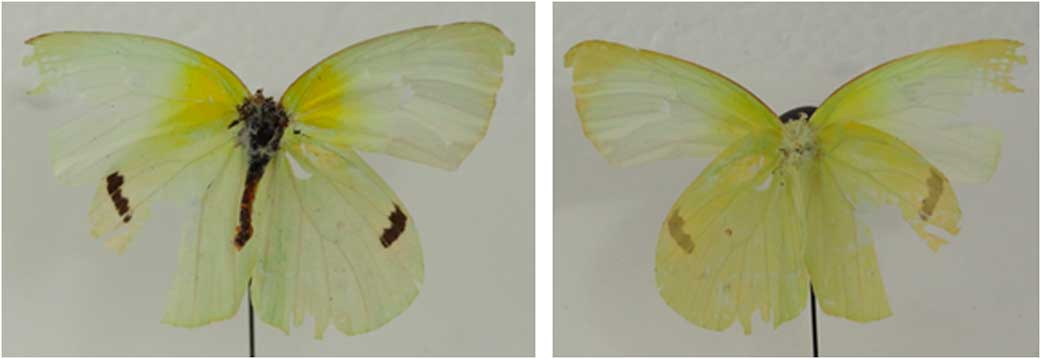
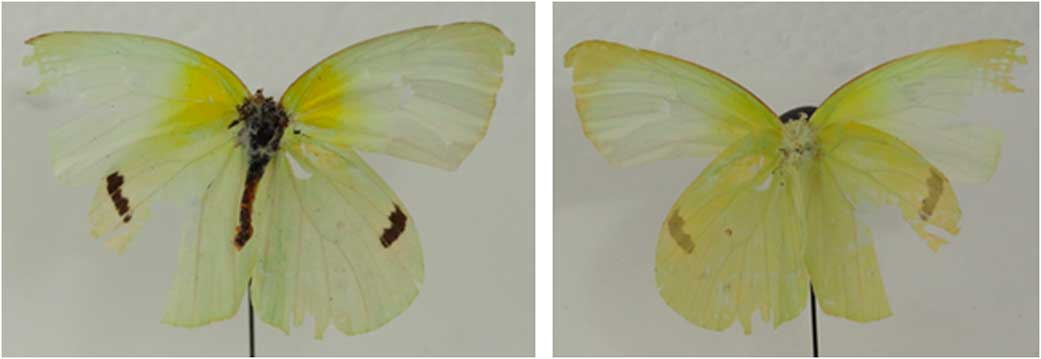
In the late morning of 4 April 2011, Jon Spero found a dead male lyside sulfur (Kricogonia lyside (Godart, 1819): Lepidoptera: Pieridae) beside Gordon Street in Guelph, Ontario, Canada, ~1.4 km NW of the centre of the University of Guelph campus. The individual had died with its wings folded ventrally. Its wings were in reasonably good condition but its head was missing (Fig. 1). It was kept frozen until a leg was removed for DNA analysis, after which it was pinned.
Dorsal (left) and ventral (right) photographs of the Kricogonia lyside specimen found dead in Guelph, Ontario, Canada, on 4 April 2011.
This is an extremely unusual record for this species, especially for early spring. Kricogonia lyside adults winter in southern Texas, United States of America and typically disperse northward into the Great Plains in mid to late summer, but not in April. In the spring of 2011, lyside sulphurs were relatively scarce in southern Texas and were not reported further north until later in the year (L. Gilbert, University of Texas, Austin, Texas, United States of America, personal communication). Historically they have been recorded in summer as far north as Nebraska, Missouri, and Kentucky, United States of America (Opler and Krizek Reference Opler and Krizek1984; Opler Reference Opler1992) and possibly Illinois, United States of America (Klots Reference Klots1951), but never in Canada.
We sequenced 433 bp of cytochrome b (cytB) from the specimen (GenBank accession KC473944). We searched the cytB sequence of the Guelph specimen in GenBank (Benson et al. Reference Benson, Karsch-Mizrachi, Lipman, Ostell and Sayers2011) using the blastn algorithim (Altschul et al. Reference Altschul, Madden, Schäffer, Zhang, Zhang and Miller1997) of the nucleotide collection (nr). There was no exact match, for as of January 2013 there were no K. lyside cytB sequences in GenBank. The fragment most closely matched specimens from five Lepidoptera families, with the most similar sequences from other species within Pieridae (GenBank accessions – HQ177611, EF584877, JQ305693, EF584873, JN246082, DQ008110, EU622524, FJ435433, FJ435434, EF545675).
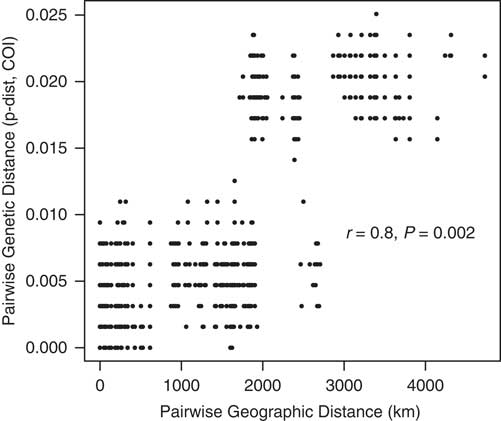
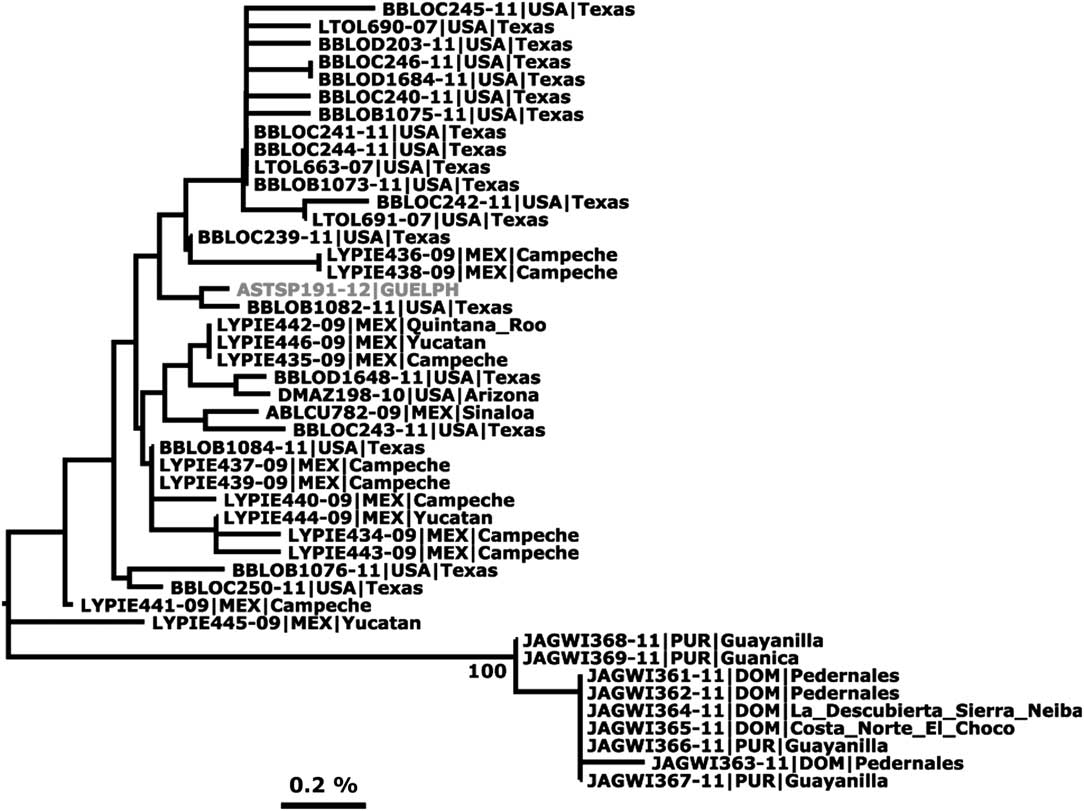
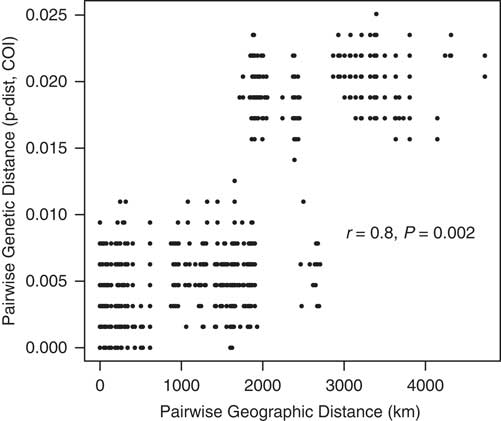
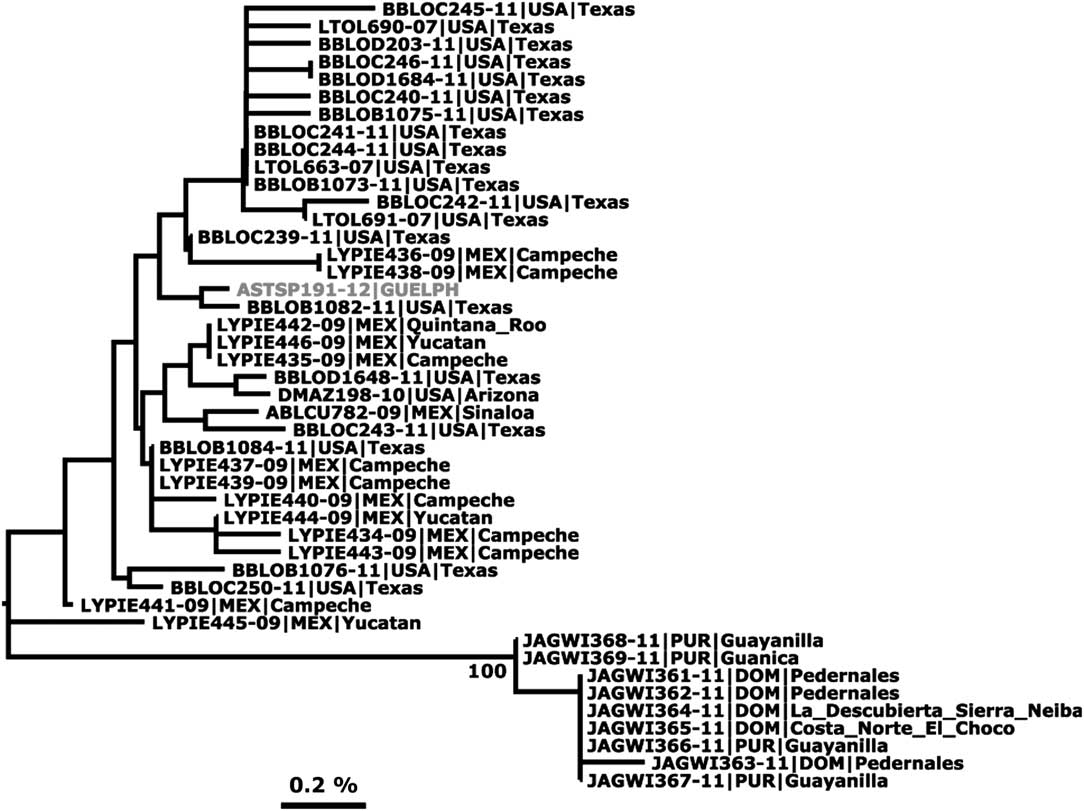
To make a more precise species identification, we sequenced the barcode region of cytochrome c oxidase I (658 bp of COI; GenBank accession KC473943) and compared it to sequences maintained in the reference library of the Barcode of Life Data System (BOLD) (Ratnasingham and Hebert Reference Ratnasingham and Hebert2007). In July 2013, BOLD contained 44 publicly available COI DNA sequences of K. lyside from Texas, Arizona, Mexico, and Caribbean islands (http://www.barcodinglife.org/index.php/Public_BarcodeCluster?clusterguid=BOLD:AAB8209). Kricogonia lyside displayed significant isolation by distance within this single mitochondrial marker (Mantel R=0.8, P=0.002, Fig. 2), suggesting that the Guelph specimen might be identifiable to both species and originating region. It was most similar to the cluster of K. lyside individuals from northern Mexico and Texas (Fig. 3). It has, on average, 3 bp differences with specimens collected in the United States of America (Texas and Arizona) and Mexico and 13 bp differences with specimens collected in the Caribbean region. The most similar specimens (1 bp difference) were collected in southwestern Texas (Fort Clark Springs: 29.305ºN, 100.41ºW; Pecos River: 30.788ºN, 101.835ºW). These analyses strongly suggest that the butterfly originated in southern Texas or northern Mexico and not the Caribbean islands.
Mantel test of geographic distance (km) and genetic distance (COI p-dist) for the 44 Kricogonia lyside publicly available on Barcode of Life Data System (BOLD). Pairwise geographic distance calculated using GDMGv1.2.3 (Ersts Reference Ersts2013) and p-dist calculated using MEGA5 (Tamura et al. Reference Tamura, Peterson, Peterson, Stecher, Nei and Kumar2011).
Genetic distances of the Guelph specimen (labelled “Guelph”) displayed with the 44 publicly available Kricogonia lyside individuals as a neighbour-joining tree (Saitou and Nei Reference Saitou and Nei1987) computed based on p-distance (Nei and Kumar Reference Nei and Kumar2000), where the units are the number of base differences per site. The percentage of replicate trees in which the associated taxa clustered together in the bootstrap test (1000 replicates) is shown next to the branches (Felsenstein Reference Felsenstein1985). The neighbour-joining tree was conducted in MEGA5 (Tamura et al. Reference Tamura, Peterson, Peterson, Stecher, Nei and Kumar2011). Tip labels are BOLD process identifications pipe-separated from collection nationality.
There are several possible explanations for the occurrence of this butterfly in Ontario in early spring of 2011.
1. Natural dispersal of the butterfly from southern Texas to Ontario
There is no evidence to suggest that lyside sulphurs were dispersing northward prior to summer of 2011. Because of the drought in southern Texas in early 2011, lyside sulphurs were uncommon there in spring and were largely absent in central Texas at that time (L. Gilbert, University of Texas, Austin, Texas, United States of America, personal communication). Guelph is ~1000 km from the most northeasterly locality (Kentucky) ever recorded for this species (see map distributional records, Butterflies and moths of North America 2013), making natural dispersal as typically occurs in this species later in summer unlikely.
2. Weather system transport of the adult butterfly
Storms and strong climatic fronts often transport butterflies outside of their normal range (Johnson Reference Johnson1969). This may have happened in this instance because a strong weather event developed over eastern United States of America between 3 and 5 April 2011 (Panovich Reference Panovich2013; Unisys Weather 2013). On the morning of 3 April 2011, the eastern half of Texas experienced high temperatures. For example, at Del Rio the temperature at 7 am was 24–28 °C at 1500 m elevation, and intense thunderstorms with cloud tops in the 8–12 km range developed during the day. High positive Convective Available Potential Energy (Unisys Weather 2013) in southern Texas created strong updrafts capable of lifting a butterfly into the jet stream. The meeting of a stationary region of high pressure over southeastern United States of America and a strong cold front (low pressure cell) approaching from the Great Plains created a line of severe weather watches from eastern Kansas to Chicago by evening of 3 April 2011. The jet stream, with wind speeds of up to 550 km/hour, bent southward to Texas, then extended northeastwards in the direction of southwestern Ontario. Cooling and low convection over Ontario by the morning of 4 April 2011 would have allowed the dead butterfly to drop to the ground.
3. Transportation of butterfly specimen on or in a vehicle
Our specimen may have been struck by a vehicle in southern Texas and fallen off in Guelph. Many Canadian “snowbirds”, who spend the winter in the southern United States of America, return home in early spring. If the specimen reached Guelph in this way, it is surprising that its wings remained in reasonably good condition after being buffeted at highway speeds for nearly 3000 km.
A live adult lyside sulphur inside a vehicle would have had likely flown to a window and should have had several opportunities to escape before reaching Canada.
4. Importation of a pupa on imported produce
Insects and spiders are often transported with produce (Office of Technology Assessment 1993). However, in this case, the host plant of larval K. lyside in Texas and northern Mexico is Guaiacum angustifolium Engelmann (Zygophyllaceae), a common shrub that inhabits shrubby grasslands dominated by mesquite (Prosopis Linnaeus species (Fabaceae)) and Opuntia Miller (Cactaceae) cacti (Gilbert Reference Gilbert1985), not croplands. A larva would have had to crawl away from its host plant and pupate in a nearby crop that was then shipped to Canada for sale. Two grocery stores are relatively close (~1.0 km NW (270°) and ~1.6 km S (70°)) to where the specimen was found. After emergence, the adult would have likely flown to the brightest areas of the store (i.e., a window, not a doorway). If it managed to exit the store, northwest surface winds on 1 and 2 April 2011 and southerly winds on 3 April 2011 (historical weather data from Environment Canada 2011) could have transported the individual from one of these stores to the site where it was collected. However, temperatures on those dates were ⩽8 °C (Environment Canada 2011) and not conducive to flight of a subtropical butterfly.
5. Specimen dropped by an insect collector
This scenario is very unlikely. Before pinning, collectors usually store butterflies with their wings folded dorsally over the thorax, unlike the position this specimen was found in. The only people known to have been collecting in regions this species inhabits in the weeks before this specimen was found were one of us (M.A.S.) and Claudia Bertrand, neither of whom had collected this species.
6. April Fool’s Day joke
This scenario is very unlikely. Someone would have had to be willing to destroy a specimen of this butterfly species by setting it out along a busy street more than 1.0 km from the university campus with a low probability it would be noticed.
7. Escapee from a live butterfly exhibit
Impossible. This species is not one imported by either of the two local live butterfly exhibits (Cambridge Butterfly Conservatory or Greenway Nursery), ruling out this possibility.
In summary, it is highly likely that the lyside sulfur individual found in Ontario originated in southern Texas or northern Mexico. Unfortunately, all possible modes of transport of this specimen are unlikely, and the way in which this unusual specimen reached Ontario remains a mystery.
Acknowledgements
The authors thank Paulson Des Brisay for conducting the cytB sequencing. Jeff Skevington and Alan Wormington provided useful discussions about the ways this butterfly could have been transported to Ontario. Jess Howell and Jon Warland condensed detailed weather data into language and explanations understandable to biologists. This study was supported by Natural Sciences and Engineering Research Council of Canada (NSERC) Discovery Grants to Alex Smith and Gard Otis. Some of the publically available specimens of Kricogonia lyside on BOLD were collected by the BIObus. The support of Texas State Parks in the collection program that produced the other lyside sulphur specimens in BOLD is acknowledged. Comments of C. Schmidt, L. Gilbert, J. Kerr, and an anonymous reviewer helped to improve the manuscript.