INTRODUCTION
Studies on the variation of parasite diversity among populations of the same vertebrate species have demonstrated the existence of substantial geographical variation in the structure of parasite communities (Fellis et al. Reference Fellis, Negovetich, Esch, Horak and Boomker2003; Luque and Poulin, Reference Luque and Poulin2007). Parasite species richness, which is the number of parasite species found in and on a given host species, has been shown to be variable in space and time at a local (Behnke et al. Reference Behnke, Barnard, Bajer, Bray, Dinmore, Frake, Osmond, Race and Sinski2004; Calvete et al. Reference Calvete, Blanco-Aguiar, Virgos, Cabezaz-Diaz and Villafuerte2004; Brouat et al. Reference Brouat, Kane, Diouf, Bâ, Sall-Drame and Duplantier2007), a regional (Krasnov et al. Reference Krasnov, Stanko, Miklisova and Morand2006; Luque and Poulin, Reference Luque and Poulin2007) or even at a latitudinal scale (Guernier et al. Reference Guernier, Hochberg and Guégan2004; Nunn et al. Reference Nunn, Altizer, Jones, Sechrest and Cunningham2005).
Most studies have adopted a local approach in their investigations and, consequently, they have focused on parasite infracommunities (all parasites found in an individual host) or parasite component communities (all parasites found in a host population). Parasite species richness was often shown to be highly variable at these local hierarchical scales in fish (Zander, Reference Zander2007), in birds (Calvete et al. Reference Calvete, Blanco-Aguiar, Virgos, Cabezaz-Diaz and Villafuerte2004) and also in mammals (Behnke et al. Reference Behnke, Barnard, Bajer, Bray, Dinmore, Frake, Osmond, Race and Sinski2004). These studies strongly suggested a poor repeatability of parasite species richness (i.e. PSR, the total number of parasites found on a host species at a given scale) in space and time (Poulin, Reference Poulin2007a) leading to doubts about the existence of strong patterns in parasite communities at host population or host species levels (Poulin, Reference Poulin2007b, but see Morand and Krasnov, Reference Morand and Krasnov2008).
However, studies that have investigated parasite communities at broader scales (i.e. regional parasite communities or parasitofaunas) have shown the existence of patterns and of some determinants that can explain them (Guégan et al. Reference Guégan, Morand, Poulin, Thomas, Renaud and Guégan2005; Nunn et al. Reference Nunn, Altizer, Jones, Sechrest and Cunningham2005; Lindenfors et al. Reference Lindenfors, Nunn, Jones, Cunningham, Sechrest and Gittleman2007). One major finding is that parasite assemblages are not the result of random processes but rather the result of the interplays among geographical location, habitat characteristics and host identity (Kennedy and Hartvigsen, Reference Kennedy and Hartvigsen2000; Nelson and Dick, Reference Nelson and Dick2002; Calvete et al. Reference Calvete, Blanco-Aguiar, Virgos, Cabezaz-Diaz and Villafuerte2004; Krasnov et al. Reference Krasnov, Shenbrot, Mouillot, Khokhlova and Poulin2005a, Reference Krasnov, Mouillot, Khokhlova, Shenbrot and Poulin2006). In other words, the number and the identity of parasites found in a host species at large scale is determined simultaneously by extrinsic factors that promote variation among host populations (such as climatic factors) and intrinsic host factors that promote stability and so repeatability in parasite communities (Aznar et al. Reference Aznar, Balbuena and Raga1994; Krasnov et al. Reference Krasnov, Shenbrot, Mouillot, Khokhlova and Poulin2005a, Reference Krasnov, Mouillot, Khokhlova, Shenbrot and Poulin2008). The host factors related to the stability of parasite communities may rely on phylogeny, ecology and immune or behavioural adaptations of species in response to parasite impacts. All these factors determine to some extent the establishment of parasites in hosts (Combes, Reference Combes2001; Poulin, Reference Poulin2007a).
Focusing on mammals, the importance of host identity or host-related factors in shaping macroparasite assemblages and notably parasite species richness has been intensively investigated. These factors are shown to be related to host morphology (i.e. body size), host ecological traits (density, geographical range) or host life-history traits (longevity, basal metabolic rate) (Morand and Harvey, Reference Morand and Harvey2000; Arneberg et al. Reference Arneberg2002; Stanko et al. Reference Stanko, Miklisova, Goüy De Bellocq and Morand2002; Ezenwa et al. Reference Ezenwa, Price, Altizer, Vitonen and Cook2006; Lindenfors et al. Reference Lindenfors, Nunn, Jones, Cunningham, Sechrest and Gittleman2007; Korallo et al. Reference Korallo, Vinarski, Krasnov, Shenbrot, Mouillot and Poulin2007). Paradoxically, the repeatability of parasite diversity at various geographical scales for various populations of the same host species (i.e. within a host species) has been investigated less in mammals. For gastrointestinal helminths, to our knowledge, there is essentially only a single study concerning 188 populations of 35 species of mammals in North America essentially (Poulin and Mouillot, Reference Poulin and Mouillot2004). This study emphasized that gastrointestinal helminth species richness was too variable across populations of the same host mammal species to be considered as a true host species characteristic. In contrast, recent studies investigating ectoparasite species richness in small mammals have shown that flea and gamasid mite species richness on different populations of the same mammal species were more similar to each other than expected by chance (Krasnov et al. Reference Krasnov, Shenbrot, Mouillot, Khokhlova and Poulin2005a, Reference Krasnov, Korallo-Vinarskaya, Vinarsky, Shenbrot, Mouillot and Poulin2008).
Taken altogether, these contradictory results stress the possibility of a lack of generalization in parasite community ecology, each host-parasite association being particular and unique (Poulin, Reference Poulin2007b). Moreover, these results highlight the need to explore more precisely the importance of host identity as a factor structuring parasite communities among populations of the same host species. As parasite species richness in arthropod ectoparasites seems to be a repeatable host species characteristic at regional scale (Krasnov et al. Reference Krasnov, Shenbrot, Mouillot, Khokhlova and Poulin2005a, Reference Krasnov, Korallo-Vinarskaya, Vinarsky, Shenbrot, Mouillot and Poulin2008), the aim of this study is to reconsider the possibility that helminth species richness is also a repeatable host characteristic. For this, we use a large database including mammal species from various continents.
MATERIALS AND METHODS
Data on parasite species richness
We focused on all helminth taxa (nematodes, cestodes, trematodes and acanthocephalans) and obtained data on endoparasite species richness from published studies. In order to get homogeneous data, we only used surveys where host sample sizes were given and rejected descriptive parasite reports for a given host species. We retained only surveys for which helminth species were investigated from the whole host body (gastrointestinal tract but also liver, respiratory tract, cardiovascular system ....) and used parasite species richness (PSR) as a measure of parasite diversity.
Comparison of parasite species richness among host species or among host populations may be confounded by uneven sampling effort (the number of hosts examined) and uneven sampling area size (Guégan and Kennedy, Reference Guégan and Kennedy1996; Morand and Harvey, Reference Morand and Harvey2000). These introduce major confounding effects in studies investigating parasite community structure and that attempt to identify the structuring processes (Calvete et al. Reference Calvete, Blanco-Aguiar, Virgos, Cabezaz-Diaz and Villafuerte2004; Guégan et al. Reference Guégan, Morand, Poulin, Thomas, Renaud and Guégan2005). For a given host species, which was sampled at least twice across its geographical area of distribution, we retained only surveys for which sampling area sizes were comparatively similar among populations of the same host species and controlled for sampling effort. Practically, we retained data in which helminth communities were established at a regional scale in 1 of 3 continents (Europe, America, Australia). There is still no consensus about what exactly a region means for parasite communities (Guégan et al. Reference Guégan, Morand, Poulin, Thomas, Renaud and Guégan2005). We therefore followed previous studies where regional community of parasite species for a given mammal species represents the parasite species occurring at the level of a state for North American surveys or at the level of a country for Europe, or in a part of a state for Australia (Krasnov et al. Reference Krasnov, Shenbrot, Mouillot, Khokhlova and Poulin2005a, Reference Krasnov, Korallo-Vinarskaya, Vinarsky, Shenbrot, Mouillot and Poulin2008). We are aware that political divisions may be arbitrary but most parasitological surveys have been done at such geographical scales. The relative homogeneity in sampling area size was then controlled by the number of states or countries included in the survey. As an example, for the mammal species Sciurus carolinensis, we retained only 2 surveys which have been both done at the level of a state (Florida and Virginia respectively) and rejected 1 survey representing a sampling area of nearly all the south-east of the United States (with more than 10 states included in the survey).
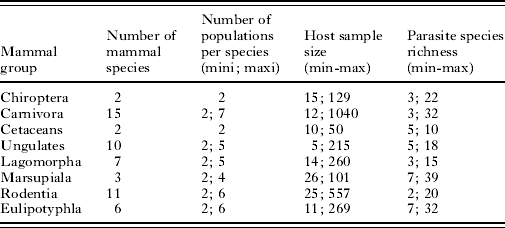
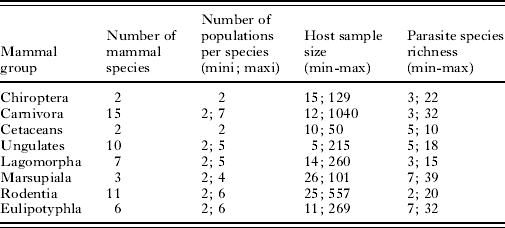
We gathered data for 171 populations representing 56 mammal species in various groups including Cetartiodactyla, Chriroptera, Carnivora, Didelphimorphia, Diprodontia, Lagomorpha, Rodentia and Eulipotyphla (Table 1).
Summary of the data on mammal parasite species richness for 56 mammal species, with variations in number of populations (minimum-maximum) per mammal species and in host sample size (minimum-maximum)
Statistical analyses
To determine whether species richness of helminth assemblages is invariant of geographical locality, we performed a repeatability analysis. We only retained mammal species that had been investigated at least twice in its geographical area. We analysed the variation in number of helminth species using a one-way ANOVA in which host species and host group were the independent factor, and the number of hosts sampled a covariate. We performed a variance component analysis. The variance of helminth species richness was divided into 2 components: host species and host group with host species was nested in host group. The number of hosts sampled remained a covariate.
RESULTS
There was a significant correlation between helminth species richness and host sample size (P=0·002, F1,170=9·935) although the variance explained is low (R2=0·055).
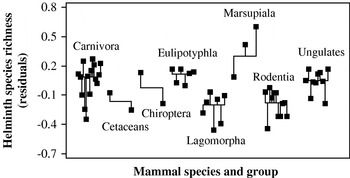
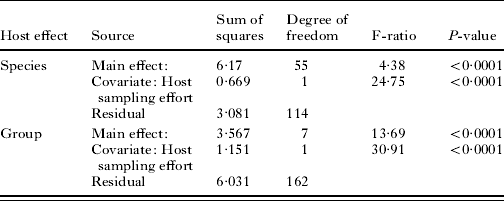
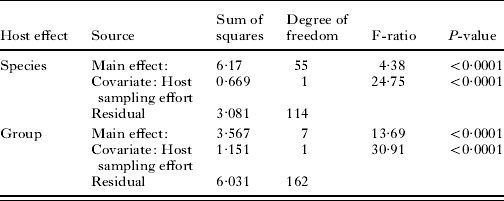
The repeatability analysis showed that helminth species richness was repeatable within host species (Table 2). The number of helminth species on the same host populations was more similar to each other than expected by chance, and varied significantly among mammal species (Table 2, P<0·0001, Fig. 1), taking into account a significant effect of host sampling effort (Table 2, P<0·0001). Helminth species richness was also repeatable within mammal groups (Table 2, P<0·0001).

Analysis of variance for helminth species richness, with host species and host group as factor and the number of hosts sampled as covariate
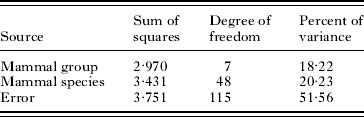
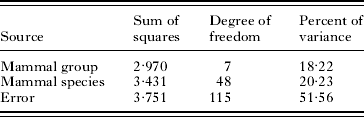
The variance component analysis showed that 18% of the variance in helminth species richness was explained by mammal groups and 20% of the variance by mammal species (Table 3).
Variance components analysis for helminth species richness, with mammal group and mammal species as factors, and the number of hosts sampled as covariate
(The factor mammal species is nested in the factor mammal group.)
DISCUSSION
Our study has focused on all helminth species whereas only gastrointestinal helminths were taken into account in the study of Poulin and Mouillot (Reference Poulin and Mouillot2004), with a larger data set with 56 mammal species in our study compared to the 35 mammal species in Poulin and Mouillot's study (Reference Poulin and Mouillot2004). Moreover, we have considered variation in helminth species richness at a more comparable scale, i.e. regional scale.
We are then able to show that regional helminth species richness is repeatable within a mammal host species despite the undeniable and well-demonstrated effects of biotic and abiotic factors (Fellis et al. Reference Fellis, Negovetich, Esch, Horak and Boomker2003; Thieltges et al. Reference Thieltges, Jensen and Poulin2008). In relation to recent results on fleas and gamasid mites, our results reinforce the importance of host identity in structuring helminth community at larger scales in mammals. Moreover, the validity of parasite species richness (PSR) as an estimator of parasite diversity is reinforced as PSR seems to be a true attribute of a host mammal species.
The results obtained in arthropod communities (Krasnov et al. Reference Krasnov, Shenbrot, Mouillot, Khokhlova and Poulin2005a, Reference Krasnov, Korallo-Vinarskaya, Vinarsky, Shenbrot, Mouillot and Poulin2008) and helminth communities (here) strongly suggest that certain intrinsic properties of mammal species may affect parasite species richness. From this perspective, our study and those of Krasnov et al. (Reference Krasnov, Shenbrot, Mouillot, Khokhlova and Poulin2005a, Reference Krasnov, Korallo-Vinarskaya, Vinarsky, Shenbrot, Mouillot and Poulin2008) are relevant for the investigation on the determinants and causes of the observed heterogeneity in parasite diversity across species (Poulin and Morand, Reference Poulin and Morand2004), but also to investigate the covariation in species diversities of different parasite taxa found in the same host species (Krasnov et al. Reference Krasnov, Shenbrot, Mouillot, Khokhlova and Poulin2005b).
Why some mammal species harbour comparatively more parasites than others may find the answer in the possibility that some parasite taxa may facilitate the installation of other species or groups of parasites (Krasnov et al. Reference Krasnov, Shenbrot, Mouillot, Khokhlova and Poulin2005b; Graham, Reference Graham2008). However, many causes and potential mechanisms, not mutually exclusive, may also play a role. Phylogeny and factors linked to host ecology or physiology (i.e. body size, feeding activity, habitat preference, geographical distribution, solitary versus social behaviour) may explain why some host species are more prone to encounter and accumulate a higher diversity of parasites in comparison to other host species (Aznar, Reference Aznar, Balbuena and Raga1994; Krasnov et al. Reference Krasnov, Stanko, Miklisova and Morand2006; Klimpel et al. Reference Klimpel, Förster and Schmahl2007; Bordes et al. Reference Bordes, Blumstein and Morand2007). By exploring the variance of PSR among host species and among host groups, our analysis highlights the importance of host phylogeny. We were able to establish that the percentage of the total variance of PSR was largely dependent on host species, but also on host group (i.e. rodents, carnivores …).
Repeatability in parasite species richness may suggest that the existence of thresholds beyond hosts may not be able to cope with multiple parasite attacks without strong effects on their survival or reproductive success. As it is established that immunity is an energetically and nutritionally demanding process (Lochmiller and Derenberg, Reference Lochmiller and Deerenberg2000; Zuk and Stoehr, Reference Zuk and Stoehr2002; Hanssen et al. Reference Hanssen, Haselquist, Folstad and Erikstad2004), interactions between parasites and several physiological tasks (reproduction, survival …) may be mediated through immunity. The great heterogeneity in parasite species richness among host species and the finding that this diversity is an attribute of host species may be linked to the level of immune investment at species level resulting from evolutionary trade-offs with other physiological tasks. Facing multiple parasitic attacks may force hosts to maintain a performing immune system against all parasite species at the expense of reproduction or even survival or to tolerate parasite accumulations with some levels of detrimental effects and/or negative effects on host energy balance.
Energetic budget and nutritional status are then expected to explain heterogeneity in parasite diversity and potentially covariation among various parasite taxa.
We thank three anonymous referees for their helpful and constructive comments.