Introduction
On 22 April 1848, 105 British sailors, dragging sledges loaded with boats and several tons of equipment and supplies, took the first steps of a long and perilous journey in freezing temperatures and spring blizzards. Two dozen deaths, nearly half of which were officers, had already reduced their original number of 129 officers and crew, including Franklin himself who had died the previous summer. They had been away from Britain for 35 months, of which the last 19 had been spent with the discovery ships HMS Erebus and HMS Terror continuously beset in the sea ice. Their desperate attempt to escape their ice-bound ships was their only hope of survival, but all would perish no further than 325 km from the ships.
By 1859, a massive search effort had revealed only the most basic outline of the expedition’s fatal outcome, much of the information coming from a single document cached as the retreat began, from Inuit who had encountered some of the men, both alive and dead, and from the discovery of one of the boats containing the remains of two sailors (Cyriax, Reference Cyriax1939; Savours, Reference Savours1999; Lambert, Reference Lambert2009). Similar discoveries would be made in subsequent years, and more than a century and a half later, the Franklin expedition’s post-mortem continues to be a topic of academic research and debate for which many essential details, such as when and where all but eight of the sailors died, are unknown (Park & Stenton, Reference Park and Stenton2019). Three of them – John Torrington, John Hartnell and William Braine – died in the winter of 1846, and were buried in marked graves on Beechey Island (Cyriax, Reference Cyriax1939; Beattie & Geiger, Reference Beattie and Geiger1987). Franklin himself died on 11 June 1847 and Graham Gore died sometime between then and April 1848, but where they were buried is unknown. Tentative identifications have been proposed for remains of 3 of the 105 men still alive in April 1848: John Irving, based on an artifact bearing his name found in association with the skeletal remains (Schwatka, Reference Schwatka and Stackpole1965); Harry Goodsir, based on isotope geochemistry and forensic facial reconstruction (Hall, Reference Hall1869; Nourse, Reference Nourse1879; Mays et al., Reference Mays, Ogden, Montgomery, Vincent, Battersby and Taylor2011); and either Thomas Armitage or William Gibson, based on the contents of a pocketbook and other items found with the skeleton (McClintock, Reference McClintock1859; Cyriax & Jones, Reference Cyriax and Jones1954; Stein, Reference Stein2007). Identifications have not been postulated for more than two dozen other men whose skeletal remains have been found and very little is known about precisely who took part in the escape attempt and who succumbed first or who survived longest as they made their way south.
Materials and methods
DNA analysis
400 uL of 10% Chelex© 100 is added to a sterile 2.0 mL tube and incubated for 2 h at 56 ºC and 500 rpms (Walsh et al., Reference Walsh, Metzger and Higuchi1991). After this time, the supernatant is mixed with 1.0 mL 4M Guanidinium Thiocyanate and 15 uL silica. This is allowed to sit for 4 h at 4 °C after which the supernatant is removed and the remaining silica is washed with Working Wash Buffer (10 mM Tris-HCl, 50 mM NaCl, 1mM EDTA, anhydrous ethanol) and 100% ethanol, and then allowed to dry. The silica is resuspended in 55 uL sterile water and incubated for 1 h at 56 °C to allow DNA to unbind from silica and dissolve in the water (Boom et al., Reference Boom, Sol, Salimans, Jansen, Wertheim-van Dillen and van der Noordaa1990).
Total DNA is quantified using the Invitrogen Qubit dsDNA HS Assay Kit on the Qubit™ 1.0 Fluorometer. Y-chromosome DNA is amplified in 10 uL reactions using the Promega PowerPlex® Y23 System using the manufacturer’s cycling parameters. This PCR reaction batch includes a positive and negative PCR control. Each locus is amplified at least twice for replication. These PCR products are resuspended in 9 uL Hi-Di Formamide and 0.3 uL WEN Internal Lane Standard 500 Y23 and run on the ABI 3130xl for sequencing analysis. Where partial profiles are obtained, Y-chromosome DNA is also amplified in 10uL reactions using Life Technologies AmpFlSTR© Y-Filer™ PCR Amplification Kit using the manufacturer’s cycling parameters. This PCR reaction batch includes a positive and negative PCR control. Some of the loci in this kit appear in smaller sizes than the Y23 kit. These PCR products are resuspended in 9 uL Hi-Di Formamide and 0.3 uL GenescanTM – 500 LIZTM size standard and run on the ABI 3130xl for sequencing analysis.
To eliminate the possibility of contamination of the NgLj-3 samples with modern DNA, four individuals who had come into direct contact with the remains, including three of the authors, provided buccal swab samples for comparison with the archaeological samples. None of the latter samples yielded sequences that matched the four modern samples, indicating no contamination of the archaeological samples with the DNA from these individuals (see Stenton, Keenleyside, Fratpietro, & Park, Reference Stenton, Keenleyside, Fratpietro and Park2017). Members of the research team had no direct contact with the buccal swab sample (FR-027-2019) submitted by the presumed descendant donor. All Paleo-DNA Laboratory personnel were also excluded as contributing to the final results, and the laboratory work for the modern and archaeological samples was performed in physically separated laboratory areas.
Bioarchaeological investigations
In 2008, new investigations of the archaeological record of the Franklin expedition were initiated by the Government of Nunavut in conjunction with searches by Parks Canada for the wrecks of HMS Erebus and HMS Terror. As a new and complementary dimension of previous bioarchaeological studies of the expedition, DNA analysis was conducted between 2013 and 2019 on 20 teeth and 21 bone samples from 9 Franklin expedition archaeological sites along the line of the April 1848 retreat (Stenton et al., Reference Stenton, Keenleyside, Fratpietro and Park2017; Stenton, Reference Stenton2018a; Stenton, Reference Stenton2019).
Thirty-nine mtDNA and 13 Y-chromosome haplogroups representing 27 individuals were obtained, all of which have western European origins consistent with the expedition’s membership. Thus, we have DNA from one-quarter of the 105 men who attempted the retreat. Of those 27 individuals, 23 came from 1 geographic location: Erebus Bay, on the southwest coast of King William Island, a little more than 80 km from the ice-bound ships (Stenton et al., Reference Stenton, Keenleyside, Fratpietro and Park2017; Stenton, Reference Stenton2018b). Evidence of a significant Franklin expedition presence at Erebus Bay was discovered in 1859 and 1861–62 (Hall, Reference Hall1869; McClintock, Reference McClintock1859; Stenton & Park, Reference Stenton and Park2017). Two sites, NgLj-2 and NgLj-3, were found less than 2 km apart, each containing a Royal Navy ship’s boat on a sledge, human skeletal remains and an assortment of personal items and Royal Navy paraphernalia. The remains of 13 individuals have been found at NgLj-2, 3 at NgLj-3, and the remains of a further 7 were found at nearby sites (Ranford, Reference Ranford1994; MacDonald, 1994; Stenton, Keenleyside, & Park, Reference Stenton, Keenleyside and Park2015). Serious problems were clearly encountered by the time the retreating parties had reached Erebus Bay, resulting in the decision to leave behind 2 boats and at least 23 dead, dying or infirm sailors. Knowledge of those sailors’ identities and, thus, their ranks and which ship they came from offered the possibility of gaining insight into the nature of the adversity they faced at Erebus Bay and whether it affected one ship or one segment of the crews disproportionately.
Franklin expedition DNA identification project
The number of fatalities that occurred at Erebus Bay served as a catalyst for attempting to identify individuals through the comparison of archaeological DNA samples with samples obtained from living descendants. Modern comparative DNA samples have been obtained from 17 of 84 individuals who self-identified as descendants of a member of the Franklin expedition based on genealogical data showing an unbroken maternal (n = 1) or paternal (n = 16) lineage. The first 16 produced no matches, but in 2019, the project team was contacted by an individual who self-identified as a direct paternal descendant of Warrant Officer John Gregory, who served as Engineer on HMS Erebus. Genealogical information indicated a direct, five-generation paternal relationship between the living descendant and John Gregory, and a buccal DNA sample (FR-027-2019) was obtained from the descendant for comparison with archaeological DNA data from the Franklin expedition.
Results
Y-chromosome analysis
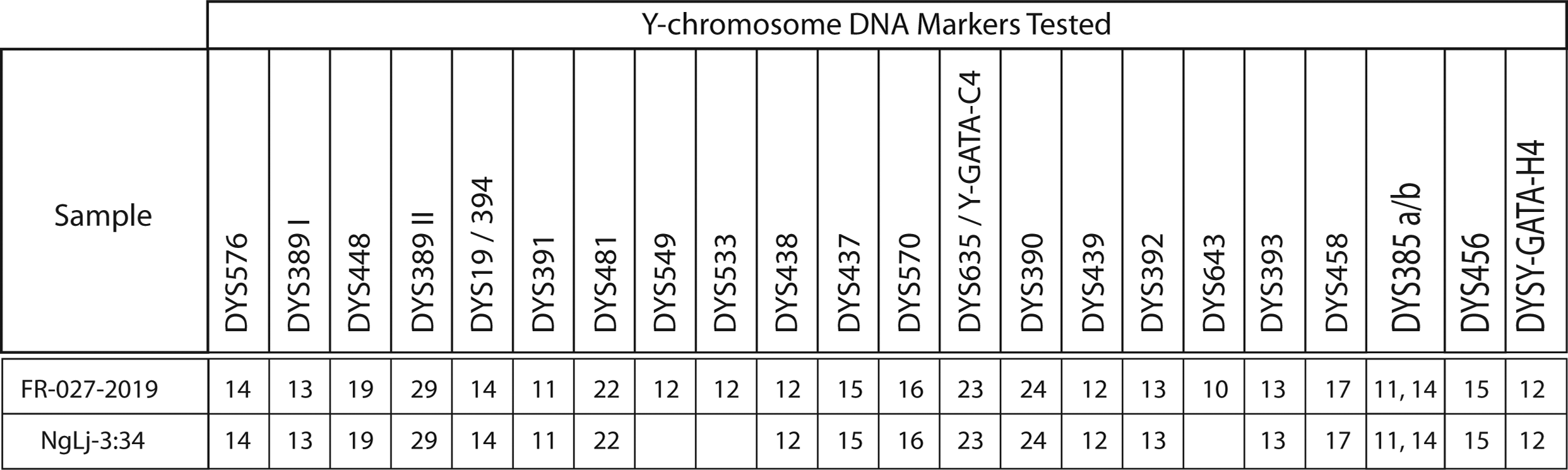
Comparison of the Y-chromosome results obtained for the presumed descendant with those in the Franklin expedition DNA database identified a molar taken from a mandible found at site NgLj-3 (NgLj-3:34) as a possible match. Seventeen markers previously obtained from NgLj-3:34 (Stenton et al., Reference Stenton, Keenleyside, Fratpietro and Park2017) in combination with additional testing for DYS576, DYS481 and DYS570 were compared to the same 20 markers obtained from the possible living paternal descendant (Fig. 1). These two individuals have a genetic distance of zero indicating a strong possibility that they shared a common paternal ancestor.
Comparison of Y-chromosome DNA markers between NgLj-3:34 and FR-027-2019.

The Y-Chromosome Haplotype Reference Database release 62 (YHRD) (Willuweit & Roewer, Reference Willuweit and Roewer2015) was used for frequency calculations. Because of the number of Y-chromosome markers involved, the PowerPlex Y23 database was chosen as the best search option. The PowerPlex Y23 database contains 73,006 haplotypes consisting of 370 population samples, 71 national databases and 28 metapopulations. The haplotype of NgLj-3:34 and corresponding FR-027-2019 markers was not found amongst 73,006 other haplotypes. This 20-marker Y-chromosome haplotype is unique within this database. Additional searches of the NgLj-3:34 haplotype using the YFiler database compared 17 markers within 246,821 haplotypes and found 187 matches. Similarly, using the minimal database, 9 markers were compared in 307,169 haplotypes and found 4988 matches. By decreasing the number of markers being compared, we saw an increase in haplotype frequency. This would indicate that the 20-marker haplotype obtained for NgLj-3:34 is sufficient for comparison as enough distinctive genetic information exists.
The Kinship Index (Buckleton et al., Reference Buckleton, Triggs and Walsh2005), the likelihood ratio of an individual being paternally related versus an individual not being paternally related is calculated to be 47,030. This calculation is based on a PowerPlex Y23 dataset consisting of 123,614 haplotypes. This indicates strong support that FR-027-2019 and NgLj-3:34 are 47,030 times more likely to be paternally related than non-paternally related.
Previous osteological analyses established that a minimum of three individuals was represented in the NgLj-3 human skeletal assemblage (Stenton et al., Reference Stenton, Keenleyside and Park2015). This number was supported by DNA results for seven samples, each of which belonged to one of the three maternal lineages (Stenton et al., Reference Stenton, Keenleyside, Fratpietro and Park2017). NgLj-3:34, NgLj-3:64 and NgLj-3:80 shared a common maternal lineage, and two (NgLj-3:34 and NgLj-3:64) could not be excluded as sharing a common paternal lineage. These three samples thus represent only one of the three individuals at NgLj-3 and the Y-chromosome results for the presumed descendant donor and NgLj-3:34 exclude the other two individuals as possible matches with the presumed descendant. In the absence of pelvic bones that could be unequivocally associated with the individual, an age estimate obtained using the ectocranial suture closure method resulted in a total age range of 23–75 years and mean ages of 41 and 45 years (Meindl & Lovejoy, Reference Meindl and Lovejoy1985).
Facial reconstruction
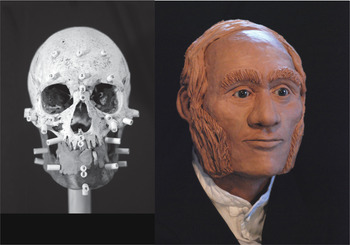
Based on their common maternal lineage, a facial reconstruction was also performed on NgLj-3:80 and NgLj-3:34 (Stenton et al., Reference Stenton, Keenleyside, Fratpietro and Park2017; Stenton et al., Reference Stenton, Keenleyside, Trepkov and Park2016) (Fig. 2). This technique is not a method of positive identification, but it can provide an approximation of what an individual might have looked like during life. Daguerreotypes taken of 14 of the 24 senior officers just prior to the expedition’s departure do not include John Gregory, and no known photographic evidence exists of him that can be compared to the reconstruction.
Facial reconstruction of individuals identified through DNA analysis as John Gregory, HMS Erebus. Photographs courtesy of Diana Trepkov.

Discussion
Our genealogical research has not conclusively established John Gregory’s date and place of birth, but census, birth, baptismal and marriage records suggest he was born in Lancashire between 1801 and 1804. These data also correct a previously reported date of birth for Gregory as 22 November 1790 in Lancashire to parents John and Mary Gregory (Lloyd-Jones, Reference Lloyd-Jones2018). That John Gregory died in infancy and was buried on 1 April 1791 (Liverpool Record Office, 283-JOH-1-3). On 14 April 1823, our John Gregory married Hannah Wilson in Ashton under Lyne, Lancashire, where Hannah was born in 1801 (Lancashire Record Office, BT’s Births 1768–1810; Lancashire Online Parish Clerk Project, Marriages 1821–1827). The marriage certificate lists both as being “of the parish” but it is unknown if John was also born there. Their first child, Edward John Gregory, was baptized two months after the wedding, on 15 June 1823 (Lancashire Online Parish Clerk Project, Baptisms 1821–1823). The modern DNA sample obtained for this study is from a direct descendant of Edward John Gregory.
In 1845, the year the Franklin expedition sailed, the Gregory family resided at 7 Ely Place, London. John was employed as an engineer at the firm of Maudslay, Sons & Field, a prominent manufacturer of marine steam engines and boilers based in Lambeth, London (Lloyd-Jones, Reference Lloyd-Jones2018; Battersby & Carney, Reference Battersby and Carney2011). This firm acquired and fitted the auxiliary power locomotive engines on HMS Erebus and HMS Terror in April 1845, and recommended John Gregory and fellow engineer James Thompson as personnel to maintain the engines on the expedition. John had no previous service and joined HMS Erebus “Per warrant” on 13 May 1845 (National Archives, ADM 29 1802–1919; National Archives, ADM 38/0672 Admiralty Ships’ Musters). Both men received double the amount paid to First-Class Engineers and both were apparently hired on one week’s notice following uninspiring results for engine performance tests conducted in the weeks prior to the expedition’s departure in May 1845 (Lloyd-Jones, Reference Lloyd-Jones2018; Battersby & Carney, Reference Battersby and Carney2011; Battersby, Reference Battersby2010).
The last information about him that John Gregory’s descendants had before now was a letter he wrote to Hannah on 9 July 1845, after the ships arrived in Greenland (Gregory, Reference Gregory1845). The letter describes an uneventful voyage, punctuated by observations from the perspective of someone who had never before been to sea, but John’s financial affairs at home were clearly on his mind…
I wish you to see Mr. Fitzpatrick with respect to the money you may place in Mr. Maudslay’s hands and arrange it with him […] also give my best respects to Mr. Pile and ask him if he has spoken to Mr. Maudslay’s about my money […] Give my best respects to Mr. and Mrs. Empey and tell them on reconsideration I have thought it better instead of placing my money in the bank to put it into Mr. Maudslay’s hands.
Gregory’s concern about financial matters might have been related to the management of the generous monthly allotment of £13 being paid to Hannah (Lloyd-Jones, Reference Lloyd-Jones2018; National Archives, ADM 27/90). But he ends affectionately:
Give my kind Love to Edward, Fanny, James, William, and kiss baby for me - and accept the same yourself.
Based on the genetic and genealogical evidence, we conclude that NgLj-3:34, 64 and 80 can be confidently identified as the remains of John Gregory, the first member of the Reference Gregory1845 Franklin expedition to be identified through the use of genetic analyses. This proves that Gregory was amongst the 105 survivors who left the ships in late April 1848 and his death at Erebus Bay probably occurred in May 1848, when he would have been between 43 and 47 years old.
The identification of John Gregory amongst those who died at Erebus Bay will be most revealing if more of those who died there can be identified, and we invite anyone who believes they are a direct maternal or paternal descendant of a member of the 1845 Franklin expedition to contact us.
Acknowledgements
We thank the Government of Nunavut, the Inuit Heritage Trust and the community of Gjoa Haven for authorising the recovery and analyses of human remains as a means of learning more about the fate of the 1845 Franklin northwest passage expedition. Field investigations at NgLj-3 were made possible through outstanding logistical support provided by the officers and crew of the Canadian Coast Guard Ship Sir Wilfrid Laurier, and with the assistance of colleagues at Parks Canada and the Canadian Hydrographic Service. Dianne Strang, BTMR Genealogy, provided critical biographical information about John Gregory. The forensic facial reconstruction was completed by Diana Trepkov and we thank her for permission to use the photographs. We are especially grateful to the Gregory family, and to other descendants of the men that perished on the Franklin expedition who have generously shared with us information about their family histories and provided DNA samples in support of our research.
Financial support
Field investigations at NgLj-3 were funded by the Government of Nunavut, Department of Culture and Heritage, Nunavut Archaeology Program. Genealogical research conducted in Britain was funded by the University of Waterloo research grant to Robert Park. Funding for the modern DNA analysis was provided by the Symons Trust Fund for Canadian Studies, Trent University.
Conflict of interest
None.
Ethical standards
The authors assert that all procedures contributing to this work comply with the ethical standards of the relevant national and institutional committees on human experimentation and with the Helsinki Declaration of 1975, as revised in 2008. Permission was granted by the Research Ethics Board, Trent University, for DNA sampling and analysis.
Author contributions
D.R.S. and A.K. led the DNA project. D.R.S. and R.W.P. conducted excavations and the recovery of the sample collection from NgLj-3. A.K. performed osteological analyses and selected, prepared and submitted the archaeological and the modern samples for DNA analysis to S.F. at the Paleo-DNA Laboratory at Lakehead University. Y-chromosome DNA extractions and analyses were performed by S.F. at Paleo-DNA Laboratory, Lakehead University. All authors reviewed and edited the final version of the manuscript.