Much of the empirical literature argues that economic sanctions are ineffective tools of coercive bargaining. These arguments claim that sanctions lack the ability to impose significant costs on target states, given the increasing economic integration of the international system and the ease with which targets are able to find alternative suppliers and markets following imposition. Yet despite this conclusion, an increasing number of states were willing to threaten and impose sanctions in foreign policy disputes in the last quarter century.Footnote 1 A common explanation behind this contradiction is that sanctions provide states with a way, short of war, to punish other states for engaging in offensive behaviors or implementing objectionable policies. For example, following the 1989 Tiananmen Square crackdown, the Bush administration faced considerable pressure to punish China for its repressive behavior. The United States signaled its objection to the Chinese government's actions against its dissidents by imposing sanctions to restrict investment, exports, and military equipment transfers. However, given the rapid growth of the Chinese market, and the quick suspension of both European and Japanese sanctions, the Bush and subsequent Clinton administrations rarely chose to enforce these sanctions and restrict American firms from doing business with China. This case presents an interesting observation: the United States imposed sanctions because of a political dispute, but refused to enforce the sanctions because of the fear that American firms would lose their market share to foreign competitors. This leads to two related questions. First, when and why do states aggressively enforce their sanctions to compel their firms to cease transactions with target states, given the risk that their firms will lose market share to foreign competitors? Second, given the ability and willingness of senders to enforce, when are sanctions likely to succeed as instruments of coercive bargaining?
This study develops a game theoretic model of sanctions enforcement to examine these questions. We argue that senders (sanctioning states) face a tradeoff when imposing and enforcing sanctions. On one hand, increasing the level of enforcement may improve the coercive power of sanctions, thereby increasing the probability that the target (the sanctioned state) will acquiesce to the sender's political demands. On the other hand, in cases where a target enjoys trading relationships with multiple states, increasing the level of enforcement may also undermine the competitiveness of the sender's firms, given that the sender cannot stop firms from foreign states from continuing their economic transactions with the target. In these cases, the threat of foreign competition may compel the sender's firms to breach sanctions law, thereby undermining the sender's foreign policy objectives. We demonstrate that sanctions are most likely to succeed in cases where the exchanges between the sender's firms and the target are not so trivial as to marginalize the economic impact of sanctions, but are not valuable enough to cause the sender's firms to evade sanctions law. However, given that targets are strategic, sanctions are likely to be observed only in cases where they are unlikely to succeed. We demonstrate that sanctions appear ineffective because they are imposed either in cases where the level of economic exchange between the sender's firms and the target is too low for sanctions to have any coercive effect or in cases where the level of exchange is so high that sanctions are unenforceable because of the profit incentives of the sender's firms. Part of the reason that sanctions seem ineffective empirically is that they are often imposed in cases where the sender cannot or will not actively enforce them, but when enforced, sanctions can be relatively effective policy instruments.
Sanctions and the Enforcement Problem
The majority of sanctions research seeks to explain how sanctions can successfully alter the behavior of targets.Footnote 2 These studies often conceptualize sanctions disputes as a bargaining problem, where a sender seeks to coerce a target by threatening to impose sanctions if the target does not acquiesce to its demands. Like military conflict, sanctions are assumed to be ex post inefficient, meaning that because sanctions result in costs for both the sender and the target, the two parties should prefer some agreement ex ante to avert their use.Footnote 3 Once imposed, sanctions are viewed as either a war of attrition where both sides absorb costs until the sender abandons its demands, the target alters its policy, or both parties reach some negotiated settlement.Footnote 4 This has led to empirical studies on how to initiate credible sanctions threats and how to increase the target's costs once sanctions are imposed. The findings demonstrate that threats to impose sanctions are more likely to gain credibility when signaled through international institutions, and can be more effective if they are directed at democratic targets and threaten to suspend a large volume of trade.Footnote 5
Although studies that use the analogy of military conflict to describe sanctions cases provide considerable insight, they do not discuss how exactly senders impose costs on targets, or why sanctions are necessarily costly for senders. These explanations typically assume that governments impose costs on each other directly when using sanctions, much in the same way states do during military conflicts.Footnote 6 During a military crisis, state leaders typically have full control of the use of force. However, although this is true in some cases such as threats to freeze assets, much of the economic activity between a sender and a target occurs between firms and individuals rather than between governments.Footnote 7 Recent studies on sanctions busting focus on how firms use third-party states to engage in illegal transactions with the target.Footnote 8 This suggests that to make sanctions work, senders depend on the willingness of private actors to sever their exchanges with other individuals and firms in the target.Footnote 9 In other words, senders typically do not directly impose costs; they do so indirectly by convincing their economic actors to suspend their exchanges with the target. To illustrate this, consider US Public Law 104–172, entitled the Iran and Libya Sanctions Act (ILSA) of 1996.Footnote 10 This law threatens any individual or corporation that engages in economic transactions related to oil or aviation in either Libya or Iran with criminal prosecution. In this case, the US government is not directly imposing costs on Iran or Libya with sanctions, but is instead creating a set of incentives to deter its firms from conducting business with these two states. Sanctions laws can therefore be seen as instruments that create market imperfections by making business transactions between private economic actors and the target costly, less efficient, and thus more difficult in an effort to harm the target's economy.Footnote 11 In this case, the sanctions imposed by the United States raise the risk and the cost of doing business with Iran and Libya in an effort to convince firms to suspend or reduce their business with these states. Theoretically, it is possible to interpret the resulting loss of revenue as the sanctions cost absorbed by the target. However, unlike military force, which directly inflicts costs on the target, sanctions impose costs indirectly through private actors engaged in economic activities.
We therefore see that senders must provide incentives to compel firms to cease exchanges with the target. The problem, however, is that although senders seek to coerce the target for political reasons, economic actors may be apolitical, and have no interest in accomplishing the policy objectives of the sender. For example, Israel imposed sanctions on Iran to prevent it from continuing its development of nuclear technology in June 2011. The purpose was clear: policy-makers remained deeply concerned about the possibility that Iran might use these weapons against Israel should a conflict erupt. Yet despite the existential threat that Iran may pose to Israel, reports surfaced that Israeli firms were evading their home country's sanctions and continuing business with Iran.Footnote 12 This suggested that for many Israeli firms, business with Iran was so lucrative that they were willing to take considerable risks to maintain their economic transactions. It therefore appeared that the first responsibility for many of these firms was to maintain their profitability rather than to comply with Israeli foreign policy objectives.
Thus, any state that seeks to use economic coercion faces an enforcement problem. To impose costs on their targets, senders must create market imperfections that will deter firms and individuals from continuing economic exchanges with the target.Footnote 13 The deterrence literature suggests that this is possible if the sender can both credibly detect evasion on the part of the firms and punish them for their unlawful behavior.Footnote 14 Empirically, senders seeking to use economic coercion effectively would devote substantial resources to both monitoring firm behavior and prosecuting firms once evasion is detected. However, a key problem for senders is that although strong enforcement may induce their firms to exit the target's market, it is entirely possible that domestic firms within the target or other foreign firms will simply fill the void left by the sender's firms. By undermining the ability of their own firms to conduct business with the target, senders may end up allowing other states to assume the value of the economic exchanges with the target. This reduces the market power of the sender's firms, and therefore ultimately harms the sender itself.Footnote 15 Additionally, it is also possible that the sender's firms will respond to sanctions by raising prices for their goods, cutting their workforces, or suspending investment plans, all of which damage individuals in the sender's economy.
Hence, the sender's “costs” of sanctions result from both the business its firms lose to foreign competition and the negative externalities created by the firm's response to the increased cost of conducting business. In addition to these potentially considerable costs, the sender faces a second problem. If the target is able to substitute its business with the sender with an alternative trade source, the sanctions will lose their coercive power. Further, the sender will lose economic revenue, given that its firms will be less profitable because of the loss of commerce with the target to foreign competitors. We therefore see that sanctions can potentially leave the sender worse off following sanctions imposition if foreign firms assume the market share lost by its firms. This outcome both undermines the coercive power of sanctions and takes profits way from the sender's businesses.
Senders therefore face a tradeoff between the political gains from coercing change in the target's behavior, and the economic damage caused by restrictions on trade and investment. On one hand, a sender can improve its welfare if the target changes its offensive behavior. This would require the sender to devote sufficient resources toward enforcing its sanctions laws, meaning the sender would need to provide the means to both monitor and prosecute offenders. On the other hand, enforcing sanctions potentially puts the sender's firms at a competitive disadvantage relative to the firms of other competing states. This might allow foreign firms to replace the sender's firms in business transactions with the target, resulting in reduced economic influence and a loss in economic welfare for the sender. Thus, the political goals of the sender must be weighed against the need to protect the senders' firms and their exchanges with the target. In some cases, the threat of losing the economic gains of the sender's firms will be minimal, and there may be little risk that competitor firms will take the sender's market share. However, the sender faces a more difficult situation if their firms are exposed to significant foreign competition. If anticipated loss is substantial and competitors are likely to overtake the sender's market share, it may be difficult, if not impossible, for the sender to stop its firms from seeking ways to evade sanctions laws. If this is the case, the key question is: How can senders maximize their gains on both the political and economic dimensions by manipulating the incentives of their firms? To answer this question, we turn to the formal model.
Model
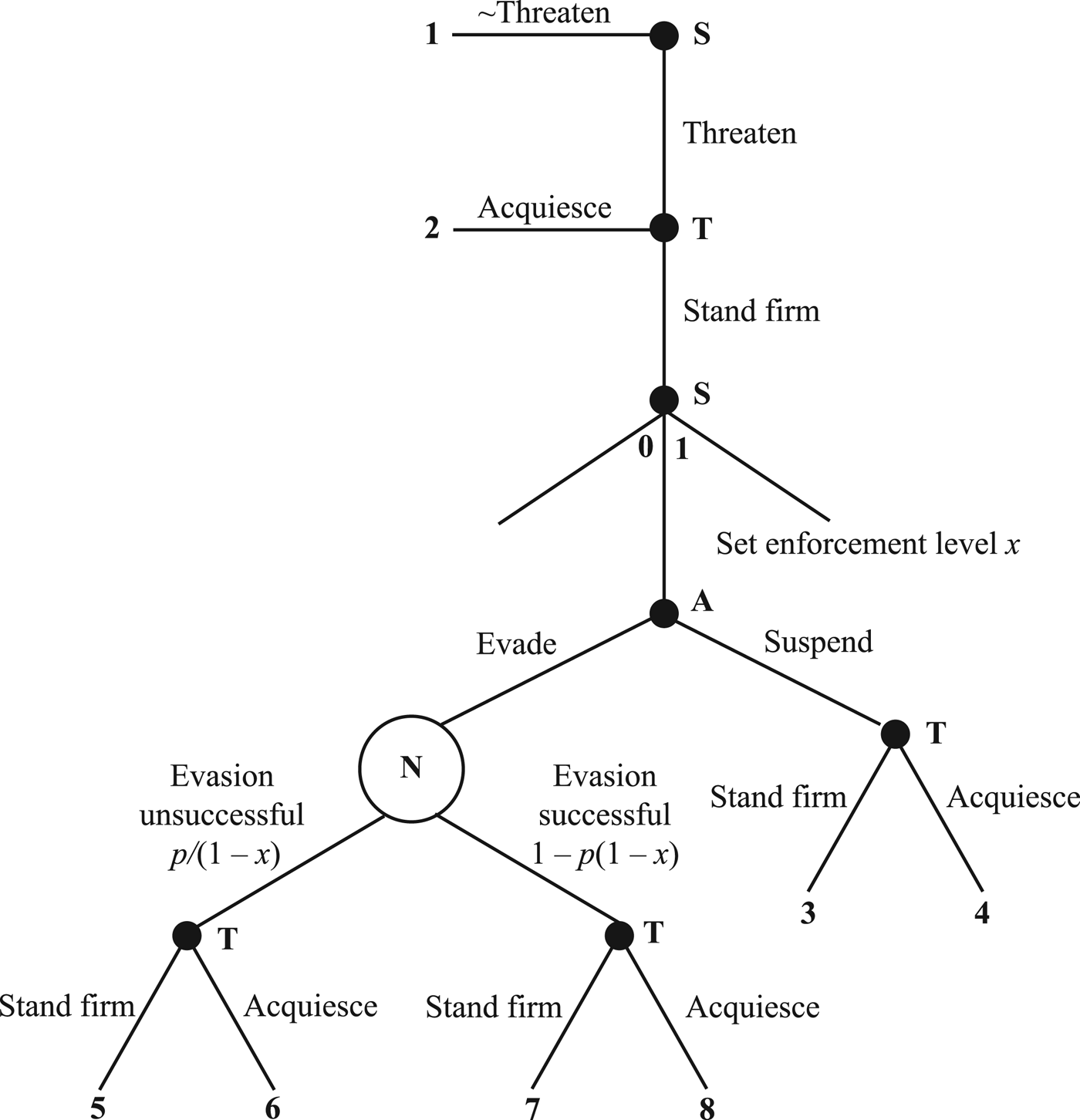
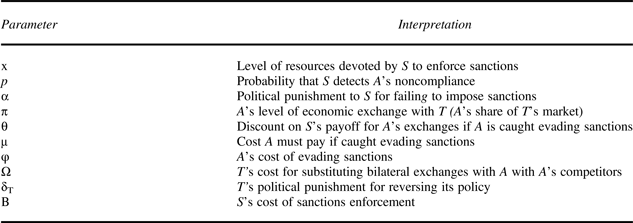
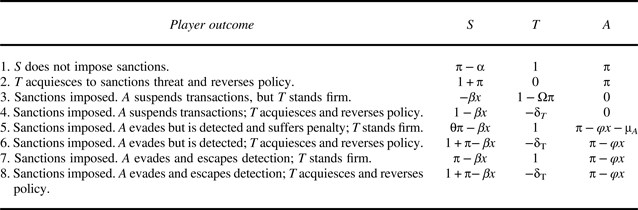
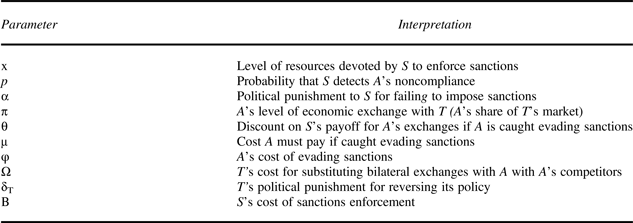
Figure 1 presents a model consisting of three players: a sender S, a target T, and a firm A that operates from within S's territory. Footnote 16 Table 1 presents the payoffs for each of the game's outcomes. The game represents a stylized, zero sum political dispute between S and T over some indivisible issue.Footnote 17 Assume that each player is rational with ordered, transitive preferences represented by Von Neumann-Morgenstern utility functions, and assume that each player is risk neutral. The payoffs to S and T reflect the two states' values for the outcome of the political dispute, as well as their values for the economic relationship between the sender's firm A and the target state T. In terms of the political dispute, S receives a payoff of 1 if she convinces T to alter his offensive behavior, and a payoff of 0 if T maintains his offensive policy. The opposite is true for T in that he receives a payoff of 0 for maintaining his offensive policy and a payoff of −1 if he is compelled to revoke it. In terms of the economic relationship, S prefers to maximize her firm A's profitability by increasing its share of T's market, which is divided between A and her foreign competitors. Represent A's share of T's market as π, and A's competitors share of T's market as 1 − π. Because S is only interested in the gains her firm A receives from its relationship with T, S's utility for the economic exchanges is equal to π. On the other hand, T benefits from his economic exchanges with both A and its competitors. T's payoff for the economic relationship with these firms is therefore equal to π + (1 − π) = 1. Although the states (S, T) care about both the political outcome and the economic relationship between A and T, A cares only about its immediate profits and protecting its market share from its competitors.Footnote 18
Sanctions imposition and enforcement game

Model parameters
Payoffs

Moves
Before the start of the game, T engages in some action that alters the political status quo in his favor. For example, T might occupy a disputed territory, engage in nuclear proliferation, or support terrorism. S then considers threatening T with economic sanctions to coerce him into reversing this offensive behavior. If S chooses not to threaten sanctions, the economic exchanges between A and T continue uninterrupted, but the political situation remains in T's favor, which leads S to suffer some political punishment α ∈ [0, A).Footnote 19 S's payoff for this outcome is therefore equal to 0 + π − α = π − α. On the other hand, T benefits politically from the new status quo while maintaining his economic exchanges with A, resulting in a payoff of 0 + π + (1 − π) = 1. A receives a payoff of π for this outcome because its transactions with T continue uninterrupted.
If S instead threatens T with sanctions, T next decides to either acquiesce to S's demands or stand firm. If T acquiesces, T alters his behavior in accordance with S's demands, and the economic exchanges between A and T continue uninterrupted. S therefore receives the benefit of these exchanges (π), plus the political benefit of reversing T's behavior (1), leading to a payoff of 1 + π. T receives a payoff of 0 for the political outcome but continues to gain the benefit of his exchanges with A, leading to a payoff of −1 + π + (1 − π) = 0. As in the first outcome, A continues to receive the benefit π for its exchanges with T, because sanctions are not imposed and its transactions are uninterrupted.
If T instead refuses to acquiesce and stands firm, S imposes sanctions by enacting a set of laws that promise to punish A if the firm continues its economic exchanges with T. S then grants some level of resources to an enforcement agency that is tasked with monitoring A's behavior and punishing the firm if it violates S's sanctions laws.Footnote 20 The enforcement agency is independent from S, and is solely interested in ensuring that A suspends its transactions with T in compliance with the sanctions law. S's delegation of enforcement responsibility to this agency ensures that the threat to punish the firm for evading sanctions is credible. Because S values her firm's profitability, she cannot credibly punish A if it circumvents sanctions, given that doing so harms the revenue she generates from A's economic gains. The enforcement agency, however, does not share the interest in protecting A's economic gains and can therefore credibly punish the firm.Footnote 21
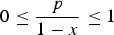
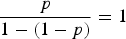
Let us represent the resources S devotes to this enforcement agency as x ∈ [0,1], which is increasing as x → 1 and decreasing as x → 0. Substantively, increases in x may involve providing the enforcement agency with additional customs agents, greater resources to police S's ports of exit and entry, and/or extra lawyers to monitor and prosecute firms that continue exchanges with the target. Let us further assume that this agency detects illicit economic exchanges between A and T with probability  $\displaystyle{p \over {1 - x}}$ and fails to detect them with probability
 $\left({1 - \displaystyle{p \over {1 - x}}} \right)$.Footnote 22 The probability that illicit exchanges are uncovered increases as x → 1 and decreases to p if x = 0. This indicates that S improves her enforcement agency's probability of detecting illicit exchanges between A and T if x → 1. On the other hand, if S sets x closer to 0, her enforcement agency is less able to detect illicit exchanges, though it is still possible to do so. While increasing the level of resources devoted to enforcement x improves the probability that the enforcement agency detects illicit exchanges, increasing these resources is assumed to be costly for S. Represent this cost of enforcement to S as −βx, where β ∈ [0, B) and is a normalizing parameter.
Once S imposes her sanctions and allocates some level of resources x toward enforcement, S's firm A decides to either suspend its exchanges with T, or attempts to evade S's sanctions and continue its exchanges illicitly. If A complies with S's sanctions and suspends its exchanges with T, it is unable to complete its transaction with T until S lifts her sanctions, which will not occur until T alters his behavior. Following A's suspension, T next decides to either continue his offensive policy or acquiesce to S's demands. If T acquiesces, S lifts her sanctions and A resumes its exchanges with T, thereby allowing T to gain the benefit of the economic exchanges. However, because T reverses his policy after sanctions are imposed, assume he pays some political cost −δT ∈ [−1, 0] for acquiescing.Footnote 23 Further, let us assume that while A is able to resume its transactions once T reverses his policy, the temporary disruption in the economic exchanges cause A to discount its profits. This is because unlike states, firms must deliver short-term profits to stay competitive and are held accountable immediately to their stockholders.Footnote 24 Let us therefore represent the short-time horizon of A by setting its payoff to 0 if it suspends its exchanges. Let us assume S also suffers if A suspends its exchanges or discounts its profits because of the interruption, given that A will seek to make up these losses by increasing prices for its goods, cutting its workforce, or reducing its plans to invest. Like A, S therefore receives a payoff 0 for the economic outcome, resulting in a payoff of 1 − βx if T responds to A's suspension by acquiescing to her demands. This captures her value for the policy change minus the cost of the enforcement effort.
Alternatively, T may respond to A's suspension of its exchanges by standing firm and maintaining his offensive policy. Although S compels A to suspend its exchanges, S cannot prevent A's foreign competitors from continuing their transactions. T therefore attempts to substitute his lost exchanges with A by increasing his exchanges with A's competitors. This represents a situation similar to the United States and China following the Tiananmen Square incident, where Presidents George H.W. Bush and Bill Clinton both feared that enforcing sanctions would allow either European or Japanese firms to replace American firms in the Chinese market. If A complies with the sanctions, A's share of T's market falls to π = 0, which indicates that A's foreign competitors take full control of T's market. However, in some cases, A may possess a unique good or service that its foreign competitors cannot easily replace, which may lead T to experience a relatively more difficult economic adjustment. For example, in a case where A and its foreign competitors sell fruit to T, it is easy for T to substitute A's goods with those of A's competitors. Alternatively, if A is selling software and has a technological advantage such that its software is more efficient, A's foreign competitors may provide a less-than-perfect substitute, which in turn may create economic costs and inefficiencies for individuals within T's market. Let us therefore assume that T may face some cost as his market adjusts from one that includes A to one that is dominated by A's foreign competitors. Represent T's payoff for substituting A's business with its foreign competitors as 1 − Ωπ, where Ω ∈ [0, 2] and captures T's adjustment cost, or the degree of difficulty T has in substituting A's transactions with those of its competitors. Using the previous example, we would expect Ω → 0 in cases where A is selling a product such as fruit, and T is able to easily replace A's business. In the software example, A's competitors cannot perfectly substitute for A's goods, so we would expect Ω → 2. This indicates that T's adjustment would be more difficult if A exits his market, and the resulting inefficiencies may undermine T's political gains for his offensive policy. T therefore receives a payoff of 1 − Ωπ if he stands firm in response to A's suspension of exchanges. S receives a payoff of −βx, indicating she pays the cost of enforcement while gaining no political benefits. A receives a payoff of 0 for suspending its exchanges and ceding its share of T's market.
Because suspending its exchanges with T will result in lost profits, A's alternative strategy is to continue its exchanges illicitly and attempt to evade S's sanctions. To do so, A must pay some cost to evade detection, which might involve the use of a third-party state, the cost of cloaking records, or the cost of bribing officials. Represent this cost as φx, where φ ∈ [1,2] and x is the level of resources S devotes to enforcement. This indicates that the cost of circumventing sanctions increases as S devotes an increasing level of resources to enforcement.Footnote 25 In other words, A's cost for evading sanctions increases as S devotes more resources toward monitoring and policing the firm's behavior. If A takes this action, it must pay this cost regardless of whether or not its attempt to evade sanctions is successful.
If A attempts to evade sanctions, it completes its transaction with T, and all sides realize the profits from the exchange.Footnote 26 The enforcement agency responds by conducting an investigation into A's behavior. Nature determines whether the enforcement agency detects A's illicit transaction successfully 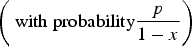 $\left( \hbox{ with probability} \displaystyle{ {p} \over {1 - x}} \right)$ or fails to do so
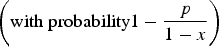 $\left( \hbox{with probability} 1 - \displaystyle{{p} \over {1 - x}} \right)$. T then observes the results of the investigation and decides whether to acquiesce to S's demands. If T acquiesces, S retroactively legalizes A's exchanges with T. Because the exchanges are legalized once T acquiesces, S receives a payoff of 1 for reversing T's offensive political behavior, plus the benefit for restoring the economic relationship (π), minus the resources she devotes to enforcement (−βx). S's payoff if T reverses his policy is therefore equal to 1 + π − βx. T loses his political benefit (−1) once he acquiesces, but he gains the full benefit of the economic exchanges with both A and its competitors (1), resulting in a payoff of 0, minus the political cost for reversing policy (−δT). Although A's decision to continue its exchanges with T was illegal initially, S's decision to retroactively legalize the exchanges allows her to gain the full benefit of the transaction (π), minus the cost she paid to conduct the transaction illicitly (−φx). A therefore receives a payoff of π − φx for this outcome.
However, if T refuses to alter his behavior following an illicit transaction with A, his offensive policy remains in place and the economic exchange remains illegal according to S's laws. T receives a payoff of 0 for keeping his policy in place, and he gains the full benefit of his economic exchanges with both A and its competitors (1). T's payoff for standing firm following the investigation is therefore equal to 0 + 1 = 1. A's payoff is determined by whether or not S's enforcement agency successfully detects its illicit behavior. If S's enforcement agency fails to detect the transaction, A realizes the transactions full benefit (π) minus the cost of evading S's law (−φx). Because T does not reverse his policy, S receives a payoff of 0 for the political outcome. However, because A receives the full benefit of its economic exchanges, and A's profits are funneled into S's economy, S gains a payoff of π for the economic dimension. S's payoff for this outcome is therefore equal to 0 + π − βx = π− βx.
If A is caught engaging in illicit exchanges with T, the firm suffers a penalty μAε [0,1] for violating the law, which represents the monetary and reputational damage done to the firm resulting from the discovery of its illegal practices.Footnote 27 This damage can be significant, given that the discovery of illicit behavior significantly harms A's reputation as a reliable business partner, which in turn may lead investors to withdraw from the company or cost the firm future contracts. As in the case where its exchanges are suspended, A again responds by passing some of these costs on to individuals within S's economy using tactics such as price increases, layoffs, or divestment. However, because A still realizes some of the profits from its illicit exchange, A's costs for this outcome are relatively lower than in the case where its exchanges are completely suspended. Because the goal of the price spikes, layoffs, or divestment is to offset costs, but A completes its exchanges and realizes at least some of the benefits, the negative externalities caused by A's response are less severe in this outcome than where its exchanges with T are completely suspended.
Let us represent S's payoff for the outcome where A's illicit transactions are detected as θπ, where θ ∈ [0,1], and captures negative externalities resulting from A's effort to pass the monetary costs of the punishment onto S's producers and consumers.Footnote 28 If θ → 1, A's decision to pass its cost on to S's producers and consumers has a minimal effect on S's economy. For example, if a luxury good importer responds to a punishment by increasing prices, it is doubtful that this would strongly affect the behavior of relatively wealthier customers. On the other hand, if θ → 0, A's decision to pass its cost on to S is much more harmful. More concretely, we might think of this as a case where an oil firm responds to a government punishment by increasing its prices, which could potentially produce an increase in layoffs and may harm consumers throughout the sender's supply chain. We therefore see that although the enforcement agency's punishment is costly for A, it may also harm S. Footnote 29 S's payoff for the outcome where her enforcement agency uncovers A's illicit exchanges is equal to θπ − βx. A's payoff is diminished to π − x − μA if its illicit transactions are uncovered, which captures the punishment levied against A by S's enforcement agency.
Uncertainty
Let us assume that neither S nor T is aware of the value of A's utility for the punishment (μ A) it will receive if the enforcement agency's investigation uncovers illicit exchanges. In other words, μ A is A's private information that is unknown to the states. This assumption of uncertainty over the firm's utility for the cost of punishment appears reasonable because firms can be very secretive about their operating costs and about the extent to which government penalties will affect their profits. In many cases, stockholders of large companies are unaware of the hidden costs of doing business, and most firms simply report their profits publicly. This assumption captures the essence of S's problem: she wants to deter A from doing business with T to induce political change but is uncertain of how much enforcement is needed to deter A from continuing its exchanges. We capture this uncertainty by assuming that μ A ~ U[0,1], but the true value of μ A is unknown to the states (S, T).
Solution
The game is solved using the Perfect Bayesian Solution concept (PBE), which indicates that the players select their best responses, given their respective beliefs. Let us begin with T's final decision of whether or not to alter his offensive behavior, given his observation of A's decision to either continue or suspend its exchanges. It is relatively straightforward to demonstrate that T does not alter his behavior if A evades S's sanctions. T's payoff for maintaining his offensive policy is equal to 0 + 1 = 1, whereas his payoff for reversing his policy is equal to −δ T. Because 1 > −δ T, T strictly prefers maintaining his policy if A continues its transactions illicitly by playing Evade. We therefore see that if A is willing to risk S's punishment and completes the exchanges, T has no reason to comply with S's demands. On the other hand, if A plays Suspend, T will acquiesce only if the economic costs of adjusting to the loss of A's exchanges outweigh the political gains from maintaining his offensive policy. This occurs if 1 − Ωπ ≤ −δT. Rearranging in terms of π, we see that this is true if:
 $$\pi \ge \displaystyle{{1 + {\delta _T}} \over {\Omega}}$$
Condition 1 demonstrates an interesting insight. If π → 0, and A controls very little of T's market, S will be unable to use sanctions to coerce political change from T. However, as π increases, it is possible to fulfill Condition 1, which indicates that a loss of exchanges with A can force T to alter his behavior in response to sanctions. This indicates that A must control at least a moderate share of T's market for sanctions to have a chance at success. A's decision to suspend its exchanges essentially has no effect on T if A's competitors dominate T's market. Additionally, T is more likely to alter his behavior if A suspends its transactions and Ω → 2. If it is difficult for T to offset the loss of A's transactions with those of its competitors, he will alter his behavior once A suspends its transactions. Let us therefore define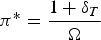 $\; {\pi ^*} = \displaystyle{{1 + {\delta _T}} \over {\Omega}}$ as the first cutpoint. This divides the solution into two sets of cases: one for which π < π*, where T will never acquiesce to S's demands, and another for which π ≥ π*, indicating that T will acquiesce to S's demands if he loses A's exchanges.
Regardless of whether or not Condition 1 is fulfilled, T determines A's type by observing the firm's decision to evade sanctions or suspend its exchanges. A suspends its transactions with T if:  $0 \gt \displaystyle{{p} \over {1 - x}} (\pi - \mu_A) + \left(1 - \displaystyle{{p} \over {1 - x}} \right)(\pi) - \varphi x$. Rearranging in terms of μA, we see that A plays Suspend if
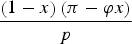
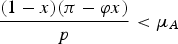 $\displaystyle{{(1 - x) (\pi - \varphi x)} \over {p}} \lt \mu_A $. Because μ A is initially A's private information, let us define both S and T's prior belief that A will play Evade as
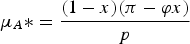 $ \mu_A \ast = \displaystyle{{(1 - x) (\pi - \varphi x)} \over {p}}$, and define both S and T's belief that A will Suspend as the corresponding probability (1 − μA*). T updates his belief regarding A's type after observing its behavior before his final move. If A chooses to evade sanctions, T updates that μA< μA*. On the other hand, if A suspends its exchanges, T updates that μA ≥ μA*.
Remark 1:
A's decision creates a separating equilibrium where types for which μA ≥ μA* play Suspend and types for which μA* > μA play Evade.
Proof:
See appendix.
Case 1. Lower Economic Exchanges between A and T (π < π*)
Let us now examine the equilibrium behavior of both S and T. In the first case where π < π*, T strictly prefers playing Stand Firm to Acquiesce, irrespective of A's type and whether or not the firm evades sanctions. S is therefore unable to change T's political behavior regardless of how many resources she devotes to enforcement. Because the loss of A's business has no coercive effect on T, S maximizes her utility by setting x = 0, and decreases her payoff if x > 0. Substantively, this indicates that if S is unable to alter T's behavior because of the low economic importance of A, S maximizes her utility by devoting no resources to her enforcement agency and making no effort to enforce sanctions. In other words, S may impose sanctions for political reasons, but will not enforce them, given that her firms are relatively marginal to T.
Remark 2:
S sets x = 0 if π < π*.
Proof:
See appendix.
T therefore anticipates that if S imposes sanctions, she will do nothing to enforce them. Because S devotes no resources toward enforcement by setting x = 0, the probability that A evades sanctions simplifies to 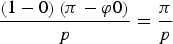 $\displaystyle{{\left({1 - 0} \right)\left({\pi - \varphi 0} \right)} \over p} = \displaystyle{\pi \over p}$. T therefore prefers to Stand Firm if
 $\displaystyle{\pi \over p}\left(1 \right)+ \left({1 - \displaystyle{\pi \over p}} \right)\left({1 - {\Omega}\pi } \right)\gt 0$. Substantively, this represents a case where the loss of economic exchanges with A is either marginal, or easily substituted. Given that this is the case, T anticipates that without any coercive power, S will devote no resources toward enforcing the sanctions. T therefore always plays Stand Firm in these cases.
Remark 3:
T strictly prefers to Stand Firm if π < π*.
Proof:
See appendix.
Given that T will always Stand Firm, and sanctions have no possibility of coercing a change in his behavior, we would intuitively expect S to avoid imposing sanctions. However, if S were to do so, she suffers the political penalty for refusing to take punitive action. S therefore faces a choice: she can pay the political cost of doing nothing, or she can impose sanctions—but refuse to devote resources toward enforcing them. In other words, if S's firms simply do not control enough of T's market to harm him economically, S may impose symbolic sanctions to avoid the political punishment for doing nothing. Because S sets x = 0 in these cases, S imposes symbolic sanctions if  $\displaystyle{\pi \over p}\left({p\theta \pi + \left({1 - p} \right)\pi } \right)+ \left({1 - \displaystyle{\pi \over p}} \right)0 \gt \pi -\alpha $, which is true if
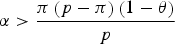 $\alpha \gt \displaystyle{{\pi \left({p - \pi } \right)\left({1 - \theta } \right)} \over p}$.
Equilibrium 1:
If π < π*, the following set of strategies constitutes a PBE:
1. T plays Stand Firm in both cases where μA ≥ μA* & μA*> μA.
2. A plays Evade if
 ${\mu _A} \lt \displaystyle{\pi \over p}$ and Suspend otherwise.
3. S plays {Threaten; set x = 0}if
$\alpha \gt \displaystyle{{\pi \left({p\left({1 + \pi \left({1 - \theta } \right)} \right)- \pi } \right)} \over p}$& {~Threaten; set x = 0} otherwise.


Case 2. Greater Exchanges between A and T (π ≥ π*)
In this next set of cases, A's exchanges are significant enough such that T will alter his behavior if A suspends its transactions. S is therefore able to coerce T into acquiescing by devoting an increasing amount of resources to her enforcement agency, which in turn makes A more likely to face punishment if it continues the exchanges. However, if S devotes this level of resources to enforcement, and A is caught evading sanctions anyway, sanctions become counterproductive because A passes the cost onto individuals in S's economy. S therefore aims to maximize the probability that her sanctions can compel A to suspend its exchanges, which in turn will force T to acquiesce to her demands. S's payoff for imposing sanctions is equal to:  ${\mu _A}^{\prime}\left[\displaystyle{{p} \over {1 - x}} (\theta \pi) + \left(1 - \displaystyle{{p} \over {1 - x}} \right) (\pi) \right] + (1 - {\mu _A}^{\prime} [ ) (1)- \beta x$. We can solve for S's optimal level of enforcement by maximizing this expression with respect to x:
 $${x^*} = \displaystyle{{{\pi ^2} + \beta p - \varphi - \pi \left({1 - \varphi + p\varphi - p\theta \varphi } \right)} \over {2\left({ - 1 + \pi } \right)\varphi }}$$
Remark 4:
S sets x = x* if π ≥ π*
Proof:
See appendix.
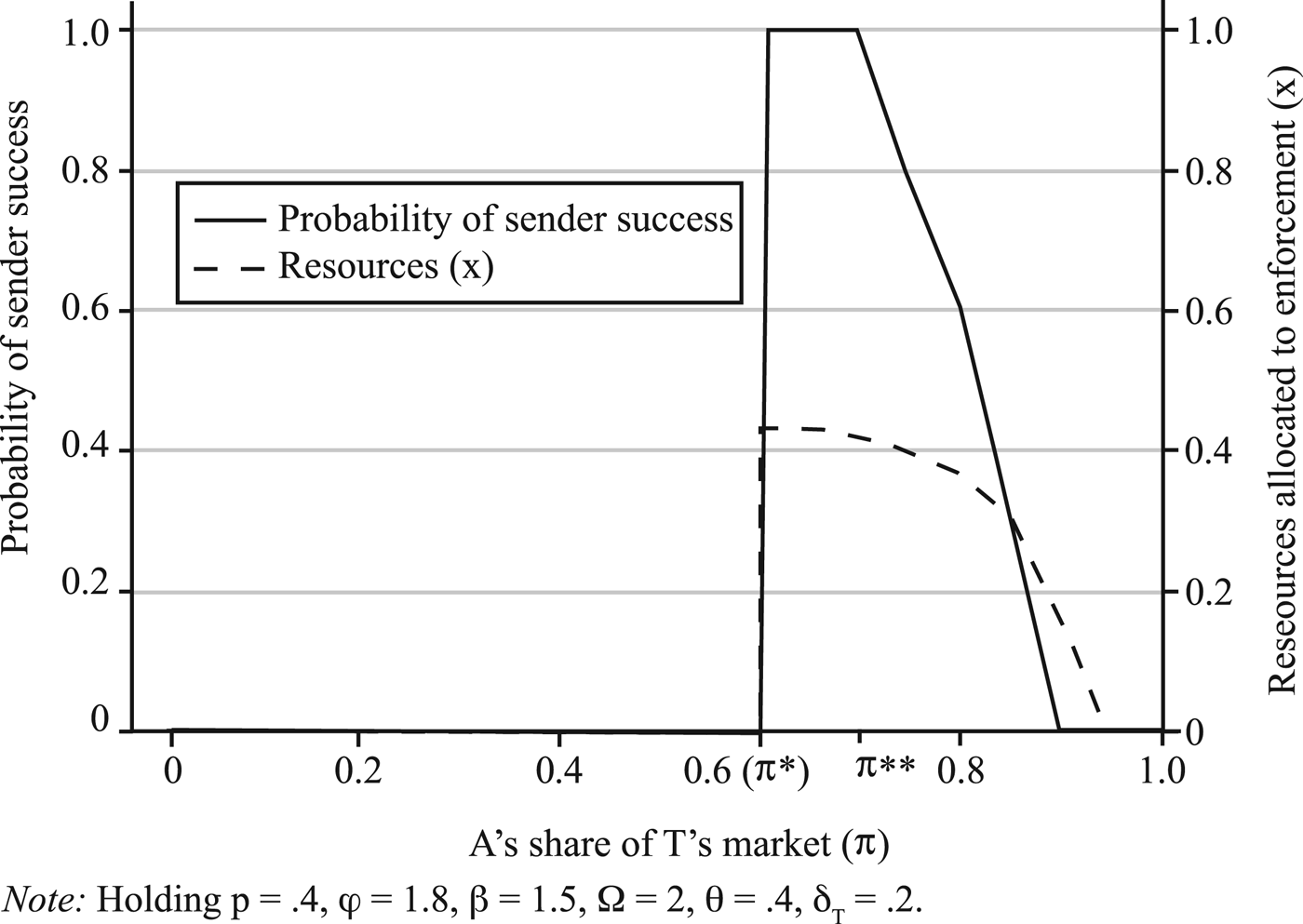
Figure 2 plots both the probability that sanctions compel a change in T's behavior, along with the optimal level of resources S allocates to enforcement (x*), as a function of A's share of T's market (π). Interestingly, we see that increasing A's share of T's market has a curvilinear effect on both the probability that sanctions succeed and S's optimal level of enforcement. Because T will not change his behavior unless π ≥ π*, S initially devotes no resources toward enforcement. However, S devotes relatively greater resources to enforcement at the cutpoint π* where A maintains a moderate share of T's market. This allocation subsequently decreases as A's share of T's market increases (π → 1), which corresponds with a decreasing probability that A will suspend its transactions and comply with S's sanctions. The falling probability of sanctions success reflects S's increasing belief that A will play Evade. S's belief that A plays Evade is equal to  $\displaystyle{{\left({1 - x} \right)\left({\pi - \varphi x} \right)} \over p}$, which is increasing as π → 1.Footnote 30 This indicates that A is more likely to continue its transactions illicitly as its share of T's market increases. In doing so, A undermines any possibility that sanctions can compel T to reverse his behavior, which corresponds to the decreasing probability of sanctions success as π → 1. Substantively, if A dominates T's market, its exchanges with T are so lucrative that it is likely to risk evading sanctions, even if S devotes substantial resources toward enforcement. If S is aware that increasing the level of enforcement is unlikely to deter A from continuing its exchanges with T, and devoting these resources is costly, S's optimal strategy is to devote relatively fewer resources to enforcement as A's market share increases. We therefore see from Figure 2 that S devotes a decreasing level of resources to enforcement as π → 1, which further decreases the probability that A will comply with sanctions.
Sender's probability of success and optimal enforcement level as a function of A's share of target's market

Let us now consider T's decision of whether to acquiesce to S's threat. T prefers to Stand Firm if μA*(1) + (1 − μA*)(−δT) > 0. Simplifying, we see that this is true if 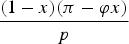 $\displaystyle{{(1 - x) (\pi - \varphi x)} \over {p}}$. We can therefore define T's critical belief as
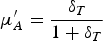 $\mu _A^{\prime} = \displaystyle{{\delta _T} \over {1 + {\delta _T}}}$. T acquiesces to sanctions if A is less likely to evade sanctions and μA* ≤ μA′, but stands firm if A is more likely to evade and μA* > μA′. Through substitution, we can see that T prefers to stand firm if:
 $${\mu _{\rm A}} \ast - {\mu _{\rm A}}^{\prime} \gt 0$$
 $$\displaystyle{{\left({1 - x} \right)\left({\pi - \varphi x} \right)} \over p} - \displaystyle{{\delta _T} \over {1 + {\delta _T}}} \gt 0 ]$$
T believes that A will suspend if μA′ > μA* and believes that A will evade if μA* > μA′. If π → 1, and A's share of T's market grows, the expression in Condition 3 is more likely to be fulfilled, and T believes that A is more likely to evade sanctions. T therefore will refuse to acquiesce to S's threats. On the other hand, if A's share of T's market is in the moderate range, the expression μA* > μA′ is less likely to be fulfilled, indicating that T believes that A is unlikely to evade sanctions. Because A will likely suspend in response to sanctions, and the loss of these exchanges is sufficiently costly, T will acquiesce to S's threat. We therefore see that T is more likely to acquiesce to S's sanctions threat if A maintains a moderate market share, but is more likely to stand firm if A maintains a large or dominant market share.Footnote 31 Let us define π** as the cutpoint where μA* = μA′, indicating that T is indifferent between acquiescing to S's demands and standing firm.Footnote 32 T believes that A will evade sanctions if π > π** and believes A will suspend if π** > π ≥ π*.
Let us first consider S's behavior in the case where when π** > π ≥ π*. Because A's share of T's market is in the moderate range, T will acquiesce to any threat. S therefore receives a payoff of 1 + π if she threatens to impose sanctions on T. On the other hand, the payoff to S for accepting the status quo is equal to π − α. Because it must be true that 1 + π > π −α, we should expect S to threaten sanctions if it is obvious that T will acquiesce. This may suggest why threats tend to be quite effective: senders select into the cases where there is an expectation that threats alone will be sufficient to alter the target's behavior. However, because of T's strategic behavior, we are unlikely to observe sanctions when A's share of T's market is moderate and sanctions are likely to succeed. If T believes that sanctions will compel A to suspend its transactions, T should prefer to acquiesce in the threat stage before imposition.
Equilibrium 2
If π** > π ≥ π* the following set of strategies constitutes a PBE:
1. T plays{Acquiesce; Acquiesce}if μA ≥ μA* and {Acquiesce; Stand Firm} otherwise.
2. A plays Evade if
${\mu _A} \lt \displaystyle{{\left({1 - x} \right)\left({\pi - \varphi x} \right)} \over p}$ and Suspend otherwise.3. S plays {Threaten; set x = x*}.
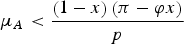
Let us now consider the case where π ≥ π**, indicating that A dominates T's market. Figure 2 indicates that if A's share of T's market grows increasingly large, A is less likely to Suspend in response to sanctions and the level of resources S devotes toward enforcement decreases. A's exchanges are so lucrative that the firm is likely to accept the risk of punishment and evade sanctions, even if S tries to enforce them. S therefore faces a situation where sanctions have very little coercive power in that they are unlikely to deny T the benefits of A's economic exchanges. Because S's enforcement is unlikely to coerce T, and because punishing her own firm is economically counterproductive, S has no reason to burn significant resources on enforcement. Therefore, because S makes little effort to enforce, T prefers to Stand Firm in the face of S's threat. Paradoxically, the model demonstrates that senders with extensive economic influence over the target cannot deter their firms from continuing their exchanges, and are therefore unlikely to gain coercive bargaining power from sanctions.
Although T refuses to acquiesce to S's threat if π > π**, T will acquiesce if A suspends its exchanges in response to S's enforcement effort. Because there is some possibility that sanctions can work, S will provide some resources to the enforcement agency. S threatens sanctions and sets  ${\rm x } = {\rm x \ast} \, {\rm if} \, {\mu _A \ast} (\displaystyle{{p} \over {1 - x}} (\theta \pi) + \left(1 - \displaystyle{{p} \over {1 - x}} \right) (\pi)]$
 $\mu_A \ast \lt \displaystyle{{(1 - x) (1 - \pi - \varphi x + \alpha)} \over {1 - x - \pi (1 - p - x - \theta p)}}$. Simplifying, we see that this condition is true if
 $\mu_A \ast \lt \displaystyle{{(1 - x) (1 - \pi - \varphi x + \alpha )} \over {1 - x - \pi (1 - p - x - \theta p)}}$. Let us therefore define S's critical belief as
 $\mu_{A}^{\prime \prime} = \displaystyle{{(1 - x) (1 - \pi - \varphi x + \alpha )} \over {1 - x - \pi (1 - p - x - \theta p)}}$. If π > π**, S threatens and imposes sanctions if μA″ > μA* and plays ~Threaten otherwise. This demonstrates that if S believes that A is unlikely to evade sanctions so long as they are enforced, she will devote some resources to the enforcement effort. However, if S believes that A is very likely to evade sanctions, the resources devoted to enforcement are likely to be wasted, and S will instead set x = 0. Through substitution, we see that S is willing to provide resources to the enforcement effort if:
 $$\displaystyle{{\left({1 - x} \right)\left({1 - \pi - \varphi x + \alpha } \right)} \over {1 - x - \pi \left({1 - p - x - \theta p} \right)}} \gt \displaystyle{{\left({1 - x} \right)\left({\pi - \varphi x} \right)} \over p} $$
Equilibrium 3:
If π > π** the following set of strategies constitutes a PBE:
1. T plays{Stand Firm; Acquiesce}if μA ≥ μA* and {Stand Firm; Stand Firm} otherwise.
2. A plays Evade if
${\mu _A} < \displaystyle{{\left({1 - x} \right)\left({\pi - \varphi x} \right)} \over p}$ and Suspend otherwise.3. S plays {Threaten, set x = x*} if μA″ > μA* and play {~Threaten, x = 0} otherwise.
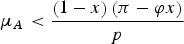
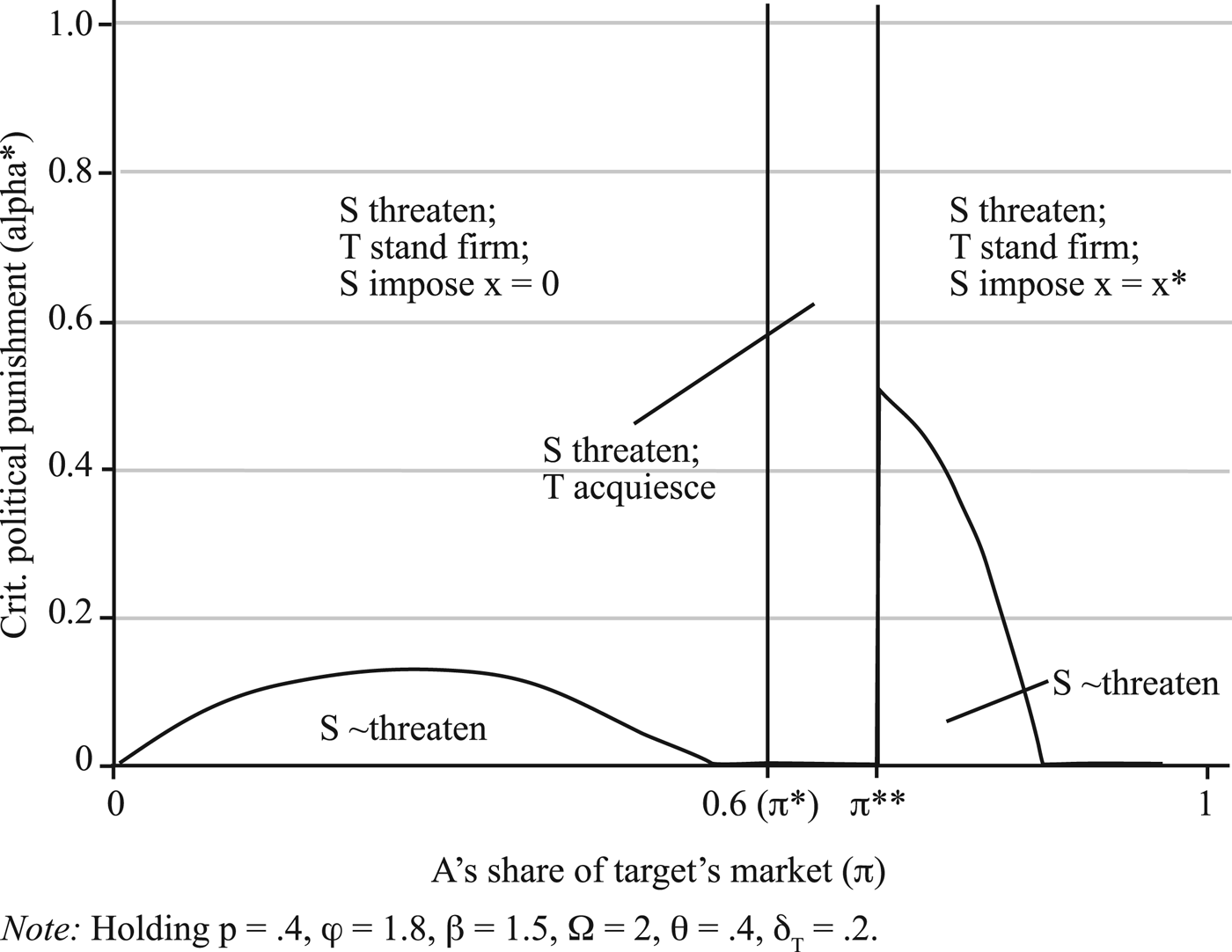
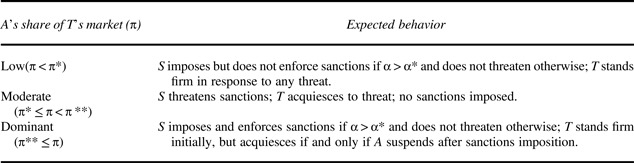
Figure 3 presents the game's equilibrium as a function of A's share of T's market, and the political punishment faced by S for taking no action (α). The model demonstrates several interesting empirical implications. First, we see that T always acquiesces to sanctions if A's share of T's market is moderate. If T will always acquiesce to sanctions, S will always threaten. We therefore see that sanctions appear most effective in cases where S's firm A controls a moderate share of T's market, but that we are unlikely to observe sanctions in these instances. Instead, T acquiesces to S's threats, thereby giving S an incentive to continue making them. On the other hand, S is likely to impose sanctions in cases where A controls a relatively smaller and a relatively larger share of T's market. If A has a relatively smaller share of T's market, the loss of exchanges with A does not impose a sufficient penalty on T such that he will alter his policy. Because sanctions will not be particularly damaging, T responds by rejecting S's demands and standing firm, and we would observe the imposition of sanctions. In the latter case, where A's share of T's market is sufficiently large, A will continue its transactions regardless of sanctions. Therefore, even if S imposes sanctions, S will have no incentive to devote considerable resources to enforcement, given that she is unlikely to deter A from continuing its transactions. Instead, S may impose sanctions to avoid the political costs of not doing so, but will devote little effort toward enforcement and will continue to enjoy the benefits of A's economic exchanges. Table 3 summarizes the game's equilibria and predicted behavior as a function of A's share of T's market (π).
The effect of A's share of T's market on equilibrium behavior

Predicted equilibrium behavior as a function of A's share of T's market

Model Analysis
The model offers several interesting insights about how sanctions are imposed and enforced. First, although sanctions may be imposed for political reasons, senders are likely to pursue real policy change from their targets only if their own firms have a moderate share of the target's market. When the sender's firms have a low share of the target's market, the target is unlikely to respond to sanctions threats. However, the sender may still impose sanctions because of domestic pressure, even though these sanctions are likely to be of little consequence. In cases where the sender's firms have greater shares of the target's market, the exchanges between the sender's firms and the target may be so lucrative that sanctions are rendered unenforceable. That is, because senders are unlikely to deter their firms from continuing their exchanges with the target, they have no reason to undermine their firms' profitability and risk the possibility that they will lose market share to foreign competition.
Second, we see that senders are less able to use sanctions as tools of coercion if their firms dominate a target's market. The curvilinear prediction is the first in the sanctions literature. This predicted effect may further explain why some studies find that high levels of economic exchange increase the probability of sanctions success,Footnote 33 whereas others do not.Footnote 34 Instead, the model suggests that sanctions are most likely to be enforced if the sender's firms maintain sufficient control over the market such that the target would reverse its policies upon losing their business, but not so much control such that sanctions are impossible to enforce. We should therefore expect sanctions to be most successful if the sender's firms maintain moderate control over the target's market.
H1:
The probability of sanctions success increases if the sender's firms maintain a moderate market share in the target's market, but decreases if the sender's firms have either a small or dominant market share.
The model offers an additional hypothesis related to sanctions imposition. For sanctions to be imposed, targets must refuse to acquiesce to the sender's demands. The model identifies two conditions under which this may occur. First, targets are unlikely to acquiesce if the sender's firms have an inconsequential presence within their market and sanctions are not costly. Second, targets are unlikely to acquiesce if the sender's firms have a dominant presence within their market, thereby making sanctions unenforceable. Empirically, this leads us to expect sanctions imposition if the sender's firms have a relatively low or relatively high level of exchange with the target. Interestingly, because targets are strategic, we are more likely to see sanctions imposition in cases where they are least likely to be effective in stopping the sender's firms from continuing illicit exchanges.
H2:
The probability of sanctions imposition decreases as the sender's market share shifts from relatively smaller to moderate, but increases as the sender's market share shifts from moderate to dominant.
Data and Methods
The theoretical model makes predictions regarding when senders will impose sanctions and when these sanctions are likely to be successful. Testing the predictions requires information about cases where sanctions were imposed as well as cases where sanctions could have been imposed but were not. We thus use the Threat and Imposition of Economic Sanctions (TIES) data.Footnote 35 Each observation in TIES represents a case where a sender threatens to impose sanctions but ultimately does not, threatens to impose sanctions and follows through on its threat, or imposes sanctions without issuing a threat. Sanctions are defined as an action taken by a sender to limit exchanges with a target in an effort to persuade a change in policy, and TIES does not consider instances where senders restrict trade for purely domestic purposes.Footnote 36 The data are appropriate to test the model's predictions because we can predict both the probability that sanctions are imposed and the probability that sanctions will succeed, given that they are imposed.
The model assumes that the sender has firms in the private sector that make independent decisions from their government, are capable of conducting significant trade with targets, and have bureaucracies devoted to sanctions enforcement. Thus, we limit the sample to sanctions cases with primary senders that are members of the Organisation for Economic Cooperation and Development (OECD). Also, because the focus of the model is on firm-level transactions, we eliminate cases where the sanctions imposed do not directly involve firms, such as asset freezes and travel bans. Although the theoretical model assumes that the sanctions imposed are unilateral, we believe that the hypotheses are empirically generalizable to both unilateral and multilateral cases. Thus, we run our statistical test on two distinct samples, one including all sanctions and a control variable for multilateral sanctions and the other including only unilateral sanctions. In all, this reduces the number of observations in our sample to 594 in the multilateral sanctions sample and 522 in the unilateral sanctions sample.Footnote 37
Because sanctions cannot succeed unless they are imposed, the success of sanctions is censored by imposition. Our analysis uses a Heckman probit model because the imposition and sanctions success occurs in a two-stage process, and both success and imposition are dichotomous. The Heckman model is appropriate theoretically and avoids selection on the dependent variable.Footnote 38
Dependent Variables
The dependent variables for the outcome and selection equations are sanctions success and imposition, respectively. The first dependent variable indicates whether or not sanctions imposed succeed in altering the target's behavior. This variable is coded using the final outcome variable in TIES, which informs us how each sanctions case ended. The variable is coded as 1 if the target acquiesces to the sender's demands, or if a negotiated settlement is reached, and 0 otherwise.Footnote 39 The second dependent variable indicates whether or not sanctions are imposed. We use information from TIES, which codes cases where a sender imposes new sanctions on a target as 1, and cases where senders only threaten sanctions and do not impose them as 0.
Independent Variables
The key explanatory variable is the sender's market share in the target, or the proportion of the target's economic exchanges with the sender's firms over the target's total amount of foreign economic exchanges. Although bilateral economic exchange can take many forms, we proxy the level of economic exchange using the proportion of the volume of sender-target trade over the target's total trade, using Gleditsch's trade data.Footnote 40 This ratio captures the relative share of the target's trade conducted with the sender and its firms. As the ratio approaches 0, this shows that trade between the sender's firms and the target is insignificant and accounts for only a small portion of the target's total trade. As the ratio approaches 1, this indicates that the sender and its firms dominate the target's total trade, which means that the sender's firms comprise nearly all of the target's foreign trade. We operationalize the sender's market share variable in terms of the target's total trade flow rather than the target's gross domestic product (GDP) for the following reasons. First, only a fraction of the firms in any state are international trading firms, so it is important to capture how dependent the target is on the sender in terms of trade volume to assess the firms' share of the target's market. Second, the population of the sender's firms is made up of a mix of domestic and multinational firms, with a large and increasing portion of multinationals. In the case of the United States, multinational exporters are typically goods producers while more than half of multinational importers are in the wholesale and retail sector.Footnote 41 The United States is the sender in more than two-thirds of the cases in our sample, hence the trade flow from these firms is most likely to be affected by sanctions that suspend economic transactions with the target. Because the hypotheses predict that the sender's market share has a curvilinear effect on the probability of sanctions imposition and subsequent success, we include the ratio and its square in the statistical models. Although this variable and its square allow us to estimate the extent to which the sender's firms dominate the target's foreign trade, we must also account for the possibility that foreign trade does not comprise a significant portion of the target's GDP. The firms of the sender may dominate the target's total trade, but the target's trade may make up only a small fraction of the target's total GDP. That is, the target may not be dependent on foreign trade. In these cases, the cost of absorbing sanctions would be minimal for the target, even though the sender's firms appear quite influential. Meanwhile, if trade represents a significant portion of the target's GDP, a sender would have greater leverage over the target's economy if its firms dominate bilateral trade. We thus include a target's trade proportion variable to capture the ratio between a target's total trade and its GDP using trade data.Footnote 42
We further include several control variables from the extant literature to ensure robustness of the statistical results. First, we include a dichotomous multilateral sanctions variable from TIES that indicates whether or not the sanctions effort is unilateral versus multilateral. Theoretically, we would expect that because a larger coalition is likely to make it more difficult for the target to substitute the lost goods from the sender's firms, multilateral sanctions should be more likely to succeed in both the threat and imposition stages. Although some of the sanctions literature claims that multilateral sanctions are less effective than unilateral efforts,Footnote 43 recent analysis using TIES data indicates that multilateral sanctions tend to be more successful than unilateral sanctions, particularly when conducted through an international institution.Footnote 44 Second, we create a dichotomous expected future conflict variable using Thompson's strategic rivalry concept that identifies states that perceive each other as threatening competitors to qualify as enemies.Footnote 45 This is to control for the argument that the shadow of conflict may increase the initiation of sanctions threats but be less able to bring about change in the target's policy,Footnote 46 as well as the claim that the use of force may rule out the impact of sanctions on changing the target's behavior.Footnote 47 Third, we control for the target's regime type because there is empirical evidence that sanctions imposed on autocratic states are less successful than those imposed against democracies.Footnote 48 We use the Polity IV data to create a target democracy variable that ranges from −10 to 10, 10 indicating full democracy.Footnote 49 Fourth, we control for the sender's dependence on foreign trade because previous findings suggest that sanctions are more effective when the sender's sanctions costs are low.Footnote 50 We introduce a sender's trade proportion variable, calculating the ratio between the sender's total trade and its GDP using trade data.Footnote 51 Fifth, we include a variable denoting the sender's commitment to accomplish its goals. Recent work on the impact of sanctions on US foreign direct investment (FDI) flows has found that the US government is more committed to coercion attempts when sanctions are implemented to accomplish major rather than minor policy goals. The level of commitment corresponds to our concept of enforcement levels.Footnote 52 Thus, we create a dichotomous major policy goal variable using the issue variable in TIES. Major policy goal is denoted as 1 if the issue includes demands to contain political influence or military behavior, destabilize the target's regime, release citizens or property, solve territorial disputes, deny strategic materials, retaliate for alliance or alignment choice, or end weapons proliferation, and 0 otherwise. Finally, we control for issue salience. Scholars have argued that senders may impose sanctions primarily to satisfy domestic interest groups or to demonstrate that the government cares and “is doing something.”Footnote 53 If the dispute between the sender and target is over a nonsecurity issue that is less salient to the domestic population, it may be less costly for the sender should sanctions fail, which may create incentives to initiate sanctions more frequently. We create a dichotomous trade issue variable using TIES, which is coded as 1 if the issue is related to trade practices, economic reform, or environmental policies, and 0 otherwise.Footnote 54
Analysis and Findings
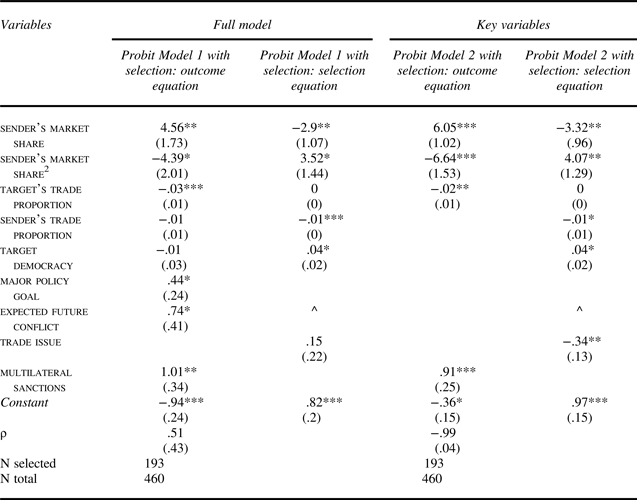
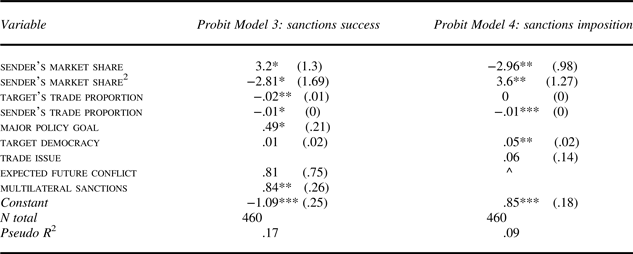
Table 4 presents the results from the statistical tests using the sample that includes both multilateral and unilateral sanctions. The first model presents the full model whereas the second model includes only the key variables of interest in the outcome equation. We observe that in both the selection and outcome equations, the coefficients for the sender's market share variable and its square are significant and in the expected directions. Consistent with H1, the sender's market share variable is positive whereas its square is negative in the outcome equation, which suggests that sanctions are more likely to succeed if the sender's firms control enough of the target's market to make sanctions damaging, but do not control so much that sanctions become unenforceable. These results suggest that sanctions are most likely to succeed if the sender's firms have a moderate share in the target's market. Also consistent with H2, the sender's market share variable is negative whereas its square is positive in the selection equation. This shows that sanctions are more likely to be imposed if the sender's firms either do not engage in significant economic exchanges with the target, or dominate the target's trade market. Taken together, we see that sanctions are most likely to work when the sender's firms have a moderate share in the target's market, but are least likely to be imposed under these circumstances. These results support our model's proposition: senders are more likely to impose sanctions when sanctions are less likely to work.Footnote 55 Because the rho coefficient is not statistically significant, we also report the results of separate probit models for sanctions success and imposition in Table 4. We see that the key coefficients in the success and imposition models are statistically significant and facing the right direction.
Estimates of the effect of sender's market share on success and imposition

Notes: Robust standard errors in parentheses. ^ expected future conflict was omitted from the equation. ***p < .01; **p < .05; *p < .1 (two-tailed).
Estimates of the effect of sender's market share on success and imposition

Notes: Robust standard errors in parentheses. ^ expected future conflict was omitted from the equation. ***p < .01; **p < .05; *p < .1 (two-tailed).
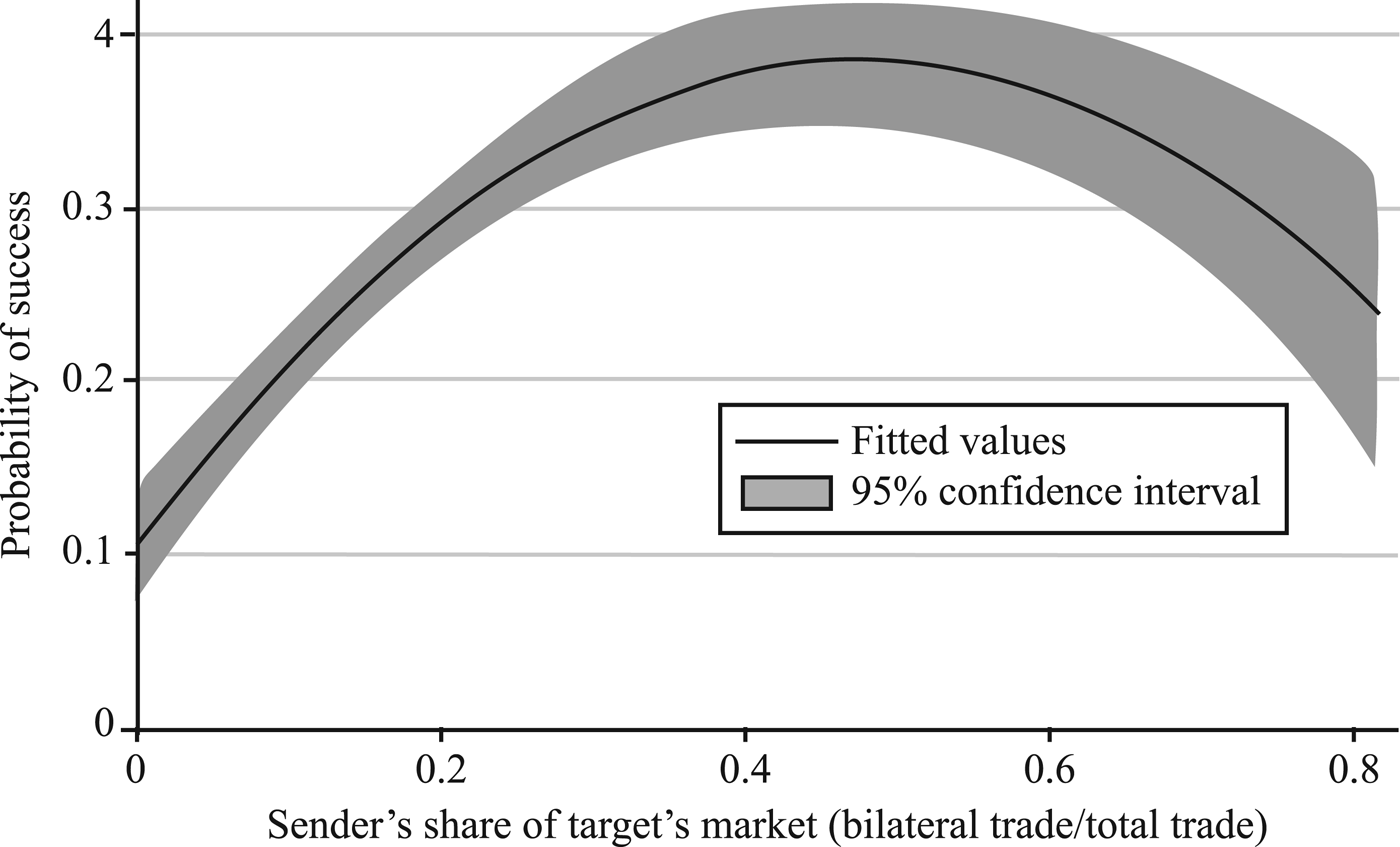
To understand the results substantively, let us first examine the predicted probabilities of success. Figure 4 presents the effect of the sender's share of the target's market on the probability that sanctions are successful.Footnote 56 The predicted probability of success maximizes when the sender's market share is within the moderate range. Interestingly, when the sender's market share increases to high levels, the probability of success decreases. This supports the theoretical model's prediction that for senders whose firms dominate the target's market, sanctions are unlikely to be effective. This produces some novel findings. First, although existing explanations have argued that increasing the sender's market share should monotonically increase the probability of compelling the target to change its policy, our model captures the curvilinear empirical pattern identified in the data. Second, Figure 4 shows that the predicted probabilities of success are on average relatively low, the highest barely reaching 0.4. This supports the claim that targets will strategically anticipate whether or not the sender's firms will continue to engage in illicit exchange. If the firms are likely to be deterred by sanctions, targets will acquiesce at the threat stage and we are unlikely to observe sanctions. When sanctions are observed, however, they are less likely to coerce the target into altering its behavior, largely because the target expects to continue its economic exchanges, either with the sender's firms or with competing foreign firms.
Predicted probabilities of sanctions success with 95 percent confidence intervals

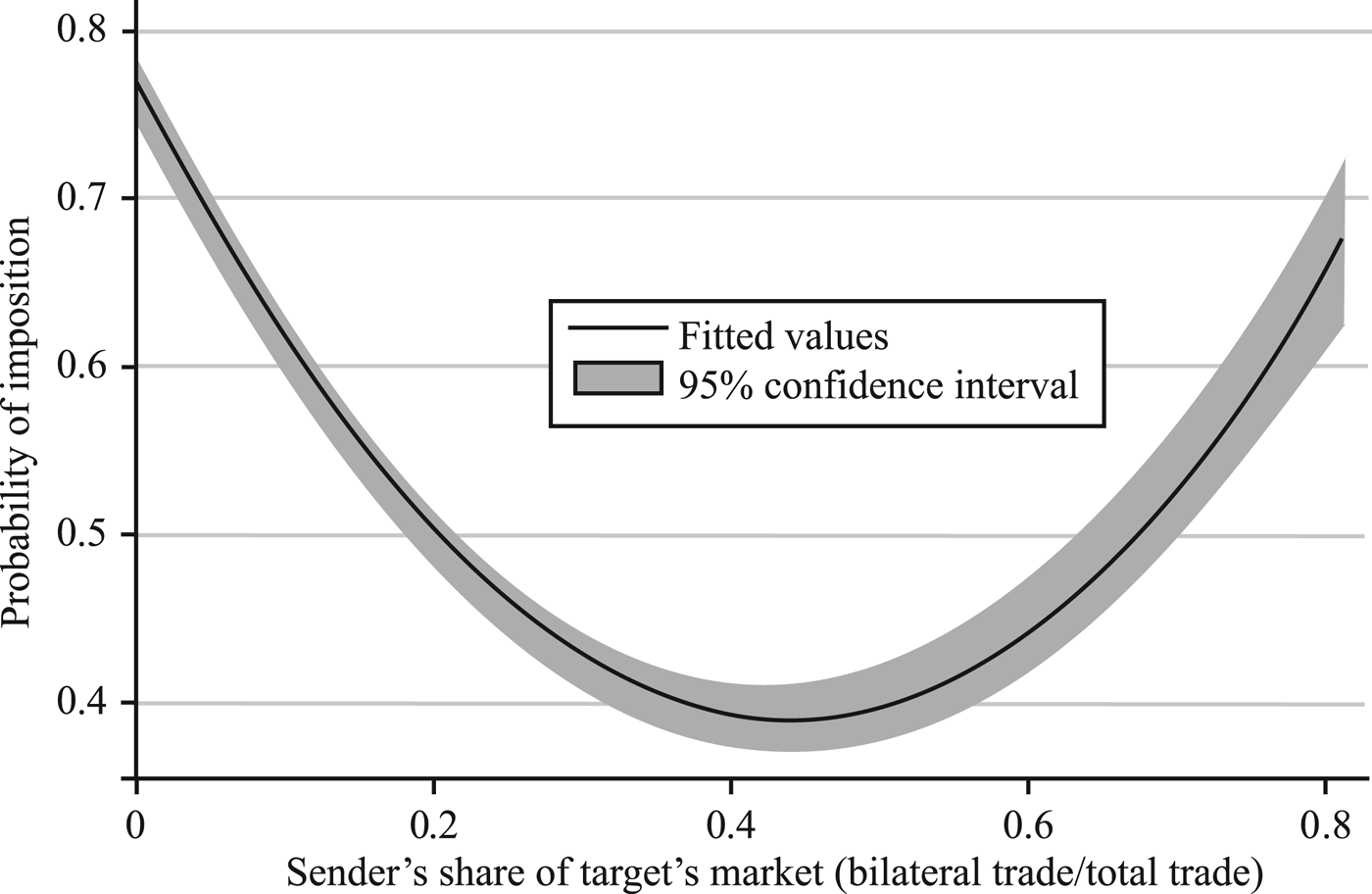
Figure 5 shows that the predicted probability of imposition is lowest when the sender's market share is in the moderate range, which coincides with when the predicted probability of success is highest. Hence, we observe the selection effect: targets acquiesce to sanctions when their exchanges with the sender's firms are likely to cease, and stand firm when these exchanges are likely to continue. The figure shows that the probability of imposition is relatively higher if the sender has relatively high or low share in the target's market. Again, this distinguishes itself from a simple explanation of sanctions imposition that might suggest senders with higher stakes are more likely to impose sanctions. According to the theoretical model, targets can anticipate if sanctions are likely to curtail the ability of the sender's firms to continue economic exchanges. If the sender's firms do not have much at stake, the target is more likely to stand firm, and we are more likely to observe sanctions. As the sender's share of the target's market increases, however, the target is more likely to acquiesce in the threat stage. As a result, the probability of sanctions imposition decreases. We see in Figure 5 that the probability of imposition minimizes when the sender's stake is approximately 0.43. However, once we exceed this point, the probability of imposition again increases, largely because targets do not believe the sender can credibly enforce its sanctions. Although both the model and the simple explanation of sanctions success would predict a higher likelihood of imposition as the sender's stakes in the target's market increase, only the theoretical model predicts the curvilinear effect. We thus see support for H2 as well as the enforcement explanation.
Predicted probabilities of sanctions imposition with 95 percent confidence intervals

The coefficients of the control variables reported in Table 4 also offer some interesting insights. The target's trade proportion variable was included in the model to ensure that the sender's stakes in the target's market accounted for how dependent the target was on foreign trade. Intuitively, the negative and statistically significant coefficient suggests that sanctions are less likely to be effective as the target becomes more trade dependent.Footnote 57 Results show that multilateral sanctions tend to be more successful than unilateral sanctions, which aligns with our assumption. The positive coefficient for major policy goal agrees with previous works that major policy goals warrant higher levels of commitment and thus stronger enforcement by the sender. However, the positive coefficient for expected future conflict and the negative coefficient for sender's trade proportion show the results are inconsistent with existing explanations. Finally, the positive coefficient of the target democracy variable in the selection equation suggests that senders are more likely to impose sanctions on more democratic regimes. Unlike previous work, however, the coefficient in the outcome equation is negative. This suggests that sanctions are less likely to succeed when the target is democratic but the results are not statistically significant.
Conclusion
This study demonstrates that senders face an enforcement problem when pursuing economic sanctions. Sanctions require states to gain the cooperation of private actors such as firms to impose costs on the target. To enhance effectiveness, senders may devote the maximum level of resources they can to police and enforce their sanctions laws. However, although this would affect the behavior of the sender's firms, it would fall short of influencing the behavior of their foreign competitors. In fact, sanctions may enable the foreign competitors to replace the sender's firms in the target's market, thereby undermining both the profitability of the sender's firms and the sender's foreign policy objectives. Because senders are concerned with the competitiveness of their firms, the revenue they bring home, and their future business prospects, the leadership may have disincentives to enforce their sanctions laws aggressively. Yet if senders do not enforce, sanctions will fail as a coercive instrument. We therefore identify an optimization problem for senders: What is the optimal level of enforcement, given that increasing enforcement improves the probability of sanctions success but reduces the competitiveness of the sender's firms?
Our game theoretic model demonstrates that the sender's decision to impose sanctions, and its optimum level of enforcement, is a function of its firms' share of the target's market. We demonstrate that increasing the sender firm's stakes within a target has a curvilinear effect on the probability of sanctions success. Although sanctions are more likely to be effective if the sender's firms maintain sufficient market share such that losing some profits would be harmful to the target, sanctions will become unenforceable if the sender's firms are dominant within the target's market and are willing to evade the law. The empirical test offers support for the model's predictions. The test demonstrates that the probability of sanctions success significantly increases as the sender's market share in the target increases up to a moderate level and decreases as the shares further increase.
Hence, the theoretical model and empirical test both demonstrate that sanctions are more likely to succeed if the sender's share of the target's market falls in the moderate range. However, because of the target's strategic behavior, we observe a selection effect when examining the effectiveness of sanctions. Targets are likely to acquiesce in the threat stage where sanctions are both enforceable and are likely to have damaging consequences. However, targets are unlikely to acquiesce in cases where the sender's firms have minimal stakes in the target, or where their stakes are so high that sanctions are unenforceable. In the latter case, sanctions may be imposed, but will not be enforced.
In sum, this study underlines the conditions under which firms attempt to evade sanctions laws, and how sender governments respond to these actions, which provides a basis for sanctions research at the firm level. This not only invites interdisciplinary theoretical discourse but also increases access to micro-level data. To complement this effort, we need to step back and further investigate how private actors influence the design of sanctions laws should they be imposed and how that ultimately has an impact on the success of sanctions.
Supplementary Material
Replication data and an online appendix are available at http://dx.doi.org/10.1017/S0020818314000290.