



%20--%3e%3c!DOCTYPE%20svg%20PUBLIC%20'-//W3C//DTD%20SVG%201.0//EN'%20'http://www.w3.org/TR/2001/REC-SVG-20010904/DTD/svg10.dtd'%3e%3csvg%20version='1.0'%20id='Layer_1'%20xmlns='http://www.w3.org/2000/svg'%20xmlns:xlink='http://www.w3.org/1999/xlink'%20x='0px'%20y='0px'%20width='64px'%20height='64px'%20viewBox='5.5%20-3.5%2064%2064'%20enable-background='new%205.5%20-3.5%2064%2064'%20xml:space='preserve'%3e%3cg%3e%3ccircle%20fill='%23FFFFFF'%20fill-opacity='0'%20cx='37.785'%20cy='28.501'%20r='28.836'/%3e%3cpath%20fill='%23595959'%20d='M37.441-3.5c8.951,0,16.572,3.125,22.857,9.372c3.008,3.009,5.295,6.448,6.857,10.314%20c1.561,3.867,2.344,7.971,2.344,12.314c0,4.381-0.773,8.486-2.314,12.313c-1.543,3.828-3.82,7.21-6.828,10.143%20c-3.123,3.085-6.666,5.448-10.629,7.086c-3.961,1.638-8.057,2.457-12.285,2.457s-8.276-0.808-12.143-2.429%20c-3.866-1.618-7.333-3.961-10.4-7.027c-3.067-3.066-5.4-6.524-7-10.372S5.5,32.767,5.5,28.5c0-4.229,0.809-8.295,2.428-12.2%20c1.619-3.905,3.972-7.4,7.057-10.486C21.08-0.394,28.565-3.5,37.441-3.5z%20M37.557,2.272c-7.314,0-13.467,2.553-18.458,7.657%20c-2.515,2.553-4.448,5.419-5.8,8.6c-1.354,3.181-2.029,6.505-2.029,9.972c0,3.429,0.675,6.734,2.029,9.913%20c1.353,3.183,3.285,6.021,5.8,8.516c2.514,2.496,5.351,4.399,8.515,5.715c3.161,1.314,6.476,1.971,9.943,1.971%20c3.428,0,6.75-0.665,9.973-1.999c3.219-1.335,6.121-3.257,8.713-5.771c4.99-4.876,7.484-10.99,7.484-18.344%20c0-3.543-0.648-6.895-1.943-10.057c-1.293-3.162-3.18-5.98-5.654-8.458C50.984,4.844,44.795,2.272,37.557,2.272z%20M37.156,23.187%20l-4.287,2.229c-0.458-0.951-1.019-1.619-1.685-2c-0.667-0.38-1.286-0.571-1.858-0.571c-2.856,0-4.286,1.885-4.286,5.657%20c0,1.714,0.362,3.084,1.085,4.113c0.724,1.029,1.791,1.544,3.201,1.544c1.867,0,3.181-0.915,3.944-2.743l3.942,2%20c-0.838,1.563-2,2.791-3.486,3.686c-1.484,0.896-3.123,1.343-4.914,1.343c-2.857,0-5.163-0.875-6.915-2.629%20c-1.752-1.752-2.628-4.19-2.628-7.313c0-3.048,0.886-5.466,2.657-7.257c1.771-1.79,4.009-2.686,6.715-2.686%20C32.604,18.558,35.441,20.101,37.156,23.187z%20M55.613,23.187l-4.229,2.229c-0.457-0.951-1.02-1.619-1.686-2%20c-0.668-0.38-1.307-0.571-1.914-0.571c-2.857,0-4.287,1.885-4.287,5.657c0,1.714,0.363,3.084,1.086,4.113%20c0.723,1.029,1.789,1.544,3.201,1.544c1.865,0,3.18-0.915,3.941-2.743l4,2c-0.875,1.563-2.057,2.791-3.541,3.686%20c-1.486,0.896-3.105,1.343-4.857,1.343c-2.896,0-5.209-0.875-6.941-2.629c-1.736-1.752-2.602-4.19-2.602-7.313%20c0-3.048,0.885-5.466,2.658-7.257c1.77-1.79,4.008-2.686,6.713-2.686C51.117,18.558,53.938,20.101,55.613,23.187z'/%3e%3c/g%3e%3c/svg%3e)
%20--%3e%3c!DOCTYPE%20svg%20PUBLIC%20'-//W3C//DTD%20SVG%201.0//EN'%20'http://www.w3.org/TR/2001/REC-SVG-20010904/DTD/svg10.dtd'%3e%3csvg%20version='1.0'%20id='Layer_1'%20xmlns='http://www.w3.org/2000/svg'%20xmlns:xlink='http://www.w3.org/1999/xlink'%20x='0px'%20y='0px'%20width='64px'%20height='64px'%20viewBox='5.5%20-3.5%2064%2064'%20enable-background='new%205.5%20-3.5%2064%2064'%20xml:space='preserve'%3e%3cg%3e%3ccircle%20fill='%23FFFFFF'%20fill-opacity='0'%20cx='37.637'%20cy='28.806'%20r='28.276'/%3e%3cg%3e%3cpath%20fill='%23595959'%20d='M37.443-3.5c8.988,0,16.57,3.085,22.742,9.257C66.393,11.967,69.5,19.548,69.5,28.5c0,8.991-3.049,16.476-9.145,22.456%20C53.879,57.319,46.242,60.5,37.443,60.5c-8.649,0-16.153-3.144-22.514-9.43C8.644,44.784,5.5,37.262,5.5,28.5%20c0-8.761,3.144-16.342,9.429-22.742C21.101-0.415,28.604-3.5,37.443-3.5z%20M37.557,2.272c-7.276,0-13.428,2.553-18.457,7.657%20c-5.22,5.334-7.829,11.525-7.829,18.572c0,7.086,2.59,13.22,7.77,18.398c5.181,5.182,11.352,7.771,18.514,7.771%20c7.123,0,13.334-2.607,18.629-7.828c5.029-4.838,7.543-10.952,7.543-18.343c0-7.276-2.553-13.465-7.656-18.571%20C50.967,4.824,44.795,2.272,37.557,2.272z%20M46.129,20.557v13.085h-3.656v15.542h-9.944V33.643h-3.656V20.557%20c0-0.572,0.2-1.057,0.599-1.457c0.401-0.399,0.887-0.6,1.457-0.6h13.144c0.533,0,1.01,0.2,1.428,0.6%20C45.918,19.5,46.129,19.986,46.129,20.557z%20M33.042,12.329c0-3.008,1.485-4.514,4.458-4.514s4.457,1.504,4.457,4.514%20c0,2.971-1.486,4.457-4.457,4.457S33.042,15.3,33.042,12.329z'/%3e%3c/g%3e%3c/g%3e%3c/svg%3e)
1. Introduction
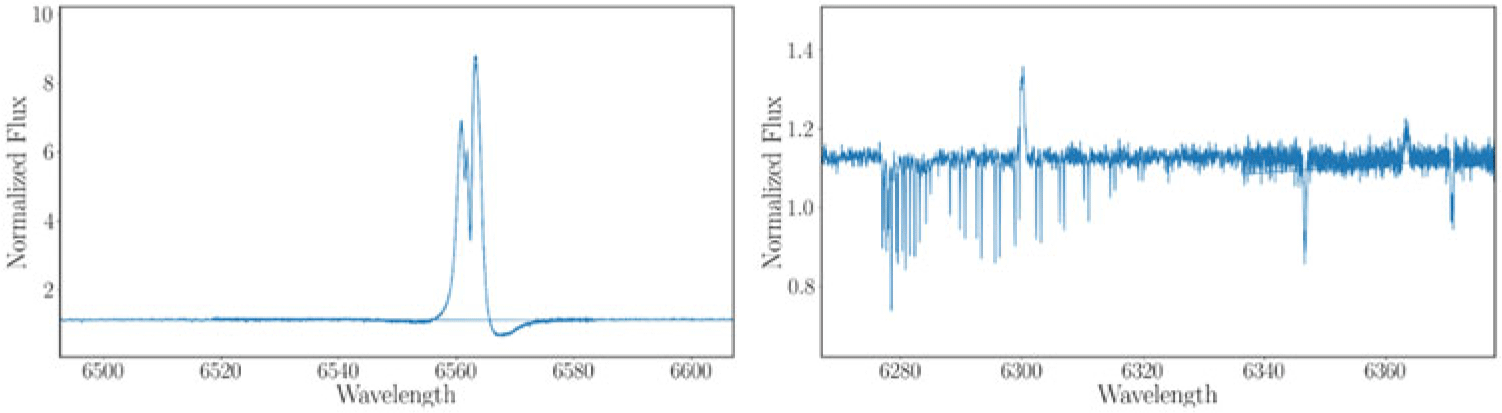
IRAS 17449+2320 belongs to a subgroup of peculiar stars called FS CMa stars. This group consists of (mainly) B-type stars that present the B[e] phenomenon, i.e. permitted and forbidden emission lines, and infrared excess (Miroshnichenko Reference Miroshnichenko2007). For the permitted emission lines, the Balmer lines are especially strong; for the forbidden emission lines, FS CMa stars present low ionization metallic lines, such as [FeII] or [OI] (Fig. 1).
H
 $\alpha$
(left panel) and [OI] 6300, 6363 Å (right panel) lines of IRAS 17449+2320.

These peculiar characteristics are produced by a huge amount of gas and dust surrounding the star. The origin of this circumstellar matter is unclear, although there are two main hypotheses that explain it: binarity and post-merger. The binarity scenario suggests that the circumstellar matter is produced due to the mass-transfer process in a binary system. During the mass-transfer process, an overflow of the Roche Lobe occurs, and the matter is released around the binary (Miroshnichenko et al. Reference Miroshnichenko, Bjorkman and Chentsov2002). The second hypothesis suggests that the circumstellar matter is created during the merger of the components of a binary system. It is supported by theoretical simulations (Scheneider et al. 2019) and the presence of a magnetic field in one of the members of this group, IRAS 17449+2320 (Korčáková et al. Reference Korčáková, Sestito and Manset2022).
Our study case is the magnetic field of IRAS 17449+2320, the first magnetic B[e] star detected to date.
2. Results
We have reduced 12 Stokes
 $V + I$
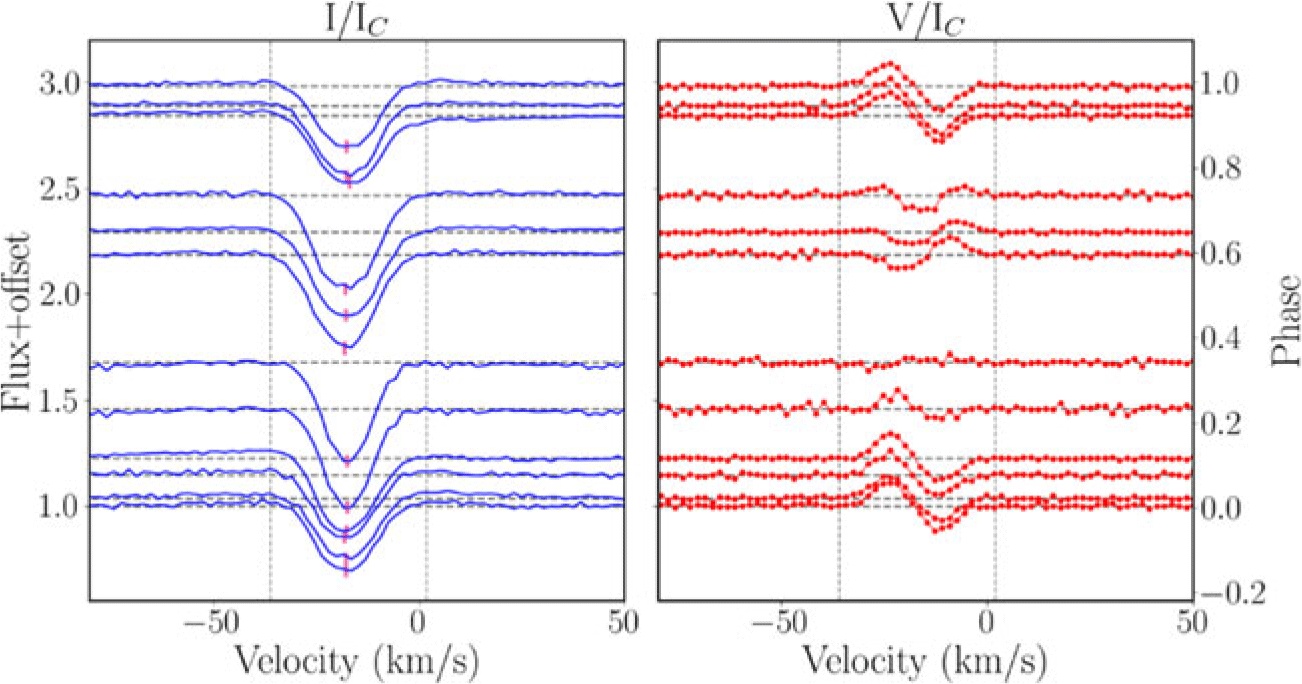
spectropolarimetric observations taken during the last 19 years with ESPaDOnS at the Canadian-France-Hawaii Telescope (CFHT). We obtained the LSD Stokes V and I from the spectropolarimetric observations (Fig. 2), and calculated the longitudinal magnetic field (B
 $_z$
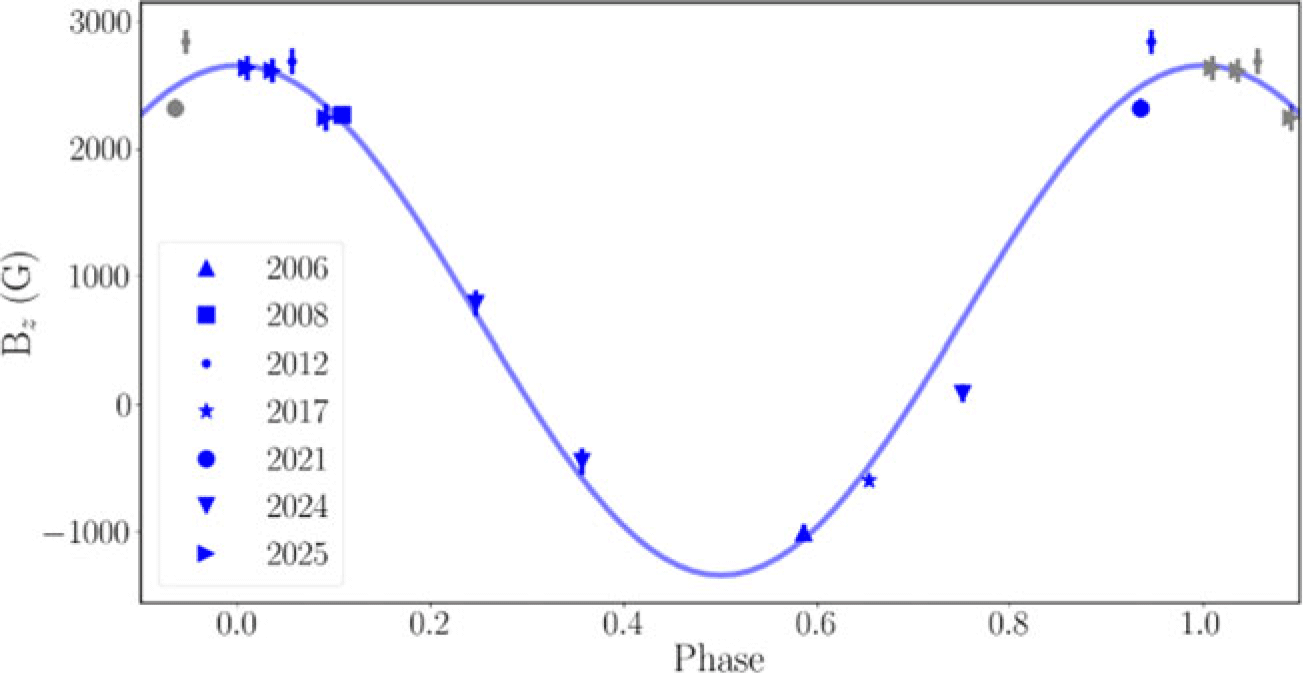
) from them. The longitudinal magnetic field ranges from 3 000 G to -1 000 G. The rotational period of the star is calculated by performing a Lomb-Scargle (LS) periodogram over B
 $_z$
. This data set follows a first-order sinusoidal fit with a period of 36.11
 $\pm$
0.01 days, as shown in Fig. 3. This variation of the longitudinal magnetic field is compatible with a rotational modulation.
LSD Stokes I and V profiles of the 12 spectropolarimetric observations, phased using the rotational period of 36.11 days. The vertical dashed lines are the limits used to calculate B
 $_z$
, and the pink lines mark the radial velocity of each observation.

The longitudinal magnetic field phased using a period of 36.11 days. Observations from different years are plotted with different symbols.

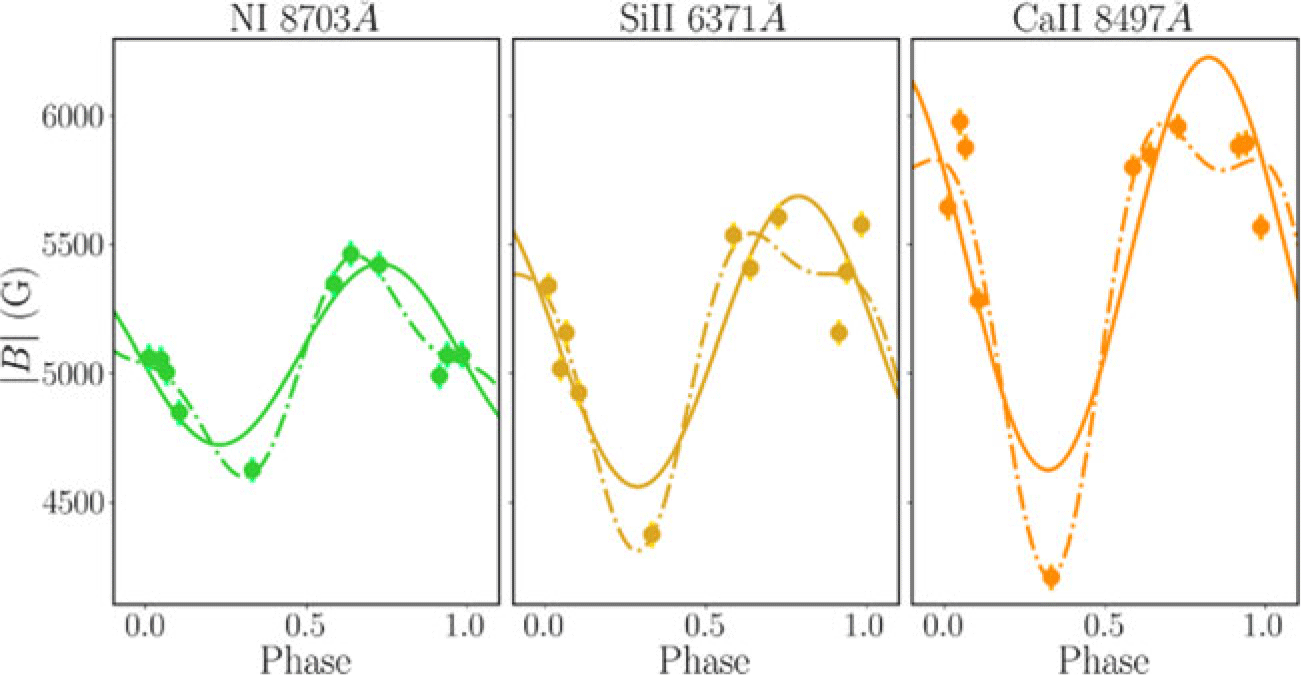
Additionally, we measured the Zeeman splitting of NI 8703 Å, SII 6371 Å and CaII 8497 Å, and obtained the magnetic field modulus (
 $|B|$
). The
 $|B|$
values range from
 $\sim$
6 000 G from the CaII line to
 $\sim$
5 000 G for the NI line (Fig. 4). These values of the magnetic field modulus were also fitted using a first-order sinusoidal function and considering a period of 36.11 days. However, as can be seen in Fig. 4, the first-order sinusoidal function was not performing a good fit over the data sets, and we used a second-order sinusoidal function to improve it. This second-order fit for the magnetic field modulus, together with the first-order fit of the longitudinal magnetic field, point to a mainly dipolar configuration of the magnetic field of the star. Moreover, by comparing
 $|B|$
and B
 $_z$
, it is noticeable that the magnetic field modulus is a factor of a few times the longitudinal field. This is consistent with a globally organized magnetic field that has remained stable during the last 19 years.
Magnetic field modulus obtained from three different lines showing Zeeman splitting. The data are phased with a rotational period of 36.11 days. The solid line corresponds to a first order sinusoid function, and the dashed line to a second order sinusoid function.

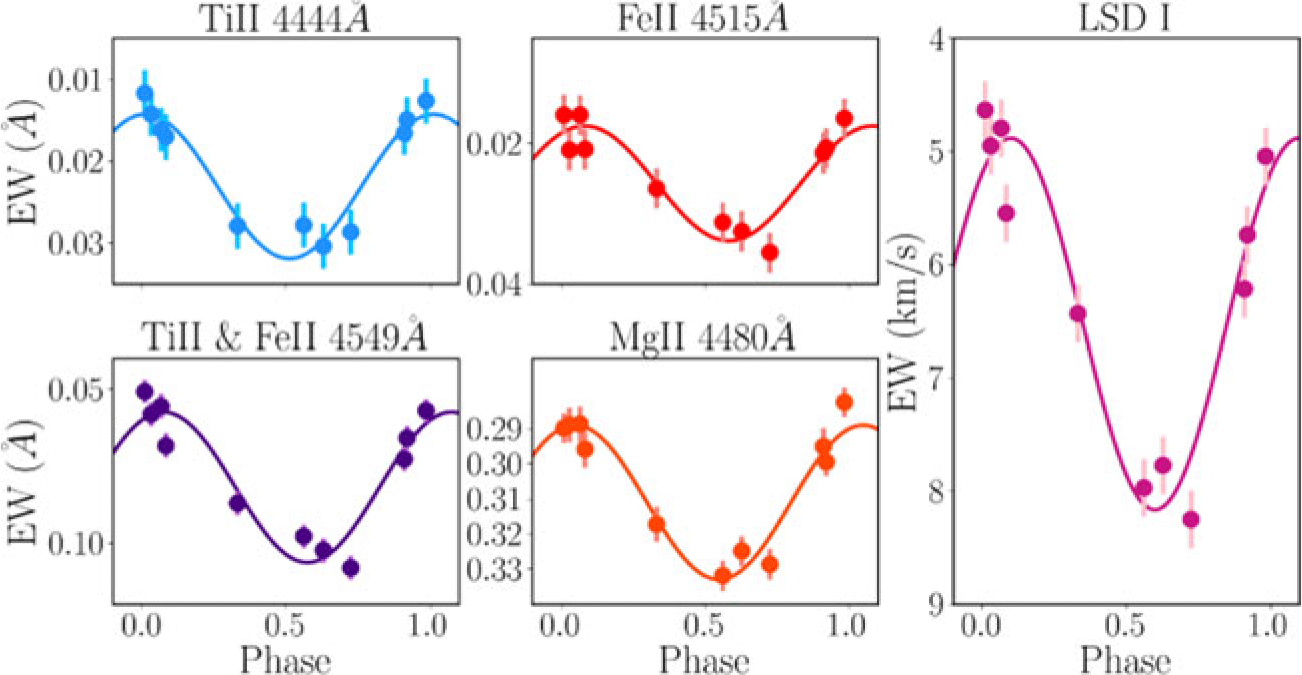
Some metallic lines and the LSD Stokes I profiles show a equivalent width (EW) variation with time (Fig. 5). It varies sinusoidally when phased with the 36.11 d period. The maximum EW corresponds with the maximum of B
 $_z$
. This equivalent width variation could be generated by inhomogeneities in the abundances of elements on the surface of the star. However, it could also be another manifestation of the Zeeman effect, called magnetic intensification; less likely scenarios include veiling or emission filling in the absorption lines. Further analysis is needed to conclude the origin of this EW variation (Bermejo Lozano et al., in preparation).
Plots of the equivalent width variation of some metallic lines and the LSD Stokes I profile. All the data sets are phased with the 36.11 days period.

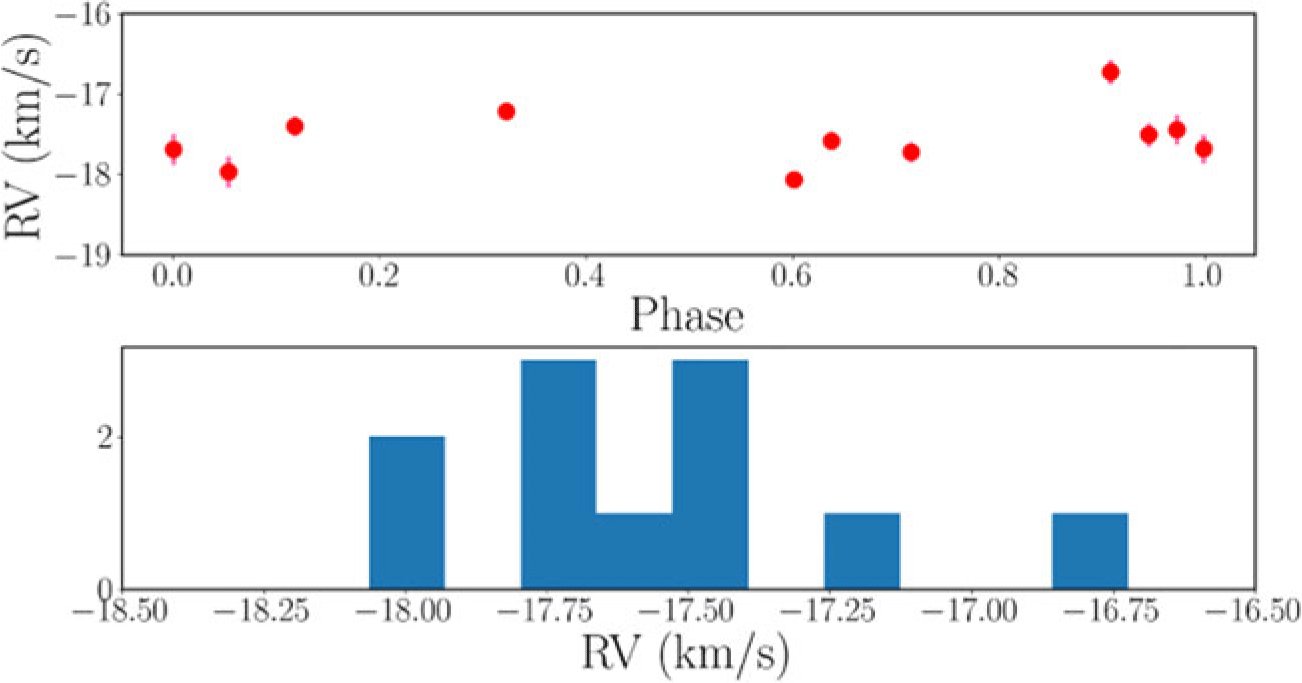
In order to obtain more information about the possible origin of this object, we studied the radial velocity (RV) variation of this star. To achieve this, we calculated the RV by fitting a Gaussian to the LSD Stokes I profiles of each observation. The radial velocities are marked as vertical pink lines in Fig. 2. The radial velocity is shown in Fig. 6, it varies from
 $-$
18.06
 $\pm$
0.08 to
 $-$
16.72
 $\pm$
0.15 km s
 $^{-1}$
, with
 $-$
17.6
 $\pm$
0.36 km s
 $^{-1}$
being the most likely value for the radial velocity of the star. The RV does not show any significant variation, and therefore, it shows no traces of binarity for this object.
Radial velocity variation of the LSD I profiles over the rotation phase (upper panel). The bottom panel shows a histogram of these radial velocities.

3. Conclusions
IRAS 17449+2320 is the first B[e] star with a magnetic field detected. The Zeeman splitting can be observed in multiple lines along the spectrum, and it is consistent with the LSD Stokes V profiles. The magnetic field configuration points to a mainly dipolar one, although we need further analysis to confirm or discard the quadrupolar contribution to it. The radial velocity of this star does not show any traces of binarity. Therefore, we suggest that the origin of this object could be a post-merger, as the magnetic field together with the large amount of gas and dust surrounding the star could have been formed during this merger process.
Supplementary material
To view supplementary material for this article, please visit https://doi.org/10.1017/S1743921326105547.
 α
 z


 Open access

