

There is a revolutionary importance in the relationship between us citizens and our local leaders. Whether members of Congress, mayors or city council members, people in positions of power hold the key to inducing change. By creating relationships with these leaders, we are granted the opportunity to voice our opinion and push towards the solutions necessary to put an end to climate change.
– Daily Camera, Letter to the Editor, Alyssia Chinda (Reference Chinda2019)The majority of Americans, Democrats and Republicans alike, believe that climate change is happening, that it threatens humans, that it is human caused and that reducing greenhouse gas emissions would reduce climate change (Van Boven et al., Reference Van Boven, Ehret and Sherman2018; see also Maibach et al., Reference Maibach, Roser-Renouf, Vraga, Bloodhart, Anderson, Stenhouse and Leiserowitz2013; Davenport & Connelly, Reference Davenport and Connelly2015; Leiserowitz et al., Reference Leiserowitz, Maibach, Rosenthal, Kotcher, Ballew, Goldberg and Gustafson2019). Yet stark partisan differences remain. As one of the world's largest carbon emitters (both overall and per capita; Union of Concerned Scientists, 2018), the USA is a place where there is an urgent need to understand what can be done to enact climate policy. Despite the recent studies showing the increasing concern in the mass public about climate change, clear partisan distinctions persist among elected officials, with Democratic elected officials expressing much more support for climate policy than their Republican counterparts. For example, as of this writing, House Resolution 763, the Energy Innovation and Carbon Dividend Act of 2019, has 80 Democratic sponsors and 1 Republican sponsor (House of Representatives, 2020).
Political divisions on climate policy partly reflect ideological differences surrounding the roles of government, business and markets in society (Kahan, Reference Kahan2012; Campbell & Kay, Reference Campbell and Kay2014), as well as differing priorities for national security, immigration and other pressing issues (McCright & Dunlap, Reference McCright and Dunlap2011; DeNicola & Subramaniam, Reference DeNicola and Subramaniam2014). Yet the polarization of environmental issues is a comparatively recent development (Neal, Reference Neal2018). The Environmental Protection Agency (EPA) was created during the Nixon administration in the USA, and policy discussions about climate change in the 1980s and early 1990s featured less sharp division among Democrats and Republicans; as recently as 2003, a Democratic Senator (Joseph Lieberman) and a Republican Senator (John McCain) introduced the Senate Climate Stewardship Act (which did not pass but obtained some bipartisan support). The polarizing role of some vested interests such as the oil and gas industry and wealthy donors opposed to government regulation (Mayer, Reference Mayer2017) helped make climate policy a ‘wedge issue’. Once established as a wedge issue to divide Democrats and Republicans, a host of recursive social–political–psychological processes increased and reinforced these political divisions.
Citizen activists have played a role in translating public concern about climate change to decision-makers and elevating it on the political agenda. Citizens, such as the Swedish teenager Greta Thunberg, have generated massive attention about the climate crisis through a series of strikes around the world (McKibben, Reference McKibben2019), with a notable one-day, all-ages strike on September 20, 2019, that, according to advocates’ estimates, included over 4,000,000 people around the world (Barclay & Resnick, Reference Barclay and Resnick2019). Such citizen activists play a unique role in the political process by providing countervailing pressure (against corporate lobbyists and other institutional interests) on behalf of climate policy. In this paper, we focus on climate activists who work to lobby Congress in the USA for climate policy, an act that often happens behind the scenes.
We draw on the USA as a particular case where the mismatch between policy and public concern is clear, and where citizen activists are trying to change that by meeting directly with policymakers. The relationship between citizen activists and members of the US Congress is centered on a dynamic of policy persuasion, and as such, it is a ripe topic for social psychological exploration, given the extensive research that has been conducted on topics such as persuasion, conflict, identity, norms and information processing.
We ask two questions in this paper. First, what psychological factors might citizen activists use when meeting with policymakers to advocate for climate legislation? We present a brief review of social psychological research suggesting four approaches that are particularly relevant. We acknowledge that there are unique constraints facing members of Congress that render the social context between constituents and elected officials distinct from that of participants in typical social psychological studies, a point we return to below. Second, we ask whether such social psychological strategies resonate with citizen activists. Do citizen activists recognize these distinct approaches, their utility and their potential effectiveness? We conducted a study of citizens who went to Washington, DC, to lobby the US Congress for a specific policy to address climate change: a carbon fee and dividend program. Many climate activists are interested and motivated to understand and apply the work of social scientists in their efforts to shape policy and priorities, and this effort can be considered a feasibility study to see whether the theories and findings of social psychologists are translatable and useful for citizen activists trying to persuade policymakers directly.
The challenge for social psychology in impacting policy
Many of social psychology's fundamental insights and ideas emerged from the work of Kurt Lewin (Reference Lewin1951) and his collaborators who engaged in ‘action research’. Through deeply embedded ‘reconnaissance’ and ‘behavioral mapping’, the work uncovered basic social psychological insights that could be used to change behavior through theoretically informed interventions. Although the field of social psychology, and psychological science more generally, has increasingly veered toward tightly controlled laboratory studies with large samples that stress internal validity (Ross et al., Reference Ross, Lepper, Ward, Fiske, Gilbert and Lindzey2010), the Lewinian tradition of theoretically relevant action research is reemerging and thriving in modern research on interventions in such domains as health, education and intergroup conflict (Walton & Wilson, Reference Walton and Wilson2018) and in the work of behavioral science units both within and outside government. These efforts emphasize the importance of a deep understanding of the physical, social and psychological structures that shape behavior. It is in this spirit that we sought to better understand the civic actions to translate public concern about climate change into meaningful climate policy by overcoming the psychological barriers that confront policymakers.
Why focus on US Congress and grassroots activism?
The underlying premise of representative democracy is that elected officials attend to the welfare of their constituents. However, in democracies across the world, in a range of different policy domains, extensive research shows that the dyadic relationship between constituent preferences and the behavior of their elected representatives is imperfect at best (see Mansbridge, Reference Mansbridge2003; Baumgartner et al., Reference Baumgartner, Berry, Hojnacki, Leech and Kimball2009; Canes-Wrone, Reference Canes-Wrone2015; Rasmussen et al., Reference Rasmussen, Reher and Toshkov2019 for syntheses of some of this work). Although many models of politics predict that legislators should, in equilibrium, hew towards the preferences of the median constituent (Downs, Reference Downs1957), reality contradicts these predictions. A range of factors, including institutional design, partisan incentives, unpredictable and uneven rates of activism in the mass public and imperfect information flows, distort the representative relationship. Put together, this body of research paints a picture of elected officials as cross-pressured individuals struggling to differentiate signal from noise amongst all of the stimuli that bombard them, while simultaneously trying to balance the competing interests of various stakeholders.
In this messy political environment, an elected official's direct interactions with constituents are one place where lines of accountability are clear. Both because of their interest in reelection and the imperatives of their job, elected officials must engage in direct interactions with their constituents – and, in fact, observational data show that they do (Fenno, Reference Fenno1977; Price, Reference Price2004; Davidson et al., Reference Davidson, Oleszek, Lee and Schickler2013). Yet, we know very little about the nature of those interactions. What approaches do constituents use in their attempts to influence legislators? How do legislators respond? Answering these questions is particularly important in contexts where constituents might have different views and priorities from legislators, or where legislators may misperceive constituent views (Hertel-Fernandez et al., Reference Hertel-Fernandez, Mildenberger and Stokes2019). In such situations, citizens might actively urge elected officials to adopt views they might not have otherwise taken.
Climate lobbying in the US Congress thus represents a particularly informative domain within which to study these interactions. As a non-parliamentary democracy, the US Congress is more candidate-centric: winning elected office depends not only on voter judgments about the party, but also on the individual candidates. It thus puts more pressure on members of Congress to develop independent relationships with constituents than the party-centric approaches that characterize most parliamentary democracies. In addition, climate policy is a domain in which the two political parties in the USA have fairly entrenched stances. Polarization has grown over time such that the average Democratic member of Congress has increasingly high environmental voting scores (as judged by the League of Conservation Voters) and the average Republican member of Congress has increasingly low environmental voting scores (Dunlap et al., Reference Dunlap, McCright and Yarosh2016).
Psychological strategies to communicate about climate policy with policymakers
We propose four strategies that advocates of climate policy could use to increase support when communicating directly in interpersonal meetings with politicians. These four strategies are empirically supported in the social psychological literature, and our study assesses whether they are both intuitive and actionable according to citizen activists. These four strategies are: (1) create an affirming context that reduces the defense of partisan identities and builds on shared values; (2) communicate descriptive norms about citizens’ views on the urgency of climate action; (3) emphasize the concern for future generations as a shared value; and (4) capture the attention and priorities of policymakers by including a focus on the immediacy of extreme weather that is increasing in strength and frequency due to climate change.
Before considering each strategy in depth, we acknowledge the many differences between the social psychological research settings – laboratories, online studies, field experiments – and the highly constrained situation where citizen activists meet with congressional policymakers (or representatives of their offices). In these meetings, both parties engage in a relatively scripted interaction within a limited time frame. Each side is likely very aware of the other side's preexisting positions, which is far different from a social psychological study where partisans may be trying to influence a neutral party or one with unknown positions. In addition, there is a clear power differential between elected officials and constituents. Yet, current persuasion attempts in these situations have not been fully informed by social psychological theory, and as the results from our initial study suggest, the intuitive use of some of these strategies may be at odds with what the literature has shown. Thus, there is value in considering the extant theorizing and literature in this new context.
Affirmation
In addition to the obvious threat to the well-being of the planet and its inhabitants, the climate crisis poses a potential threat to the global self-integrity of people – their views of themselves as competent, worthy, moral and adaptive individuals (Steele, Reference Steele and Zanna1988; Sherman & Cohen, Reference Sherman, Cohen and Zanna2006) – across the political spectrum. On the political right, for politicians who have consistently stood against climate policy, it could be threatening to their self-conceptions as competent and effective public servants to contemplate information about the risks of climate change, which suggests that it has been their intransigence that has fueled environmental crises and posed danger for the planet. It could also be threatening for them to change their opinion and face claims of inconsistency in the media or face a cutoff of financial support they may have previously received from, for example, the fossil fuel industry. And on the political left, for politicians who generally believe in climate change but have not acted to propose or support climate policy, climate change information can pose a threat to their self-conceptions because it implicates their lack of action when they knew that action has been needed to protect the environment. The potential for self-threat exists for congressional staffers as well as for Congressional Representatives, who may be even more torn between their views of the reality of climate change and the lack of support or inability of their Representative's office to advance climate legislation.
The aim of the self-affirmation approach is to reduce identity pressures so that people are more open to otherwise threatening information. In social psychology, there is a long history of research demonstrating that affirmations of alternative sources of self-worth can lead people to be more open-minded to otherwise identity-threatening information (for a review, see Cohen & Sherman, Reference Cohen and Sherman2014). Inviting people to affirm the self by reflecting on core, nonpolitical values, for example, has reduced partisan disagreement and increased acceptance of information that poses a threat to people's identities on a range of political topics, including abortion, capital punishment (Cohen et al., Reference Cohen, Aronson and Steele2000), US foreign policy (Cohen et al., Reference Cohen, Sherman, Bastardi, Hsu, McGoey and Ross2007) and the risk that climate change poses for humanity (Sparks et al., Reference Sparks, Jessop, Chapman and Holmes2010; van Prooijen & Sparks, Reference van Prooijen and Sparks2014). An implication of this research is that politicians who are in a more affirming and less threatening context may be more willing to risk criticism and would be better able to withstand concerns about changing their positions.
There remains an untested assumption, however, about the external validity of the affirmation approach in reducing defensiveness and increasing openness to otherwise threatening information. Would such affirming activities generalize beyond the laboratory or online settings where they have been studied to citizen activists engaging policymakers? A New York Times (Bornstein, Reference Bornstein2017) article illustrated an example of how citizen activists might effectively put this approach into action. It describes how, at a meeting in Congress, the citizen activist first thanked the Republican Congressional Representative for his service in Iraq and in the state legislature before mentioning anything about climate change. The congressman was pleasantly surprised and felt that a wall had been broken down, and ultimately he came to support the proposed climate policy initiative. This reaction illustrates the potential impact of creating an affirming context on breaking down barriers to support climate policy.
This anecdote is consistent with the empirical literature on the effects of affirmation in situations of intergroup conflict. A review of this literature (Sherman et al., Reference Sherman, Brookfield and Ortosky2017) finds that affirmations – typically having people express their core values outside of the identity-threatening domain by writing or reflecting on such things as relationships with family, religion or the arts – have been shown to reduce (1) the strength with which identity-protective beliefs are held, (2) the biased processing of information and (3) the resistance to seeing common ground in negotiations. In one illustrative example, Democrats and Republicans who completed self-affirming writing activities were less polarized in their assessments of presidential debate performance, and Republicans who were affirmed (in a study completed weeks before the 2008 election) were more optimistic about the success of the Obama administration (Binning et al., Reference Binning, Sherman, Cohen and Heitland2010). By expressing shared values and appreciation for the work that others do, an affirming context may create the space necessary for people to be more receptive to information related to climate policy.
Norms
Social norms describe two types of inferences that people make about behavior: how things truly are (descriptive norms) and how things ought to be (prescriptive (or injunctive) norms). Both types of norms can influence people to take action (Cialdini, Reference Cialdini2007; Brauer & Chaurand, Reference Brauer and Chaurand2010); descriptive normative appeals have been shown to promote green behavior as people gravitate their actions towards what they learn are the actions of others (Schultz et al., Reference Schultz, Nolan, Cialdini, Goldstein and Griskevicius2007, Reference Schultz, Khazian and Zaleski2008). Through public opinion research with the American public, we identified a striking pattern in regard to the norms about beliefs about climate change (Van Boven et al., Reference Van Boven, Ehret and Sherman2018). We conducted two surveys with large and diverse national samples in 2014 and 2016 in which we asked participants whether climate change is happening, threatens humans, is caused by human activity and whether reducing carbon emissions would mitigate the problem. Contrary to much discussion in the media and academic circles, most Republicans (70% and 63% in 2014 and 2016, respectively), like most Democrats (93% and 89%, respectively) and independents (78% and 70%, respectively), agreed with these statements. While the belief in climate change and its impact was more common among Democrats than Republicans, it was striking, given contemporary debates and the polarization in US Congress, that it was normative to believe in climate change and to perceive that reducing carbon emissions would help address the problem (Van Boven et al., Reference Van Boven, Ehret and Sherman2018). We observed similar patterns in data from the 2016 American National Election Study, a nationally representative survey that employed different operationalizations of the question of belief in climate change (Van Boven et al., Reference Van Boven, Ehret and Sherman2018).
The second aspect of this striking pattern was that people misperceived this norm. Participants across the political spectrum underestimated the degree to which both Republicans and Democrats believed in climate change, with underestimation of Republicans being more pronounced (Van Boven et al., Reference Van Boven, Ehret and Sherman2018; see also Mildenberger & Tingley, Reference Mildenberger and Tingley2017). Republicans were somewhat more accurate in their estimates of fellow Republicans, but nevertheless, like Democrats and independents, they underestimated other Republicans’ belief in climate change.
The social psychological approach, then, is to communicate the accurate norms to politicians about what their constituents believe, for example by reporting actual percentages of American individuals’ beliefs in climate change, risk perceptions and support for environmental policy at the local level across the USA (Howe et al., Reference Howe, Mildenberger, Marlon and Leiserowitz2015). Such social norm interventions, by presenting people with accurate information about their peers’ attitudes and behaviors, have been effective across domains (Miller & Prentice, Reference Miller and Prentice2016). Correcting inaccurate normative beliefs can lead people to move their own beliefs and behaviors away from the perceived norm and closer to the actual norm. In this specific context, if activists lobbying a particular member of Congress present information suggesting that support for climate policy is of increasing importance to the member's constituency, their normative appeals can be linked to members’ goals for reelection (Mayhew, Reference Mayhew1974; Fenno, Reference Fenno1977, Reference Fenno1978).
In addition to communicating norms of support for policy among citizens, research has shown that providing people with information that there is a scientific consensus on climate change can reduce polarization (van der Linden et al., Reference van der Linden, Leiserowitz and Maibach2018, Reference van der Linden, Maibach and Leiserowitz2019). The Gateway Belief Model shows that correcting misperceptions about scientific consensus can change people's beliefs about climate change, their emotional judgments about the issue and their support for climate policy (van der Linden et al., Reference van der Linden, Leiserowitz, Feinberg and Maibach2015a). Communicating that 97% of climate scientists have concluded that anthropogenic climate change is occurring can shift people's beliefs in the direction of supporting climate policy across the political spectrum (for a discussion, see van der Linden et al., Reference van der Linden, Maibach and Leiserowitz2019). Thus, a wide range of approaches to communicate accurate scientific and attitudinal norms have been effective at changing attitudes, behaviors and policy support relevant to climate change.
Legacy
When activists communicate shared values in exchange with policymakers, one value that may be of particular importance is the impact that people's actions have on future generations. Emphasizing this value may provide policymakers with the broader perspective needed to motivate support for environmental policies whose impact may not be seen immediately. Encouraging policymakers to think about the type of legacy they will leave on future generations may be an effective strategy that is achieved through decreasing the temporal distance they feel to the potential long-term rewards of environmental policies (or forestalling the long-term disasters that may occur as a result of a lack of policy). In a review, Wade-Benzoni (Reference Wade-Benzoni1999) highlights the importance of taking an intergenerational perspective when contemplating tradeoffs between economics and the environment. When economic values are broadened to include the interest of parties in future generations, it enables people to see that environmental and economic interests may converge in the long run as resources are passed down across generations. In other words, it may be motivating to emphasize the people who will have to deal with the consequences of society's climate decisions in the future, particularly focusing on children and grandchildren (Van Lange & Bastian, Reference Van Lange and Bastian2019).
Furthermore, individuals’ motivations to leave a positive legacy can be leveraged to increase their engagement with climate change and other environmental problems. In one study, inducing people to think intergenerationally increased their desire to purchase green products and donate to an environmental charity (Zaval et al., Reference Zaval, Markowitz and Weber2015). Highlighting the consequences of climate inaction for future individuals and personalizing it in terms of ‘our own children and grandchildren’ are now clearly parts of the strategy used by youth activists to increase pressure on policymakers (e.g., Friedman, Reference Friedman2019; McKibben, Reference McKibben2019; see also Van Lange et al., Reference Van Lange, Joireman and Milinski2018).
However, with the use of legacy appeals comes potential caveats, as recent work has demonstrated that future-focused appeals (versus past-focused appeals) in certain cases may not be effective among political conservatives (Baldwin & Lammers, Reference Baldwin and Lammers2016; Lammers & Balwin, Reference Lammers and Baldwin2018). In a series of studies that manipulated the temporal framing of environmental messages, the researchers found that, due to their ideological focus emphasizing a relative preference for the past over the future, conservatives were more likely to report more pro-environmental attitudes and donate more to environmental charities after reading past-focused (versus future-focused) messages (Baldwin & Lammers, Reference Baldwin and Lammers2016). For liberals, there typically was no difference. These results suggest how temporal focus may affect receptiveness to messages that emphasize the past or future.
Legacy appeals, with their inherent emphasis on potential injury to future generations, tend to evoke a sense of loss and personal harm. This presents another factor for citizen activists to consider while employing legacy appeals that emphasize the potential long-term costs and benefits of different actions (or inactions) in response to climate change. In their review of psychologically based strategies for improving public engagement with climate change, van der Linden et al. (Reference van der Linden, Maibach and Leiserowitz2015b) argue that people respond in fundamentally different ways to gain- versus loss-framed messages, especially in the context of climate change. Much of today's public discourse about climate change is centered around losses: the harm that climate change will evoke on our planet or, solutions-wise, the higher taxes that people will have to pay. Yet, people are particularly sensitive to losses (Kahneman & Tversky, Reference Kahneman and Tversky1979) and vigilant for negative information (Pratto & John, Reference Pratto and John1991). With the use of legacy appeals, climate impacts are framed as potential losses for future generations, while solutions are framed as definite losses in the present. People tend to be more tolerant of risks when considering losses, so legacy framing could lead people to tolerate the risky status quo instead of making immediate sacrifices in the service of uncertain futures (van der Linden et al., Reference van der Linden, Maibach and Leiserowitz2015b).
Furthermore, climate change impacts are typically communicated to the public as future (uncertain) consequences that will happen over varied points in time, which is disadvantageous because people tend to discount the risks of future events and instead make choices that maximize their present benefits (Berns et al., Reference Berns, Laibson and Loewenstein2007). Indeed, research has shown that people judge the risks of climate change to be more severe in the future and to other people rather than to themselves (e.g., Leiserowitz, Reference Leiserowitz2005; Gifford et al., Reference Gifford, Scannell, Kormos, Smolova, Biel, Boncu, Corral, Güntherf, Hanyu, Hine and Kaiser2009). To reduce the abstract, psychologically distant nature of climate change, communicators could highlight climate change's regional negative impacts and offer immediate, concrete modes of action (in tandem with future-focused messages of intergenerational equity) to highlight the positive impact that people's actions can have on future generations (van der Linden et al., Reference van der Linden, Maibach and Leiserowitz2015b).
Immediacy
For too long and for too many, climate change has typified an abstract, distant threat that does not evoke the emotion and motivation necessary to propel immediate action. The most severe consequences of climate change are not expected to unfold for several decades, and the biggest threats may confront dissimilar people in faraway places. People value events that occur elsewhere to other people in the future substantially less compared to immediate, self-relevant events (O'Donoghue & Rabin, Reference O'Donoghue and Rabin1999; Frederick et al., Reference Frederick, Loewenstein and O'Donoghue2002; Jones & Rachlin, Reference Jones and Rachlin2006). People consequently prioritize immediate but smaller and concrete threats over larger but abstract and distant threats.
Highlighting the immediacy of climate-related extreme weather – that extreme events such as flooding, fires and heatwaves are already occurring – may provide the emotional urgency needed to take immediate action on climate change. People respond strongly to threats that evoke immediate emotions (Loewenstein et al., Reference Loewenstein, Weber, Hsee and Welch2001). For example, people donate disproportionately to humanitarian crises that are randomly assigned to arouse immediate (rather than past) emotion (Huber et al., Reference Huber, Van Boven, McGraw and Johnson-Graham2011) and deem as more worthy of mitigation those terrorist threats that are randomly assigned to arouse immediate (rather than past) fear (Van Boven et al., Reference Van Boven, White and Huber2009). People also perceive as more threatening and worthy of mitigation those environmental threats that arouse immediate emotion because people's attention has been experimentally drawn to those threats (Mrkva et al., Reference Mrkva, Cole and Van Boven2020).
Importantly, the human tendency to neglect future risks is reduced when people are made to feel emotions about those risks (Loewenstein, Reference Loewenstein2005; Van Boven et al., Reference Van Boven, Loewenstein, Welch and Dunning2012). Feelings of fear and foreboding not only provoke direct action (Loewenstein et al., Reference Loewenstein, Weber, Hsee and Welch2001; Baumeister et al., Reference Baumeister, Vohs, Nathan DeWall and Zhang2007), but they also reduce the psychological distance of threats, making them seem closer in time and space (Van Boven et al., Reference Van Boven, Kane, McGraw and Dale2010). In observational studies, there is a strong correlation between proximity and risk perception. Individuals living closer to the shoreline or who read about impacts to their local area were more likely to believe in climate change and support environmental action (Scannell & Gifford, Reference Scannell and Gifford2013; Milfont et al., Reference Milfont, Evans, Sibley, Ries and Cunningham2014). Multiple findings thus indicate that highlighting the immediacy and emotional potency of climate-related threats can increase policymakers’ willingness to act. A sense of proximity and emotionality may help address policymakers’ seeming apathy and excessive patience in addressing climate change.
Summary
The four approaches reviewed above – affirmation, social norms, legacy and immediacy – are not exhaustive, but they present a theoretically grounded social psychological framework that has been supported by laboratory, online and field studies. They have been effective in some situations at changing beliefs and behaviors regarding the environment and, in some cases, climate policy. However, the testing of most of these strategies has been confined to social psychological experiments and has not examined the strategies in the context of interactions between citizens and policymakers. Most of the laboratory-based research has, furthermore, examined tightly scripted strategies, nearly always delivered by an experimenter, whereas citizen activism entails strategies delivered by laypeople. Whether non-experts can intuitively make sense of these strategies is an important question.
To address this, we have collaborated with a federated national climate advocacy organization in the USA that focuses on advocating for national policies to address climate change through nonpartisan education of congressional offices. Members of this organization engage in a wide range of activities (i.e., writing letters to the editor, meeting with Congress, meeting with local city officials) designed to promote a bipartisan climate fee and dividend policy. This research has thus far yielded several suggestive findings. Before describing some of these findings, it is instructive to consider the collaborative research project we designed with them.
Collaboration between behavioral scientists and climate activists
The collaboration began with the publication of scientific findings (Van Boven et al., Reference Van Boven, Ehret and Sherman2018) that, as the title of that paper (‘Psychological Barriers to Bipartisan Public Support for Climate Policy’) indicates, the authors hoped would encourage dialogue between climate policy advocates and scientists. This, as well as an op-ed summarizing the research (Van Boven & Sherman, Reference Van Boven and Sherman2018), led the organization to contact the researchers to learn more about the findings. The organization invited the researchers to share the findings with a broader group of the organizations’ members and volunteer leaders. The organization, which has a highly engaged activist base, and the researchers engaged in dialogue about psychological barriers to supporting climate policy, lobbying strategies to overcome those barriers and the psychological insights behind those strategies.
Our research team and the organization's leadership collaborated on a study to help frame and translate social psychological theorizing into organizational practice. Our team studied the organization's webpages and training documents to co-construct a survey that presented those strategies to organizational activists in terms used in the organization's training materials. The study was an opportunity to document both whether those strategies were used and what the experience of using them was like. We present two surveys that we conducted—pre-lobbying and post-lobbying—in an exploratory study. We collected additional measures not reported in the main text (for descriptions of the complete surveys along with data used for reported analyses, see https://osf.io/2t6z9/). The study was designed to assess the potential use, perceived effectiveness and comprehensibility of these strategies, but it would require a different study design to assess their actual impacts.
Study of citizen activists before and after the lobbying effort
Participants included 352 citizen activists, of whom 264 completed a pre-test before the congressional lobbying effort in November 2018 and 292 completed the post-test after lobbying efforts in Washington, DC (204 completed both pre-test and post-test).Footnote 1 Demographic data were collected on 316 participants (percentages below represent the percentages of people who responded; demographic data were not obtained for 36 people who completed a version of the survey that did not include demographics) (52.2% male, 47.2% female, 0.6% transgender/prefer not to answer; 92.7% White/Caucasian American; 2.2% Asian/Asian American; 1.6% Hispanic/Latin American; 0.9% Black/African American; 2.5% other/prefer not to answer; the mean age was 55.6 years old (range: 18–82)). Of the 260 participants who responded to the question during the pre-test asking them how much experience they had lobbying, 51 (19.6%) said they had never lobbied, 28 (10.8%) said they had lobbied once, 26 (10.0%) said they had lobbied twice and 154 (59.2%) said they had lobbied three or more times. Hence, this was an experienced group of activists.
The lobbying efforts centered on a day when citizen activists converged from around the country to participate in a conference, training activities and, ultimately, a series of visits to Capitol Hill. Citizen lobbyists visited the offices of every member of Congress, presenting information to encourage support and sponsorship of a specific policy to address carbon emissions.
The survey was based on the four strategies that we developed in association with the climate organization. Participants were asked about the different ways in which they may talk about climate issues with elected officials and were provided with a non-exhaustive list. The four strategies corresponded to the four approaches reviewed above, but they were framed in common language and not psychological jargon (see Appendix A for a description of the strategies as they were presented to the activists). We sought to organize the strategies following theoretical guidelines, not to define new strategies. This was less intrusive to the organization and allowed us to leverage citizen lobbyists’ familiarity with existing strategies.
Corresponding to the affirmation approach was establishing shared values: “Establishing Shared Values (Optimism, Relationships, Integrity, Being Non-Partisan) in a context to highlight that staff and volunteers share common ground and can work together towards public support for policy solutions grounded in these values that manage the risks of climate change.” The purpose of establishing shared values is to demonstrate that volunteers want to work with the member of Congress and their office to arrive at solutions grounded in their valid concerns towards addressing climate change.
Corresponding to the norms approach was being a trusted messenger: “Being a Trusted Messenger, or sharing local leader and constituent letters that communicate information about Americans who support a carbon fee and dividend policy.” By sharing constituent letters as well as statistics from the Yale Climate Opinions Maps about the support for climate policy within the area, the purpose of being a trusted messenger is to dispel misinformation about support for carbon pricing policy by showing the actual level of support.
Corresponding to the legacy approach was establishing Long-Term costs of climate change, “where volunteers tell personal stories about how the climate has already changed in their personal experience and discuss what the long-term costs will be to future generations.” The purpose of presenting long-term costs and benefits is to encourage Congressional Representatives to think about the harm that climate change is presenting to future generations and the potential benefit that could occur by addressing it.
Corresponding to the immediacy approach was: “Discussing the connection between Extreme Weather and Climate to stress the immediacy of climate change and its negative impacts, increasing likelihood of flooding, drought and wildfires while increasing their intensity and duration.” By discussing the connection between climate change and extreme weather events, citizens could highlight the alarming trends and immediate costs that leaving climate change unaddressed continues to impose.
Pre-election results
In the week prior to the 2018 election, participants were randomly assigned to either complete demographic information only (n = 130) or to a condition where they were presented with the four strategies (see Appendix A) and estimated their likelihood of using the four strategies (n = 134). The purpose of this manipulation was to explore whether informing people of the strategies would increase the likelihood that they would use those strategies in the lobbying sessions. As there was no consistent evidence of increased usage as a function of the pre-test condition, this is not further discussed. Participants who were presented with the strategies assessed their likelihood of using each (“How likely are you to use this approach during your lobbying activities in November?”) in 10-point increments from 0% to 100%. They also assessed how effective they thought each strategy would be (“How effective would this strategy be in moving someone who does not support carbon fee and dividend towards supporting carbon pricing policy if you are to use it in November?”) using a seven-point scale from 1 (not at all effective) to 7 (extremely effective).
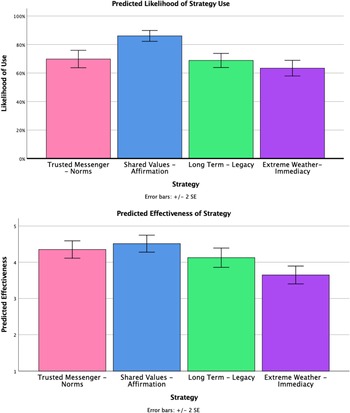
Figure 1 illustrates the results. For predicted likelihood of use, participants said they were substantially more likely to use Shared Values (Affirmation; M = 86.0%, 95% confidence interval (CI) = 82.3–89.8%) than the other three strategies: Trusted Messenger (Norms; M = 69.8%, 95% CI = 63.8–75.9%), Long-Term (Legacy; M = 68.8%, 95% CI = 63.9–73.7%) and Extreme Weather (Immediacy; M = 63.4%, 95% CI = 58.0–68.9%), as indicated by repeated-measures analysis of variance (ANOVA), F(3, 330) = 19.86, p < 0.001, η p2 = 0.15, individual contrasts of Shared Values versus other strategies all p-values < 0.001. Emphasizing shared values is part of the ethos of the organization from which members participated in the study, and the organization explicitly works with activists to create this ethos, so it is not surprising that the Shared Values strategy was most anticipated to be used.
Prior to lobbying, the likelihood of use and predicted effectiveness of four different strategies to persuade people to support climate policy. Top image y-axis ranges from 0% to 100%. Bottom image y-axis ranges from 1 (not at all effective) to 7 (extremely effective). Error bars are ±2 SEs.

Regarding predicted effectiveness, all of the strategies were anticipated to be at least moderately effective at moving people to support the policy, with Shared Values (M = 4.51, 95% CI = 4.28–4.75) and Trusted Messenger (M = 4.35, 95% CI = 4.11–4.59) being seen as significantly more effective than were Long-Term (M = 4.13, 95% CI = 3.86–4.39) and Extreme Weather (M = 3.65, 95% CI = 3.41–3.89), F(3, 330) = 16.10, p < 0.001, η p2 = 0.13. Shared Values and Trusted Messenger did not differ from each other (p = 0.22), and Extreme Weather was perceived to be less effective than all the other strategies (all p-values < 0.001).
It is important that the citizen activists, on average, differentiated between the four strategies, viewing some as more likely to be used than others and more likely to be effective than others. Participants who deemed the strategies as more effective also said they were more likely to use them (Trusted Messenger: r(122) = 0.267, p = 0.003; Shared Values: r(113) = 0.250, p = 0.007; Extreme Weather: r(111) = 0.527, p < 0.001; Long-Term: r(109) = 0.521, p < 0.001). At the individual level, participants said they were more likely to use strategies that they viewed as more effective than they were to use strategies that they viewed as less effective. The average within-person correlation between each participant's ratings of the four strategies’ effectiveness and that person's ratings of the likelihood that they would use each strategy was significantly positive (average within-person r = 0.39, one-sample t(99) = 6.90, p < 0.001).Footnote 2 These findings indicate that citizen lobbyists differentiate in what they perceive to be effective strategies. Such differentiation attests to the usefulness of identifying these different strategies as different means of lobbying for climate policy. With this as the background, we next examine the extent to which these strategies are translated into action in the post-lobbying survey we conducted.
Post-lobbying results
In the week after the 2018 midterm election, after extensive training with members of the organization, there was a citizen lobbying day with small delegations (median number of people in delegation = 5) meeting with every congressional office (either member of staff) to try to get them to support the carbon fee and dividend policy. A total of 292 citizen lobbyists who went to Washington, DC, to meet with Congressional Representatives completed an online questionnaire about their experiences. We asked the participants whether they met with the office of their own Congressional Representative; 81.8% indicated that they had, and they answered the questions about strategies below in regards to that meeting with their own Congressional Representative. A total of 18.2% said that they did not meet with the office of their own Congressional Representative, and they answered the questions below in regard to the first office that they visited that day. In total, 53% focused on a meeting with a Republican and 47% focused on a meeting with a Democrat. Among the participants completing the survey, 88% met with a member of staff and 12% met with a member of Congress.
We first examined the use of the four strategies. Participants reported, for the target meeting, how much they used each of the strategies on five-point scales (not at all; a little; moderate; somewhat; a great deal). Consistent with the expectations at the pre-test, the strategy most used was Shared Values (96.9% used at least a little; median usage = a great deal), and then Trusted Messenger (85.4% used at least a little; median usage = moderate). As in the pre-test expectations, participants anticipated using Extreme Weather (69.2% used at least a little; median usage = a little) and Long-Term (70.4% at least a little; median usage = a little) somewhat less. The majority of participants thus indicated that they had used all four strategies in their meeting with congressional offices.
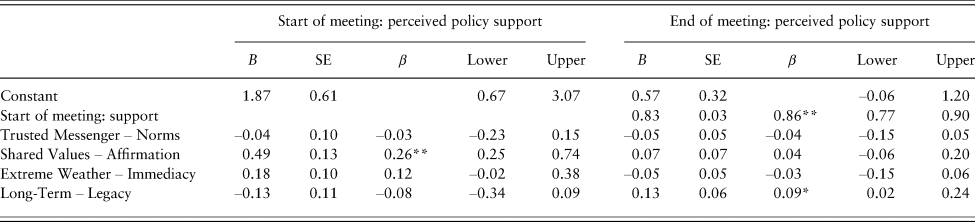
The second goal was to examine whether the citizen lobbyists used the strategies differently among those for whom they were trying to convince to switch from opposing to supporting the policy than among those for whom they were trying to convince to take a more active role (those who already support the policy). Participants responded to the prompt: “At the start of the meeting with the Congressional Representative, how supportive did you perceive him or her to be of carbon tax and dividend policy?”Footnote 3 on a scale from 1 (not at all supportive) to 7 (very supportive). We conducted a multiple regression analysis with initial support (on the 1–7 scale) as the outcome and the four strategies as simultaneous predictors (see Table 1, left). Shared Values – Affirmation was strongly positively predictive of initial support for the policy, β = 0.26, t(233) = 3.95, p < 0.001; this was the only strategy that was significantly associated with initial support. People reported using the strategy that featured affirmation more to the extent that the member of Congress already supported the policy.Footnote 4 Participants may have found it easier to see and hence discuss shared values with a person (a representative of a congressional office) that they perceived as agreeing with them on the necessity to act on climate change by supporting the policy.
Multiple regression results predicting perceived policy support of Congressional Representatives at the start of the meeting (left) and at the end of the meeting (right). The results indicate that participants used Shared Values – Affirmation more with those whom they perceived as more strongly supporting the policy and that the use of Long-Term – Legacy was most associated with increases in perceived support during the meeting.

*p < 0.05, **p < 0.001.
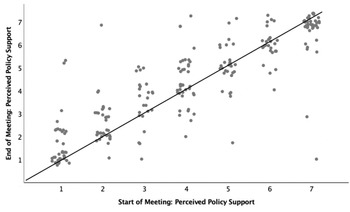
Participants completed additional questions about their experience with the strategies before estimating the support for the climate policy of the person they met with at the end of the meeting on the same seven-point scale as the initial question reported above. Figure 2 plots the perceived support at the end of the meeting on the y-axis and the perceived support at the beginning of the meeting on the x-axis. Of the 230 participants who reported their perceptions of the Congressional Representative's support before and after the meeting, the most common response (57.4%) was that the Representative's position did not change. Of those who perceived the Representative as having changed, 12.1% of lobbyists estimated that the Representative became less supportive, whereas 30.4% estimated that the Representative became more supportive of the carbon fee and dividend plan.
Perceived policy support at the end of the meeting with the Congressional Office as a function of perceived support for the policy at the start of the meeting. The black line is the identity line, and points close to that line represent people who perceived no change (57.4% of sample). Points above the identity line (30.4%) are perceived increases in support and points below the line (12.1%) are perceived decreases in support. Random noise is introduced to the scatterplot via ‘jittering’ to better distinguish among closely packed data points.

We explored whether the use of any of the strategies was associated with the perception of an increase in support for the policy during the course of the meeting. We conducted a multiple regression analysis with support at the end of the meeting as the outcome and use of each of the four strategies as predictors, controlling for support at the start of the meeting, which was also included as a predictor (see Table 1, right).Footnote 5 The only strategy that was associated with increase in support for the policy was emphasizing the shared Long-Term costs of climate change, β = 0.09, t(223) = 2.37, p = 0.019. This finding suggests that emphasizing the long-term costs of climate change for future generations and the potential benefits of addressing it may be an effective strategy to communicate to Congressional Representatives in order to increase support for climate change policy.
Whether use of a strategy predicts perceived support at the end of the meeting (controlling for perceived support at the start of the meeting) is an indirect assessment of the effectiveness of the strategy. We also directly asked participants how effective they thought each of the four strategies were at “moving the person you met with towards supporting the carbon pricing policy” on a seven-point scale with anchors 1 (not at all effective) and 7 (highly effective). This question was asked only of participants who reported that they had used the strategy (e.g., “a little” or more), so the number of participants who responded to each strategy differed. Overall, participants viewed Shared Values as most effective (n = 234, M = 3.99, 95% CI = 3.76–4.22; it should be noted that the mean is almost exactly the midpoint of the scale). The other three strategies were seen as similarly (in)effective: Trusted Messenger (n = 216, M = 3.56, 95% CI = 3.33–3.79), Long-Term (n = 163, M = 3.66, 95% CI = 3.40–3.92) and Extreme Weather (n = 169, M = 3.71, 95% CI = 3.45–3.97). A repeated-measures ANOVA found a similar pattern among those participants (n = 111) who reported using all of the strategies, with Shared Values being perceived as more effective than the other three strategies, F(3, 330) = 4.85, p = 0.03, η p2 = 0.042. When directly asking participants, they thought that the strategy related to affirmation was most effective, whereas the indirect assessment, examining the relationship between each strategy and perceived increases in support, indicated that focusing on long-term costs and benefits was most effective.Footnote 6
To conclude, the activists recognized and utilized the four approaches differently during their various meetings with a range of congressional offices – some of whom supported the policy and some of whom did not – and they had their own perspectives on the likely effectiveness of each approach. Analyses of these patterns suggest directions for education and training.
Summary
Surveys conducted with citizen activists before they went to advocate for a carbon policy in Washington, DC, around the time of the 2018 election indicated that they were most likely to anticipate using the strategy of expressing shared values. Examinations of their perceptions after the lobbying experience suggests that they did employ this strategy most frequently and perceived it to be most effective. However, they used shared values relatively more among those who they perceived as more strongly supporting the policy rather than with those who they perceived as not supporting the policy, which would suggest a potential unrealized opportunity. Affirmation is theorized to increase open-mindedness among people whose identity is most threatened in a particular context (Sherman & Cohen, Reference Sherman, Cohen and Zanna2006). This suggests that the people for whom affirmation would be most important (from the perspective of the citizen lobbyists) are those who did not support the policy and would be challenged by the lobbyists. Yet, lobbyists were less inclined to use affirmation of shared values with this group. Such reluctance makes intuitive sense given the difficulty of identifying shared values among those with dissimilar views. But limiting the use of affirmation of shared values when it is difficult may be a missed opportunity to use the approach where it may be most effective.
The second approach that yielded suggestive findings was emphasizing the long-term costs of climate change to future generations and the long-term benefits of confronting the problem now. While this strategy was employed less frequently than affirmation of shared values and seen as less effective, it was the only strategy that was associated with perceived increases in support of the carbon fee and dividend policy. The disconnect between the relative lack of use of this approach and its seeming effectiveness suggests another opportunity for training activists, as they may lack a coherent representation of what strategies are most effective. One reason for why this approach may have been successful was that it emphasized not only the long-term costs of climate change, but also the long-term economic benefits for generations to come of putting a price on carbon (van der Linden et al., Reference van der Linden, Maibach and Leiserowitz2015b).
Of course, this exploratory study carries several limitations. First, the findings are correlational. The associations between use of a particular approach and effectiveness, for example, do not necessarily imply that adopting that approach will increase support for a policy. It may not at all, and it may only for certain audiences. The research review section highlights studies that provide stronger causal evidence for related psychological approaches. Second, there is no objective assessment of strategy usage or effectiveness, so the analysis is wholly reliant on citizen activists’ retrospective perceptions – perceptions that may not be accurate reflections of their own behavior or of Representatives’ stances. Yet, to the extent that lobbyists are not enacting strategies that they perceive as potentially effective, there is greater potential for effective communication. In addition, the survey focused on four approaches that were developed by the researchers in conjunction with the organization. These approaches did not perfectly match the social psychological principles. Another important issue for future work is to more carefully refine the implemented strategies to align with theoretically relevant strategies. Nevertheless, the results of this initial study indicate that the four social psychological approaches are utilized to varying degrees, and they suggest directions for more specific training on how to implement them.
General discussion
There is a disconnect between the beliefs of Americans that climate change is a problem that needs addressing and the actions of the US Congress that has failed to enact climate policy. Research suggests that members of Congress may disproportionately pay attention to constituents who reach out to them, but there are limited data showing what those interactions look like. Understanding this dynamic is important, given research showing that members of Congress may have distorted perceptions of constituent opinion (Hertel-Fernandez et al, Reference Hertel-Fernandez, Mildenberger and Stokes2019). For example, in one study of US Congressional staff members, it was found that staff members consistently and systematically misestimated the opinions of their constituents (Hertel-Fernandez et al., Reference Hertel-Fernandez, Mildenberger and Stokes2019) – 78% of congressional staff members underestimated the support of their constituents for limiting carbon dioxide emissions in their jurisdictions. In follow-up surveys, the authors explored the sources of the misperceptions and found that staffers who rely more on conservative and business groups are most likely to underestimate support for a carbon policy (Hertel-Fernandez et al., Reference Hertel-Fernandez, Mildenberger and Stokes2019). Citizen activists who present the actual and changing normative beliefs of constituents to politicians could provide a counterweight to this influence of corporations and lobbyists.
The limited translation of the widespread concern about climate change into policy is not restricted to the USA. An international survey conducted by Pew in 2018 found that, in most surveyed countries, a majority of people report that global climate change is a major threat to their countries (Fagan & Huang, Reference Fagan and Huang2019). The USA may be extreme on this count, with President Trump having withdrawn from the Paris climate accord, but other signatories to the Paris accord have not implemented strong enough climate policies to keep warming below the 2°C target (Rogelj et al., Reference Rogelj, Den Elzen, Höhne, Fransen, Fekete, Winkler, Schaeffer, Sha, Riahi and Meinshausen2016). The broader point is that in the USA, without meaningful Congressional legislation, presidents can undo the executive actions and EPA regulations of their predecessors. Moreover, without Congressional legislation, it is difficult for other governments to negotiate with the USA. Thus, it is of central importance to understand the contexts in which citizens could influence policymakers.
The role of citizen activists is to raise concern, persuade the public and pressure politicians. As Greta Thunberg demonstrates, citizen activists can raise awareness of climate policy and potentially elevate it on the political agenda. Marching in the street and leading school and work walk-outs may also, under certain circumstances, pressure leaders from around the world to act to stem the climate crisis. Sometimes threat can be used as a motivational lever to achieve desired change, and other times it merely leads to defensiveness and resistance (for a discussion, see Walton & Wilson, Reference Walton and Wilson2018). Activists who work behind the scenes to present information to Congressional Representatives demonstrate a complementary approach to protests in the streets. The role of citizen activists, whether marching in the streets or meeting in a politician's offices, is not merely to raise awareness, but, in the words of a citizen's letter to the editor, to “push towards the solutions necessary to put an end to climate change.”
Acknowledgments
The authors would like to thank Brett Cease, Emily La, Jessica Weiss and Daniel Yi for their assistance in this research. David Sherman is a member of the UCSB Center for Social Solutions to Environmental Problems.
Appendix A. The four strategies that citizen activists evaluated
Strategy 1
Being a Trusted Messenger, or sharing local leader and constituent letters that communicate information about Americans who support a carbon fee and dividend policy, via highlighting:
• The data from their legislative district on the actual support for carbon pricing policies of their constituents.
• The impressive list of ‘notable US businesses organizations’ who do support carbon fee and dividend.
• The newspaper editorials calling for carbon fee and dividend.
• The local governments and individuals from the member's community who also support carbon fee and dividend.
• The purpose of being a Trusted Messenger, or sharing local leader and constituent letters, is to dispel misinformation about support for carbon pricing policy by showing the actual support.
Strategy 2
Establishing Shared Values (Optimism, Relationships, Integrity, Being Non-Partisan) in a context to highlight that staff and volunteers share common ground and can work together towards public support for policy solutions grounded in these values that manage the risks of climate change.
• Optimism – believing in people and democracy and working towards solutions.
• Relationships – being generous and respectful in order to build consensus.
• Integrity – do plenty of research to achieve information, not opinions.
• Being Non-Partisan – welcoming everyone and working with different officials on different ends of political spectrum to make allies out of everyone.
• The purpose of establishing Shared Values is to demonstrate that volunteers want to work with the member and their office to arrive at solutions grounded in their valid concerns towards addressing climate change.
Strategy 3
Discussing the connection between Extreme Weather and Climate to stress the immediacy of climate change and its negative impacts.
• Climate change increases the likelihood of flooding, drought and wildfires while increasing their intensity and duration.
• Current data show that each of these trends has been increasing over time.
• The problem is very current and is hurting the US economy.
• The purpose of discussing the connection between Extreme Weather and Climate is to highlight the alarming trends and immediate costs that leaving climate change unaddressed continues to impose.
Strategy 4
To establish the Long-Term costs of climate change, volunteers tell personal stories about how the climate has already changed in their personal experience and discuss what the long-term costs will be to future generations.
• By highlighting national studies like the Regional Economic Models, Inc., Report (which studied the effect of a revenue-neutral carbon price on the American economy) and the economic benefits that many studies find when putting a price on carbon, volunteers will illustrate the long-term economic benefits of climate change prevention, focusing on a positive vision of the future that includes new, well-paying jobs.
• The purpose of presenting Long-Term costs and benefits is to encourage thinking about the harms that climate change is presenting to future generations.