Introduction
The term ‘pastured poultry’ refers to a poultry production system that is characterised by flocks of birds being kept primarily on pasture. The fourth edition of the American Heritage College Dictionary defines ‘pasture’, the noun, as, ‘A tract of land that supports grass or other vegetation eaten by domestic grazing animals’. ‘To pasture’, the verb, is defined by The American Heritage® Dictionary of the English Language, Fourth Edition as, ‘To herd (animals) into a pasture to graze’. The Compact Oxford English Dictionary of Current English 3rd revised edition has, for ‘to pasture’ - ‘to put (animals) to graze in a pasture’ Origin: Latin pastura meaning ‘grazing’.
The term ‘pastured poultry’ is associated with Joel Salatin, author of the popular book, ‘Pastured Poultry Profits’ (Salatin, Reference SALATIN2004). Salatin has developed a system of pasture rotation that produces nutrient-rich grass and maximises the spreading and composting of animal waste. Floorless pens are moved (once or twice daily) around a green pasture. Many producers have modified the pen size and configuration to better suit their own needs, but the basic method involved in raising ‘pastured poultry’ remains. An ideal pasture system with fixed house and four rotationally used grassed pens was described and illustrated by Elson (Reference ELSON1995).
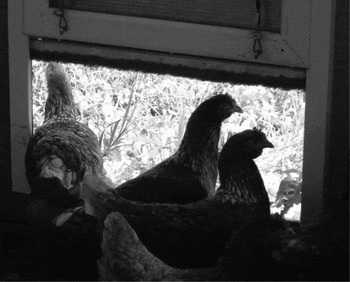
The terms ‘free-range poultry’ and ‘organic poultry’ are commonly used among both consumers and producers of eggs and poultry meat. When it comes to the consumer's perception of ‘free-range’, arguably the vision that ‘free-range’ most often conjures up is one of an unfenced bird, happily hunting and foraging in the grass. Because of the wholesomeness associated with the term ‘organic’, many consumers take for granted that all certified organic poultry kept for meat and eggs are kept outside on green pasture. However, when someone purchases poultry products labelled ‘free range’ or ‘organic’, many of the birds may never have actually seen the light of day or green grass during their entire life. Technically, they simply need a pop-hole leading out of their confinement (Figure 1), but they don't have to necessarily walk through that pop-hole to meet the requirements. The legal requirement for free-range eggs sold in the European Union is that they should be produced by hens that have ‘continuous daytime access to open-air runs mainly covered with vegetation and not used for other purposes except for orchards, woodland and grazing livestock, if the latter is authorised by the competent authorities’ (Commission Regulation 1651/2001). These runs must also satisfy the conditions of Council Directive 1999/74/EC; the stocking density within them must not exceed 2500 hens per hectare and they must not extend beyond a radius of 150 m from the nearest pop hole of the building; the latter dimension can be extended to a maximum of 350 m if a sufficient number of shelters and drinking troughs are provided, evenly distributed throughout the open-air run.
Pop-holes give outdoor access to the birds (N.AG.RE.F. Experimental farm).

The history of poultry production includes a long chapter on pastured poultry. In the past, even the conventional poultry industry kept the birds with outdoor access. Production moved indoors largely because of concerns of high feed intake, mortality due to predators, endo-parasites and disease, poor winter egg output because of lack of light and climate control, but also to allow production on an intensive scale with automated feeding and watering (Fanatico, Reference FANATICO2000; Reference FANATICO2006).
For the purposes of this publication, the term ‘pastured poultry’ is used to include those farmers using the ‘Salatin type’ of moveable pens, or other types such as ‘free-range’, ‘yarding’, ‘outdoor’ or ‘day range’. Thus, our definition is: ‘Poultry kept outside (as the season and daylight hours permit), utilizing a movable or stationary house for secure shelter, feeding, nesting, dust bathing and roosting with constant daytime outdoor access to fresh-growing palatable vegetation’.
The welfare of poultry in pasture-based systems
Animal welfare is a principal concern when setting standards for livestock. For practical purposes, it can be translated into the so-called Five Freedoms (Farm Animal Welfare Council, Reference FARM ANIMAL WELFARE COUNCIL1991). Pastured poultry are widely perceived as being welfare friendly and should therefore comply with all Five Freedoms. Outdoor access provides birds with ample space, fresh air, direct sunlight, and allows them to express natural behaviours such as dust bathing, scratching, foraging, running, flying etc, and can also provide certain nutrients in the pasturage (Fanatico, Reference FANATICO2008a, Reference FANATICO2008b). The first Freedom, from hunger and thirst, is met by properly managing the basic poultry production standards mainly within the house. The Freedom from thermal and physical discomfort is challenging as pasture-based systems face more climatic extremes than intensive controlled environment ones. However, they may also provide more ‘control to the animal by offering a choice when seeking warmth or a cool place to rest (Spoolder, Reference SPOOLDER2007). The Freedom from pain, injury and disease is the most difficult one to achieve, as pastured poultry are not always beak-trimmed although it is still important to prevent feather-pecking and cannibalism. Moreover, birds are more exposed to climatic extremes, wildlife and predation, more at risk of smothering, contracting infectious diseases and prone to endo- and exo-parasitic infestation. The Freedom to express normal behaviour can be met through environmental enrichment and group housing where birds are able to behave naturally. Under appropriate range conditions, birds can show high vigour, firm and strong feather coverage, as well as warm red combs and wattles (Bogdanov, Reference BOGDANOV1997). Birds may show signs of calmness and comfort, such as dust and solar bathing (although sunburn is a risk and shade must be available), stretching wings, beak cleaning and preening. The Freedom from fear and distress is supported by extra (social) space. Stress can be reduced by access to range, small flocks and low stocking density. However, poultry can exhibit fear of open spaces, which is partly why only a minority venture out.
Although pasture-based systems may appear preferable from the welfare point of view to ‘caged’ or ‘barn’ production, the reality of commercial production is often quite different from the image portrayed. It is clear from practical experience that there are a number of potential problems to be addressed and overcome, as listed below:
• Birds kept in large flocks can compromise their welfare. A literature review by Elm Farm Research Centre concluded that ‘many of the birds in free-range poultry production systems do not leave the house’ (O'Brien, Reference O'BRIEN2006). A Danish study of 37 organic free-range egg laying flocks on five farms revealed that, on average, only 9% of the flock used the range and there was considerable variation both within and between flocks. Range use was affected by temperature, weather conditions, season and age (Hegelund et al., Reference HEGELUND, SORENSEN, KJAER and KRISTENSEN2005). Even the birds that do go outside often stay close to their houses since they fear open spaces and lack of suitable shelter can discourage greater freedom of movement in the outdoor areas. Chickens prefer wooded areas, avoid bright sun and either stay close to the house or seek tree cover or other shelter (Sossidou et al., Reference SOSSIDOU, FORTOMARIS, KIPOUROU, ELSON and TSERVENI-GOUSSI2010a). A wide open field is not a preferred habitat (Dawkins et al., Reference DAWKINS, COOK, WHITTINGHAM, MANSELL and HARPER2003). Integrated agro-forestry systems seem to offer a suitable habitat but adequate knowledge of potential health and optimal wellbeing is currently limited (Weerd and Elson, Reference ELSON2009).
• When pasture is not periodically rested, this can reduce access to fresh grass for the birds and increase the risk of diseases and parasitic infestations building up in the soil.
• Feather pecking can be a particular problem in large units and wherever hens crowd into small spaces (the latter can also result in smothering). To minimise this feather and injurious pecking, the majority of hens have their beaks trimmed as young pullet chicks – a mutilation that can be painful and may also prevent the hens from expressing their natural foraging behaviour (Pye-Smith, Reference PYE-SMITH2003).
• High incidence of bone breakage in free range flocks during the production period represents a serious issue which compromises some other apparent welfare benefits. The recently approved three year Bristol University study to explore ways of reducing the incidence of this skeletal damage might lead to alleviation of this problem (Elson, Reference ELSON2009).
• Mortality in free-range flocks is a specific welfare problem that must be addressed if extensive systems of egg production are to remain in use (Elson, Reference ELSON2008). One study showed that mortality can be higher in free-range than caged production (i.e. 15% compared to 4%) (Phelps, Reference PHELPS1991); a more recent large scale European study of 39 well-managed, beak trimmed flocks recorded a mean mortality of 14% in free-range flocks but only 3% in furnished cages (Elson and Croxall, Reference ELSON and CROXALL2006). High mortality can be a consequence of many different factors; the risks of predation, smothering and endo-parasitic infestation leading to increased mortality are greater when birds go outside. Several reports have indicated a broad range of diseases in pasture-based systems e.g. Pasteurella multocida, egg drop syndrome (Adenovirus), E. coli, Brachyspira and Histomonas meleagridis (Black-head). Fowl cholera, caused by P. multocida, may be present in most species of birds, and transmission from wild birds to domestic poultry has been demonstrated. Furthermore, due to outdoor conditions and hens staying at a high density close to the house in large flocks, parasitic diseases are very common. Several studies have shown that all animals are infested by parasites at some stage in their life and that Ascaridia galli, Heterakis gallinarum, Capillaria obsignata and Eimeria spp. are common infestations. Moreover, a specific welfare problem of intensively housed broilers has been found with much greater prevalence and severity in extensive free-range, and especially organically reared broilers. This comes under the term ‘contact dermatitis’ and includes hock burn, breast burn and foot pad dermatitis (Pagazaurtundua and Warriss, Reference PAGAZAURTUNDUA and WARRISS2006).
• Another aspect of pasture poultry mortality is ‘missing’ mortality. A recent study in Denmark has shown that in 18 flocks of intact beaked organic free-range hens, the mean total mortality was over 22 %, of which the average rate for ‘missing mortality’ was 3.4% (Hegelund et al., Reference HEGELUND, SORENSEN and HERMANSEN2006). Most ‘missing mortality’ is thought to be caused by smothering or predation; in either case the carcases may be removed or consumed by wild animals.
Elson (Reference ELSON2008) reported that ‘no single [housing] system is outstandingly superior in all aspects of poultry welfare. Allowing poultry outside access increases their freedom and behavioural repertoire but it is accompanied by greater risks to important aspects of their well-being’.
Management issues in pasture-based systems
The management of range birds is labour intensive and complex due to the uncontrolled environmental conditions. Weather conditions can be a major variable for outdoor operations. The spread of disease is worse for outdoor birds during the times of the year when mosquitoes are active and during wet and rainy conditions. Standing water and runoff from heavy rains can be health hazards for chickens on pasture, especially on heavy land (e.g. clay soils).
Sanitation and isolation are preventative measures to control disease problems. The ‘all-in, all-out’ approach is a useful way to maintain flock health in confined flocks. Under this method, each batch of birds is treated as a unit from the time it arrives on the farm until departure for slaughter. Facilities should be thoroughly cleaned and disinfected between batches of birds. Providing feed, water, shade, and shelter in outdoor areas will encourage more birds to use yards or runs (Fanatico, Reference FANATICO2006). The outdoor run can be made attractive by offering different kinds of shelter (Zeltner and Hirt, 2003; Sossidou et al., Reference SOSSIDOU, FORTOMARIS, KIPOUROU, ELSON and TSERVENI-GOUSSI2010a), such as high grass, bushes and trees (Castellini et al., Reference CASTELLINI, DAL BOSCO and MUGNAI2009a). According to Phillips et al. (Reference PHILLIPS, CINDY and WOLFE2002), the domesticated chicken evolved from a ground-dwelling forest fowl that inhabited forest clearings and woodland edges.
Good pasture management is essential when applying this type of poultry production in order to keep a high status of bird health and welfare (Dal Bosco et al., Reference DAL BOSCO, MUGNAI, SARTI, PERELLA, MOSCATI, BATTISTACCI, FERRANTE and CASTELLINI2009; Castellini et al., Reference CASTELLINI, PERELLA, MUGNAI and DAL BOSCO2006; Mugnai et al., Reference MUGNAI, DAL BOSCO and CASTELLINI2009). The ground has to be kept in good condition in order to provide some forage for the birds at range, to prevent the area from becoming muddy and avoid the problems of poaching and the build-up of parasitic and bacterial populations. Mud can increase fly breeding areas, transmit diseases, creates an unsafe footing and increase polluted runoff. Even when we achieve a good quality sward, the area directly outside the poultry house tends to suffer the greatest amount of damage, due to the intensive foraging and scratching of hens (Sossidou et al., Reference SOSSIDOU, ROSE, HALL and TSERVENI-GOUSSI2010b). Well drained gravel or slatted areas around the outside of pop-holes is good practice. There is on-going research to investigate innovative solutions on the above issues such as the use of composted vegetable waste transformed into valuable added soil medium for free-range laying hens units (Sossidou et al., Reference SOSSIDOU, ROSE and TSERVENI-GOUSSI2006; Sossidou et al., Reference SOSSIDOU, ROSE and TSERVENI-GOUSSI2008b; Sossidou et al., Reference SOSSIDOU, ROSE, HALL and TSERVENI-GOUSSI2010b) or the cultivation of aromatic plants in the pasture area (Kosmidou et al., Reference KOSMIDOU, SOSSIDOU, FORTOMARIS, YANNAKOPOULOS and TSERVENI-GOUSSI2006; Kosmidou et al., Reference KOSMIDOU, SOSSIDOU, FORTOMARIS, YANNAKOPOULOS and TSERVENI-GOUSSI2008). Rotation is key to good management practice. It allows pasture to recover from grazing and reduces the build up of excessive nutrients and pathogens, and birds are moved to new pasture by moving the house or moving the birds to a new yard.
Another frequent cause of problems at range level is that pasture areas are attractive to predators. Foxes, dogs, badgers, mink, buzzards and other birds of prey can also cause damage and death. In addition to direct attacks on the birds, the presence of these predators can cause panic and smothering in the flock.
No matter how good the design, without a skilled and knowledgeable stock person looking after the broilers or laying hens, bird welfare and performance are never likely to reach the highest standard. Routine husbandry includes some of the most important tasks such as inspection and culling, interventions to minimise feather pecking, disposal of dead birds, handling and moving birds, feeding and watering birds, collecting floor eggs and record keeping. Good health and welfare status can be achieved through a high standard of animal husbandry, effective management, adequate housing, well-maintained equipment and a good flock health plan. The knowledge to attain such a standard of welfare is available as well as how conditions may be achieved to meet appropriate requirements (Sossidou et al., Reference SOSSIDOU, STAMATIS, GEERS and SZÜCS2008a; Szücs et al., Reference SZÜCS, GEERS and SOSSIDOU2009).
Poultry genetics for pasture-based poultry production systems
The right choice of genotype is important in both outdoor poultry meat and egg production. By way of definition, fast-growing, meat birds are used in conventional production and were selected for environmentally-controlled housing; fast-growing broilers reach market weight within about six weeks. However, slow- and medium-growing genotypes may be more adapted for specialty production, including free-range and organic, which use open housing where temperature fluctuations occur and access to the outdoors. Slow-growing birds take about twelve weeks to grow, and medium-growing genotypes take nine to eleven weeks to grow.
Indeed, the recommendations for organic production of poultry and especially those related to the presence of grassland and to the use of slow-growing breeds seem to be of greater concern to animal welfare compared to the compulsory rules (Castellini et al., Reference CASTELLINI, BERRI, LE BIHAN-DUVAL and MARTINO2008; Castellini et al., Reference CASTELLINI, DAL BOSCO and MUGNAI2009a). Several authors emphasise the role of genotype in welfare problems (Castellini et al., Reference CASTELLINI, MUGNAI and DAL BOSCO2002a; 2002b; 2002c; Bessei, Reference BESSEI2006; Duncan, Reference DUNCAN2004; Mench, Reference MENCH2004). Keeping commercial breeds under free-range conditions reduced, but did not eliminate lameness, though selective breeding for slower growth reduced lameness almost to zero (Kestin et al., Reference KESTIN, SU and SØRENSEN1999).
Slow-growing strains in comparison with fast-growing ones also showed more active behaviour, fewer heart abnormalities, less tendon degeneration (Bokkers and Koene, Reference BOKKERS and KOENE2003), lower mortality, lower culling rate (Castellini et al., Reference CASTELLINI, DAL BOSCO, MUGNAI and BERNARDINI2002b) and ascites. In agreement with the papers mentioned in the previous paragraph, Lewis et al. (Reference LEWIS, PERRY, FARMER and PATTERSON1997) observed that genetic selection of animals for a faster growth rate modified their behaviour, reducing kinetic activity. Weeks et al. (Reference WEEKS, NICOL, SHERWIN and KESTIN1994), using fast-growing broilers, showed that free-range birds made little use of pasture and tended to stay indoors and/or near the house, rather than foraging in the pasture due to leg weakness, which prevented the birds from pasturing and behaving naturally. Castellini et al. (Reference CASTELLINI, DAL BOSCO, MUGNAI and BERNARDINI2002b) compared performance and behaviour of three different chicken strains, reared according to the EEC-Regulation 1804/1999 organic system. The strains had very slow (Robusta maculata), slow (Kabir) and fast (Ross) growing rates, respectively. Robusta maculata and Kabir chickens showed more intense walking activity and better foraging aptitude and their antioxidant capacity was also superior. Ross chickens had a high growth rate and feed conversion index, reaching a very high body weight, but the mortality and the culling rate were high indicating that fast-growing strains do not adapt well to organic production. In a study aimed to evaluate the kinetics activity of chicken genotypes reared under organic conditions, Castellini et al. (Reference CASTELLINI, MUGNAI and DAL BOSCO2009b) and Dal Bosco et al. (Reference DAL BOSCO, MUGNAI, ZAMPARINI, SIRRI and CASTELLINI2010a) compared behavioural observations and showed that slow-growing chickens covered an average daily distance of 1,130 m, while fast-growing ones walked only 220 m.
Comparative analysis of the crop contents showed different feeding behaviours among different strains, although it is difficult to precisely estimate chick ingestion, because the more fibrous particles tend to move more slowly toward the proventriculus and gizzard. In particular the crop contents of slow-growing birds had less protein and energy and higher amounts of α-tocopherol and carotenoids, indicating higher grass ingestion (Castellini et al., Reference CASTELLINI, DAL BOSCO, MUGNAI and BERNARDINI2002b). Such difference in foraging behaviour agree with the statement of Appleby et al. (Reference APPLEBY, HUGHES and ELSON1992), who display that free-range conditions allow poultry, mainly from slow-growing strains, to express not only species-specific behaviour, but also their innate ability to provide for their own nutritional requirements.
In order to improve animal biodiversity, adaptability and rusticity of chickens destined to pasture based systems and to improve performance, crossbreeding could be a suitable strategy for the preservation of some autochthonous breeds. Dal Bosco et al. (Reference DAL BOSCO, MUGNAI and CASTELLINI2010b) compared performance and meat quality of pure (Ancona) and crossbred (Cornish x Ancona) chicks organically reared and concluded that crossbreed chickens with respect to purebred ones showed higher performance and almost similar meat characteristics and could be a suitable compromise between the diffusion of a local breed and the economical sustainability of their raising.
In commercial laying hen production, the choice of genotype is important for optimum welfare as well as performance since growing pullets and laying hens kept in loose housed, free range conditions are at risk from feather pecking and cannibalism (Bessei, Reference BESSEI1984; Kjaer and Sørensen, Reference KJAER and SØRENSEN1997; Rodenburg et al., Reference RODENBURG, BUITENHUIS, ASK, UITDEHAAG, KOENE, VAN DER POEL and BOVENHUIS2003; Rodenburg et al., Reference RODENBURG, VAN HIERDEN, BUITENHUIS, RIEDSTRA, KOENE, KORTE, VAN DER POEL, GROOTHUIS and BLOKHUIS2004). The local market usually dictates the colour of egg required, which in turn will decide the range of possible breeds or hybrids available. Within these, some will be more prone to feather and injurious pecking than others. The choice is particularly important in countries and organisations where beak trimming is banned. Uitdehaag et al. (Reference UITDEHAAG, KOMEN, RODENBURG, KEMP and VAN ARENDONK2008) compared six pure lines from a Rhode Island Red origin (brown egg layers) and six pure lines from a White Leghorn origin (white egg layers) and found a consistent difference in feather damage between the two origins. White Leghorn lines had more feather damage than Rhode Island Red lines. These line differences can be used to breed laying hens with a reduced propensity to develop feather pecking and cannibalism. It would be useful to further study the causation of feather pecking in these different lines, and study whether birds that are active and show high levels of foraging at young age develop more feather pecking as adults (Newberry et al., Reference NEWBERRY, KEELING, ESTEVEZ and BILCIK2007).
Sustainability in pasture-based systems
The term ‘sustainable agriculture’ refers to an integrated system of plant and animal production practices that contributes to satisfy human food needs, to enhance environmental quality by making the most efficient use of non-renewable resources and, thus, to sustain the economic viability of farm operations. The basic outcome of sustainable agriculture is the preservation of global resources as well as the promotion of farmers’ quality of life and of society welfare as a whole. Referring to different views within society, the Report of the UN's Brundtland Commission entitled ‘Our Common Future’ published in 1987 alerted the World to the urgency of making progress toward economic development that could be sustained without depleting natural resources or harming the environment. The report provided a key statement on sustainable development, defining it as ‘development that meets the needs of the present without compromising the ability of future generations to meet their own needs’.
According to the definition given by the DEFRA (Reference DEFRA2001), ‘pastured poultry is a sustainable livestock production system that integrates well with other farm enterprises and can help keep more family farmers on their land’. However, recent studies investigating mechanisms to minimise the ‘carbon footprint’ of an enterprise indicate that intensive poultry production can be more sustainable on that respect than extensive methods. Studies at Cranfield University in the UK concluded that ‘intensively (housed) poultry production has much less impact on global warming than organic or free-range production (Sluis, Reference SLUIS2007).
Environmental benefits
Research along with the observations of many producers, suggest that birds and pasture offer mutual benefits. Planting diverse forages that improve soil quality by fixing nitrogen or adding organic matter makes good sense, even though poultry producers sometimes debate how much grass or other forage meat birds and layers actually eat, and how much benefit they get from it (Berton and Mudd, Reference BERTON and MUDD2009). Poultry can do a lot to remedy problem soil and control both insect pests and weeds while creating a new revenue stream for the farm. Poultry that are free to roam can act as miniature manure spreaders that fertilise the soil provided they range well over the land. They turn and mix soil and manure as they scratch for insects and worms, increasing organic matter and improving fertility (Berton and Mudd, Reference BERTON and MUDD2009).
Furthermore, poultry can be integrated with other species in a ‘diversified system’. Diversified systems focus on services that poultry can provide, such as fertilisation, tillage, and insect and weed control rather than only egg or poultry meat production (Gordon et al., Reference GORDON, BHOGAL and WALKER2002; Miao et al., Reference MIAO, GLATZ, RU, WYATT and RODDA2005). A concept called ‘stacking’ combines several enterprises on the same piece of ground. Various species of domestic animals can be kept together to complement each other, creating mutually beneficial relationships although care must be taken to ensure that certain endo-parasites do not start their lifecycle in one species and complete it in another. Diversified farming is an important part of sustainable agriculture, and poultry can be integrated with livestock, crop, and vegetable production in ‘permaculture’ systems that integrate principles of natural systems with agriculture (Fanatico, Reference FANATICO2006).
Economic benefits
Pastured poultry is a niche market that taps into increased consumer demand for more natural and humanely raised protein sources. Consumers demanding this type of poultry product are generally willing to pay more for the system, which includes raising poultry on pasture to deliver a product that is considered by many consumers to be healthier and tastier, as well as more environmentally sound (Mitchell, Reference MITCHELL2000; Andersen, Reference ANDERSEN2005). Pastured poultry production generally has lower entry costs and thus is attractive to smaller or limited resource farmers.
SARE-funded researchers at Wisconsin's Centre for Integrated Systems (CIAS) studied five farms that raise boilers on pasture and found that the systems, while highly variable, yielded a significant profit for broiler growers on diversified farms. Employing a pastured poultry model and moving pens containing 75 broiler chickens once each day brought the farmers, on average, a net return of $2.43 per bird. Researchers found a wide range, however – varying from -$2.82 to $7.05 – depending on feed costs, experience and whether producers strove for profit as a primary goal (Berton and Mudd, Reference BERTON and MUDD2009).
Summarising the results of 35 farm families who, from 1996-1999, participated in a project titled ‘Integrating Pastured Poultry into the Farming Systems or Limited Resource Farmers’ the experience proved favourable for 27 of the project families (Fanatico, Reference FANATICO2006).
A good example showing the economic benefits deriving from a pastured-poultry system is the Label Rouge program in France. It began 40 years ago as a grassroots movement led by visionary farmers. As poultry became more industrialised after World War II, demand grew in France for the taste of traditionally kept farm chickens. The Label Rouge bird's performance has been ‘stunning’ and now accounts for 30% of poultry sales to the public, in spite of its high price – which is twice the price of conventional poultry. This program provides premium products to consumers, increases farmer income, and strengthens rural development.
Social benefits
There are many social benefits of raising pastured poultry, such as family work ethics, community involvement and improving lifestyles. This alternative enterprise fits with the farmers desire to live on the farm and to be self-sufficient and self-directed, in other words the willing of farmers to raise their own good quality food, including vegetables, knowing the inputs used. Family poultry are also valued in religious and socio-cultural lives. Strengthening communities is another benefit of pastured poultry extensive systems in certain areas and countries and can result from community work that may be shared e.g. in moving pens, bird processing, and word of mouth marketing. Although requiring some lower resource inputs and generally considered secondary to other agricultural activities by smallholder farmers, this type of production has an important contribution in supplying local populations with additional income (Sossidou et al., Reference SOSSIDOU, FORTOMARIS, DIMOVELIS, YANNAKOPOULOS and TSERVENI-GOUSSI2008c).
Conclusions
Pastured-poultry production is growing in some countries due to good consumer demand at premium prices and environmental, economical and social benefits for farmers. It is a fairly sustainable livestock production system that can integrate well with other farm enterprises. There are many reasons for keeping pastured poultry, such as improving pasture fertility, increasing farm diversity, family work ethics, community involvement and improving lifestyles in some areas.
Good pasture and livestock management are key issues to maintain health and welfare standards in the pasture-based systems. Some serious welfare issues such as higher mortality and greater rates of contact dermatitis and skeletal damage in organic and free-range systems still have to be addressed. Also, difficult working conditions and lack of automation especially in small scale enterprises can be disadvantages in extensive systems. The risks to poultry wellbeing are likely to increase if and when more birds are encouraged outside.