Introduction
Sketching is a natural and intuitive means of communication for expressing a concept or an idea. A sketch may serve several purposes: it can be used as a support tool for problem-solving, it might record something that a person sees, it can be a way of storytelling as a part of human interaction, or it can be used for developing ideas at any stage of a design process. Thus, sketching is seen as a method for creativity and problem-solving and is considered to be central to the design-oriented disciplines of architecture, engineering, and visual communication (Craft and Cairns, Reference Craft and Cairns2009). In order to assess the effectiveness of sketching, researchers conducted experiments using applications in areas, such as industrial design (Schütze et al., Reference Schütze, Sachse and Römer2003; Lugt, Reference Lugt2002), route planning (Heiser et al., Reference Heiser, Tversky, Silverman, Gero, Tversky and Knight2004), and interface design (Landay and Myers, Reference Landay and Myers1995). These studies demonstrate that participants who are allowed to sketch freely during the experiment are able to design products which have better functionality while experiencing fewer difficulties in the design process (Schütze et al., Reference Schütze, Sachse and Römer2003). Moreover, when compared to note taking, the act of sketching offers better support to individual re-interpretative cycles of idea generation and enhances individual and group access to earlier ideas (Lugt, Reference Lugt2002). In route design, sketching is shown to enhance collaboration, with users who are allowed to use sketches designing more efficient routes in less time, demonstrating the ability of sketches to focus attention and provide easy communication between groups (Heiser et al., Reference Heiser, Tversky, Silverman, Gero, Tversky and Knight2004). Moreover, in interface design, sketching has been shown to aid the evaluation and formation of ideas, allowing designers to focus on the larger conceptual issues rather than trivial issues such as fonts or alignment of objects (Landay and Myers, Reference Landay and Myers1995).
The intuitive and communicative nature of sketches has brought the act of sketching to the attention of human–computer interface designers who focus on developing intuitive interfaces. Sketch-based interfaces have the potential to combine the processing power of computers with the benefits of the creative and unrestricted nature of sketches. However, realizing this potential requires combining efforts from several research areas, including computer graphics, machine learning, and sketch recognition. Sketch recognition has many challenges that arise from the computational difficulties of processing the output of the highly individual and personal task of sketching, requiring algorithms that can overcome the ambiguity and variability of the sketch. An effective sketch recognition method should be able to recognize freehand drawings, created on any surface and with any material. Achieving high recognition rates that meet these constraints remains a challenge.
This paper builds on the discussions which took place during a three-day workshop held at the University of Malta in March 2018. This workshop brought together researchers with experience in sketch interpretation, sketch-based retrieval, sketch interactions in virtual and augmented reality (VR/AR) interfaces, and non-photorealistic rendering (NPR). Although these research areas are often discussed independently, they complement each other: natural interfaces in augmented reality systems allow for the exploration of concepts in collaborative design. Interpretation of drawings made in physical or digital ink also focuses on natural interfaces, albeit in two-dimensional (2D) digital or paper drawings. Thus, seeking common grounds between these two research areas allow for the integration of different sketching modalities in conjunction with augmented reality rendering. To such a synergy, research in three-dimensional (3D) object search makes it possible to integrate library searching of object parts within the augmented reality environment. The object simplification through NPR is then particularly useful in this context to search for specific parts. This paper presents the position taken by the participants after this workshop. In the paper, we take a broad view and look into the interpretation problem in diverse contexts, for example, in the context of 3D modeling, sketch-based retrieval, multimodal interaction, VR and AR interfaces. Conclusions reached in this paper are a result of the discussions which took place during the workshop and reflect not only the authors' opinions but also the insights brought into the workshop by practicing manufacturing engineers and architectural designers who were also present at the workshop.
The rest of the paper is divided as follows: the section “State of the art in sketch interpretation and modeling” provides a review of the state of the art in sketch interpretation and sketch-based modeling algorithms, the section “Future directions” discusses open challenges and future directions that should be addressed to improve the practicality of these systems, while the section “Conclusion” concludes the paper.
State of the art in sketch interpretation and modeling
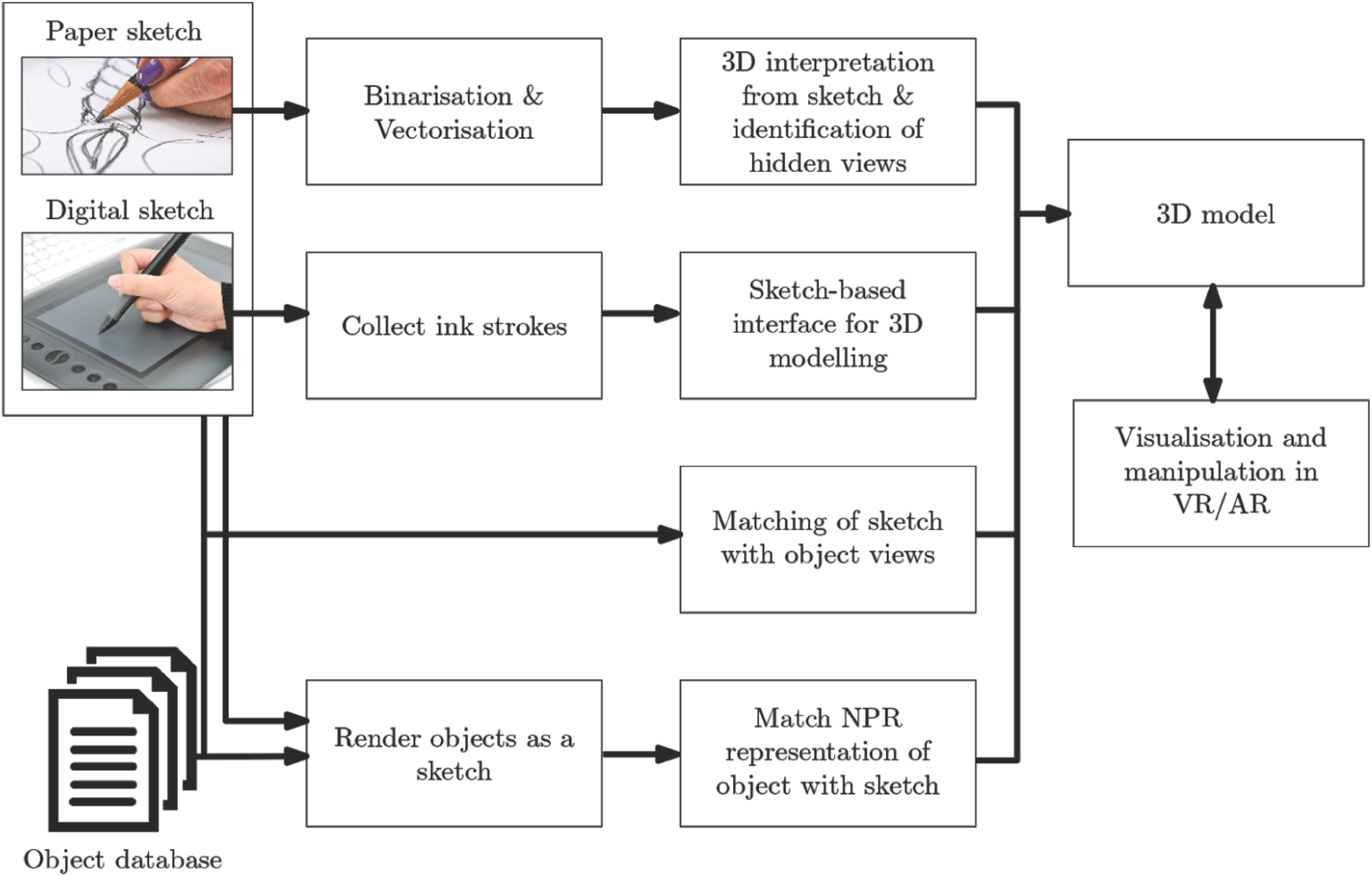
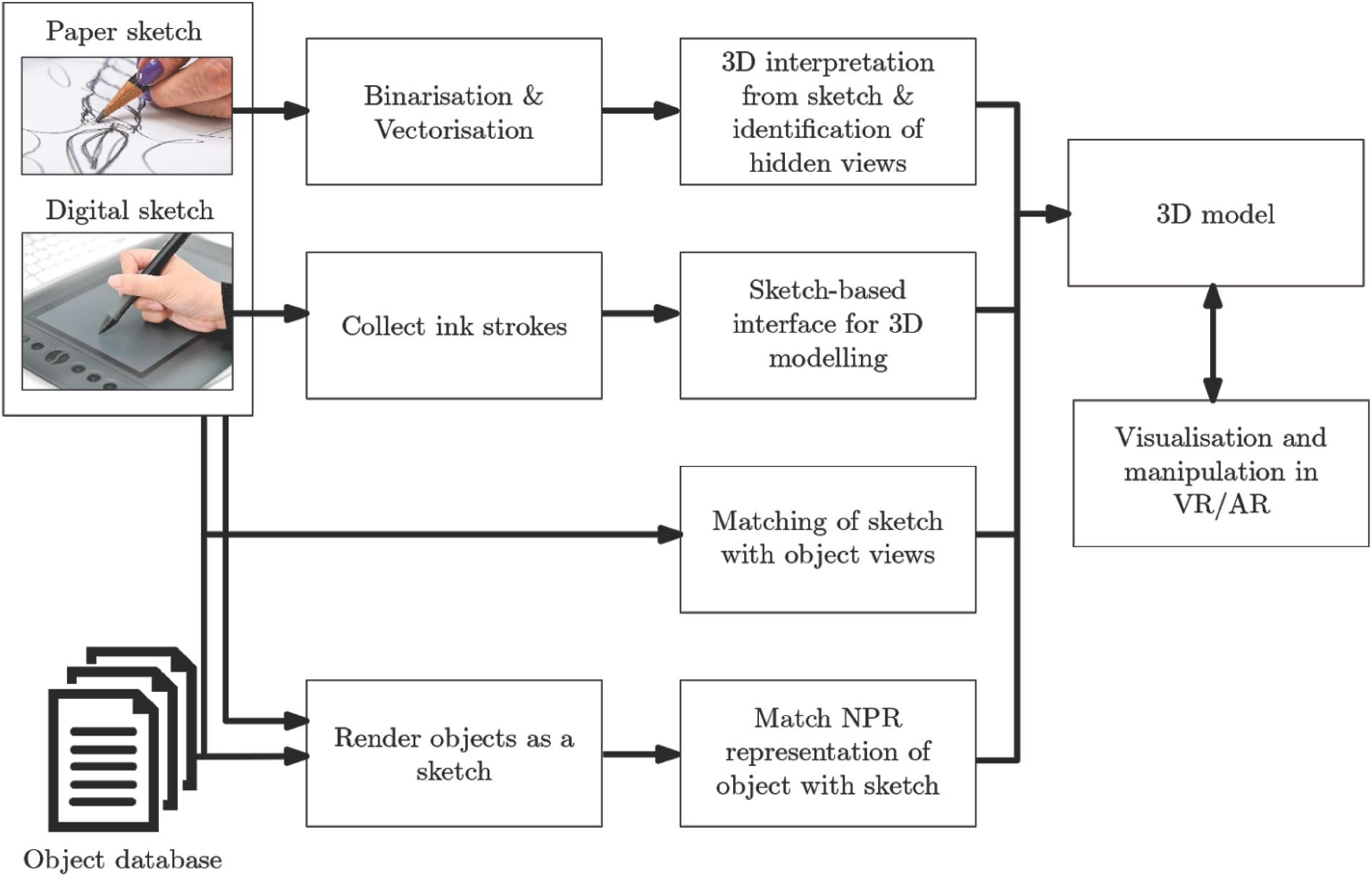
Machine interpretation of drawings dates back to as early as the 1960s with the development of algorithms able to interpret blueprints and cadastral maps to automate the digitization process of such drawings (Ablameyko and Pridmore, Reference Ablameyko, Pridmore, Ablameyko and Pridmore2000), branching quickly into the interpretation of drawings as 3D objects (Clowes, Reference Clowes1971; Huffman, Reference Huffman1971). Research in sketch interpretation remains active through attempts to relax drawing constraints as well as the development of different technologies which changed the way people draw. Figure 1 illustrates the different sketch interactions which will be discussed in this paper. The section “Interpretation of offline sketches” describes the processing steps to obtain 3D models from paper-based sketches. The section “Interactive sketches” describes the interactive interfaces which require digital sketching. The section “Sketch-based shape retrieval” describes sketch-based retrieval approaches which can compare the sketch directly to some 3D object database or to a sketched rendering of the object. Finally, the section “Beyond the single-user, single-sketch applications” describes sketching interactions in VR and AR which can be used to either manipulate a premade 3D object or create a fresh 3D object within the VR/AR environment.
An overview of the different sketch interaction modes discussed in this paper.
Interpretation of offline sketches
In its most primitive form, a sketch captures fleeting ideas (Eissen and Steur, Reference Eissen and Steur2007). The sketch may, therefore, be incomplete and inaccurate, but the ability to explain abstract concepts through drawings makes the sketch a powerful means of communication (Olsen et al., Reference Olsen, Samavati, Sousa and Jorge2008). Notwithstanding the strengths of pen-and-paper sketching, the sketch serves only as an initial working document. Once a concept is sufficiently developed, initial sketches are redrawn using computer-aided design (CAD) tools to obtain blueprints for prototyping (Cook and Agah, Reference Cook and Agah2009) or to benefit from VR or AR interactions with the product. Despite the effectiveness and ability of CAD tools to handle complex objects, these tools have a steep learning curve for novice users and even experienced designers spend a considerable amount of time and energy using these CAD tools. Ideally, the conversion from paper-based sketches to a working CAD model is achieved without requiring any redrawing of the sketch. The machine interpretation of paper-based drawings may be loosely divided into three steps, namely distinguishing ink marks from the background through binarization; representing the ink strokes in vector form; and obtaining shape information from the drawing to change the flat drawing into a 3D working model.
Image binarization
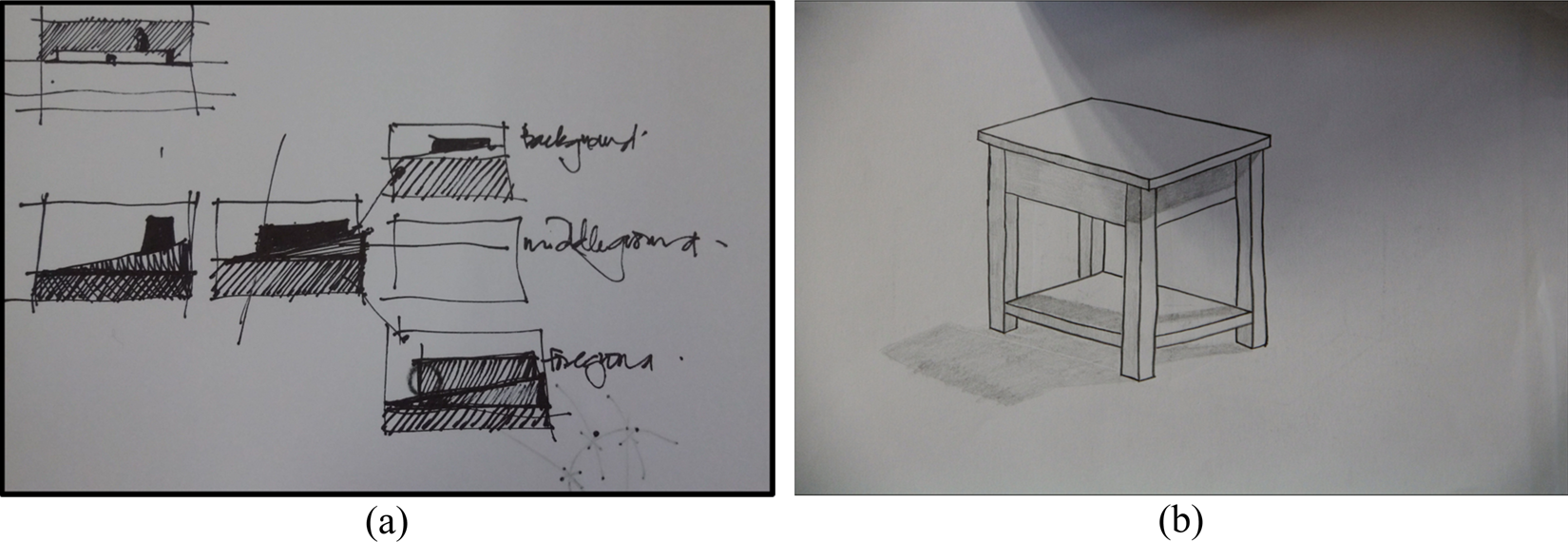
Off-the-shelf binarization algorithms, such as Otsu's or Chow and Kaneko's algorithms (Szeliski, Reference Szeliski2010), provide a suitable foreground to background separation when drawings are drawn on plain paper and scanned. However, problems arise with the introduction of textured paper, such as ruled or graph paper, bleed-through from previous drawings, as illustrated in Figure 2a and even variable illumination, as illustrated in Figure 2b. Thus, binarization algorithms need to be robust to these gray-level artifacts, leading to more robust binarization algorithms such as Lins et al. (Reference Lins, de Almeida, Bernardino, Jesus and Oliveira2017), among others.
(a) A pen-based sketch with bleed-through (drawing provided by Stephen C. Spiteri). (b) A pencil sketch showing variable illumination.
Vectorization
Once the ink strokes are distinguished from the image foreground, vectorization is applied to allow the ink strokes to be redrawn under the CAD environment (Tombre et al., Reference Tombre, Ah-Soon, Dosch, Masini, Tabbone, Chhabra and Dori2000). The focus here lies in the accurate representation of the topology of the ink strokes, paying particular attention to preserve an accurate representation of junction points (Katz and Pizer, Reference Katz and Pizer2004). Skeletonization algorithms, which remove pixels contributing to the width of the ink strokes while retaining the pixels which contribute to the medial-axis of strokes, are a natural first step toward vectorization (Tombre et al., Reference Tombre, Ah-Soon, Dosch, Masini, Tabbone, Chhabra and Dori2000). However, skeletonization produces spurious line segments, especially if the ink strokes are not smooth. Thus, skeletonization algorithms rely heavily on beautification and line fitting of the skeletal lines (Hilaire and Tombre, Reference Hilaire and Tombre2006). Alternatively, rather than attempt to correct the spurs created through skeletonization, the medial-axis may be obtained through matching pairs of opposite contours (Ramel et al., Reference Ramel, Vincent, Emptoz, Blostein and Kwon1998) or horizontal and vertical run lengths (Keysers and Breuel, Reference Keysers and Breuel2006). All of these algorithms require visiting each pixel in the image to determine whether it forms part of the medial-axis. Line strokes can, however, be approximated as piecewise linear segments, and thus, it is possible to reduce the computational costs for locating the medial-axis by adopting a sampling approach (Dori and Wenyin, Reference Dori and Wenyin1999; Song et al., Reference Song, Su, Chen, Tai and Cai2002). These sampling approaches then rely on heuristics to propagate the sampler through the stroke and attempt to propagate the line for its entirety, beyond the junction point.
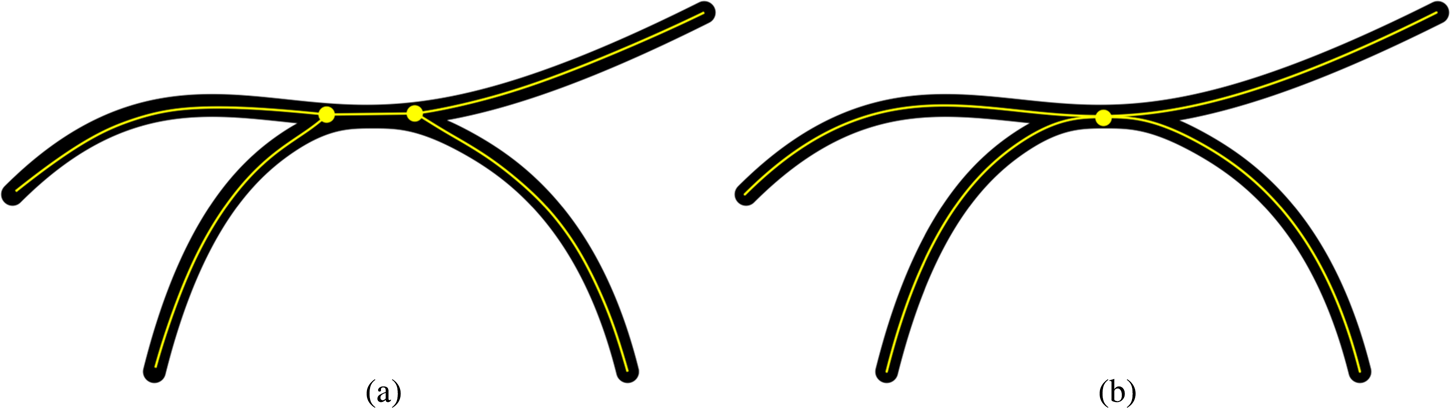
Junction points, however, have an essential role in the interpretation of the drawing, and thus, if the vectorization does not find the junction locations directly, these are often estimated from the intersection points of lines (Ramel et al., Reference Ramel, Vincent, Emptoz, Blostein and Kwon1998). This approach, while suitable for neat, machine-generated line drawings, is not suitable for human sketches which are typically drawn sloppily with poorly located junctions (Ros and Thomas, Reference Ros and Thomas2002) as illustrated in Figure 3. Moreover, these algorithms typically assume that the drawings consist predominantly of straight lines and circular arcs. Problems arise when this assumption is relaxed to include a larger variety of smooth curves, which allows for drawings with more natural surfaces, as illustrated in Figure 4. Recent vectorization algorithms shifted the focus from the location of lines to the localization of junction points, borrowing from computer vision approaches of finding corners in natural images but adapting this to sketched drawings. Notably, Chen et al. (Reference Chen, Lei, Miao and Peng2015) use a polar curve to determine the number of branches at a potential junction point, hence establishing the junction order as well as locating the junction position. Noris et al. (Reference Noris, Hornung, Sumner, Simmons and Gross2013), Pham et al. (Reference Pham, Delalandre, Barrat and Ramel2014), Favreau et al. (Reference Favreau, Lafarge and Bousseau2016), and Bessmeltsev and Solomon (Reference Bessmeltsev and Solomon2019) characterize the topology of junctions typically found in sketches, describing the different possible points of contact between the central lines of two strokes at every junction, while Bonnici et al. (Reference Bonnici, Bugeja and Azzopardi2018) use Gabor-like filters to first roughly localize junctions, and then refine the junction position and topology by focusing only on the image area around the junction.
Lines do not necessarily intersect accurately at a junction point.
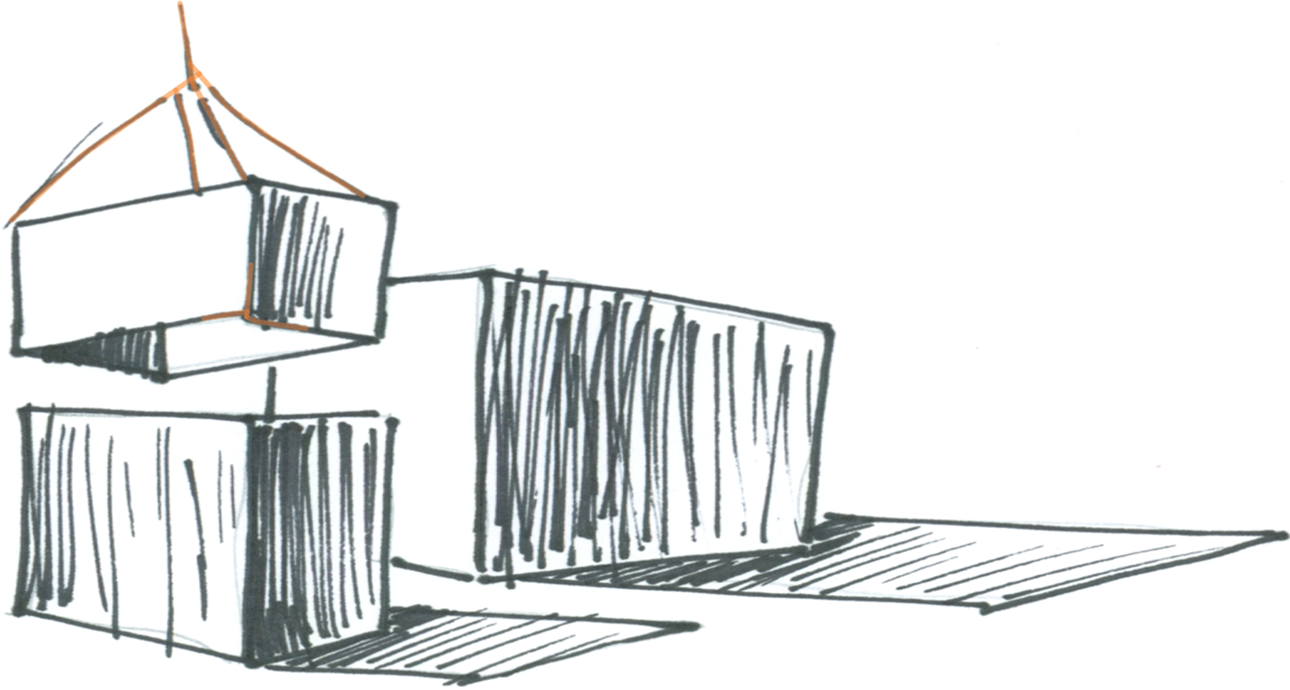
The two smooth curves are badly represented by two junction points in (a) rather than the single tangential point of intersection as in (b).

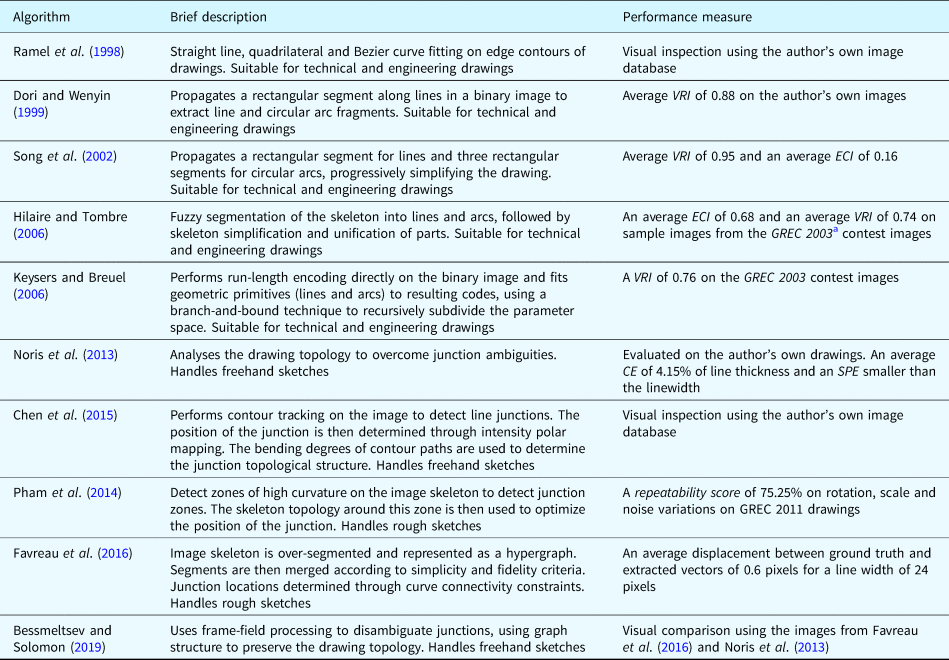
Table 1 provides an overview of the vectorization algorithms discussed and their performance. We note that the evaluation of vectorization algorithms does not follow a standardized procedure, and there are four metrics described in the literature. The edit cost index (ECI) which is the weighted average of the number of false alarms, the number of misses, the number of fragmented ground-truth vectors, and the number of individual ground-truth vectors grouped into a single vector (Chhabra and Phillips, Reference Chhabra and Phillips1998). This measure, therefore, assesses the number of corrections to the vector data that the user must perform to correct any algorithmic errors. Dori and Wenyin (Reference Dori and Wenyin1999) introduce the vector recovery index (VRI) which gives a measure of the similarity between the extracted vectors and the ground-truth vectors, taking into account the overlap between vectors, fragmentation and merging of vectors. Noris et al. (Reference Noris, Hornung, Sumner, Simmons and Gross2013) later introduce two alternative metrics. The centerline error (CE) measures the shift in the detected centerline position from ground-truth centerline as a ratio of the line thickness, while the salient point error (SPE) measures the distance between the detected junction points and the ground-truth junction points as a percentage of the line width.
Comparison of vectorization algorithms listing a brief description of the algorithms and their performance
Moving away from traditional preprocessing required for vectorization techniques, Simo-Serra et al. (Reference Simo-Serra, Iizuka, Sasaki and Ishikawa2016) employ a fully convolutional neural network (CNN) to change a rough sketch into a simplified, single-line drawing. The CNN is designed to have three parts. First, an encoded spatially compresses the image. The second step then extracts the essential lines from the image, while the third step acts as a decoder and converts the simplified representation into a gray scale image of the same resolution as the input. The CNN is trained using pairs of rough and simplified sketches, with the rough sketches being generated through an inverse reconstruction process, that is, given a simplified sketched drawing, the artist is asked to make a rough version of the sketch by drawing over it. Data augmentation is then used to introduce tonal variety, image blur and noise, thus increasing the drawing pairs. Similarly, Li et al. (Reference Li, Liu and Wong2017) apply CNNs to extract structural lines from manga images. Here, a deeper network structure is used to overcome the patterned regions of the manga. The use of CNNs can, therefore, provide the necessary preprocessing to allow for the extraction of line vectors from rough sketches exhibiting over-sketching, as well as textures typical of shading strokes.
Interpretation
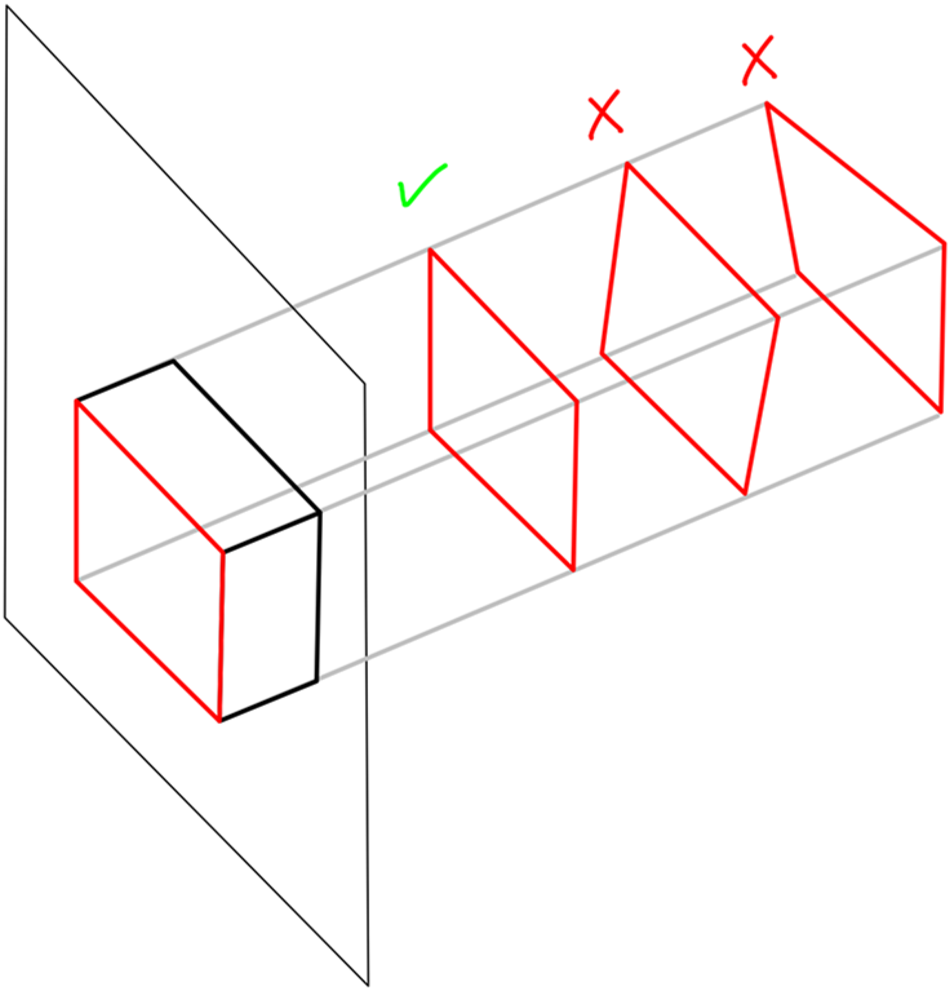
Once vectorized, the sketch can be rewritten in a format which is compatible with CAD-based software such as 3DMaxFootnote 1 among many others. These drawings remain, however, flat 2D drawings and obtaining the desired sketch-to-3D interpretation requires further drawing interpretation. The problem of assigning depth to a drawing is not a trivial task due to the inherent ambiguity in the drawing (Lipson and Shpitalni, Reference Lipson and Shpitalni2007; Liu et al., Reference Liu, Chen and Tang2011). Edge labeling algorithms, such as those described in Clowes (Reference Clowes1971), Huffman (Reference Huffman1971), Waltz (Reference Waltz and Winston1975), and Cooper (Reference Cooper2008) among others, determine the general geometry of the edge, that is, whether an edge is concave, convex, or occluding. These algorithms define a junction as the intersection of three or four edges, creating a catalog of all possible junction geometries. The catalog of junctions is used as a look-up table to recover the 3D structure from the drawing. Although this approach is effective, its main drawback lies in the intensive computation to search and manage the junction catalog. Moreover, specifying the geometry alone is not sufficient for the formation of the 3D shape since there may be numerous 3D inflations of the sketch which satisfy this geometry. Thus, optimization-based methods, such as those described in Lipson and Shpitalni (Reference Lipson and Shpitalni2007) and Liu et al. (Reference Liu, Chen and Tang2011), use shape regularities, such as orthogonality and parallel edges, to obtain a 3D inflation which closely matches the human interpretation of the drawing as illustrated in Figure 5. Alternatively, the initial inflation can make use of perspective or projective geometries, for example, by locating vanishing points to estimate the projection center, then using camera calibration techniques to estimate the 3D geometry (Mitani et al., Reference Mitani, Suzuki, Kimura, Cugini and W ozny2002).
A 2D drawing may have several 3D inflations. Optimization algorithms based on heuristic regularities, such as orthogonality and parallel edges, may be used to prune out unlikely interpretations.
The problem remains in deducing the hidden, unsketched part of the drawing. Algorithms, such as that described in Ros and Thomas (Reference Ros and Thomas2002), obtain the full 3D structure by solving planar equations of the object surfaces and assume that a wireframe drawing of the object is available. However, when people sketch, they typically draw only the visible part of the object such that the wireframe drawing is not always readily available. Moreover, our visual understanding of sketches allows us to infer the hidden parts of the drawing without too much effort (Cao et al., Reference Cao, Liu and Tang2008).
Identification of hidden sketch topology typically starts from the geometric information held within the visible, sketched parts. In general, several plausible connections between the existing, visible vertices in the drawing are created to obtain a reasonable, initial wireframe representation of the drawing. This initial representation is then modified by breaking links, introducing new vertex nodes to merge two existing edge branches, or introducing new edge branches to link two otherwise disconnected vertices (Cao et al., Reference Cao, Liu and Tang2008; Varley, Reference Varley2009). These modifications are carried out in such a way that the final hidden topology satisfies some heuristics, mainly based on human perception principles, such as the similarity between the hidden faces and visible faces (Cao et al., Reference Cao, Liu and Tang2008), retaining collinear and parallel relationships, and minimizing the number of vertices in the topology (Kyratzi and Sapidis, Reference Kyratzi and Sapidis2009). An exhaustive exploration of all the possibilities with which the visible vertices can be combined to form the hidden topology remains a problem. Kyratzi and Sapidis (Reference Kyratzi and Sapidis2009) resolve this problem by adopting graph-theoretical ideas, allowing for multiple hypotheses of the hidden topology to exist in the branches of the tree structure.
The main limitation in the interpretation of paper-based sketched drawings remains that of the accuracy of the drawing. Misrepresentation of a junction point will result in a bad match between the sketched junction and the cataloged junctions which in turn results in incorrect geometry labels. This error will then propagate to the sketch inflation and estimation of the hidden viewpoints. Human interpretation of a 3D shape from sketches can, however, tolerate considerable variations from the true geometric form. Moreover, the geometric constraints used in the creation of depth from drawings may not fully represent the human ability of understanding the shape from sketches. Learning-based approaches may, therefore, be more suited to this task. Lun et al. (Reference Lun, Gadelha, Kalogerakis, Maji and Wang2017) consider such an approach, using deep networks to translate line drawings into 2D images representing the surface depth and normal from one or more viewpoints. A 3D point cloud is generated from these predictions, following which a polygon mesh is formed. Although the architecture proposed by Lun et al. (Reference Lun, Gadelha, Kalogerakis, Maji and Wang2017) can be trained to provide a reconstruction from a single viewpoint, the network architecture does not obtain sufficient information from this single viewpoint to reconstruct the 3D shape accurately. Lun et al. (Reference Lun, Gadelha, Kalogerakis, Maji and Wang2017) propose to allow users to introduce viewpoints interactively, bridging the gap between offline interpretation techniques and interactive sketching.
The interpretation of offline sketches, therefore, relies on the ability of the vectorization algorithms to extract the lines and junctions that form the drawing topology as well as the interpretation algorithms that convert the 2D drawing into its 3D geometry. Perhaps the most difficult task of the vectorization algorithms lies in the identification of the line strokes and junction locations when presented with rough sketches consisting of overtracing and scribbling. While the most recent literature, particularly the works proposed by Pham et al. (Reference Pham, Delalandre, Barrat and Ramel2014) and Favreau et al. (Reference Favreau, Lafarge and Bousseau2016), allows for some degree of roughness in the drawing, vectorization algorithms need to be robust to a greater degree of scribbling and incomplete drawings if these algorithms are to be useful for an early-stage design.
The interpretation algorithms which add depth to the 2D drawing also need to become more robust to drawing errors which can be introduced due to the quick manner with which initial sketches are drawn. While learning approaches, such as that described in Lun et al. (Reference Lun, Gadelha, Kalogerakis, Maji and Wang2017), can relax the need for strict adherence to correct geometry, a compromise between learning wrong interpretations of a junction geometry and the possibility of handling badly drawn junctions needs to be reached. The algorithms must, therefore, be able to learn the broader context in which the junction is being interpreted. Human artists resolve ambiguities through the use of artistic cues such as shadows and line weights. Thus, learning-based algorithms could also include the interpretation of these cues when gathering evidence on the geometric form of the sketched object.
Interactive sketches
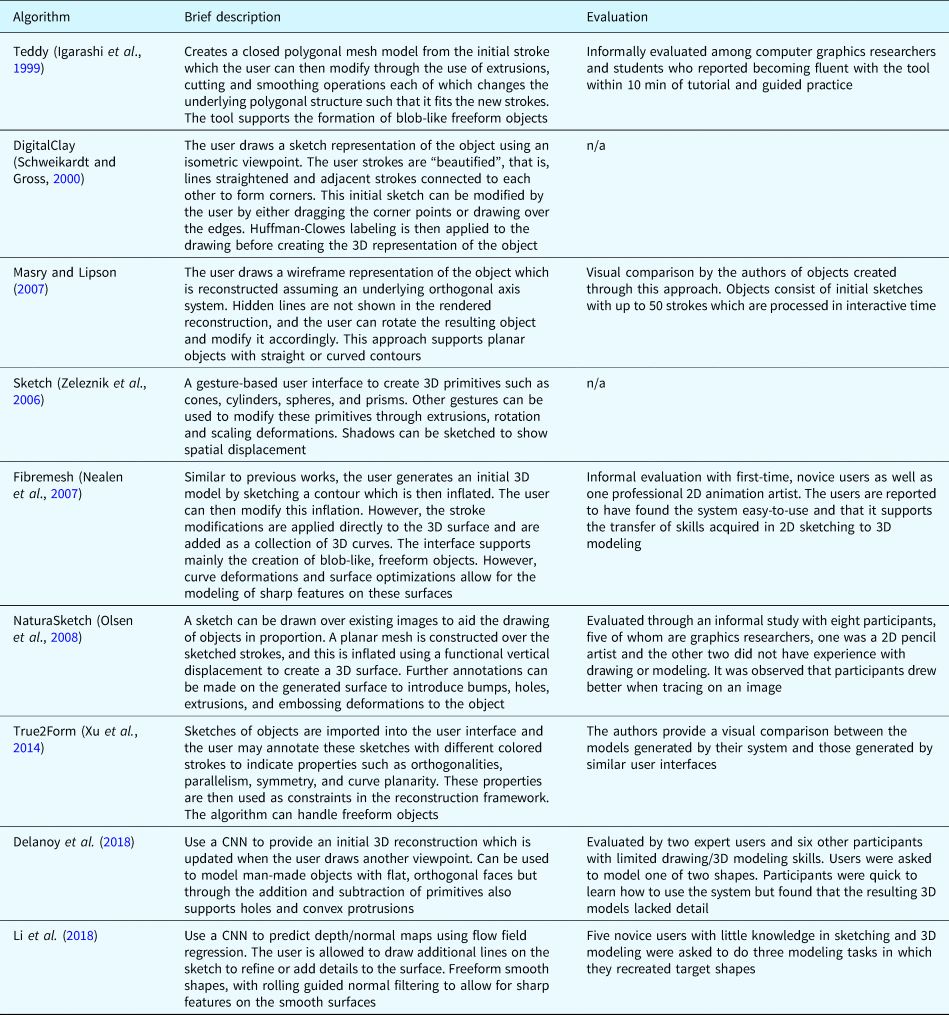
The availability and increasing popularity of digital tablets brought about a shift in the sketching modality from the traditional pen-and-paper to interactive sketches drawn using digital ink. Sketch-based interfaces, such as Sketch (Zeleznik et al., Reference Zeleznik, Herndon and Hughes2006), Cali (Fonseca et al., Reference Fonseca, Pimentel and Jorge2002), NaturaSketch (Olsen et al., Reference Olsen, Samavati and Jorge2011), Teddy (Igarashi et al., Reference Igarashi, Matsuoka and Tanaka1999), Fibermesh (Nealen et al., Reference Nealen, Igarashi, Sorkine and Alexa2007), and DigitalClay (Schweikardt and Gross, Reference Schweikardt and Gross2000) among many others, make use of additional inked gestures to allow users to inflate or mold the 2D drawings into a 3D shape.
Sketch-based interfaces often require that the user creates sketches using some particular language. For example, in Teddy (Igarashi et al., Reference Igarashi, Matsuoka and Tanaka1999), the user draws a simple 2D silhouette of the object from which the 3D shape is constructed through the operation of blobby inflation. The algorithm first extracts the chordal axis of the triangulated mesh of a given silhouette. Then, an elevating process is carried out to inflate the 2D shape into 3D space, which is mirrored by the other side of the shape. The system demonstrates a simple but effective interface of sketch-based modeling. However, it can only handle simple and bulbous shapes, and hence cannot be easily generalized to other shape modeling such as shapes with sharp features.
While sketch-based interfaces overcome some of the difficulties in the interpretation of the sketch, they introduce a sketching language which distracts from the natural spontaneity of freehand sketching. Moreover, the interfaces are often designed such that the user progressively refines the 3D shape (Masry and Lipson, Reference Masry and Lipson2007; Xu et al., Reference Xu, Chang, Sheffer, Bousseau, McCrae and Singh2014), which can be time-consuming.
Delanoy et al. (Reference Delanoy, Aubry, Isola, Efros and Bousseau2018) learn to reconstruct 3D shapes from one or more drawings, using a deep CNN that predicts occupancy of a voxel grid from a line drawing. The CNN provides an initial 3D reconstruction as soon as the user draws a single view of the desired object. This single view will be updated once a new viewpoint is introduced, using an updater CNN to fuse together information from different viewpoints without requiring stroke correspondences between the drawings. The CNN is trained on primitive shapes, such as cubes and cylinders, which are combined through geometric additions and subtractions to create objects which have flat orthogonal faces but which can also support holes or protruding convex surfaces. A total of 20,000 such objects were created, using 50 of these shapes for testing, while the rest were used for training. Li et al. (Reference Li, Pan, Liu, Tong, Sheffer and Wang2018) also adopt a CNN to infer depth from the 2D sketch of the 3D surface. This approach, however, aims at rendering general freeform shapes, focusing on geometric principles and optional user input to overcome drawing ambiguities. The CNN is used to predict depth/normal maps using flow field regression and a confidence map, which gives the ambiguity at each point of the input sketch. As with Delanoy et al. (Reference Delanoy, Aubry, Isola, Efros and Bousseau2018), the user first draws a single viewpoint of the object which is rendered as a 3D object. The user can then either further modify the surface by drawing curves over the surface, or providing depth values at sparse sample points, or reuse the frontal sketch to draw the back view of the object. Training data for CNN was generated by applying NPR to 3D shapes to attain sketch-like silhouette curves.
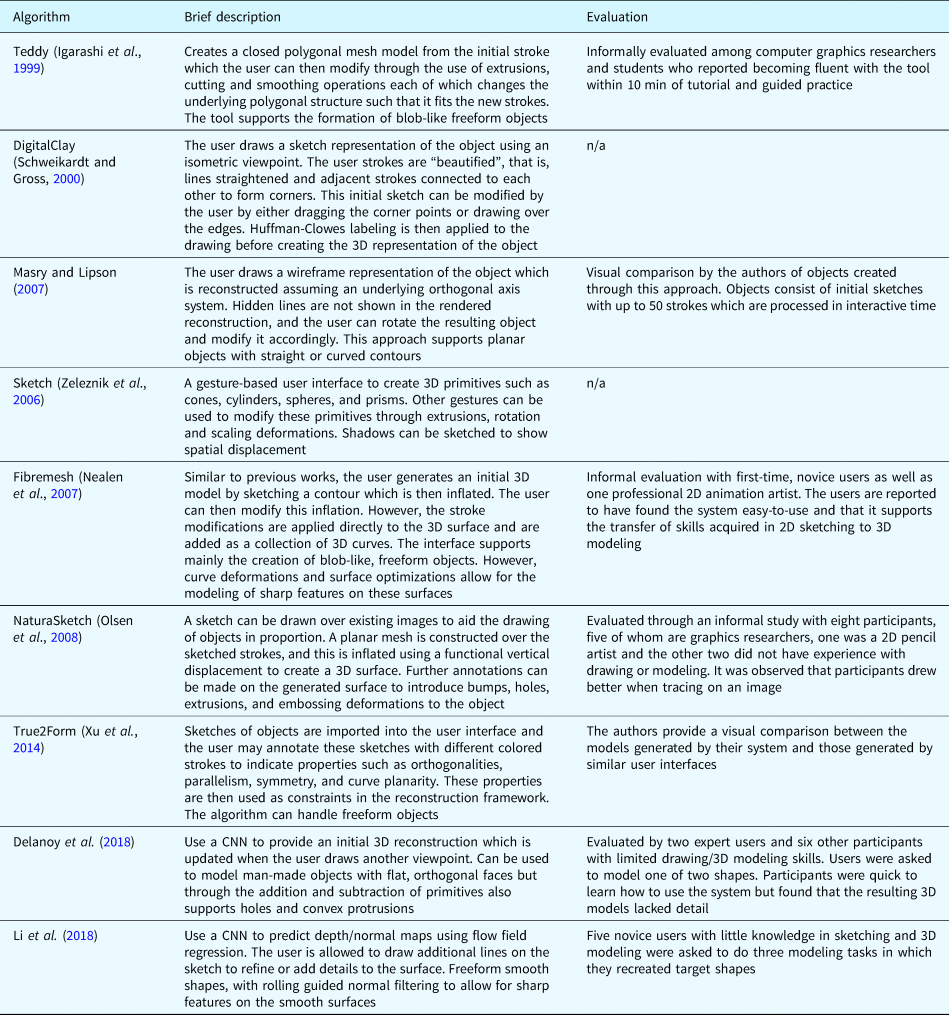
Table 2 compares some of the interactive sketch-based interfaces described in the literature. We observe that interactive systems which perform an initial blob-like inflation of the drawing, seem to require less effort to create the first 3D model of the object. However, these systems then require effort to deform the initial shape to the desired object form. On the other hand, language-based systems may require more effort to create the initial model, but then, this would require fewer deformations to achieve the desired shape. Deep learning systems appear to provide a good middle ground, using viewpoints which are a natural way of reducing ambiguities. By removing the need to align the viewpoints, these systems reduce the burden on the user. However, these systems produce models which appear to be lacking in object detail. Hence, more work is required to capture the desired level of surface detail with such systems.
Comparison of interactive sketch-based algorithms
Sketch-based shape retrieval
The interpretation methods discussed thus far attempt to create a new 3D model based on the sketched ink strokes. An alternative approach to generating the 3D model linked to the sketch is to assume that a model already exists in some database and that the sketch may be used to retrieve the best fitting model. Sketch-based shape retrieval engines have been used to improve human–computer interaction in interactive computer applications and have been studied since the Princeton Shape Benchmark (Shilane et al., Reference Shilane, Min, Kazhdan and Funkhouser2004). While sketches are generally simpler than images, they sufficiently describe 3D shapes and are easily produced by hand. Sketch-based retrieval engines for 3D models are important in large datasets where we require fast and accurate methods.
In the approach described by Shilane et al. (Reference Shilane, Min, Kazhdan and Funkhouser2004), the user draws the side, front, and top views of the 3D object to retrieve the 3D object whose shape agrees most closely to the given views. Retrieval-based modeling algorithms then consist of three steps, namely view selection and rendering, feature extraction and shape representation, and metric learning and matching (Chen et al., Reference Chen, Tian, Shen and Ouhyoung2003; Pu and Ramani, Reference Pu and Ramani2005; Yoon et al., Reference Yoon, Scherer, Schreck and Kuijper2010). To improve the quality of the retrieval, efforts are made for more effective descriptors of both sketches and shapes. For instance, in Chen et al. (Reference Chen, Tian, Shen and Ouhyoung2003), light field descriptors are extracted to represent 3D shapes.
Complex objects can then be modeled by retrieving and assembling the object in a part-wise manner (Chen et al., Reference Chen, Tian, Shen and Ouhyoung2003), while complex scenes comprised of different objects can be modeled by retrieving each object individually (Eitz et al., Reference Eitz, Richter, Boubekeur, Hildebrand and Alexa2012). However, retrieval-based methods require very large collections of shapes. Moreover, despite the size of the dataset, the likelihood of finding an identical match between a 3D shape and its sketched counterpart is very small. This is because sketch-based retrieval algorithms typically assume that the sketched drawing will match one of the selected viewpoint representations of the object in the database. However, there can be no guarantee that the user's sketch will match the selected object viewpoint. Nor is there a guarantee that the sketching style will correspond to the database object representation. Thus, shape retrieval algorithms also focus on improving the matching accuracy between the sketched query and the shape database, for example, in Wang et al. (Reference Wang, Kang and Li2015), CNNs are used to learn cross-domain similarities between the sketch query and the 3D object at the image level by projecting 3D shapes into 2D images, thus avoiding the need to specify the object viewpoint. In Zhu et al. (Reference Zhu, Xie and Fang2016), a cross-domain neural networks approach is proposed to learn the cross-domain mapping between 2D sketch features and 3D shape features directly. A different method, deep correlated metric learning (DCML), is proposed in Dai et al. (Reference Dai, Xie and Fang2018). The proposed DCML exploits two different deep neural networks for each domain to map features into feature space with a joint loss. They aim to increase the discrimination of features within each domain as well as the correlation between different domains, thus minimizing the discrepancy across the sketch and the shape domain. The proposed method in this study performs significantly better than the proposed method in Wang et al. (Reference Wang, Kang and Li2015).
One approach to implementing database queries is to learn alternative representations of 3D shapes to improve retrieval performance. Xie et al. (Reference Xie, Dai, Zhu and Fang2016) propose to learn the barycenters of 2D projections of 3D shapes for significant improvement in sketch-based 3D shape retrieval. A different approach is to convert the database contents into a sketch-like form since this would make subsequent query matching more straightforward. Thus, lines making up strokes should be extracted from 2D images. The same approach can be deployed for 3D models by first generating multiple 2D views, from which the lines are extracted, or else the lines can be directly extracted from the geometry of the 3D model. For example, in Eitz et al. (Reference Eitz, Richter, Boubekeur, Hildebrand and Alexa2012), the main idea is to generate a set of 2D sketch-like drawings from the 3D objects in the database, thus, performing matching in 2D rather than direct matching between the 2D sketch and the 3D shape.
2D image-based line detection
Extracting lines from images has been a well-studied topic in computer vision for more than 20 years. In particular, there are a number of common applications in areas such as medical imaging (e.g., blood vessel extraction from retinal images) and remote sensing (road network extraction from aerial images), and these have spawned a variety of line detection methods such as methods based on eigenvalues and eigenvectors of the Hessian matrix (Steger, Reference Steger1998); the zero-, first-, and second-order Gaussian derivatives (Isikdogan et al., Reference Isikdogan, Bovik and Passalacqua2015); and 2D Gabor wavelets among others (Soares et al., Reference Soares, Leandro, Cesar, Jelinek and Cree2006). Alternatively, general features such as local intensity features can be used in conjunction with classifiers (e.g., neural network classifiers) to predict the existence of lines (Marin et al., Reference Marin, Aquino, Gegundez-Arias and Bravo2011). Line detection can also be applied to NPR which aims at resynthesizing images and 3D models in new styles, which include (but are not limited to) traditional artistic styles. Thus, NPR provides the means to convert the 3D model database contents into a sketch-like form.
One effective NPR approach was described by Kang et al. (Reference Kang, Lee and Chui2007), who adapted and improved a standard approach to line detection, which performs convolution with a Laplacian kernel or a difference-of-Gaussians (DoG). As with some of the methods described above, Kang et al. (Reference Kang, Lee and Chui2007) estimate the local image direction and apply the DoG filter in the perpendicular direction. The convolution kernel is deformed to align with the local edge flow, which produces more coherent lines than traditional DoG filtering.
Another NPR technique related to line detection is the rendering of pencil drawings, in which methods aim to capture both the structure and tone of pencil strokes. The former is more relevant to sketch retrieval, and the approach described in Lu et al. (Reference Lu, Xu and Jia2012) generates a sketchy set of lines while trying to avoid false responses due to clutter and texture in the image. They first perform convolution using kernels as a set of eight line segments in the horizontal, vertical, and diagonal directions. These line segments are set to the image height or width. The goal of this initial convolution is to classify each pixel into one of the eight directions (according to which direction produces the maximum response), thereby producing eight response maps. The second stage of convolution is applied, using the eight line kernels on the eight response maps. The elongated kernels link pixels into extended lines, filling gaps, and slightly lengthening the lines present in the input image, producing a coherent and sketchy effect.
With the advent of deep learning, CNN approaches have also been applied in recent years to image-based line detection for the same applications and tend to out-perform traditional methods. For instance, Xu et al. (Reference Xu, Xie, Feng and Chen2018) extracted roads from remotely sensed images using a segmentation model that was designed based on the UNET architecture (Ronneberger et al., Reference Ronneberger, Fischer, Brox, Navab, Hornegger, Wells and Frangi2015) in which the contracting part was implemented using DenseNet (Huang et al., Reference Huang, Liu, Van Der Maaten and Weinberger2017). In addition, local attention units were included to extract and combine features from different scales. Leopold et al. (Reference Leopold, Orchard, Zelek and Lakshminarayanan2019) described an approach to retinal vessel segmentation that was also based on the UNET architecture. Across several datasets, the model's performance did not always achieve the state of the art. However, it was argued that this was due to the downsizing of the input images that was performed in order to improve computational efficiency. Gao et al. (Reference Gao, Tang, Liang, Su and Zou2018) tackled pencil drawing using a vectorized CNN model (Ren and Xu, Reference Ren and Xu2015) and given the difficulty in obtaining suitable ground truth they used a modified version of Lu et al. (Reference Lu, Xu and Jia2012) to generate the training set. In order to improve the quality of the training data, they manually adjusted the parameters of Lu et al.'s algorithm to obtain the best result. This enabled them to build a final deep model that was able to produce more stable results than Lu et al. (Reference Lu, Xu and Jia2012).
As alluded to above, an issue in line detection is coping with noisy data. Many line detection methods also include a postprocessing step for improving the quality of the raw line detection. For instance, Marin et al. (Reference Marin, Aquino, Gegundez-Arias and Bravo2011) apply postprocessing in order to fill pixel gaps in detected blood vessels and remove isolated false positives. Isikdogan et al. (Reference Isikdogan, Bovik and Passalacqua2015) and Steger (Reference Steger1998) use the hysteresis thresholding approach that is popular in edge detection: two-line response thresholds are applied, and those pixels above the high threshold are retained as lines, while those pixels below the low threshold are discarded. Pixels with intermediate line responses between the thresholds are only retained if they are connected to pixels that were determined to form lines (i.e., above the high threshold).
Although state-of-the-art image-based line detection methods are fairly effective and robust, they are limited by the lack of RGB images to directly capture the object's underlying geometric information. Another limitation is the lack of semantic knowledge needed to disambiguate conflicting information or handle missing information. These factors make the current methods prone to detecting lines arising from the clutter in the images, whereas humans are better able to focus on the salient contours. Moreover, the output of typical image-based line detection methods can be somewhat fragmented and noisy.
3D model-based line detection
If lines are extracted from 3D models, then these lines can directly reflect the geometry of the object. In comparison, lines extracted from images are determined by the image's intensity variations, which can be affected by extraneous factors, such as illumination, and perspective distortion, meaning that significant lines may easily be missed, and spurious lines introduced.
A straightforward approach to locate lines on the surface of a 3D model is to find locations with extremal principal curvature in the principal direction – such loci are often called ridges and valleys. The curvature of a surface is an intrinsic property, and thus, the ridge and valley lines are view independent. While this might seem advantageous, DeCarlo et al. (Reference DeCarlo, Finkelstein, Rusinkiewicz and Santella2003) argued (in the context of NPR) that view-dependent lines better convey smooth surfaces and proposed an alternative that they termed suggestive contours. These are locations at which the surface is almost in contour from the original viewpoint and can be considered to be locations of true contours in close viewpoints. More precisely, the suggestive contours are locations at which the dot product of the unit surface normal and the view vector is a positive local minimum rather than zero.
Related work by Judd et al. (Reference Judd, Durand and Adelson2007) on apparent ridges also modified the definition of ridges to make them view-dependent. They defined a view-dependent measure of curvature based on how much the surface bends from the viewpoint. Thus, it takes into consideration both the curvature of the object and the foreshortening due to surface orientation. Apparent ridges are then defined as locations with maximal view-dependent curvature in the principal view-dependent curvature direction.
This earlier work was systematically evaluated by Cole et al. (Reference Cole, Golovinskiy, Limpaecher, Barros, Finkelstein, Funkhouser and Rusinkiewicz2008), based on a dataset that they created which contains 208 line drawings of 12 3D models, with two viewpoints and two lighting conditions for each model, obtained from 29 artists. Using precision and recall measures, they quantitatively compared the artists' drawings with computer-generated (CG) drawings, namely image intensity edges (Canny, Reference Canny1986), ridges and valleys, suggestive contours and apparent ridges. They showed that no CG method was consistently better than the others, but that instead, different objects were best rendered using different CG methods. For instance, the mechanical models were best rendered using ridges and edges, while the cloth and bone models were best rendered using occluding contours and suggestive contours. Cole et al. (Reference Cole, Golovinskiy, Limpaecher, Barros, Finkelstein, Funkhouser and Rusinkiewicz2008) experimented with combining CG methods, and found for example that folds in the cloth model could be identified by the presence of both suggestive contours and apparent ridges. They also found that the artists were consistent in their lines, and in a later user study showed that people interpret certain shapes almost as well from a line drawing as from a shaded image (Cole et al., Reference Cole, Sanik, DeCarlo, Finkelstein, Funkhouser, Rusinkiewicz and Singh2009), which confirms the hypothesis that a sketch-based interface should be an effective means of accessing 3D model information.
In contrast to image-based line detection, there has been substantially less take-up of deep learning for 3D models due to the irregular structure of 3D data. Thus, a common approach is to process 3D as multiview 2D data. For instance, Ye et al. (Reference Ye and Zhou2019) take this approach. They aim to generate line drawings from 3D objects but apply their model to 2D images rendered from the 3D object. Their general adversarial network (GAN) incorporates long short-term memory (LSTM) to enable it to generate lines as sequences of 2D coordinates. Nguyen-Phuoc et al. (Reference Nguyen-Phuoc, Li, Balaban and Yang2018) propose a CNN-based differentiable rendering system for 3D voxel grids which is able to learn various kinds of shader including contour shading. While voxel grids provide the regular structure missing from meshes, in practice their large memory requirements limit their resolution, and so Nguyen-Phuoc et al. (Reference Nguyen-Phuoc, Li, Balaban and Yang2018) resize their 3D data to a 64 × 64 × 64 voxel grid.
Displaying the search results
Equally important in the sketch-based retrieval approach is the way the matching results are presented to the user for the user to make full benefit of search. Traditionally, search results are displayed as thumbnails (Shilane et al., Reference Shilane, Min, Kazhdan and Funkhouser2004) and applications, such as Google's 3D WarehouseFootnote 2, allow the user to select and modify the viewpoint of the object. These display strategies, however, do not take into account the advantages of human–computer interaction paradigms and devices. Adopting VR/AR environments for the exploration of search results have the advantage of allowing far more content to be displayed to the user by making full use of the 3D space to organize the content, allowing the user to examine search results with respect to three different criteria simultaneously (Munehiro and Huang, Reference Munehiro and Huang2001). The challenge here is to determine how to arrange the query result in the open 3D space such that the organization remains meaningful to the user as the user navigates in the 3D space. While the 3D axis has been used for such purposes, with each axis defining a search criterion, the display problem is a more complex problem and requires more attention. Also, challenging is establishing the way the users interact with the search objects in the immersive environment. While gestures seem like the most natural interaction modality, the interpretation of unintended gestures may lead to undesirable states (Norman, Reference Norman2010).
Beyond the single-user, single-sketch applications
The applications discussed thus far focus on single-user, single-object, sketch-to-3D applications. While this remains a significant research challenge, sketch communication is not limited to single-user applications, nor does it have to be focused on individual objects. Sketches may be used in communication with multiple parties and may capture not only the physical form of the object but also the interaction of the sketched object with other objects in its environment or the functionality of the object. The interpretation of the sketch, therefore, goes beyond the interpretation of the ink strokes but should include other means of communication, such as speech or eye-gaze, which occur while sketching. The collaborative aspect of sketching may be extended from the physical world to the VR or AR domain, where improved tools make virtual sketching more accessible. VR and AR opens sketching applications to sketching directly in the 3D sketching domain and to applications where collaborators may be present together in the virtual world. The following sections discuss these aspects of sketching interfaces in greater depth.
Multimodal sketch-based Interaction
When people sketch, particularly when sketching is taking place in a collaborative environment, other, natural and intuitive methods of communication come into play. Thus, combining sketch interpretation with different sources of information obtained during the act of sketching increases the richness of the data available for understanding and interpreting the sketch to improve the user-interface experience. Hence, the need for multimodal sketch-based interactions.
Informal speech is one of the leading interactions in multimodal sketch-based systems since speech is a natural method of communication and can provide additional information beyond that captured in the sketch. The research questions that arise are twofold: how will the user using such a system want to interact with the system and how will the system analyze the conversation that has arisen? Experiments have been carried out to find answers to these questions by analyzing the nature of speech–sketch multimodal interaction. These studies investigate general tendencies of people, such as the timing of the sketch (Adler and Davis, Reference Adler and Davis2007), and the corresponding conversation interaction to design effective sketch–speech-based systems (Oviatt et al., Reference Oviatt, Cohen, Wu, Vergo, Duncan, Suhm, Bers, Holzman, Winograd, Landay, Larson and Ferro2000).
During sketching, people exhibit subtle eye-gaze patterns, which in some cases, can be used to infer important information about user activity. Studies demonstrate that people perform distinguishing eye-gaze movements during different sketch activities (Çığ and Sezgin, Reference Çığ and Sezgin2015). Thus, the natural information coming from eye-gaze movements can be used to identify particular sketch tasks. These observations lead researchers to take eye-gaze information into account when creating multimodal sketch-based interaction. For example, in Çığ and Sezgin (Reference Çığ and Sezgin2015), eye-gaze information is used for early recognition of pen-based interactions. They collect data from 10 participants (6 males and 4 females) over five different tasks to train an SVM-based system for task prediction with an 88% success rate. They demonstrate that eye-gaze movement that naturally accompanies pen-based user interaction can be used for real-time activity prediction.
An important aspect which eye-gaze and speech prediction systems need to address is the ability of the systems to recover from prediction errors. While error recovery is important in all steps of the sketch interpretation, it becomes more critical with eye-gaze and speech predictions since the user's natural reaction to errors would be to change their behavior in an attempt to force the system to correct the error. Such a change in behavior could, in turn, further reduce the prediction performance.
While eye-gaze and speech provide information about the sketch, haptic feedback is a different mode of interaction which provides information to the user, conveying the natural feeling of interaction to the user. Haptic feedback changes the sketch interaction in VR or AR applications, providing a realistic substitute for the interaction with physical surfaces (Strasnick et al., Reference Strasnick, Holz, Ofek, Sinclair and Benko2018). In this study, they propose three prototypes a novel VR controller, Haptic Links, that support the haptic rendering of a variety of two-handed objects and interactions. They conduct a user evaluation with 12 participants (ages 25–49, 1 female) that shows users can perceive many two-handed objects or interactions as more realistic with Haptic Links than with typical VR controllers. Such a feedback is of particular use when the virtual environment plays a significant role in sketch interaction. Such tasks include sketching or drawing on a virtual object or writing on a board, where haptic feedback enhances the user experience through the physical feelings of the virtual surface. Systems which include haptic feedback use principles of kinematics and mechanics to exert physical forces on the user. For example, in Massie and Salisbury (Reference Massie and Salisbury1994), a force vector is exerted on the user's fingertip to allow the user to interact with and feel a variety of virtual objects including controlling remote manipulators, while in Iwata (Reference Iwata1993), a pen-shaped gripper is used for direct manipulation of a freeform surface.
Augmented and virtual reality
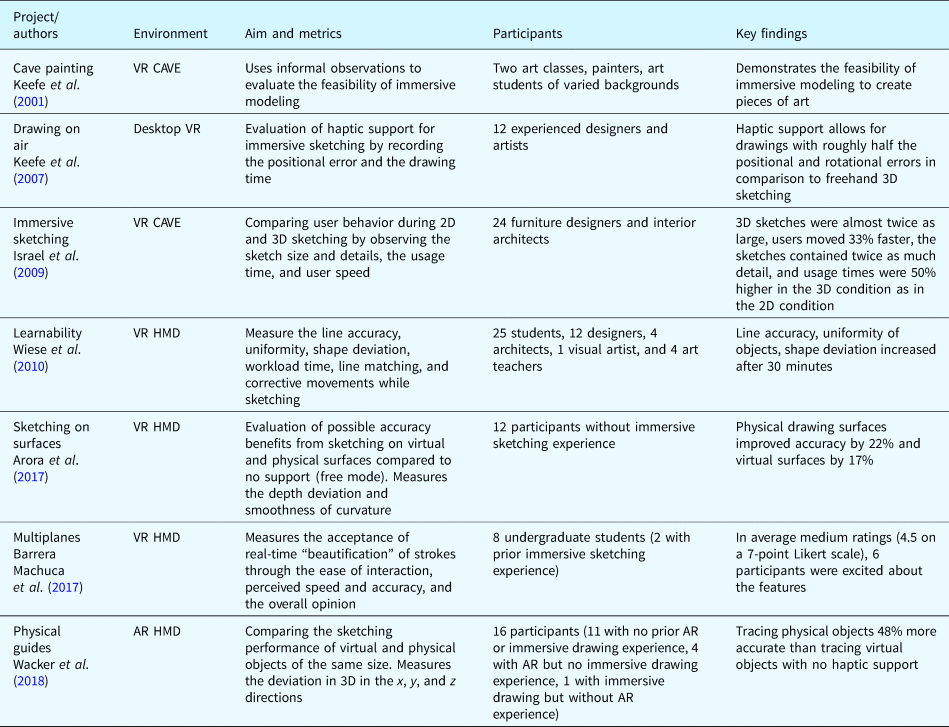
The qualities of sketching as an easy and efficient method to create visual representations have also had an impact in the field of VR and AR. Virtual and augmented media are inherently 3D spatial media, and thus, sketching in VR and AR involves usually the creation of 3D visual representations. Such systems typically allow users to draw and immediately perceive strokes and planes in 3D space. Users create strokes by using input devices, such as controllers or pens, which are also tracked by the VR system. Users can easily perceive the drawings from different angles by just moving their head and body. Table 3 provides a comparative summary of the VR and AR interactions discussed here under.
Overview of immersive sketching studies
Early immersive sketching systems were developed by Keefe et al. (Reference Keefe, Feliz, Moscovich, Laidlaw and LaViola2001), who created a sketching environment for artists within a cave automatic virtual environment (CAVE), Fiorentino et al. (Reference Fiorentino, De Amicis, Stork and Monno2002), who tried to introduce 3D sketching in industrial styling processes, or Schkolne et al. (Reference Schkolne, Pruett and Schröder2001), who suggested to use bare hands for the creation of rough sketches. The Front Design Sketch Furniture Performance Design Footnote 3 project demonstrated an AR-alike application of freehand 3D sketching for the design of furniture, including printing of the results using rapid prototyping technologies. Among the most recent immersive sketching systems are commercially available tools such as Tilt BrushFootnote 4 and Gravity-SketchFootnote 5 which provide modeling functionalities, including the creation of strokes, surfaces, volumetric meshes, or primitives. Such tools provide advanced 3D user interfaces, menus, and widgets and can be run with most of the latest VR headsets and 3D controllers.
The VR market has seen a major technology shift in the past years particularly, with the emergence of affordable high-resolution head-mounted displays (HMDs) in the consumer markets. Industrial VR solutions make more and more use of HMDs which today significantly outnumber projection-based solutions. This shift is also visible in the field of immersive sketching. Where earlier works such as those described in Fiorentino et al. (Reference Fiorentino, De Amicis, Stork and Monno2002), Keefe et al. (Reference Keefe, Feliz, Moscovich, Laidlaw and LaViola2001), Israel et al. (Reference Israel, Wiese, Mateescu, Zöllner and Stark2009), and Wiese et al. (Reference Wiese, Israel, Meyer and Bongartz2010) among others, mainly used projection-based solutions, recent research systems such as those described in Arora et al. (Reference Arora, Kazi, Anderson, Grossman, Singh and Fitzmaurice2017) and Barrera Machuca et al. (Reference Barrera Machuca, Asente, Lu, Kim and Stuerzlinger2017) and commercial systems such as Tilt Brush and Gravity-Sketch, typically employ HMDs. HMDs offer the advantages of lower costs, lower space requirements, and increased mobility in comparison to projection-based systems. However, HMDs typically block the view of the physical environment, whereas in projection-based systems, users can see each other, even though usually only one user can perceive the 3D scene from the right perspective (Drascic and Milgram, Reference Drascic and Milgram1996).
A considerable number of studies has investigated the characteristics of immersive freehand sketching. In their seminal paper “CavePainting: A Fully Immersive 3D Artistic Medium and Interactive Experience”, Keefe et al. (Reference Keefe, Feliz, Moscovich, Laidlaw and LaViola2001) were the first to show that immersive sketching within a CAVE can foster creative drawing and sculpting processes among artists. They reported their observations of participants from two art classes, painters, and art students of varied backgrounds. They noted that skilled artists, young artists, and novice users were able to create “meaningful piece[s] of art” (op. cit., p. 92) with their system. In another study among 12 experienced designers and artists, Keefe et al. (Reference Keefe, Zeleznik and Laidlaw2007) investigated the effects of two bimanual 3D drawings techniques with haptic support. They found that these techniques allow for drawings with roughly half the positional and rotational errors compared to freehand 3D sketching techniques. Israel et al. (Reference Israel, Wiese, Mateescu, Zöllner and Stark2009) compared 2D and 3D sketching processes and the resulting sketches. In a study among 24 furniture designers and interior architects, they found that 3D sketches were almost twice as large as 2D sketches, users moved 33% faster in the 3D condition than in the 2D condition, the resulting 3D sketches contained twice as many details than 2D sketches, and usage times were 50% higher in the 3D condition. Furthermore, users reported that it felt more “natural” to draw three-dimensionally in a 3D environment. The 3D environment seemed to support the creation of 3D representations in one-to-one scale and to foster the interaction with sketches from the moment of their creation, which could, in turn, stimulate creative development processes. In an effort to investigate the effects of visual and physical support during immersive sketching, Arora et al. (Reference Arora, Kazi, Anderson, Grossman, Singh and Fitzmaurice2017) discovered in an observational study among five design experts that they prefer to switch back and forth between controlled and free modes. In another study among 12 participants without professional drawing experience, Arora et al. (Reference Arora, Kazi, Anderson, Grossman, Singh and Fitzmaurice2017) used depth deviation and smoothness of curvature as a measure of accuracy and show that a physical drawing surface helped to improve the accuracy of a sketch by 22% over their free mode counterpart. Virtual surfaces, which are easy to implement, were surprisingly close with a 17% improvement. The use of visual guides, such as grids and scaffolding curves, improved the drawing accuracy by 17% and 57%, respectively. However, the drawings were less esthetically pleasing than the free mode sketches, especially with the use of scaffolding curves. A system developed by Barrera Machuca et al. (Reference Barrera Machuca, Asente, Lu, Kim and Stuerzlinger2017) followed another approach. Here, 3D strokes were projected onto 2D planes and corrected or “beautified” in real time. In a preliminary evaluation among eight undergraduate students, of which 25% had prior immersive sketching experience, users appreciated this informal and unobtrusive interaction technique and were satisfied with the quality of the resulting sketches.
The question of how fast users can adapt to immersive sketching was subject to a learnability study with 25 design, arts, and architecture students by Wiese et al. (Reference Wiese, Israel, Meyer and Bongartz2010). In the study, Wiese et al. (Reference Wiese, Israel, Meyer and Bongartz2010) measured immersive sketching abilities during three test trials occurring within 30 min of each other and in which users had to draw four basic geometries. Wiese et al. (Reference Wiese, Israel, Meyer and Bongartz2010) report improvements of approximately 10% in line accuracy, 8% in shape uniformity, and 9% in shape deviation. These results underline the hypothesis that immersive sketching skills can improve over time, even after short periods of learning.
With the growing popularity of AR, some AR-based 3D sketching approaches recently surfaced. In AR, the user can perceive their physical environment, seamlessly augmented with virtual information and objects. Typical AR frameworks either use the hardware of mobile device, for example, Apple ARKitFootnote 6, Google ARCoreFootnote 7, and VuforiaFootnote 8 or HMDs, for example, Microsoft HoloLensFootnote 9. Both frameworks have the potential for drawing and sketching applications. Smartphone-based solutions typically use the motion, environmental and position sensors as well as the device's camera to determine its position in space. The user can either draw directly on the screen or by moving the screen.
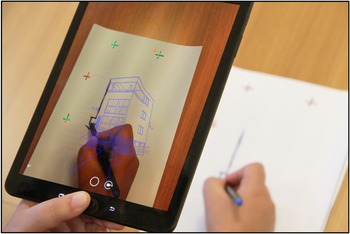
Among the AR-based sketching systems, SketchARFootnote 10 helps users to increase their drawing skills. The application uses the phone's camera to capture the physical environment. When the system detects physical paper in the image, the user may overlay a template, such as the sketch of a face as shown in Figure 6, onto the physical paper. The user can then use physical pens to trace the template on the physical sheet of paper while controlling the result on the smartphone display. CreateARFootnote 11, another AR-based sketching applications, allows users to create and place sketches at particular geo-locations, making them accessible for other users (Skwarek, Reference Skwarek2013). Similar applications are also available for Microsoft's HoloLens; most applications let the user draw by pressing the thumb against the forefinger, creating strokes when the user moves their hand. In a study among 16 participants (4 female, 12 male, 11 with no prior AR nor immersive drawing experience, 4 with AR but no immersive drawing experience, 1 with immersive drawing but without AR experience), Wacker et al. (Reference Wacker, Voelker, Wagner and Borchers2018) compared the sketching performance on virtual and physical objects of the same size in AR. They found that tracing physical objects can be performed 48% more accurate than on virtual objects with no haptic support.
Sketching with SketchAR: the application overlays a template over the image of the physical paper which the user can then trace onto the paper using physical pens.

Interesting research questions remain in the field of learnability, especially in the AR/VR context. Future mid- and long-term studies could investigate to which degree users can develop freehand sketching skills and if they can even reach the accuracy of traditional sketching on paper. Physical and virtual scaffolding curves, grids and planes have been shown, to a limited extent, to improve the drawing accuracy. However, in some cases, these structures result in overloaded user interfaces and reduce the esthetic quality of the resulting sketches. The search for supporting structures which do not compromise the creativity and fluidity of the sketching process will thus remain an essential branch of research in the field of immersive sketching. AR-related research has also shown that haptic feedback also improves accuracy when tracing virtual objects. This raises the question of whether haptic feedback may introduce the structure introduced by grid lines or scaffolding curves without the same hindering effect on the esthetics of the resulting sketches.
Future directions
While there are many breakthroughs in the literature in the area of sketch-based interpretations and interactions, these are not reflected in the tools available in the industry, particularly in the design industry where there still exists a gulf between 2D sketching and 3D modeling for rapid prototyping and 3D printing. Examining the problems faced in industrial applications lead us to identify the following questions and challenges.
Media breaks in the product design workflow
The different nature of the sketches and drawings used at each stage in the design process calls for different software/hardware support throughout the design process (Tversky and Suwa, Reference Tversky, Suwa, Markman and Wood2009). For instance, sketch-based modeling which does not require precise dimensions is ideal for the development of 3D models from initial sketches. However, precise dimensions are required at later, detailed design stage, and thus, the sketch-based interface should allow for their introduction. Moreover, while novel AR and VR environments are useful to visualize and interact with the virtual prototypes, the more traditional CAD tools may be more suited for detailed design. One must also take into consideration the human factor: people may be more comfortable and proficient using the tools they are familiar with.
The current sketch-based interfaces and sketch-based modeling tools described in the literature do not take these factors into account. Thus, while there is support for sketching systems on 2D media, sketching in AR and VR environments as well as sketch-based queries, these systems are not interoperable, resulting in media breaks which limit the practical use of these systems. What is required is a system which allows for different sketch interpretation systems to integrate seamlessly with each other such that there is no interruption of the workflow. Early work described in Bonnici et al. (Reference Bonnici, Israel, Muscat, Camilleri, Camilleri and Rothenburg2015) transitions from a paper-based sketch to a 3D model in a virtual environment, providing a glimpse that seamless transitions between media are possible. Full interoperability will require an investigation into a file interchange format to facilitate the transition of sketch and model data between different applications.
Thinking sketches
There is some considerable difference between sketches drawn at an individual level and those drawn during group brainstorming sessions. Recording multimodal interactions become necessary in group sketching to capture fully the thought process, especially since gestures can be considered as a second-layer sketch. Through the concept of reflection in action, the fluid, mental representation of the concept is objectified and externally represented, refining the concept through gestures.
However, recording and using gestures raises further challenges. Gestures are subconscious actions, unlike sketching, which is a conscious action. Capturing all unconscious actions during sketching, while interesting will overload the interpretation system with information, giving rise to the need to filter out natural gestures, such as habitual arranging of one's hair, which are not related to the act of sketching. Such filtering requires identifying gestures which are commonly used across different cultures and which can be interpreted in the same manner across the board, raising the question of whether it is possible to find such common gestures which have been naturally adopted across different cultures, or if the interpretation system can adapt to the personalization of gestures. However, before a system that records all gestures is brought into place, it is worth investigating whether such a system would bring about a change in the group interaction since full recording may be seen as inhibiting and imposing on the “free-will” of the group participants.
Support for off-site collaborative sketches
Internationalization has brought about a greater need for off-site collaboration in the design process. Technology has made it possible to share media in the form of text documents, sketches, computer-aided models, or physical artifacts which facilitates this collaboration. However, despite the advances in telepresence systems, one of the main bottlenecks, reducing the effectiveness of communication in collaborative work, remains the lack of mechanisms for communicating nonverbal cues such as the locus of attention on the shared media at any given instance in time (D'Angelo and Gergle, Reference D'Angelo and Gergle2018). In small groups of two or three, the participants, predominantly the speaker, issues deictic gestures (naturally by hand or finger pointing) to communicate the locus of attention and context. Previous work on communication of distant dyads shows that speech and deictic gestures collectively carry complementary information that can be used to infer regions of interest in 2D shared media (Monk and Gale, Reference Monk and Gale2002; Kirk et al., Reference Kirk, Rodden and Stanton Fraser2007; Cherubini et al., Reference Cherubini, Nüssli and Dillenbourg2008; Eisenstein et al., Reference Eisenstein, Barzilay and Davis2008). For larger groups, and in particular in remote collaboration, the inability to issue deictic gestures severely limits the quality of communication and makes it difficult to create common ground for communication. Real-time eye-gaze visualizations can, therefore, support the collaboration process by providing the means for communicating shared visual space, thus improving the coordination between collaborating parties (D'Angelo and Gergle, Reference D'Angelo and Gergle2018). However, the real-time eye-gaze display is often considered to be distracting because of the low signal-to-noise ratio of the eye-gaze data which is a result of the constant movement of the eyes (Schlösser, Reference Schlösser2018). This calls for the need of further investigations into the visualization of shared spaces from eye-gaze information. D'Angelo and Gergle (Reference D'Angelo and Gergle2018) apply eye-gaze visualizations to search tasks, illustrating shared spaces using two approaches, first by displaying heat-maps which are retained for as long as a pair of collaborators fixate on an area and second through path visualizations. The findings of this study show that while eye-gaze information does facilitate the search task, the used visualization methods received mixed responses.
In collaborative sketching applications, inferred regions of interest could be used to create loci of attention, highlighting the object parts that are under study. Combined with speech information streamed from participants, such a part highlighting, or VR/AR-based augmentation is expected to aid the communication process. Thus, further research is required on the joint fusion of eye-gaze information and speech information such that this can be visualized effectively without introducing unnecessary distractions which are counter-productive to the design process. It is also worth noting that D'Angelo and Gergle consider pairs of collaborators. Thus, the visualization of the co-resolution of the different point of regards in larger group settings also needs to be investigated.
Data tracking: sketch information indexing through the workflow
The different workflows in the design process give rise to different sketches, often by different designers working at different phases in the project. Thus, another important aspect of the design process is the ability to trace through the different sketches, for example, to identify when a specific design decision was taken. The concept of product lifecycle management (PLM) in product design is a management system which holds all information about the product, as it is produced throughout all phases of the product's life cycle. This information is made available to everyone in an organization, from the managerial and technical levels to key suppliers and customers (Sudarsan et al., Reference Sudarsan, Fenves, Sriram and Wang2005). Smart and intelligent products are becoming readily available due to the widespread availability of related technologies such as RFIDs, small-sized sensors, and sensor networks (Kiritsis, Reference Kiritsis2011). Thus, although sketching interfaces consider the interaction between the designer and the artifact being designed, it is important to look beyond this level of interaction and consider all stakeholders of the artifact.
Such PLM systems typically include product information in textual or organizational chart formats, providing information different key actors along the product's life cycle on aspects such as recyclability and reuse of the different parts of the product, modes of use and more (Kiritsis, Reference Kiritsis2011). Expanding this information with the sketches, drawings and 3D modeling information carried out during the design process will, therefore, extend the information contained in the PLM. Consumers would be able to trace back to the design decisions of particular features on the object, while designers would be able to understand how consumers are using the product and could exploit this information, for example, to improve quality goals.
The challenge, therefore, lies in providing the means to establish an indexing and navigation system of the product design history, providing a storyboard of the design process from ideation stages to the final end-product.
Data collection for a reliable evaluation test cases
Related to all of the above is the need to create common evaluation test cases upon which research groups may evaluate their algorithms. Notably challenging is the need to collect and annotate data of people interacting naturally with an intelligent system when such a system is not yet available.
From Table 1, we may observe that the GREC dataset has been used for vectorization algorithms which are more suited for neat, structured drawings such as circuit diagrams or engineering drawings. However, a similar database for freeform objects is not readily available, leading Noris et al. (Reference Noris, Hornung, Sumner, Simmons and Gross2013), Favreau et al. (Reference Favreau, Lafarge and Bousseau2016), and Bessmeltsev and Solomon (Reference Bessmeltsev and Solomon2019) to use their own drawings. Thus, a dataset useful for the evaluation of vectorization algorithms should depict a broader range of 3D objects. Moreover, these should be available not only as neat drawings but also as rough sketches. Simo-Serra et al. (Reference Simo-Serra, Iizuka, Sasaki and Ishikawa2016) note the difficulty in aligning ground-truth drawings with rough sketches, and employ an inverted dataset reconstruction approach, asking artists to draw rough sketches over the predefined ground-truth sketches. This approach, however, restricts the drawing freedom of the artist. A reverse approach was adopted in Bonnici et al. (Reference Bonnici, Bugeja and Azzopardi2018), whereby the artist was allowed to sketch freely, following which, the sketch was scanned and traced over using a new layer in a paint-like application. In this application, however, artists were given drawings depicting 3D objects to copy. While this approach serves the purposes for sourcing of data for vectorization algorithms, a more holistic approach could, for example, require that the artists draw rough sketches of physical 3D objects. In this manner, besides collecting sketches for the vectorization process, a dataset of different sketch representations of 3D objects is also collected. If these sketches are also coupled with depth scans or 3D models of the physical object, the same sketches can also be used to assess 3D object reconstruction and retrieval algorithms.
Conclusion
In this paper, we have presented a review of the state of the art in sketch-based modeling and interpretation algorithms, looking at techniques related to the interpretation of sketches drawn on 2D media, sketch-based retrieval systems, as well as sketch interactions in AR and VR environments.
We discuss how current systems are focused on solving the specific problems related to the particular interpretation problem, however, few systems address the overarching sketch interpretation problem which provides continuity across different sketching media and sketching interactions to support the entire design process.
At an algorithmic level, we note that offline drawing interpretation systems would benefit from robust extraction of junctions and vectors from drawings which exhibit a greater degree of roughness and scribbling than that typically used to evaluate the algorithms described in the literature. At the same time, the interpretation of the 2D sketch as a 3D object requires the added flexibility to accept drawing errors and provide the user with plausible interpretations of the inaccurate sketch. This flexibility is necessary for offline interpretation algorithms to be applicable for early-stage design drawings, which are drawn rapidly and with not much attention to geometric accuracy. We have also discussed online interpretation algorithms, noting that interactive systems typically compromise between fast creation of initial objects and overall deformation and editing time required to achieve the desired object shape. Language-based interactive systems generally require the user to dedicate more effort in reducing ambiguities at the sketch-level but require knowledge of more drawing rules, whereas blob-like inflation systems can provide the initial inflation quickly but require more effort to adjust the object. Combining online and offline interpretation techniques could, therefore, provide solutions whereby the user can obtain the initial 3D representation of the object using offline interpretation techniques, such that the initial model has more detail than the blob-like inflation systems, but can be achieved through natural sketching without the need to introduce any language-based rules. The interactive techniques can then be used to modify the shape of the object to correct for 3D geometry errors due to drawing ambiguities or errors.
We discuss that, while sketch interpretation algorithms are typically concerned only with the generation of the 3D object generated, these interpretation systems can be used in conjunction with sketch retrieval algorithms to help designers retrieve similar objects from online resources and catalogs. Research in this area needs to take into consideration two important aspects. The first is how to match sketchy drawings with objects. Here, NPR techniques can be used to facilitate the matching problems, although these algorithms would benefit from further research in line extraction in order to obtain line drawing representations of objects that are less susceptible to image noise and closer to the human-perceived lines. The second problem to investigate is the visualization of the search results so as not to overwhelm the user with many results. Here, VR and AR systems may provide users with better search space exploration tools.
VR and AR systems offer a platform for sketching in their own right, introducing a variety of user interactions and multiuser collaborations which would, otherwise, not be possible from traditional sketching interfaces. While user studies show that AR/VR sketching systems are viable options, medium- and long-term evaluation studies on the use of these systems are, thus far, not available. Such studies are necessary to help shape future immersive interactive systems.
Overall, although sketch interpretation systems are more intuitive and pleasant to use than the traditional CAD-based systems, these systems are still not widely used among practitioners in the design industry. One factor affecting this is the time and effort required by the user to take the initial sketch into its desired 3D form. For these systems to have any impact among practitioners, the time and effort required to create a model using automated sketch interpretation techniques should be less than that required to redraw the object using traditional CAD systems. Another factor that should be taken into consideration is the interoperability of the interpretation system. Design companies invest resources for systems and tools, and thus allowing for the seamless integration of novel tools with existing work flow practices, designers are more likely to embrace the new technologies being researched and developed.
Future sketch-based interfaces should also support collaborative design, including interactions between all stakeholders of the product design. We believe that addressing the challenges presented in this paper will allow for the development of new sketch interpretation systems that take a more holistic approach to the design problem and will, therefore, be of more practical use to practicing designers.
Alexandra Bonnici graduated as an Electrical and Electronics Engineer from the University of Malta and obtained her MPhil and PhD also from the University of Malta, working in the area of sketch recognition and interpretation. Her research interests include the application of image and signal processing as well as machine learning algorithms to areas of sketch interpretation and music analysis. Alexandra is a member of the IEEE, the ACM, and the Eurographics.
Alican Akman received his BSc degree in Electrical and Electronics Engineering with a double major in Physics from Bogazici University in 2017, both with high honors. He was also an exchange student in the Electrical and Computer Engineering Department at the University of Illinois at Urbana-Champaign in 2016. He is currently a research and teaching assistant at Koç University IUI Laboratory as an MSc student as well as a data scientist at Turkcell. His research interests include explainable artificial intelligence, machine learning, big data analytics, and computer vision. His latest research is focused on developing machine learning methods for novel applications such as animation generation and 3D model sketching.
Gabriel Calleja received the BEng (Hons) in Electrical and Electronics Engineering and MSc in Signals, Systems and Control degrees from the University of Malta in 2017 and 2018, respectively. He is currently working as a Systems and Network Engineer at ICT Solutions Ltd Malta designing and maintaining various networks and systems that meet client's needs.
Kenneth P. Camilleri graduated in Electrical Engineering from the University of Malta in 1991 and received the MSc in Signal Processing & Machine Intelligence and PhD in Image Processing & Pattern Recognition in 1994 and 1999, respectively, from the University of Surrey, Guildford, UK. He is currently the Head of Department of Systems and Control Engineering in the Faculty of Engineering and Director of the Centre for Biomedical Cybernetics at the University of Malta. Professor Camilleri has a long track record in research in the area of computer vision and in the analysis of brain signals, publishing over 120 research papers in peer-reviewed international journals and conferences. His present research work, together with his PhD students and research colleagues spans the areas of computer vision for eye-gaze tracking, various applications of thermal image analysis (thermography), sketch and drawing understanding, scene understanding augmented by natural language, ultrasound signal and image processing, electroencephalography (EEG) signal processing, brain–computer interfacing, multi-sensorial gait and motion analysis, stroke patient rehabilitation monitoring and neurorehabilitation.
Patrick Fehling is a student of Applied Computer Sciences at the HTW Berlin and participates in the research project Virtual Environment for Teamwork and ad-hoc Collaboration between Companies and heterogeneous User Groups (VENTUS). His work focuses on the Leapmotion controller and novel 3D user input techniques as alternatives to traditional handheld interaction devices. Besides, he works for BOC Information Technologies Consulting GmbH as a student employee in the development team of Business Process Modeling and Enterprise Architecture Management tools.
Alfredo Ferreira is an Assistant Professor at the Instituto Superior Técnico, University of Lisbon. He received his PhD (2009), MSc (2005), and BS (2002) degrees in Information Systems and Computer Science from the Technical University of Lisbon. He is simultaneously a researcher of the Visualization and Intelligent Multimodal Interfaces Group at INESC-ID Lisboa. He works on multimodal and natural interfaces, virtual and augmented reality, and 3D object retrieval. He has been involved in several national and European (SmartSketches, EuroTooling21, MAXIMUS) projects focusing on these topics. Alfredo Ferreira is also a member of ACM, IEEE, and Eurographics.
Florian Hermuth is a Master student of Applied Computer Science at the University of Applied Sciences HTW Berlin. He also works as a research assistant for the VENTUS research project, together with Prof. J.H. Isreal. Florian received a Bachelor of Science in Applied Computer Science at the University of Applied Sciences HTW Berlin, with a focus on multimedia. During his studies, Florian worked on different projects about virtual sketching in 2D and 3D.
Johann Habakuk Israel is a Professor of Applied Computer Sciences at the HTW Berlin and a member of the special interest group Be-greifbare Interaktion (tangible interaction) of the German Informatics Society. His main research areas are human–computer interaction, virtual reality, 3D user interfaces, immersive sketching and modeling, tangible interaction, and transdisciplinary research.
Tom Landwehr is a Bachelor student of Applied Computer Sciences at the HTW Berlin and was an intern with the research project Virtual Environment for Teamwork and ad-hoc Collaboration between Companies and heterogeneous User Groups (VENTUS) focusing on components of the user interface, as well as their implementation in a virtual reality environment.
Juncheng Liu received a Bachelor degree in Software Engineering from the Dalian University of Technology, China, in 2013. He is currently a PhD candidate at the Institute of Computer Science and Technology, Peking University, China. His main research interests include 3D processing, pattern recognition, and machine learning.
Natasha Mary Jane Padfield graduated from the University of Malta with a Master's degree in Signals, Systems and Control in 2018. Her main area of interest is signal processing, and she is currently reading for a PhD at the University of Strathclyde, with a research focus on brain controlled human–computer interfaces.
T. Metin Sezgin received a B.S. in Computer Science with summa-cum laude with Honors distinctions from Syracuse University in 1999, and the MS and PhD degrees from the Massachusetts Institute of Technology, in 2001 and 2006, respectively. He subsequently joined the University of Cambridge as a postdoctoral research associate, and held a visiting researcher position with Harvard University in 2010. He is currently an associate professor at Koç University, Istanbul, and directs the Intelligent User Interfaces (IUI) Laboratory. His research interests include intelligent human–computer interfaces and HCI applications of machine learning. He is particularly interested in applications of these technologies in building intelligent pen-based interfaces.
Paul L. Rosin is Professor at the School of Computer Science & Informatics, Cardiff University. Previous posts include lecturer at the Department of Information Systems and Computing, Brunel University London, UK, a research scientist at the Institute for Remote Sensing Applications, Joint Research Centre, Ispra, Italy, and lecturer at the Curtin University of Technology, Perth, Australia. His research interests are wide and include: low-level image processing, performance evaluation, shape analysis, facial analysis, medical image analysis, 3D mesh processing, cellular automata, and non-photorealistic rendering. Much of this work has been performed in multidisciplinary collaborations. In the area of non-photorealistic rendering, he has published many papers over the last decade, and he co-organized the “Vision meets Graphics” workshop in 2015 and 2017, the International Symposium on Computational Aesthetics in Graphics, Visualization in 2014 and 2015, and the workshop on Photographic Aesthetics and Non-Photorealistic Rendering in 2013. He was co-editor of the book “Image and Video-Based Artistic Stylisation” published by Springer in 2013. In the area of 3D object retrieval, in addition to his published papers, he co-organized the SHREC competition for “Canonical Forms for Non-Rigid 3D Shape Retrieval”, as well as the SHREC competition for “Shape Retrieval of Non-Rigid 3D Human Models”.