Introduction
The history of schistosomiasis in Sudan before 1925 is not well documented and available information is fragmentary and sometimes conflicting. Most information refers to shell collections of large terrestrial snails (Amin & Satti, Reference Amin and Satti1973). Schistosomiasis, otherwise known as bilharzia or bilharziasis, has been present in Sudan since 2600 BC. It is thought to have been introduced by Ancient Egyptian raids and traders’ missions (Archibald, Reference Archibald1933). In 1921, an epidemic of bilharziasis was reported in the pump irrigation farms at Nuri and Gurreir in Dongla Province, northern Sudan (Archibald, Reference Archibald1923); at the same time infected bilharzia foci were discovered in Kordofan Province at Um Rawba and Abu Zabad. In Khartoum Province, boys from Goz and Rumeila villages along the White Nile were examined and found to be infected with urinary schistosomiasis (Annual Report of Health Services, 1926). In the Annual Report of Sudan Medical services (1927) the following areas were declared endemic: Wadi Halfa, Dongola and Berber (Northern Province), the northern part of Fung (Blue Nile Province) and foci in Kordufan and Darfur Provinces. Schistosomiasis is now a major public health problem in Sudan, with social and economic implications. It is endemic in all states of the country, except the Red Sea State, with social and economic implications. An estimated 5.8 million people in Sudan (around 15% of the total population) require treatment; the majority of those infected are children (WHO/EMRO, 2013).
This study aimed to identify the changing patterns of schistosomiasis infection over different political eras among the communities working in the Gezira Irrigation Scheme, Sudan. It identifies the factors influencing the changing patterns of infection over time and examines critically the different attempts to control schistosomiasis in the Gezira Scheme since its establishment in 1925. The reasons behind the non-sustainability of control programmes are assessed. The paper is divided into three parts. The first part highlights the history of the Gezira Scheme, including the socio-demographic changes that took place during the different eras in the history of schistosomiasis control. The second part is a chronological review and analysis of the intervention processes in the different eras. The last part discusses factors that led to the downfall of the interventions while comparing intervention success stories in Sudan and other parts of the world.
Brief history of the Gezira Irrigation Scheme
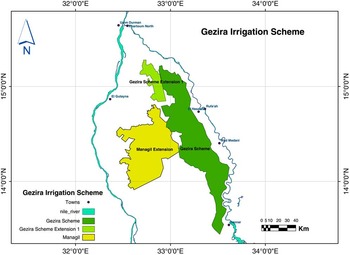
The Gezira Irrigation Scheme lies between the Blue and White Niles in Gezira State, some 250 km south of Khartoum (Fig. 1). It occupies about 5 million feddans (one feddan is equivalent to 1.38 acres), of which 3 million are suitable for irrigation. In 1911, cotton was planted on a small experimental scale with irrigation by pumps. When cotton production proved successful, it was decided to establish a dam at Sennar, which was finalized in 1925. The Sudan Plantations Syndicate of London financed the Gezira Irrigation Scheme initially, then later on the British Government secured funds to develop it. Sir John Watson Gibson OBE, a civil engineering contractor, built the Sennar and Gebel Aulia Dams. The Gezira Scheme was nationalized in 1950 and was operated by the Sudan Gezira Board as a government enterprise (Hyslop, Reference Hyslop1952). Water flowed by gravity from two main canals, one for the Gezira Scheme and the other for the Managil Extension, into major canals then in minor canals. Irrigation channels, called abu-eshreens, branched from minor canals at 300 m intervals. Several drains took excess water from the major canals.
Map of the Gezira Irrigation Scheme, Sudan.

Ten thousand Egyptians fellaheen (farmers) were employed in construction work. Before irrigation by canalization, the population was approximately 135,000 people (El Nager, Reference El Nagar1958). The gradual implementation of the scheme in the Gezira region led to a change in the composition of the population.
For centuries, Gezira had been the thoroughfare and rallying place for a great number of migrating tribes and the sedentary population (Gaitskell, Reference Gaitskell1959). The development of the agricultural scheme created the need for a larger workforce and established in-migration. The first population census of Sudan in 1955–56, based on ethnic subdivisions, revealed slight differences in population pattern between the eastern census areas (covered by the scheme) and those of western Gezira (not yet included in the scheme or not concerned by the extension). In the areas covered by the scheme, Arabs constituted 76.5% of the total population while West Sudanese and foreigners (predominately West Africans) were, respectively, 12.9% and 3.8% (Sudan Gezira Board, 1980). Thereafter, the population influx promoted by the scheme turned demographically in favour of West Sudanese and West Africans, while the proportion of Arabs decreased. This change in the dynamic of the population raised important sociological problems related to the integration of immigrants within Gezira society.
The British system sought to reduce the Gezira Scheme’s tenants to similar circumstances and avoided creating any positions of authority among them. In Gaitskell’s words, the administration was ‘a direct administration consciously emancipating, by the opportunity of economic independence, the individual tenants from the control of masters and fathers to whom otherwise they would still have been subservient’ (Gaitskell, Reference Gaitskell1959, p. 199). Through this process, the Arab youth felt liberated to migrate to the Gulf States in the late 60s and early 70s and came back with money to resume working and hired migrants to work in the fields.
The switch of life-style became observable in the life of Arabs shifting from the traditional single-roomed hut with its pointed thatched roof, which characterized the villages outside the scheme, to a square mud-brick room with a flat mud roof. New rules of decency required a greater segregation of women than in the past, as well in the organization of the household and their participation in field activities (Brausch, Reference Brausch1964). Strong resistance arose towards women going to the fields to work. It even became dishonourable for a woman to be observed in the agricultural field for fear of ‘strangers’ (Western migrants working in the fields). The new tenants adopted the habit of the old landlords of hiring labour for work in the fields and confined themselves to supervision. New standards of nutrition were adopted, and the diet included more meat stews, tea, coffee and sugar. Standards of dress changed and their whole life became more sophisticated. Instead of collecting dried dung for firewood they bought charcoal; rather than grinding flour themselves they sent grain to the mill to be ground, and when the pilgrimage season came, large parties set out for Mecca, quite a number of them by air (G. Culwick unpublished work, p. 56, quoted in Brausch, Reference Brausch1964; Barnett, Reference Barnett1977). Hired labour became a routine part of the cotton production process on all subsequent schemes. It was then formally institutionalized to the extent that scheme management routinely provided loans to tenants to pay labourers (Bernal, Reference Bernal1997, p. 447).
When market prices of cotton reverted to normal, the tenants had difficulty abandoning their illusions of wealth. The new ways of life they had adopted were carried on, perpetuating obstacles to the improvement of the management methods of their tenancies. Examples were their reluctance to allow women to participate in agricultural activities, and pride in having labourers in their service, although this became more and more of a financial burden. The effects of these handicaps were revealed by a comparative study of the management of tenancies, respectively by Arab and migrant tenants (from outside Sudan). Migrant populations from outside Sudan carried out most of the work, helped by their wives and children. They hired labourers during the picking season (Bernal, Reference Bernal1997, p. 447). Consequently, their net income was notably higher than that of the Arab tenants, who had to pay large amounts to their workers (Brausch, Reference Brausch1964). A social survey carried out in June 1963 by a group of students from the University of Khartoum established that often the material standing of a Fellata tenant was higher than that of an Arab tenant. The later continued to persist in thinking of himself as a landowner who must maintain a sophisticated standard of life (Brausch, Reference Brausch1964, p. 357).
In the early 70s, the demographic composition of the area mainly constituted of tenants who lived with their families, agricultural workers from western Sudan and immigrants from neighbouring countries. The migrants lived either in camps or in unregistered villages with inadequate health services, electricity, clean-piped water supply or schools. Their children could attend the nearest primary school and some migrants made use of the nearby dispensary or dressing station (Fenwick et al., Reference Fenwick, Cheesmond, Kardaman, Amin and Manjing1982). The estimate of the population of Gezira State in millions was 3.57 in 2008, 3.85 in 2010 and 4.10 in 2012 (Annual Health Statistical Report of Federal Ministry of Health, 2012), of which about 700,000 people were migrants primarily from Darfur and Kordufan States (Sudan) and neighbouring countries. These migrants formed a permanent pool of agricultural labour. Due to their low socioeconomic status, the immigrants played an important role in the transmission of schistosomiasis and other helminthic infections (Bella et al., Reference Bella, Marshal, Omer and Vaughan1980; Fenwick et al., Reference Fenwick, Cheesmond, Kardaman, Amin and Manjing1982).
Chronological review of the control of schistosomiasis in the Gezira Irrigation Scheme
Secondary data have been selected from original research work done on the area at different political eras since the early construction of the Gezira Irrigation Scheme. They have been used to critically review and carefully speculate on the processes of the intervention. The corresponding author is in a unique position to reflect changing approaches, as he has been actively involved in the control of schistosomiasis since 1968.
The colonial era: 1925–1955
Before the establishment of the Gezira Irrigation Scheme, no bilharzia was found among children from twenty villages in the middle of Gezira (Jordan, Reference Jordan2000), but in 1926, 1% of 4000 children examined had urinary bilharzia. Thirty months following the completion of the canals Bulinus snails (intermediate host of urinary bilharzia) were found throughout the system. Twelve months later Biomphalaria snails (intermediate host of intestinal bilharzia) were widely spread. The prevalence rate of Shaematobium was 0.3% and 4.3% in local and non-local Sudanese respectively. It was 14.3% in immigrants coming from all parts of Sudan. Intestinal schistosomiasis was not yet investigated and by 1927 snail hosts of both S. mansoni (Biomphalaria spp) and S. haematobium (Bulinus spp) were reported in irrigation canals (Humphreys, Reference Humphreys1932). Interest in the control of schistosomiasis in the Sudan was raised and intensified by the establishment of the Gezira irrigation Scheme in 1925. Successful treatment of schistosomiasis by antimony potassium tartrate in 1918, by Christopherson, was initiated following clinical trials on infected patients at Khartoum Hospital (Christopherson, Reference Christopherson1918). The health authorities of the Sudan Medical Services (SMS) were well aware of the consequences of bilharzia in the Gezira Irrigation Scheme: ‘failure to prevent would be disastrous and probably irreversible’ (Annual Report of Health Services, 1925). Measures adopted included screening of workers, compulsory treatment of infected people and snail control. The results of these measures were monitored by annual surveys. Between 1926 and 1935, 10,000–20,000 men were examined. The prevalence of S. haematobium varied between 0.06% and 0.77% and among thousands of children screened, between 0.22% and 1.12% were infected. No attempt seems to have been made to monitor S. manosoni during this period. The situation deteriorated during World War II and intestinal bilharzia replaced urinary infection as the main parasite (Stephenson, Reference Stephenson1947). In 1952, Greany examined over 80,000 people and found 8.77% were infected with S. mansoni and 8.86% with S. haematobium (Greany, Reference Greany1952). It was obvious that the infection rates of the two parasites varied from village to village and from area to area within Gezira.
The onset of the Second World War inevitably led to resources being shifted away from the control of bilharzia – in Gezira in particular, and health care in Sudan in general – towards fighting the war. The control of bilharzia began to be prioritized at independence in 1956.
Independence (1956) to 1979
Early attempts to control schistosomiasis following independence in 1956 focused on molluscicides to kill the snail vectors. The pioneers of this approach were El Hadi El Nagar, Province Medical Officer of Health (PMOH), and Hamid Sharaf el Din, a senior public health inspector stationed at Blue Nile Province (now Gezira State). They recommended the use of 30 parts per million (ppm) copper sulphate. This was done by means of small bags of copper sulphate tied to the ends of bamboo poles, lifted in and out of the water along both banks of each canal. This mass sulphation was followed by a continuous application of 0.125 ppm copper sulphate to act as a continuous chemical barrier. This was done by suspending copper sulphate bags at the off-takes of the major canals. The amount of copper sulphate was such that it required replenishment every 24 hours. In addition, mechanical barriers were erected at various places on the main canals to stop drifting snails from invading other watercourses. The mechanical barriers consisted of a series of fine mesh galvanized iron screens fitted to rails stretching across the canal. Diagnostic and treatment teams toured the area periodically from one village to the other using thick smear films for diagnosis of S. mansoni and antimony for treatment of infected subjects (Sharaf Eldin & El Nagar, Reference Sharaf Eldin and El Nagar1955; El Nagar, Reference El Nagar1958).
The major increase in prevalence of schistosomiasis in Gezira came after 1960. One factor, instituted by the Gezira Scheme, was the cropping rotation change to include ‘winter’ wheat. Farmers kept the canals filled with water from March to May, when they had previously been dry (Fenwick, Reference Fenwick1989). Another factor was the creation of the adjoining Managil Extension, which left tenants without adequate water supplies or sanitation facilities.
In late 1967, a Bilharzia Research Department was established for the first time at the Public Health Laboratories of the Ministry of Health (Stack Laboratory). Apart from the founder (Mutamad Amin), the Department had no staff, no budget, no equipment and no transport. Between 1967 and 1970 the existing schistosomiasis control measures, including the use of copper sulphate and mechanical barriers, were evaluated. It was concluded that copper sulphate was far from being an ideal molluscicide for use in the Gezira Scheme and that it should be abandoned when a better molluscicide was found. The mechanical barriers also proved to be inefficient and costly. They were removed on recommendation of a study by Amin (Amin, Reference Amin1972). Limited snail control measures, low cure rate, poor compliance by the community for the antimony drug, increased population (2 million by 1975) and shortage of funds resulted in an increase in schistosomiasis prevalence. A prevalence rate up to 70% was reported among school children (Amin et al., Reference Amin, Fenwick and Osgerby1976, Reference Amin, Fenwick, Teesdale, McLaren, Marshall and Vaughan1982).
The London Khartoum Bilharzia Project
During the Bilharzia symposium held in Addis Ababa in 1970, the lead author (Mutamad Amin) proposed to his PhD supervisor, Professor George Nelson of the London School of Hygiene and Tropical Medicine, a joint collaborative research project on bilharzia between the London School of Hygiene and Tropical Medicine and the Sudan Ministry of Health. Young British scientists joined their counterpart Sudanese to gain experience in tropical medicine and the London School provided logistic support for the project. The idea was welcomed by Professor Nelson and the project, thereafter named the London Khartoum Bilharzia Project, was established in 1970 as an agreement between the London School of Hygiene and Tropical Medicine, the Faculty of Medicine of the University of Khartoum, the Ministry of Health and the National Council for Research (NCR) in Sudan. The long-term objective was to recommend schistosomiasis control procedures for the Gezira Scheme. The champions of this agreement were Professor George Nelson from the London School of Hygiene and Tropical Medicine and Professor Ahmed El Hassan from the Faculty of Medicine, University of Khartoum. The Research leaders were Mutamad Amin and Alan Fenwick. The research findings of the project were documented and published (Amin et al., Reference Amin, Fenwick and Osgerby1976, Reference Amin, Fenwick, Teesdale, McLaren, Marshall and Vaughan1982; Kardaman et al., Reference Kardaman, Amin, Fenwick, Cheesmond and Dixon1983). The capacity building and research outcome of the London Khartoum Bilharzia project formed the basis of the schistosomiasis control strategy within the comprehensive plan of the Blue Nile Health Project. These early connections opened the gate for postgraduate studies for several students receiving scholarship from World Health Organization (WHO) Sudan and UK. Further exchange visits for researchers from the UK and Sudan were promoted.
The Blue Nile Health Project 1979–1990
In 1979, the Blue Nile Health Project (BNHP) was established to control malaria, schistosomiasis and diarrhoeal diseases in the Gezira-Managil and Rahad Schemes. The late President Nimairi strongly supported the project by issuing a presidential decree for its establishment and encouraging international donors to support the project. A comprehensive and integrated approach was adopted. Funding was assured to the BNHP as a joint venture between the Sudanese Government and international agencies such as the WHO, World Bank, Japanese Aid, DANIDA, ODA (now UK DFID) and USAID. After an international appeal for funding during a meeting at the Friendship Hall in Khartoum in 1980, the BNHP was able to develop a budget of 154 million US dollars for 10 years, including 60 million earmarked for water supply and sanitation (El Gadal, Reference El Gadal1985; Jobin, Reference Jobin2012). Mutamad Amin presented the international appeals for bilharzia and Abdel aziz Haridi for malaria. The objective was to reduce the overall prevalence of S. mansoni and S. haematobium to less than 10%. A comprehensive approach, including treating infected people, snail control, improving sanitation and water supply, providing health education and encouraging community participation through educating school children and tenants to protect themselves and their families, was implemented (Murda, Reference Murda1985).
In many respects, the BNHP was a great success story in the history of the control of water-associated diseases. The overall prevalence of schistosomiasis was reduced from 53% to 6%. It should be noted that the outcome of the studies conducted by the BNHP on various aspects of schistosomiasis such as focality of transmission, aquatic vegetation in the Gezira irrigation canals and community participation were added values for the improvement of control of schistosomiasis, not only in the Sudan, but worldwide (El Gadal, Reference El Gadal1985). The donated funds for 10 years were supposed to cover the Managil Extension. Unfortunately, this did not happen, mainly because of the devaluation of the Sudanese pound at that time. Following the termination of the BNHP, most of the trained qualified staff of the BNHP and universities left Sudan for jobs in the Gulf States because of the lack of job opportunities and low salaries.
From 1991 to 1999
Schistosomiasis was no longer a public health priority for policymakers and health authorities, not only in Sudan, but also in most endemic countries. Hence, it received little or no financial support despite the WHO declaring thirteen diseases, including schistosomiasis, to be Neglected Tropical Diseases. Since independence, no budget was disbursed by the Sudan Ministry of Finance for the control of schistosomiasis in the Sudan. The only fund came mainly from the Tenants Union. Aid or loans from international donors (except the World Bank) and Arab countries were directed to socioeconomic development projects, even though this stopped because of the sanctions imposed on Sudan by the USA and European countries. The sanctions affected all sectors, including the universities, and resulted in emigration of all types of specialization, not only to the Gulf countries but also to the USA, Canada, Australia and other countries.
No specific organized body responsible for controlling schistosomiasis characterized this era. Schistosomiasis was completely neglected because of more important diseases such as HIV/AIDS, TB and malaria. During this era, schistosomiasis affected communities in most Sudanese states, especially in the absence of drugs in health settings and molluscicides for snail control. Endemicity of S. mansoni and its patterns of transmission (focality, seasonality) were reported in 1995 in five villages in the Managil Irrigation Scheme (extension of the Gezira Scheme). Marked differences in prevalence rates between villages were recorded. The prevalence rates ranged from 33.3% to 54.8% and the intensity of infection varied from 77.3 to 135.0 eggs/g faeces. The overall prevalence and intensity of infection peaked among those aged 10–14 years and then declined slowly with increasing age for females, but not for males. The infection pattern was influenced by occupation and water contact activities such as farming, water collection from canals, swimming or washing in canals and lack of access to latrines (Hilali et al., Reference Hilali, Madsen, Daffalla, Wassila and Christensen1995).
The National Control Programme: 2000 to date
From 2000 to date shistosomiasis had spread to most states of Sudan, including Khartoum State. Prevalence rates of 72.8% in males and 62.3% in females were reported in a village in the Gezira Scheme in 2006 and the overall prevalence of splenomegaly was 35.8% (Saeed et al., Reference Saeed, El Wali, Dessein, Adeel, Magzoub and El Samani2006). A recent study showed a prevalence of 32.0% in children in the Habiba Administration Unit in Gezira State (Amin et al., Reference Amin, Swar, Kardaman, Elhussein, Gibril and Abdelhafiez2012). In 2000, a National Control Programme was established at the Federal Ministry of Health as a vertical programme under the General Directorate of Preventive Medicine. The programme began its work in Khartoum State and then extended to the other states by the middle of 2011. A co-ordinator was appointed in each state with the mandate to run the programme. The activities implemented by the National Programme and state co-ordinators from 2005 to 2012 included school surveys followed by mass chemotherapy. All the affected states were covered at different times. The sustainability of control activities conducted by the National Control Programme depended on the donation of praziquantel and availability of operational funds, which were not always available. The oil money was spent mostly on security and development projects. After the adoption of the federal system and discovery of oil, the control of schistosomiasis became the responsibility of the State of Gezira. Once again, a government law adopted in 2005 dismantled the Gezira Irrigation Scheme and the administration was weakened. The Sudan Tribune, in 2013, interviewed the Governor of Gezira State, who slammed the government law of 2005, saying, ‘It has done nothing to improve productivity of the country’s largest agricultural scheme that contains one of the world’s biggest irrigation projects’. The Governor also criticized the fact that the Gezira project administrators were not accountable to a higher body, as well as the non-existence of a general assembly to govern it. He proposed giving his state a stake in the project in terms of administration and overseeing it. He also noted that, ‘the scheme had not benefited from development loans received by the country over the years’ (Sudan Tribune, 2013).
Discussion
This review of the different attempts to control schistosomiasis in the Gezira Irrigation Scheme over the years has revealed that several factors were responsible for their failure and lack of sustainability, among which political will and financial support played important roles.
Political factors
After the dismantling of the Gezira Irrigation Scheme in 2005, funds donated by the Tenants Union for the control of schistosomiasis ceased, as well as funds that used to come from other countries. No budget allocation from the Sudan Ministry of Finance was allocated for the control of schistosomiasis.
Environmental factors
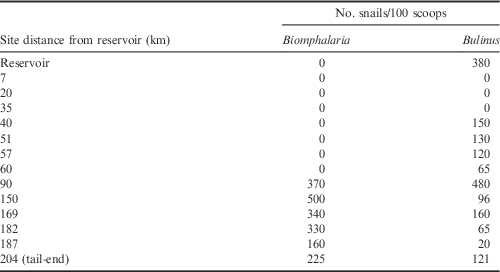
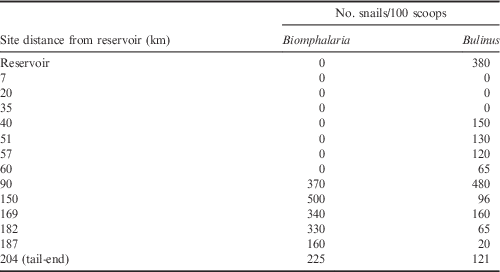
The distribution and abundance of the snail intermediate hosts of schistosomiasis in the Gezira Irrigation Scheme system were found to be influenced by several environmental factors in a study by Amin (Reference Amin1972). Using a metal scoop, ‘snail men’ examined snails along the edges of the water on both sides of the canal. The technique for using the scoop was to start at the edge of the canal, push away, scraping the canal bed and the vegetation to a distance of about one metre towards the middle of the canal and then firmly lift the scoop upwards vertically with a slight shake through the water. All vegetation and snails were transferred to a plastic bowl. The numbers of snails in 100 scoops were classified (Bulinus and Biomphalaria) and counted. The snail densities in the main canal are shown in Table 1. Biomphalaria pfeifferi, the intermediate host of S. mansoni, was not found in the reservoir or in the main canal up to the 90 km mark (distance from reservoir) because of the absence of suitable vegetation and the fast speed of the water flow. They were well established between 90 km up to the tail-end (204 km). Bulinus truncatus, intermediate hosts of S. haematobium, were found at the reservoir and in the first 35 km. The ecological requirements of the two snail species had an impact on the patterns of the disease. Urinary schistosomiasis was endemic in villages around the reservoir and along both sides of the main canal after 35 km. Intestinal schistosomiasis was endemic in most villages from 90 km. In general, snails were few in the main and major canals.
Snail density in main canal, Gezira Irrigation Scheme, Sudan, 1972
Source: Amin (Reference Amin1972).
The water was fast flowing in the first 50 km. Many acacia trees were found on the banks between 60 km and 120 km. Towards the tail-end of the canal the water was comparatively slow and some floating plants were seen. Mechanical barriers were found at 7, 35, 51 and 57 km from the reservoir.
The minor canals, drains and abu-eshreen (irrigation channels) are the major sites of breeding and transmission of schistosomiasis. These snail habitats are influenced by water flow, temperature, water turbidity and vegetation (Amin, Reference Amin1972; Fenwick et al., Reference Fenwick, Cheesmond and Amin1981; Hilali et al., Reference Hilali, Desougi, Wassila, Daffalla and Fenwick1985).
Currently the Gezira Scheme is suffering from a deterioration of irrigation water management and performance is below expectation because of a change in policy introduced by a government law of 2005. An increase in silt and absence of vegetation in the minor canals will lead to reduced snail densities, especially Biomphalaria, and consequently a reduction in S. mansoni infection (Amin et al., Reference Amin, Fenwick and Osgerby1976).
Human behavioural factors
Human behaviour is resistant to change and behavioural modification will be achieved only with an increase in the knowledge and understanding of schistosomiasis transmission in conjunction with an increase in standards of living (Stothard et al., Reference Stothard, Mook, Mgeni, Khamis, Khamis and Rollinson2006). Thus, although education has been successful in promoting behavioural change, it may have a limited impact on the prevalence or intensity of infection without access to safe water and sanitation.
Water contact activities
Water contact could be through occupational or recreational activities conducted in infested open water. Variation in patterns of infection depends on exposure time as well as age and gender (Hilali et al., Reference Hilali, Desougi, Wassila, Daffalla and Fenwick1985). For example, a peak infection rate occurs in younger age groups, and in areas of intensive transmission, such as the population of the unregistered camps of the Gezira Scheme. Another pattern of infection has been found in a group of people working as canal cleaners in the Gezira Scheme. They were employed by the Ministry of Irrigation to remove weeds from canals to help in the movement of water, and stay for long hours in infested water on a daily basis, transferring schistomiasis from one canal to another. An overwhelming acute spread of schistosomiasis in the body of these canal cleaners was reported in 1973 (Amin & Omer, Reference Amin and Omer1973).
Defecation and urination behaviour
Defecation and urination do not take place in water sources except by children when swimming in open water and emptying their bladders, releasing S. haematobium eggs. Pollution of watercourses and rivers occurs when S. mansoni eggs are released into them. Most rural communities in South Africa do not have access to running water, toilets or latrines; they use watercourses for defecation and urination. In many cases, where they are present, latrines are located upstream from where the community collects their water supply (Randa Water Foundation, 2014). Rural latrines play an important role in the promotion of schistosomiasis control, economic development and social harmony, as shown in Jiangsu Province, China (Zhongguo et al., Reference Zhongguo, Chong and Zhi2011). In the Gezira Scheme in the 80s migrant labourers lived with their families in small camps and unregistered villages that had no piped water, latrines or health services. They relied on canal water for domestic uses. Their preferred site for defecation was near eucalyptus trees, which offered complete privacy, with subsequent washing in the nearby abu-eshreen, the small irrigation canals (Fenwick et al., Reference Fenwick, Cheesmond, Kardaman, Amin and Manjing1982)
Sanitation, safe water supplies and behaviour change
Sanitation, safe water supplies and behaviour change strategies supported by health education are essential components for the control of schistosomiasis. Children will always play in water and empty their bladders, releasing S. haematobium eggs into the environment. A behavioural change of the population is necessary to stop the contamination of open water bodies. Epidemiological review studies have showed a 77% reduction of schistosomiasis from well-designed water and sanitation interventions that prevent faeces and urine from contaminating surface water (Esrey et al., Reference Esrey, Potash, Roberts and Shiff1991), as revealed by Zimbabwe community health workers involved in the implementation of improved water supply, sanitation and health education (Chandiwana et al., Reference Chandiwana, Taylor and Matanhire1991). Such activities proved to be highly successful in educating different communities in the health aspect of schistosomiasis. In remote communities in Ethiopia, local health personnel and farmers ran successful control programmes where the whole community was involved in the management of schistosomiasis (Gundersen et al., Reference Gundersen, Birrie, Torvik and Scherbaum1990). In Sudan, the Blue Nile Health Project managed to reduce the prevalence of schistosomiasis from 53% to 6% by adopting a comprehensive approach combining chemotherapy, snail control, water supply and sanitation. Local communities endorsed this approach because of health education. They identified their health problems, and planned and participated in the control of vector-associated diseases in the Gezira irrigation area (Murda, Reference Murda1985).
Migration
In Sudan, agricultural labourers from Egypt, Nigeria and western Sudan have played a significant role in the spread of schistosomiasis and the change in the patterns and type of infection (Amin & Satti, Reference Amin and Satti1973; Bella et al., Reference Bella, Marshal, Omer and Vaughan1980). The prevalence of intestinal schistosomiasis was high in the Gezira Agricultural Scheme in the late 1970s, while that of urinary schistosomiasis was variable but generally low (Kardaman et al., Reference Kardaman, Amin, Fenwick, Cheesmond and Dixon1983). Changes in the patterns and type of infection were related to the waves of incoming migrants from different areas of Sudan to work in the Gezira Scheme (El Gadal, Reference El Gadal1985). The causes of migration to Gezira have been religious, socio-political and racial (Hassoun, Reference Hassoun1952). Population movements also play an important role in the cross-border transmission and control of schistosomiasis, as revealed in the Jazan region (Saudi Arabia). Trade, social activities and seasonal visits to holy places through Jazan have played a significant role in the local transmission of schistosomiasis due to daily population movement between Saudi Arabia and Yemen (Ageel & Amin, Reference Ageel and Amin1997; Al Ghatani & Amin, Reference Al Ghahtani and Amin2005).
Lessons learnt from successful schistosomiasis control programmes
Successful schistosomiasis control programmes have been reviewed (Chitsulo et al., Reference Chitsulo, Engels and Montresor2000; WHO, 2000; WHO/EMRO, 2007; Rollinson et al., Reference Rollinson, Knopp, Levitza, Russell, Amadou, Mohammedi and Schurb2013). Countries at the fringes of endemic areas, or those experiencing high socioeconomic development, are more likely to achieve elimination (Fenwick et al., Reference Fenwick, Rollinson and Southgate2006). Consideration of local socio-cultural, economic and political factors is essential for the success of elimination programmes as these factors will influence the application and acceptance of intervention strategies (Aagaard-Hansen et al., Reference Aagaard-Hansen, Mawanga and Bruun2009). In the Mediterranean region, schistosomiasis has been eliminated in Morocco, Lebanon and Tunisia. Countries with low endemicity, including Oman, Libya, Egypt, Jordan, Iraq and Syria, have been targeted for elimination (WHO, 2000; WHO/EMRO, 2007). Socioeconomic development in most areas of Saudi Arabia has resulted in improved sanitation and water supplies, and a significant increase in medical care and education. This has played a large part in the interruption of transmission (Swailem Reference Swailem1988; Ashi et al., Reference Ashi, Arfaa, Jeffri and Suwiry1989).
In Sudan, the El Girba Scheme (182,000 acres) is an excellent example of the prevention and control of schistosomiasis by the socioeconomic development of the re-settled Wadi Halfa people. The population left their home areas in northern Sudan because of the establishment of the Aswan High Dam and re-settled in 25 villages scattered throughout the scheme at reasonable distances from watercourses. The planners took into consideration the optimum village size (250–300 families) and provided economic community services such as schools, health centres, social clubs and piped water, and a latrine in each household. Before the establishment of irrigation in 1964, schistosomiasis was not known in the El Girba area. The re-settled population had a prevalence rate of S. haematobium of 4–6% and had no S. mansoni infection (Omer, Reference Omer1978). Surveys in 1979 showed that S. haematobium was non-existent among the migrant Nubians and the prevalence of S. mansoni was only 8% for a period of about 20 years (Mamoun, Reference Mamoun1979).
Conclusions
For ninety years (1925–2015), the control of schistosomiasis could not be sustained in the Gezira Irrigation Scheme. Efforts until the 1970s to control schistosomiasis by treating infected people and killing of snails with molluscicides or by mechanical means were not effective. Following the discovery of an efficient and easy to administer drug, praziquantel, the WHO Expert Committees stressed the importance and feasibility of reducing morbidity due to schistosomiasis via control programmes and recommended the use of operational components, such as safe water supply, sanitation, environmental management, snail control and health education, along with chemotherapy, in an integrated manner (WHO, 1998). The main lesson learned from Sudan and other countries is that the control of schistosomiasis has to be within the context of socioeconomic development according to the success stories mentioned above in Sudan and elsewhere. A strong political commitment and engagement through allocation of a budget line and an annual disbursement of funds from the national budget for schistosomiasis control and water resource development will enhance the elimination of schistosomiasis in Sudan.
Acknowledgments
The authors would like to thank Melissa Parker (Associate Professor) of the London School of Hygiene and Tropical Medicine in the United Kingdom and Mounkaila Noma (Medical Doctor) of the University of Medical Sciences and Technology in Sudan for their valuable views and comments on different stages of the article.