INTRODUCTION
Caridean shrimps show considerable variation in sexual systems and mating behaviours (Correa & Thiel, Reference Correa and Thiel2003a; Bauer, Reference Bauer2004). While most caridean shrimps are gonochoric (e.g. Macrobrachium, Palaemonetes and Palaemon sp.), some species can change sex from male to female (protandry) and a few have also evolved protandric simultaneous hermaphroditism (e.g. Lysmata sp., Bauer, Reference Bauer2000, Reference Bauer2004; Baeza & Anker, Reference Baeza and Anker2008; Onaga et al., Reference Onaga, Fiedler and Baeza2012; Baeza et al., Reference Baeza, Behringer, Hart, Dickson and Anderson2014b). In some species of caridean shrimps (e.g. Macrobrachium and Rhynchocinetes), dominant males are larger than females and equipped with enlarged chelipeds or third maxillipeds which serve as weapons in fighting for and defending females (Ra'anan & Sagi, Reference Ra'anan and Sagi1985; Correa & Thiel, Reference Correa and Thiel2003a; Bauer, Reference Bauer2004). In many other caridean species, males are smaller than females, and weaponry is similar in relative size to that of females (Wickler & Seibt, Reference Wickler and Seibt1981; Bauer, Reference Bauer2004). Such differences in sexual dimorphism are correlated with mating systems. Species with large male size and hypertrophied weapons show variations of female defence and guarding, while ‘small male’ species have promiscuous ‘pure search’ mating systems with little precopulatory interaction between males and females (Wickler & Seibt, Reference Wickler and Seibt1981; Correa & Thiel, Reference Correa and Thiel2003a; Bauer, Reference Bauer2004).
In some species of the family Rhynchocinetidae, e.g. Rhynchocintes typus and R. brucei, the males undergo striking morphological changes during ontogeny: they become sexually mature in the typus morphotype (TM) stage (similar in morphology to females), then pass through several intermedius morphotype (IM) moults before they reach the final or terminal moult stage, termed robustus morphotype (RM). During male ontogeny the 1st pereopods (major chelipeds) and the 3rd maxillipeds experience strong allometric growth and are extremely developed in robustus males (Correa et al., Reference Correa, Baeza, Dupre, Hinojosa and Thiel2000; Thiel et al., Reference Thiel, Chak and Dumont2010). Males also differ in important behavioural and physiological characters, indicating that the largest males dominate the mating process owing to their high resource holding potential (Correa et al., Reference Correa, Baeza, Hinojosa and Thiel2003). In the other rhynchocinetid genus, Cinetorhynchus, there is also a similar ontogeny of males in which the larger males have hypertrophied major chelipeds (but not third maxillipeds) and in which a similar mating system has been hypothesized (Bauer et al., Reference Bauer, Okuno and Thiel2014).
Several types of mating systems have been suggested for caridean shrimps (Correa & Thiel, Reference Correa and Thiel2003a). In some species in which large males with hypertrophied weaponry (third maxillipeds and/or major chelipeds) are dominant over other males, the proposed mating system is termed ‘neighbourhoods of dominance’. Mating success depends on the ontogenetic stages of male morphotypes, and dominant males engage in mate guarding of receptive females to prevent mating by subordinate males (Ra'anan & Sagi, Reference Ra'anan and Sagi1985; Correa et al., Reference Correa, Baeza, Dupre, Hinojosa and Thiel2000; Thiel & Hinojosa, Reference Thiel and Hinojosa2003; Thiel et al., Reference Thiel, Chak and Dumont2010). Typically, the largest males of Macrobrachium (blue claw) and Rhynchocinetes (robustus or dominant) have a higher reproductive potential than subordinate males of Macrobrachium (small and orange claw stages) and Rhynchocinetes (intermedius and typus stages). Dominant males are attractive to females and their guarding behaviour guarantees successful fertilization of receptive females in the highly competitive environment found in their natural habitat (Ra'anan & Sagi, Reference Ra'anan and Sagi1985; Thiel et al., Reference Thiel, Chak and Dumont2010; Bailie et al., Reference Bailie, Fitzpatrick, Connolly, Thiel and Prodöhl2014).
The genus Rhynchocinetes is primarily distributed in the Indo-Pacific region. At least two species, R. typus and R. brucei, exhibit different male morphotypes during ontogenetic development, with increasing size and other changes in the first pereopods (major chelipeds) and third maxillipeds (Correa et al., Reference Correa, Baeza, Dupre, Hinojosa and Thiel2000; Thiel et al., Reference Thiel, Chak and Dumont2010). However, a third species, R. uritai lacks such morphotypes (Bauer & Thiel, Reference Bauer and Thiel2011). These variations in male morphology are associated with differences in mating behaviour (Correa et al., Reference Correa, Baeza, Dupre, Hinojosa and Thiel2000; Thiel et al., Reference Thiel, Chak and Dumont2010; Bauer & Thiel, Reference Bauer and Thiel2011). Description and analysis of sexual morphology and mating systems of other species in the family are necessary to test hypotheses about ancestral states and evolution of these features (Baeza et al., Reference Baeza, Bauer, Okuno and Thiel2014a).
One such species for which sexual dimorphism and mating system has not been studied is the hingebeak shrimp R. durbanensis Gordon, which has a wide distribution in the Indo-Pacific, e.g. South Africa, Ryuku Islands, Philippines and Indonesia (Chace, Reference Chace1997). In Indian waters, this species has been recorded from the Karnataka coast (Dinesh Babu & Zacharia, Reference Dinesh Babu and Zacharia2007; Zacharia et al., Reference Zacharia, Krishnakumar, Dineshbabu, Vijayakumaran, Rohit, Thomas, Sasikumar, Kaladharan, Durgekar and Mohamed2008), Gulf of Mannar (Prakash & AjithKumar, Reference Prakash and Ajithkumar2013) and Andaman waters (Subramoniam, Reference Subramoniam2013). Due to the growing demands of the marine ornamental industry (Calado, Reference Calado2008), crustacean decapods, in particular caridean shrimps, are widely collected in the Indo-Pacific region and traded throughout the world. Among the family Rhynchocinetidae, eight species have been highly targeted by the marine ornamental shrimp industry (see Calado et al., Reference Calado, Lin, Rhyne, Araujo and Narciso2003: Table 1). In India, it has been harvested frequently from the Gulf of Mannar for marine aquarium trade (personal observation SP). Despite its wide geographic distribution, detailed studies on life cycle, larval development, commercial culture techniques, mating behaviour and other reproductive aspects have not been done in R. durbanensis. Thus, in the present study, we investigated sexual dimorphism and mating systems of R. durbanensis by analysing the reproductive morphology of secondary sexual characters, morphometry, and mating behaviours of three male morphotypes to test the hypotheses that (i) populations of this species have clearly distinguishable male morphotypes, and (ii) that the various male morphs utilize different mating behaviours with females.
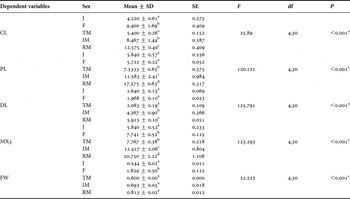
One-way ANOVA of morphological characters of Rhynchocinetes durbanensis (CL, Carapace length; PL, propodus length; CAL, carpus height; DL, dactyl length; MX3, Length of third maxilliped; MX-SP, number of maxilliped spines; FW, basipod flange width) (J, Juveniles; F, females; TM, typus male; IM, intermedius male; RM, robustus male).

*P < 0.001; superscripts indicates significant levels based on Duncan-Multiple Range Test (DMRT).
MATERIALS AND METHODS
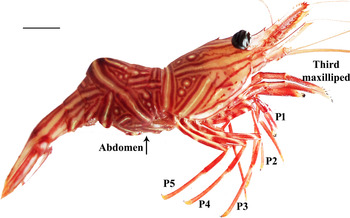
The hingebeak shrimp Rhynchocinetes durbanensis (Figure 1) was recently reported from the Gulf of Mannar, Tamil Nadu, India (Prakash & AjithKumar, Reference Prakash and Ajithkumar2013). These shrimps were collected in this area near the city of Tuticorin among coral crevices and rocky substrata in subtidal waters. The areas sampled were gently sloped sandy bottoms with large boulders and coral patches, slightly covered with coralline algae. All shrimps were collected by scoop nets and dip nets by snorkelling and scuba diving at water depths ranging from 2–15 m. The shrimps were abundant enough in the locations sampled to yield sufficient material for the study. During daytime hingebeak shrimps frequently hide in crevices (Ory et al., Reference Ory, Dudgeon, Duprey and Thiel2014), and therefore we focused on these habitats to catch them. Samples collected from the field were immediately preserved in 5–10% seawater formalin initially and later washed with fresh water and transferred to 70% ethanol for permanent storage.
Ovigerous female Rhychocinetes durbanensis Gordon (CL 11.2 mm) showing the morphological parts; P1 to P5 indicates pereopods. Scale bars = 10 mm.

Reproductive morphology of males
Species identification of preserved specimens of Rhynchocinetes durbanensis was done using Gordon (Reference Gordon1936), Okuno & Takeda (Reference Okuno and Takeda1992) and Prakash & AjithKumar (Reference Prakash and Ajithkumar2013). The measurement of body size (CL – carapace length in mm) was taken as the distance from the posterior edge of the eye orbit to the mid-dorsal posterior edge of the carapace. Specimens were sexed using the presence (male) or absence (female) of an appendix masculina and appendix interna with cincinnuli on the endopod of the second and first pleopod respectively (Bauer, Reference Bauer2004). Individuals within the male size range (<5 mm CL) that lacked an appendix masculina were considered juveniles. As in other Rhynchocinetes species (R. typus and R. brucei: Correa et al., Reference Correa, Baeza, Dupre, Hinojosa and Thiel2000; Thiel et al., Reference Thiel, Chak and Dumont2010; R. uritai, Bauer & Thiel, Reference Bauer and Thiel2011), we described male variation in the morphology of R. durbanensis in order to distinguish male ontogenetic morphotypes. As Thiel et al. (Reference Thiel, Chak and Dumont2010) had considered a variety of morphometric measurements to differentiate the morphotypes, we used carapace length (CL), length of the distal segment of third maxillipeds (MX3), propodus length (PL) and dactyl length (DL) of the major chelae (1st pereopods). To investigate the possibility of protandrous sex change, the basipod flange width (FW), which is wider in breeding females, was also measured in both males and females (Bauer, Reference Bauer1986). All measurements were made with the use of an ocular meter in a stereomicroscope (Olympus SZ51, Japan) to the accuracy of 0.1 mm.
Mating behaviour
For studies on mating behaviour, individuals of R. durbanensis (N = 20) were collected separately from the study site without causing any damage to the body parts and pereopods. Shrimps were sampled by gently guiding individuals into polyethylene bags, packed with sufficient oxygen and transferred to the Marine Ornamental Fish Hatchery at the Centre of Advanced Study in Marine Biology, Annamalai University, Tamil Nadu. Live shrimps were then acclimatized for 3–4 h and thereafter transferred to flowing seawater tanks (0.91 m length × 0.46 m width × 0.46 m height) in the hatchery where they were maintained with ad libitum food supply (e.g. boiled oysters, mussels, shrimps and commercial pellets). Rocks from the natural environment and PVC pipes were provided for the shrimps during the acclimation and observation periods; moulting individuals (particularly males) sought shelters because they suffered cannibalism by other individuals in the tanks. The water quality parameters were maintained at 26–27°C, 30 ppt and 4–6 ml L−1 of dissolved oxygen.
For studying mating behaviour, three treatments were used, with females individually paired with each of the three male morphotypes (typus, intermedius and robustus). Three replicates were conducted for each treatment, and each individual was used only once. Female individuals for all treatments were selected within a size range of 9–10 mm CL. For these observations, male morphotypes were tentatively classified by body size (CL): typus (6–7 mm), intermedius (9–10 mm) and robustus (12–13 mm). Before initiating the observations, each pair was transferred and maintained separately in small 54 L glass tanks (0.60 m length × 0.30 m width × 0.30 m height) with non-living coral rubble as a substratum. Observations were conducted in a non-competitive environment (1 female: 1 male) to avoid intra-sexual conflicts between the male morphotypes.
Mating events were recorded by a Sony DSC-H90 digital camera hanging above the tank with day illumination by overhead fluorescent lights using 15 W white bulb (Philips, India) and night illumination with 15 W red lamps (Philips, India). Although these shrimps are normally nocturnally active, mating occurred during both day and night hours in the laboratory. After acclimation in the observation tanks, the shrimps were monitored continuously as soon as the males began to approach the females before they moulted. Visual observations and video recordings were made on mating behaviours (touching, overlapping and guarding) performed by each morphotype with the receptive females, as well as measurements of the time spent by male morphotypes during the process of moulting to mating and mating to spawning (appearance of egg mass in the abdomen). After successful mating and spawning of females, the egg mass could be clearly observed attached underneath the ventral side of the abdomen as a dark mass, which contrasted with the body of this semi-transparent shrimp. Initiation of spawning was observed by the bending of the abdomen in females and spawning was ended with several pleopodal beats for the arrangements of eggs in the abdomen.
Statistical analysis
Sexual dimorphism and morphological differences among male ontogenetic stages (TM, IM and RM), initially identified on the basis of size, were examined by canonical discriminant analysis based on the comparison of morphometric variables described above. This discriminant analysis is robust for studying differences among morphotypes, and multivariate analysis was carried out on measures of the morphological variables to differentiate among females and male morphotypes. After meeting the assumption of homogeneity of variances, one-way ANOVA was also utilized as necessary for the comparison of morphometric characters, reproductive behaviours (touching, overlapping and holding) and time duration between mating events (moulting to mating and mating to spawning) of male morphotypes (TM, IM and RM) using SPSS statistical software package version 16.0, USA (Norusis, Reference Norusis2009).
RESULTS
Identification of secondary sexual characters and male morphotypes
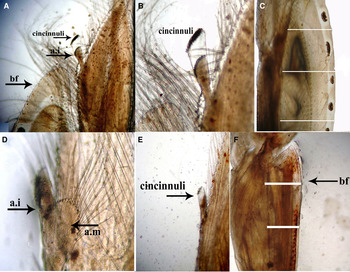
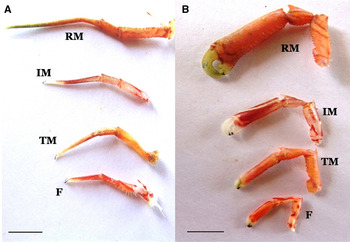
The females were easily recognized by the absence of an appendix masculina on the second pleopod, which also bears an appendix interna with cincinnuli (coupling hooks) as do pleopods 2–5 in both males and females (Figure 2A, B). Compared with males, the postero-lateral basipod flange width of the second pleopod of females is much enlarged and expanded (Figure 2C), a structure which forms, in part, a spawning and incubatory chamber for embryos (Bauer & Thiel, Reference Bauer and Thiel2011). The males were identified by the presence of an appendix masculina on the endopod of the second pleopod (Figure 2D) and an appendix interna with cincinnuli on the endopod of the first pleopod (Figure 2E), which is typical of rhynchocinetid males (e.g. Okuno & Takeda, Reference Okuno and Takeda1992). In males, the basipod flange width was much smaller in size (Figure 2F). Among the collected males, three ontogenetic stages (typus, intermedius and robustus) were identified based on the morphology and relative size as in other two species R. typus (Correa et al., Reference Correa, Baeza, Dupre, Hinojosa and Thiel2000) and R. brucei (Thiel et al., Reference Thiel, Chak and Dumont2010). The typus (TM) and intermedius males (IM) are characterized by 5–7 dark spines on the tips of the maxillipeds. Males in the final robustus (RM) or terminal moult stage were easily recognized by the presence of elongated third maxillipeds with one pointed ‘spine-like’ structure. The structure and relative size of the third maxillipeds and first chelipeds (pereopods 1) among females and male morphotypes are shown in Figure 3A, B. Carapace length increased in size from TM to IM to RM (Table 1). These male morphotypes were further confirmed using canonical discriminant analysis (see below).
Reproductive morphology of ovigerous female (A–C) and male (D, E) of Rhynchocinetes durbanensis: (A) a.i and bf of pleopod 2 of ovigerous female – 8 mm CL; (B) a.i with cincinnuli magnified; (C) bf width magnified (white lines); (D) pleopod 2 of male – 10.1 mm CL showing both a.i and a.m; (E) a.i on pleopod 1; (F) reduced basipod flange in males (white lines). Scale bars: A, D = 1 mm; B, C, E, F = 0.5 mm (a.i: appendix interna; a.m: appendix masculina; bf: basipod flange).

Variation in third maxilliped and major chelipeds of female and male morphotypes (TM, typus; IM, intermedius; RM, robustus). (A) extended third maxillipeds and (B) major chelipeds (TM, 5.7 mm; IM, 10.2; RM, 13 mm and F,8 mm CL). Scale bars: = 10 mm.

Variation in morphometry of R. durbanensis
A total of 35 individuals (5 juveniles, 13 males (3 typus; 6 intermedius; 4 robustus) and 17 females) were specifically collected, identified and measured for morphometry of reproductive characters. The result of one-way ANOVA of morphometry with dependent variables CL, PL, DL, MX3 and FW for juveniles, females, TM, IM and RM is shown in Table 1. Carapace length (CL), propodus length (PL) and dactylus length (DL) increase from TM to IM to RM morphotypes. The length of the terminal article of the third maxillipeds (MX3) shows a similar increase among male morphotypes but showed only slight variation in females, which were larger in size than TM and IM but smaller than RM. The relative size of the basipod flange width (FW) increased with body size of all females, but only showed slight differences among male morphotypes.
Canonical discriminant analysis
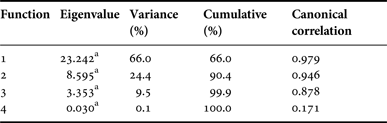
Initial separations of morphotypes were further supported by canonical discriminant analysis by combining all the measurable morphometric characters to obtain comprehensive separation among the individuals. The four eigenvalues obtained from these morphometric characters were 23.242, 8.595, 3.353 and 0.030, with the first component showing variability of 66.0% (Table 2). Larger eigenvalues indicate stronger variation between the dependent variables (CL, PL, DL, MX3 and FW). Overall morphometric measurements of individuals showed 90.4% of variability (Table 2), which showed a considerable discrimination among male ontogenetic stages and females.
Canonical discriminant analysis of morphometric comparisons for differentiating females and male ontogenetic stages (typus, intermedius and robustus) of Rhynchocinetes durbanensis.
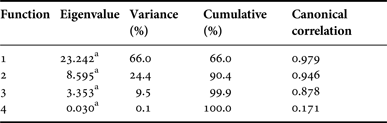
a First four canonical discriminate functions were used in the analysis.
Plots of canonical discriminant functions 1 and 2 (positive and negative correlations of measurable characters among sexes) of all the morphometric characters used in the analysis showed a complete separation of females and male ontogenetic stages (TM, IM and RM) (Figure 4). Individuals were well separated and absolutely differentiated based on the first component variables.
Canonical discriminant functions 1 and 2 include morphometric comparisons of all the characters of R. durbanensis for differentiating juveniles (J), females (F) and male ontogenetic stages: typus (TM), intermedius (IM) and robustus (RM).

Mating behaviour of male morphotypes
A total of nine mating events were observed from initial contact, copulation and final separation of mating partners. Mating occurred both during daytime (N = 4) as well as at night (N = 5). Mating was first initiated by males, which contacted reproductive females with various behaviours such as touching, overlapping and holding behaviour before and after moulting, mating and spawning events. During touching, the male frequently touched the female with its antenna, extended maxillipeds and chelae of the first pereopods (Figure 5A). In overlapping, the males perched over the female and slightly remained perpendicular to the body by covering either the cephalothorax or pleon (Figure 5B). Just before spermatophore transfer, the males were positioned directly above and over the female, with both individuals facing in the same direction (holding behaviour; Figure 5C) and the male tapping the female's thorax region with his major chelipeds (pereopod 1) and other pereopods (2–5). During spermatophore transfer in all morphotypes, the male placed himself 45° above the female and bent its pleon underneath the female's body, so that their genital regions were in contact for 1–6 s. After transfer, the males (particularly IM and RM morphotypes) held the females for a few seconds and separated from females before spawning (appearance of egg mass). However, TM separated immediately after spermatophore transfer; holding or other postcopulatory guarding of females by TM was not observed.
Mating events of R. durbanensis. (A) initial contact of robustus male with female using antenna, extended third maxilliped and major chelipeds (touching behaviour); (B) overlapping and (C) holding behaviour. Scale bars A = 1 mm; B, C = 0.5 mm.

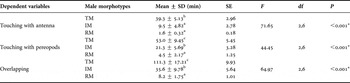
In IM (N = 3) and RM (N = 3) morphotypes, continuous chasing of females by the males was observed for 0–30 min before female moulting. These males regularly visited the females by touching the body parts using antennae and pereopods. After moulting, the RM and IM males moved towards the receptive females to initiate spermatophore transfer. In the beginning, males touched the receptive females using antennae and maxillipeds for 1–2 min by RM and 1–15 min by IM morphotypes (F (2, 6) = 71.65; P = 0.001). Further contacts were also established using pereopods for 2–6 min (RM) and 10–30 min (IM) (F (2, 6) = 44.45; P = 0.001), followed by overlapping which varied from 3–10 min (RM) and 20–45 min (IM) (F (2, 6) = 64.97; P = 0.001) (Table 3). A mixture of touching and overlapping were continuously exhibited by the RM and IM morphotypes until mating. After overlapping, the males gently held the receptive females and spermatophore transfer was attempted only once by each male morphotype during the entire observation. In IM and RM morphotypes the sperm transfer event lasted 3–6 s, which was longer than typus males. The spermatophore transfer events in RM and IM morphotypes were terminated by the male slowly moving away from the female. The female stayed idle for a few seconds before moving again. The total time span from the female moult to spermatophore transfer event (mating) lasted for 11–23 min (mean 16.67 ± 3.48 SD min) in RM and 47–81 min (64.33 ± 9.82 SD min) in IM morphotypes, respectively (F (2,6) = 32.21; P = 0.001) (Table 4).
One-way ANOVA of total time duration (min) of reproductive behaviours performed by male morphotypes (TM, typus male; IM, intermedius male; RM, robustus male) of R. durbanensis.

*P < 0.001; different superscripts indicates significant levels based on Duncan–Multiple Range Test (DMRT).
One-way ANOVA of mating events of male morphotypes of R. durbanensis (MM, molting to mating; MS, mating to spawning (appearance of egg mass) (TM, typus male; IM, intermedius male; RM, robustus male) (N = 3 for each morphotype).

*P < 0.001; # P < 0.05; superscripts indicate significant levels based on Duncan Multiple Range Test (DMRT).
In a few cases, particularly the RM (N = 2) and IM (N = 1) morphotypes held the female for few seconds (1–4 s) after spermatophore transfer, but no prolonged holding or mate guarding was observed as in some other Rhynchocinetes species (Correa et al., Reference Correa, Baeza, Dupre, Hinojosa and Thiel2000; Thiel et al., Reference Thiel, Chak and Dumont2010). After spermatophore transfer, the males usually revisited the females by touching with the antenna and pereopods and some overlapping was also displayed by the robustus males. The revisiting time duration lasted from few to several minutes in IM and RM morphotypes, which assured the successful spawning of reproductive females. The total time span from mating to spawning (appearance of egg mass) varied from 16–36 min in RM and 39–72 min in IM and showed significant differences (F (2, 6) = 6.28; P = 0.034) (Table 4).
In TM morphotypes (N = 3), the male did not approach the females before moulting; instead, it roamed around the aquarium. Early antennal or pereopodal contacts were also not displayed. Once the female had started the moulting process, the typus males stayed close to the females and slowly established the antennal and pereopod contacts, which lasted for 30–60 min. Furthermore, the receptive females rejected the TM males in many instances when the males tried to overlap with the female for spermatophore transfer. Finally, the males transferred the spermatophores quickly within a short duration of 1–3 s. Before the completion of spermatophore transfer onto the female abdominal region, sudden withdrawal (backward swimming) or escape response aided by abdominal tail flips of the receptive females was observed. The total time span from moulting to attempted spermatophore transfer ranged from 92–125 min (109.33 ± 9.56 SD min). Until spawning, these typus males continued to approach the females occasionally to establish antennal contacts, but the overlapping or holding of reproductive females by typus males was not observed. The duration of spermatophore transfer event to spawning ranged from 59 to 92 min (70 ± 11.0 SD min) (Table 4).
Cleaning below the abdomen and of pleopods was observed in all females after spermatophore transfer. Females mated by typus males continued cleaning the egg mass after spawning had commenced, and they removed and started consuming the eggs. During initiation of spawning, females tend to bend the abdomen few times before releasing the eggs and the spawning is ended with continuous pleopodal beats that may help in the arrangement of eggs under the abdomen. Successful fertilization of females by RM and IM morphotypes was observed by monitoring the embryonic development of female broods until hatching. Females carrying embryos successfully retained the brood until the larvae hatched after 9–12 days. In contrast, the females carrying embryos fertilized by TM were unable to incubate the embryos successfully. In all observations on females mated by TM males, the females appeared to lose the embryos within 3–5 days of spawning.
DISCUSSION
In many caridean shrimps, growth may be accompanied by considerable morphological changes, particularly in males. The occurrence of different male morphotypes has evolved in some palaemonids (Lee & Fielder, Reference Lee and Fielder1982; Ra'anan & Sagi, Reference Ra'anan and Sagi1985; Kuris et al., Reference Kuris, Ra'anan, Sagi and Cohen1987; Moraes-Riodades & Valenti, Reference Moraes-Riodades and Valenti2004; Rojas et al., Reference Rojas, Morales, Rivadeneira and Thiel2012), rhynchocinetids (Correa et al., Reference Correa, Baeza, Dupre, Hinojosa and Thiel2000; Thiel et al., Reference Thiel, Chak and Dumont2010; Bauer et al., Reference Bauer, Okuno and Thiel2014; present study) and hippolytids (Tirmizi & Kazmi, Reference Tirmizi and Kazmi1971; Bauer, Reference Bauer1977; Jensen, Reference Jensen2014). In these shrimps, the changes during male ontogeny are striking and there are discrete differences among male morphotypes, which can be clearly distinguished based on the colour patterns of the major chelae, variation in cheliped morphology, and other morphometric characters.
Earlier studies have suggested that morphometry of the species is fundamental in separating the ontogenetic stages (Warheit, Reference Warheit1992), particularly in the genus Macrobrachium (Jayachandran, Reference Jayachandran1998; Mariappan & Balasundaram, Reference Mariappan and Balasundaram2004). These authors used ratios between the characters such as merus, carpus, palm, propodus and dactyl to total lengths to identify the male morphotypes (Moraes Riodades & Valenti, Reference Moraes-Riodades and Valenti2004; Konan et al., Reference Konan, Allassane, Beatrice and Germain2008). In Rhynchocinetes brucei similar analysis of PL/CL ratio followed by PCA analysis (Thiel et al., Reference Thiel, Chak and Dumont2010) was used to distinguish among the females and male morphotypes (TM, IM and RM). Here, we used canonical discriminant function based on a number of morphological variables to distinguish successfully among females and male morphotypes of Rhynchocinetes durbanensis.
In many species of caridean shrimps the moulting events are apparently not synchronized among females, and hence only very few receptive females will be available at any one time, leading to strong mate competition among males (Correa & Thiel, Reference Correa and Thiel2003b). Intrasexual competition has had an important role in shaping mating system in a wide variety of animal taxa (Darwin, Reference Darwin1871; Emlen & Oring, Reference Emlen and Oring1977). Although our observations were conducted in a non-competitive environment for R. durbanensis, the large males (RM and IM morphotypes) approached the receptive females and established antennal and pereopodal contacts prior to the female moult, perhaps indicating that males are able to detect such an event shortly before it occurs. Similarly, in the subtropical species R. brucei, robustus-like males have also been identified, and these guard females during mating interactions (Thiel et al., Reference Thiel, Chak and Dumont2010).
The mating behaviour of males in some Rhychocinetes species includes a ‘caging’ behaviour in which males hold the female in a basket formed by their pereopods (Correa et al., Reference Correa, Baeza, Hinojosa and Thiel2003; Thiel et al., Reference Thiel, Chak and Dumont2010). During this time, males copulate (transfer spermatophores) with the female several times in R. typus but usually just once in R. brucei. In R. durbanensis, the IM and RM males retained the female by ‘holding’ behaviour in which the males perched above and over her for variable lengths of time, but not enclosing her in a pereopod cage. Unlike R. typus, males of R. durbanensis copulated and transferred spermatophores only a single time. Successful fertilization of broods was observed only in IM and RM morphotypes, but the time interval from molting to mating, and mating to appearance of egg mass varied substantially between the morphotypes, as observed similarly in R. typus (Thiel & Hinojosa, Reference Thiel and Hinojosa2003).
Dennenmoser & Thiel (Reference Dennenmoser and Thiel2007) suggested that the dominant males were more active in searching for females than subordinate males, which were more active in search of food than for reproductive females. The TM morphotypes of R. durbanensis took a longer time to approach the female, and receptive females started rejecting TM with escape responses through backward swimming (abdominal tail flips). This suggests that a receptive female of R. durbanensis prefers only the IM and RM morphotypes and this may also be due to the dominance of these morphotypes during mating events. Thiel & Hinojosa (Reference Thiel and Hinojosa2003) suggested that female R. typus avoided harassment (convenience polyandry) from subordinate males by accepting their sperm. The prolonged mate guarding of reproductive females, particularly by the largest males have also been observed in the genera Macrobrachium (Chow et al., Reference Chow, Ogasawara and Taki1982; Ra'anan & Sagi, Reference Ra'anan and Sagi1985) and Rhynchocinetes (Correa et al., Reference Correa, Baeza, Hinojosa and Thiel2003; Thiel et al., Reference Thiel, Chak and Dumont2010). The well-developed robust chelipeds and long slender third maxillipeds are useful to hold and monopolize the female during mate guarding in some Rhynchocinetes species. However, in R. durbanensis no prolonged mate guarding was observed in large dominant males after spermatophore transfer events, suggesting that the risk of multiple matings and sperm competition might be limited in this species.
CONCLUSION
The present study examines the reproductive morphology of the hingebeak shrimp Rhynchocinetes durbanensis. It documented the presence of sexual dimorphism and different male morphotypes (TM, IM and RM) using canonical discriminant functions. Furthermore, the mating observations on male morphotypes with receptive females in a non-competitive environment suggest that RM and IM morphotypes dominate the mating events by approaching the females quickly to initiate the mating process. Future studies are needed to reveal details of the mating success of the three different male morphotypes of R. durbanensis in a competitive environment. An understanding of the reproductive biology and mating behaviour of this species is important for development of successful culture techniques for this ornamental shrimp species, as well as for providing insights which may contribute to sustainable management of stocks in the natural environment (Calado et al., Reference Calado, Lin, Rhyne, Araujo and Narciso2003).
ACKNOWLEDGEMENTS
Authors S.P. and T.T.A. are grateful to their Director & Dean Professor K. Kathiresean, Faculty of Marine Sciences, Annamalai University for his constant support and encouragement throughout the study. They are also thankful to the authorities of Annamalai University for the facilities provided. S.P. is indebted to Mr J. Balamurugan for his generous help in statistical analysis. S. P. and T.S. are also grateful to Dr Jeppiaar, Chancellor, Sathyabama University, Chennai for his constant support to the Centre for Climate Change Studies. This is contribution no. 169 of the University of Louisiana, Lafayette, Laboratory for Crustacean Research.
FINANCIAL SUPPORT
S.P. acknowledges the Council of Scientific and Industrial Research (CSIR), New Delhi for granting a doctoral fellowship.