1 Introduction
Legal information systems are indispensable tools for many legal practitioners. An emerging area of research is the use of text analytics to derive structured data from legal text (e.g., norms, opinions, recommendations, or court decisions). In this context, one of the most relevant activities is the automatic extraction and processing of events and temporal expressions (TEs) with a view to creating timelines.
In this context, a TE is a word or sequence of words making reference to a time instant (e.g., ‘seven o’clock’) or a time interval (e.g., ‘from seven to ten’). TEs frame events or happenings implicitly or explicitly mentioned in the document. Temporal relations bind TEs to events and determine the relative position of some events with respect to other events (through relations such as ‘after’ or ‘before’).
The example below is a text excerpt from a court decision of the European Court of Human Rights (ECHR) describing the facts of the Aras v. Turkey case (no. 21824/07, 20 July 2017). The text contains three TEs (in bold below), two of them being in an absolute form (e.g., 11 December 2002) and one in a relative form (same day).
On 11 December 2002 the applicant’s statement was taken by the public prosecutor and, on the same day, the judge at Istanbul State Security Court ordered her detention on remand. On 7 December 2002 the applicant was arrested on suspicion of membership of a terrorist organisation.
This temporal information is related to three events, namely, the public prosecutor taking the statement, the judge ordering a detention, and the applicant being arrested. Each of the events is related to the other entities, either named (Istanbul State Security Court) or not (the applicant). Although the two absolute dates in the text above appear in the same format, this is not always the case and very often different formats are used even within the same document. Although our exemplary legal case can be used to motivate an investigation into both temporal and event extraction (e.g., Schilder, Reference Schilder2005; UzZaman et al., Reference UzZaman and Allen2010), in this paper we focus specifically on TEs.
Temporal taggers operate on texts like the one above, performing different tasks, namely TE identification, normalization, and classification. Identification (also called detection or extraction) is a task which involves finding TEs and their start and end position in the text. Normalization (or anchoring) is a task that interprets TEs to obtain specific instants and intervals represented in a standard format. This task resolves relative TEs (as ‘the same day’) from context information, localizes time formats (i.e., mm/dd/yy vs. dd/mm/yy), considers timezones, and enables the reformatting of the TEs into a standard format (e.g., ISO 8601Footnote 1). In contrast, a classification task is used to determine which kind of TEs has been found. For instance, on 7 December 2002 is most likely a time point, while from 7 December 2002 to 12 December 2002 is a time interval. The TEs found by the temporal taggers are usually represented in domain-agnostic formats, such as TimeML.Footnote 2 TimeML is the most widely accepted mark-up language for TEs, and its use is justified over domain-specific formats (e.g., Akoma NtosoFootnote 3 in the legal domain) for it permits representing more details and nuances specific to the temporal terms.
Although several temporal taggers have been proposed and investigated in different domains, the suitability of existing methods to extract temporal information from legal texts has been relatively unexplored to date as being only a side effect for other tasks, for instance document classification or reasoning over documents. Additionally, the lack of temporal resources in the domain is a major drawback when it comes to research in this direction. To the best of the authors’ knowledge, there is no preexisting temporal annotation gold standard based on legal text corpora. Consequently, there is no previous evaluation of how well standard temporal tagging tools perform in this domain. To this end, this paper makes the following contributions:
an analysis of the particularities of temporal annotation in the legal domain;
the provision of a temporally tagged corpus (named TempCourt, freely available onlineFootnote 4), composed of legal documents from three sources, namely the ECHR, the European Court of Justice (ECJ), and the United States Supreme Court (USSC); and
a broad comparison of state-of-the-art cross-domain temporal taggers using the proposed gold standard.
The remainder of this paper is structured as follows: Section 2 describes existing work on temporal information extraction. Section 3 examines the particularities of dealing with TEs in the legal domain. Section 4 presents the methodology used for the construction of the TempCourt corpus. Section 5 introduces several existing temporal taggers. Section 6 evaluates ten state-of-the-art temporal taggers over documents from three different legal sources, namely the ECHR, the ECJ, and the USSC. Finally, Section 7 presents our conclusions and discusses future work.
2 Related work
Temporal tagging is a mature area of research that has been applied in different contexts, but scarcely in the legal domain. This section reviews several corpora with temporal annotations, along with the work done previously in temporal annotation of legal texts and in other domains.
The temporal information of a text document can be represented in structured, ad-hoc formats such as TIDES TIMEX2 (Ferro et al., Reference Ferro, Gerber, Mani, Sundheim and Wilson2005) or TimeML (Pustejovsky et al., Reference Pustejovsky, Castano, Ingria, Sauri, Gaizauskas, Setzer, Katz, Radev and Maybury2003b). TimeML is the ISO standardFootnote 5 for time and event markup and annotation. Other general-purpose annotation standards can also be used to represent TEs, such as the W3C Web AnnotationsFootnote 6 or the NLP Interchange FormatFootnote 7 (NIF) (Hellmann et al., Reference Hellmann, Lehmann and Auer2012). TimeML uses TIMEX3 tags (modeled on previously mentioned TIMEX2) for marking TEs, and distinguishes between different types (namely, DATE, DURATION, TIME, and SET, the latter being the type associated with sets of recurrent times). Other attributes in TIMEX3 tags allows for the expression of temporal information as a normalized value, for instance the actual date instead of relative expressions such as yesterday, following the ISO 8601 standard (value). TIMEX3 can also mark the presence of modifiers (mod) such as END or LESS_THAN, or specific information for each type, such as the frequency (freq) for SET.
Thus, for the analysis of TEs, the following three domains received the most attention: medical texts (e.g., the THYME corpus; Styler IV et al., Reference Styler IV, Bethard, Finan, Palmer, Pradhan, de Groen, Erickson, Miller, Lin and Savova2014), news (e.g., the Timebank corpus (Pustejovsky et al., Reference Pustejovsky, Hanks, Sauri, See, Gaizauskas, Setzer, Radev, Sundheim, Day, Ferro and Lazo2003a) and the MEANTIME corpus (Minard et al., Reference Minard, Speranza, Urizar, Altuna, Van Erp, Schoen and Van Son2016)), and historical documents (e.g., the Wikiwars corpus; Mazur et al., Reference Mazur and Dale2010). Corpora have also included texts in different language registers, such as tweets (Tabassum et al., Reference Tabassum, Ritter and Xu2016), colloquial texts (Strötgen et al., Reference Strötgen and Gertz2012), or scientific abstracts (Strötgen et al., Reference Strötgen and Gertz2012). However, to the best of the authors’ knowledge, there are no temporally annotated legal corpora publicly available that relate to English language court decisions. Although annotation challenges (both in general and also in different specific domains) have been identified in literature (Strötgen et al., Reference Strötgen and Gertz2012; Ji et al., Reference Ji, Cassidy, Li and Tamang2014; Styler IV et al., Reference Styler IV, Bethard, Finan, Palmer, Pradhan, de Groen, Erickson, Miller, Lin and Savova2014), very little work has been conducted in connection with the legal domain. A description of the different approaches adopted by existing temporal taggers, including the identification of several state-of-the-art temporal taggers, can be found in Section 5.
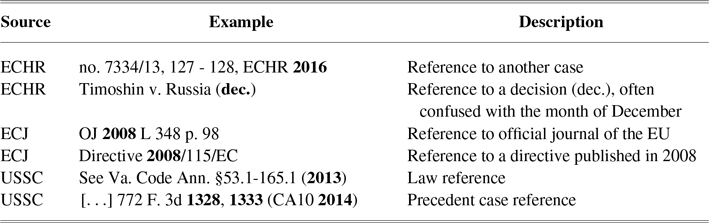
In the legal domain, previous research work by Schilder (Reference Schilder2005) already pointed out the relevance of the temporal dimension of information in legal documents. In this work, an analysis of the different types of legal documents and the temporal information that can be found in them was outlined. Schilder distinguished between dates in transactional documents (namely, documents written by lawyers for specific transactions, such as contracts or agreements), constraints in statutes or regulations, and legal narratives in case law. While the first two types of documents received dedicated attention, narratives in case law were assimilated to narratives present in news. An alternative approach proposed by Isemann et al. (Reference Isemann, Ahmad, Fernando and Vogel2013) used both Named Entity Recognition (NER) and temporal processing to extract temporal dependencies from regulations with no narrative-structure. The authors also described some of the recurrent pitfalls temporal taggers have to deal with, such as the confusion between legal references (e.g., ‘Directive 2009/28/EC’) and actual dates, as shown in Table 2, or the distinction between episodic and generic events—the former referring to a specific moment (e.g., ‘the rescission of the contract was done on 7 December 2017’) and the latter referring to an event in general truths, laws, rules, or expectations (e.g., ‘Every rescission implies the following actions’). Other approaches in the legal domain include works on transactional documents by Naik et al. (Reference Naik, Vanitha and Inturi2011), where a first framework for dealing with temporal information in that kind of texts is proposed. Also additional efforts focused on reasoning with legal evidence (burden of proof) and coherence of narratives (e.g., plausibility and completeness) were made (Vlek et al., Reference Vlek, Prakken, Renooij and Verheij2013), using temporal information but without extracting it from scratch.
Works in other fields, such as the medical domain, are also of interest since they share common requirements, such as the need of domain knowledge for identifying specific eventsFootnote 8 and for dealing with the existence of several timelines in the same text, among others. The analysis by Styler IV et al., (Reference Styler IV, Bethard, Finan, Palmer, Pradhan, de Groen, Erickson, Miller, Lin and Savova2014) in the clinical domain identifies the need of specific guidelines for temporal annotation, which require domain-specific temporal knowledge and the definition of general phases in clinical processes (some kind of commonsense domain knowledge). Furthermore, new tags not included in the temporal annotation standard TimeML, commonsense information, and events are defined in the same work along with annotation needs, and different timelines (such as discussions with other colleagues and notes about risks in treatment) were redesigned for fitting the medical particularities. We work under the assumption that most of these considerations and challenges can also be present in a similar form in legal documents, requiring therefore a dedicated approach. We conclude that one of the primary limitations of existing work is the fact that no special consideration has to date been given to both the narrative structure and the particularities of the legal domain (see Section 3 for additional details).
3 Particularities of legal English
Temporal information is a very important aspect of legal cases. It has an effect on the version of the applicable law and it creates a chronological order of events in a legal case. Sometimes it is important to know whether event A or event B happened first. In addition, temporal information is also used to assess whether past events may be time-barred.
When it comes to the automatic extraction of temporal information from legal documents, it is important to highlight that legal documents, and in particular court decisions, slightly differ in structure and writing style from documents from other domains. These differences include deeper parse trees, differences in part-of-speech distributions, and more words per sentence (Dell’Orletta et al., Reference Dell’Orletta, Marchi, Montemagni, Plank and Venturi2012).
Judgments are usually framed in legal processes following specific procedures, events, and timings, whose mention in the judgment constitutes context information that should not be lost in the annotation process. An example of this is the concept of preliminary ruling, a legal term referring to a phase previous to the decision when the ECJ is asked how law should be interpreted, being therefore a reference to this period and a hint for temporal localization of other events. Also specific events happening in legal frameworks must be considered when processing legal texts, as done in other domains such as the medical domain (Styler IV et al., Reference Styler IV, Bethard, Finan, Palmer, Pradhan, de Groen, Erickson, Miller, Lin and Savova2014).
Structure of ECJ, ECHR, and USSC decisions

3.1 Structure of judgments
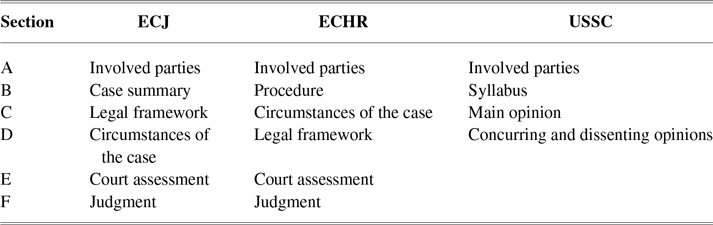
Table 1 illustrates the differences in document structure for judgments made by the ECJ and the USSC, and preliminary assessments of applications submitted to the ECHR. The court decisions from the European courts follow a similar structure that already hints which categories of TE could be expected in different parts of the texts. In particular, both ECJ and ECHR start with a description of the involved parties (section A) and are then followed by a case summary (B), stating concisely why this case has been brought to the respective court and what happened so far in terms of the legal proceedings. In ECJ decisions, the legal proceedings are followed by the applicable legal framework and then by the case description, whereas the ECHR structure is the other way round. The decisions of the ECJ and ECHR courts conclude with the matching of the law with the facts of the case under the legal basis (E) and the resulting judgment (F). In contrast to ECHR documents, the ‘Legal framework’ section (D) in ECJ documents cites European and local legislation, without any direct references to the case itself, and as such this information was excluded from the final documents in the corpus presented in this paper. Although TEs corresponding to other related events such as prior decisions could be extracted from these sections, we focus on case-related temporal information and leave the extraction of events for future work. Apart from beginning with the involved parties (A) in a particular case, the structure of USSC decisions is quite different. The second section (B) is called ‘syllabus’ and contains a short summary of the case. It is followed by the main opinion (C) that includes the final decision of the court and explains how the court came to this decision, by referring to the legal foundations. The last part of a decision states, where applicable, the concurring and dissenting opinions of the involved justices (D). An opinion is called ‘concurring’ if a justice follows the main opinion but grounds the decision on a different legal rationale. A dissenting opinion is issued in cases where a justice disagrees with the main opinion and the underlying legal rationale. Following a consistent structure makes legal documents comparable, and fulfills the expectations of readers who are used to find a specific kind of information always at the same place in the same kind of legal document. Furthermore, the consistent structure of legal documents (from the same authority or within a jurisdiction) leads to expectations with respect to the type of temporal information which could be expected in each section of the document. We expect temporal references describing the facts of the case (what happened when?), which could be used for generating timelines for document summarization, to be present in the case summary (ECHR), Circumstances of the case (ECJ) or syllabus (USSC) sections in the judgment of the respective deciding court, but mentions to general temporal events to appear throughout the entire document. The structural properties of legal documents could also be exploited for the automatic creation of timelines, as legal documents can be very long. For the analysis of a judgment, it is necessary to understand the order of the events as this can affect the legal proceedings. The easier understanding could be supported with a visual representation of the order of events; hence, a timeline that shows the important events and provides a visual summary of the case.***
Dates are used in virtually every domain. In contrast to posts published in social media, for example, Facebook or Twitter, where every user might write dates in different formats, documents from official authorities, such as courts, usually use the same format to represent dates in all documents. Differences in date representation that can be noticed are for instance the order of day and month or the used separators. Therefore, the differences in date representation are seldom found within a document, but may vary from court to court.
3.2 Mistaken or misleading temporal expressions in legal documents
References to legal documents often include some sort of temporal information, usually forming a text pattern prone to be confused with a true TE (see examples in Table 2). Typical references containing temporal information are references to previous court cases, laws, or legal literature, where the temporal information indicates a point in time when the respective reference has been decided or published. However, temporal information contained in references is not considered relevant for a specific case in terms of describing what happened when? For example, the expressions in Table 2 convey some temporal information, for example, four-digit sequences that could be recognized as years, but which only in some cases indeed refer to actual years. Tagging these kind of expressions as TEs may become a major problem and lead to additional errors—for instance nearby dates in the text can be normalized from these wrong references leading to further errors in the entire text. Additionally, references to other legal documents often present their creation date, which must be differentiated from dates in the document timeline of referred case events. An example of this, where the given date refers to the date of a Council Directive of the European Union and thus is irrelevant for the narrative of the text, is the excerpt below:
Examples of mistaken and misleading temporal information

Council Directive 93/13/EEC of 5 April 1993 on unfair terms in consumer contracts must be interpreted as not precluding (…)
For processing these kinds of expressions, we could first detect and hide them from the temporal tagger (e.g., replacing them for an innocuous expression before processing and restoring them afterwards) or alternatively we could filter them in a post-processing step.
3.3 Incompleteness of the TimeML standard for the annotation of legal documents
During the annotation of the corpus presented in this paper, we also detected relevant information that the TimeML standard is not able to represent. The main drawbacks of the TimeML standard applied to legal documents are summarized in the following subsections.
3.3.1 Specific legal terminology as modifiers
Documents in the legal domain are rich in non-colloquial noun phrases representing temporal information. For example, the sentence ‘the expiry of the three-day period’ is badly understood by parsers in comparison with ‘the end of the three-day period’.
Similarly, when the extension of a duration is uncertain (e.g., range between two points, such as in ‘period of between seven and thirty days’), there is no way to properly represent the uncertainty. Likewise, when referring to different possibilities frequently found in the legal language such as ‘was a year or two more of prison time’, this information cannot be properly annotated—even if some taggers such as SUTime (Chang et al., Reference Chang and Manning2012) provide alternative values for similar expressions, that is, ‘from one to two years’, the standard specification does not allow them.
The standard should be able to represent all these particularities of the legal domain. Similarly, a temporal tagger for the legal domain should be able to reason with this level of granularity.
3.3.2 Missing levels of granularity
TEs are important in the legal domain. Not only points in time which are used to determine the applicability of a particular law, but also durations are of high importance especially in formal laws determining the limitations of time (e.g., to plead the statute of limitations) for actions that must be taken before they preclude. For instance, in the legal domain a different way to count days is often applied. While DURATION is sufficient to indicate the absolute lapse of time, TimeML is not sufficient to indicate non-absolute durations such as ‘10 working days’.
Temporal taggers could be enhanced with external knowledge to recognize special constraints being applied to durations, for instance, work calendars where working days are identified. Eventually, also the capability to reason at this level of granularity would be desirable.
3.3.3 Exhaustive list of attributes
The TimeML attribute functionInDocument allows for the marking of some TEs as special reference ones, but just as one among: ‘creation_time’, ‘expiration_time’, ‘modification_time’, ‘publication_time’, ‘release_time’, ‘reception_time’, or ‘none’. This is not enough for legal documents, where domain expressions such as ‘lodgement_time’, ‘argued_time’, or ‘decision_time’ would be more useful. Domain-specific extensions to the TimeML standard could be used to solve this particular problem.
3.3.4 Limited expressivity of the existing format
There are TEs whose anchor time is not the DCT (Document Creation Time) nor are they related to any TEs in the text, but in other legal documents cited in the text, such as in ‘The dissent also relies heavily on Missouri v. Frye, 566 U. S. 134 (2012), and Lafler v. Cooper, 566 U. S. 156 (2012). (…) Lafler, decided the same day as Frye (…)’.
To cover this issue a temporal tagger needs to be combined with a co-reference system in order to find the matching events to which a certain TE relates. This could be addressed by making use of the clear structure of legal documents which usually use the same citation style in all documents such that TEs appearing next to case references can be annotated as belonging to them.
The official TIMEX3 tags cannot properly represent precise intervals on their own. A time interval such as ‘between 12.45 and 18.45’ can only be represented as a DURATION (of 4 hours) or as two unrelated datetime points. This is a problem in cases where exact intervals are needed to solve legal problems such as confirming an alibi or evaluating exact timespans.
While some of these limitations could also be found anecdotally in other kinds of texts, they are common in legal documents, and relevant to their temporal dimension. Other nonlegal issues raised when using the TimeML standard are the correct extent of the tags or how to deal with multiple normalization options (for instance, ‘one decade’ can be ‘P1DE’ or ‘P10Y’, and ‘a few weeks later’ can be a duration with a known beginPoint or a FUTURE_REF).
3.4 Temporal dimensions
In legal texts TEs can be attributed to different temporal dimensions. We identify three different temporal dimensions and illustrate them based on the example decision Sophie Mukarubega v Préfet de police and Préfet de la Seine-Saint-Denis (ECLI:EU:C:2014:2336).
3.4.1 Temporal dimension of the legal process
Each court proceeding is based on some formal rules and new events are added with the gradual advancement of the legal proceeding. This temporal dimension covers events related to the legal process itself, for instance the date a lawsuit has been filed, date of the hearings, or the decision date.
By a decision of 21 March 2011, adopted after hearing the person concerned, the Director General of the Office francais de protection des refugies et apatrides (OFPRA) (Office for the protection of refugees and stateless persons) rejected her application for asylum. (…)
This TE indicates that a certain event has happened, in this case the rejection of asylum.
3.4.2 Temporal dimension of the case
This temporal dimension covers factual information about the case which serves as the basis for a judgment.
Ms Mukarubega, who was born on 12 March 1986 and is of Rwandan nationality, entered France on 10 September 2009 in possession of a passport bearing a visa. (…)Footnote 9
The highlighted date refers to a fact of the case, hence the entrance of France.
3.4.3 Temporal dimension of the legal context
Temporal information can also affect the legal context and determine the applicable law and the degree of the resulting penalty. This is especially relevant when determining the limitation of liability in time or when checking a legal reference to know the applicable law version. We can illustrate this in the following example of a preliminary ruling request to the ECJ with the dates marked in bold.
(…) This request for a preliminary ruling concerns the interpretation of Article 6 of Directive 2008/115/EC of the European Parliament and of the Council of 16 December 2008 (…)
Ms Mukarubega, who was born on 12 March 1986 and is of Rwandan nationality, entered France on 10 September 2009 in possession of a passport bearing a visa. (…)Footnote 10
By a decision of 21 March 2011, adopted after hearing the person concerned, the Director General of the Office francais de protection des refugies et apatrides (OFPRA) (Office for the protection of refugees and stateless persons) rejected her application for asylum. (…)
The first, third, and fourth TE refer each to a point in time that is relevant for the legal context. A preliminary ruling for the interpretation of an article requires the article to exist (first date). In the second paragraph, the birth date is general information about the defendant, which does not affect the temporal dimension of the case but might influence the temporal dimension of the legal context. This is especially important in criminal cases when the birth date in conjunction with the date of the offence constitutes the application of the criminal law relating to juvenile offenders. The third date, on the other hand, refers to a fact of the case, the day of entrance in the host country, being therefore part of the temporal dimension of the case. Finally, the fourth date indicates when a decision on the case in the legal process was reached, so this TE corresponds to the temporal dimension of the legal process.
3.4.4 Conflict of temporal dimensions
One could wonder whether there is the possibility of an overlap of temporal dimensions such that a single event might be part of the temporal dimension of the legal process and of the temporal dimension of the case. For instance, in cases that go through the entire hierarchy of courts, decisions are reversed by higher courts and referred back to the previous court. In these cases the judgments of the previous courts do have an influence on the following proceedings, as courts might be bound to former judgments or receive an order to investigate certain parts of former proceeding in more detail and do more investigation work. However, from our perspective the temporal dimension of the case encompasses the events inherent to the case, while revisions and case remands do not change anything in the temporal order of events in the original case, instead such information adds context which is relevant for the further proceeding without affecting the temporal dimension of the case.
In this section, we outlined the particularities of documents in the legal domain which encompass the special structure of judgments, legal terminology, annotation standards such as TimeML and its incompleteness for annotation tasks in the legal domain as well as a classification of temporal dimensions present in judgments.
4 Temporal annotation
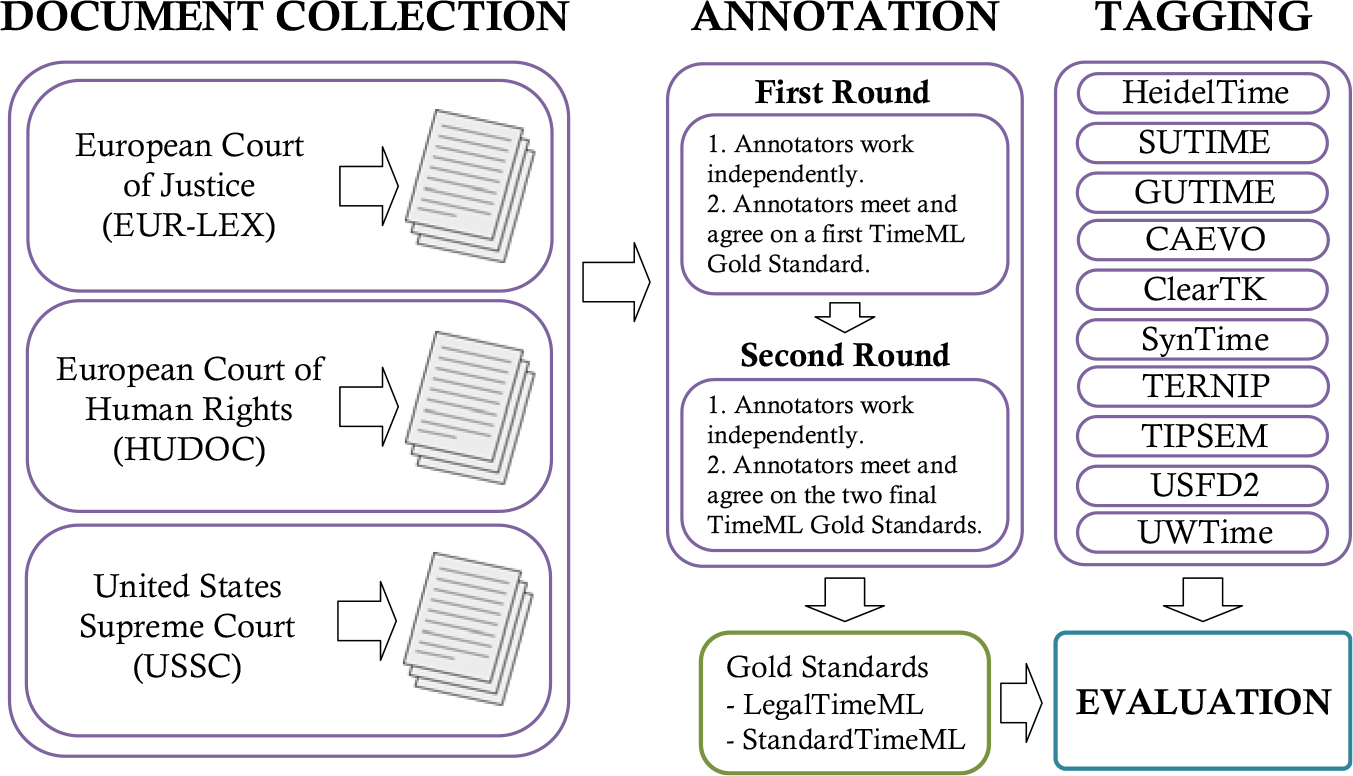
In this section, we aim at evaluating in how far the automatic identification (and normalization) of TEs is feasible using existing taggers, and to test the effectiveness of such tools. In order to enable such an evaluation, we propose two gold standards, one domain focused (LegalTimeML, composed of temporal information important for the facts of the case), and one generic (StandardTimeML, including all temporal information), which can be used to compare the results of temporal taggers and to determine which of them is most suited to be used when working with legal documents. The temporal annotation of all documents used in this work is based on the TimeML annotation language.Footnote 10 Figure 1 illustrates the methodology we followed in order to create and evaluate our proposed gold standards. In the document collection phase we retrieve the documents, and in the annotation phase we create in two rounds the gold standards which are then used to compare the results retrieved from the temporal taggers in the tagging phase.
4.1 Document collection
Although different types of documents could have been chosen to create a gold standard in the legal domain, our proposed corpus TempCourt is composed of judgments and preliminary assessments of applications as they contain a large number of TEs.
As many of the taggers do not have full support to other languages, we selected court decisions in English to enable a fair comparison of the results of the temporal taggers. Also, in order to increase the variety of ways in which temporal information is represented in different types of courts, we decided to investigate the judgments of courts acting in different jurisdictions and domains. Specifically, we focus on the court decisions of the ECJ, which is the highest court of the European Union, and of the USSC, and on preliminary assessments of applications submitted to the ECHR. The documents for the two European courts are available in the respective databases, namely EUR-LexFootnote 11 for the ECJ and HUDOCFootnote 12 for the ECHR, while the USSC documents were collected from the website of the USSC.Footnote 13 The corpus created for this work, named TempCourt, consists of 30 court decisions, composed of an even distribution of ten documents per court in each subcorpus. Documents provided by the ECHR are allowed to be reproduced for private use or for the purposes of information and education in connection with the Court’s activities when the source is indicated and the reproduction is free of charge.Footnote 14 The same policy applies to documents retrieved from EUR-Lex, whose documents are allowed to be reused in conjunction with the Commission Decision of 12 December 2011 on the reuse of Commission DocumentsFootnote 15 for commercial and non-commercial purposes given the source is acknowledged.Footnote 16 Documents published by US governmental institutions (such as the US Supreme Court) are in the public domain.Footnote 17
Outline of our work, including document collection, annotation, and evaluation of taggers

Legal documents often contain names of persons, especially court decisions. The documents in our corpus contain the names of the involved judges and the names of parties in a non-anonymized way. Names are considered personal data and need to respect the General Data Protection RegulationFootnote 18 (GDPR) which in the case of public data involves providing transparency with respect to the processing on request (Article 14 GDPR). Consent for the processing of personal data from the data subject is not required for public data.
For the purpose of temporal annotations, we are mainly interested in the section of the court decisions describing the facts of a case, because we expect to find the most valuable temporal information about the chronology of a case in this section, whereas temporal information in other sections is expected to be relating to laws or previous cases. Therefore, we omitted in our corpus the ‘Legal framework’ section of the documents from the ECJ.
Corpus statistics

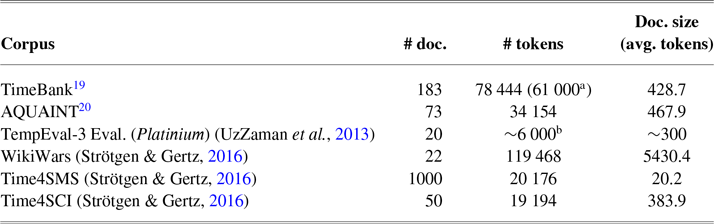
Statistics of corpora annotated with TimeML in literature

a The website just mentions 61k non-punct tokens, the other figure was extracted from Strötgen and Gertz (Reference Strötgen and Gertz2016).
bJust approximate figures were provided (UzZaman et al., Reference UzZaman, Llorens, Derczynski, Allen, Verhagen and Pustejovsky2013).
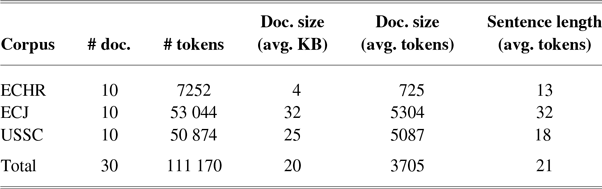
The figures in Table 3 illustrate the differences between documents depending on their source. Although we include documents from three different courts in this paper, the corpus statistics show that the documents in the ECJ and USSC subcorpora are similar in terms of document size and length. The documents in the ECHR subcorpus are only one-fifth in terms of size in comparison with the other two subcorpora. As stated previously, legal texts often make use of very long and complicated sentences to explain legal details, thus we also included the average sentence length in tokens for each corpus. We show that the sentences of the ECHR are roughly one-third of length compared to the USSC court decisions, and also tend to be shorter than the ones in the ECJ corpus. These numbers contrast with those relating to corpora from other domains and sources, such as Wikipedia articles (25.1 words per sentence; Kajiwara et al., Reference Kajiwara and Komachi2016), the CONLL 2007 corpus of documents from the Wall Street Journal (24 and 23.4 tokens per sentence in training and test data, respectively; Nivre et al., Reference Nivre2007), and the basic corpus of everyday documents (Pellow et al., Reference Pellow and Eskenazi2014), including all kind of common texts, such as banking or shopping documents (with an average of 17.2 words per sentence). Regarding the amount of documents in each corpus, Table 4 provides an overview (extracted from previous literature; UzZaman et al. Reference UzZaman, Llorens, Derczynski, Allen, Verhagen and Pustejovsky2013) of the size of referential corpora manually annotated with TimeML. These figures provide evidence that despite the fact that we have less documents per corpus, our corpus is substantially bigger in terms of tokens than most of the previous corpora.
4.2 Annotation
For each subcorpus (ECJ, ECHR, and USSC), the ten documents were selected at random. In order to compare the results of different temporal annotation tools, all 30 documents have been annotated in multiple steps. In the first part of the annotation process, two different annotators performed the manual annotation of the documents following the TimeML guidelines.Footnote 21 Once manual annotation, which was done independently by two persons using General Architecture for Text Engineering (GATE) (Cunningham et al., Reference Cunningham, Tablan, Roberts and Bontcheva2013), was completed, they met to create a gold standard with annotations agreed by both annotators. When doubts arose, the TimeML guidelines were consulted specifically looking for similar cases; if the doubt persisted, also the TIDES TIMEX2 guidelinesFootnote 22 were examined, as referred to in the TimeML annotation guidelines. However, due to the particularities of the legal domain, some annotation decisions needed further discussion as shown in the following examples:
1. The word now is heavily used in legal documents and was only annotated when it was not used as an adverb, hence the meaning is not currently or at the moment. For instance in the case ECJ C-457/12, […] so the provision is now worded as follows […].
2. For the annotation of references to the present time, some taggers use the PRESENT_REF token as a value, while others normalize to a date (usually the creation date). We decided for the legal domain we should follow the latter approach, since all the documents in the corpus contain this information and humans would also be able to derive it.
3. Legal documents, especially judgments, often contain references to previous court decisions in the legal grounding of a decision. The citation of such preceding cases depends on how decisions of such courts are usually referenced. Typically, a year is contained in the citation and annotated as a temporal reference. Temporal information contained in identifiers used to refer to collections of court decisions (e.g., 2006I) or included in the document identifier should not be annotated (e.g., EC:C:2013:180).
4. Expressions such as the date indicated, appearing for instance in the excerpt ‘the application lodged on the date indicated in (…)’, are not considered as temporal references but as co-references, being therefore not annotated in the gold standard, since a temporal tagger would not be expected to do so.
The discussion between the two annotators resulted in the creation of two gold standards StandardTimeML and LegalTimeML:
1. StandardTimeML annotates all the TEs following the TimeML guidelines, and uses the PRESENT_REF, PAST_REF, and FUTURE_REF tokens as usually done in the domain.
2. LegalTimeML annotates just the TEs relevant to the narratives of the judgment, following the particularities in the legal domain previously discussed (no dates in legal references, normalize to dates…). As per the StandardTimeML annotation set, it follows the guidelines but does not annotate all the expressions, being therefore a subset considering domain particularities.
The Inter-Annotator Agreement between both gold standards is high (0.95), as well as Cohen’s kappa (Cohen Reference Cohen1960) (0.94) and Scott’s Pi (Scott Reference Scott1955) (0.94), indicating that the normalization of the TEs that are included in both annotation sets have a high agreement. If we check differences between annotations, we find there are an average of 13.1 common TEs per document, 0.3 partial coincidences and about 16.2 TEs that are not in the LegalTimeML but appear in the StandardTimeML. The recall among both annotation sets is of 0.44 while precision is of 0.90, which confirms that a lot of TEs are not relevant for the case timeline (44% with regard to the ones annotated following the full TimeML standard), but that the way to tag them by the annotators is highly similar.
4.3 Tagging
Once the corpus was collected, the following temporal taggers: HeidelTime (Strötgen et al., Reference Strötgen and Gertz2012), SUTime (Chang et al., Reference Chang and Manning2012), GUTime (which is part of the TARSQI toolkit) (Verhagen et al., Reference Verhagen, Mani, Sauri, Littman, Knippen, Jang, Rumshisky, Phillips and Pustejovsky2005), CAEVO (Chambers et al., Reference Chambers, Cassidy, McDowell and Bethard2014), ClearTK-TimeML (Bethard, Reference Bethard2013), SYNTime (Zhong et al., Reference Zhong, Sun and Cambria2017, TERNIP (Northwood, Reference Northwood2010), TIPSem (Llorens et al., Reference Llorens, Saquete and Navarro2010), USFD2 (Derczynski et al., Reference Derczynski and Gaizauskas2010), and UWTime (Lee et al., Reference Lee, Artzi, Dodge and Zettlemoyer2014) were executed over our legal corpus, as they represent the different approaches available and are the most widely used in literature. These temporal taggers will be introduced in Section 5. HeidelTime was used in its configuration for narrative text. GUTime was used as a part of the TARSQI toolkit, using it alone with the preprocessor in the pipeline. Since the code available online was just able to annotate a specific corpus, USFD2 was slightly modified in order to annotate any input and to generate TIMEX3 tags as output.Footnote 23 All other taggers were used with default parametrization.
The output of the taggers which generated offline annotations (such as GUTIME/TARSQI) were modified in order to be comparable with the output of the rest of the taggers and ensure they were readable by GATE. These processes were executed using a new coded converter, which added the temporal annotations to the document and excluded non-temporal entities. Once the outputs of all the taggers were in the same format, they were loaded into the same GATE document, which contained twelve annotation sets (two for the manually-created gold standards and one for each of the ten temporal taggers).
4.4 Final corpus
The final documents have been generated in several formats.Footnote 24 First, as GATE XML documents that facilitate the storage of different annotation sets and also the visual and numerical comparison of the different sets. Second, a set of TimeML documents (TML) is provided for each of the manual gold standards. These documents contain the same annotations as in the correspondent annotation set in the corresponding GATE document, but makes the comparison with the output of other temporal taggers easier, as it is in the official TimeML format. Also a set of TML documents without any tag is provided to facilitate testing. These TML documents have been validated using the TimeML validatorFootnote 25 from TempEval-3,Footnote 26 so it is guaranteed that they fulfill the guidelines of the TimeML standard. Finally, all original documents are stored as TXT-files; these documents are of similar size in terms of kilobyte and length in tokens as shown in Table 3.
5 Temporal taggers
Many of the temporal taggers described in the literature over the last few years are no longer available, not maintained, or just work for previous annotation schemas like the formerly mentioned TIMEX2. Some examples are DANTE (Mazur & Dale, Reference Mazur, Dale, Vetulani and Uszkoreit2009), TEA (Han et al., Reference Han, Gates and Levin2006), JU_CSE (Kolya et al., Reference Kolya, Kundu, Gupta, Ekbal and Bandyopadhyay2013), or ManTIME (Filannino & Nenadic Reference Filannino and Nenadic2015). Therefore, we focus on the most widely used active temporal taggers which are often cited in literature and report good results on corpora from different domains, or have successfully participated in well-known temporal challenges, such as TempEval-3.Footnote 27
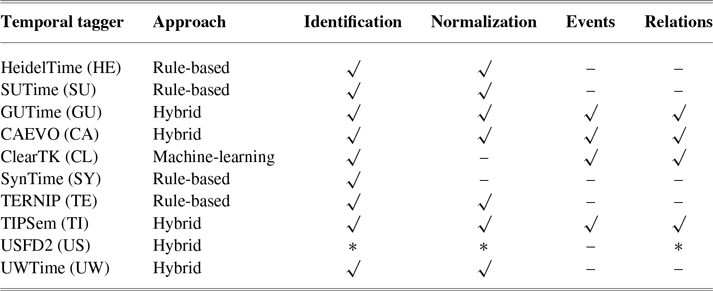
Table 5 provides an overview of the temporal taggers under investigationfor which an implementation is freely available. The first column is used to refer to particular temporal taggers later on.
Overview of temporal taggers

*Not all the types are covered.
The following aspects will be discussed for each tagger: supported languages, used approach, covered functionality, parametrization options, implementation language, availability, integration, and interoperability with other software and dependencies on other resources and required installations.
5.1 Tasks of temporal taggers
The functionalities of temporal taggers can be classified into four categories as shown in Table 5. Some temporal taggers support all functionalities while other taggers require some additional tools.
Identification means that the system is actually able to identify TEs in a text compared to other systems which are only used for normalization of already tagged texts.
Normalization refers to the ability to represent temporal information in the written text into the corresponding standard value following the ISO 8601 norm, which can be further processed. For instance, expressions like ‘the next day’ refer to the day before which might be indicated with an explicit date in the text, and the temporal tagger is able to normalize this expression and assign the actual date as the value to the temporal annotation.
Events are real-world situations at a particular time and are classified into seven categories, such as OCCURENCE, STATE, or REPORTING, in the TimeML standard (Saurí et al., Reference Littman, Knippen, Gaizauskas, Setzer and Pustejovsky2006).
Relations indicate a certain connection between events, times, or a mixture of both usually classified into temporal TLINK, subordination SLINK, and aspectual ALINK links (Saurí et al., Reference Littman, Knippen, Gaizauskas, Setzer and Pustejovsky2006).
5.2 Approaches
The detection of TEs in a text is based on different approaches. Some taggers use rules for both identification and normalization tasks, while others use Machine Learning for the former. Also hybrid approaches have been proposed in literature. Nevertheless, it must be noted that normalization is generally tackled using rules, even when the identification is done otherwise.
5.2.1 Rule-based approach
Temporal information is detected based on manually created rules (e.g., regular expressions), which need to cover all possible variations of how temporal information might be expressed. Thoroughly created rules are expected to perform better than other approaches, but come with the disadvantage of being inflexible. A missing or erroneous rule will prevent the temporal tagger from finding a TE.
HeidelTime (Strötgen et al., Reference Strötgen and Gertz2012) is a rule-based domain-sensitive temporal tagger. Available for more than 200 languages (just 13 of them based on manually developed resources, the rest of them being automatically created), it offers the option to select from four different text categories: News, Narratives, Colloquial, and Scientific, the last two are only available for English. HeidelTime covers both TE identification and normalization, having different strategies for each domain. HeidelTime, implemented in Java, can be used as a standalone version,Footnote 28 or integrated in other pipeline environments like the General Architecture for Text Engineering (GATE) (Cunningham et al., Reference Cunningham, Tablan, Roberts and Bontcheva2013) or a UIMAFootnote 29 pipeline. In spite of being one of the most popular temporal tagging tools, to the best of our knowledge, it has never been used in the legal domain.
SUTime (Chang et al., Reference Chang and Manning2012) is the Stanford CoreNLP (Manning et al., Reference Manning, Surdeanu, Bauer, Finkel, Bethard and McClosky2014) annotator for TEs. SUTime is a rule-based temporal tagger built on the TokenRegex tool (Chang et al., Reference Chang2014) (a pattern definition service also part of CoreNLP), able to both identify and normalize TEs. SUTime produces TimeML/TIMEX3 tags with new attributes not included in the standard, such an alternative value more flexible than the one covered by the standard. SUTime presents several related limitations (as analyzed by the authors themselves in Chang et al., Reference Chang and Manning2012) and offers no domain adaptation. SUTime is available as part of the CoreNLP pipeline as a NER system for different languages. Still, the tool works better in English than in other languages. The Java codeFootnote 30 is available online, and also a GATE plugin and a Python wrapper have been developed.Footnote 31
SynTime (Zhong et al., Reference Zhong, Sun and Cambria2017) is a rule-based tagger that proposes a type-based approach as it defines different types of tokens (time tokens, modifiers, and numerals) with similar syntactic behavior and builds heuristic rules on these types instead of doing it on strings or regular expressions. As the types are domain independent and the rules work on types, the system is designed to be domain and language independent; nevertheless, to work in different domains or languages, more tokens need to be added for each type. SynTime only performs TEs recognition and does not normalize them. For initialization, both tokens and regular expressions over them are collected for the independent temporal tagger SUTime (Chang et al., Reference Chang and Manning2012). It is written in Java and available online.Footnote 32 It uses the Stanford CoreNLP library for Part of Speech (POS) disambiguation.
TERNIP (Temporal Expression Recognition and Normalization in Python) (Northwood, Reference Northwood2010) is a rule-based Python 2.7 library that identifies and normalizes TEs. The rules used for both subtasks can be easily extended. It only covers English and provides no domain particularities. It can be used as an API or be integrated as a GATE processing resource, via an XGAPP file (a GATE application file format) available with the code.Footnote 33 TERNIP relies on the Natural Language Toolkit library (NLTK) (Loper & Bird Reference Loper and Bird2002).
5.2.2 Machine-learning-based approach
In contrast to rule-based approaches, machine-learning based temporal taggers do not rely on previously created rules to identify TEs. Using machine-learning techniques makes temporal taggers much more flexible and enables them to detect TEs in an unexpected form; however, it requires a good pre-trained model based on a large annotated corpus that supports a variety of TEs which can be expected later in the document to be tagged with TEs. A poor training set with missing variations of TEs will result in a poor performance of the temporal tagger in terms of precision Footnote 34 and recall.Footnote 35
ClearTK-TimeML (Bethard, Reference Bethard2013) is a system that identifies temporal information in English texts using external machine-learning tools. It uses specific annotators modeled as a BIOFootnote 36 token-chunking (for extent/identification of the expressions) or as a multiclass classification task (for types and attribute classification). The TIMEN normalization tool (Llorens et al. Reference Llorens, Derczynski, Gaizauskas and Saquete2012) is suggested for the normalization task as this is not covered by ClearTK-TimeML. The features used are the ones proved to be the most successful in previous independent temporal taggers, and are extracted by a morpho-syntactic annotation pipeline with tools like OpenNLP and Apache. While ClearTK-TimeML does not offer domain-specific adaptations, the pipeline and the parameters can be customized by the user. It is written in Java and can be found online.Footnote 37
5.2.3 Hybrid approach
Hybrid approaches combine rules with machine-learning. For instance, creating rules of large corpus with machine-learning techniques to be manually refined afterwards.
GUTime (Mani et al., Reference Mani and Wilson2000) was developed at the Georgetown University originally for the temporal annotation of news. GUTime was subsequently incorporated into TARSQI, a modular system for automatic temporal annotation (Verhagen et al., Reference Verhagen, Mani, Sauri, Littman, Knippen, Jang, Rumshisky, Phillips and Pustejovsky2005). The approach of GUTime is different from the temporal taggers previously mentioned, as it does not only use rules to find TEs, but it also applies a hybrid approach of rules and machine-learning techniques. The hand-crafted rules serve in GUTime as a basis for temporal annotations that are extended by additional machine-learning ones discovered using the C4.5 algorithm (Quinlan, Reference Quinlan1993), that is, rules to support term disambiguation. The TARSQI framework is also able to extract events and relations from English texts. TARSQI is written in PythonFootnote 38 and well described.Footnote 39
CAEVO (Chambers et al., Reference Chambers, Cassidy, McDowell and Bethard2014) (CAscading EVent Ordering) is a sieve-based architecture, which uses 12 different classifiers (both rule-based and machine-learning), pipelined in a cascade way, starting with the one with the highest precision. Even when these classifiers work individually, some transitivity constraints are imposed; also the order of the classifiers can be modified, and new sieves can be added. In contrast to other taggers, CAEVO focuses on the extraction of temporal relations for event ordering, producing dense temporal graphs where events and TEs are heavily connected. CAEVO is an expansion of NavyTime (Chambers, Reference Chambers2013) and reuses part of the code of ClearTK-TimeML (Bethard, Reference Bethard2013) for part of its sieves. It works just for English texts and has no domain adaptations. It is written in Java, and it is available online.Footnote 40
TIPSem (Llorens et al., Reference Llorens, Saquete and Navarro2010) (Temporal Information Processing based on Semantic information) is an hybrid temporal tagger able to extract temporal information from English and Spanish. It uses both Semantic Role Labeling (Gildea & Jurafsky, Reference Gildea and Jurafsky2002) and Conditional Random Field (CRF) (Lafferty et al., Reference Lafferty, McCallum, Pereira, Brodley and Danyluk2001) models. Different features are used by CRF recognition models, such as morphological or syntactic considerations at token level, along with semantic level ones such as the Role, the Governing Verb, or Lexical Semantic information for each token. Similar features are used at tag level for classification. Finally, the relation extraction features differ depending on the type of relation. TIPSem tackles therefore all the temporal tasks. The Java code is available online,Footnote 41 but it requires installation of additional software, and also optional libraries for certain languages (such as Spanish).
USFD2 (Derczynski et al., Reference Derczynski and Gaizauskas2010) is a temporal tagger focusing on TEs and relations, using a rule-based approach for TEs and both rules and the NLTK’s Maximum Entropy classifier for relations. USFD2 obtains a good recall with a smaller set of rules when compared with other taggers, since they consider specific heuristics for specific tags, such as DATEs and DURATIONSs as TE types, which are the most common. It only works for English. The Python code of USFD2 is available online,Footnote 42 but it must be noted that it is developed for the evaluation of specific datasets, so it must be slightly modified for custom use. This has been done for the results on our corpus described in this paper.
UWTime (Lee et al., Reference Lee, Artzi, Dodge and Zettlemoyer2014) follows a hybrid approach, using a Combinatory Categorial Grammar (CCG) (Steedman et al., 2001) parser with hand-crafted rules and learning. UWTime just tackles the recognition and normalization of TEs. It uses features such as surrounding tokens and POS, lexical and dependency information, and relies on techniques such as AdaBoost (Freund et al., Reference Freund, Schapire and Abe1999) for optimization. UWTime is only available in English with no domain particularities. It can be downloaded online,Footnote 43 used as an API or as a server. UWTime relies on Stanford CoreNLP software.
6 Evaluation and results
The final step of our research methodology involved a comparison of the effectiveness of all 10 taggers on the two gold standards, along with the analysis of the results.
6.1 Evaluation methodology
After having all documents annotated with the 10 different temporal taggers, we evaluated the results, for which we used the typical precision, recall, and F-measure metrics, which are commonly used in literature for the evaluation of extraction and normalization of temporal annotations (Strötgen et al., Reference Strötgen and Gertz2012). Precision is defined as the share of correctly identified items in percent compared to all identified items, whereas recall is defined as the number of items correctly found compared to the number that should have been found. The third measure we included in the evaluation, the F-measure, describes a weighted average between precision and recall (Rijsbergen, Reference Rijsbergen1979). It is worth noting that we elected to provide both the strict-F-measure (which only considers completely correct and ignores partially correct annotations) and the lenient-F-measure (which admits partial annotations). The reason to do so is that while it is important to identify the complete TE, it is also true that some taggers normalize correctly an expression even if they do not fully cover it. It must also be taken into account that in some cases the correct extent of a TE is not clearly derivable from the guidelines; for this reason we decided that providing both measures would allow for the evaluation of both the degree of support with respect to the guidelines and the actual detection capabilities.
The evaluation process was designed in a way to avoid a bias or preference towards a particular temporal tagger. Therefore, the results of all taggers are consolidated in a single document with individual annotation sets for each tagger containing the temporal annotations and respective features. Each evaluation involves a key set (the correct reference) and a response set (the annotations to evaluate). Since the goal is to create gold standards for the legal domain, the manually annotated TEs in both annotation sets, LegalTimeML (LTML) and StandardTimeML (STML), serve as the key sets. The annotation sets of each tagger act as the response set for each evaluation run. We therefore evaluated each automatic tagger for all three sections of the corpus (i.e., the documents from the three different legal sources) against each of the manually created gold standards LegalTimeML and StandardTimeML and calculated the lenient and strict precision, recall, and F-measure.
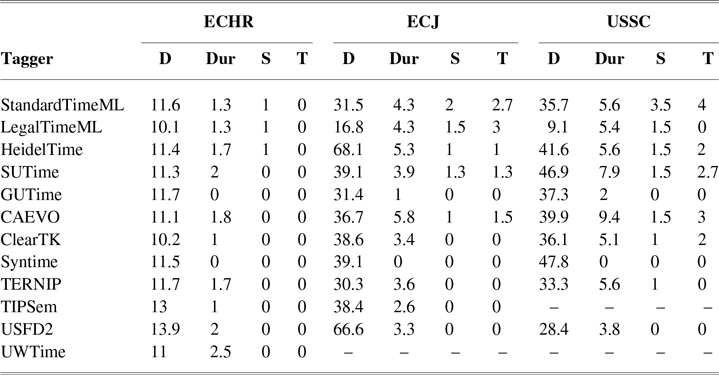
All the temporal taggers were applied to the corpus with the standard configuration, and there were no domain-specific modifications to achieve better results specifically for the legal domain.Footnote 44 The standard configuration was chosen so as to evaluate the out-of-the-box performance of each annotator and the suitability when applied to the legal domain. The average number of annotations per corpus in both Gold Standards (STML and LTML) and the various taggers are shown in Table 6, which illustrates the occurrences of different TIMEX3 annotation types (DATE, DURATION, TIME, and SET) for each analyzed corpus. It is clearly shown that the most used annotation type in court decisions is DATE. This result is not surprising as the date is considered to be sufficient in most cases as the actual time of the day is not relevant. Furthermore, deadlines in the legal domain usually indicate the end of the day and it is not important if an action is taken in the morning or in the afternoon. It must also be noted that the pattern of appearances of each of the TIMEX3 types does not fit any of those of the domains analyzed by (Strötgen et al., Reference Strötgen and Gertz2012) (news, narratives, colloquial, and scientific).
Average number of annotation types per document for each corpus (Date, Duration, Set, Time)

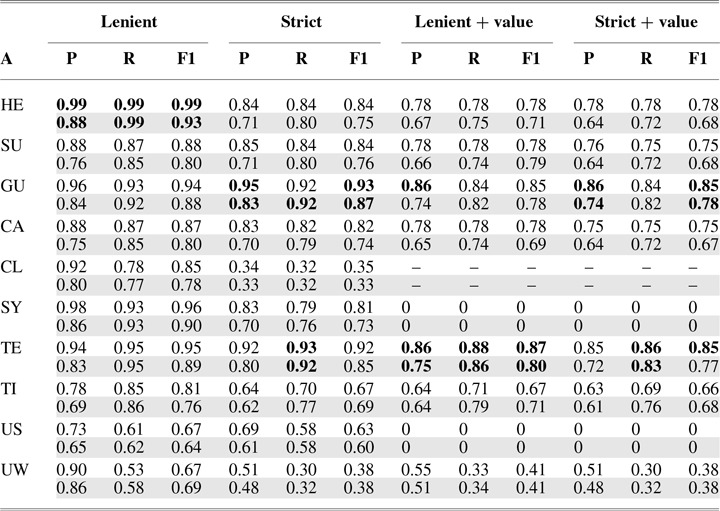
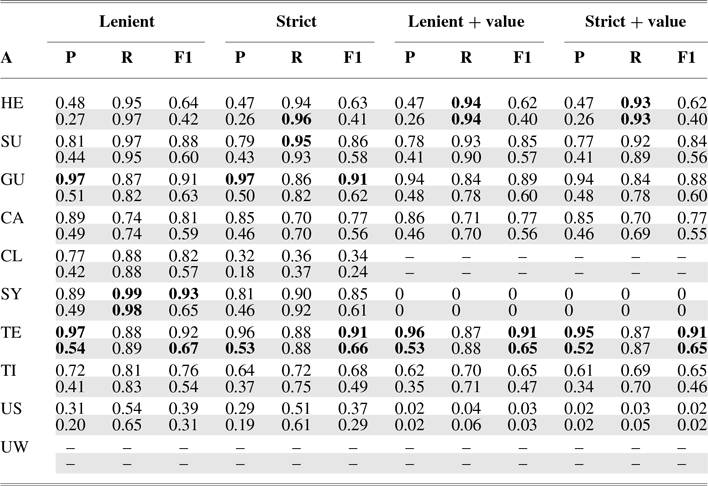
Evaluation results for the ECHR corpus for each temporal tagger, both for identification (two first columns, lenient and strict) and normalization (two last columns, lenient and strict) The first row (in white) corresponds to results against the StandardTimeML gold standard, while the second (in gray) corresponds to the LegalTimeML gold standard

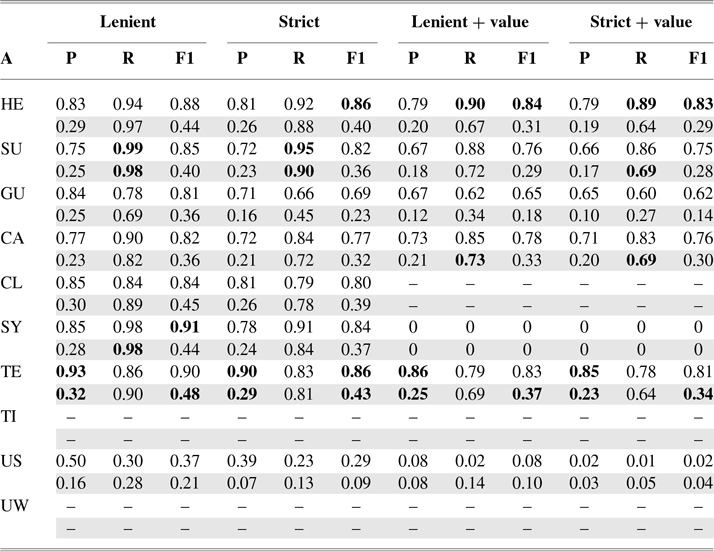
Table 7 clearly shows that most taggers perform well on the short ECHR subcorpus and tend to find the same number of annotations as in the gold standard, especially if we focus on the lenient figures, showing that the errors are mostly in the extension of the tagging more than in its identification. In the ECJ and USSC subcorpora (Tables 8 and 9, respectively), the number of annotations by the taggers differs from the gold standards, especially HeidelTime draws attention to its annotations in the ECJ corpus. When looking into the documents, the reason for this significant difference becomes obvious. The designators of European legal acts such as regulations and directives follow a special scheme which also includes the year when the legal act has been agreed. A typical designator of an EU directive is therefore, for instance, 2016/679, which is considered to be a designator of a legal act but it is not a valuable temporal reference within a court decision.
Evaluation results for the ECJ corpus for each temporal tagger, both for identification (two first columns, lenient and strict) and normalization (two last columns, lenient and strict) The first row (in white) corresponds to results against the StandardTimeML gold standard, while the second (in gray) corresponds to the LegalTimeML gold standard

Evaluation results for the USSC corpus for each temporal tagger, both for identification (two first columns, lenient and strict) and normalization (two last columns, lenient and strict) The first row (in white) corresponds to results against the StandardTimeML gold standard, while the second (in gray) corresponds to the LegalTimeML gold standard

6.2 Results
From the results shown in Tables 7 (ECHR), 8 (ECJ), and 9 (USSC), we can see that the performance of the individual temporal taggers is quite similar for each section of the corpus. Furthermore, the numbers for all three measures that have been calculated are unexpectedly high for some taggers in comparison to the application of temporal taggers (out of the box without any domain-specific modifications) in the case of nonlegal text. They tend to be nevertheless less performant than results previously reported by taggers in general evaluationsFootnote 45 (Chang et al., Reference Chang and Manning2012).
On the ECHR corpus most taggers perform equally well when strictly evaluated, while GUTime provides the best results, closely followed by TERNIP. On the contrary, TIPSem, USFD2, and UWTime are not as performant. This is because the ECHR uses fully qualified dates (e.g., 10 January 2017) and does not include many references to other court decisions. These results fall when we look at the normalization values. It also must be noted that most taggers (except of GUTime, SynTime, and TERNIP) struggle with identifying dates denoting the birthdates of the persons involved in the cases and case numbers, with some also normalizing them. It must be noted how big differences between lenient and strict values such as those of UWTime or ClearTK-TimeML do not always affect in terms of differing in the extent of the tag, but it also impacts in the normalization values. For instance, if instead of marking up ‘October 13’, just ‘October’ is marked, the lenient score will count it as positive, the strict will not, but the normalization will for sure be wrong.
In the ECJ corpus one outlier in the figures can be spotted immediately, which is the precision of the HeidelTime annotations that is significantly different from its other precision values across each section of the corpus. The much better performance of GUTime in the ECJ corpus can be explained by the fact that it does not annotate numbers referring to collections of judgments (such as TIPSem or ClearTK-TimeML do).
The USSC corpus is slightly different to ECHR and ECJ as it uses a different date format and it also repeats part of the text in the judgment, which leads to poorer performance as incorrect annotations are also repeated.
Different date formats are a typical challenge which occur when applying temporal taggers to a corpus. Typically dates found across all evaluated documents are fully qualified dates containing a day, the month in full, and a year. The format in which these dates are provided are different for European and American sources of legal documents. The date in Europe is usually indicated in the format Day, Month, Year (e.g., 10 January 2017), whereas the American date format is ‘Month DD, YYYY’ (e.g., January 10, 2017). This particular difference in the date format has been processed correctly by some taggers, such as HeidelTime and SUTime, annotating both versions as a single date. GUTime, however, was not reliable in this context, despite the fact that it is the best tagger in the other corpora. It either detected only one part of the American-formatted date (e.g., January 10) or it treated both parts of the same date as two different annotations.
The performance of GUTime in terms of precision, recall, and F-measure is pretty good over all three subcorpora. However, GUTime performs poorly on the USSC corpus. Inspecting the GUTime annotations in this corpus confirms the fact that GUTime has a hard time recognizing dates in the American format, as already pointed out above, an issue that is also reflected in normalization figures (where TERNIP maintains the performance from the other subcorpora).
In summary, although the results of the evaluation are promising, it is worth noting that legal documents, especially court decisions, have some particularities (such as those highlighted in Section 3) which cause some stumbling blocks for automatic temporal taggers being applied out-of-the-box. An example of this would be the case of ‘dec.’, a non-TE that appears when citing decisions on admissibility Footnote 46 that most taggers (such as CAEVO or SUTime) normalize as December.
With regard to the comparison between the two reference standards, if we check the differences between figures and focus on the recall (since the taggers are not trained for the particularities of this annotation set, the precision is obviously not expected to be high and does not indicate the tagger’s usefulness), we see that the best taggers remain more or less the same (GUTime, TERNIP, SUTime, and HeidelTime, since although SynTime performs well in terms of recognition it does not provide a value).
6.3 Comparative analysis of several temporal taggers
The thorough analysis of the corpus documents and the manual inspection of the most frequent errors of the taggers led to the synthesis of a collection of test cases that present the phrases prone to cause errors. The most salient results are described below, where the output of the tagger is represented in bold and the correct tag is underlined.
HeidelTime is able to identify temporal modifiers (e.g., at least five years) automatically and add the feature to the annotation. However, it fails to detect the correct date format (e.g., DD/MM/YYYY vs MM/DD/YYYY) as well as failing to recognize the indication of the age of mentioned persons (e.g., ‘a 62-year-old woman’). It does not normalize expressions like today and annotates them with the value PRESENT_REF. In legal texts, it tags as TEs references to other documents or IDs (e.g., ‘No 1612/68’, ‘No. 15-1031’, ‘See Pet. for Cert. 5-7’). It also has an interval option that does not work well in this kind of document.
SUTime also fails to identify the correct date representation form (e.g., DD/MM/YYYY vs MM/DD/YYYY). In addition, SUTime exhibits inconsistencies when parsing the same expression in different paragraphs, and it also wrongly annotates expressions like ‘fall’ and ‘may’ as TEs although they refer to an action ‘to fall’ and ‘may’ instead of the season. SUTime also has some limitations with respect to ambiguity resolution or non-whole numbers recognition.
Although GUTime has a good performance in general, sometimes it does not normalize some expressions and has problems with some ways to represent hours (e.g., it does not recognize ‘(…) between 12.15 and 18.45’, nor if it was expressed as ‘12:15 and 18:45’, it just recognizes ‘12h15 and 18h45’). Also some DURATIONs are not recognized, series or dates neither (in ‘15 and 16 December 2008’ it just recognizes the part in bold), and sometimes it tags expressions that look like years, such as ‘EUR 2000’.
CAEVO does normalize DATEs in the format DD/MM/YYYY as MM/DD/YYYY, so it does not even recognize the ones not fitting it, such as ‘25/03/2016’. It also partially annotates expressions such as ‘On the next day’ (categorizing it as a DURATION) and tags separately ‘once a week’, as a PAST_REF DATE and a DURATION, respectively. It also does not recognize 15 in ‘15 and 16 December 2008’, and tags ‘62-year-old woman’, year-like expressions as ‘§ 1101’ and time-like expressions as ‘Order in No. 2:10-cv-02698 (WD Tenn.)’. Finally, it also tags separately ‘sentenced to a year and a day in prison’.
Similar to GUTime, ClearTK-TimeML does not recognize TIMEs when expressed as in ‘(…) between 12.15 and 18.45’; it does not either recognize expressions like ‘09/01/1981’ as DATEs. Some DURATIONs are also not recognized (e.g., ‘at least five years’), and tags expressions such as ‘May’ or ‘62-year-old woman’. It just annotates partial expressions such as ‘23 January 2013’ or ‘once a week’ (that is categorized as a DURATION).
SynTime just normalizes to the date when it is executed. Although it is able to recognize expressions such as ‘15 and 16 December 2008’, it fails when it finds expressions such as ‘as amended by Council Regulation (EC) No 1791/2006 of 20 November 2006’, where it annotates all in bold, not just the underlined correct part. It also seems to recognize all four-digit expressions as years (e.g., ‘See 10 U. S. C. §1408(c)(1)’, ‘So. 3d 1264, 1269-1272’) and ambiguous expressions as ‘may’, ‘the second’, or ‘fall’, but fails to fully annotate some TEs (e.g., ‘per month’, ‘May 15, 2017’).
TERNIP tags expressions such as ‘EUR 2000’, ‘may’, and ‘fall’, but fails to identify some DATEs and DURATIONs. It also does not identify 13 in ‘13 and 27 October 2008’, but is on the other hand is able to recognize misspelled TEs such as ‘eighth months’ (even if it is not correctly normalized). It also tags ‘303, 98 Stat. 2045, 21 U. S. C. §853(a)(1),’ as DATEs expressions.
TIPSem is not able to annotate some of the documents in the corpus (namely the ones from the USSC subset), and does not recognize the first DATE in the ECJ subset, expressed as in the format DD Month YYYY; since it recognizes in the rest of the document without a problem, it is probably due to a lack of a syntactic/semantic context for it. It tags expressions such as ‘Directives 2004/83, 2005/85 and 2003/9]’ or ‘Article 5 of Directive 2008/115’, ‘Directive 2001/42’ or ‘the judgment of 28 February 2012’. It also tags expressions such as ‘MON 810’ or random numbers or words as ‘4,285’, ‘(in euros)i’, that tends to mark as FUTURE_REF. On the other hand, it does not recognize some dates, as ‘29/02/2016’, but it does so with a similar one like ‘28/09/2016’.
USFD2 is unable to parse some of the documents in the corpus, throwing errors when trying to normalize expressions it considers out of the range and warnings for some ASCII codes. It also tags some numbers randomly, such as in ‘amending Regulation (EEC) No 1612/68 and repealing Directives 64/221/EEC, 68/360/EEC’ and always normalizes DATEs to the present day. It does not recognize straightforward dates and tags ambiguous words even when they are a part of another word, such as in ‘Sotomayor’; TIME expressions are categorized as DATEs.
Finally, UWTime is not able to parse long legal sentences, throwing several errors because of the lack of head rules defined for some of the expressions it finds. In our corpus, it was not able to annotate even one-third of the documents.
The most commonly occurring errors in which the taggers fall, whether because they happen frequently in the text or because several taggers incur in them, are the following:
Separation of whole SET expressions as ‘Once a week’ into ‘Once’ and ‘a week’, converting one SET into a PAST_REFDATE and a DURATION.
Not recognizing series of DATEs such as ‘15 and 16 December’, but detecting the last DATE of such a series only.
Separation of DURATIONs such as ‘One year and one day’ into two different DURATIONs.
In some documents (as also happens in other kinds of legal texts, such as in the previously mentioned transactional ones), some information is put into brackets, such as in ‘before the expiry of a period of [48] hours’; usually generic temporal taggers are not able to detect them (for instance tagging in this concrete example just ‘hours’).
Tagging general ambiguous expressions such as ‘fall’ or ‘may’ or specific ambiguous ones such as the previously described case of ‘dec.’.
Tagging year-like expressions such as ‘No 1612/68’ or ‘§1408’; most taggers tag every four-digit number as a year.
Problems with dates expressed in the format ‘DD/MM/YYYY’, frequently in identification but in some cases also in normalization.
Identification of a currency as a year (‘EUR 2000’).
Tagging of expressions such as ‘62-year-old’.
Most taggers do not take modifiers (mod) into account, probably because of the low ratio of appearance of SETs in other domains, despite the fact that they are extremely important in legal documents. Namely, HeidelTime correctly taggedFootnote 47 17 out of 28 modifiers, while TERNIP tagged 10 out of 28. The remaining taggers tagged no modifiers (Fexcept of UWTime, in one of the few documents it tagged, but not correctly).
The case of the quant and freq attributes is similar for SETs. While HeidelTime marks correctly 2 out of 11 quant, and marks incorrectly two freq as 1 (when it should be 1X), TERNIP just marks one quant (and incorrectly, since it must be in capital letters) out of 11 and no freq.
7 Conclusion
In this paper, we pointed out the importance of temporal information contained in legal documents. An extensive state-of-the-art analysis showed that the extraction of temporal information has been investigated for other domains but not for the legal domain.
Considering the specific requirements of temporal annotation in the legal domain, we identified a lack of corpora that can be used for the evaluation of temporal entity extractors. In order to fill this gap, we created a corpus of 30 documents from the ECHR, the ECJ, and the USSC, containing manually annotated TEs. The corpus is presented in two forms: (i) a generic gold standard called StandardTimeML; and (ii) a domain-focused gold standard called LegalTimeML. The latter was tailored specifically for temporal dimensions that are important for the entailed legal case, namely the temporal dimension of the legal process and the temporal dimension of the case.
We also performed an in-depth analysis of several state-of-the-art temporal taggers and performed a comparative evaluation against our corpus. The results of our analysis on the StandardTimeML gold standard shows that the best temporal taggers are quite effective when it comes to finding all possible TEs in legal text; however, they fail when they encounter misleading references to legal documents. This can generally be attributed to the fact that courts tend to use a clear structured language and absolute date formats. It is not surprising that the performance of the cross domain temporal taggers on the LegalTimeML gold standard is much less impressive, highlighting the need for tools and guidelines that are specifically tailored to particularities of the legal domain.
The work presented herein is a prerequisite for future work which focuses on the automatic extraction of timelines from legal text. In this context, it will also be necessary to evaluate existing event extraction techniques, with respect to the particularities of the legal domain. The combination of temporal information and legal events could result in the creation of a temporal events taxonomy, which would help in better understanding of legal processes. Additionally, based on our analysis and experience working with both TEs and events, we aim to develop a set of guidelines, which will be of benefit for the legal informatics community. Besides the extension of this work towards event extraction and timeline creation, the legal domain is also very language dependent. Documents published in various countries and jurisdictions are typically written in the national language. Therefore, an interesting avenue for future research is to analyze the performance of existing temporal taggers over legal corpora that are written in languages other than English.
Acknowledgements
This work was partially funded by a Predoctoral grant from the Programa Propio de la Universidad Politécnica de Madrid, and from a grant from Consejo Social de la Universidad Polit’ecnica de Madrid. This work was supported by the Republic of Austria’s Federal Ministry for Digital and Economic Affairs and the Jubilüaumsfonds der Stadt Wien