Flexible work and the work–life balance
The participation of women in the labour force has increased drastically since the 1970s. Despite the feminisation of the labour market, inequality in public life continues, the gender gap in wages persists and women's representation in positions with responsibility is still lower than men's (Meulders and Plasman, Reference Meulders and Plasman2002). Although men perform more housework and childcare than in the past (Bianchi et al., Reference Bianchi, Milkie, Sayer and Robinson2000; Gershuny et al., Reference Gershuny, Bittman and Brice2005; Sayer, Reference Sayer2005), the distribution of paid and unpaid work is still highly gender-based. In 2004, the percentage of working men (68 per cent) in Belgium was still considerably higher than that of working women (53 per cent) (FOD Economie, 2006). The average Flemish woman was occupied with household tasks for 24 hours a week, with 3 hours 39 minutes spent on childcare. The equivalent figures for men were 14 hours and 1 hour 26 minutes, respectively (Glorieux et al., Reference Glorieux, Minnen and Vandeweyer2005). Women remain the principal caregivers at home and do the bulk of household work (Hochschild, Reference Hochschild1989; Glorieux and Vandeweyer, Reference Glorieux and Vandeweyer2002; Koelet, Reference Koelet2005). A review of the literature confirms that women still do more adjusting than men where family is concerned (such as taking time off work to care for a sick child) and that men still prioritise paid labour over family (Baird and Reynolds, Reference Baird and Reynolds2004; Maume, Reference Maume2006). Those women who opt for part-time or flexible, lower-paid work risk facing reduced pension income in later life (Evandrou and Glaser, Reference Evandrou and Glaser2003). An overwhelming body of research indicates the shift from male breadwinners to dual-earner couples has created growing concern about reconciling the demands of work and family (Jacobs and Gerson, Reference Jacobs and Gerson2001; Mennino and Brayfield, Reference Mennino and Brayfield2002; Pitt-Catsouphes and Christensen, Reference Pitt-Catsouphes and Christensen2004). Combining work, family and leisure time has become a delicate balancing act, in which men also can make their mark. The extent to which career break legislation and time credit measures have succeeded in encouraging a different combination of work and family life among men will be discussed in this article.
Flexible work arrangements have been implemented for various reasons in recent years. The fact that those in part-time jobs are mostly women indicates that flexible work arrangements are eagerly addressed as a solution for juggling the demands of work and family life. Flexibility in timing (‘flexitime’) and flexibility in the place of work (‘flexplace’) have often been projected as a way to reconcile the demands of work and family. Previous research supports the idea that perceived job flexibility in timing and location of work is positively related to a better work–family balance (Hill et al., Reference Hill, Hawkins, Ferris and Weitzman2001) and shows that flexible work hours can increase home and family involvement (Noonan et al., Reference Noonan, Estes and Glass2007). Not all research corroborates the advantages of flexible work, however (Christensen and Staines, Reference Christensen and Staines1990). Flexible working arrangements can only be family-friendly when they are voluntary and not imposed by employers (ILO, 1997). The negative impact of following non-standard work schedules has been documented in previous studies. Working evening or night shifts may be a risk factor for depressive symptoms and relationship conflicts for new parents, and is related to worse family functioning and less effective parenting (Strazdins et al., Reference Strazdins, Clements, Korda, Broom and D'Souza2006; Perry-Jenkins et al., Reference Perry-Jenkins, Goldberg, Pierce and Sayer2007). Teleworking or flexplace can simultaneously improve the work–life balance while perpetuating traditional work and family roles (Sullivan and Lewis, Reference Sullivan and Lewis2001). This is the case when the social organisation of time among teleworkers reflects traditional gender roles. Females who work at home tend to adjust their working time so that they are available for family tasks, thus leading to a fragmented working day, whereas men reproduce a standard working day at home (Osnowitz, Reference Osnowitz2005).Footnote 1 Women working from home end up with the difficult task of responding to the demands of both paid and unpaid work simultaneously. Some authors have even used the term exploitation: women homeworkers are socially isolated, subject to the demands of their employer and family, and under the supervision of their husbands (Silver, Reference Silver1993).
Giving employees opportunities for a better combination of work and private life is beneficial not only for both parents and children but for businesses as well (Dermott, Reference Dermott2001). The introduction of family-friendly employment policies in the workplace has primarily been encouraged for economic reasons and the need to improve productivity and competitiveness. Providing a work environment where workers have the ability to meet family obligations grew rather out of concern about stress levels among employees, absenteeism, job turnover, the cost of losing a highly trained workforce with family responsibilities and the need to maintain a flexible workforce that can respond to fluctuating demands (Lewis, Reference Lewis1997; Papalexandris and Kramar, Reference Papalexandris and Kramar1997; Noonan et al., Reference Noonan, Estes and Glass2007). Apart from the importance of profits, organisations can opt for family-friendly policies to conform to public opinion and legal pressure and because similar organisations do likewise. Larger organisations, organisations with high percentages of women workers and unionised workplaces are more likely to adopt flexible working arrangements. Larger organisations have enough manpower to provide replacements for flexible employees without jeopardising the company's daily routines, whereas having a large proportion of women in the workforce yields opportunities to balance work and family demands in ways that are more salient for both employers and workers. The presence of unions in organisations may be a guarantee of the implementation and close follow-up of family-friendly policies (Baird and Reynolds, Reference Baird and Reynolds2004).
Job flexibility can take numerous forms: flexibility of work arrangements (four-day week, flexitime and so on), flexibility in performed working hours (part-time work, job-sharing, compressed working time and so on), flexibility in the way that work periods can be split up (career breaks, parental leave, sabbatical leave and so on) and flexibility with respect to place of work (flexplace or teleworking) (Papalexandris and Kramar, Reference Papalexandris and Kramar1997). In this article we introduce the relatively unknown Belgian system of career break. This form of leave is generally open to all employees and is not restricted to those providing care. More specifically, we examine the time use of men who took advantage of this flexible work arrangement to determine whether this leave period can contribute to a better balance of work and private life. While there is ample information on the take-up rate of men in flexible working arrangements (part-time work, parental leave, paternity leave and so on), relatively few studies to our knowledge document how men spend their time off work. Using time diaries we compare the time use of men taking part-time and full-time career breaks to that of full-time working men. Our analyses can contribute to existing knowledge of the impact on men of government decisions regarding leave policy. The hypothesis that men regard family life as being as important as work will be put to the test. In the next paragraphs a short review of the research on men and flexible work is given, followed by the presentation of the Belgian career break system. The research design precedes the results of this study.
Men and flexible work: the gender bias
More men than women have access to flexible work arrangements in the form of adjustable start and stop times at workFootnote 2 (Glorieux et al., Reference Glorieux, Koelet, Mestdag, Minnen, Moens and Vandeweyer2006: 53). This advantage is more often reserved for highly trained and educated staff and the self-employed. Due to the glass ceiling there are still more men in these types of jobs than women. Part-time work, on the other hand, is mostly a female option. In 2005, around 18 per cent of the European employed population (27 countries) worked part-time, 7 per cent of men versus 31 per cent of women. The comparable figures for part-time work in Belgium are 22 per cent for the population at large: 7 per cent of male employees compared to 40 per cent of female employees (Eurostat, 2006). These figures reveal part-time work among men remains relatively insignificant and can be considered an atypical cultural phenomenon for them (Vanderweyden, Reference Vanderweyden2002: 303). While part-time workers are more likely to achieve a better work–life balance, part-time jobs are also associated with several negative working conditions (ILO, 1997; European Foundation for the Improvement of Living and Working Conditions, 2006).
The gender segregation in part-time work is also reflected in leave-taking. Apart from maternity and paternity leave, parental leave is the most common form of leave in most European countries. The proportion of fathers taking up parental leave is usually very low; in particular, when the leave is unpaid and where leave can be shared between parents, mothers take the largest proportion (Moss and O'Brien, Reference Moss and O'Brien2006). The low prevalence of men engaging in leave arrangements is in sharp contrast with the presumed trend towards less gendered patterns of paid and unpaid work and the heightened desire of men to participate in active fatherhood (Dermott, Reference Dermott2001). The Scandinavian countries are an exception and are usually regarded as the classic examples of good practice in work–family issues. In Sweden, for example, parental leave for Swedish fathers has been a legislated right since 1974. The leave period amounts to 12 months, to be shared by the parents, and is paid at 80 per cent of prior salary, up to a certain wage level. About 70 to 90 per cent (depending on the source) of Swedish fathers take up parental leave, as do almost all Swedish women. Notwithstanding the gender gap in leave-taking and domestic tasks and childcare, which is also present in this country, the take-up rate is far higher than in any other country (Haas, Reference Haas2003; European Commission, 2004; Bygren and Duvander, Reference Bygren and Duvander2006; Moss and O'Brien, Reference Moss and O'Brien2006).
The duration of the leave period and the financial compensation are often used as explanations for the differential take-up rate of leave schemes in countries such as Sweden on the one hand, and England and the United States on the other, where parental leave is unpaid and where the (male and female) participation in these schemes is very low (Moss and O'Brien, Reference Moss and O'Brien2006). Most fathers in the United States take some days off after the birth of their child or when circumstances require it, but usually in the form of sick leave, personal leave or paid vacation days (Seward et al., Reference Seward, Yeatts, Zottarelli and Fletcher2006). Many men express the wish to work fewer hours but are reluctant to do so because of the financial implications (Reynolds, Reference Reynolds2005). Some authors remain sceptical about the usefulness of financial compensation as a means of increasing the take-up rate among men. In Sweden, government campaigns to encourage fathers’ involvement were at least as important as the financial stimulus (Dermott, Reference Dermott2001). A gender gap in leave-taking also exists in the Scandinavian countries, in the form of shorter periods of leave-taking among fathers (Moss and O'Brien, Reference Moss and O'Brien2006).
The multiple barriers to flexible work for men should be considered when trying to answer the question why men do not opt for more part-time jobs and flexible working arrangements such as parental leave. The lack of take-up of flexible working or work–life policies by men has been explained in terms of gender roles, social norms, economic reasons and organisational culture in previous studies. Gender stereotypes and societal norms, whereby work is still assumed to be a major basis for masculine identity and housework and childcare are regarded as women's tasks, die hard (Brandth and Kvande, Reference Brandth and Kvande1998; Sheridan, Reference Sheridan2004). As long as the earnings gap between women and men continues and jobs for women are considered less prestigious and rewarding, for some women the role of motherhood can represent an important source of self-fulfilment, satisfaction and autonomy. This means they remain reluctant to swap their ‘authority’ as a housewife for a more equal distribution of household tasks (Koelet, Reference Koelet2005; Sayer, Reference Sayer2005). The lack of socially acceptable alternative roles for men in our society can, according to some authors, explain why most men work full-time and are reluctant to give up their position as the main financial provider of the household (Elchardus and Glorieux, Reference Elchardus and Glorieux1995; Glorieux, Reference Glorieux1995; Derks et al., Reference Derks, Elchardus, Glorieux and Pelleriaux1997). Previous research shows the organisational culture and workplace situation likewise impact upon men's choice of flexible work (Haas et al., Reference Haas, Allard and Hwang2002; Bygren and Duvander, Reference Bygren and Duvander2006). Not all organisations welcome flexible working arrangements for men (see above). Mennino and Brayfield (Reference Mennino and Brayfield2002) point to the social organisation of occupations, suggesting male-dominated occupations may not possess features to facilitate the work–life balance. Their research showed that people in ‘male-dominated’ occupations make more job/family trade-offs compared to people in either integrated or ‘female-dominated’ occupations. The social construction of an ideal (male) worker still consists of the ever-present and available employee. Challenging this widespread belief is giving in to the risk of falling out of grace with employers and colleagues alike and endangering future job prospects (Lewis, Reference Lewis1997).
An important responsibility lies on the shoulders of governments whose policies regarding equal opportunities for men and women and the promotion of leave schemes can impact upon organisational culture and public opinion. In Norway, taking parental leave for one month is common practice among men, but only became so after the state had introduced a legal framework for paid parental leave. This legal framework gave Norwegian fathers the added stimulus, justification and legitimisation for staying at home (Brandth and Kvande, Reference Brandth and Kvande2001, Reference Brandth and Kvande2002). The most generous parental leave system was introduced in Iceland in 2000 and was followed by a dramatic increase in fathers’ use of leave (see Moss and O'Brien, Reference Moss and O'Brien2006). Several other studies corroborate the finding that fathers’ use of parental leave responds to policy changes and stress the importance of the institutional framework created by the labour market and the state as a catalyst for change in the employment behaviour of men (Haas, Reference Haas2003; Anttila et al., Reference Anttila, Nätti and Väisänen2005; Deven and Moss, Reference Deven and Moss2005; Moss and O'Brien, Reference Moss and O'Brien2006).
The Belgian career break system
Legislation on career breaks was introduced by the Belgian government in 1985. It allows employees to reduce working hours or to interrupt their employment altogether, linked to job security, for a specific period during which a state allowance is paid covering, in part, the loss of earnings.
Initially, the legislation was aimed at achieving a redistribution of labour to counter rising unemployment. Each leave-taker was to be replaced by an unemployed person. Only on fulfilment of this condition did the leave-taker receive a compensatory allowance. In the second half of the 1990s, three additional forms of career break (besides the general scheme), referred to as thematic leave, were introduced: career break for palliative care (in 1995), parental leave (in 1997)Footnote 3 and medical care-based career break (in 1999). At the beginning of 2002, the system was given a radical overhaul, and became known as ‘time credit’ in the private sector (Devisscher, Reference Devisscher2004). In the public sector, leave kept the name ‘career break’. The replacement rule for the general scheme was withdrawn, but the thematic leave forms of career break are still in action. The general schemes of career break and time credit exist alongside parental leave, and the two are not to be confused. An EU directive stipulates all member states must provide at least three months parental leave per parent, while there are no EU regulations on career break. Apart from Sweden, Belgium is the only country providing leave not related to childcare for up to 12 months.
Parental leave in Belgium is an individual entitlement of three months leave per child for each parent until the child reaches the age of six. The leave may be taken full-time, part-time over six months or one day a week for 15 months and is paid at a flat rate depending on the take-up rate (approximately €615 per month for full-time leave). The Flemish Government offers an extra incentive premium (approximately €160 per month for full-time leave).
Career break or time credit is available to all employees who have worked at least one year for the same employer (with a maximum of 5 per cent of employees per organisation able to take leave simultaneously), can be taken anytime during the course of life, and is not limited to specific reasons for leave. All employees have the right to one year of this type of leave, which can be extended to five years by collective agreement on a sector or company level and can be taken up flexibly. In the public sector, employees can reduce their working time by one-fifth, one-quarter, one-third or one-half or take a full-time break. In the private sector time credit allows interruption of employment or reduction of hours by one-half or one-fifth (Deven and Moss, Reference Deven and Moss2002; Desmet et al., Reference Desmet, Glorieux and Vandeweyer2006; Moss and O'Brien, Reference Moss and O'Brien2006). The allowance is dependent on age, household composition and years of employment and is considerably lower than in the case of parental leave. An employee younger than 50 in the public sector receives between €300 and €400 per month for a full-time break, and in the private sector up to €500. The additional incentive premium from the Flemish government is also offered for this type of leave.
The current policy intends, on the one hand, to enable a more relaxed career and acknowledges the need for time across a lifespan for activities other than employment. On the other hand, the policy encourages employees over 50 to stay in the labour market by allowing them to work four-fifths or one-half of normal hours until their pension age.Footnote 4 Since 2002, there has been a special ruling in place for the over-50s, with more flexible conditions and larger contributions. The so-called ‘landing-strip jobs’, whereby over-50s voluntarily reduce the number of hours they work, are used by the majority of workers as a transition from work to retirement. In 2004, 18.2 per cent of the female working population over 50 and 10 per cent of men in the same category chose to take advantage of this form of part-time career break (Geurts and Van Woensel, Reference Geurts and Van Woensel2005: 111). This possibility is extensively used in cases of company restructuring. The general schemes of career break and time credit therefore function as an employment policy as well as a work–life balance policy.
In 2004 in Flanders, 9 per cent of the working female and 2.9 per cent of the working male population – 89,000 women and 35,000 men in total – took advantage of career leave or time credit schemes, in part or in full. Although the total share of male workers using these schemes has grown in recent years, it still represents a small group. If we look at the male working population under the age of 50, only 1.1 per cent took career leave (as opposed to 7.3 per cent of employed women) (Geurts and Van Woensel, Reference Geurts and Van Woensel2005: 110–11).
This article will focus on the relatively small group of male career-breakers. Why do men opt to take a career break or time credit, and can the longing for a better balance of work, family life and leisure be achieved by these means? How do men spend their time when they work less or not at all?
A study of career-breakers
In 2004, the University of Antwerp and the Free University of Brussels carried out a major surveyFootnote 5 among Flemish career-breakers aged between 20 and 49 in order to gain a picture of their lifestyle and time use. A conscious decision was made to survey only career-breakers under the age of 50 to avoid the issue of work to retirement transitions. Both those respondents taking advantage of the general career break and time credit schemes, as well as those taking thematic leave, formed the subjects of this study. To simplify matters, we refer to all these groups as ‘career-breakers’. Only career-breakers who, at the time of sampling, had at least five months to go on their career breaks were selected, in view of the fact that the time between the initial sampling process and when the respondents were visited by the interviewer could be a few weeks to several months. For that reason, shorter breaks were not considered for inclusion in this study.
With the help of the National Employment Office a sample of Flemish career-breakers was drawn. In the population of career-breakers from which the sample was taken, the proportion of female part-time career-breakers was 73.9 per cent, male part-time career-breakers 13.2 per cent, female full-time career-breakers 10.6 per cent and male full-time career-breakers 2.3 per cent. In total, 15.5 per cent of the population was male as opposed to 84.5 per cent who were female, and 12.9 per cent interrupted their careers on a full-time basis (so temporarily no longer worked) against a part-time percentage of 87.1 per cent. These figures reveal the gendered nature of leave-taking in Flanders. A postcard was sent to a sample of career-breakers to invite them to participate in the study. Of the 8,907 postcards that were sent, 2,411 were returned with a positive answer.
In total, 607 male and 629 female career-breakers were interviewed, supplemented by a control group of 278 respondents in employment.Footnote 6 The experimental design of the study was set up so as to interview equal numbers of men and women, spread equally over part- and full-time leave. Each subgroup of career-breakers is representative of the Flemish population of career-breakers, namely part-time or full-time career-breakers aged between 20 and 49 years with a career break of at least five months. Respondents were weighted according to age and leave rate (see technical report: Desmet et al., Reference Desmet, Glorieux and Vandeweyer2006).
Around half of the career-breakers kept a diary for a period of seven days in which they noted down what they were doing at a particular time, who was present, to whom they had spoken, what the reason was for their action and, if they were travelling, the mode of transport they were using. This article focuses on the full-time and part-time male career-breakers who kept a diary for a week. In order to reveal the changes in how males who were career-breakers spent their time, they were compared with full-time working men in the same age group from the Flemish TOR’04 time use survey.
The methodology used in the career break survey was identical to that used for the TOR’04 time use survey. The field work for both studies was carried out at the same time, from 15 April to 30 October 2004, with a summer break of six weeks. Diaries and questionnaires were used as measurement instruments. The same diaries were used in both studies. The questionnaires contained one section unique to the situation of career-breakers and a section in common with the TOR’04 time use survey. The first section treated the experience of being on leave, the changes in habits and time use, and future outlook, among other things. The general section contained the classical social demographic variables of the respondents and their partners, attitudes towards work and modalities of (previous) work (timing, duration, flexibility), leisure activities, social participation and volunteer work, media preferences and general attitudes, for example towards traditional role patterns (non-exhaustive list). The parallel setup of both surveys allowed a comparison of the demographic characteristics, outlook and attitude of career-breakers to be made with those of the Flemish population in general.
In this article, we have identified four groups of men according to their working situation: full-time workers (n = 433), full-time career-breakers with work-related activitiesFootnote 7 during their career breaks (n = 53), part-time career-breakers (n = 188) and full-time career-breakers with no work-related activities (n = 55).
Characteristics of the respondents
In order to get a better picture of the 20–49 year old men on career breaks, we examined their educational backgrounds and their family situations. The average age of the men in this study was approximately 37. Part-time career-breakers were considerably older (40).
Educational qualifications
In comparison with the overall Flemish population, career-breakers are, on average, more highly educated (Denis, Reference Denis1995). However, it is more sensible to compare their educational level with that of the Flemish male working population (who are better educated than Flemish men without employment), precisely because, potentially, they are also in a position to take career leave.
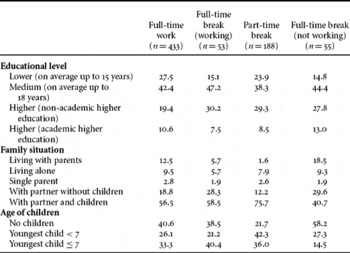
Our sample of full-time working males is a fairly good reflection of the total male working population in Flanders.Footnote 8 The proportion of lower-educated workers is lowest for full-time male career-breakers (regardless of whether they worked during the break or not). However, there are no significant differences with respect to educational level between the four groups collectively. In other words, male career-breakers come from all layers of the population who might potentially take career leave.
Family situation
A career break is taken not only to alleviate the work and family burden. Although the most dominant form of family life among working men and male career-breakers is that of living in a household with children, not all male career-breakers live with a partner or have children (Table 1). Part-time male career-breakers more often tend to live with a partner and children and have more and younger children than both full-time workers and full-time career-breakers (whether working or not). The subgroup of full-time career-breakers without any working activities contains more men still living at home with their parents or who cohabit with a partner yet are without children. In terms of family situation, full-time male career-breakers engaged in working activities do not differ from working men in the same age category. Furthermore, the two working groups do not differ with respect to any background characteristic.
Men by educational level, family situation, age of children and by employment status (column percentages)

Note: *statistically significant difference at the level p<0.05.
Men who take part-time career leave are clearly unique in relation to the men in the other groups. On average they are slightly older, are more often likely to live with a partner and children, and have younger children than the other men. One-fifth of part-time male career-breakers have taken the break because of parental leave. Only 2 per cent of the full-time career-breakers have taken parental leave.Footnote 9
Why choose a career break?
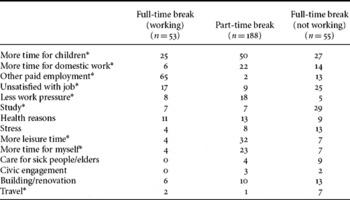
The reasons for taking a career break vary depending on whether part-time or full-time leave is taken.Footnote 10 For full-time career-breakers (working or otherwise during the period of leave), 37 per cent made the decision on account of another work-related activity (as opposed to 2 per cent for the part-timers). This group of men also recorded the highest number of working hours in their diaries. In view of the fact that the aim of this article was to find out how men's use of time changes when they work less or not at all, the decision was made to divide full-time career-breakers into two groups: those who performed another professional activity and those who recorded no working time during their period of leave. In consequence, we will discuss full-time male workers (no career break) and three groups of male career-breakers (full-time career-breakers with another work-related activity, part-time career-breakers and non-working full-time career-breakers). If we compare the three separate groups of career-breakers, the reasons for taking career leave differ significantly (Table 2).
Motivations for career interruption (percentages)

Note: *statistically significant difference at the level p<0.05.
For full-time career-breakers with work-related activities, the questionnaire reveals that the majority (65 per cent) chose to take career leave because of another professional activity. ‘More time for the children’ was specified by one quarter of this group. Seventeen per cent were dissatisfied with their jobs and 11 per cent chose a career break because of health problems. The reasons for taking part-time career leave differ. The combination of work and family plays a clear-cut role here. Half of part-time career-breakers wanted more time for the children and one-fifth mentioned ‘more time for domestic chores’ as one of the reasons for career leave.Footnote 11 In addition, 32 per cent wanted more leisure time and 23 per cent more time for themselves.Footnote 12 The last reasons mentioned indicated a desire to ‘slow down’. Full-time career-breakers without a work-related activity likewise formed a separate group, among whom almost one-third specified a course or study as a reason for career leave.Footnote 13 However, spending more time with children (27 per cent) and domestic chores (14 per cent) were also important. Male career-breakers with children especially cited these last two reasons and chose a break in their career to take up greater family responsibilities. One-quarter of the non-working male full-time career-breakers were also dissatisfied with their jobs.
Changes in time use during career leave
Previous research on fathers with parental leave or in other flexible working arrangements showed at best a slight increase in time spent with their children, if any; fathers remained largely uninvolved in household tasks. Men merely assisted with housework or took over some tasks when their wives’ flexible working hours kept them away from home (Brandth and Kvande, Reference Brandth and Kvande1998; Seward et al., Reference Seward, Yeatts, Zottarelli and Fletcher2006; Noonan et al., Reference Noonan, Estes and Glass2007). Generally, in these studies the few changes in lifestyle were explained by the short duration of the leave periods. Due to the sampling procedure, the men in our study were on leave for a longer period. How did this affect their time use? In order to analyse changes in how people spend their time when taking full or partial career leave, we have divided time use into five different categories: working activities, personal care, education, social participation, and leisure time and travel.
Total workload was not in proportion to the number of hours worked
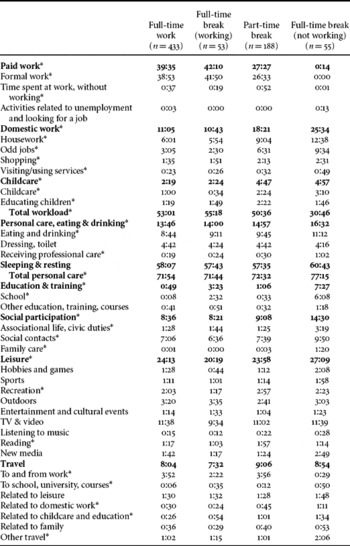
Full-time male career-breakers singled themselves out noticeably from the others in their reasons for taking career leave. Trying out a different job, spending more time with the children and following a course of study were all mentioned. The reason for taking career leave determines to a large extent the pattern of activities during the period of leave. The first remarkable finding is that the number of hours worked by full-time male career-breakers is fairly high. On average they work 20 hours 41 minutes per week, as opposed to 27 hours 27 minutes for part-time career-breakers and 39 hours 35 minutes for full-time workers (Table 3). This finding is less noteworthy when we find that 54 per cent of full-time career-breakers carry out a work-related activity during their period of leave. Consequently, a large number of men choose to take full-time career leave in order to try out another job. For this reason we decided to subdivide full-time career-breakers into: full-time career-breakers with work-related activities (that is, having carried out work during the registration week); and full-time career-breakers without a job. This allows us to identify changes in use of time patterns that occur as a result of working less, or not working at all. Full-time career-breakers with work-related activities barely differ from full-time workers: their background characteristics are not divergent and how they spend their time is pretty much the same.
Time (in hours:minutes) spent on main activities (total week)

Note: *statistically significant difference at the level p<0.05.
If we disregard men choosing to take leave for other work-related activities, a career break goes hand in hand with a significant reduction in the total workload. The total workload consists of paid work, domestic work and childcare. Working full-time career-breakers have the highest overall workload totals! They work on average for 55 hours 18 minutes, and this is more than full-time workers, who work around 53 hours per week. For part-time male career-breakers, the total workload is 2 hours 25 minutes per week less, and non-working full-time male career-breakers have a workload that is 22 hours 15 minutes less than full-time working men. In terms of total workload, full-time male career-breakers who perform work-related activities do not significantly differ from working men with respect to paid work, domestic work and childcare.
Part-time career leave does not imply a radical reduction in total workload. After all, the lower number of hours worked by part-time workers (12 hours 8 minutes less than full-time male workers), is partially compensated for by an increase in domestic work (+ 7 hours 16 minutes) and childcare (+ 2 hours 28 minutes). A large proportion of the part-time male career-breakers choose to reduce their hours of employment in order to free up time for their families. Sixty per cent of the part-time male career-breakers recorded childcare activities in their diaries for that particular week as opposed to 42 per cent of full-time male workers (whether career-breakers or not) and 35 per cent of the full-time male career-breakers without work-related activities. To a significant extent, men with part-time career leave are more likely to live with a partner and children than are other men.Footnote 14
Full-time male career-breakers without work-related activities showed a marked reduction in total workload. Their workload is 20 to 25 hours less than that of men who are in part-time or full-time employment. In comparison with full-time male workers, they spend 14 hours 29 minutes more on domestic work and 2 hours 38 minutes more on childcare. Non-working full-time career-breakers also carry out more domestic work than part-time career-breakers (+ 7 hours 13 minutes). However, childcare hours do not rise as a proportion of time freed up by not working.
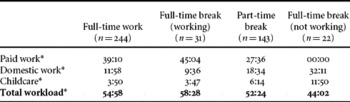
Part-time or full-time career leave can indeed act as a catalyst for performing more family-based activities. The total workload is connected closely with the family situation. The aforementioned results do not take into account that 76 per cent of part-time male career-breakers cohabit with a partner and children, whereas for working men this percentage is between 56 per cent and 58 per cent, and for full-time male career-breakers without work-related activities it is 41 per cent. We get a better picture of the changes in the combination of work-based and family-oriented activities if we look exclusively at fathers (Table 4). Among fathers, the overall workload differs significantly. For male career-breakers with a family, a clear-cut redistribution of workload can be identified. Less paid work or no paid work at all correlates well with a gradual increase in household tasks and childcare.
Time (in hours:minutes) spent on paid work, domestic chores and childcare for men with partner and children (total week)

Note: *statistically significant difference at the level p<0.05.
An exception to this is the full-time career-breakers who, in reality, do not interrupt their professional careers but start a new work-related activity. They perform considerably more paid work than full-time workers, but roughly the same amount of domestic work and childcare. In view of the small number of fathers among full-time career-breakers, these figures should be regarded as indicative.
Recent research in Australia (Craig, Reference Craig2006) has shown that parenthood has a completely different meaning for men than for women. Motherhood implies a great deal more than fatherhood: carrying out different activities at the same time, more physical childcare, more time spent with the children, more time restrictions in general and taking on more responsibilities vis-à-vis the children. These differences persist in families where women are employed on a full-time basis. Table 4 shows that men who take a career break can bring about changes in this and take on part of the family-related workload. After all, almost 90 per cent of fathers taking career breaks have a working partner. In the questionnaire, fathers with part-time career leave report taking on approximately 44 per cent of the total childcare responsibilities. For non-working fathers with full-time career leave, this rises to 66 per cent. Full-time working fathers on a career break say they are responsible for just 40 per cent of the childcare.
Personal care: a constant?
Personal care accounts for the largest portion of weekly time spent. Working men do not differ very much in this. The less time men work, the more time they devote to personal care (Table 3). A full or partial break in employment causes a significant increase in time devoted to drinking and eating. In addition, non-working full-time career-breakers spend more time on professional forms of personal care (the hairdresser, medical care at home or externally and so on). This difference is not accounted for by poorer health conditions among non-working full-time career-breakers. Getting dressed and washing, regardless of the work situation, occupy approximately four and half hours every week.
Combining work and family-based tasks takes its toll: part-time male career-breakers sleep and rest the least. Full-time career-breakers without work benefit the most from sleep, more so than part-time career-breakers and working men.
Studying while on leave
Table 2 reveals that almost one-third of full-time career-breakers without work-related activities take leave because they wish to pursue an education or training programme. Full-time career-breakers with or without work-related activities spend significantly more time with their noses in books than full-time workers (3 hours 23 minutes and 7 hours 27 minutes, respectively). For part-time and full-time workers this fluctuates around one hour per week (Table 3).
This is consistent with the questionnaire, which revealed that 31 per cent of men taking a full-time career break (whether working or not) are enrolled in an educational or training programme that occupies more than 30 hours of their time on an annual basis. Among part-time career-breakers this percentage is just 13 per cent. The nature and reason for pursuing or adding a course of study differs depending on whether the career leave is part-time or full-time. Full-time career-breakers prefer a full-time course of study, at a college of higher education or university, in order to improve their future job prospects. Part-time male career-breakers usually participate in a training course or workshop rather than a full-time course of study. This education might be acquired in a college of higher education or university, in formal adult education (‘education for social advancement’), in non-formal adult education (‘in a social or cultural association’) or in art education. More than half engage in this type of education out of interest.
The data again reveal that men with full-time career leave differentiate themselves clearly from part-time career-breakers. Whereas the latter use the freed-up time to facilitate a more balanced combination of work, family and leisure time, almost one-third of full-time career-breakers choose to interrupt their jobs to enhance their future career prospects.
Less work, more leisure time?
It is often assumed that work (paid employment and family-based work) and leisure time are reciprocal entities. Fewer compulsory activities should go hand in hand with more leisure activities. However, the data on time use suggest that this is not always the case. It appears that full-time career-breakers who engage in other work-related activities have the least amount of time for social participation and leisure (28 hours 40 minutes). Working men spend four more hours on social and leisure activities: that is, 32 hours 49 minutes. The difference for part-time male career-breakers is slight and not significant (17 minutes). The lower total workload of 2 hours 25 minutes for part-time career-breakers is therefore not automatically exchanged for more spare time activities. It is the full-time male career-breakers without work-related activities, in particular, who benefit considerably from more leisure time, with 41 hours 39 minutes per week or almost 6 hours a day that are not devoted to family tasks, sleeping and other personal care.
It is likewise interesting to examine social participation and leisure time separately. Full-time workers and full-time career-breakers who work differ only marginally when it comes to social participation (Table 3). Likewise, taking part-time career leave is no guarantee of greater social participation: they do not spend significantly more time on social activities than full-time male workers or full-time career-breakers with a job. Only among full-time career-breakers without a job is there a significant increase in time for social activities. They spend most of their participation time on associational life, social contacts and providing care or assistance to the rest of the family.
As far as leisure time is concerned (Table 3), full-time career-breakers with a job differentiate themselves noticeably from full-time workers and other men. With an average of 20 hours 19 minutes, they have the least leisure time of all. The other groups do not differ significantly from each other in terms of overall time devoted to leisure activities. Watching television takes up the most time. However, the four groups only differ significantly from each other when it comes to recreational activities and reading. Recreational activities (such as walking, cycling and swimming) and reading are most common among part-time career-breakers.
Combining work and family leads to longer journey times
A temporary break in work, whether part-time or full-time, brings about longer journey times (about one hour per week) than full-time workers require (Table 3). The nature of the journey reflects the pattern of other activities. Full-time career-breakers without work-related activities, of course, spend the least time on travel to work, but spend more time on travel that is related to household and childcare activities. But they also have the longest journey times travelling to school and for other travel purposes.
Men who interrupt their career on a full-time basis to carry out other work-related activities spend less time travelling to and from work than full-time workers. Only 62 per cent of working full-time career-breakers spent time travelling to work in the week recorded, as opposed to 85 per cent of full-time workers. This suggests that full-time career breaks are taken to engage in self-employed activities at home. When working full-time career-breakers were asked where and how they intended to work after the end of their career break, 64 per cent responded that they would continue on a self-employed basis. Only 6 per cent of non-working full-time career-breakers wanted to work on a self-employed basis afterwards. None of the part-time career-breakers chose this option.
Allocation of freed-up working time
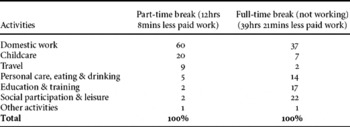
Another way of looking at changes in how career-breakers use their time is to examine how time that is freed up by not working or working less is allocated among other activities when compared to full-time workers (Table 5).
Allocation of reduced working time compared with full-time working men (in percentages)

Part-time career-breakers work 12 hours 8 minutes less than full-time workers. About 80 per cent of the time that they gain by working on a part-time basis is spent on family-based tasks (domestic work and childcare). Almost one-tenth of the time is spent on journeys.
Among full-time career-breakers without work-related activities, 44 per cent of freed-up time is devoted to family tasks (Table 5). In other words, these individuals spend a smaller share of freed-up time on family tasks than part-time career-breakers. On the other hand, around one-fifth of freed-up time is spent on social and leisure activities and another fifth on study. If we consider only the full-time career-breakers without work-related activities and with children, they would appear to spend around three-quarters of freed-up time on family tasks, just like part-time career-breakers. However, their numbers are too low for our data to provide any statistical significance in this respect.
Discussion and conclusions
Leave policy is a hot topic at present. Most countries report significant recent changes in their leave arrangements that increase the scope of leave entitlements (Moss and O'Brien, Reference Moss and O'Brien2006). The Belgian general career break and time credit schemes are unique in that they can be taken up regardless of the underlying reason throughout the life cycle. The policy aims at facilitating a better work–life balance to keep people with competing interests in the workforce. Leave arrangements and part-time work prevent women from adopting drop-out transitions from the labour market when family obligations become too onerous (Anxo and O'Reilly, Reference Anxo, O'Reilly, Schmid and Gazier2002). Career breaks and parental leave offer fathers a legitimate framework to free up time for their children. Clearly, the general scheme of career break is intended not only for parents, and recognises that one might like a break from employment at any age for other reasons: to travel around the world, to build a house, to study, to switch careers, to pursue a hobby, to relax, to engage in volunteer work, to be there for demanding children, to take care of elders or for any other reason. Such a policy acknowledges the many uses of time that make for a good life (Deven and Moss, Reference Deven and Moss2002: 248). The relatively low wage compensation in the general scheme does not allow it to be mistaken for a ‘paid’ holiday. Although the system is under assault each time political alliances have to be renewed, the leave system has been expanded during the past 30 years. As such, it could provide the basis for a flexible or transitional labour market from which employers, individuals, families and communities could benefit (Schmid, Reference Schmid1998; Anxo and O'Reilly, Reference Anxo, O'Reilly, Schmid and Gazier2002; Deven and Moss, Reference Deven and Moss2002; Schmid and Gazier, Reference Schmid and Gazier2002).
Previous research indicated that men are reluctant to take parental leave. The situations in Belgium for parental leave and for the more general scheme of career break are not different. In 2004, about three-quarters of the participants were women, and their main reason for taking leave was to combine work and family obligations. Few men opt for a career break: only 1.1 per cent of employees were younger than 50. Can we consider those men to be in the vanguard of change?
Interrupting the career full-time can especially seem like a daring and atypical choice for men. Strangely enough, our analyses demonstrate that 54 per cent of full-time male career-breakers continue to work during the break. In fact, taking career leave to try out another job is the most popular reason for taking a full-time career break. These men have the highest total workload and are subject to the greatest time pressures of all men. Whether the leave provides them with a better work–life balance is questionable.
Male career-breakers on full-time leave and with no other work activities have no fewer than 39 hours 21 minutes extra time available compared to their working counterparts. On average, non-working full-time male career-breakers spend just 43 per cent of the freed-up working time on family tasks (domestic work and childcare). One-fifth of freed-up working time is devoted to social and leisure activities and one-fifth to study. In consequence, this group of men has the largest amount of spare time and the smallest total workload and time pressure.
For men, full-time career leave is, first and foremost, a means of trying out another work-related activity. Full-time male career-breakers who do not perform any work-related activity during the period of leave are mainly divided between men who enrol in a course of study (this group contains hardly any fathers) and men who primarily perform family tasks. This last, small group of fathers made a conscious decision to swap paid work for unpaid work, and acted upon it. The same conclusion can be drawn for men on part-time leave.
Part-time male career-breakers use time that has been freed up primarily for domestic work and childcare: 80 per cent of this time is devoted to family tasks. To a lesser extent, more time is spent on travel: in particular in relation to household chores and childcare, personal care, engaging in a study option and social participation and leisure time. The combination of a part-time job and family-based tasks ensures that the total workload is not lower than for full-time male workers and that time pressures are just as high.
Part-time male career-breakers present a strong image as caring fathers. They use career leave and time credit schemes effectively to achieve a better balance between paid work and family life. This demonstrates that when men are presented with an opportunity to work less and are supported in taking up an alternative role by means of career leave and time credit schemes, they will effectively take on more family tasks (temporarily).
The men who used the career break to considerably reduce their working hours effectively spent far more time on household chores and childcare than working fathers. These findings contradict previous research on men's use of parental leave (Brandth and Kvande, Reference Brandth and Kvande1998; Seward et al., Reference Seward, Yeatts, Zottarelli and Fletcher2006). The time use diaries and questionnaires provide a unique insight into the life of career-breakers. However, the sample size was small. A larger sample is needed to further test these findings. Ideally, time diaries from both partners should be collected before and during the break. The men in our sample could well be exemplary men in households where an equal sharing of household tasks was already not an issue before the leave-taking.
Although the proportion of men in leave arrangements is still very small compared to women, the number of male career-breakers is increasing each year.Footnote 15 Government policies should further encourage men to take advantage of leave arrangements and especially to work fewer hours. The high take-up rate of parental leave in the Scandinavian countries is partly due to strong government campaigns (and high compensation wages), which have slowly succeeded in forcing a switch in mentality among employers and employees. This study suggests that if men reduced their working hours (by taking a career break or other flexible work arrangements), a more even distribution of paid and unpaid work in the household could be established and a better balance between work and family life obtained. When only women take advantage of flexible leave arrangements, this could well lead to the perverse effect that work–family policies aiming at more gender equality lead to the exact opposite, when it is taken for granted that women will lower their work ambitions to prioritise family life.