Introduction
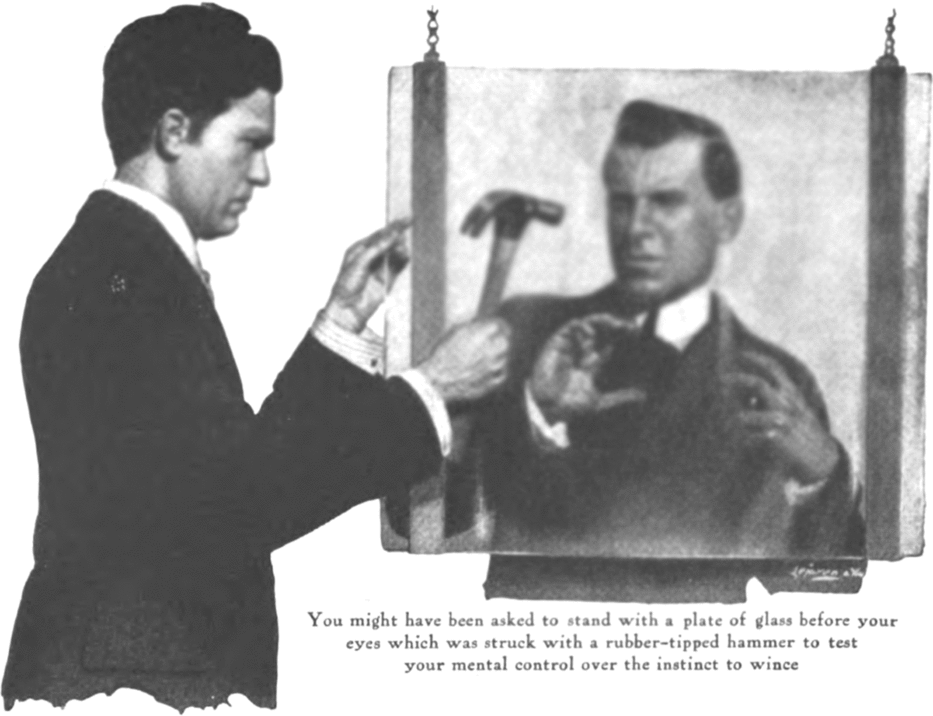
On 7 November 1914, twenty-seven applicants for the position of traveling salesman with the American Tobacco Company arrived at the Harvard Psychological Laboratory. “The tests that will count the most at examination today,” reported the Boston Journal, “will be the facts caught by impersonal instruments and carefully recorded in a strictly scientific way” (Anon. 1914a). Led into one of five rooms by a student guide, applicants were asked to stand facing a plate of glass. Over repeated trials, test subjects were instructed not to blink while the psychologist, aiming square between their eyes, struck the glass plate with a rubber-tipped hammer (fig. 1). The goal of this experiment was to assess the ability to control “instinctive impulses” (Münsterberg 1915a, 286). In another test, subjects peered into a tachistoscope, an instrument for displaying visual stimuli at precise intervals, and observed a pattern of interwoven shapes briefly flashed upon a screen. By recalling each geometric form in its correct orientation, attention and memory were gauged. After nine hours of testing, Hugo Münsterberg, Director of the Psychological Laboratory, calculated the results and recommended the top ten candidates for the traveling salesman position. In “The Man-Screen,” Richard Washburn Child's account that appeared in Cosmopolitan the following May, the titular image evokes a kind of psychotechnical sieve, filtering out vocational misfits like pebbles in a fine-mesh screen (Child Reference Child1915). At the same time, in passing through each psychological test not only were candidates’ aptitudes and deficiencies disclosed, but self-presentation ostensibly discerned from true self.
Illustration by Lejaren A. Hiller. In “The Man-Screen,” by Richard Washburn Child, Cosmopolitan Magazine (May 1915):647.

One year later, Child's image of “The Man-Screen” would take on new meaning when Paramount Pictures announced that famed Harvard psychologist, Hugo Münsterberg, would engage moviegoers in a series of psychological tests produced for the screen. “Nobody should be a manager, a newspaperman, a chauffeur, a farmer, a salesman, a teacher, a physician, who has not the mental traits for it” read one press release. Through “psychological tests upon the screen,” the announcement continued, Professor Münsterberg was to show “millions how to find personal mental traits” and avoid becoming another square peg in a round hole (Anon. 1916b, 465). Speaking at the First National Motion Picture Exposition at Madison Square Garden, Münsterberg explained that each screen test had been arranged so “that motion picture audiences may learn what characteristics equip one for special kinds of work.” Borrowing directly from the battery of psychological tests he had utilized in screening applicants in the psychological laboratory, one experimental film, for example, presented an animated word jumble as a test of mental dexterity. Such tests, he asserted, were “for the executive type of mind, which must be able to grasp the meaning of a situation as soon as it presents itself” (ibid.) Work requiring attention to detail called for a different scenario; by showing images with missing elements not immediately apparent, the power of observation was tested. In short, there was “no type of mind,” Münsterberg concluded, which could not “be classified through this series, which may do a wonderful work in making the necessary connection between talent and the occupation for which it is best suited.”Footnote 1 More than mere movies, these were psycho-cinematic experiments for guiding the vocationally uprooted, displaced, or dissatisfied worker in search of their true calling amidst the cacophony of an increasingly complex socio-economic order (Wiebe Reference Wiebe1967; Baritz Reference Baritz1960).
In recent decades there has been a marked revival of scholarly interest in Münsterberg's life and work. This is particularly pronounced in film and media studies where Münsterberg's The Photoplay: A Psychological Study (1916) is often credited as the first major contribution to film theory. Giuliana Bruno, for example, has described The Photoplay in relation to the material culture and experimental practices at home in the Harvard Psychological Laboratory. Robert Brain, emphasizing the philosophical framework underpinning The Photoplay, has provided much needed intellectual context for understanding and interpreting Münsterberg's work. While Brain (Reference Brain2012), Bruno (Reference Bruno2009), and Schweinitz (Reference Schweinitz and Schweinitz1996), to name a few recent examples, have situated The Photoplay in its proper experimental, philosophical, and material context, remarkably little attention has been paid to Münsterberg's contribution to the Paramount Pictographs and its relationship to psychotechnics and vocational psychology.Footnote 2
By moving away from The Photoplay and towards Münsterberg's psychological tests for the screen, the present study suggests new points of contact between early cinema and film theory and the history of psychological tests (Sokal Reference Sokal1990) and early-applied psychology (Capshew Reference Capshew1999; O’Donnell Reference O’Donnell1985). For example, as Daniel Kevles has noted (Kevles Reference Kevles1968), Münsterberg exerted a strong influence on his student and colleague Robert M. Yerkes, who would go on to direct the U.S. Army intelligence testing program during World War I (Carson Reference Carson1993; Reed Reference Reed and Sokal1990; Von Mayrhauser Reference von Mayrhauser and Sokal1990). As Yerkes himself reflected in his unpublished autobiography, the “intimate association with that pioneer advocate of the application of psychology, Hugo Münsterberg . . . had gone far to prepare me for this unexpected chance to apply psychological methods to military problems and needs.”Footnote 3 Placed in this context, Münsterberg's “Testing the Mind” film series, was not merely an outlier experiment in the commercialization of psychological techniques, but marked a novel method of group testing amidst a growing array of individual and group testing practices developed before, during, and after the war.
Still, a crucial difference distinguishes screening candidates in the laboratory from the screening of vocational tests in the cinema. In Münsterberg's laboratory, psychological tests were deployed as scientific means to an end;Footnote 4 an employer like the American Tobacco Company brought applicants in to the laboratory, and Münsterberg, with the help of his students, psychotechnically separated the wheat from the chaff. In this sense, the “man-screen” was wielded by employers as an instrument of selection and a shield of scientific authority against workers’ claims to autonomy and self-definition. In the movie theater, on the other hand, the screening of psychological tests was construed as a form of empowerment from below. By opening up the cloistered laboratory to the world and inviting audiences into the experiment, the cinema became a new method to “know thyself,” not simply be known. Moreover, as Münsterberg believed that employers and employees alike, in the absence of psychological training, would be deceived by naive methods of introspection and observation, “Testing the Mind” was promoted as a democratic means of disseminating proper experimental protocols to the average person.Footnote 5 By replacing the psychologist with instructional title cards, experimental stimuli with moving pictures, and subjects with spectators, Münsterberg's experimental films aimed to transform hidden aptitudes and deficiencies into observable behavior for the edification and vocational enlightenment of the movie-going masses. For in Münsterberg's idealist vision, society had a place for everyone, and through psychological self-analysis each individual would be capable of discovering their unique piece in the increasingly specialized puzzle of industrial society (Hale Reference Hale1980).Footnote 6 In summary, from screening candidates in the psychological laboratory to psychological tests upon the silver screen, this article interrogates the connection between Münsterberg's “Testing the Mind” film series and the origins of vocational psychology and psychotechnics.
From Psychophysics to Psychotechnics: Hugo Münsterberg and the Harvard Psychological Laboratory
“What has Psychology to do in a laboratory? What part has she in instruments and experiments?” (Münsterberg Reference Münsterberg1893, 201). When Hugo Münsterberg arrived at Harvard in 1892, to take the reins from William James as Director of the Psychological Laboratory, these were the two questions he most frequently faced. After all, psychology was but a new discipline, somewhere between moral philosophy and metaphysics in the popular mind (Burnham Reference Burnham1987, 85–94; Coon Reference Coon1992), and the psychological laboratory he had inherited was not yet the established institution it would become.
In answering these questions Münsterberg explained to the readers of Harvard Graduates’ Magazine that psychology as a laboratory science had begun to develop when armchair speculations about mind-body relations were traded in for experimental methods adapted from physics and physiology. Sparking this transformation, Münsterberg, like many practitioner historians (Boring Reference Boring1929), cited Fechner's Elements of Psychophysics (1860), in which mathematical laws for human sensation were developed from simple stimulus-response experiments. Connected to psychophysics Münsterberg also pointed to the discovery of the “personal equation” in the context of astronomy as a catalyst for scientific psychology. If multiple astronomers simultaneously observing a phenomena differed in their recorded values, how, they probed, might this psycho-physiological error be calculated and controlled? Testament to the stability of disciplinary narratives, E. G. Boring, thirty-six years later, would similarly trace experimental psychology back to astronomy, which as he put it, “furnished it with a problem, some facts, a method and some apparatus,” and Fechner's psychophysics, which “set experimental quantitive psychology off upon the course which it has followed” (Boring Reference Boring1929, 142, 286).Footnote 7
Psychophysical quantification, more importantly, was predicated on instrumental methods: methods and apparatus that made psychology more credible in the eyes of the scientific community (Capshew Reference Capshew1992; Gundlach Reference Gundlach, Ash and Sturm2007, 218–220; Sturm and Ash Reference Gundlach, Ash and Sturm2005). Like the biologist's microscope or the anatomist's scalpel, psychological instruments sharpened and standardized the scientific gaze. The tachistoscope coupled with the chronoscope, for example, allowed psychologists to control the exposure of visual stimuli down to the millisecond while automatically recording test subjects’ physiological responses upon the rotating drum of a kymograph. By transmuting mental sensation into objective traces, and reaction times into data sets, psychological instruments not only provided psychologists with the material means for carrying out experiments, but also with the hard currency of “mechanical objectivity” (Daston and Galison Reference Daston and Galison2007; Latour and Woolgar 1979).
The great value invested in apparatuses has led some historians to refer to the late nineteenth and early twentieth century as the age of “brass-instrument psychology” (Davis 1970; Coon Reference Coon1993; Ash Reference Ash, Porter and Ross2003). Instrumentation, however, did not replace introspection. Like William James and E. B. Titchener, Münsterberg maintained that above all else, introspection, or for Münsterberg, “self-observation,” lay at the heart of the psychological experiment (Green 2010; James Reference James1890, 185).Footnote 8 “All the equipment of our institutes and all the instruments for our investigations” he asserted, “would be just as useless without self-observation as a microscope without an eye to look through it” (Münsterberg Reference Münsterberg1895). To be trustworthy, however, self-observation had to be harnessed to a social technology. Psychological training was key, as well as restricting the pool of test subjects to graduate students and professors. Kurt Danziger has suggested that this kind of artisanal technique regulating early psychological laboratories represents the “socially constructed nature of psychological knowledge” (Danziger Reference Danziger1990; Morawski Reference Morawski, Ash and Sturm2007). For Deborah Coon, however, “standardizing the subject” in psychology was a product of industrialization and “cancomitant technological ideal.” Psychologists at the turn of the century, according to Coon sought to “rationalize the production of this psychological knowledge by standardizing their methods and instruments in conformity with the ideals of an industrializing society” (Coon Reference Coon1993). Reliable introspection, in other words, was achieved when the experimental subject acted like a well-calibrated machine capable of producing credible knowledge out of subjective experience.
More than a site for validating psychological knowledge or a screen from the noise and vibrations of the outside world (Schmidgenn Reference Schmidgen2003), the laboratory itself was a powerful symbol of psychology's entry into the “fraternity of science” (Benjamin 2000; Capshew Reference Capshew1992; O’Donnell Reference O’Donnell1985; Poppleston and McPherson Reference Popplestone, McPherson and Brožek1984). And no psychological laboratory held greater symbolic weight than that of Münsterberg's teacher Wilhelm Wundt, founder of the first psychological institute in 1879 at the University of Leipzig (Bringmann et al. Reference Bringmann, Bringmann and Tweney1980). After taking his Ph.D. under Wundt in Leipzig and M.D. in Heidelberg in 1888, Münsterberg moved to the University of Freiburg where, building on the Leipzig model, he founded his own laboratory, only the fourth in Germany at the time (Hale Reference Hale1980; Spillmann and Spillmann Reference Spillmann and Spillmann1993). Largely self-financed and constrained to two rooms in his home, as director of his own laboratory Münsterberg nevertheless managed to establish himself as a leading experimentalist in Germany attracting students from across Europe as well as overseas. Among his first American students was a young man from Harvard by the name of Edmund Delabarre who would go on to write his dissertation at Freiburg on the “Sensation of Movement” (1891), which he dedicated to his teachers Münsterberg and William James.
Parallel to German developments, William James was among the first in North America to establish a psychological laboratory and to proclaim psychology a new, or at least nascent, natural science. There was, however, one small problem. In a letter to Münsterberg, dated 21 February 1892, James explained “I, at the age of 50, disliking laboratory work naturally . . . could, tant bien que mal, make the laboratory run, yet am certainly not the kind of stuff to make a first-rate director thereof.” After courting Münsterberg for several months, on 3 May 1892, James emerged victorious. “It is an enormous relief to me” he told Münsterberg, “to see the responsibility for experimental psychology in Harvard transferred from my feeble and unworthy shoulders to those of a man as competent as you.” After a three-year trial period at Harvard, Münsterberg was reappointed as Director of the Psychological Laboratory, a position he would hold until his death on 16 December 1916.
According to Münsterberg, in the first decade of his tenure his “experimental labors had been devoted to strictly theoretical interests” (Münsterberg Reference Münsterberg1917, 46). “Just as the chemist examines his materials theoretically without asking whether they are poisons or means of nourishment for the body,” Münsterberg maintained that the psychologist, too, “has to investigate the phenomena of consciousness without considering side issues” (Münsterberg Reference Münsterberg1893, 208).Footnote 9 This commitment to “pure science,” however, was more than just an epistemic priority, it was a safeguard to the young discipline's scientific credibility. Like many of his contemporaries, Münsterberg subscribed to the idea that experimental psychology had first to reach a certain stage of development before its application would be feasible. While instruction in general psychology had educative and indeed practical value in and of itself, direct application to practical problems in pedagogy, for example, was still out of the question for Münsterberg in the 1890s. “Call me conservative, call me reactionary, call me ignorant,” he exclaimed in an 1895 speech before the Massachusetts Schoolmasters’ Club, “but I adhere to my belief, that the individual teacher, for his teaching methods, does not need any scientific psychology, and that tact and sympathy and interest are more important for him than all the twenty-seven psychological laboratories of this country.” The logic of the laboratory and the real world were not governed by the same rules, he contested; therefore, translating experimental science into practical prescription was an ill-fated ambition.
At the turn of the twentieth century, however, “the time seemed ripe,” according to Münsterberg, “for applying science to the practical affairs of life” (Münsterberg Reference Münsterberg1917, 46). While scholars disagree over what exactly brought about this change of heart, the convergence of several important institutional, social and intellectual factors goes a long way towards an explanation. Intellectually, the influence of his academic friends, William Stern at the University of Breslau and James McKeen Cattell at Columbia University, were particularly important. Cattell and Stern had both been early promoters of the psychology of individual differences. Citing Stern, Münsterberg would write in Psychology and Industrial Efficiency that while “the study of individual difference itself is not applied psychology . . . it is the presupposition without which applied psychology would have remained a phantom” (Münsterberg Reference Münsterberg1913a, 10). Nevertheless, like Münsterberg, Stern had initially warned his fellow psychologists in 1900 against premature application, as practical failures, he feared, threatened to discredit the whole discipline: “If we work restlessly but not in haste on the theoretical problems, then when the time comes practical success will come as ripened fruit falling from the tree: gnosis precedes dia-gnosis and pro-gnosis!” (Stern, quoted in Lamiell Reference Lamiell2003, 37).
Evidently for Stern the harvest came in 1903 when he founded the Beiträge der Psychologie der Aussage (Contributions to the Psychology of Testimony).Footnote 10 In the journal's first article entitled “Angewandte Psychologie” (Applied Psychology), Stern outlined the two sides of applied psychology, Psychotechnik (psychotechnics) and Psychodiagnostik (psychodiagnostics). While psychodiagnostics referred to the psychological assessment of human personality, psychotechnics he defined in terms of psychological aid in everything from education, to law, medicine, and music. Interestingly, in Stern's second article in the same volume he outlined various methods for testing the reliability of testimony. Notably one test method called for screening a short film and asking subjects to report upon what they recalled seeing.Footnote 11 Around the same time Stern coined the term psychotechnics (1903) and co-founded the Institute of Applied Psychology in Berlin (1906), similar themes began to appear in Münsterberg's own writing, including a series of articles in 1907 on psychology and the law.Footnote 12
In addition to the growing institutional legitimacy applied psychology had begun to enjoy through Stern's Institute of Applied Psychology in Berlin and his Zeitschrift für angewandte Psychologie (Journal of Applied Psychology), Münsterberg also observed the beginnings of advertising psychology and the success of Walter Dill Scott in this new field. Like Scott, advertising managers had reached out to Münsterberg as early as 1901, but at the time he was wary of connecting his name with industry (Friedman Reference Friedman2004, 174; Baritz Reference Baritz1960). Scott's appointment as director of the psychological laboratory at Northwestern University in 1905 and the publication of his Psychology of Advertising in 1908 may have helped to assuage this anxiety. Meanwhile, at Harvard there was also growing institutional support for applied science that extended beyond engineering. For example, in 1906 Harvard established a Division of Education that included educational psychology in its curriculum the same year the Graduate School of Applied Science was formed. The new legitimacy and public recognition of educational and advertising psychology led to new interactions between psychologists, artists, educators, and businessmen. For example, in 1904 Münsterberg consulted on a series of art education textbooks published by the Prang Educational Company and even contributed his own volume on the subject, The Principles of Art Education, issued by the same publisher the following year. Although not applied psychology in the modern sense, this book translated experimental aesthetics, a field pioneered by Fechner, into a kind of instructional guide for art teachers. Many themes from this book were carried over into The Photoplay: A Psychological Study (1916), Münsterberg's final contribution to applied psychology (Brain Reference Brain2012; Fredericksen Reference Fredericksen1977).
It was on the back of these developments that in his 1907–1908 annual report Münsterberg announced the inauguration of a “department in the laboratory devoted to applied psychology” (Münsterberg Reference Münsterberg1909). Clarifying the vast scope of the new field, Münsterberg explained in his report:
We understand by applied psychology inquiry into the practical help which experimental psychology can give to the various professions and industries, especially to the work of the teacher, of the lawyer, and of the physician, but hardly less to that of the worker in commerce and industry in art, in social reform, etc. The aim is thus the development of a science related to psychology as engineering is to physics. (Ibid.)
That science on the horizon Münsterberg called “psychotechnics,” reaffirming the analogy to engineering and the model of the technical institute.
In Psychology and Industrial Efficiency (Reference Münsterberg1913a), Münsterberg distinguished pure psychology from psychotechnics in terms of means and ends. Pure psychology, put simply, was science for science's sake, a means toward no particular end other than knowledge itself. Psychotechnics, on the other hand, designated the application of psychological means (psycho-techniques) toward given ends. Like the engineer hired to build a bridge, Münsterberg asserted that the task of the psychotechnical expert was merely to reach certain concrete ends, “but whether these ends are the best ones is not a care with which the psychologist is to be burdened” (Münsterberg Reference Münsterberg1913a, 19).
Psychotechnics and Vocational Psychology
As psychotechnics was not generative of its own ends, inspiration for applied research in the Harvard Psychological Laboratory came of necessity from without. For example, Michael Pettit has described Münsterberg's early contribution to the psychology of trademark infringement through his connection to the Chicago attorney Edward S. Rogers. Rogers, whose corporate clients included Coca-Cola, Pabst Brewing Company, and Quaker Oats, wrote to Münsterberg in early 1909 hoping to interest the Harvard professor in the practical problem of trademark infringement. From Münsterberg Rogers hoped some form of psychological test or scale might be developed in his laboratory that could be used to judge lawful similarity from unlawful imitation (Pettit Reference Pettit2007). Sufficiently intrigued, Münsterberg assigned the problem to several students in the hope that it would “lead to results which may, indeed, make such a psychotechnical use possible” (Münsterberg Reference Münsterberg1913a, 292).
The chief outcome of this line of research was a dissertation by Münsterberg's student Gustave A. Feingold entitled “Recognition and Discrimination” (1915). For his initial experiments, which focused on the discrimination between words similar in appearance or meaning, Feingold sat each subject before a screen that concealed the experimenter from view. “In this screen” he described, there was “an oval aperture through which the observer looked with both eyes at the printed card, or at the picture post cards of the later experiments, exposed on a black background” (ibid., 15). Seated in this darkened enclosure, Feingold then read to each subject the following directions:
In daily life one is occasionally confronted with the phenomenon of mistaking one name or one word for another, because they have some resemblance either in spelling, sound or meaning. Now, I am going to expose a group of words for x seconds, and after an interval of 20 seconds I shall reexpose the same group either intact or with some change. See if you can discover that change. . . . Try not to let your mind wander during the interval. Yet be natural . . . In short, do your best, in your own way, to recognize a change if one occurs and tell me, if possible, what that change is. (Ibid., 16–17)
The significance of this arrangement in relation to cinema is revealed in the “epistemological architechtonics,” to borrow Giulian Bruno's term, or the relationship between space, instrumentality, and the epistemological conditions of the experiment. A subject, seated in a darkened room, faces a screen upon which visual stimuli are flashed through an aperture. By directing test subjects’ attention to such details as product names not only is an aspect of everyday life, like browsing at a market, reproduced, but subjective experience is transformed into recorded objective data. Replacing the psychologist with textual directions projected onto the screen, we have the basic arrangement for “Testing the Mind.”
To understand the vocational orientation of Münsterberg's films, however, we must look to the influence of another attorney, Frank Parsons, founder of the first vocational bureau in Boston in 1908. In Choosing a Vocation, Parsons outlined two phases in guiding advice-seekers towards occupations well suited to their personality and individual strengths. The first phase entailed scientific analysis of “each person's aptitudes, abilities, ambitions, resources, and limitations” in relation to “the conditions of success in different industries” (Parsons Reference Parsons1909, 3). This information was gathered primarily through interviews with a vocational counselor and self-analysis guided by a questionnaire. Second, it required the collection of information about the diverse physical and mental requirements of potential vocations so that compatibility of work and worker might be more accurately guaged.
Although Münsterberg agreed with Parsons’ general vision and the mission of the Boston Vocation Bureau, he took issue with the lack of psychological expertise involved in the guidance process. Parsons, in fact, initially expressed great interest in enlisting the resources of the psychological laboratory in vocational guidance; however, after his sudden death in Septemeber 1908, the potential for collaboration quickly faded. This was, in large part, due to the movement's new leadership, an issue we will return to shortly.
Münsterberg's dissatisfaction with the post-Parsons era of vocational guidance was unambiguously expressed in his essay “Finding a Life Work,” published in McClure’s in 1910. The average person, Münsterberg argued, was fundamentally incapable of accurate self-analysis and the vocational counselor, untrained in psychology, was ill-equipped to make scientifically sound observations. “To emancipate one's self from the method of ordinary self-observation” and the counselor's psychologically naive interview, he suggested they be replaced with the “objective experiment in the psychological laboratory” (Münsterberg Reference Münsterberg1913a, 45). Towards this end he envisioned in every municipal vocation bureau an in-house psychological laboratory and expert psychologists on hand.Footnote 13
Meyer Bloomfield, the Boston Vocation Bureau's new director, took Münsterberg's words to heart. The Vocation Bureau, Bloomfield claimed, could ill-afford to turn their “consulting-rooms into clinics and psychological laboratory” (quoted in Bruce Reference Bruce1913). “You see,” Bloomfield argued in a 1911 interview with H. Addington Bruce,
if we were to attempt to test boys and girls the way Professor Münsterberg suggests, their parents would at once leap to the conclusion that we thought there was something the matter with them, and that would be the last we should see of them. People, as you know, are extremely suspicious of things they do not understand, and psychology is a sealed book to most laymen. (Bruce Reference Bruce1911, 35)
Bruce, to be sure, was no impartial reporter. Having relocated to Cambridge in 1906 to study psychology and philosophy at Harvard, Bruce, by 1911, had become a leading advocate for applied psychology in the popular press. Therefore it is not surprising that he would follow Bloomfield's indictment of vocational psychology with the rebuttal that “Many of the most helpful tests may be made by the use of simple devices . . . and whatever instruments are required may be concealed behind screens” (Bruce Reference Bruce1913). Foreshadowing later developments, Bruce understood that a screen was all it took to make laboratory psychology more palatable to the average person.
At the Second National Conference on Vocational Guidance in 1912, Bloomfield similarly critiqued the clinical gaze employed in the time-motion study films of Frank and Lillian Gilbreth. Following a factory visit in Providence earlier that week Bloomfield said:
I submitted to a moving picture myself, so as to see how it feels to be trying to do some work with a camera reeling off films, while trying to assemble a knitting machine. I didn't like the experience. That may be the best thing to do for that industry, but if our children are to undergo tests of that sort, we want to have a hand in the outcome; we want to have a hand in their experiences, because they are our children, not the employer's children. (Bloomfield 1913, 191)
Despite an early openness to psychological testing in vocational guidance, in the hands of Bloomfield and his ilk, Münsterberg felt that the psychologist had become “crowded out” of the Vocation Bureau (Münsterberg Reference Münsterberg1915b, 215). However, as the door to the vocation bureau closed, a new alliance with employment managers soon opened.
Münsterberg's earliest ally in developing the selection side of his vocational psychology was Emil Leopald Boas, Director of the Hamburg-American Line. Boas had learned about Münsterberg's pioneering work in applied psychology through the writing of the above-mentioned H. Addington Bruce and believed he had a problem that could be taken up in the Harvard Psychological Laboratory. Therefore on 18 October 1911 he wrote Münsterberg to see if it would be possible to develop a psychological test for screening prospective sailors for work on the Hamburg-American fleet. The result, as Münsterberg relates in Psychology and Industrial Efficiency (1913), was “a long series of experiments in order to construct artificial conditions under which the mental process of decision in a complicated situation, especially the rapidity, correctness, and constancy of the decision, could be made measurable” (Münsterberg Reference Münsterberg1913a, 85). Uncertain what in the end would prove the best method for selecting sailors, Münsterberg once again assigned students in his laboratory to approach the problem from several different angles. One of these students, James W. Bridges, attacked the problem by experimenting with various tests to classify individuals according to “decision type.” “There is a type of subject who, in simple situations (i.e. easy decisions), is very quick and constant; but who, when the decisions are more difficult, becomes relatively slower and more inconstant”; this observation, he believed, would be “of considerable significance in vocational guidance . . . for such subjects must be eliminated if a selection of unfailingly quick constant workers is to be made” (Bridges Reference Bridges1914, 8).
Answering Boas’ plea, Münsterberg eventually presented the Hamburg-American Line with a vocational test in the form of a twenty-four card deck. The test required that subject-applicants sort the deck of cards as quickly as possible into four piles according to the predominant letter printed on each card. Simplicity of design, Münsterberg pointed out, had the advantage of mobility, reproducibility, and easy administration by examiners with limitied or no psychological training. As H. C. McComas, another student working under Münsterberg noted, “It is not practicable . . . in a psychological laboratory to examine great numbers and it is impossible in work of the kind in hand to go outside for material, as the apparatus is not easily transported” (McComas Reference McComas1911, 2). The movie theater, by contrast, not only came equipped with the necessary experimental apparatus (film projector), but also provided a relatively controlled space and large group of willing test subjects.
Münsterberg's next ally in the business community was the American Telephone and Telegraph Company for whom he devised a battery of tests to be used in the selection of switchboard operators. That same year he came into contact with the Boston Elevated Railway by way of the American Association for Labor Legislation's ad hoc committee organized to investigate streetcar accidents. Although a handful of applied psychologists contributed to the committee's work, Münsterberg was eventually tasked with developing psychological tests for the selection of motormen in consultation with the Boston Elevated Railway,
The final apparatus bore a family resemblance to Edison's kinetoscope (Brown Reference Brown2005, 49–50; Curtis Reference Curtis1996). By cranking a handle, a gridded card bisected by two dark lines representing tracks passed through a small window to “simulate the quickly changing panorama of the street” (Münsterberg Reference Münsterberg1913a, 66). Test subjects controlling the apparatus then called out potential hazards as they appeared on the grid in the form of color-coded numerals representing pedestrians, horses, and motor vehicles. A similar problem had been undertaken two years earlier in Münsterberg's laboratory by his student Charles Sherwood Ricker who tried to develop a test for the selection of chauffeurs. In this experiment, the test subject was placed in the driver's seat of a modified automobile jacked up off the ground so as to allow the test vehicle to operate while stationary. In place of the windshield there was an “opaque screen” with three lights – white, green, and red. Following a set of predetermined commands, each subject was to respond appropriately to each signal as it appeared (Ricker Reference Ricker1910).
Reports of Ricker's unusual apparatus for testing chauffeurs in the Harvard Psychological Laboratory quickly snowballed in both trade journals and the popular press under misleading titles such as “Motion Pictures to Test Auto Drivers.”Footnote 14 The vivid description of the imagined experiment is worth quoting at length:
Professor Hugo Munsterberg, the famous member of the psychology department of Harvard College . . . is greatly interested in the Cinematography, both as a means of entertainment – and as an aid to the science of which he is a shining light. The professor finds that moving pictures can determine whether a man is qualified to operate an automobile; Professor Munsterberg puts the following plan into operation. A man is at the wheel of an automobile in a darkened room . . . Just in front of the machine there is a screen upon which pictures are projected. A spotlight is thrown upon the embryo chauffeur, and a picture is suddenly flashed upon the screen, showing a child or a dog running into the street . . . Now comes the test. The chauffeur must handle his car as if it were really in motion, and about to reach the child or dog . . . These tests show that some men do just the right thing . . . while others take short, but most valuable seconds to decide what must be done. Still others fail absolutely, and go through the operations that would make the “auto” smash into the victim on the screen. (Anon. 1912)
In a letter to the New York Times in 1913, Münsterberg adamantly denied that cinematography of this kind had ever been used in his laboratory. Perhaps he feared that the experiment's resemblance to the then popular amusement Hale's Tours, a virtual travel ride where spectators seated in a stationary train were transported to distant places through moving images projected onto window-screens (Fielding Reference Fielding1970), would injure the credibility of psychological science. After all, as Münsterberg confessed in 1915 he had been “one of those snobbish late-comers” who “should have felt it as undignified for a Harvard Professor to attend a moving-picture show just as I should not have gone to a vaudeville performance or to a museum of wax figures or to a phonograph concert” (Münsterberg Reference Münsterberg1915b).
Münsterberg and the Paramount Pictographs
That Münsterberg felt the need in 1913 to deny reports of cinematographic experiments in his laboratory is surprising given the work he would undertake two years later in connection with Paramount Pictures. In late 1914, under the leadership of W. W. Hodkinson, the recently formed Paramount Pictures Corporation launched a campaign to attract the “better classes” to the movies (Bowser Reference Bowser1990). One strategy in this multifaceted effort was to lure established talent from the world of theater and literature to write and produce “high-class” photoplays.Footnote 15 “Don't say ‘movie’ unless you mean the kind of pictures shown at nickelodeons” read one Paramount advertisement in The New York Times. “The better class of photoplays shown at the best theaters to the best people are known as Paramount Pictures.”
More inventive, however, than pandering to the cultural pretensions of a growing middle class audience was their weekly “magazine on the screen” called the Paramount Pictographs, successor to the Paramount Newspictures newsreel. Launched in early February 1916, each week Paramount advertised a new issue of its celluloid magazine featuring film articles by “leading minds of the country” and “picturized in such a manner as to clearly edit the thought conveyed by the contributor” (The Moving Picture World, 19 Feb. 1916). Counted among the motion picture magazine's impressive list of early contributors were figures no less than Nikola Tesla, Elmer Sperry, Waldemar Kaempffert, Theodore Roosevelt, and Hugo Münsterberg. Having had occasion to pre-screen the first release of the Pictograph on 25 January 1916, Münsterberg reported back to Roosevelt:
Yesterday in the office of the Paramount Pictures Corporation in New York I had the pleasure of a private performance showing your fervid preparedness speech on the piazza of your house. As psychological experiments of mine will appear in the same reel, I shall be with you before many thousands of audiences, but let me assure you once more I am with you in a better sense than a mere pictorial companionship on the screen. (Münsterberg to Roosevelt, 26 January 1916, in Münsterberg papers)
The outbreak of the war had created tension between the old friends, and cinema, Münsterberg hoped, might bring them back together.
On 3 December 1915, Münsterberg submitted to George R. Meeker, managing editor of the Pictographs, his first scenarios. Each film, Münsterberg explained, was to engage the audience in a different “psychological experiment.” The complete series, he suggested, be advertised as “Testing the Mind,” as each experiment was to measure a different mental quality in relation to the psychological requirements of various vocations. “In submitting to the Paramount Company this course of psychological test picture,” he told Meeker,
I want only to emphasize that they are in a way incomparable with anything else which the moving picture companies have as yet undertaken. . . . Here for the first time people in the audience are not merely passive spectators, that see there plays or news or other demonstrations but are able to do something and are almost playing a game which they enjoy but are able to do something which at the same time instructs them. (Münsterberg to Meeker, 3 December 1915, in Münsterberg papers)
Münsterberg had made a similar observation about a test he had used screening candidates for the American Tobacco Company which required unscrambling a word jumble, such as “Chicago” from “Cogiach.” The test “appeared to the candidates like a puzzle game,” he remarked in his book Business Psychology (Münsterberg Reference Münsterberg1915b, 285). Perhaps it was the tested entertainment value of the word jumble which led Paramount to include the film version in their first release.
Indeed vocational tests and simple experiments from the Harvard Psychological Laboratory supplied ample fodder for Münsterberg's scenarios. In “Can You Make a Quick Estimate?” for example, Münsterberg had borrowed almost verbatim the imagery from his student Charles T. Burnett's published study on “The Estimation of Number.” In Münsterberg's description, the audience would be prompted to estimate the number of apple trees in an orchard then shown corresponding imagery for a period of three to five seconds. In the next trial, audiences were shown moving pictures of a crowded hall and asked to estimate how many people were in the room. Burnett's study, while using more abstract stimuli like white dots on a black board, described the practical significance of the research in relation to its referent:
There are situations not few in life in which we find ourselves estimating the number of objects in some group . . . The public speaker finds himself wondering whether this present scattering audience is larger than the one that crowded into the front seats. The farmer riding between adjoining orchards judges roughly the prospective yield by the comparative estimate of the fruit in sight. (Burnett Reference Burnett1906)
Münsterberg's vision, however, was not merely to translate laboratory experiments into interactive film experiences, but make films into a means of self-analysis and vocational guidance. In a speech at Madison Square Garden, Münsterberg explained:
I have arranged my mental tests in the Pictograph so that motion picture audiences may learn what characteristics equip one for special kinds of work, so that each individual may find his proper setting. There are tests to show whether one has a constructive imagination, the ability to think quickly – these are for the executive type of mind . . . My scenario shows simply how the constructive mind can build names out of letters arranged in a totally different order from the original one. For the man who does detail work there is another kind of test. In this the pictures show how keen is one's power of observation and the scenes have important details missing which may not be apparent at first glance. There is no type of mind which cannot be classified through this series, which may do a wonderful work in making the necessary connection between talent and the occupation for which it is best suited. (Quoted in Anon. 1916a, 1215)
Following his earlier critique of vocational guidance under Parsons, Münsterberg maintained that the average person was incapable of accurate self-observation. “Testing the Mind,” however, could intervene in this process by providing an objective means of self-evaluation. In this way, Münsterberg's tests were not intended to screen audiences for employers, but reveal aptitudes and deficiencies to the spectators themselves towards the end of self-selection. However, as he considered the mind plastic he also hoped that the Pictographs would encourage a spirit of self-improvement (Curtis Reference Curtis1996, 73).
While sympathetic with his bold vision, letters between Münsterberg and Paramount between December 1915 and June 1916, reveal a plethora of obstacles, misunderstandings, and competing interests. One notable incident occurred on 11 December 1915, shortly after Münsterberg had viewed the first rough cuts at the Paramount offices in New York City. So unsettled was Münsterberg by what he had seen, that upon returning to Cambridge that evening he wired George R. Meeker, managing editor of the Pictographs, demanding they halt production until further notice. Two days later Münsterberg wrote Meeker, outlining in painstaking detail, the unique demands of his scenarios and the studio's failure to meet those special requirements.
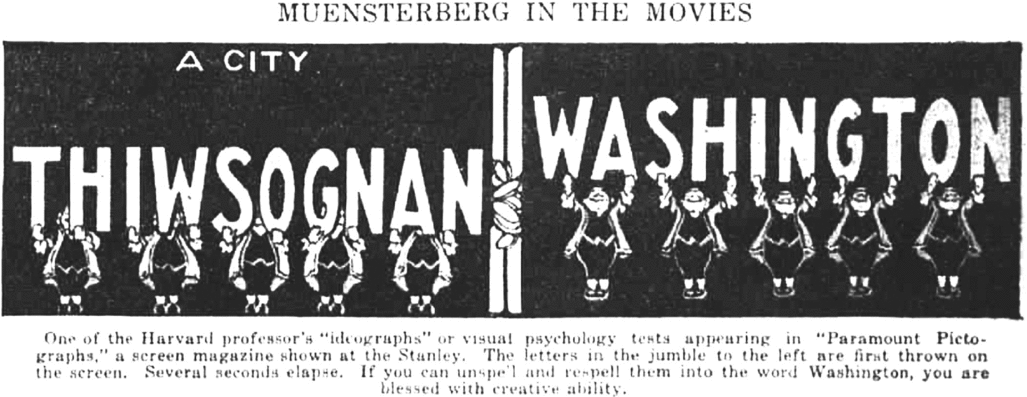
High on the list of complaints was Münsterberg's sense that Paramount had failed to live up to their own self-advertised mission of delivering high-class content to the masses. This criticism had been stimulated by the appearance of an animated chicken in one of his experimental films. “I know very well” he told Meeker, “that in your New York houses a large part of the audience link the word ‘chicken’ with a girl.” Ever-sensitive to the power of association, Münsterberg did not want to “be the one who stimulates them to do so.” “The more I thought about it” he continued, “the more I felt that such a rather vulgar effect and especially such use of Broadway slang would lower the level of the whole undertaking” (Münsterberg to Meeker, 13 December 1915, in Münsterberg papers). It was, he suggested, perhaps the unconscious yielding “to the less refined taste of your cartoon draughtsman,” which was at fault. His issues with the rough cuts, however, were not only on cultural grounds, but experimental as well. In “Have You a Constructive Imagination?” audience members were to be presented with a series of incrementally more difficult word jumbles. In an attempt to make the tests more entertaining, Paramount handed production over to the animation department. What resulted was a sequence in which each series of letters was brought out on screen by a different cast of animated characters. First, four letters were delivered by four boys, next five letters hauled on screen by a donkey cart, and with each subsequent series a different delivery system. Such inconsistencies in presentational form, Münsterberg insisted were outright “dangerous,” threatening to “spoil the psychological conditions of the experiment.”
In dissecting the issue as a problem in experimental design, he explained that the audience would become “distracted” if forced “to orientate itself anew for every new experiment.” What he wanted was for the first trials to function as a sample question whereby the audience would “learn to understand the plan for the experiment with simple four letter words,” and then for the scheme “to remain the same for all the following ones in the scene.” The critical thing was that “the scheme remain the same through the scene in order to have the adjusted attention of the spectators” (fig. 2) (Münsterberg to Meeker, 13 December 1915, in Münsterberg papers).
Image from Münsterberg's film, “Have You a Constructive Imagination?” In “Münsterberg in the Movies,” Evening Ledger, Philadelphia: February 26, 1916.
Münsterberg, in short, was invoking standards of experimental practice from the laboratory, insisting on standardization and that subjects “master the rules of the game” before beginning the actual experiment. The latter was intended to diminish the effect of practice, and the former involuntary attention. Whether in the laboratory, vocation bureau, or movie theater, experimental control was necessary in any testing situation. After all, should a spectator be distracted by the donkey cart or other silly animation and fail to solve the puzzle as quickly as they would otherwise, he or she may be led to mismeasure their own mental powers. If the movie theater was to be Münsterberg's laboratory, then the animator was to be his instrument maker, crafting and calibrating the apparatus for the experiment. Therefore any unwanted flourish in Münsterberg's screen tests threatened the objectivity of the experiment.
Later in the same letter to Meeker, Münsterberg would suggest replacing animation with proper cinematography. Live-action, he reasoned, would be altogether “more convincing, because the audience would be less suspicious that they are tricked by the draughtsman.” For the tests to be received as scientific Münsterberg understood that trust was everything, and the magic of animation, he feared, would cast the psychologist more as a prestidigitator than an experimentalist. For applied psychologists in this period this was all the more important given the resurgent interest in phrenology and physiognomy particularly around the question of vocational guidance and selection (Brown Reference Brown2005).
Shortly after the Paramount Pictographs premiered, Meeker wrote Münsterberg to allay the professor's anxieties over certain editorial decisions. “The psychological experiments” he reported, “are making good in every way,” adding, “perhaps after all, the suggestion which the editor made will in turn work out, and we shall be the means of seeing that officials are fitted to their jobs” (Meeker to Münsterberg, 19 February 1916, in Münsterberg papers). In subsequent months, Münsterberg continued to make compromises and win an occasional battle, however, big changes at Paramount soon made such progress a moot point On 20 June, Münsterberg received word that the new leadership at Paramount would be taking a new course and soon after he was told they would no longer need his contributions.
In just six short months, Münsterberg received from Paramount Pictures two-thousand six-hundred dollars in remuneration, almost a third of his annual salary. However, the abrupt end to the venture had left him wanting more. On 28 September 1916, Münsterberg sent off a proposal to Samuel McClintock, Educational Director at the La Salle Extension University in Chicago. McClintock had been responsible for publishing Münsterberg's book Business Psychology in 1915.Footnote 16 Making his pitch, Münsterberg explained that when most people think of “mental tests” they think of Binet's or Yerkes’ system of rating the intelligence of children. However, far more important, he claimed, were tests like those he had produced for Paramount, which helped all people in the kind of self-analysis so important in finding one's life work. “The subtle study of the mental capacities with experimental methods” he told McClintock “must replace that superficial slipshod analysis of the past.” Towards this end, Münsterberg proposed the establishment of an adjunct institution to the correspondence school to distribute a booklet of mental tests as well as process test results. As the “moving picture scenarios went under the title ‘Testing the Mind,’” Münsterberg suggested the same title for the booklet, in which he also hoped to “give the story of those moving pictures” (Münsterberg to McClintock, 28 September 1916, in Münsterberg papers).
Shared between these two projects was more than just overlapping source material, it was a vision of bringing psychotechnics to the masses. In “Testing the Mind” the screen was the medium of dissemination and the movie theater the makeshift laboratory for administering the experiments. In the proposed booklet, paper took the place of celluloid and virtually any site, from living room to lecture hall, was opened up to experimental use. The critical issue was to take the kinds of testing techniques developed in the seclusion of the psychological laboratory, and transform them into open psychotechnologies, available to anyone in search of objective psychological insight. Moreover, by looking back at early experimental psychology, we see that the same methodological concerns over experimental controls and the standardization of self-observation were projected onto the very production of Münsterberg's films themselves, thus screening to the masses not only the means of self-analysis but the epistemic norms of the psychological laboratory.
Archives
Hugo Münsterberg papers, 1890–1916. Boston Public Library, Rare Books and Manuscripts Department.
Records of the President of Harvard University, Abbott Lawrence Lowell, 1909–1933, UAI 5.160x. Harvard University Archives, Harvard University.