1. Introduction
The origins of expropriation can be traced back to the international law standards for the protection of aliens. In modern international investment protection law, expropriation is permitted only if it is carried out on a non-discriminatory basis, for a public purpose, and in compliance with due process and the principle of payment of compensation. Bilateral investment treaties (BITs) regulate the exercise of the state's power to expropriate investments. In fact, investors' chances of succeeding in a claim against a state for expropriation are rather slim, in particular in cases where the disputed expropriation is a regulatory one. Tribunals have always found it difficult to conclude either that the state's actions amount to an actual taking or that the accumulative effect of the state's act reaches the threshold of expropriation.
Expropriation is a critically important issue in Chinese BITs,Footnote 1 considering China's enormous foreign capital, its history of nationalizing foreign investment soon after the founding of the PRC,Footnote 2 and China's emerging ‘new state order’ and ‘creeping renationalization’ ‘attack[ing] private enterprises’ by grabbing state land from privately-owned coal mines and residents.Footnote 3 However, the utility of expropriation clauses in China's 129 BITs and a dozen free trade agreements (FTAs) including the Peru–China Free Trade Agreement (the Peru–China FTA), entered into between China and Peru on 28 April 2009, remains a mysterious arena given the fact that extremely few BIT arbitration cases brought to ICSID involved Chinese BITs.
Tza Yap Shum v. The Republic of Peru is one of the few cases until now that touch upon the expropriation clause in a Chinese BIT,Footnote 4 that is, the Agreement between the Government of the Republic of Peru and the Government of the People's Republic of China Concerning the Encouragement and Reciprocal Protection of Investments (the Peru–China BIT) dated 9 June 1994. Tza Yap Shum (Tza), the claimant, a Chinese national resident in Hong Kong, brought a claim before ICSID on 29 September 2006 against the Republic of Peru (Peru), the respondent. The claim involved an alleged tax debt of 12 million Peruvian Nuevos Soles (S/.) and a tax lien charged and imposed by the Superintendencia Nacional de Administración Tributaria (SUNAT), Peru's taxing authority, on bank accounts belonging to TSG Peru SAC (TSG), a Peruvian company in the business of manufacturing fish-based food products and distribution and export thereof to Asian markets, which was indirectly owned by Tza with a 90 per cent stake. Tza claimed that the freezing of TSG's bank accounts amounted to an expropriation without compensation, prohibited under the Peru–China BIT. The Final Award on the Merits (the Award), rendered by the arbitral tribunal (the Tribunal) on 7 July 2011 for Tza Yap Shum v. The Republic of Peru (ICSID Case No. ARB/07/6)Footnote 5 is of great value to understanding how a large number of expropriation clauses in Chinese BITs can be interpreted, applied, and eventually utilized for foreign investment protection.
Aside from its 128 BITs, China has been an active player in negotiating and concluding free trade agreements (‘FTA’) with various countries, including, relevant to our analysis here, the Peru–China Free Trade Agreement (the Peru–China FTA), entered into between China and Peru on 28 April 2009. Further, China has been proactive in promoting multilateral efforts towards regional integration by entering into regional or multilateral free trade agreements and economic co-operation agreements with regional organizations. As of January 2013, China has signed FTAs with 18 countries and regions and is in negotiations with numerous other countries including Australia, the Gulf Co-operation Council, Norway, and the Southern African Customs Union.Footnote 6 According to the figures of the Chinese Ministry of Commerce, a quarter of the Chinese mainland's foreign trade is with its FTA partners.Footnote 7 The latest products include an Agreement on Investment of the Framework Agreement on Comprehensive Economic Co-operationFootnote 8 concluded with the Association of South East Asian Nations (ASEAN) in Bangkok, Thailand on 15 August 2009 (the China–ASEAN Treaty), and the Agreement among the Government of the Republic of Korea, the Government of the People's Republic of China, and the Government of Japan for the Promotion, Facilitation, and Protection of Investment (TIT), signed by China, Korea, and Japan on 13 May 2012 in Beijing. China's FTAs and multilateral investment treaties such as the China–ASEAN Treaty and TIT often include a chapter providing for investment protections. The expropriation clauses in these FTAs are more detailed, if not more advanced, than those in China's BITs.
This article attempts to understand the expropriation clauses in the Peru–China BIT (one of the old-generation Chinese BITs) and Peru–China FTA (an equivalent one of the new-generation Chinese BITs) by reference to the Award. It focuses on understanding how and why the notion of expropriation evolved in Chinese BITs and the rationale behind such an evolution against a wider legal/economic background. This article is structured as follows. Part 2 looks into the scope and content of an ‘indirect expropriation’ under various Chinese BITs. Part 3 investigates the key conditions validating a justifiable expropriation. Part 4 explains compensation and its key components. Part 5 tries to, from both local and global perspectives, rationalize China's move from a restrictive to liberal stance on expropriation clauses in BITs. The article ends with a short conclusion in Part 6.
2. Concept of ‘indirect expropriation’: Scope and content
Under investment treaty jurisprudence, it is almost settled that, subject to the precise words of the BIT, expropriation extends to both direct and indirect measures as well as to ‘creeping expropriation’.Footnote 9 However, investment treaties do not define expropriation, in particular, indirect expropriation, and leave the specific contours of the concept to customary international law.Footnote 10 This approach has also been recognized in BIT jurisprudence,Footnote 11 recent US BITs,Footnote 12 and Chinese FTAs.Footnote 13 The lack of a uniform definition of ‘indirect expropriation’ has become the greatest source of trouble not only for host governments but also for investment arbitration tribunals.
Some Chinese BITs, such as the Germany–China BIT, touch upon indirect expropriation by stipulating that ‘investments by investors of either Contracting Party shall not directly or indirectly be expropriated, nationalized or subjected to any other measure the effects of which would be tantamount to expropriation or nationalization in the territory of the other Contracting Party’.Footnote 14 The Mexico–China BIT expressly refers to expropriation being made directly or ‘indirectly through measures tantamount to expropriation or nationalization’.Footnote 15 The term ‘tantamount to . . . expropriation’Footnote 16 allows a number of tribunals to provide the broadest protection for the investments of foreign investors who may suffer harm by being deprived of their fundamental investment rights.Footnote 17 For instance, in Eureko v. Republic of Poland, the tribunal concluded that ‘tantamount to deprivation’ extends to the frustration of the benefits of an investor's contractual rights.Footnote 18
A large number of Chinese BITs demonstrate variations of this effect. Examples are the Czech Republic–China BIT, Denmark–China BIT, Indonesia–China BIT, and Iceland–China BIT, which include the phrase ‘having an effect equivalent to . . .,’Footnote 19 the Greece–China BIT with the caveat of ‘tantamount to,’Footnote 20 and the France–China BIT using the phrase ‘same effect’. Based on the extensive jurisprudence, any of these formulations may be held by the tribunals to have the effect of bringing indirect expropriations into the ambit of a treatyFootnote 21 as the state's actions or measures effectively ‘neutralize the benefit of the property of the foreign owner’.Footnote 22 In line with the general BIT practice,Footnote 23 the Peru–China BIT, like most Chinese BITs, contains a generic expropriation clause:
Neither Contracting Party shall expropriate, nationalize or take similar measure (hereinafter referred to as “expropriation”) against investments of investors of the other Contracting Party in its territory, unless the following conditions are met:
(a) for the public interest;
(b) under domestic legal procedure;
(c) without discrimination;
(d) against compensation.Footnote 24
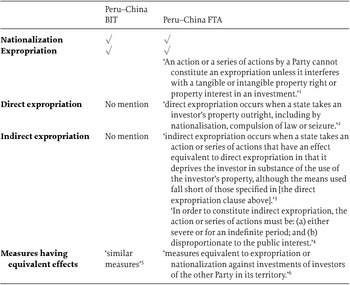
A similar provision appears in the Peru–China FTA.Footnote 25 However, subtle differences exist between these two documents as indicated in Table 1.
Definition of expropriation under the Peru–China BIT and the Peru–China FTAFootnote *

* Compiled by the author.
1 Peru–China BIT, Ann. 9, Art. 1.
2 Footnote Ibid., Ann. 9, Art. 2(a).
3 Footnote Ibid., Ann. 9, Art. 2(b).
4 Footnote Ibid., Ann. 9, Art. 3.
5 Footnote Ibid., Art. 4.
6 Footnote Ibid., Art. 133.
In contrast with other Chinese BITs and the Peru–China FTA, the Peru–China BIT contains no rules on indirect expropriation through the reference to ‘other measures having similar effects’,Footnote 26 which resembles the wording in NAFTA.Footnote 27 The Peru–China BIT's silence on ‘indirect expropriation’ creates uncertainty for an investor when considering whether to bring a claim to investor–state arbitration. Nor does the Peru–China BIT, apart from the phrase of ‘other similar measures’, contain a more functionalist definition of ‘indirect expropriation’, which consequently may allow the tribunals to adopt a more expansive approach to cover ‘indirect expropriation’.Footnote 28 Due to the lack of guidance in the Peru–China BIT in applying the treaty standard to specific circumstances, the application of international law to relevant disputes seems to be an option.
What is noteworthy is the completeness contributed by the Peru–China FTA to the definition of ‘indirect expropriation’, which not only covers an ‘equivalent effect’ scenario but also provides a two-pronged test for determining the existence of ‘indirect expropriation’, that is, the severity or an indefinite period of the expropriatory act and proportionality to the public interest. In determining the legal nature of SUNAT's measures, the Tribunal looked into two critical elements: first, the effects of the measures; and second, the severity of the effects.Footnote 29 As discussed, this two-pronged test does not appear in the Peru–China BIT but in the Peru–China FTA. The Peru–China BIT does not specify the evidentiary requirement of a causal link between a measure of expropriation and subsequent damages. Apart from the severity of impact, the Tribunal placed an emphasis on the duration of the impact.Footnote 30 The theoretical consensus is that ‘the intensity and duration of the economic deprivation is the crucial factor in identifying an indirect expropriation or equivalent measure’.Footnote 31 The deprivation needs to be permanent or for a substantial period of time. The length of an administrative action, that is, ‘an indefinite period’, has been included into the Peru–China FTA as one of three elements in considering whether the action constitutes indirect expropriation.Footnote 32 The Tribunal eventually determined that SUNAT's measures created a ‘direct, close or permanent’ effect other than an ‘indirect, remote or temporary’ one. Therefore, SUNAT's preliminary measures constituted indirect expropriation without compensation.Footnote 33
International investment treaty jurisprudence makes a structural distinction between full or substantial deprivations and ‘regulatory takings’, the latter referring to measures taken in the context of the modern regulatory state including strangulating taxation.Footnote 34 This distinction is not easily sustainedFootnote 35 but has been recognized as one of the most contentious issues in international investment lawFootnote 36 by both international legislative documentsFootnote 37 and case law. The general rule is that a diminution in value remains uncompensated, so long as rights of use, exclusion, and alienation remain untouched.Footnote 38 Most tribunals follow this legal approach while others integrate some economic elements. In the latter approach, economic elements are taken into account to assess questions of causation and damage. Some tribunals have favoured the economic approach. The tribunal in Telenor required ‘a major adverse impact on the economic value of the investment’,Footnote 39 and in Parkerings ‘a substantial decrease of the value of the investment’.Footnote 40 In Tecmed, the tribunal held that the deprivation analysis is focused on ‘economic use and enjoyment of its investments as if the rights related thereto – such as the income or benefits related to [the expropriation] – ha[d] ceased to exist’.Footnote 41
The Peru–China FTA sides with a more legalistic approach by providing that ‘the fact that an action or series of actions by a Party has an adverse effect on the economic value of an investment, standing alone, does not establish that an indirect expropriation has occurred’.Footnote 42 The Tribunal in this case took both approaches into account but leaned towards a more legalistic stance.Footnote 43 One thing the Tribunal decided was whether Tza was substantially deprived of the economic use and enjoyment of his investment. This was regarded by the Tribunal as one of the main elements distinguishing ‘regulation’ from ‘expropriation’.Footnote 44 However, the Tribunal made no reservations in deciding that a total destruction of value would be considered an expropriation, a position adopted by other tribunals.Footnote 45 Therefore, the Tribunal pragmatically avoided the technical difficulty of contemplating the concept of ‘expropriation’ by merely looking into the destructive harm the exercise of taxation policing power had brought to Tza. The Award ruled that SUNAT's imposition of interim measures had constituted an indirect expropriation of Tza's investment. In sum, a taking does not have to be complete or full but must ‘have the effect of depriving the owner, in whole or in significant part, of the use or reasonably-to-be-expected economic benefits of property even if not necessarily to the obvious benefit of the host State’.Footnote 46
There has been some doubt over the question whether the ‘sole effect’ doctrine should be the only factor in determining whether a regulatory measure in the field of tax, environment, health, human rights, and other welfare interests of the state affects a taking.Footnote 47 It has been argued that the purpose and context of the governmental measure should be taken into account. Peru's argument is reflective of a greatly narrow, restrictive, and obsolete approach which required Tza to prove an expropriatory ‘purpose’. This is a purpose-orientated approach focusing on the host state's intention or motivation to expropriate.Footnote 48
Further clarity has been brought to China's newer BITs and FTAs. Both the Finland–China BIT and Netherlands–China BIT are even closer to the US approachFootnote 49 to expropriation.Footnote 50 The most sophisticated definition of ‘indirect expropriation’, drawing on recent BIT case law, appears in the New Zealand–China FTA, under which it is confined to measures which are (i) equivalent to direct expropriation, in that ‘[they] deprive . . . the investor in substance of the use of the investor's property . . .’; (ii) either severe or indefinite; and (iii) disproportionate to the public purpose.Footnote 51 Clear interpretative guidelines are provided on what actions constitute expropriation.
In the Protocol of the India–China BIT 2006, the criteria for indirect expropriation were stipulated in detail as follows:
(2) The determination of whether a measure or a series of measures of a Party in a specific situation, constitute measures as outlined in paragraph 1 above requires a case by case, fact based inquiry that considers, among other factors:
(i) the economic impact of the measure or a series of measures, although the fact that a measure or series of measures by a Party has an adverse effect on the economic value of an investment, standing alone, does not establish that expropriation or nationalization, has occurred;
(ii) the extent to which the measures are discriminatory either in scope or in application with respect to a Party or an investor or an enterprise;
(iii) the extent to which the measures or series of measures interfere with distinct, reasonable, investment-backed expectations;
(iv) the character and intent of the measures or series of measures, whether they are bona fide public interest purposes or not and whether there is a reasonable nexus between them and the intention to expropriate.
(3) Except in rare circumstances, non-discriminatory regulatory measures adopted by a Contracting Party in pursuit of public interest, including measures pursuant to awards of general application rendered by judicial bodies, do not constitute indirect expropriation or nationalization.Footnote 52
These largely copy the provisions from the US Model BIT 2004Footnote 53 and indicate China's intention to emulate the US approach on the subject of expropriation. Few BITs specify the treaty interpretative methodology. The Peru–China FTA calls for ‘a case-by-case, fact based inquiry’.Footnote 54 This common law type of case-by-case method is also codified into other BITs including the Canadian Model BIT 2004.Footnote 55 This pragmatic and realist approach was adopted by the Tribunal in this instant case. The Tribunal echoed that the constitution of expropriation ‘cannot be answered in the abstract but only on the basis of particular circumstances and in the context of particular purposes’.Footnote 56
3. Defences to unlawful expropriation
Expropriation is not unlawful under international law as long as certain conditions are complied with by the state. This is a highly formalistic area of law. Under customary international law,Footnote 57 the well-recognized conditions include four elements, namely, the expropriation must be (i) for the public interests, (ii) pursuant to domestic legal procedure, (iii) non-discriminatory, and (iv) with compensation. These four elements consistently appear in almost all Chinese BITs except a few BITs such as the UK–China BITFootnote 58 and the Italy–China BIT.Footnote 59 Both the Peru–China BIT and the Peru–China FTA, in a fairly traditional term, clone the Chinese investment treaty practice by imitating these four elements. The Peru–China BIT, like most BITs to which China is a party, allows expropriation only upon the satisfaction of certain conditions. However, the Peru–China BIT offers little guidance since key terms such as ‘public purpose’ and ‘discrimination’ are not defined.
3.1. ‘Public purpose’
In international law, the existence and validity of public interests have traditionally been accepted. A ‘public purpose’ is germane to expropriation as the regulatory measure can be authorized by the government for diverse reasons. The requirement of public purpose for an act of expropriation is a widely accepted principle in customary international law as well as investment treaties.Footnote 60 However, the term ‘for a public purpose’ has not been well defined. Nor has it been explained in a form of illustrative grounds. Thus, the application of this criterion in the expropriation analysis leaves the tribunal with some discretion. Variations to the phrase ‘for a public purpose’ include ‘for the public interests’ adopted by a large number of Chinese BITs such as the Cyprus–China BIT and Benin–China BIT and ‘for public benefits’ which appears in the Germany–China BIT. These terminologies do not indicate substantial differences. The formulae of ‘public purpose, security or national interests’ adopted by the Belgium–Luxembourg–China BIT makes this criterion more operative even though the host state may be in a more advantageous position as such an operative criterion is easier to be satisfied. Other variations such as ‘the need of social and public interest’ and ‘national security and public interest’ appearing in the Argentina–China BITFootnote 61 and the Philippines–China BITFootnote 62 respectively are less operative due to their wide or vague coverage. But these varied terms indicate the scope and nature of the ‘for a public purpose’ criterion, and would entail consideration of detailed facts in the specific case.
Some Chinese BITsFootnote 63 contain a carve-out for the reasonable exercise of a state's ‘police powers’, which is intended to offer a safe harbour for regulation that is reasonably justified in the public interest. Given the lack of a ‘police powers’ carve-out in some BITs, the ‘for a public purpose’ condition may function as a safe harbour for expropriation regulations. ‘Public power’ that refers to the authority of state governments to enact measures to protect public health, welfare, and morals, serves the ‘public purpose’. As it may serve a local protectionist purpose, it is difficult to discern from an international perspective. The tribunals may then weigh heavily such elements as bad faith, arbitrariness, or discrimination in determining whether a ‘public’ but more domestic ‘purpose’ is acceptable or not.
Peru's defenceFootnote 64 was based on a ‘presumable legitimacy’ doctrine.Footnote 65 Promoting a public interest, i.e., the maintenance of order, health, or public morals, as the Peruvian government argued, justified the confiscation of property. This is similar to the ‘pre-eminent public interest’ theory some tribunals have adopted to justify expropriation even in the absence of express treaty provisions. In Saluka, for example, the tribunal made a similarly categorical statement:
it is established in international law that States are not liable to pay compensation to a foreign investor when, in the normal exercise of their regulatory powers, they adopt in a non-discriminatory manner bona fide regulations that are aimed at the general welfare.Footnote 66
In adjudicating this ‘pre-eminent public interest’ doctrine, the Tribunal resorted to some arbitral awards and acknowledged the ‘considerable consensus’ reached by these tribunals.Footnote 67 In weighing the deferential treatment of the state's regulatory power against the exercise of such power vis-à-vis the investor,Footnote 68 the Tribunal rejected Peru's argument.
BIT jurisprudence recognizes that the invocation of pre-eminent public interests and the termination of rights according to laws are acceptable deprivations that do not require payment of compensation. This suggests that bona fide and non-discriminatory regulation, even when fully destroying the value of an investment, may not constitute expropriation. Some tribunals may have simplified the formula by looking into the investor's ability to carry out its business. If the investor still possesses the ability to continue its business, interferences then do not justify the investor's claim for compensations even if profits are diminished.Footnote 69 Still, partial destruction of the value or temporary deprivation may be tantamount to an expropriation ‘in some contexts and circumstances’.Footnote 70 Other tribunals have refused to accept a blanket exception for regulatory measures on the grounds that this would ‘create a gaping loophole in international protection against expropriation’.Footnote 71 The tribunal in Pope and Talbot explicitly rejected Canada's argument that regulation cannot amount to expropriation and pointed out that ‘much creeping expropriation could be conducted by regulation’.
A claimant's counter argument towards the respondent state's public interest defence can be that the depriving measure was illegally or arbitrarily imposed. Even if the government's police power has a legitimate objective, it remains possible that officials may act arbitrarily and disproportionality. This possibility requires the tribunal to review
whether the measure was proportionate or necessary for a legitimate purpose; whether it discriminated in law or in practice; whether it was not adopted in accordance with due process of law; or whether it interfered with the investor's legitimate expectations when the investment was made.Footnote 72
This counter-argument is based on illegality and lack of due process. Arbitrariness is also grounded on a lack of proportionality. The rationale is that the state can take any action in pursuit of the public interest but that action is lawful only when taken in a manner that is legal, procedurally appropriate, and proportionate. Public interest comes in all types and varieties, covering the full spectrum from the most weak and ordinary to the most serious. The pervasive uncertainty surrounding any effort to determine the public interest justifies a straightforward approach by which compensation should be paid as long as property is fully or substantially destroyed.
3.2. ‘Due process’
Due process is a required element to satisfy the public interest exception. Some Chinese BITs prescribe that the expropriation must be effected according to notions of due process. Different from the Western terminology, a large number of Chinese BITs often use the term ‘under domestic legal procedure’Footnote 73 or ‘applicable domestic law’Footnote 74 instead of ‘in accordance with due process’. Only in the TITFootnote 75 is the condition ‘in accordance with international standard of due process of law’ adopted.Footnote 76 In a few Chinese BITs, the phrase ‘due process’ is used but with some Chinese characteristics. For instance, the expropriation may need to be carried out in accordance with the ‘due process of national laws’Footnote 77 or ‘due process of law’.Footnote 78 However, the meaning of ‘due process of national laws’ or ‘due process of law’ has never been clarified. The distinction between these two similar terms seems clear that ‘due process of law’ is closer to ‘due process’ whereas ‘due process of national laws’ leans more towards ‘national laws’. The investor can be protected in a better way if ‘due process of law’ is adopted as the investor may rely upon customary international law for protection whilst ‘due process of national laws’ may give the investor less leeway. Therefore, it is easy to understand why some Chinese BITs used the term ‘in accordance with its laws’Footnote 79 or ‘relevant domestic laws’Footnote 80 instead. The most advanced version may be the ‘laws and international standard of due process of law’ adopted by the TIT.Footnote 81
Both the Peru–China BIT and the Peru–China FTA adopt the term ‘under domestic legal procedure’.Footnote 82 The reference to ‘domestic’ law provides the state with more flexibility and control over the process as the expropriation process will be subject to the domestic laws of the expropriating state. The Peru–China BIT's ‘under domestic legal procedure’ is different from ‘due process of law’.Footnote 83 Legally speaking, ‘domestic legal procedure’ can be narrower than ‘due process’, thereby bringing in more local law elements into international investment arbitration.
Under some Chinese BITs, the norm ‘due process of national laws’ or ‘in accordance with its laws’ is more operative as the investor is granted the right to a judicial review of a completed expropriation and of the amount of compensation due. The UK–China BIT, for example, provides that ‘the national or company affected have a right, under the law of the Contracting Party making the expropriation, to prompt review, by a judicial or other independent authority of that Party, of his or its case and of the valuation of his or its investment in accordance with the principles set out in this paragraph’.Footnote 84 Similar rights are granted under other Chinese BITs such as the Germany–China BIT, according to which the investor may request ‘the legality of any such expropriation and the amount of compensation shall be subject to review by national courts . . .’.Footnote 85 The ASEAN–China Treaty does not follow this route of providing the investors with the right for review. Accordingly, the investor may have to rely upon the investor–state arbitration for claims against expropriation.
Since the Peru–China BIT does not offer a functional definition of ‘under the domestic legal procedure’, the Tribunal made a reference to both international and domestic law. This again confirms the hybrid nature of the international investment arbitration jurisprudence, which is composed of both international and municipal law.Footnote 86 The Tribunal assessed the legitimacy of Peru's regulatory measures by focusing on two conditions. First, the proceedings must be reasonable. Second, the said measures must not be deployed in a confiscatory, abusive, or discriminatory manner.Footnote 87 The Tribunal determined that SUNAT failed to comply with its own internal guidelines and procedures which required, inter alia, (i) a more precise identification of the assets to be seized via interim measures; (ii) a reasoned basis for the imposition of the ‘exceptional’ remedy of interim measures accompanied by detailed evidentiary support; and (iii) efforts to avoid interfering with the debtor's business operations. The Tribunal was of the opinion that SUNAT could have seized TSG's accounts receivables instead of imposing preliminary measures such as seizure over TSG's funds in the bank accounts.Footnote 88 Arbitrariness was also evidenced by SUNAT's failure to make relevant inquiries or requests for additional information from the auditor before imposing interim measures.
States are under an obligation to provide a fair and effective system of justice to correct the challenged action.Footnote 89 This problem of ‘denial of justice’ has been often tested in international investment law. The state is held liable only if the system as a whole has been tested and the initial delict remained uncorrected.Footnote 90 Violation of international law lies in the inadequacy or misadministration of civil or criminal procedure, denial of access to courts, or unjust decisions.Footnote 91 Other judicial failures such as unconscionable delay, manifest discrimination, corruption, or subservience to executive pressure may also amount to a breach of international law.Footnote 92 The Tribunal's characterization of SUNAT's failure as a denial of justice fits well in the international investment law jurisprudence.
3.3. ‘Without discrimination’
Non-discrimination in regard to the status and treatment of aliens and alien property is a well-established principle of customary international law,Footnote 93 treaty law,Footnote 94 and case law.Footnote 95 The breach of the non-discrimination principle gives rise to international responsibility.Footnote 96 The non-discrimination requirement appears in many Chinese BITs and is only absent in a small number of BITs between China and Austria, Germany, Indonesia, Italy, Oman, and the UK. This requirement adds more value to the investor protection if the BIT does not offer the national treatment protection. In practice, discrimination complaints are more likely to be raised with regard to due process and payment of compensation. However, the discriminatory factor, due to the lack of guidance and specificity, is ‘extremely difficult to prove in concrete cases’.Footnote 97 Thus, the blanket exception for non-discriminatory measures may create more complexity or a ‘gaping loophole in international protections against expropriation’.Footnote 98
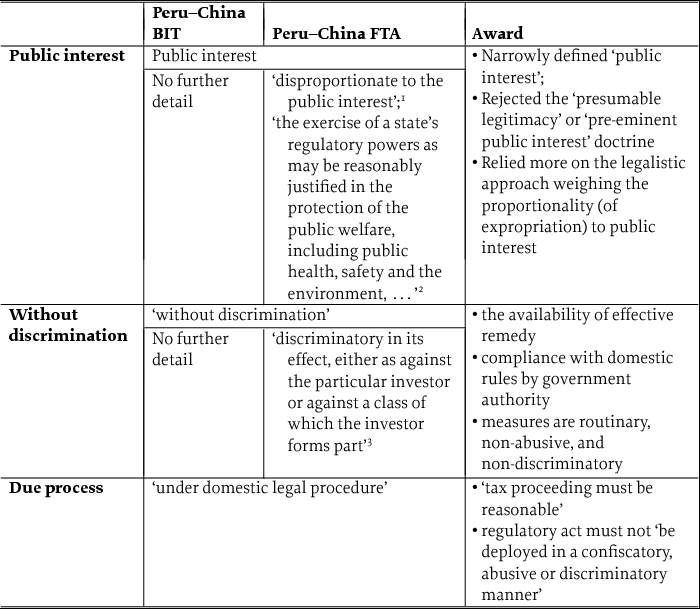
It is worth noting that the Tribunal was mindful that, despite the fact that the Peru–China BIT makes no mention of any exclusion clause, the Peru–China FTA provides a legitimate ground for indirect expropriation, that is, a deprivation of property shall not be discriminatory in its effect, either as against the particular investor or against a class of which the investors forms part; or in breach of the state's prior binding written commitment to the investor, whether by contract, license, or other legal document.Footnote 99 Under the Peru–China FTA, an indirect expropriation may be ‘reasonably justified in the protection of the public welfare, including public health, safety and the environment’.Footnote 100
The Tribunal did review the legitimacy of SUNAT's actions against the difficulty in making a deferential treatment to the public authority's regulatory power, and chose to make a reference to other relevant BIT cases in which the legitimacy of tax authorities’ measures and actions was the key issue. It was noticed by the Tribunal that arguments in favour of indirect expropriation in these cases had often been rejected. In addition, considerable consensus had been formed in the BIT jurisprudence that the imposition and application of tax measures could attain an expropriatory character if they were of a confiscatory, arbitrary, abusive, or discriminatory nature,Footnote 101 or were applied unfairly and inequitably. The Tribunal recognized the deference given to a state's regulatory and administrative powers and noted the general rule that a state is not liable for any losses resulting from the good faith application of general taxes and regulations. However, such a defence was also bound by the principle of reasonableness and non-arbitrariness reflected in public international law, Peruvian law, and treaty practice. The approach taken by the Tribunal in examining the procedural side of the governmental action represents its concern over the quantum threshold of the interferences as well as the proportionality, which is identified by the Peru–China FTA as one of the three elements for the assessment of ‘indirect expropriation’.Footnote 102
Table 2 summarizes key differences of the defences in the Peru–China BIT, the Peru–China FTA, and the Award.
Conditions to lawful expropriation in the Peru–China BIT, the Peru–China FTA, and the AwardFootnote *
* Compiled by the author.
1 Peru–China FTA, Ann. 9, Art. 3(b).
2 Footnote Ibid., Ann. 9, Art. 6.
3 Footnote Ibid., Ann. 9, Art. 5(a).
4. Compensation and key components
Payment of compensation is required to validate expropriation. In some most recent cases, the ‘lawfulness’ of the expropriation depends on the satisfaction of the requirement of compensation.Footnote 103 The tribunals increasingly focused on the adequacy of compensation for expropriation instead of the legality of expropriation. It is difficult to reach consensus on an acceptable standard of compensation for lawful expropriation. The great majority of BITs adopt customary international law on lawful expropriation including the Hull FormulaFootnote 104 except for some variations in language.Footnote 105 Under old-generation Chinese BITs, the standard of compensation is usually not clarified. The relevant provision in the Norway–China BIT was a typical example:
Compensation shall be made without undue delay and shall be realizable and freely transferable. It shall amount to the value of the investment immediately before the expropriation, and shall include interest until the date of payment.Footnote 106
This apparently was far away from the Hull formula, which was viewed by China as a typical standard demanded by developed countries. Chinese BITs prefer to endorse ‘reasonable’ or ‘appropriate’ compensation. For instance, the UK–China BIT defines the ‘reasonable standard’ by providing that
such compensation shall amount to the real value of the investment expropriated immediately before the expropriation or impending expropriation became public knowledge, shall include interest at the normal rate until the date of payment, shall be made without undue delay, be effectively realizable and be freely transferable.Footnote 107
This may be seen as a de facto Hull formula.
4.1. ‘Value’
Investment treaty jurisprudence has shown an increasing level of convergence in that compensation needs to be equivalent to the ‘market value’Footnote 108 or the ‘fair market value’.Footnote 109 In a few occasions, variations such as ‘real value’Footnote 110 and ‘genuine value’Footnote 111 are used instead. These formulae refer to the price voluntarily reached by the seller and buyer in an arm's length transaction. As such, modern BIT jurisprudence appears to support full or ‘adequate’ compensationFootnote 112 even though the degree of specificity and sophistication concerning the calculation of compensation differs from one BIT to another.Footnote 113 A number of Chinese BITs link compensation to the ‘value of the expropriated investment’.Footnote 114 Some BITs clarify the ‘value’ by a reference to ‘genuine’,Footnote 115 ‘actual’,Footnote 116 ‘market,’Footnote 117 or ‘fair market’Footnote 118 value. The reliance upon the ‘value of the expropriated investment’ demonstrates the host state's willingness to provide the investors with ‘just compensation’. At the technical level, a tribunal is more capable of achieving ‘just compensation’ as the ‘value’ formulation reflects the genuine value of the property affected.Footnote 119
The Peru–China BIT adopts the following ‘compensation’ clause:
The compensation mentioned in Paragraph 1, (d) of this Article shall be equivalent to the value of the expropriated investment at the time when the expropriation is proclaimed, be convertible and freely transferrable. The compensation shall be paid without unreasonable delay.Footnote 120
Among others, the investment chapters of some recent FTAs such as the New Zealand–China FTAFootnote 121 and the new generation Chinese BITs including the Germany–China BIT have the most detailed provisions on awarding compensation for a lawful expropriation. These provisions not only adopt the Hull Formula but also spell out the details of the compensation terms.
The Peru–China FTA adopts a similar ‘compensation’ clause as follows:
The compensation mentioned in subparagraph 1(d) of this Article shall be equivalent to the fair market value of the expropriated investment immediately before the expropriation took place (“the date of expropriation”), convertible and freely transferrable. The compensation shall be paid without unreasonable delay.Footnote 122
This provision reflects ‘adequate’ and ‘prompt’ respectively. The first sentence in the quoted clause connects the financial concept of fair market value to the abstract concept of adequate compensation as the market value of the taken property is supposed to be adequate to compensatee the investor. BITs usually do not explicitly define the term of ‘fair market value’. Given the fact that China has insisted on ‘appropriate compensation’ in the past few decades,Footnote 123 accepting the ‘fair market value’ requirement highlights China's willingness to align with the Hull formula and to be more liberalized on these expropriation-related terms. As a result, the provisions of expropriation in Chinese and American BITs are strikingly similar.
These two legal instruments are in line with the general ‘value’ formulae but the differences are also obvious. The Peru–China FTA moves one step further by stipulating that compensation shall ‘be equivalent to the fair market value of the expropriated investment’. However, none of these two ‘value’ formulae is operative in a practical sense. First, neither formulae provides for the standard of fair market value and the method for its calculation. By contrast, NAFTA, for instance, states that compensation must be ‘equivalent to the fair market value of the expropriated investment immediately before the expropriation took place’, and the valuation criteria for calculating the fair market value shall include ‘going concern value, asset value including declared tax value of tangible property, and other criteria, as appropriate’.Footnote 124 Second, the distinction is not made in these two instruments between lawful and unlawful expropriations. Compensation is often awarded in a different way to lawful and unlawful expropriation. When the property is unlawfully expropriated, compensation covers the lost future profits (lucrum cercans) in addition to the loss actually suffered (damnum energens).Footnote 125 Third, it is not clarified in these two instruments whether and how interest should be calculated. The Energy Charter Treaty explicitly states that compensation shall include ‘interest at a commercial rate established on a market basis’Footnote 126 while NAFTA requires interest to be included in compensation, calculated at a commercially reasonable rate and transferred freely.Footnote 127
Some Chinese BITs, for example the Sweden–China BIT, expressly codified the methodology to ‘place the investor in the same financial position as that in which the investor would have been if the expropriation or nationalization had not taken place’.Footnote 128 The Greece–China BIT further clarified this approach by adding the wording ‘. . . and on the basis of generally accepted methods’Footnote 129 even though there have been no uniform international standards in this regard. Neither the Peru–China BIT nor the Peru–China FTA explicitly adopted this approach. The Tribunal confirmed that the Draft Articles on Responsibilities of States for Internationally Wrongful Acts, adopted by the International Law Commission in 2001,Footnote 130 are the key sources of customary international law, according to which the state is under a legal obligation to make full reparation for the injury caused by the internationally wrongful act. Reparation here is meant to wipe off all the consequences of the illegal act and re-establish the status which would have existed if that act had not been committed.Footnote 131 In practice, however, the principle of full reparation is still a vague doctrine, which can determine the exact amount of compensation of damages only if other disciplines including valuation and calculation are taken into consideration. As to compensation, the Tribunal's approach to measuring damages was to place Tza in the same position as if there were no expropriation.
Some Chinese BITs took a lead by incorporating practical valuation methods or introducing valuation-related terms. For instance, under the Zimbabwe–China BIT, the calculation shall be made taking ‘as may be appropriate, the net asset value as certified by an independent firm of auditors as well as the market value’.Footnote 132 The valuation under the Guyana–China BIT shall be determined as ‘if the investments were to be sold as an ongoing concern on the open market’.Footnote 133 To adopt more operative valuation methods and principles is the approach recommended by the World Bank, incorporated in NAFTA and endorsed by some tribunals in order to increase the transparency of the valuation method.Footnote 134 Another concern about the Peru–China FTA's compensation formulae is that it is still not clear if the wording actually refers to the full market value. In this sense, the Peru–China FTA makes little progress in clarifying how to evaluate the expropriated investment. Certainly, it is arguable that the Peru–China FTA's approach gets closer to the Hull formula since the wording has absorbed some market-orientated factors.
4.2. Valuation date
Chinese BITs usually fix the valuation date by relying on one or two cut-off points, e.g., ‘immediately prior to the time when the expropriation became public’Footnote 135 or ‘immediately before the expropriation measures were taken’.Footnote 136 Few Chinese BITs designate the date of the taking as the valuation date. The Greece–China BIT adopts both and states that ‘such compensation shall amount to the value of the investments affected immediately before the measures . . . occurred or became public knowledge’.Footnote 137
The Peru–China FTA uses ‘the date immediately before the expropriation took place’ as the date of expropriation. While this may be beneficial to the aggrieved investor, it does not offer much clarity or practicality. In this regard, the China–ASEAN Treaty's wording that ‘at the time when expropriation was publicly announced or when expropriation occurred, whichever is earlier’Footnote 138 may be a useful reference. The cut-off point for the valuation purpose is clearer as the caveat of ‘whichever is earlier’ allows the choice of an earlier time between the occurrence of expropriation and the announcement of expropriation. The purpose of having such a caveat, as the China–ASEAN Treaty provides, is that ‘the fair market value shall not reflect any change in market value occurring because the expropriation had become publicly known earlier’.Footnote 139 This seems to avoid potential upward or downward effects on the value of the expropriated property. The standard of compensation is therefore equated with the genuine value of the property affected,Footnote 140 thereby ensuring just compensation.
4.3. Interest
Old-generation Chinese BITs such as the Peru–China BIT usually do not provide for interest to be payable on compensation,Footnote 141 which is consistent with the earlier investment treaty practice being unspecific on the payment of interest.Footnote 142 Since the late 1990s, the interest provision has appeared in some Chinese BITs with a reference to the ‘normal,’Footnote 143 ‘commercial,’Footnote 144 ‘appropriate,’Footnote 145 ‘fair and just,’Footnote 146 ‘usual bank,’Footnote 147 or ‘LIBOR’Footnote 148 rate of interest. More recent Chinese BITs attempts to standardize the practice by incorporating more specific terms. Take one example, the interest provision in the China–ASEAN Treaty reads as follows:
The compensation shall be settled and paid without unreasonable delay. In the event of delay, the compensation shall include interest at the prevailing commercial interest rate from the date of expropriation until the date of payment.Footnote 149
The first sentence in the cited paragraph is not particularly meaningful as the term ‘delay’ is not well defined. The sentence immediately following seems to suggest that it constitutes a delay when compensation is not made at the date of expropriation. This interpretation, however, does not seem sensible as the investor and state may be in dispute on the existence of expropriation. The Iceland–China BIT prescribes the exact meaning of a delay in payment by providing that ‘the delay starts by the submission of a relevant application and must not exceed six months’.Footnote 150 Waiting until a tribunal finds expropriation could incentivize states’ refusal to admit expropriation and delay payment without the state needing to pay interest. The Iceland–China BIT seems to largely address this problem.
The phrase ‘prevailing commercial rate’ also appears in other Chinese BITs such as the Germany–China BIT and the Netherlands–China BIT. The reference to the ‘prevailing commercial’ rate of interest is practically specific so as to avoid the situation that the interest rate may be determined by the tribunal in an over subjective manner due to the lack of restriction. The China–ASEAN Treaty continues to follow this general practice by specifying that the interest is payable between the ‘date of expropriation’ and the ‘date of payment’. This may result in a fairer scenario whereby the arbitral tribunal awards interest from the date of the arbitral award, which may be earlier than the date of payment. Neither the Peru–China BIT nor the Peru–China FTA makes a reference to any specific interest rate. Both, however, require compensation to ‘be paid without unreasonable delay’. This ambiguity provides a prospective tribunal with some flexibility.
4.4. Exchange rate
Compensation should be made in a form usable by the investor. The currency of payment must be freely usable or convertible into a freely usable currency.Footnote 151 The China–ASEAN Treaty, for instance, states that ‘the compensation, including any accrued interest, shall be payable either in the currency in which the investment was originally made or, if requested by the investor, in a freely usable currency’. Although the ‘currency in which the investment was originally made’ may not be satisfactory to the investor in cases where the currency is not freely convertible, the China–ASEAN Treaty provides leeway for the investor who is entitled to choose a freely usable currency, which is defined by the China–ASEAN Treaty as meaning ‘any currency designated as such by the IMF under its Articles of Agreement and any amendments thereto’.Footnote 152 Under this standard, ‘freely usable currency’ is limited to the US dollar, the euro, the pound sterling, and the Japanese yen.Footnote 153 As such, the China–ASEAN Treaty makes compensation effective. Nevertheless, it has to be pointed out that this clause in the China–ASEAN Treaty is not the most satisfactory arrangement to the investor. Some Chinese BITs confirm that ‘compensation will be convertible and realizable and freely transferable without delay’,Footnote 154 which effectively gives the investors more protections from the risk of currency depreciation.
Some Chinese BITs adopted formulas such as the ‘average of the daily exchange rates’,Footnote 155 the ‘official exchange rate’ on the day of transfer,Footnote 156 and the ‘exchange rate applicable for the payment of the compensation . . . on the date used to determine the value of the investment’,Footnote 157 all of which are helpful in avoiding a potential dispute. Neither the Peru–China BIT nor the Peru–China FTA specifies a way to determine the exchange rate between the local currency and the freely usable currency. However, both require compensation to ‘be convertible and freely transferrable’.Footnote 158 Tza made his monetary claim in Peruvian Nuevos Soles but the Tribunal granted damages in US dollars. Likely, the Tribunal took into consideration the required elements of convertibility and free transferability.
5. Rationalizing China's evolving stance in local and global contexts: Where are we and where are we going?
Both the Peru–China FTA and the Award offer more jurisprudential value to understanding China's BIT practice and guiding prospective tribunals to assess the existence of expropriation. A review of the expropriation clauses in the Peru–China BIT and the Peru–China FTA indicates an apparently liberalizing progress China has made in its BIT practice. In terms of the BIT rules and compensation standards, China's BITs are already closer to the Western practice. Recent China BITs and FTAs have afforded ‘full protection and security’ to investments, and otherwise are remarkably compatible with the American approach. There are both internal and external reasons for recent dynamic changes.
China's internal stress on the rule of lawFootnote 159 has led to its continuous expansion of the limited protection to investorsFootnote 160 and liberalization of previously restrictive rules on expropriation. China's progressive liberalization approach is deeply rooted in its social, economic, and geopolitical contexts. China's property rights law has been in a changing process in the past decade. In 2004, China amended its constitution to enshrine private property rights. But the symbolic constitutional amendment did not bring any substantial changes until the passing of the Property Rights Law in 2007. The Property Rights Law is a landmark law in the sense that it offers the same legal protection for individuals’ property as the state's. The passage of the Property Rights Law indicates the ruling party's determination to move away from Chinese egalitarianism and towards a market-orientated economy.
Expropriation of land for piffling or no compensation has been the main cause of thousands of protests across the country.Footnote 161 The Property Rights Law does not necessarily bring the full property rights protection China's economic and democratic developments need. The Property Rights Law, however, is a necessary step to build a more sophisticated legal system. The Property Rights Law, if fully implemented, may secure legal foundation for private entrepreneurship and enhance social stability, the lack of which may shake the legitimacy of the Chinese government's rule. The government is in the process of amending the land expropriation law to improve the legal regime and the associated takings practices. Some regulatory reforms indicated promising improvements in laws on compulsory land seizures. The regulations of the State Council, China's cabinet, promulgated in January 2011, concerning the compulsory expropriation of urban properties, allows government seizures of urban land rights and real estate only for truly ‘public interest projects’, thereby eliminating the possibility of exercising unconstrained public power to serve private and for-profit projects. The regulations also require a court order before evictions can occur, which is a significant improvement to prevent procedural abuses by local governments.Footnote 162
Still, China's eminent domain law is imperfect compared to its Western counterparts. For example, the ‘public interest’ prerequisite is vaguely defined. The current laws and regulations do not set detailed compensation standards to allow farmers to capture more of the value generated from converting land to non-agricultural use. The process lacks transparency and public participation. Nevertheless, China's changing eminent domain law allows China to take a more liberal stance in its BIT negotiations.
China is not only a major capital importer but also a significant capital exporter. China became the third largest investor in 2012 and 2013, right after the United States and Japan.Footnote 163 In terms of its foreign direct investment (FDI) stock, China is one of the largest developing country investors in Africa.Footnote 164 It is the top investing country in some least developed countries such as Sudan, Nigeria, Zambia, and Algeria.Footnote 165 Starting in 2001, China shifted its policy and has been steadily promoting outbound FDI in order to lessen the external surplus and secure access to natural resources in other developing countries. The Communist Party of China (‘CPC’), China's ruling party, took the initiative in crafting the well-known ‘go global’ strategy in 1998.Footnote 166 In embarking on this strategy, the State Council not only included it in the 10th Five-Year Plan for National Economy and Social Development of 2001, but also set a clear objective of promoting up to 50 globally competitive ‘national champions’ by 2010.Footnote 167 In playing a guiding role in the promotion of overseas expansion,Footnote 168 the State Council in 2004 formulated regulations replacing the substantial approval regime with the registration regime.Footnote 169 This regulatory and policy change may adequately explain why, after 2004, China's outbound FDI saw a sharp surge,Footnote 170 as indicated in Figure 1.
Growth of China's outbound investment (1990–2013)1*

Given China's massive foreign currency reserves and its continuous efforts to liberalize its foreign exchange controls,Footnote 171 Chinese companies desire to grow globally. Likely, this wave of outbound investment from China will continue to increase.Footnote 172 In the global financial crisis, Chinese players have yet to slow their expanding pace. Rather, more Chinese companies are finding their way to a heightened profile in a growing number of industries.Footnote 173 It appears inevitable that Chinese companies will become a major force in FDIs in the global sphere.
Naturally, China placed more emphasis on using BITs as legal instruments for the protection of Chinese investments overseas by signing new BITs with developing countries and updating old BITs with developed countries. Against this background, China's stance in BIT practice was evolving from a restrictive to a balanced or even liberal stance. Starting with the Barbados–China BIT of 1998, China started to provide foreign investors with stronger and more comprehensive substantive and procedural protections, largely comparable to those of capital exporting states.Footnote 174 It is no coincidence that the change in Chinese BIT policy overlapped in time with the launch of the ‘go global’ strategy. China's increased confidence in providing sufficient protections to foreign investors, its increasing outbound FDI, and its more sophisticated legal system explain China's growing acceptance of modern BIT jurisprudence and related international investment law. Owing to more disputes raised on the ground of indirect expropriation, recent BITs concluded by the US and Canada have included more detailed provisions, and China appears to take on this trend in BIT jurisprudence and practice.
The facts that China's growing outbound FDI, the US's promotion of the Trans–Pacific Partnership Agreement (TPP) without the involvement of China, and the TPP's more preference margins than the BITsFootnote 175 would further affect or even reshape China's strategy to negotiate and enter into BITs with its trading partners. The key goal of the US's expansion of BITs, and particularly the TPP nowadays, is to entrench some protections of customary law so as to assure full protection and security, to dismantle public law regulations inimical to the market,Footnote 176 and to protect the rights of the TPP countries to regulate in the public interest.Footnote 177 Apart from its economic, political, and ideological importance, the TPP would help the US reshape a newer FTA standard worldwide in the twenty-first century and create a better investment environment for its trading partners.Footnote 178 Without tying itself to the TPP or a new wave of FTA standards influenced by the TPP, China may not manage to maintain its competitiveness and avoid marginalization in the global market. China's attitudes towards the TPP may imply its geopolitical concerns. However, it would be in China's great interest to upgrade its BIT standards and expand its FTA network to offset any impacts that the TPP may exert upon the Asia-Pacific region. The TPP covers a wide range of fields and includes investment,Footnote 179 which provides China with a new tool for serving its internal structural reform and external institutional objectives. For instance, a negative list approach is being transplanted into China, in particular, into Shanghai's free trade zone. Meanwhile, China is actively exploring the possibility of reaching a regional trade and investment pact in the framework of Regional Comprehensive Economic Partnership (RCEP), involving the 10 ASEAN member states and their FTA partners such as India, Australia, Japan, Korea, and New Zealand.Footnote 180 In a larger context, China needs to reconsider and re-engineer its policies and strategies in foreign investment protection by being more active in negotiating FTAs with pro-investment terms. The wider FTA network gives China a new opportunity to participate in shaping multilateral rules and global administrative law order.Footnote 181 One strategy China may take is to upgrade its standards of review, and one core standard is compensation for expropriation. It may be fair and safe to predict that China may be likely to move towards a more pro-investment protection stance in its future BIT/FTA/RCEP negotiations.
6. Conclusion
This article, with reference to the first China-BIT-related ICSID case, explores the evolvement of expropriation clauses in Chinese BITs of two generations, namely the Peru–China BIT and the Peru–China FTA. The survey of Chinese BIT practice in relation to the issue of expropriation appears to demonstrate a commitment on the part of China to embracing a principled and internationally accepted standard on the subject matter. However, why would, one might ask, China ever enter into a BIT the subject matter of which would be questioned by or in a tribunal who would cast doubt on the legality of the Chinese government's approach to promulgating laws and regulations and to regulating foreign investment activities? It is the theme of this article that China's seemingly evolving stance on the expropriation issue in the context of BIT practice is indeed reflective of its internal improvements on the rule of law and its increasing external FDI in other countries. As China plays a larger and more active role in the global cross-border transactions, it will likely be compelled to adopt a more market-orientated approach and create a level playing field consistent with international standards so as to remain competitive in the global market, especially in the face of the mounting pressure from the US in the TPP negotiations.