This article describes three areas of intersection between information and communication technology and SLA. First, it illustrates how tasks developed through technology present opportunities for studying conditions for SLA by expanding characteristics of the learning tasks that researchers can design for learners. Second, it describes the use of research tasks for gathering a variety of data on learners' performance—data that reflect significant episodes of discourse (e.g., negotiation of meaning) and cognitive processes (e.g., noticing). Third, it outlines the influence of SLA in the pedagogy and research on computer-assisted language learning (CALL).
Computer-Assisted Second Language Research
Computer-assisted second language research (CASLR) tasks require learners to work on the target language interactively with a computer program or with other people through the medium of the computer. CASLR tasks may appear to the learners to be a regular part of instruction or assessment, or they may be introduced to learners as research tasks (Chapelle, Reference Chapelle2001). Such tasks are used in SLA research to (1) operationalize learning conditions so researchers can test hypotheses about SLA and (2) gather data that allow the researcher to make inferences about learners' knowledge and strategies.
1. Operationalizing Learning Conditions
As SLA researchers Larsen-Freeman and Long (Reference Larsen-Freeman and Long1991) indicated, what is needed is an “applied research agenda to identify and assess the outcomes of psycholinguistically relevant instructional design features.” CASLR is ideally suited for gathering evidence about the effects of such instructional design features. For example, a special issue of Studies in Second Language Acquisition (Hulstijn, Reference Hulstijn1997) included a number of such studies, in which CASLR tasks were developed to test instructional conditions such as the value of explicit versus implicit instruction (de Graaff, Reference de Graaff1997). The degree of control over the instructional conditions in such research far exceeds what can be obtained in classroom research where teachers are to teach in a particular way.
As a consequence, a number of studies have tested precise hypotheses about SLA under pedagogical conditions. For example, Abraham (Reference Abraham1985) investigated how inductive and deductive grammar presentation and practice interacted with individual differences in English as a second language learners' cognitive style. Doughty (Reference Doughty1991) tested the effects of carefully varied input conditions for the acquisition of relative clauses in reading contexts. Sanz and Morgan-Short (Reference Sanz and Morgan-Short2004) tested the effects of conditions varying in the presence or absence of grammar explanation and explicit feedback on the acquisition of Spanish word order. In short, for over 20 years, CASLR tasks have proven to be a reliable source of data about some aspects of instructed SLA. The selection of participants, control of conditions, assessment of individual differences, and testing of outcomes that can be done in such experiments are conducive to providing a stable basis for theory.
New types of language-learning tasks afforded by technology expand the options that teachers and researchers have for developing second language (L2) tasks for learners, and pedagogical CALL tasks contain some of the conditions of interest for SLA such as enhanced input (Plass, Chun, Mayer, & Leutner, Reference Plass, Chun, Mayer and Leutner1998; Yoshii & Flaitz, Reference Yoshii and Flaitz2002), a variety of feedback (Nagata, Reference Nagata1993), types of help (Peters, Reference Peters2007), and written interaction (Blake, Reference Blake2000). As a result of the expanded set of task characteristics afforded by technology, SLA researchers might reconsider the analytic categories used for studying tasks beyond cognitive and interactional ones (Pica, Kanagy, & Falodun, Reference Pica, Kanagy, Falodun, Crookes and Gass1993; Skehan, Reference Skehan1998) to include mode and location, for example (Chapelle, Reference Chapelle2003).
2. Assessing Learners' Knowledge and Processes
SLA researchers use many different methods to collect data on learners' performance from asking them to judge the grammaticality of a sentence or the existence of a word to asking them to engage in interaction with another learner. Gass and Mackey (Reference Gass and Mackey2007) pointed out that the choice of research tasks depends on the questions to be investigated. When questions concern examinees' reaction time, or performance on a carefully sequenced task, the obvious choice for data collection is the computer (e.g., Hagen, Reference Hagen, Tarone, Gass and Cohen1994), and such data collection procedures are often borrowed from psycholinguistic research in psychology departments (Hulstijn, Reference Hulstijn2000).
These and other CASLR tasks allow the researcher to make inferences about aspects of learners' language ability and learning processes (e.g., vocabulary, metacognitive strategies). In other words, such behaviors are used as evidence for what the learner knows and how the learner approaches the learning task (Mislevy, Reference Mislevy1996). For example, learners' requests for vocabulary help may signify instances of noticing (Hegelheimer & Chapelle, Reference Hegelheimer and Chapelle2000). The idea that such behaviors in online learning can be used as evidence for assessment inferences is powerful in combination with the reality that learners work on interactive CALL tasks that have the capability for capturing and systematically summarizing relevant evidence (Hulstijn, Reference Hulstijn1993).
Constructs for which SLA researchers might seek evidence in recorded behavioral data include individual cognitive attributes and processes as well as social dimensions of interaction patterns, or a combination of the two. In terms of cognitive individual differences, Chun and Payne (Reference Chun and Payne2004) found that the learners with lower verbal working memory capacity tended to use the built-in dictionary functions to look up more words. Might this variation in individual difference be revealed by lookup and other behaviors online? Data obtained during online social interaction can be interpreted descriptively—that is, to demonstrate what language and communication strategies were used on a given occasion or to show learners' development of performance over time (Belz & Kinginger, Reference Belz and Kinginger2003; Negretti, Reference Negretti1999). However, an important research question is to what extent such data warrant more stable inferences about the status of language learners' abilities in contexts where they are using language through interactive technology (see Chapelle, Reference Chapelle2003, chap. 4).
SLA and CALL Pedagogy
The conceptual leap between CASLR tasks and pedagogical tasks is not great. Indeed, research and practice in CALL demonstrates the utility of concepts from SLA for research and development of CALL. As Doughty (Reference Doughty and Smith1987) pointed out, instructional designers desperately need foundations to help them make some of the many decisions they are faced with in designing or selecting software for classroom learning tasks. Moreover, researchers need perspectives that can help them to evaluate learning through CALL. Pica's (Reference Pica1997) assertion that theory and research motivated by cognitive and social perspectives to SLA are relevant to language instruction is nowhere illustrated as clearly as in CALL.
In the late 1990s, CALL pedagogy was being framed in terms of perspectives from SLA. Egbert, Chao, and Hanson-Smith (Reference Egbert, Chao, Hanson-Smith, Egbert and Hanson-Smith1999) introduced their edited collection on CALL pedagogy around conditions that SLA theory suggested were important for creating good learning opportunities. They argued that “before talking about the use of technology in language classrooms, we must talk about how additional languages are learned (p. 2). Chapelle (Reference Chapelle1998) suggested ways that CALL tasks can engage learners in interaction that helps them to make essential connections between form and meaning. Drawing on hypothesized benefits of interaction (Gass, Reference Gass1997), she outlined the aspects of instructional design that would ideally be built into CALL tasks. Based on theoretical hypotheses about how acquisition is promoted through exposure to language, recommendations can be made for learning materials such as the following:
• Make key linguistic characteristics salient by highlighting and providing opportunities for repetitions and modifications for particular forms.
• Support modified interaction between the learner and the computer by providing the learner with control over when to request help, modify responses, and get access to repetition and review (Chapelle, Reference Chapelle1998).
Doughty and Long (Reference Doughty and Long2003) drew on SLA to outline methodological principles of task-based language teaching that can be developed through technology-supported pedagogy. The principles encompass learning activities (e.g., use tasks, not texts, as the unit of analysis), input (e.g., elaborate input), learning processes (e.g., provide negative feedback), and learners (e.g., individualize learning). These types of methodological principles are critically important for teachers and researchers to make judgments about the quality of CALL tasks (Jamieson, Chapelle, & Preiss, Reference Jamieson, Chapelle and Preiss2005). Such judgments about the extent to which CALL tasks adhere to hypothesized opportunities for language learning define a good starting point for empirical research on CALL.
SLA and CALL Research
Researchers have found that cognitive interactionist and sociocultural SLA theories offer a means of interpreting prior research on CALL and suggest a point of departure for designing future studies of CALL activities that are based on human–computer interaction and computer-mediated communication.
1. Human–Computer Interactions
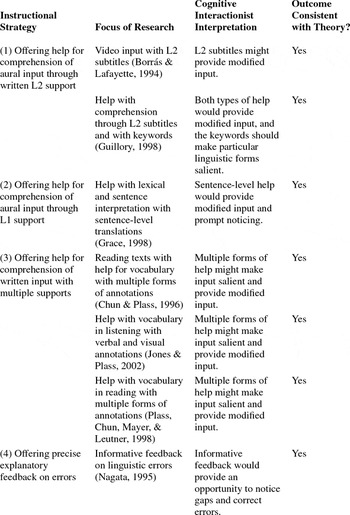
Table 1 summarizes research investigating instructional design strategies that can be interpreted through a cognitive interactionist perspective because of the help that the software provides for the learners' comprehension of aural or written input or the feedback it provides. Help with comprehension, in interactionist terms, provides modified input, helps make the input salient, potentially resolves miscomprehension, and prompts noticing.
Research investigating instructional design strategies interpreted through cognitive interactionist SLA

In studies by Borrás and Lafayette (Reference Borrás and Lafayette1994) and by Guillory (Reference Guillory1998), the software provided L2 subtitles and keyword support that offered learners some input modification through the presentation of input in two modes. In such cases, if learners attempt to comprehend the aural input through listening, and refer to the written text only as needed, this support in some cases should modify the aural input and aid comprehension. In the study by Grace (Reference Grace1998), help in the form of first language (L1) translation and multiple forms of annotations for vocabulary would also be expected to provide modified input, resolve miscomprehension, and prompt noticing. In studies by Chun and Plass (Reference Chun and Plass1996), Jones and Plass (Reference Jones and Plass2002), and Plass et al. (Reference Plass, Chun, Mayer and Leutner1998), learners were provided multiple forms of modified input as aural input, translations, images, and video. Any of these would be expected to serve in providing valuable modified input and resolving miscomprehension, as well as prompting noticing and deep processing of input.
The study by Nagata (Reference Nagata1995) investigated software that provided informative feedback that learners were given in response to errors in their production. Such feedback would be expected to prompt their noticing of gaps in their linguistic knowledge and help them to correct their production. In short, these aspects of instructional design in CALL can be construed as creating opportunities for beneficial interactions and even a highly structured form of negotiation of meaning as learners control the input and its various modified forms. Learners can play the video, or scroll down the screens of written text, but when a comprehension breakdown occurs, they can stop the normal flow of comprehension to review, repeat, or ask for help. The construct of negotiation of meaning as developed in SLA research has also been studied in research investigating computer-mediated communication.
2. Computer-Mediated Communication
Modeled on SLA research on face-to-face communication, studies of computer-mediated communication (CMC) are concerned with the types of interactions that learners engage in, and in some cases, the effects of CMC tasks. Some researchers have investigated the written interaction among L2 learners working on CMC tasks to determine whether or not negotiation of meaning is evident. For example, Blake (Reference Blake2000) assigned jigsaw tasks, requiring learners to piece together a solution by sharing information each possessed, and decision-making tasks, requiring learners to make a decision based on shared information. In the data consisting of their online conversation, he looked for instances of negotiation of meaning, such as the one that appears in the following dialogue:
Student A: Cuales son en común? [What are in common?]
Student B: como se dice común en ingles? no comprehende. [How do you say “common” in English? no understand.]
Student A: común es cuando algo y una otra algo son el mismo; entiendes mi explicación? [“Common” is when something and another thing are the same; do you understand my explanation?]
Student B: si, gracias. . . .[Yes, thank you. . . .]
In a number of studies such as Blake's, researchers have found negotiation of meaning in the tasks that learners complete using Internet communication tools (ICTs). The results suggest that similar positive findings can be found in such tasks as those found in communication tasks that take place through face-to-face conversation. In addition, however, such research investigating written interaction has found that when learners communicate in writing, another type of negotiation can also appear—negotiation of form. For example, transcripts of the written interaction of learners of Spanish have found that conversations taking place in writing can exhibit a closer attention to form and self-correction such as the following one from a study by Pellettieri (Reference Pellettieri, Warschauer and Kern2000).
G: Es tu hombre tiene una corbata y los anteojos? [Is your man wearing a necktie and glasses?]
R: Si, el tiene. [Yes, he is wearing.]
R: Si, el los tiene. [Yes he is wearing them.]
Moreover, oral communication over the Internet for completion of L2 tasks can result in a combination of oral and written modes mixed in a way that uses the writing to support aural comprehension and expression (Sauro, Reference Sauro2001). All of these findings suggest the potential utility of Internet conversations for language learners as well as for SLA researchers who are interested in studying the episodes of interaction that have proven to be of interest in face-to-face conversations.
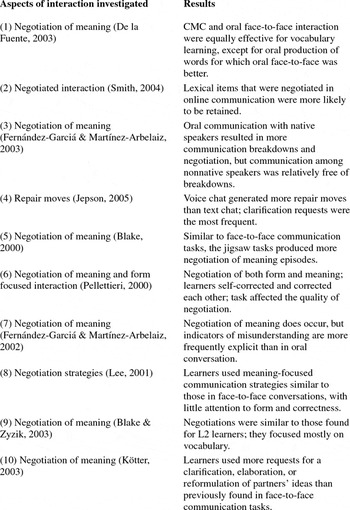
Table 2 summarizes some recent studies of CMC for SLA. The first two studies investigated online communication tasks to determine the extent to which task negotiations affected retention of vocabulary (De la Fuente, Reference De la Fuente2003; Smith, Reference Smith2004). Fernández-Garciá and Martínez-Arbelaiz (Reference Fernández-Garciá and Martínez-Arbelaiz2003) found that in communication with native speakers of Spanish, the communication breakdowns and negotiation that learners experienced was primarily during the oral communication rather than in text chat. Jepson (Reference Jepson2005) compared L2 learners' repair moves in synchronous text chat rooms and in voice chat rooms on the Internet. Voice chat generated more repair moves and moves associated with negative feedback consisting of recasts, explicit feedback and questions, as well as uptake consisting of incorporations of feedback and self-corrections.
Studies of computer-mediated communication

Blake's (Reference Blake2000) study, mentioned earlier, investigated online text-based communication tasks in accordance with those designed by SLA researchers (Gass & Varonis, Reference Gass, Varonis, Gass and Maden1985) and looked for three moves in the negotiation of meaning sequence: the trigger, which was the language that causes miscommunication, the indicator; which is provided to signal that the miscommunication has occurred and the flow of conversation should be interrupted; and the solution, which resolves the miscommunication. Examining negotiation of meaning this way, Blake compared different types of tasks, finding that the jigsaw tasks in CMC, like those in face-to-face communication tasks, seem to best prompt negotiation of meaning. He characterized the process of completing the CMC tasks as an opportunity for the learners to “heighten their metalinguistic awareness of where they are in their own L2 vocabulary development and where they still need to go in order to gain more targetlike lexical control” (Blake, Reference Blake2000, p. 133).
The following four studies (6–9 in Table 2) were conducted using the descriptive research methods of focused discourse analysis from SLA research. Pellettieri (Reference Pellettieri, Warschauer and Kern2000) developed tasks that research on classroom SLA had found to be successful in promoting negotiation of meaning, and form, as mentioned above. Fernández-Garciá and Martínez-Arbelaiz (Reference Fernández-Garciá and Martínez-Arbelaiz2002) investigated whether negotiation of meaning would take place in the text chat discussion among third-year university students studying Spanish. Also, drawing on negotiation of meaning as it was operationalized by Gass and Varonis (Reference Gass, Varonis, Gass and Maden1985), they found some instances of negotiation in the text chat conversations of learners as they discussed questions about readings, but the researchers also found more instances of resolution of communication breakdown through the use of the L1 than they felt was ideal. Investigating intermediate Spanish learners' use of negotiation in synchronous text CMC, Lee (Reference Lee2001) found a variety of strategies for resolving communication breakdowns including a small percentage of L1 use. Overall, she concluded that the learners used negotiation effectively for meaning-focused communication, but negotiations did not help them to use grammatically correct language because of their primary focus on meaning.
Two other studies have made similar findings about focus on meaning to the neglect of grammatical language and about L1 use. Blake and Zyzik (Reference Blake and Zyzik2003) hypothesized that CMC conversations between heritage speakers of Spanish (i.e., those who have some knowledge of Spanish from their family background) and L2 learners of Spanish would exhibit some of the advantages that interactionist theory posits for conversations between expert and novice speakers. They found that the heritage learner-L2 learner pairs engage in the same types of negotiation routines (e.g., “clarification requests, expansions, recasts, self corrections”) as learner pairs (p. 538), and that these focused on lexical items for the most part, with many syntactic errors going unnoticed. The heritage learners provided more help for the Spanish L2 learners than the L2 learners provided for the heritage learners, but both took the roles of resolving communication breakdowns.
Kötter (Reference Kötter2003) examined negotiation of meaning in synchronous written chat between German learners of English and American learners of German as they worked collaboratively on a project that was to be presented at the end of the semester. He found many instances of negotiations that were similar to those found in prior studies of face-to-face communication, but in addition, he found many more instances of code-switching.
Investigation of interactive written communication has also prompted researchers to look at the discourse from different perspectives—beyond what is typically used in task-based language research. Differences in communication prompt discourse analysis of L2 CMC to expand the scope of inquiry to examine phenomena such as L2 play (Warner, Reference Warner2004) and other contextual factors that affect the amount and quality of interaction in online communication (Belz, Reference Belz2001). In short, the new pragmatic contexts created through the use of ICT afford new opportunities for studying the communication that L2 learners engage in and identifying episodes within the communication that may be important for SLA.
Directions for Research
In view of the ubiquity of technology in the lives of language learners and all language users, the integration of technology with theory, research, and practice in SLA needs to be increased. This need might be addressed with research in three broad areas.
1. Expand SLA Theory and Research
Some SLA researchers have used computer technology to operationalize learning conditions and assess learning to test hypotheses about SLA, but the implications of technology for research and theory in SLA remain absent for the most part. Examination of the technology–SLA interface underscores a point that is being made by some SLA researchers—that the study of SLA requires a more detailed consideration of contexts of language development (Ortega, Reference Ortega2005). CALL expands how L2 tasks can be constructed and investigated in the L2 classroom. Tasks based on learner–computer interaction offer precise, accurate, and multimodal modified input upon request or according to a particular pedagogical design. Such task features provide a means of grounding CALL research in the same domain as classroom research-based L2 pedagogies. At the same time, CALL research provides a means of investigating various operationalizations of constructs such as interaction, which can refer to both human–computer interaction or CMC among learners (Chen, Belkada, & Okamoto, Reference Chen, Belkada and Okamoto2004).
However, the SLA–technology connection only begins with laboratory and classroom experiments that test conditions for second language acquisition. It extends to issues such as how to define second language ability as including (1) the ability that can be displayed with the help of readily accessible L2 technology aids (such as online bilingual dictionaries and grammar checkers); (2) the ability to make appropriate linguistic choices across a range of face-to-face, remote, written, and oral modes; and (3) the ability to choose appropriate technologies for communication and language learning. Technology dramatically extends and changes the breadth and depth of exposure that learners can have with the target language. As a consequence, all approaches to SLA that theorize a role for input need to consider the way that technology changes linguistic input and how learners access to new forms of input might affect acquisition.
2. Increase the Effectiveness of Assessment for Learning and Research
The capacity of technology for providing systematic, appropriate instruction to language learners has barely been tapped. Advances that take advantage of the computer's capacity for adaptive instruction require research that seeks to use principles of diagnostic assessment, student models, and natural language processing (NLP) to document learners' performance precisely, store relevant information, draw appropriate inferences, and take action for future instruction.
This process, which seems to be intuitively logical, is stymied by imprecise professional knowledge and underdeveloped technology for language analysis and inference. For example, how can useful areas of diagnostic information be selected by material developers? How can reliability of diagnostic inferences be achieved and monitored? How can diagnostic feedback be communicated to language learners? How can learners' language performance be summarized and stored for subsequent use? What evidence suggests that language learners are able to use and benefit from diagnostic feedback? What evidence suggests that learners benefit from the feedback and adaptivity afforded by NLP? How can adaptive learning paths be set to individualize learning effectively? Surprisingly little progress has been made to address these critical issues aimed at improving instruction in ways that are different from what can be accomplished with a teacher in front of a large class or by student–student conversation.
3. Incorporate SLA into CALL Design and Evaluation
At one time it was difficult for CALL researchers to find guidance from theory and research in SLA for CALL instructional design. Despite the variety of approaches toward SLA, little of the theory and research pertained to instructed SLA. Today, in contrast, research on learner–computer interaction and CMC demonstrates the utility of SLA for framing research questions and interpreting results. Theory posits cognitive processes fostering acquisition as well as how these processes are engaged through input that a task designer can manipulate. Theory also provides a means of examining collaboration in CMC (Gutiérrez, Reference Gutiérrez2003). Tasks of theoretically pedagogical value can therefore be designed on the basis of principles. Work in this area, however, is only beginning to explore the relevant task characteristics in CALL tasks and the value of collaboration. Such research faces many of the challenges of classroom research, including navigation of the variety of classroom and distance learning contexts in which students learn language today.
Conclusion
The changes in language learning, assessment, and research afforded by technology are significant, far-reaching, and complex. Moreover, these changes are unlikely to diminish; on the contrary, the march of technology throughout all aspects of the lives of language learners is expanding whether it be through formal education or in their everyday lives. Such environments, of course, are of interest not only because of the resources they offer researchers, but also because they represent the context in which a great many language learners are studying language today. As a consequence, research identifying support for methodological principles in CALL holds the potential for directly influencing pedagogy for many learners.
Years ago it was necessary to argue that the design and evaluation of CALL could be strengthened by drawing on perspectives and methods from SLA (Doughty, Reference Doughty and Smith1987; Chapelle, Reference Chapelle1997). Today, the productivity of SLA perspectives for CALL is an argument made easily (Kitade, Reference Kitade2000). It is made through the many examples of CALL research and development that explicitly draw on SLA as a basis for design and evaluation even though CALL can be studied from a variety of perspectives (Egbert & Petrie, Reference Egbert and Petrie2005; Levy & Stockwell, 2006; Thorne, Reference Thorne2003; Warschauer, Reference Warschauer1998). Today, the argument is being made for more technology-sensitive perspectives on SLA—perspectives that encompass hypotheses about the ubiquitous and varied target language contact learners have through technology as well as conceptions about technology-assisted language use and acquisition.