Introduction
Lichens are considered key elements of the Antarctic flora. Their distribution ranges from coastal regions of maritime Antarctica (Schmitz et al., Reference Schmitz, Villa, Michel, Putzke, Pereira and Schaefer2021) to climatically harsh areas of continental Antarctica (Wagner et al., Reference Wagner, Brunauer, Bathke, Cary, Fuchs, Sancho and Ruprecht2021). They occupy various environments and substrates and exhibit region- and site-dependent biodiversity determined mainly by macro- and microclimatic characteristics. The Antarctic peninsula and the adjacent island on the eastern (e.g. Seymour Islands, Vega Island, James Ross Island) and western side of the Antarctic peninsula (e.g. South Shetlands Isl., Livingstone Isl., Deception Isl., Argentine Islands, etc.) belong to the regions with highest reported lichen biodiversity (Green, Sancho, Pintado, & Schroeter, Reference Green, Sancho, Pintado and Schroeter2011; Halıcı, Bartak, & Güllü, Reference Halıcı, Bartak and Güllü2018; Sancho, Schulz, Schroeter, & Kappen, Reference Sancho, Schulz, Schroeter and Kappen1999; Singh et al., Reference Singh, Dal Grande, Divakar, Otte, Leavitt, Szczepanska and Schmitt2015). Thanks to the relatively good accessibility of these islands for scientists during austral summer season, these locations belong among the most studied Antarctic regions.
According to long-term climatic characteristics, James Ross Island has a cold, polar-continental climate (Martin & Peel, Reference Martin and Peel1978). The climate of the island is relatively dry because of the Trinity Peninsula mountains (Antarctic Peninsula) that shield the island from precipitation (Davies et al., Reference Davies, Glasser, Carrivick, Hambrey, Smellie and Nývlt2013). Precipitation estimates range from 200 to 500 mm per year (Van Lipzig, King, Lachlan-Cope, & Van den Broeke, Reference Van Lipzig, King, Lachlan-Cope and Van den Broeke2004) and, therefore, James Ross Island is considered a semi-arid environment.
Conversely, ecological studies (e.g. Cannone & Guglielmin, Reference Cannone and Guglielmin2008) rank James Ross Island as among those having a maritime climate. Recent biological studies (see e.g. Kopalová, Nedbalová, Elster, & Van de Vijver, Reference Kopalová, Nedbalová, Elster and Van de Vijver2013 for biodiversity of diatoms) suggest that James Ross Island might be considered a transitional zone between maritime and continental Antarctica. The lichen biota supports such view because some species such as Usnea aurantiaco-atra are quite frequent in the South Shetland Islands (maritime Antarctica) but absent from James Ross Island.
Taxonomic studies of lichens from James Ross Island have been carried out for several decades. Thanks to a large deglaciated area on the northern part of the Island of about 250 km2 (Jennings et al., Reference Jennings, Davies, Nývlt, Glasser, Engel, Hrbáček, Carrivick, Mlčoch and Hambrey2021), a great variety of microhabitats are available there for biological colonisation (Barták, Váczi, Stachoň, & Kubešová, Reference Barták, Váczi, Stachoň and Kubešová2015). Some ice-free parts of the island have not yet been inspected for lichens, which is why a lichen biodiversity list for the island is far from being complete. Several new species for the island and/or Antarctica have been described, mainly in last decade (e.g. Halıcı et al., Reference Halıcı, Bartak and Güllü2018; Halıcı, Kahraman, Scur, & Kitaura, Reference Halıcı, Kahraman, Scur and Kitaura2022). In this study, we report three infrageneric taxa of lichens which were previously not known from Antarctica collected at James Ross Island. Morphological and anatomical descriptions of these taxa are provided along with original photographs and phylogenetic positions of these taxa are discussed as well.
List of species used in phylogenetic trees. The newly generated sequences are in bold.

Materials and methods
Collection sites
Lichen specimens were collected from three different locations on James Ross Island. Locality No.1 is a long-term research plot (LTRP) located close to the J.G-Mendel station on the northern coast of the island. The LTRP is close to the coast (geographical co-ordinates: 63°48´03″ S, 57°52´50″ W, altitude of 5 m a.s.l.) in between the confluence of the Bohemian and Algal streams. The area is dominated by Bryum pseudotriquetrum that forms small-area carpets, with smaller areas rich in microbial mats formed mainly by Nostoc sp. colonies. Several seepages located on the LTRP are rich in algae (e.g. Zygnema sp.) and cyanobacteria. Mean annual temperature of the site is –4.6°C and annual relative air humidity varies within the range of 60–100% (Láska, Barták, Hájek, Prošek, & Bohuslavová, Reference Láska, Barták, Hájek, Prošek and Bohuslavová2011). Locality No. 2 is a group of boulders (each of several cubic metres dimension) of volcanic rock located on the lower slopes (63°48’22.5” S, 57°51’00” W, altitude 140 m a.s.l.) of the Berry Hill mesa. The upper surface of the boulders is, due to nutrient availability from the occasionally resting skuas (Catharacta maccormicki), rich in lichens. Typically, Umbilicaria decussata can be found together with nitrophilous lichens Caloplaca sp., Candelaria sp. and Candelariella sp. (personal observations, not yet published). Locality No. 3 is located at the SE margin of the Johnson Mesa, 63°49′46.2″ S, 57°54′21.6″ W, at the altitude of 292 m a.s.l. The locality represents a vegetation-rich, sorted stony surface formed by the activity of an active layer of permafrost on the table mountain (mesa). An organo-mineral substrate is available, mainly at the margins of the stony polygons, which typically form shallow depressions with enhanced snow accumulation. Therefore, water availability in such places is higher than that in the polygon centres, which is beneficial for the development of lichen-dominated communities at the margins of polygons. At locality No. 3, Dermatocarpon polyphyllizum and Xanthoria elegans are found quite frequently.
The lichen species referred to in this study were collected from the following sites: Farnoldia micropsis (stone surfaces at locality No. 1), Gyalolechia epiphyta (boulder surface at locality No. 2) and Placidium squamulosum var. argentinum (sorted stony soils of a table mountain at locality No. 3)
Handling of specimens
Samples of lichenised fungi were collected from James Ross Island which, according to bioecological characteristics, belongs to the North-East Antarctic Peninsula Region (Terauds & Lee, Reference Terauds and Lee2016). The specimens detailed below are deposited in the Erciyes University Herbarium Kayseri, Turkey (ERCH). Before transport from Antarctica, the specimens were dried in the field and stored for 3 days in a deep freezer. They were numbered starting with “JR” and added to the database of the herbarium under those numbers. All the lichen specimens were examined by standard microscopic techniques. Hand-cut sections were studied in water, potassium hydroxide (KOH) and Lugol’s solution (I). Measurements of anatomical structures such as ascospores were made in water. Standard spot tests were carried out to determine the lichen secondary metabolites present. Ascospores were measured from five different ascomata for each species. The measurements are reported in the format: (minimum) mean minus standard deviation – mean – mean plus standard deviation (maximum), from N measurements. The descriptions of the lichen species are based on the specimens collected from James Ross Island by the authors.
DNA isolation, PCR and sequencing
Genomic DNA extraction was performed directly using fresh apothecia, perithecia (fruiting bodies) or small-area thallus fragments. DNA was extracted using the protocol of the Dneasy Plant Mini Kit (Qiagen). The nuclear rDNA ITS gene region was amplified by using the fungi-specific primer ITS1-F (5′-CTTGGTCATTTAGAGGAAGTAA-3′) and the universal primer ITS4 (5’-TCCTCCGCTTATTGATATGC-3’) (Gardes & Bruns, Reference Gardes and Bruns1993; White, Bruns, Lee, & Taylor, Reference White, Bruns, Lee and Taylor1990). The mtSSU gene region was amplified by using the primers mtSSU1F (GATGATGGCTCTGATTGAAC) (Shiguo & Stanosz, Reference Shiguo and Stanosz2001) and mtSSU3R (ATGTGGCACGTCTATAGCCC) (Zoller, Scheidegger, & Sperisen, Reference Zoller, Scheidegger and Sperisen1999). The RPB1 gene region was amplified using the primers RPB1-5F pelt 5'-TTCAACAARCTBACVAARGATGT-3' (Denton, McConaughy, & Hall, Reference Denton, McConaughy and Hall1998) and fRPB1-11aR 5'- GCRTGGATCTTRTCRTCSACC-3' (Liu, Whelen, & Hall, Reference Liu, Whelen and Hall1999). PCR amplification was carried according to the following protocol. The final volume of 25 μL consisted of 12.5 μL of 2 × Power Taq PCR Master Mix, 1 μL of each primer (10 μM), 4 μL of extract DNA and 7.5 μL of deionised water. The PCR cycling parameters included initial denaturation at 95 °C for 5 min, followed by 35 cycles at 95 °C (30 s), 1 cycle at 52 °C (30 s), another 1 at 72 °C (1 min), followed by a final elongation at 72 °C for 8 min. The PCR products were visualised on 1.2% agarose gel as a band of approximately 550–600 base pairs (bp) (ITS), 700–800 bp (mtSSU) or 750 bp (RPB1). All amplified products were electrophoresed on a 1.2 % agarose gel and compared with a 1 Kb Plus DNA Ladder for size estimation. The PCR amplification products were sequenced by the BM Labosis Laboratory (Ankara).
Phylogenetic analyses
Phylogenetic analyses were performed based on ITS, mtSSU and RPB1 sequence data (Table 1). Newly generated sequences were subjected to a BLAST search to assess their affinities and aid in taxon sampling for the phylogeny. The sequences were aligned using Clustal W. The resulting alignment was further adjusted manually in a BioEdit v.7.2 sequence alignment editor (Hall, Reference Hall1999). Ambiguous regions were delimited and excluded from the alignment. Phylogenetic relationships between taxa were investigated using a MEGA 7 software (Tamura, Stecher, Peterson, Filipski, & Kumar, Reference Tamura, Stecher, Peterson, Filipski and Kumar2013). The dataset was analysed using the maximum likelihood method and support values were obtained using a bootstrap analysis of 1,000 pseudoreplicates. The out-groups used in the phylogenetic trees were chosen to be phylogenetically related with the in-groups. When necessary, the variable sites of the gene regions of nrITS, mtSSU or RPB1 were shown using BioEdit v.7.2 programme (Hall, Reference Hall1999).
Results and discussion
After morphological and molecular examination of the specimens collected from James Ross Island, we report here three infrageneric taxa which were previously not reported from Antarctica: Farnoldia micropsis, Gyalolechia epiphyta and Placidium squamulosum var. argentinum. Morphological descriptions based on Antarctic specimens and comparisons with the related species are provided below along with photographs. mtSSU and RPB1 gene regions of Farnoldia micropsis, nrITS and mtSSU gene regions of Gyalolechia epiphyta and nrITS gene region of Placidium squamulosum var. argentinum were sequenced and the phylogenetic positions of the species are discussed.
Farnoldia micropsis (A. Massal.) Hertel
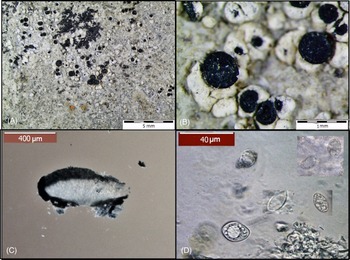
Thallus crustose, areolate, areoles well developed, flat to convex, contiguous or scattered, up to 1.5 mm thick, dirty white, prothallus not visible. Medulla white, I + blue. Apothecia lecideine, black, epruinose, 0.3–0.6 mm in diam, flat to slightly convex or concave disc. Proper exciple black, 30–50 µm thick. Epihymenium dark greenish-blue; hymenium colourless, slightly greenish tinge present in the upper part, 80–100 µm tall; paraphyses branched and anastomosing, apical cells ∼ 3 µm wide. Hypothecium grayish. Asci 8-spored; ascospores simple, colourless, ellipsoid, (13–)15,5–18–20.5(–23) × (6–)8,5–11–13.5,5(–16) µm, length/width ratio (1–)1,4–1,7–2(–2,5) µm (n = 44) (Fig. 1).
Farnoldia micropsis. A. Thallus overview. B. Areolles and apothecia in close view. C. Apothecial section. D. Ascospores.
Notes: To date, the genus Farnoldia Hertel was represented in Antarctica by only one species, F. dissipabilis (Nyl.) Hertel (Øvstedal & Lewis Smith, 2001). That species has ochre-yellow to ochre-brown verrucose areolate to subsquamulose thallus, whereas F. micropsis has whitish areolate thallus. Of the other species of the genus, F. jurana (Schaer.) Hertel subsp. jurana has a very poorly developed thallus and F. similigena (Nyl.) Hertel has narrowly ellipsoid ascospores ≤ 7 µm wide (Nimis, Reference Nimis2016).

Chemistry: Spot tests: Epihymenium N + red.
The specimen of F. micropsis was collected on small pebbles in the coastal zone of James Ross Island. This species was previously reported from Murmansk region of Russia (Melechin, Reference Melechin2015), SE Alaska, Montana, Colorado, and Utah of USA (McCune, Glew, Nelson, & Villella, Reference McCune, Glew, Nelson and Villella2007), France (Sussey, Reference Sussey2012), China (Zhao, Hu, & Zhao, Reference Zhao, Hu and Zhao2016), Sweden (Westberg et al., Reference Westberg, Arup, Berglund, Ekman, Nordin, Prieto and Svensson2016), Slovenia (Batic et al., Reference Batic, Primozic, Surina, Trost and Mayrhofer2003), Siberia, Finland, Turkey, Canada (Hertel, Reference Hertel2001), Alaska (Hertel & Andreev, Reference Hertel and Andreev2003), Arctic (Hertel, Reference Hertel1991), Italy (Ravera et al., Reference Ravera, Vizzini, Puglisi, Adamčík, Aleffi, Aloise and Vallese2020), Germany (Wirth et al., Reference Wirth, Hauck, Brackel, Cezanne, de Bruyn, Dürhammer and John2011), Greenland, Svalbard (Kristinsson, Hansen, & Zhurbenko, Reference Kristinsson, Hansen and Zhurbenko2015), Macedonia, Romania, Bulgaria, Montenegro (Oukarroum, Strasser, & Schansker, Reference Oukarroum, Strasser and Schansker2012), Australia (Reiter & Türk, Reference Reiter and Türk2001) and Spain (Gómez-Bolea et al., Reference Gómez-Bolea, Burgaz, Atienza, Dumitru, Chesa, Chiva and Casares2021) on rocks with intermediate carbonate content, being rare on pure limestone (McCune et al., Reference McCune, Glew, Nelson and Villella2007), on calcareous boulders (Westberg et al., Reference Westberg, Arup, Berglund, Ekman, Nordin, Prieto and Svensson2016) and various calcareous rock types (Hertel & Andreev, Reference Hertel and Andreev2003). This is the first report of this species from the Southern Hemisphere and Antarctica.
Unfortunately, only one species of Farnoldia (F. jurana subsp. jurana) has RPB1 and mtSSU sequence data in GenBank and none have nrITS sequence. 665 nucleotides in the RPB1 gene region and 550 nucleotides in mtSSU gene region of two Farnoldia species (F. micropsis and F. jurana subsp. jurana) were compared. 640 nucleotides were found to be conserved sites (C) and 25 nucleotides were found to be variable sites (V) in RPB1 gene region. The light coloured parts in Figure 2 show the nucleotide differences. According to this comparison, there is a 3.75 % difference between F. micropsis and F. jurana subsp. jurana.
Shortened RPB1 alignment, including only variable positions of Farnoldia jurana subsp. jurana and F. micropsis.

542 nucleotides were found to be conserved sites (C) and 7 nucleotides were found to be variable sites (V) in mtSSU gene region. The light coloured parts show the nucleotide differences (Fig. 3). According to this comparison, there is a 1.27 % difference between F. micropsis and F. jurana subsp. jurana.
Shortened mtSSU alignment, including only variable positions of Farnoldia jurana subsp. jurana and F. micropsis.

Specimen examined: Antarctica, Antarctic Peninsula, the James Ross Island, Long Term Research Plot (subplot No.7), 63° 48′ 03″ S, 57° 52′ 50″ W, alt. 3 m., on small calcareous pebbles, 13.02.2017, leg. M. G. Halıcı & M. Bartak (JR 0.016).
Gyalolechia epiphyta (Lynge) Vondrák
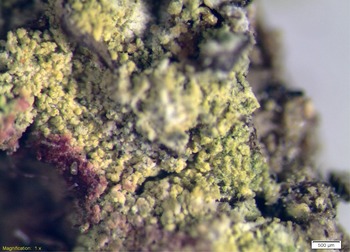
Thallus crustose, blastidiate/granulose (without true soredia), lemon yellow, areoles 0.1–0.2 mm in diam. Apothecia and pycnidia not observed (Fig. 4).
Gyalolechia epiphyta. Blastidiate/granulose thallus.

Chemistry: Thallus K+ red, C-, KC-, P-.
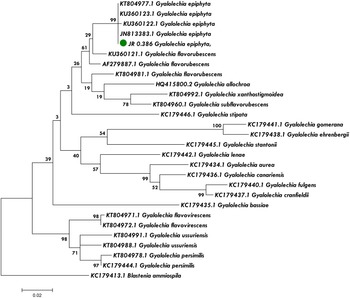
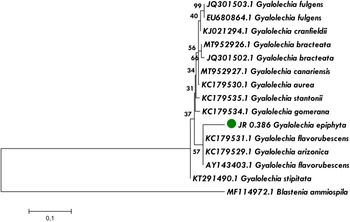
This species is typical in the genus with its blastidiate/granulose thallus and absence of true soralia but also quite similar to the sorediate taxa of the genus (G. persimilis (Wetmore) Søchting, Frödén & Arup, G. ussuriensis (Oxner, S.Y. Kondr. & Elix) Vondrák and G. xanthostigmoidea (Räsänen) Søchting, Frödén & Arup) (Vondrák et al., Reference Vondrák, Frolov, Davydov, Urbanavichene, Chesnokov, Zhdanov and Tchabanenko2016). In the nrITS tree (Fig. 5), it is clearly seen that the nrITS sequence of the Antarctic specimen collected by us is placed in the supported clade of G. epiphyta and differs from G. persimilis, G. ussuriensis and G. xanthostigmoidea. There is no sequence of G. epiphyta and fewer data of the genus for the mtSSU gene region in GenBank. In the mtSSU tree (Fig. 6), the closest relatives to our Antarctic specimen are G. flavorubescens s. lat. (Huds.) Søchting, Frödén & Arup and G. arizonica (H. Magn.) Søchting, Frödén & Arup.
Maximum likelihood (ML) analysis inferred from nrITS sequences of Gyalolechia epiphyta and related species.

Maximum likelihood (ML) analysis inferred from mtSSU sequences of Gyalolechia epiphyta and related species.

The Antarctic specimen was collected on soil at 140 m altitude on James Ross Island. This species is usually reported on bark or moss cushions but also occurring on calcareous rock (Vondrák, Ismailov, & Urbanavichus, Reference Vondrák, Ismailov and Urbanavichus2017). The type specimen of G. epiphyta (Lynge) Vondrák is from Greenland and it has a wide distribution in the Northern Hemisphere including Russia, China, Iran, USA and Canada (Esslinger, Reference Esslinger2016; Vondrák et al., Reference Vondrák, Frolov, Davydov, Urbanavichene, Chesnokov, Zhdanov and Tchabanenko2016). This is the first report of this species from the Southern Hemisphere and Antarctica.
Specimen examined: Antarctica, Antarctic Peninsula, James Ross Island, Puchau, 63° 48′ 25″ S, 57° 50′ 28″ W, alt. 142 m., on soil, 07.02.2017, leg. M. G. Halıcı & M. Bartak (JR 0.016).
Placidium squamulosum var. argentinum (Räsänen) Breuss.
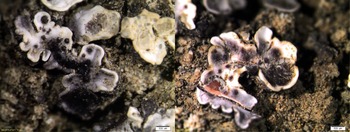
Thallus consisting of squamules, to 2–4 mm diam., lobed, not overlapping, upper surface grayish and bluish pruinose, margins paler (almost white) and curled up, lower surface creamish brown to brown (Fig. 7). Thallus 150–250 µm thick; upper cortex 25–50 µm thick, paraplectenchymatous with an epinecral layer ∼ 30 µm thick. Rhizohyphae hyaline, 5–6.5(–7.5) µm thick. Perithecia immersed usually in the marginal parts of the squamules, pyriform, exciple hyaline. Asci 8-spored, cylindrical; ascospores uniseriately arranged. Ascospores colourless, simple, (11.5–)13–15–17(–19) × (5.5–)6.5–8–9.5(–16) µm (n = 20). Pycnidia laminal, conidia oblong ellipsoid, 2.5–5 × 1.5–3 µm.
Placidium squamulosum var. argentinum. Squamules on soil.

Chemistry: Spot tests all negative.
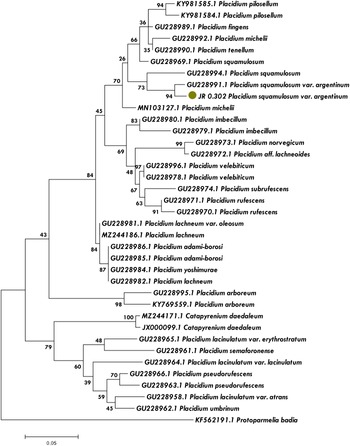
Breuss (Reference Breuss2001) reported Placidium squamulosum (Ach.) Breuss as a cosmopolitan species that grows on soil and humus in all continents except of Antarctica (Breuss, Reference Breuss2001). Here we report this species as new to Antarctica; so the species is now known from all continents. The Antarctic specimen collected on soil at the altitude of 292 m a.s.l. from James Ross Island has bluish grey squamules that are not appressed by the whole underside. Placidium squamulosum (Ach.) Breuss has a dull or subnitid, pale to dark brown upper surface, and squamules densely aggregated, mostly appressed to the substratum by the whole underside, occasionally with slightly raised margins (Breuss, Reference Breuss1993). However, P squamulosum var. argentinum differs from the type in having broader ascospores (12–16 × 7.5–8.5 µm vs. 12–16 × 5.5–7.5 µm) and thinner rhizohyphae (4–5 µm vs. 5–6.5 µm) (Breuss, Reference Breuss1993; Prieto, Aragón, MartÍnez, & Breuss, Reference Prieto, Aragón, MartÍnez and Breuss2008). Actually, the Antarctic specimen has wider ascospores as in P. squamulosum var. argentinum but wider rhizohyphae as var. squamulosum. In the nrITS tree (Fig. 8), it is clearly seen that the nrITS sequence of the Antarctic specimen places it in the supported clade of P squamulosum var. argentinum. 593 nucleotides in the nrITS gene region of P. squamulosum (Ach.) Breuss, P squamulosum var. argentinum from Argentina and Antarctica were compared. When the Antarctic specimen was compared with P. squamulosum (Ach.) Breuss, 431 nucleotides were found to be conserved sites (C) and 40 nucleotides were found to be variable sites (V) in nrITS gene region. The light coloured parts in Figure 9 show the nucleotide differences. According to this comparison, there is a 6.74 % difference between P. squamulosum (Ach.) Breuss and P squamulosum var. argentinum from Antarctica. When the Antarctic specimen was compared with P. squamulosum var. argentinum (Räsänen) Breuss from Argentina, 471 nucleotides were found to be conserved sites (C) and 5 nucleotides were found to be variable sites (V) in nrITS gene region. According to this comparison, there is a 0.84 % difference between the Antarctic and Argentina samples. Two species of the related genus Catapyrenium: C. daedaleum (Körb.) Stein and C. lachneoides Breuss were reported from Antarctica by Øvstedal & Lewis Smith (Reference Øvstedal and Smith2001), but these species differ morphologically from our collection, and nrITS sequences of C. daedaleum from GenBank are phylogenetically distinct.
Maximum likelihood (ML) analysis inferred from nrITS sequences of P. squamulosum var. argentinum and related species.

Shortened nrITS alignment, including only variable positions of P squamulosum and P squamulosum var. argentinum.

Specimen examined: Antarctica, Antarctic Peninsula, James Ross Island, Southeast of Johnson Mesa, 63° 49′ 46″ S, 57° 54′ 21″ W, alt. 292 m., on soil, 26.01.2017, leg. M. G. Halıcı & M. Bartak (JR 0.302).
Acknowledgements
The first author thanks the Erciyes University for the financial support that allowed him to perform the field work on James Ross Island, Antarctica and the infrastructure and facilities of J. G. Mendel Station provided during the Czech Antarctic expedition, Jan–Feb 2017. This study was financially supported by the TÜBİTAK project No. 118Z587. The first author’s scientific work is also supported by Turkish Academy of Science (TÜBA). M. Barták is grateful to the ECOPOLARIS project (CZ.02.1.01/0.0/0.0/16_013/0001708) for funding.