Introduction
Obsessive–compulsive disorder (OCD) is a psychological condition characterised by persistent and intrusive obsessions that can result in the performance of repetitive and time-consuming behaviours known as compulsions (American Psychiatric Association, 2013). The contamination/cleaning subtype of OCD (COCD) typically involves intrusive and repetitive thoughts about stimuli considered to be dirty or infectious, avoidance of the perceived contaminants and purposeful, repetitive washing/cleaning behaviours (Jones & Krochmalik, Reference Jones, Krochmalik, Menzies and de Silva2003). Contamination obsessions and washing compulsions are among the most common expressions of OCD (De Silva & Rachman, Reference De Silva and Rachman1992; Rachman, Reference Rachman2004).
Cognitive models of OCD emphasise the role of maladaptive appraisals in the aetiology and maintenance of the condition (e.g., Rachman, Reference Rachman1997, Reference Rachman1998; Salkovskis, Reference Salkovskis1985). Overestimation of threat is considered an important dysfunctional belief in OCD (Obsessive–Compulsive Cognitions Working Group, 1997, 2005), and excessive threat expectancies of both the likelihood and severity of (Cougle et al, Reference Cougle, Wolitzky-Taylor, Lee and Telch2007) contamination-related illness are theorised to play a significant role in triggering and maintaining COCD related symptoms (Cisler, Brady, Olatunji, & Lohr, Reference Cisler, Brady, Olatunji and Lohr2010; Jones & Menzies, Reference Jones and Menzies1997a; McKay et al., Reference McKay, Abramowitz, Calamari, Kyrios, Radomsky, Sookman, Taylor and Wilhelm2004). A substantial body of research provides support for the role of threat appraisals in COCD (e.g., Abramowitz, Lackey, & Wheaton, Reference Abramowitz, Lackey and Wheaton2009; Haberkamp, Schmidt, Hansmeier, & Glombiewski, Reference Haberkamp, Schmidt, Hansmeier and Glombiewski2019; Jones & Menzies, Reference Jones and Menzies1997a, Reference Jones and Menzies1998a; OCCWG, 2005; Tolin, Woods, & Abramowitz, Reference Tolin, Woods and Abramowitz2003). For example, Jones and Menzies (Reference Jones and Menzies1997a) employed a contamination-relevant Behavioural Avoidance Task (BAT) in which 27 participants with COCD were asked to place their hands in a garbage bin containing potting soil, animal hair, raw meat, and food scraps. Of the cognitive variables examined both likelihood of disease and severity of disease threat expectancies were found to be the most likely mediators of subjective urge to wash, level of distress, behavioural avoidance, and handwashing.
In a later study using the same BAT, Jones and Menzies (Reference Jones and Menzies1998a) demonstrated that experimentally increasing threat expectancy resulted in significantly greater avoidance and washing behaviour. Additionally, treatment that specifically focuses on decreasing threat estimates has been found to be effective in reducing COCD symptomatology (Govender, Drummond, & Menzies, Reference Govender, Drummond and Menzies2006; Hambridge & Loewenthal, Reference Hambridge and Loewenthal2003; Jones & Menzies, Reference Jones and Menzies1997b, Reference Jones and Menzies1998b; Krochmalik, Jones, & Menzies, Reference Krochmalik, Jones and Menzies2001; Krochmalik, Jones, Menzies, & Kirkby, Reference Krochmalik, Jones, Menzies and Kirkby2004).
In addition to threat estimations, the emotion disgust has been increasingly implicated in the development and maintenance of OCD (Bhikram, Abi-Jaoude, & Sandor, Reference Bhikram, Abi-Jaoude and Sandor2017; Cisler et al., Reference Cisler, Brady, Olatunji and Lohr2010; Knowles, Jessup, & Olatunji, Reference Knowles, Jessup and Olatunji2018; Ludvik, Boschen, & Neumann, Reference Ludvik, Boschen and Neumann2015; Rachman, Reference Rachman2004; Rozin, Haidt, & McCauley, Reference Rozin, Haidt, McCauley, Lewis and Haviland1993). Disgust is a universal emotion conceptualised as revulsion at the prospect of becoming contaminated by a potential pollutant (McNally, Reference McNally2002). Feelings of disgust can motivate a person to evade or neutralise pollutants so as to avoid contamination (Olatunji & Sawchuk, Reference Olatunji and Sawchuk2005). The disease-avoidance model suggests an evolutionary advantage as the basis for disgust, proposing that an individual who is contaminant-averse is more likely to avoid infection and live a longer, healthier life thus having a greater opportunity to produce viable offspring (Matchett & Davey, Reference Matchett and Davey1991).
Researchers have identified two distinct mechanisms within the construct of disgust, namely disgust propensity (DP) and disgust sensitivity (DS) (Cavanagh & Davey, Reference Cavanagh and Davey2000). DP is how readily or frequently an individual experiences disgust and DS is the negative valence individuals assign to being disgusted (Van Overveld, de Jong, Peters, Cavanagh, & Davey, Reference Van Overveld, de Jong, Peters, Cavanagh and Davey2006). There is evidence that DP and DS may be important factors in COCD since both have been shown to independently predict COCD symptoms after controlling for negative affect (Olatunji, Moretz et al.,Reference Olatunji, Moretz, Wolitzky-Taylor, McKay, McGrath and Ciesielski2010)). However, some researchers have suggested DS may be more important in the maintenance of COCD symptoms (Olatunji, Cisler, Deacon, Connolly, & Lohr, Reference Olatunji, Cisler, Deacon, Connolly and Lohr2007; Olatunji, Cisler, McKay, & Phillips, Reference Olatunji, Cisler, McKay and Phillips2010) and others only DP (Cisler et al., Reference Cisler, Brady, Olatunji and Lohr2010; Olatunji et al., Reference Olatunji, Cisler, McKay and Phillips2010; Melli, Moulding & Poli, Reference Melli, Moulding and Poli2016). While there is limited research to date examining the distinct functional roles that DP and DS have in the aetiology and maintenance of COCD, there is sufficient evidence to indicate that disgust is likely to play an important role in this condition.
While many studies have focused on either threat expectancies or disgust in COCD, more recent research has integrated the two (e.g., Cisler et al., Reference Cisler, Brady, Olatunji and Lohr2010; MacDonald & Jones, Reference MacDonald and Jones2015; Melli, Moulding & Poli, 2016; Thorpe, Barnett, Friend, & Nottingham, Reference Thorpe, Barnett, Friend and Nottingham2011). For example, Cisler et al. (Reference Cisler, Brady, Olatunji and Lohr2010) investigated the role of threat overestimation in potentiating the effects of disgust on contamination concerns using self-report measures in a non-clinical sample. The results revealed that overestimations of threat significantly moderated the relationship between disgust and contamination fear. However, a replication study conducted by Melli, Moulding and Poli (2016) using a clinical OCD sample found that DP, not obsessive beliefs including threat predicted COCD symptoms, perhaps due to the heterogeneity of participants in regard to OCD symptom domain.
Thorpe et al. (Reference Thorpe, Barnett, Friend and Nottingham2011) extended the work of Jones and Menzies (Reference Jones and Menzies1997a), by employing the same BAT compound stimulus and measures of threat expectancies, anxiety, urge to wash, and washing but added disgust ratings. Results demonstrated that high levels of disgust were associated with increased handwashing but that this relationship was almost entirely mediated by danger expectancies concerning the judgement of the severity of consequent disease. Deacon and Olatunji (Reference Deacon and Olatunji2007) also employed BATs to investigate the relationship between threat expectancies and disgust in COCD. Participants engaged with three contamination-relevant BATs in steps increasing in intensity. While both trait disgust and threat expectancies predicted BAT avoidance, the significant relationship between threat expectancies and BAT responding became non-significant after controlling for DS.
In a more recent study, MacDonald and Jones (Reference MacDonald and Jones2015) employed a disgust induction and the contamination-relevant BAT compound stimulus used previously by Jones and Menzies (Reference Jones and Menzies1997a) and Thorpe et al. (Reference Thorpe, Barnett, Friend and Nottingham2011). Participants were randomly allocated to a disgust condition (in which a disgusting smell was added to the BAT stimulus), or a control condition (no disgust evoking smell). Support for both threat expectancies and disgust in COCD was found. Avoidance was greater for participants exposed to the smell as well as those with higher levels of pre-existing trait disgust. Participants with high-threat expectancies for the likelihood and severity of a consequent disease also exhibited increased avoidance. Finally, threat expectancies for both the likelihood and severity of illness mediated the relationship between trait disgust and BAT avoidance. However, data were unable to be collected from 21% of participants in the disgust condition as they declined to participate in the BAT. MacDonald and Jones (Reference MacDonald and Jones2015) suggested that future research should employ a hierarchical stepped BAT, so that initial tasks are easier to perform and therefore data can be collected from most participants. Additionally, while this study measured threat estimations, threat itself was not experimentally manipulated.
The current study aims to experimentally manipulate both threat and disgust and examine their respective and combined roles in COCD while overcoming methodological limitations identified in previous research. The proposed study employing a non-clinical undergraduate student sample will manipulate threat using two sets of verbal instructions previously used by Jones and Menzies (Reference Jones and Menzies1998a). These instructions inform participants that for the BAT procedure there is (1) ‘always a possibility of picking up bacteria that could result in serious illness’, or (2) ‘no possibility of picking up bacteria that could result in serious illness’. Disgust will be manipulated by either the presence or absence of a disgusting smell utilised previously by MacDonald and Jones (Reference MacDonald and Jones2015) and Schnall, Haidt, Clore, and Jordan (Reference Schnall, Haidt, Clore and Jordan2008).
Mindful of the importance of both DS and DP in OCD the current study will utilise both scales of the DPSS-R (Van Overveld et al., Reference Van Overveld, de Jong, Peters, Cavanagh and Davey2006). It is also important to control for negative affect as otherwise disgust-sensitive responding may be confounded with the general avoidant behaviour common with negative affect (Shook, Thomas, & Ford, Reference Shook, Thomas and Ford2019). The study will also integrate the BAT compound stimulus designed by Jones and Menzies (Reference Jones and Menzies1997a) with a hierarchical stepped format adapted from the BAT used by Cougle et al., (Reference Cougle, Wolitzky-Taylor, Lee and Telch2007) and Najmi and Amir (Reference Najmi and Amir2010). Since latency has largely been unexplored in COCD research, this study will also measure the latency to begin each step and this will operate as an additional measure of avoidance. The proposed study will be the first, to our knowledge, to manipulate both disgust and threat during a BAT.
-
Hypothesis 1. Consistent with findings from Jones and Menzies (Reference Jones and Menzies1998a) and Thorpe et al. (Reference Thorpe, Barnett, Friend and Nottingham2011), it was predicted that participants in the high-threat conditions would demonstrate higher threat estimates, anxiety, behavioural avoidance, and longer washing duration at post-BAT than those in the low-threat conditions.
-
Hypothesis 2. It was hypothesised that participants in the high-disgust conditions would demonstrate higher disgust, behavioural avoidance, and longer washing duration at post-BAT than those in the low-disgust conditions.
-
Hypothesis 3. Consistent with correlational research findings (Cisler et al., Reference Cisler, Brady, Olatunji and Lohr2010), it was expected that the interaction effect of high-threat and high-disgust would show higher reported anxiety, disgust, behavioural avoidance, and longer washing duration than those in the other three conditions (i.e., high-threat/low-disgust, low-threat/high-disgust, and low-threat/low-disgust).
-
Hypothesis 4. Consistent with research indicating that DP and DS may have different functional roles in the aetiology and maintenance of COCD symptoms (Olatunji et al., Reference Olatunji, Cisler, McKay and Phillips2010), it was predicted that higher ratings of DP would elicit more avoidance behaviour and disgust and higher levels of DS would elicit higher ratings of anticipated anxiety.
Method
Participants
One hundred and twenty undergraduate students enrolled in first-or-second year psychology units at an Australian University volunteered to participate in the 1-h study in exchange for course credit. Five participants were excluded from the study due to cuts, abrasions, or recent tattoos on either hand. The remaining 115 participants were randomly assigned using Research Randomiser (www.randomizer.org) to one of four conditions: high-disgust/low-threat (n = 29), high-disgust/ high-threat (n = 29), low-disgust/low-threat (n = 27), or the low-disgust/high-threat condition (n = 30). The age range of the sample was 18–47 years, and the average age was 20.46 (SD = 4.76) years, with 94 females and 21 males. The majority of participants identified as Anglo-Celtic (35%) or Chinese (31%).
Materials
The BAT stimulus was the same as that employed by Jones and Menzies (Reference Jones and Menzies1997a, Reference Jones and Menzies1998a) and MacDonald and Jones (Reference MacDonald and Jones2015). The stimulus was an open-topped plastic cylindrical garbage bin approximately 40 cm in diameter and 50 cm high, containing approximately 60% potting soil, 22% common household food scraps including potato peelings and eggshells, 15% raw meat, and 3% animal hair. The BAT consisted of six steps; touch mixture with a sheet of tissue; touch mixture with a finger; touch mixture with one hand; touch mixture with both hands; touch mixture, then touch arms and chest; touch mixture then touch face. Steps were completed in a graduated hierarchy, if participants were able to complete the first step, they were asked to complete the next one on the hierarchy. This continued until either all six steps were completed or the participant was unwilling to continue. The stimulus employed for the disgust manipulation was a commercially available ‘fart spray’, a disgusting smell used in studies by Schnall et al. (Reference Schnall, Haidt, Clore and Jordan2008) and MacDonald and Jones (Reference MacDonald and Jones2015).
Measures
Demographic questionnaire
This consisted of three questions regarding participant age, gender, and ethnicity.
Depression Anxiety and Stress Scales 21-Item version (DASS-21; Lovibond & Lovibond, Reference Lovibond and Lovibond1995)
The Depression Anxiety and Stress Scale (DASS) is a 21-item self-report measure that assesses an individual's symptoms of depression, anxiety, and stress. Participants rate how much each statement (e.g., ‘I could see nothing in the future to be hopeful about’.) applied to them over the last week on a 4-point scale ranging from 0 (did not apply to me at all) to 3 (applied to me most of the time). The total scale score ranges from 0 to 63 (subscales range from 0 to 21) with higher scores indicating greater symptom severity. The analysis of the current study revealed high internal consistency for the total and subscales; Depression, Anxiety and Stress Scale-21 (α = .87); Depression, Anxiety and Stress Scale-21-Depression (α = .93); Depression, Anxiety and Stress Scale-21-Anxiety (α = .79); Depression, Anxiety and Stress Scale-21-Stress (α = .86).
Positive and Negative Affect Schedule, Negative Affect Subscale (PANAS-NA; Watson, Clark, & Tellegen, Reference Watson, Clark and Tellegen1988)
The Positive and Negative Affect Schedule, Negative Affect Subscale (PANAS-NA) is a 10-item mood scale that measures symptoms of negative affect. Participants are asked to rate on a 5-point scale ranging from 1 (very slightly or not at all) to 5 (extremely) the extent to which they had experienced a range of negative emotions (e.g., upset) in the past week. In the current study, the PANAS-NA had high internal consistency (α = .89).
Obsessive–Compulsive Inventory-Revised (OCI-R; Foa et al., Reference Foa, Huppert, Leiberg, Langner, Kichic, Hajcak and Salkovskis2002)
The Obsessive Compulsive Inventory-Revised (OCI-R) is a self-report measure consisting of 18 items designed to assess OC symptoms. The OCI-R provides a total score (ranging from 0 to 72) as well as scores for the six subscales (ranging from 0 to 12) of washing, checking, ordering, obsessing, hoarding, and neutralising. Participants rate how much an experience has distressed them in the past month from 0 (not at all) to 4 (extremely), with higher scores indicating greater distress. The recommended cut-off score is 21, with scores at or above this level indicating the likely presence of OCD. Both the total score (α = .91) and the washing subscale (α = .83) both showed good internal consistency.
Disgust Propensity and Sensitivity Scale-Revised (DPSS-R; Van Overveld et al., Reference Van Overveld, de Jong, Peters, Cavanagh and Davey2006)
The Disgust Propensity and Sensitivity Scale-Revised (DPSS-R) is a self-report measure with 16 items designed to evaluate the likelihood of disgust experiences (DP) and how negatively the emotion of disgust is experienced (DS). Participants were asked to indicate how often a statement was true for them on a 5-point scale ranging from 1 (never) to 5 (always). The DPSS-R provides a total disgust score (ranging from 16 to 80) and a score for each of the two subscales of DP and DS (ranging from 8 to 40). Higher scores indicate greater levels of disgust. Good internal consistency was found for the DPSS-R (α = .81) and DPSS-R-DP (α = .80) and acceptable internal consistency for the DPSS-R-DS (α = .74)
Visual analogue scales
Anticipated Anxiety (AA): ‘How anxious would you feel if I asked you to place your hands in the container up to wrist level on a scale from 0 (no anxiety) to 100 (worst anxiety you can imagine)’.
Anticipated Disgust (AD): ‘How disgusted would you feel if I asked you to place your hands in the bin up to wrist level on a scale from 0 (no disgust) to 100 (most disgust you can imagine)?’
Disease Likelihood (DL): ‘How likely is it that you will catch a disease or become ill on a scale from 0 (not at all possible) to 100 (certain to occur)?’
Disease Severity (DS): ‘If you caught a disease or become ill, how severe would you imagine this illness to be on a scale from 0 (no noticeable symptoms/minor illness) to 100 (terminal illness/certain death)?’
State Anxiety (SA): ‘How anxious did that task make you feel? 0 (no anxiety) to 100 (worst anxiety you can imagine)’.
State Disgust (SD): ‘How disgusted did that experiment make you feel? 0 (no disgust) to 100 (most disgust you can imagine)’.
Task Latency (TL): The number of seconds participants took to begin each step after the task was explained was covertly measured by a concealed stopwatch.
Manipulation check
Based on Schnall et al. (Reference Schnall, Haidt, Clore and Jordan2008), this is a two-part question: ‘Were you consciously aware of any unpleasant odour while you carried out the task, yes or no?’ If they replied yes, they were also asked ‘How much did the odour bother you?’ Participants answered on an 8-point Likert scale from ‘0 (didn't notice any smell) to 7 (the smell completely nauseated me)’.
Handwashing duration
The number of seconds participants spent handwashing was covertly timed. Timing began when the participant touched the liquid soap dispenser and ended when they turned off the tap.
Procedure
All participants were exposed to the procedure individually in a single session conducted by the first author. The procedure in this study had three phases: Pre-BAT, During-BAT, and Post-BAT.
Pre-BAT
Upon arrival to the testing room, participants were assessed for any cuts, abrasions, or recent tattoos on their hands or lower arms. Participants sat at a computer and were shown the Participant Information Statement. Informed consent was given via an online form, participants were then prompted to complete the demographic questionnaire, followed by the battery of self-report measures: OCI-R, DSPS-R, PANAS-NS, DASS-21 that were presented in a random counterbalanced order. After completing the questionnaires, participants were asked to exit the room, so the BAT could be set up. For the high-disgust conditions, eight sprays of the disgusting gas were used. No disgusting gas was sprayed for the low-disgust conditions. Participants returned to the testing room and were shown the stimulus. Initial instructions developed by Jones and Menzies (Reference Jones and Menzies1997a) and used by MacDonald and Jones (Reference MacDonald and Jones2015) were given; ‘The bin in front of you contains potting soil, animal hair, food scraps and raw meat. In a moment I am going to ask you some questions about this container. There are no right or wrong answers. Each question is designed to be answered quickly and not meant to be thought about too much’. Participants were then asked to provide ratings for Anticipated Anxiety Anticipated Disgust, Disease Likelihood, and Disease Severity.
During-BAT
Participants were then informed ‘What I am going to ask you to do now is a test of your ability to approach a feared situation for as long as you comfortably can. It is not a test of courage. You are free to refuse to engage in the task, so you can end the task at any point without penalty. If you do wish to stop the task, please let me know’. Participants in the high-threat conditions were told ‘For ethical reasons I should inform you that in this sort of procedure there is always a possibility of picking up bacteria that could result in serious illness’. Participants in the low-threat conditions were told: ‘For ethical reasons I should inform you that in this sort of procedure there is no possibility of picking up bacteria that could result in serious illness’. Participants were then asked to complete the six graduated BAT steps. Task Latency and State Anxiety were measured at the end of each step completed.
Post-BAT
After completion or termination of the BAT, participants were asked to complete the State Disgust, Disease Likelihood, Disease Severity, and the disgust manipulation check questions. Participants were then told they could wash their hands and were escorted to the nearby sink where the researcher set the flow of water and handwashing duration was measured. Participants were then informed that the study had ended and given a copy of the study debrief.
Sample size
An a priori power analysis was conducted using G power (Faul & Erdfelder, Reference Faul and Erdfelder1992). The results revealed that a minimum sample of 128 participants was required to obtain 80% power in the detection of a medium sized effect (d = .5) using a two-tailed test.
Results
Preliminary Analysis
Replicating the procedure previously used in analysis that includes a hierarchical BAT (Cougle et al., 2007; Najmi & Amir, Reference Najmi and Amir2010), average scores for state anxiety were calculated by summing each participant's scores for each step of the BAT and then dividing these scores by the total number of steps completed. The psychometric analysis of this approach revealed high internal consistency and sound discriminant validity for a hierarchical BAT (Najmi & Amir, Reference Najmi and Amir2010). Given the effectiveness of this procedure and as latency was also measured across each step, the same technique of averaging the variable across the number of steps completed was applied. Before conducting any analyses, outliers and violations of any analysis of variance (ANOVA) assumptions were examined. Homogeneity of variance was assessed using Levene's test for equal variance, and normality was evaluated by the Shapiro–Wilk test and a visual inspection of the distribution.
Age, gender, and ethnicity
Two tests of independence were performed. In violation of the expected cell count assumption for Chi-square tests of independence, 50% of the cells for gender and 82% of the cells for ethnicity had expected counts below 5. Consequently, the more conservative and robust Fisher's exact test (FET) was employed. The findings for both analyses were non-significant indicating no significant differences in gender or ethnicity distribution across the four conditions. A one-way ANOVA revealed there were no significant differences in ages across the four conditions. The demographic characteristics of the participants in the four conditions as well as the results of the FET and ANOVA are shown in Table 1.
Demographic Characteristics and Tests of Equivalence Across Conditions

Note: N = number of observations; LDLT = low-disgust/high-threat; LDHT = low-disgust/high-threat; HDLT = high-disgust/low-threat; HDHT = high-disgust/high-threat; M = mean; SD = standard deviation.
Questionnaire measures
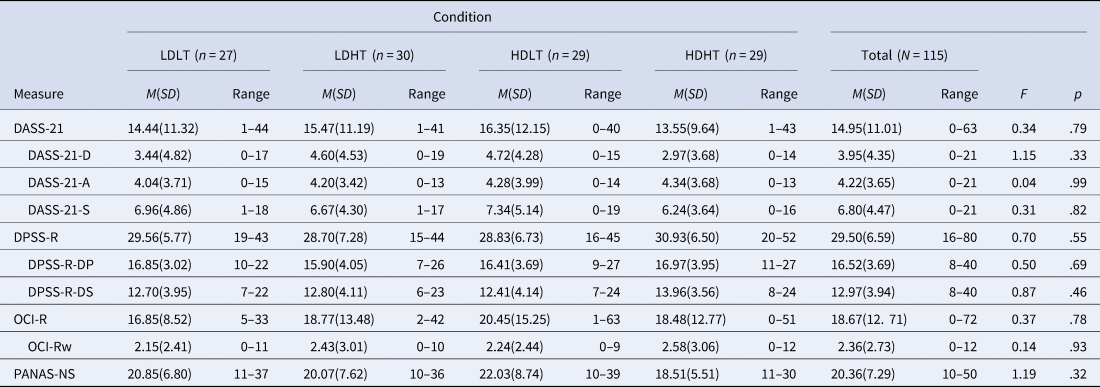
The results of 10 one-way ANOVAs indicated there were no significant differences in the mean scores of any of the questionnaires or their subscales across the four conditions. Results are shown in Table 2.
Descriptive Statistics and Tests of Equivalence Across Conditions for Clinical Questionnaire Measures

Note: DASS-21 = Depression, Anxiety and Stress Scale-21 Item Revised; DASS-21-D = DASS-21 Depression subscale; DASS-21-A = DASS-21 Anxiety subscale; DASS-21-S = DASS-21-Stress subscale; DPSS-R = Disgust Propensity and Sensitivity Scale-Revised; DP = Disgust Propensity subscale; DS = Disgust Sensitivity subscale; PANAS-NS = Positive and Negative Affect Scale-Negative subscale; M = mean; SD = standard deviation.
Descriptive statistics for BAT variables
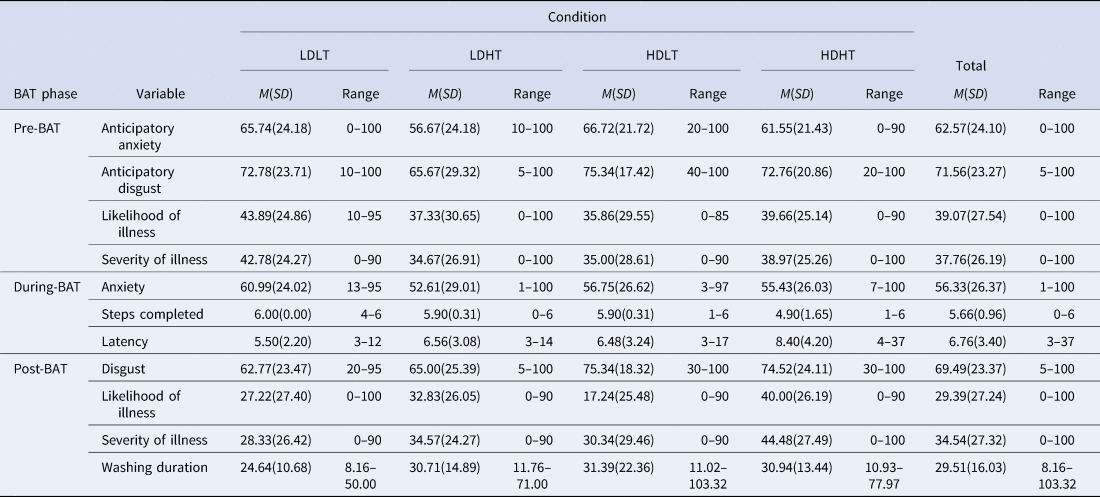
Relevant means, standard deviations, and ranges for BAT variables are presented in Table 3.
Descriptive Statistics for BAT Variables

Note: LDLT = low-disgust/low-threat; LDHT = low-disgust/high-threat; HDLT = high-disgust/low-threat; HDHT = high disgust/high-threat; BAT = Behavioural Avoidance Task; M = mean; SD = standard deviation; All variables were measured on visual analogue scales except steps completed which was the number of steps completed and latency which was measured in seconds.
Manipulation checks
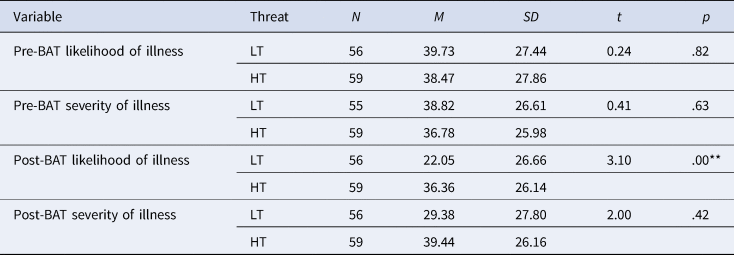
All participants were asked if they had been bothered by an odour. A one-way ANOVA revealed that participants in the high-disgust conditions (M = 40.86, SD = 19.22) were significantly more bothered by a smell than those in the low-disgust conditions (M = 4.30, SD = 12.73), F(1, 115) = 144.15, p < .001. In addition, a one-way ANOVA revealed that there was a significant difference in disgust ratings for participants in the high-disgust (M = 74.93, SD = 3.02) compared with the low-disgust (M = 63.89, SD = 3.05) conditions averaged over threat F(2, 111) = 6.62, p = .011. To establish the efficacy of the threat induction, the differences in threat estimations before and after the threat manipulation were compared. A series of four independent samples t-tests revealed that prior to the threat manipulation, mean ratings of the likelihood and severity of illness were not significantly different across the high and low-threat groups. However, after the manipulation, a significant difference between groups was found (see Table 4). This result was largely due to the low-threat conditions reduced threat likelihood estimations. Given these results, the threat manipulation was considered successful as it had created two distinct groups (i.e., high and low-threat) of participants that differed significantly in responses to threat likelihood estimations.
Results of Threat Estimation Comparisons Before and After the Threat Manipulation

Note: BAT = Behavioural Avoidance Task; LT = low-threat; HT = high-threat; N = number of observations; SD = standard deviation; M = mean; ** p <.01.
Main Analysis
Bivariate correlations
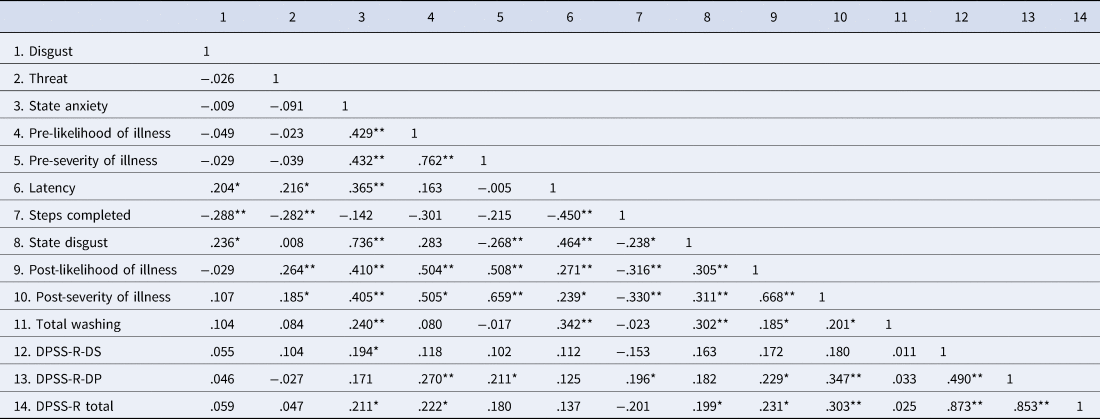
Correlational analysis was conducted to assess the relationships between variables of interest and measures and is shown in Table 5. Avoidance behaviour (i.e., latency and steps completed) was significantly correlated with both disgust and threat variables. In addition, a significant positive correlation with threat and likelihood of illness post-BAT was found. For the measure of disgust, the DP subscale of the DPSS-R was significantly negatively correlated to the avoidant behaviour measure of steps completed, indicating that higher scores on the DP subscale were related to the completion of fewer BAT steps. DP was also significantly correlated to threat estimations of likelihood and severity of illness before and after the BAT, indicating higher scores on the DP were associated with higher threat estimations. State anxiety was the only outcome variable demonstrating a significant correlation with the DS subscale.
Zero-Order Correlations Between the Dependent and Independent Variables and Clinical Disgust Measures

Note: *Correlation is significant at the 0.05 level (two-tailed); **Correlation is significant at the 0.01 level (two-tailed); BAT = Behavioural Avoidance Task; Post = Post-BAT; Pre = Pre-BAT; DPSS-R = Disgust Propensity and Sensitivity Scale-Revised; DPSS-R-DS = DPSS-R-Disgust Sensitivity; DPSS-R-Disgust Propensity.
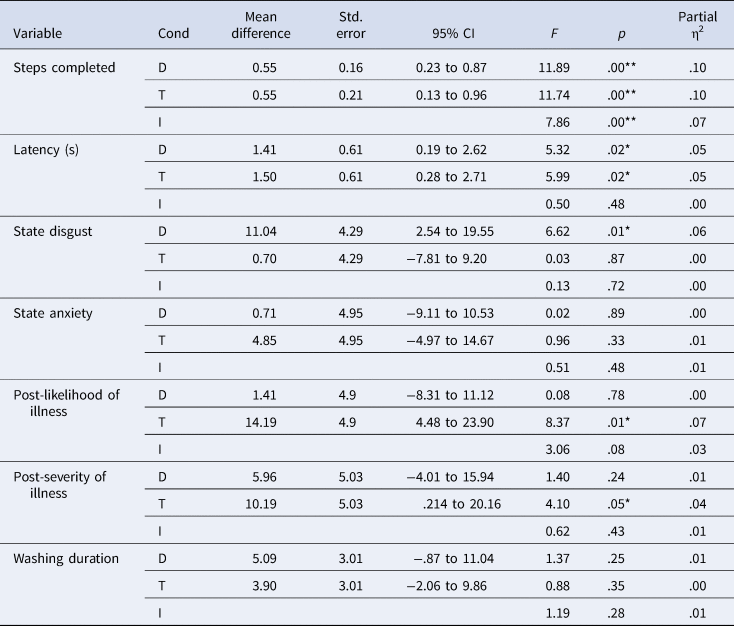
A series of seven, two-way ANOVAs were conducted to investigate hypotheses 1–3. The analyses concerned the disgust and threat conditions and outcome variables of interest, as well as any potential interactions. The outcome variables were avoidance behaviour (i.e., steps completed and latency), state anxiety, state disgust, threat estimations of likelihood and severity of illness after the BAT, as well as washing duration. Bonferroni adjustments were made for multiple comparisons, and results are shown in Table 6.
Results of Two-Way ANOVAs with Outcome Variables of Interest

Note: N = 115: D = disgust condition; T = threat condition; I = interaction; s = measured in seconds; Post = Post Behavioural Avoidance Task; CI = confidence interval; partial η2 = Partial Eta squared; Std. Error = standard error; *p<.05; **p<.01.
Avoidance Behaviour
Steps completed
The results of a two-way ANOVA revealed that those in the low-disgust conditions completed significantly more steps than those in the high-disgust conditions averaged over threat conditions F(1, 111) = 11.89, p < .01, partial η2 = .10.
Additionally, participants in the low-threat conditions completed significantly more steps than those in the high-threat conditions, averaged over disgust F(1, 111) = 11.74, p < .01, partial η2 = .10. A significant interaction effect was also found, F(1, 111) = 7.86, p < .01, partial η2 = .07. After testing for simple main effects for participants in the high-disgust conditions, those in the low-threat conditions were able to complete on average 1.00 more step, 95% CI (0.55, 1.45) than those in the high-threat conditions F(1,111) = 19.609, p < .01, partial η2 = .15.
Average latency
A two-way ANOVA showed that participants in the high-disgust conditions on average took significantly longer to begin tasks than the participants in the low-disgust conditions, F(1, 111) = 5.32, p = .02, partial η2 = .05. The main effect for threat was also significant, with participants in the high-threat conditions taking significantly longer than those in the low-threat conditions, on average, to begin a task F(1, 111) = 5.99, p = .02, partial η2 = .05. However, the interaction effect was not statistically significant, F(2, 111) = 0.50, p = .48, partial η2 = .004.
State Disgust
Participants in the high-disgust conditions reported feeling significantly more disgusted, on average, than those in the low-disgust conditions, F(1, 111) = 6.62, p = .01, partial η2 = .06. Whilst participants in the high-threat conditions reported feeling more disgusted than those in the low-threat conditions, on average, the difference between the two groups was not statistically significant, F(1, 111) = 0.03, p = .87, partial η2 < .01. The interaction effect was also not statistically significant, F(1, 111) = 0.126, p = .72, partial η2 < .01.
Threat Estimations Post-BAT
Likelihood of illness
Participants in the high-disgust conditions did not report significantly higher likelihood of illness ratings on average than those in the low-disgust conditions, F(1,111) = 0.08, p = .78, partial η2 < .01. However, participants in the high-threat conditions reported significantly higher likelihood of illness than those in the low-threat conditions, F(1, 111) = 8.37, p = .01, partial η2 = .07. The interaction effect was not statistically significant, F(1, 111) = 3.06, p = .08, partial η2 < .03.
Severity of illness
Participants in the high-disgust conditions did not report significantly higher ratings concerning the severity of illness on average than those in the low-disgust conditions, F(1, 111) = 1.40, p = .24, partial η2 = .01. However, participants in the high-threat conditions did report significantly higher ratings concerning the severity of illness on average than those in the low-disgust conditions, F(1, 111) = 4.10, p < .05, partial η2 = .04. However, the interaction effect was not statistically significant, F(1, 111) = 0.62, p = .43, partial η2 < .01. The remaining results were statistically non-significant.
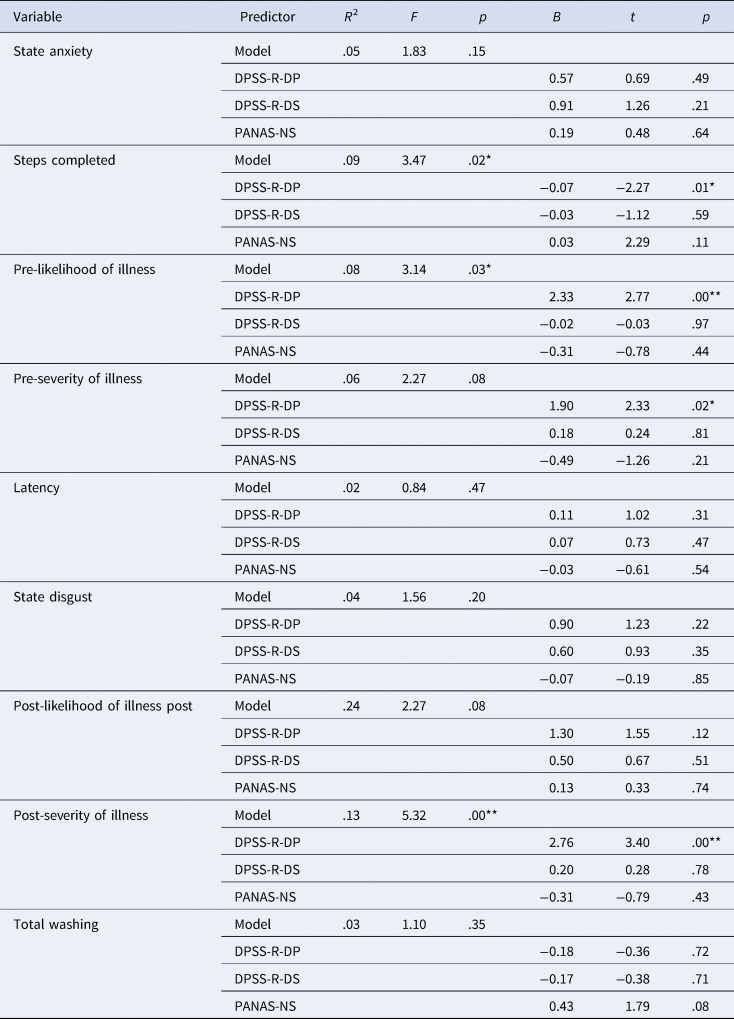
A series of seven standard multiple regressions were conducted to assess the ability of the subscales of the DPSS-R (i.e., the Disgust Propensity & Disgust Sensitivity) to predict relevant outcome measures. In order to control for negative affect, the PANAS-NS was also included in the model.
Testing of regression assumptions
The Durbin–Watson test was used to establish the independence of residuals at a value approximating 2. Homoscedasticity of variance and the assumption of linearity were established by a visual inspection of the plots of studentised residuals versus unstandardised predicted values for the relevant dependent variables.
Multicollinearity was assessed by checking the Pearson correlation coefficients between variables were all below .70. The analysis of the collinearity statistic indicated there was no multicollinearity present as VIF scores were all well below 5. Cook's distance was assessed with all scores below 1, indicating the absence of any excessively influential cases. Finally, a visual inspection of histograms and Q–Q plots of the studentised residuals was performed to check for normality of the residuals. There were some non-normal distributions detected; however, regression analysis is robust to violations of normality (Field, Reference Field2013; Williams, Gomez Grajales, & Kurkiewicz, Reference Williams, Gomez Grajales and Kurkiewicz2013). The predictor variables were scores on the DPSS-R-DP, DPSS-R-DS, and PANAS-NS, and the results of the analysis including regression coefficients and standard errors are reported in Table 7.
Results of Multiple Linear Regressions on Relevant Outcome Variables

Note: N = 115; DPSS-R = Disgust Propensity and Sensitivity Scale-Revised; DP = Disgust Propensity; DS = Disgust Sensitivity; PANAS-NS = Positive and Negative Attitude Scale-Negative Scale; Post = Post-BAT; Pre = Pre-BAT. *= p<.05; ** = p<.001.
Steps completed
The overall regression model for steps completed was statistically significant with the predictor variables accounting for 8.6% of the variance in the number of steps completed, R 2 = .09, F(3, 111) = 3.47, p = .02. The predicted number of steps completed was 6.50 − 0.07(DP score) − 0.03(DS score) + 0.03(PANAS-NS score). Participants completed 0.07 less steps for every unit increase in DPSS-R-DP scores, which was statistically significant. Participants also completed 0.03 less steps for every unit increase in DPSS-R-DS score which was non-significant. Participants completed 0.03 more steps for every unit increase on the PANAS-NS which was statistically non-significant.
Pre-BAT likelihood of illness
The overall regression model was statistically significant with the predictor variables accounting for 7.8% of the variance in the likelihood of illness predicted pre-BAT, R 2 = .08, F(3, 111) = 3.14, p = .03. Participant's predicted ratings of likelihood of illness pre-BAT was 7.28 + 2.33(DP score) − 0.02(DS score) − 0.31(PANAS-NS score). Participants rated the likelihood of illness 2.33 units higher for every unit increase in DPSS-R-DP scores, which was statistically significant. Neither the DPSS-R-DS nor the PANAS-NS predictors were statistically significant.
Post-BAT severity of illness
The overall regression model was statistically significant, with the predictor variables accounting for 12.6% of the variance in the severity of illness predicted post-BAT, R 2 = .13, F(3, 111) = 5.32, p < .01. Participant's predicted ratings of post-BAT severity of illness was − 7.43 + 2.76(DP score) + 0.20(DS score) − 0.31(PANAS score). Participant's rated severity of illness 2.76 units higher for every unit increase in DPSS-R-D P scores, which was statistically significant. The last two predictors, the DPSS-R-DS and the PANAS-NS, were not statistically significant.
Discussion
This study aimed to build upon previous research that has investigated the role of disgust and threat in the COCD and is the first to concurrently manipulate both disgust and threat and examine the interaction between the two variables. Partial support was found for the first hypothesis. As expected, after completing the BAT participants in the high-threat conditions expressed greater threat estimations than those in the low-threat conditions. They also exhibited greater avoidance as they completed less BAT steps and took longer to begin each step, than those in the low-threat conditions. These findings are consistent with Jones and Menzies (Reference Jones and Menzies1998a) and MacDonald and Jones (Reference MacDonald and Jones2015) who demonstrated that experimentally increasing threat expectancy resulted in significantly greater threat estimates and BAT avoidance. However, contrary to Jones and Menzies (Reference Jones and Menzies1998a), no significant differences were found between the high-threat and low-threat conditions for level of anxiety reported during the BAT. We suggest that the design of the BAT employed in the current study could account for this. It has previously been recognised that a hierarchically structured BAT in which the steps increase in intensity can elicit little anxiety (Deacon & Olatunji, Reference Deacon and Olatunji2007). While Jones and Menzies (Reference Jones and Menzies1998a) and MacDonald and Jones (Reference MacDonald and Jones2015) employed a single consistent BAT stimulus, the BAT employed in the current study encompassed a series of separate graduated BAT steps.
Additionally, no significant differences were found between the high-threat and low-threat conditions for washing duration at post-BAT. While this finding was unexpected and inconsistent with Jones and Menzies (Reference Jones and Menzies1998a), it could be understood by possible environmental constraints in the study, or the ethnic heterogeneity of the sample. The overall mean washing duration of 30 s observed in the current study was much lower than post-BAT washing durations reported in other studies. Thorpe et al. (Reference Thorpe, Barnett, Friend and Nottingham2011) used a non-clinical sample and reported an overall mean washing time of 131.90 s, and Jones and Menzies (Reference Jones and Menzies1997a) employed a clinical sample and reported a mean washing duration of 90.71 s. The relatively low handwashing duration may lie in the ethnic background of the participants. In the current study, 31% of participants indicated they were of Chinese heritage. Other studies that have shown longer washing duration, had overwhelmingly ethnically homogenous samples (97% ‘White British’; Thorpe et al., Reference Thorpe, Barnett, Friend and Nottingham2011). While still only in the foundational stages, cross-cultural research concerning OCD symptoms in samples from mainland China indicate that the importance of interpersonal harmony may lead individuals to suppress washing behaviour, especially in public (Li, Marques, Hinton, Wang, & Xiao, Reference Li, Marques, Hinton, Wang and Xiao2009). This may have led to the shorter mean washing duration observed in the current study since participants were asked to move from the laboratory post-BAT to an adjacent corridor, so they could wash their hands in the kitchen sink. The open nature of the kitchen and its location along a corridor meant that the possibility of being observed by others, or thoughts about others wanting to use the sink could have decreased the time spent washing. Future studies of this nature need to ensure that the setting the washing takes place in provides sufficient privacy. As the BAT was undertaken in the laboratory with only the researcher present, the number of steps completed or task latency were not likely to have been similarly inhibited.
Consistent with the second hypothesis, participants in the high-disgust conditions endorsed higher ratings of disgust, completed significantly less BAT steps, and took significantly longer to begin a step than those in the low-disgust conditions. This is consistent with findings by MacDonald and Jones (Reference MacDonald and Jones2015), who reported that after adding a disgusting smell to the BAT, participants were more likely to avoid the BAT than those who were not exposed to the smell. The finding that heightened disgust increases latency is consistent with research into attentional latency that suggests delays in responding provide an opportunity for emotion regulation and decision-making (Cisler & Koster, Reference Cisler and Koster2010). Thus, as the BAT steps became more difficult, participants in the high-disgust conditions required more time to control negative feelings of discomfort before they could begin the task. These findings were also in line with the disease-avoidance model which posits that disgust motivates individuals to avoid potential contamination (Matchett & Davey, Reference Matchett and Davey1991; Woody & Teachman, Reference Woody and Teachman2000).
However, handwashing duration was not significantly different between those in the high and low-disgust conditions. While washing duration was significantly correlated with state disgust, participants in the high-disgust conditions did not wash for significantly longer than those in the low-disgust conditions. These findings were inconsistent with the extant evidence of a predictive relationship between disgust and washing behaviour (Athey et al., Reference Athey, Elias, Crosby, Jenike, Pope and Hudson2015; Olatunji et al., Reference Olatunji, Cisler, McKay and Phillips2010). As discussed earlier, we propose that the setting where the handwashing took place and the characteristics of the sample may explain the non-significant results obtained for post-BAT handwashing duration between the high-disgust and low-disgust conditions.
For the third hypothesis, the interaction effect of high-threat and high-disgust was expected to result in higher anxiety, disgust, behavioural avoidance, and washing duration for participants in the high-threat/high-disgust condition, compared with those in the other three conditions (i.e., high-threat/low-disgust, low-threat/high-disgust, and low-threat/low-disgust). There was partial support for this hypothesis. A significant interaction effect was found between disgust and threat in predicting behavioural avoidance for the number of BAT steps completed. Participants in the high-disgust/high-threat condition completed on average one less BAT step than those in the high-disgust/low-threat condition. This finding supports correlational research that has demonstrated an interaction between disgust and threat on COCD symptoms (Cisler et al., Reference Cisler, Brady, Olatunji and Lohr2010). The results also support theoretical models that propose a contingent relationship between disgust and threat, such that the negative valence attached to disgusting stimuli only causes pathological obsessive–compulsive symptoms if cognitive distortions such as overestimation of threat are also present (Rachman, Reference Rachman2004).
Contrary to expectation, heightened threat did not interact significantly with heightened disgust to increase latency or handwashing when compared with the other conditions. Given the BAT stimulus consists of a garbage bin containing dirt, household food scraps, raw meat, and animal hair, this stimulus is likely to be already inherently disgust-inducing. Therefore, when considering an interaction, there may be a ceiling effect. If participants are already disgusted by the BAT, increasing threat may not elicit a difference in responding across the disgust conditions for handwashing and latency. Given the possible limitation of the setting in which the handwashing took place and the novelty of the latency measure in COCD studies, further research is required, particularly considering preliminary correlational results have shown an interaction effect such that threat potentiates the effects of disgust on COCD symptoms (Cisler et al., Reference Cisler, Brady, Olatunji and Lohr2010).
In contrast to previous findings in both non-clinical (Thorpe et al., Reference Thorpe, Barnett, Friend and Nottingham2011) and clinical samples (Olatunji et al., Reference Olatunji, Cisler, McKay and Phillips2010), trait disgust as measured by scores on the DP and DS scales of the DPSS-R (Van Overveld et al., Reference Van Overveld, de Jong, Peters, Cavanagh and Davey2006) did not predict washing duration. As this study aimed to address current limitations in the research by examining both DP and DS, while also controlling for negative affect, the non-significant findings may suggest that negative affect in general, rather than the feeling of disgust in particular, leads to longer handwashing duration. However, the result may also have been confounded by the overall low handwashing duration previously discussed. Measures of DP were found to predict the number of steps completed, but not behavioural latency. Given the aforementioned link between latency and emotion regulation and that latency may be highly related to general negative affect, controlling for this may mean measures of DP are no longer significant predictors of latency.
The final hypothesis predicted that higher ratings of DP would elicit more avoidance and disgust and higher levels of DS would elicit higher ratings of anticipated anxiety. As expected, DP, not DS significantly predicted the number of steps completed, even after controlling for negative affect. The present findings are consistent with previous research that has indicated DP, not DS, plays a causal role in task avoidance for individuals with COCD (Deacon & Olatunji, Reference Deacon and Olatunji2007; Olatunji et al., Reference Olatunji, Cisler, Deacon, Connolly and Lohr2007). These results also support research suggesting a fundamental and phenomenological difference between the constructs assessed by the DP and DS subscales of the DPSS-R (Cavanagh & Davey, Reference Cavanagh and Davey2000; Olatunji & Cisler, Reference Olatunji and Cisler2009). For example, DS has been linked to a general anxiety sensitivity and DP to avoidance behaviour (Knowles et al., Reference Knowles, Jessup and Olatunji2018).
While DS was significantly associated with state anxiety, after controlling for negative affect, heightened DS no longer significantly predicted higher levels of state anxiety. This result may be due to a failure in specificity of the DS to measure anxiety when controlling for negative affect (Goetz, Lee, Cougle, & Turkel, Reference Goetz, Lee, Cougle and Turkel2013). This finding is consistent with the findings from other studies examining DS where negative affect has been controlled for (Fan & Olatunji, Reference Fan and Olatunji2013; Travis & Fergus, Reference Travis and Fergus2015).
In regard to the interplay between disgust and threat, after controlling for negative affect and consistent with previous research (Thorpe et al., Reference Thorpe, Barnett, Friend and Nottingham2011), higher DP predicted post-BAT ratings of the severity of a potential illness, but not the likelihood of illness. These findings support previous research that suggests an expectancy bias for individuals high in DP, indicating they anticipate a more severe consequence of contamination than those low in DP and that this rating is higher after contact with a disgusting stimulus (Knowles et al., Reference Knowles, Jessup and Olatunji2018; Thorpe et al., Reference Thorpe, Barnett, Friend and Nottingham2011). These results provide compelling evidence of the salience of threat estimations concerning the severity of contamination in eliciting obsessive–compulsive symptoms.
The current study was the first to concurrently manipulate both disgust and threat and examine the interaction between the two variables in COCD. The study overcame methodological limitations identified in earlier research, for example in the MacDonald and Jones (Reference MacDonald and Jones2015) study, there was a relatively high number of participants who refused to engage with the BAT. Utilising a BAT with a hierarchical stepped structure (Cougle et al., 2007) meant enhanced engagement with the stimulus and that all participants were able to complete at least one step. Additionally, the multi-measure design included the objective observation of behaviour which ensured that the study was largely unaffected by the limitations inherent in employing only self-report measures (Cisler et al., Reference Cisler, Brady, Olatunji and Lohr2010). The study also used behavioural latency as an additional measure of avoidance. Avoidance is a key symptom of COCD, and theoretical models suggest it may develop because of latent inhibition (Merckelbach, de Jong, Arntz, & Schouten, Reference Merckelbach, de Jong, Arntz and Schouten1993). By avoiding disgusting stimuli, individuals fail to establish a realistic assessment as to the likelihood and severity of potential contamination, this makes extinction difficult and maintains the maladaptive fear. As such, gaining a better understanding of behavioural latency could prove an important new direction for future research.
Overall, the results support previous research demonstrating that disgust and threat mechanisms play important roles in COCD symptoms, particularly regarding behavioural avoidance. However, support for an interaction effect between disgust and threat that may potentiate COCD symptoms requires further research. While handwashing was not found to be significantly different between the high and low-disgust conditions or the high and low-threat conditions, the overall low mean washing duration of 30 s may account for these results. There were also no significant differences in the level of anxiety for participants in the high-threat compared with the low-threat conditions. It is likely that anxiety remained relatively low across conditions as a result of the graduated BAT structure.
Future research should ensure that BATs are sufficiently anxiety provoking and washing is able to occur in an appropriately private location. Additionally, 115 participants took part in the current study. This was below the minimum sample of 128 participants that our a priori power analysis revealed was required, therefore researchers should endeavour to recruit an appropriately large number of participants in future studies of this kind. Finally, the study employed a non-clinical sample. No OCD symptom pre-screening was conducted, instead participants were recruited from the overall cohort of undergraduate students enrolled in first-or-second year psychology units. The mean score of 18.67 on the Obsessive–Compulsive Inventory-Revised (Foa et al., Reference Foa, Huppert, Leiberg, Langner, Kichic, Hajcak and Salkovskis2002) for the sample was below the recommended clinical cut-off score of 21 that indicates the likely presence of OCD. Therefore, conducting future studies of this kind with sufficiently large clinical OCD samples to test the generalisabilty and robustness of these findings is warranted.
Funding
This research received no specific grant from any funding agency, commercial or not-for-profit sectors.
Declaration of interest
None.
Ethical standards
The authors assert that all procedures contributing to this work comply with the ethical standards of the relevant national and institutional committees on human experimentation and with the Helsinki Declaration of 1975, as revised in 2008.