Introduction
The efficient exploitation of plant genetic resources is of utmost concern for agricultural production and for societies in general, as they represent the raw material of future elite cultivars and serve as an indicator of agricultural sustainability (Gepts, Reference Gepts2006). Seeds are the primary means of delivering the potential of plant genetic resources; thus, maintaining seed quality is of utmost importance. Seed quality is commonly referred to as the avoidance of the physiological causes affecting seed vigour and germination. This paper highlights the existence of and the means to deal with an overlooked genetic cause of seed degradation due to the hidden negative correlation between yielding and competitive ability, which favours the gradual proliferation of low yielding, strong competing plants (yC) at the expense of high yielding, weak competing ones (Yc), when seeds are propagated under dense stands.
Materials and methods
The starting material for selection was breeder's seed of a well-known local barley variety, cv. Athenaida, long maintained as a pure line and registered in the Cyprus national variety catalogue. In 2007–08, a nonreplicated honeycomb trial (Fasoulas and Fasoula, Reference Fasoulas and Fasoula1995) of 600 plants was established at the Athalassa experimental station, with 1 m plant-to-plant distance, excluding interplant competition. Standard agronomic practices were followed during the growing season. In 2008–09, seeds from six superior plants, representing six entries (families), along with seed from the control (original seed of cv. Athenaida) as the seventh, were grown in a replicated R7 honeycomb trial (Fasoulas and Fasoula, Reference Fasoulas and Fasoula1995) with 50 replications/family, summing up to a total of 350 plants. Seed from the ten best plants from each of the two superior families, selected on the basis of selection equation A (Fasoula, Reference Fasoula, Prohens and Badenes2008), were advanced as lines in 2009–10 and tested in a randomized complete block (RCB) trial.

where x is the yield in grams/plant and  the average yield of a representative sample of surrounding plants (Supplementary Fig. S1, available online only at http://journals.cambridge.org). These plants, forming circular moving complete replicates, serve as a common denominator that erases the masking effect of soil heterogeneity on single plant yields, while
 and s are the mean and standard deviation of the entry to which each plant belongs. The stability parameter
 , termed coefficient of homeostasis (Fasoula, Reference Fasoula, Prohens and Badenes2008), converts the plant yield potential into crop yield potential (Supplementary Fig. S2, available online only at http://journals.cambridge.org). The plants in the 2009–10 RCB trials involving the two higher yielding of the six lines on the basis of equation A, along with the control (original seed of cv. Athenaida), were grown in two locations (Athalassa and Zygi), in a four-row plots of 4 m long, with four replications. The two central rows of each plot were harvested.
Results and discussion
The negative correlation between yielding and competitive ability
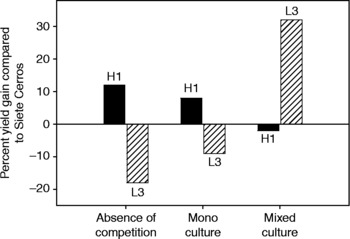
In an important earlier piece of work, Kyriakou and Fasoulas (Reference Kyriakou and Fasoulas1985), selecting in a rye population in the presence (15 cm) and absence (90 cm) of interplant competition, demonstrated that selection was effective in the absence of competition and ineffective in its presence. They hypothesized a strong negative correlation between yielding and competitive ability. In a systematic study of the correlation between yielding and competitive ability in wheat, Fasoula (Reference Fasoula1990) measured this correlation and found it to be high and negative r = − 0.94. As shown in Fig. 1, honeycomb selection within the soft wheat cultivar Siete Cerros for high (H) and low (L) yield in the absence of competition, resulted in the isolation of H-lines outyielding the L-lines in monoculture, but lagging behind the L-lines in mixed stand with Siete Cerros. The occurrence of Yc and yC plants within Siete Cerros demonstrated that the traditional propagation under dense stand led to a gradual degeneration of the cultivar, due to the preferential proliferation of the yC types at the expense of the Yc ones; hence the inability to efficiently select for yield under dense stand and the gradual cultivar degeneration.
Percent yield of the derived lines H1 and L3 compared to the original Siete Cerros in three conditions: (1) absence of competition, (2) monoculture and (3) mixed culture with Siete Cerros. Line H1, selected as a Yc, outperforms both Siete Cerros and L3 under conditions 1 and 2. Conversely, line L3, selected as a yC, outperforms Siete Cerros and H1 under condition 3 only (based on data from Fasoula, Reference Fasoula1990).

With competitive ability defined as the ability to gain a growth advantage over other plants by interfering with the equal sharing of growth resources, the negative correlation between yielding and competitive ability represents both an invisible cause of cultivar degradation and the principal reason hindering the response to selection for yield on a single plant basis under competition (Fasoula and Fasoula, Reference Fasoula and Fasoula1997). This helps to distinguish between the undesirable competitive ability and the desirable attribute of the sometimes called ‘competitive ability against weeds’, also called ‘weed tolerance’ or ‘weed suppression ability’. As a hidden cause of seed and variety degeneration and a detriment to the efficient response to selection, this negative correlation may further explain the eloquently described by Zeven (Reference Zeven1999) practice of ‘inexplicable’ seed replacement among traditional farmers.
Necessity of and means for nonstop selection – a novel selection equation
The development of the selection equation (Fasoula, Reference Fasoula, Prohens and Badenes2008) used in this study is a new addition in the breeders' toolbox. The results of the 2009–10 RCB trials (Table 1) show line 2 to outyield the original barley cultivar 2.5 times on the average, across both sites. Using the equation A, all plants in the trial are assigned a unitless equation value, ranked on the basis of their crop yield potential. All plants have equal opportunities to be selected, effectively eliminating the masking effects of soil fertility that interfere with selection efficiency (Supplementary Figs. S1 and S2, available online only at http://journals.cambridge.org). This permits the application of very high selection pressures (1–0.5%), leading to the reliable isolation of top yielding plants and to the corresponding increase of progress through selection.
Yield of the two central rows of the selected lines in % of the control (cv. Athenaida) in RCB trials in two locationsa

a The 100% mean yield of the control corresponds to 1213 g in location Athalassa and to 1688 g in location Zygi. Means with different letters differ significantly at the 5% level.
In order to effectively exploit the capacity of crops to gradually build up resistance to abiotic and biotic stresses and keep ahead of mutating pathogens, constant ‘nonstop selection’ (Fasoula and Fasoula, Reference Fasoula and Fasoula2000) for high and stable crop yield in the absence of competition is an important and necessary step. The process of nonstop selection, greatly enhanced by the use of equation A, is leading to the development of density-neutral cultivars, i.e. to cultivars that yield optimally over a wide range of plant densities, possessing also the ability to reduce the number of competitive weeds. Relevant data confirming the efficiency of nonstop selection in terms of developing resistance to soil pathogens are reported by Fasoulas (Reference Fasoulas and Gillham2000) in cotton. As to the perennial significance of the efforts to keep pace with the mutating pathogens, it is of interest to consider the recent call by Borlaug (Reference Borlaug2008) for a pulling together of the world's scientists to develop a new generation of resistant wheat varieties in order to avoid catastrophes from epidemics, aptly remarking that diseases and pests never sleep.
General conclusions
The invisible cause of seed and variety degradation due to the negative correlation between yielding and competitive ability is counteracted by nonstop selection at ultra-wide plant spacings on the basis of equation A. Furthermore, the process of nonstop selection effectively exploits the capacity of plant genetic resources to steadily release adaptive variation through the endogenous mechanisms of the genome in response to environmental stimuli, ensuring continuous progress through selection.