Introduction
Dietary habits are strongly influenced by gender attitudes and behaviours, and these habits, in turn, promote differential disease risks between men and women (Vari et al., Reference Vari, Schazzocchio, D’Amore, Giovannini, Gessani and Masella2016). Gender-specific attitudes and behaviours towards eating are often reflected in their food intake patterns. For instance, the consumption of red meat and larger portions is often associated with masculinity, while the consumption of vegetables, fruit, fish and dairy products such as yoghurt and cottage cheese tend to be associated with femininity (Wardle et al., Reference Wardle, Parmenter and Waller2000; Arganini et al., Reference Arganini, Saba and Comitato2012; Vartanian, Reference Vartanian2015; Alkazemi, Reference Alkazemi2018). Women tend to engage in more health-promoting behaviours and have healthier lifestyle patterns than men (Vari et al. Reference Vari, Schazzocchio, D’Amore, Giovannini, Gessani and Masella2016). The literature also shows that women show more dietary restraint and higher disinhibition levels than men (Leblanc et al. Reference Leblanc, Begin, Corneau, Dodin and Lemieux2015). Evidence from the US and Europe indicates that there is a tendency for women to consume more fruit and vegetables, legumes and whole foods, while men tend to consume more sweets and cakes (Masella, Reference Masella2017). In general, there is a tendency for men to eat food rich in fats and proteins, and to drink more wine, beer, spirits and sweet carbonated drinks – behaviours that increase the risk of overweight and obesity (Masella, Reference Masella2017). Young people in particular, irrespective of their gender, often have unhealthy dietary habits, such as the non-consumption of the recommended five or more servings of fruit and vegetables every day, consumption of little milk and dairy products, skipping meals and frequently eating energy-dense nutrient-poor fast- and ready-to-eat foods (Lowry, Reference Lowry, Galuska, Fulton, Wechsler, Kann and Collins2000; Malinauskas, Reference Malinauskas, Raedeke, Aeby, Smith and Dallas2006).
There is plenty of evidence that lifestyle is a key determinant of health, with an unhealthy diet, insufficient physical activity, heavy alcohol consumption and tobacco use being key risk factors (Vari et al., Reference Vari, Schazzocchio, D’Amore, Giovannini, Gessani and Masella2016, Reference Vari, Schazzocchio and Papa2017). Analysis of high-risk behaviours indicates gender differences in the patterns of unhealthy lifestyles due to differences in men’s and women’s attitudes and behaviours (Varela-Mato et al., Reference Varela-Mato, Cancela, Ayan, Martin and Molina2012; Jovicic, Reference Jovicic2015). Women tend to consume more fruit and vegetables and to have more interest in healthy diets and a desire to eat food lower in energy than men (Rolls et al., Reference Rolls, Fedoroff and Guthrie1991; Fagerli & Wandel, Reference Fagerli and Wandel1999). Males have a tendency to ‘eat anything to fulfil their hunger’ (Devine & Olson, Reference Devine and Olson1991) and eat fast food and large quantities of food (Donkin et al., Reference Donkin, Johnson and Lilley1998). Other studies have shown that students in the USA and Sweden, regardless of gender, generally show sufficient knowledge of what a ‘healthy diet’ means, with girls appearing to be more willing to make positive changes in nutrition and physical activity levels to improve their lifestyle (von Bothmer & Fridlund, Reference von Bothmer and Fridlund2005; Livingstone Reference Livingstone, Saafir and Manuel2012; Yahia et al., Reference Yahia, Wang, Rapley and Dey2015). The burden of non-communicable diseases (NCDs) is not only unequally distributed among different social classes, but also shows variation by gender (Diez-roux et al., Reference Diez-roux, Link and Borthridge2000; Torun et al., Reference Torun, Stein, Schroeder, Grajeda, Conlisk and Rodriguez2002; Adhikari, Reference Adhikari2014).
Studies in Western countries show gender differences in food consumption, nutrient intake and attitudes towards food (Prattala et al., Reference Prattala, Paalanen, Grinberga, Helasoja, Kasmel and Petkeviciene2006). Women are more concerned about a healthy diet and more often classify food according to its assumed nutrient content than men (Fagerli & Wandel, Reference Fagerli and Wandel1999; Rozin et al., Reference Rozin, Fischler and Imada1999). Women do not only take more care of their diet, but also of their food choices and the health of their families (Monge-Rojas et al., Reference Monge-Rojas, Fuster-Baraona, Garita, Sanchez, Castro-Smith, Valverde-Cerros and Colon-Ramos2015; Wah, Reference Wah2016). Men tend to consume more meat, potatoes, bread and alcohol and less fruit, vegetables, fish, chicken, cheese and sweets than women in Finland and Baltic countries (Prattala, Reference Prattala, Paalanen, Grinberga, Helasoja, Kasmel and Petkeviciene2006).
Men and women have biological/physiological differences and have different levels of exposure and vulnerabilities to the risk of NCDs. For example, the World Health Organisation (WHO) has indicated that in many low- and middle-income countries (LMICs), the lower socioeconomic, legal and political status of girls and women increases their exposure and vulnerability to the risk factors for NCDs (WHO, 2010), and that the leading cause of death for women is NCDs, accounting for 65% of all female deaths and translating into 18 million deaths each year. NCDs kill more than 36 million people annually with close to 80% of NCD deaths taking place in LMICs. Most of the annual NCD deaths (17 million people) are accounted for by cardiovascular diseases, followed by cancers (7.6 million), respiratory diseases (4.2 million) and diabetes (1.3 million) (WHO, 2012). All these diseases share four risk factors: tobacco use, physical inactivity, the harmful use of alcohol and an unhealthy diet (African Union, 2013). Most NCDs are preceded by unhealthy behaviours (behavioural risk factors), followed by the emergence of metabolic risk factors. Other risk factors, which are biochemical processes in the body’s normal functioning, include raised blood pressure, overweight/obesity, raised blood glucose and raised cholesterol (WHO, 2012).
In Botswana, studies have demonstrated gender differences in NCD prevalences and their risk factors. Keetile et al. (Reference Keetile, Navaneetham and Letamo2015) observed that, for males, the prevalence of hypertension was higher among those who were obese (31.1%) than in those who were not (8.6%). For females, hypertension also had a higher prevalence in those who were obese (29.1%) than in those who were not (15.6%). The main NCDs observed in Botswana are hypertension (14.2%), asthma (5.3%) and diabetes (3.3%) (Letamo et al., Reference Letamo, Keetile, Navaneetham and Phatsimo2016). Women in Botswana are more likely to be overweight and obese than men (Letamo, Reference Letamo2011; Keetile et al., Reference Keetile, Navaneetham, Letamo and Rakgoasi2019b), and a higher proportion of men are underweight (Letamo & Navaneetham, Reference Letamo and Navaneetham2014). A recent study of malnutrition in Botswana demonstrated that there had been a rise in the proportion of adult people who were overweight/obese and a decline in the proportion of those who were underweight (Letamo, Reference Letamo2020). The increase in overweight/obesity was much more pronounced among males than females (ibid). The key risk factors for NCDs were identified as inadequate physical activity, alcohol consumption and overweight (Keetile et al., Reference Keetile, Navaneetham, Letamo and Rakgoasi2019a). However, the gender/gender dimension of the risk factors of NCDs has not been adequately addressed.
Gender roles can affect health, and these can be modified by information, educational and communication approaches that promote healthy eating habits (Hosokawa et al., Reference Hosokawa, Ishikawa and Okada2016). There is little information on this in the context of Botswana, and most existing studies on this issue have been conducted in the US and Europe, and it is inappropriate to extrapolate these results to countries that are geographically and culturally different (Masella, Reference Masella2017). This study therefore aimed to assess gender differences in the prevalence non-communicable diseases (NCDs) and in associated health-related habits, weight status and common risk factors in Botswana. It is hoped that the information generated by this study will allow for the identification of health-related problems that can be addressed through health education programmes.
Methods
Study design
The study data were derived from the cross-sectional population-based Botswana STEPS Survey II, based on people aged 15–69 years, conducted in 2014. The survey used a multi-stage cluster sampling methodology to arrive at a nationally representative sample. A detailed report on the methodology of the Botswana STEPS Survey is available elsewhere (Republic of Botswana, 2015). This study used secondary analysis of data from this survey. Because the sampling design included more than one stage of sampling, sample weights were used to adjust for differential selection probabilities.
Sampling procedure
Since a multi-stage stratified sampling procedure was used in the 2014 Botswana STEPS Survey, the use of standard statistical methods to analyse the data would have produced unreliable estimates of the desired parameters. A complex sample module from SPSS was therefore adopted to account for the multiple stages of sampling. The target sample size for the 2014 Botswana STEPS Survey was 6410, but only 4074 individuals (age group 15–64) participated, yielding an overall response rate of 64% (Republic of Botswana, 2015). For the present study, 2549 respondents in the age group 25–64 and who answered all the relevant questions were included.
Primary and secondary NCD risk factors
The following variables were included in the analysis. Tobacco use was measured as the percentage of respondents who currently smoked any tobacco product such as cigarettes, cigars or pipes. Alcohol use was assessed using the concept of ‘standard drinks’. A standard drink is any alcoholic drink containing 10 g of pure alcohol (ethanol). Heavy alcohol consumption was defined as consuming six or more standard drinks on one occasion (males and females). Consumption of fruit and/or vegetables was assessed as number of servings. In the survey showcards were used to collect data on fruit and vegetable consumption on a typical day, and reported as the percentage of respondents who had less than five servings of fruit and/or vegetables on average per day. Physical inactivity was definded as not meeting the WHO recommendation on physical activity for health of at least 600 total physical activity metabolic equivalent minutes (MET-minutes) per week. Respondents who, in a typical week, engaged in any physical activity such as work, travel to and from places and/or recreational activities reported the number of days and the amount of time spent doing those activities. Body mass index (BMI) is the ratio of weight in kilograms divided by height in metres squared. Height was measured in centimetres in the survey, but was converted to metres during the analysis. Height was restricted to 1.0–2.7 m, while weight was restricted to 20–35 kg, as per the WHO recommendation. BMI was categorized into four groups as per WHO recommendations: underweight (BMI <18.5 kg/m2), normal (18.5 kg/m2 ≤BMI<25 kg/m2), overweight (25 kg/m2 ≤BMI<30 kg/m2) and obese (BMI ≥30 kg/m2).
The Multiple NCD risk factors variable was composed of five risk factors: daily smoking, consuming less than five servings of fruit or vegetables a day, low physical activity, high BMI (≥25 kg/m2) and arterial hypertension (SBP ≥140 mmHg or DBP ≥90 mmHg or those currently on hypertension medication). If respondents had 0 risk factors they were categorized as having low risk for developing NCDs; 1–2 risk factors meant they were at risk for developing NCDs; and 3–5 risk factors meant they were at high risk for developing NCDs.
Socio-demographic variables
The independent variables used in this study were selected based on a literature review and their availability in the 2014 Botswana STEPS survey. These included: gender, age (25–34, 35–44, 45–54 and 55–64 years), education (no education, primary, secondary and tertiary and above), nationality (Motswana or other) and work status (working or not working). Participants who described their main work status over the past year as government employee, parastatal, non-governmental employee or self-employed were classified as ‘working’ and those in unpaid work, i.e. family helper, student, homemaker/housework, retired, unemployed (able to work) and unemployed (unable to work) were classified as ‘not working’.
Statistical analysis
Separate binomial logistic regression models were used for the dichotomous variables, including tobacco use, heavy alcohol consumption, insufficient fruits and vegetable consumption, physical inactivity, hypertension, diabetes, cholesterol and angina. An ordinal logistic regression model was used for the outcome variable BMI category. A multinomial logistic regression model was used for the outcome variable with multiple risk factors categorized as three. In all the models the covariates age, gender, education and work status were included. The predicted probabilities (given in terms of percentages) for males and females were calculated to assess gender differentials. All statistical analyses were done in SPSS version 25.
Results
Socio-demographic characteristics of respondents
Table 1 presents the socio-demographic characteristics of the selected sample. Of the 2947 respondents, two-thirds were female, slightly more than a tenth had no education, about a third were aged 25–34 years, approximately 96% were Batswana and 54% were not working.
Socio-demographic characteristics of respondents, Botswana STEP Survey, 2014

Physical activity, smoking status, alcohol consumption and fruit and vegetable consumption of respondents
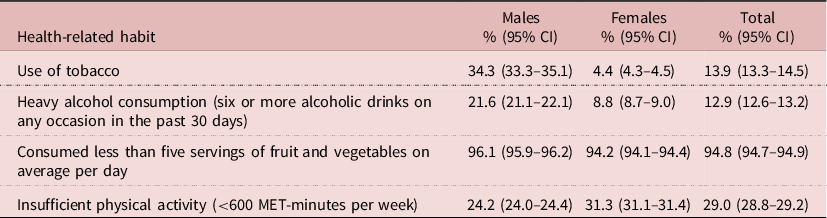
Table 2 shows the predicted probabilities of tobacco use, heavy alcohol consumption, insufficient fruit and vegetable consumption and physical inactivity of the respondents by gender. Tobacco use was statistically different between males and females: 34.3% (95% CI: 33.3–35.1) and 4.4% (95% CI: 4.3–4.5), respectively. Males tended to engage more in heavy alcohol consumption than did females (21.6% vs 8.8%, respectively), and this was statistically significant. Also, on average, a majority of respondents of both genders did not consume sufficient fruit and/or vegetables per day: 96.1% for males and 94.2% for females. About 31.3% of females compared with 24.2% of males had insufficient physical activity (less than 600 MET-minutes per week). This was statistically significant at a 95% level of confidence.
Predicted probabilities (%) of tobacco use, heavy alcohol consumption, insufficient fruit and vegetable consumption and insufficient physical inactivity by gender, Botswana, 2014

Predicted probabilities were derived for each outcome variable using the binary logistic regression model controlling for age, gender, education and work status.
BMI by gender
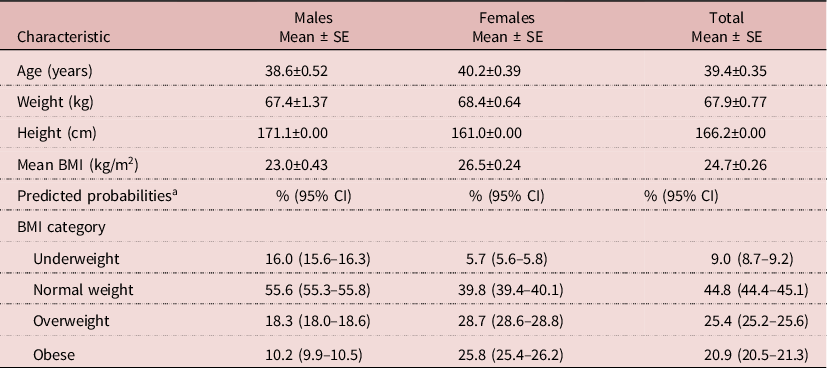
Table 3 presents the predicted probabilities of respondents’ weight status, based on their BMI classification, by gender. Females tended to be heavier than their male counterparts, as indicated by their overall mean BMI: 27 kg/m2 for females compared with 23 kg/m2 for males. About 29% of females were overweight compared with 18% of males, and 26% of females were obese compared with only 10% of males. Overall, about 55% of females were overweight or obese compared with only 29% of males.
Weight status of respondents by gender, Botswana 2014

BMI=Body mass index; SE=Standard error; CI=Confidence interval.
a Predicted probabilities were derived for the BMI outcome variable using the ordinal logistic regression model controlling for age, gender, education and work status.
Prevalence of combined NCD risk factors by gender
Table 4 shows the respondents’ predicted probabilities of being exposed to selected common risk factors for NCDs by gender. Only 3.5% of the respondents had no common NCD risk factors and no gender difference in this was evident. Approximately 28% of males had 3–5 of the common risk factors compared with 32.2% of females, and this gender difference was statistically significant at the 95% level of confidence.
Predicted probabilities (%) of respondents having multiple NCD risk factors by gender, Botswana, 2014

Common NCD risk factors included: current daily smokers; consuming less than five servings of fruit and/or vegetables per day; low level of physical activity; overweight (BMI >25 kg/m2); and raised BP (SBP >140 and/or DBP >90 mmHg or currently on medication for raised BP). Predicted probabilities were derived for multiple risk factor outcome variables using a multinomial logistic regression model controlling for age, gender, education and work status.
Prevalence of NCDs by gender
Non-communicable diseases are quite prevalent in Botswana, with hypertension being the most frequently reported. The problem of NCDs appears to be more prevalent among females than males (Table 5). A higher proportion of females than males reported having hypertension (39.5%, 95% CI: 38.9–40.0 vs 26.1, 95% CI: 25.5–26.8). About 8% of respondents reported having diabetes, with no difference by gender. The high cholesterol prevalence was reported more by females than males (21.3% vs 15.6%, respectively). However, all gender differentials were not statistically significant, except for hypertension.
Predicted probabilities (%) of respondents having selected NCDs by gender, Botswana, 2014

Predicted probabilities were derived for each outcome variable using a binary logistic regression model controlling for age, gender, education and work status.
Discussion
This study aimed to assess the gender differences in the prevalences of health-related habits, weight status and common NCD risk factors, and prevalence of NCDs, among adults aged 25–64 years in Botswana. The results indicated that dietary behaviours, malnutrition, a combination of common NCD risk factors and the prevalence of NCDs differed by gender. Of the four selected common NCD risk factors studied, men tended to use tobacco more than women and this finding was statistically significant. This possibly emanates from the societal acceptance that it is ‘cool’ for men to use tobacco, but not women. However, the WHO reports that tobacco use among women is increasing in some countries.
Males in Botswana tended to report higher levels of alcohol consumption compared with their female counterparts. However, there were no gender differentials in fruit and/or vegetable consumption. A large proportion of Botswana’s population barely consume sufficient fruit and/or vegetables, and therefore there was less variability by gender. The WHO recommends the consumption of at least five servings of fruit and/or vegetables on average per day, and the current study showed that fruit and/or vegetable consumption is low in Botswana. Gender differences in dietary behaviours have been documented in other studies. For instance, studies from numerous countries have shown that women eat more fruit, vegetables, cereal products, milk dairy and wholegrain than men (Wardle et al., Reference Wardle, Haase, Steptoe, Nillapun, Jonwutiwes and Bellisle2004; Chung & Hoerr, Reference Chung and Hoerr2005; Arganini et al. Reference Arganini, Saba and Comitato2012). However, the consumption of red meat, eggs, alcohol, soft drinks and certain high-starch foods, such as potatoes and bread, has been found to be higher in men (Beer-Borst et al., Reference Beer-Borst, Hercberg, Morabia, Bernstein, Galan and Galasso2000; Fraser et al., Reference Fraser, Welch, Luben, Bingham and Day2000; Wardle et al., Reference Wardle, Haase, Steptoe, Nillapun, Jonwutiwes and Bellisle2004; Kiefer, Reference Kiefer, Rathmanner and Kunze2005; Prattala, Reference Prattala, Paalanen, Grinberga, Helasoja, Kasmel and Petkeviciene2006). Also, Ruel (Reference Ruel, Minot and Smith2004) demonstrated that female-headed households allocated a significantly larger share of their budget to fruit and vegetables than male-headed households, which supports the idea that more women than men consume fruit and/or vegetables.
Approximately 30% of the study respondents were not engaging in physical activity that exceeded 600 MET-minutes per week, implying that they were not meeting the minimum WHO recommended amount of physical activity. The WHO states that physical activity reduces the risk of coronary heart disease and stroke, diabetes, hypertension, various types of cancer (including colon cancer and breast cancer), as well as depression (WHO, 2018). The low proportion of the population with adequate physical activity reported in the current study implies that Botswana can expect to see an increase in the prevalence of these NCDs in the future. The WHO Global Action Plan target of a 10% reduction in the prevalence of physical inactivity (WHO, 2013) may not be achievable in the country unless deliberate, effective and intensive strategies are adopted and implemented immediately.
As for secondary NCD risk factors, the study demonstrated that females in Botswana were heavier than men, with a statistically significant difference in the prevalence of overweight or obesity between the genders. This finding is consistent with those of other studies in Botswana (Letamo, Reference Letamo2011; Ford et al. Reference Ford, Patel and Narayan2017; Keetile et al., Reference Keetile, Navaneetham, Letamo and Rakgoasi2019b). This could be could due to the culturally ideal body size for women in Botswana. It is not unusual for men to view overweight women as beautiful and desirable. Puoane et al. (Reference Puoane, Steyn, Bradshaw, Laubscher, Fourie, Lambert and Mbananga2002) argued that being obese is perceived to reflect affluence and happiness in many sectors of the African population. Overweight and obesity are also thought to reflect who are healthy and without HIV/AIDS (Clarks et al., Reference Clarks, Niccolai, Kissinger, Peterson and Bouvier1999). The emergent overweight/obese phenomenon could also be explained by the change from traditional diets composed of whole foods such as whole grains and traditional fruit consumption to an energy-dense and nutrient-poor diet of refined carbohydrates, high fat and processed foods, along with less physical activity (Drewnowski & Popkin Reference Drewnowski and Popkin1997; Bray & Popkin, Reference Bray and Popkin1998; Ford et al., Reference Ford, Patel and Narayan2017). Also, added sugars are a dietary driver of obesity worldwide, especially when consumed in beverages such as soft drinks, sweetened coffee and tea, juices and alcoholic drinks (Rivera et al., Reference Rivera, Barquera, Gonzalez-Cossio, Olaiz and Sepulveda2004).
Food choices are influenced by context, consumer experience and consumer preferences (Hirotsu et al., Reference Hirotsu, Tufik and Andersen2015). Missagia (Reference Missagia, Oliveira and Rezende2013) suggested that there were nine distinct factors influencing an individual’s food selection: health, mood, convenience, sensory appeal, natural content, price, weight control, familiarity and ethical concerns. Men in Botswana generally consume large amounts of meat, particularly beef, and this tradition has been passed on from one generation to the next. The study findings on the gender differences in food consumption patterns appear to be consistent with those of previous research, in that the consumption of meat symbolizes a masculine diet (Hirotsu et al., Reference Hirotsu, Tufik and Andersen2015). These authors also found that women had higher awareness and better knowledge of nutrition than men. Despite these gendered food choices and knowledge of nutrition, which should lead to decreased weight gain by females, women in Botswana tend to be heavier than men.
The multiple risk factor results showed that adult males had a higher adjusted risk of having 1–2 risk factors for NCDs than females, but females had a greater risk of having 3-4 factors compared with males. The gender differences were statistically significant at the 95% level of confidence. This elevated NCD risk for men in Botswana is driven by the fact that males are more likely to smoke tobacco products and consume large amounts of alcohol, and less likely to consume sufficient fruit and vegetables. Previous studies in some countries such as United Kingdom have shown that males tend to eat anything to fulfil their hunger, eating larger quantities of food than females (Devine & Olson, Reference Devine and Olson1991) and more fast-food (Donkin et al., Reference Donkin, Johnson and Lilley1998).
This study also found that the adjusted prevalence of NCDs was generally higher among females than males, but only significant in the case of hypertension. In particular, the adjusted prevalence of hypertension was significantly higher for females (39.5%) compared with males (26.1%). The relatively high prevalence of NCDs among females than males is supported by previous research. A study in Botswana observed that females were almost twice more likely to report having at least one NCD compared with their male counterparts (Letamo et al., Reference Letamo, Keetile, Navaneetham and Phatsimo2016). Keetile et al. (Reference Keetile, Navaneetham and Letamo2015) reported that hypertension prevalence in Botswana was higher in females than males, which could be explained by their higher levels of overweight and obesity. The association between obesity and hypertension has been documented elsewhere in sub-Saharan Africa (Mufunda et al., Reference Mufunda, Mebrahtu, Usman, Nyarango, Kosia and Ghebrat2006; Njelekela et al., Reference Njelekela, Mpembeni, Muhihi, Mlingiliche and Spiegelman2009; Commodore-Mensah et al., Reference Commodore-Mensah, Samuel, Dennison-Himmelfarb and Agyemang2014).
This study has several strengths. First, it used a nationally representative sample from across Botswana. Also, to the authors’ knowledge, it is the first to investigate gender differentials in dietary behaviours and health habits related to NCDs in Botswana. However, it had its limitations. First, the data used in the study were cross-sectional, so no causal conclusions could be drawn. Second, the data lacked some key variables, such as wealth status, that are known to influence weight gain and fruit and vegetable consumption.
This study has important policy and programme implications. The problems of high levels of smoking, harmful use of alcohol, low fruit and/or vegetable consumption, overweight and obesity and the rising prevalence of NCDs require the implementation of appropriate and immediate policy and programme interventions in Botswana. Intensive awareness campaigns and legislative measures such as tobacco taxation need to be strengthened and implemented. Health promotion messages to promote healthy living need to be implemented. Instead of using traditional and standard modes of communication such as radios and pamphlets, innovative technologies such as mobile phones could be used to disseminate health promotion messages. Social media is now used widely in Botswana and health promotion messages through this will have great reach and coverage. Further research should include the key variables that this study was not available in the dataset used for this analysis.
Overall, this study demonstrates gender differences in health-related behaviours, malnutrition, NCD risk factors and NCD prevalence among adults in Botswana, with men especially engaging in lifestyle and dietary behaviours that increase their risk of developing NCDs. However, women in Botswana have higher levels of overweight and obesity, and men have higher levels of underweight. The combined risk factors for NCDs show that women were at higher risk of developing NCDs than men. This could be because women in Botswana have a higher prevalence of overweight and obesity than men, which increase their chances of having raised blood pressure.
Acknowledgments
The authors wish to thank the WHO and the Ministry of Health and Wellness for access to the Botswana STEPS Survey II dataset. Furthermore, they thank the University of Botswana, especially the Department of Population Studies, for providing resources to analyse data for the study.
Funding
This research received no specific grant from any funding agency, commercial entity or not-for-profit organization.
Conflicts of Interest
The authors have no conflicts of interest to declare.
Ethical Approval
The study used anonymized secondary data available in the public domain. All ethical formalities for the STEPS survey II were therefore handled by WHO and the Ministry of Health and Wellness.
Author Contributions
GL conceived the study, did the initial analysis and wrote the first draft of the manuscript. MK, KN and KM assisted in the analysis, interpreting the results, writing and reviewing the manuscript. All authors read and approved the final manuscript.