INTRODUCTION
Throughout sub-Saharan Africa the linguistic legacy of European colonization is at its most apparent in urban areas, owing to the fact that African cities, many of which first came into being as colonial cities, historically constituted the site of most intense contact between African and European populations. Theorized by cultural historians through concepts such as contact zone (Pratt Reference Pratt1991)Footnote 1 and lieux de colonisation, places of resistance and mediation (Coquéry-Vidrovitch Reference Coquéry-Vidrovitch1993), each of these colonial cities has its own unique history. They are, to be sure, often histories of economic exploitation and slavery, but they are also histories of cultural métissage where new forms of identity, new cultural practices, and new languages came into being. In addition to creoles such as Krio, which developed in urban Sierra Leone in the coastal city of Freetown, the outcomes of this contact include the use of indigenized varieties of European languages (Mufwene Reference Mufwene2001:172), as well as urban varieties of African languages such as Town Bemba spoken in urban Zambia (Richardson Reference Richardson1961, Spitulnik Reference Spitulnik1999), Sheng spoken in Nairobi (Abdulaziz & Osinde Reference Abdulaziz and Osinde1997) and the topic of this study, urban Wolof spoken in Senegal's cities, and especially the capital, Dakar (Swigart Reference Swigart1992a, Reference Swigart1992b, Reference Swigart1994; Mc Laughlin Reference Mc Laughlin2001). Urban varieties of African languages such as these are generally characterized by extensive borrowing from the language of the former colonial power, which is most often French or English. Urban African contact languages have typically been considered a postcolonial phenomenon, a new way of speaking that has emerged either since independence – which for most African countries came in the early 1960s – or shortly before, but usually no earlier than the beginning of the 20th century. They bespeak a modernity and cosmopolitanism that identifies their speakers as urban and distinguishes them from the rural population (Spitulnik Reference Spitulnik1999, Mc Laughlin Reference Mc Laughlin2001), and they are often associated with youth (Kiessling & Mous Reference Kiessling and Mous2004). Like the cities in which they came into being, each urban language has its unique history and many of them have indeed emerged relatively recently, but in this essay I argue that urban Wolof, a variety that Swigart Reference Swigart1994 considers to be a postcolonial phenomenon and one that Cruise O'Brien has called “the hand-me-down outcome of the French colonial policy of assimilation” (Reference Cruise O'Brien2003:133), is in fact a variety with a long history, dating back certainly to the mid-19th century, and possibly as far back as the 18th.
Evidence for my position that urban Wolof is an older variety of Wolof than is commonly assumed comes most concretely from a French-Wolof phrase book written by Louis Descemet, published in Saint-Louis du Sénégal in 1864. The Wolof phrases in Descemet's book clearly reveal it to be a contact language, and one, I argue, that is an ancestor of contemporary urban Wolof. Based on historical evidence, including most significantly the phrase book, I propose that the urban variety of Wolof first emerged not in Dakar, which was founded as a city only in 1857, but in the older coastal cities of Saint-Louis and possibly Gorée in the 18th and 19th centuries. I also propose that urban Wolof did not arise out of widespread societal bilingualism in Wolof and French, but rather emerged as a prestigious urban code, modeled after the speech of a small group of bilingual elites, including the métis or mixed-race population of Saint-Louis, who dominated commercial and political life at the time and of which Louis Descemet was a member. In this essay I make the argument that the complex history and social makeup of 19th-century Saint-Louis du Sénégal left an imprint on the type of Wolof that was spoken there, and that today's tolerant attitudes toward urban Wolof that are so prevalent among older people reflect Saint-Louis's traditional status as Senegal's cultural capital. Although the city fell into a slow economic and social decline from the time Dakar took its place as capital of French West Africa at the beginning of the 20th century up until the early 1990s, when a new university was opened, its prestige and stature in the popular Senegalese imagination remain untarnished. Auer (Reference Auer1999:310) observes that “little is known about the dynamic aspects of speech in individual bilingual communities over a period of time.” This essay attempts to make a contribution in this area, and specifically to the history of urban languages in Africa.
URBAN WOLOF IN CONTEMPORARY SENEGAL
Senegal is officially a francophone country and has, since independence in 1960, assumed a prominent role in the international community of francophone states known collectively as la francophonie. But beyond Senegal's francophone veneer it is Wolof, an Atlantic language of the Niger-Congo family, that serves as the nation's lingua franca. Wolof is known informally as the national language, although no such official status has been accorded it above and beyond that of other national languages.Footnote 2 Wolof has been gaining speakers steadily since at least the colonial period and most likely before, and the process of Wolofization has become more intense with the rapid increase of urban migration from rural parts of the country that began in the mid-20th century. Current estimates are that 90% of the population speaks Wolof as either a first or second language, and the number rises to approximately 96% in Dakar, the capital (Cissé Reference Cissé2005).
Dakar is a multilingual city with significant populations who speak various Atlantic languages, including Pulaar, Seereer, and Joola; some Mande languages, including most significantly Malinke and Soninke; and several more of the 25 or so African languages spoken in Senegal. There are also substantial populations who speak Cape Verdean and Casamance Portuguese-based Creoles, French, and several dialects of Arabic, including Hassaniyya, the Mauritanian dialect, as well as Moroccan and Levantine dialects.Footnote 3 Against this background of heteroglossia, the language that serves as lingua franca is urban Wolof, a variety that is distinguished from rural dialects of the same language by its large-scale borrowing from French, evidenced in examples (1)–(3). Wolof morphemes are in boldface, while French morphemes are represented by italics, a convention that will be used throughout the study where the two languages are contrasted.Footnote 4
(1)
Footnote 5
(2)
(3)


The intertwining of Wolof and French in contemporary urban Wolof has been described variously as codeswitching (Meechan & Poplack Reference Meechan and Poplack1995), unmarked codeswitching (Myers-Scotton Reference Myers-Scotton1993:124), and code-mixing (Swigart Reference Swigart1992b). It is not my goal here to assign urban Wolof to a specific category of contact language nor to favor one type of classification over another, since the language, like many urban vernaculars, is highly variable in terms of both the individual speaker's repertoire and that of the speech community at large, depending to some extent on how well speakers know French. It is important to note, however, that even speakers who use many French borrowings in their Wolof may not actually speak French, as is the case in examples (1) and (2) above, or they may speak only very rudimentary French.
THE DESCEMET PHRASE BOOK OF 1864
In 1864 Louis Descemet, member of a prominent métis family from Saint-Louis du Sénégal, published a 48-page booklet entitled Recueil d'environ 1,200 phrases françaises usuelles avec leur traduction en regard en ouolof de Saint-Louis (Collection of around 1,200 everyday French phrases with a facing translation in Saint-Louis Wolof). The phrase book forms one continuous text that is not divided into different thematic sections, but it nonetheless covers a number of coherent topics organized sequentially. These include school life, cuisine, religion, local and regional geography, political events of the time, and military life, which, in addition to linguistic information, provide a vivid glimpse at everyday life for those of Descemet's class and status in 19th-century Saint-Louis. But what is particularly striking about the phrase book is that the Wolof translations, written in a coherent and comprehensible French orthography, contain a great number of French borrowings, in a manner that can occasionally approximate the intensity of borrowing in contemporary urban Wolof, as illustrated by examples (4) and (5).Footnote 6
(4)
(5)


In his preface, Descemet states that the goal of the volume is to teach French to Wolof primary school children. Revealing a liberal and experimental outlook on education, Descemet proposes that the task of educating Wolof children who know no French in that very language is altogether a different task from educating French children in their native language, and he criticizes the practice of using the same methods, the same lessons, and the same books in Senegalese primary schools that are used in French ones, a practice that was presumably in place at the time of his writing. The “deplorable result” of this misguided policy, writes Descemet, is a generation of schoolchildren who can read fluently in French after a certain number of years at school, without understanding a single word they have read (Reference Descemet1864:5).Footnote 7 It is clear from the preface that Descemet intended the schoolchildren who used his book to commit these everyday phrases to memory, and the Wolof translations to help them remember what they meant. What is of intense interest to the linguist in the volume, however, is the series of Wolof translations of the “everyday phrases” in French. Here is how Descemet characterizes his Wolof translations:
Le mode de représentation adopté pour l'ouolof est le plus simple possible: il n'était pas nécessaire qu'il fût le plus exact, puisque ce n'est, en quelque sorte, qu'un moyen mnémonique d'indiquer aux yeux, et par suite, à l'esprit du lecteur ouolof, le sens de la phrase française en regard.
(Descemet Reference Descemet1864:5)[‘The system of representation adopted for the Wolof is the simplest possible: it was not necessary for it to be the most exact, because it is only, in a sense, a mnemonic device to indicate to the eyes, and subsequently to the mind of the Wolof reader, the meaning of the French sentence facing it.’]
Given this explanation, it becomes clear that the legacy of Descemet's phrase book is one that no grammar or dictionary can rival, because it depicts a Wolof that is essentially free from prescriptive norms. The Wolof transcriptions are incidental. They are not the focus of the volume in the way that the French phrases are, and they thus presumably reflect the way that the language was actually spoken at the time. Descemet's phrase book is essentially the closest we can come to the equivalent of an audio recording of the Wolof of almost 150 years ago.
Historical data of this sort are not without problems. As Lodge (Reference Lodge2004:5) points out in his sociohistorical study of Parisian French, historical data can provide only part of the picture since, as Milroy (Reference Milroy1992:45) articulates, “historical data have been accidentally preserved and are therefore not equally representative of all aspects of the language of past states.” While this may be true, in the discussion of Saint-Louis and Louis Descemet's own social milieu presented in this essay I make the case that Descemet was a member of a class of linguistic brokers who very likely determined the outcome of contact between Wolof and French at the time. Even though, as Lodge points out, Labov (Reference Labov1994:74) claims that “historical data are inherently bad,” some are better than others, and the Descemet phrase book contains possibly the best that we could hope for.
FURTHER EVIDENCE FROM FAIDHERBE'S VOCABULARY
During the same year that Descemet published his phrase book, Governor Louis Faidherbe, who was a good amateur linguist, published a vocabulary list that bears an interesting relationship to the phrase book. Faidherbe's volume is entitled Vocabulaire d'environ 1.500 mots français avec leurs correspondants en Ouolof de Saint-Louis, en Poular (Toucouleur) du Fouta, en Soninké (Sarakhollé) de Bakel (Vocabulary of around 1,500 French words with their correspondants in Wolof of Saint-Louis, in Pulaar (Tukulor) of the Fouta, in Soninke (Saraxole) of Bakel). The vocabulary was apparently published earlier in the year than the phrase book because Descemet mentions it in his preface, stating that it was already in use in the schools. There are many parallels between the volumes, starting with their respective titles, and given that Descemet was Faidherbe's secretary at the time of publication, it is not surprising to see evidence of intertextuality between the two. For example, the guide to pronunciation of Wolof in Descemet's case, and of three African languages in Faidherbe's case, is almost identical for both volumes, showing equivalents for certain sounds based on English, Arabic, Spanish, German, Italian and Greek examples. Faidherbe's project, which preceded Descemet's, may have inspired the latter, and although we have no concrete evidence for it, it is also possible that Descemet served as a linguistic informant for Faidherbe's Wolof. Considering the likely possibility that Descemet was involved in some way in Faidherbe's vocabulary, even if it were merely in a secretarial capacity, a phrase book would be the logical extension of a project to provide reference materials that could be used in an environment where Wolof and French were spoken and which could be of use to both French colonials and Wolof-speaking school children. The idea of a phrase book might have originated with Descemet, or he might have been encouraged by Faidherbe to produce such a document. Although at this point we can only speculate on these details, it is nevertheless abundantly clear from the texts themselves that the two men were aware of and involved in each other's projects.
Faidherbe's vocabulary is an interesting one and, happily for historical studies, he includes the noun classes with nominal entries and gives the origin of loanwords. The languages are arranged together on a page in four columns beginning with the French, followed by Wolof, then Pulaar, and finally Saraxole. What is striking in this arrangement, especially because of the visual ease of comparison, is that in many places where there is no equivalent for the French term in either Pulaar or Saraxole there is an entry for Wolof, and that entry is more often than not a French borrowing. As Faidherbe puts it in his introduction:
Beaucoup d'objets introduits par nous, dans le pays, sont désignés, en ouolof, par le nom français estropié, et n'ont naturellement pas de nom dans les langues de l'intérieur.
(Reference Descemet1864:3)[‘Many objects introduced by us (the French), in the country, are designated, in Wolof, by the mangled French name, and naturally have no name in the languages of the interior.’]
The languages spoken in the interior, despite the fact that they were spoken along the Senegal River, which was a major trade route, had not at the time of Faidherbe's writing absorbed many French borrowings, whereas Wolof had. The absence of words in Pulaar and Saraxole for concepts and material products that moved up the river from Saint-Louis to Pulaar- and Saraxole-speaking areas points to the use of Wolof as a lingua franca between ships' crews and the local people with whom they did business.
Faidherbe has his own commentary on the incorporation of French borrowings into Wolof, but he also points out the specificity of the dialect that he links to the locale of Saint-Louis, as does Descemet in turn, evidenced by the title of his phrase book. Here are Faidherbe's comments on Wolof, which give a sense of how widely it was spoken as a commercial language, along with his justification for picking the Saint-Louis dialect:
La langue ouolof se parle à Saint-Louis, à Gorée, à Sainte-Marie de Gambie, dans le Oualo, dans le Cayor, dans le Djolof. Elle est comprise par la moitié des habitants du Baol, du Sine et du Saloum. C'est la langue commerciale de tout le Sénégal; la moitié des Trarza le parle. Elle est encore répandue le long de la côte d'Afrique jusqu'à Sierre-Léone … C'est le ouolof de Saint-Louis que nous donnons ici; ce n'est pas le plus pur, mais c'est celui dont la connaissance est le plus utile.
(Faidherbe Reference Faidherbe1864:4)[‘The Wolof language is spoken in Saint-Louis, in Gorée, in Saint Mary's of Gambia, in the Waalo, in Kayoor, in Jolof. It is understood by half of the inhabitants of Bawol, Siin and Saalum. It is the commercial language of all Senegal; half of the Trarza speak it. It extends along the African coast to Sierra Leone … It is the Wolof of Saint-Louis that we present here; it is not the purest, but it is the one that is most useful to know (emphasis added).’]
This useful, widely spoken, less than pure dialect of Wolof that Faidherbe describes emerged in the island city of Saint-Louis during its beginnings as an urban establishment and is the ancestor of contemporary urban Wolof, a dialect that is equally useful, widely-spoken, and less than “pure.”
SAINT-LOUIS DU SENEGAL AS A LIEU DE COLONISATION
In this essay I suggest that Louis Descemet was a member of a class of linguistic brokers who helped fashion the unique variety of urban Wolof that emerged in Saint-Louis du Sénégal in the 19th century. The full significance – and justification – of this proposal can be understood only within the context of Saint-Louis as a lieu de colonisation (Coquéry-Vidrovitch Reference Coquéry-Vidrovitch1993), a city that was both an outpost of the French colonial world and a truly African city, where a unique and heterogeneous society came into being as the result of the French presence on the West African coast. The history of Saint-Louis is an old and complex one that can be treated only briefly here, but it is a necessary backdrop to understanding Louis Descemet's role as a linguistic broker within the type of urban society that emerged there.
The founder populations
Saint-Louis du Sénégal was founded as a comptoir or trading post by the French in 1654, making it the oldest French settlement in Africa. The geographic disposition of the small island of Ndar, as it is known in Wolof, in the Senegal River not far from the Atlantic outlet protected it from sea attacks by other European powers, of whom the greatest threat were the English, and also from the mainland. The French used it as a base from which to explore further upriver and into the hinterland. By the mid-18th century Saint-Louis was an established port that participated in the networks of Atlantic commerce and whose main commodities were gum arabic, supplied through commerce with Moorish traders from Trarza and Brakna north of the Senegal River, and slaves. Although intermittently controlled by the English, France's main rivals in the quest to explore and eventually dominate the West African coast, Saint-Louis came into being primarily as the result of French occupation.
Until the middle of the 18th century the African population on the island was fairly transient, but by 1740 Africans started settling permanently in Saint-Louis (Searing Reference Searing2005:7). The urban society that subsequently came into being consisted of Africans and metropolitan Frenchmen, as well as an important métis population. Many of the inhabitants of Saint-Louis were in some way involved in commerce and trade and they included French sailors and merchants working for the Compagnie du Sénégal, Muslim African (Wolof and Haalpulaar) merchants, Catholic Africans known as gurmets, and signares (from Portuguese senhora ‘lady’), who were African or métis women who had their own commercial interests, often enhanced by way of an alliance with a French merchant.
Searing Reference Searing2005 argues that the signares were the founders of the African urban population of Saint-Louis. They headed households with large numbers of domestic slaves, some of whom they contracted out to work as sailors for the French in the Senegal River trade, and others who provided the necessary kitchen and laundry services to the Europeans. Many signares entered into temporary marriages with European men. They provided comfortable domestic environments for their European husbands, especially when the men fell ill from diseases such as yellow fever, cholera, and malaria that ravaged the European populations on the island. The signares were economically and socially powerful women who lived relatively luxurious lives, indulging in fine clothes and jewelry and lavish entertainment, thereby sowing the seeds of Saint-Louis's reputation for refinement that persists to this day. Much has been made of the mixed-race heritage of the signares, and they have been likened to creole populations who emerged in other places on the West African coast with a distinct cultural identity; but historical evidence, as Searing Reference Searing2005 shows, indicates that their culture was predominantly a Wolof one. According to accounts of the time, they patronized Wolof jewelers and griots, and their clothing, while richer than the average woman's, was based on Wolof strip-weave.
Although we do not have any written records of speech from the period, 18th-century travel accounts show that the habitants (residents) or originaires of Saint-Louis spoke Wolof:
All the habitants, men and women, mulattoes and free blacks, speak French passably well. Their usual and natural language is Wolof, which is that of the neighboring peoples. Foreigners first learn how to count in Wolof.
(Durand Reference Durand1802:217, cited in Searing Reference Searing2005:13).Other accounts warn Europeans that they should learn Wolof in order not to be tricked:
To be proof against their wiles, it is absolutely necessary to know the Yolof language; for when a man is not acquainted with it, recourse must be had to interpreters, who necessarily belonging to this people, always cheat and share, according to agreement, the produce of their knavery.
(Saugnier Reference Saugnier1792:273).The interpreters that Saugnier points to here were laptots, the slave sailors contracted out for expeditions up the Senegal River by the signares, and the term has come to mean ‘interpreter’ in Wolof. The laptots no doubt played an important role in enhancing the role of Wolof as a trade language and lingua franca in communities along the river.
When we consider, insofar as we can, the nature of social relations between Wolof and French-speaking groups in Saint-Louis, we can partially reconstruct the linguistic history of urban Wolof and posit why a French-based creole never emerged in this context. First, the fact that Saint-Louis is a small island, just 2.5 kilometers long and 300 meters wide, must have contributed to the promiscuity of the populations involved. The African founder population of the island, consisting of the signares and their households, provided much-needed services to the male European population and were thus powerful actors in the settling of the city. The intimate nature of relations between the two groups and the general parity in their social status allowed for a linguistic environment where the signares and many members of their households could learn French “passably well,” to cite Durand Reference Durand1802, obviating the restructuring that is characteristic of a creole, which normally comes into being in social contexts where relations between the two groups are more restricted, unequal, and less frequent.Footnote 8
It is clear from all historical accounts that Wolof was the language of Saint-Louis, and that those who came from non-Wolof-speaking areas of the interior had to learn it when they arrived. Although the habitants may have spoken French, their “usual and natural language” was Wolof (Durand Reference Durand1802). Given the cultural innovations that came about during the early history of the island and the new ideas and objects that were introduced into the Wolof-speaking society of the time, it is highly likely that French terms were already being borrowed into Wolof at this very early period of contact with French. According to the founder principle in linguistics as elaborated by Mufwene Reference Mufwene1996, Reference Mufwene2001, the founding population of a speech community has a disproportionate influence on the evolution of the language that emerges from it, regardless of subsequent influences. If our understanding of the way this early society in Saint-Louis was formed is correct, and if in addition to being cultural brokers between Europeans and the mainland African population the signares and laptots were also linguistic brokers, then urban Wolof, since its very origins in the 18th century, must have been a contact language that was characterized by borrowings from French.
Descemet's world: Saint-Louis in the 19th century
By 1817 the French presence was firmly established in the comptoirs on the Senegalese coast, although their interests were not necessarily stronger than local ones. The habitants of Saint-Louis, who wielded considerable economic and political power, constituted a robust civil society. Their privileged status as originaires allowed them political participation in local government and limited representation in Paris. Diouf (Reference Diouf1998:672) cites the 1789 drafting of a Register of Grievances by the prominent men of Saint-Louis that was dispatched to the Estates General at Versailles during the French Revolution as a turning point in the politics of the island city. Their grievances included the granting of trade privileges to the Compagnie du Sénégal that worked to the disadvantage of local merchants and traders, and they demanded free trade. It was at this time that the first local assemblies emerged in Saint-Louis. A second turning point cited by Diouf (Reference Diouf1998:673) is the impact of the revolution of 1848 on the French colonial empire, resulting in “the Second Republic's decision to offer its colonies, including Senegal, the power to send a representative to the French National Assembly.” Elections were subsequently held in Saint-Louis and Gorée, and all (male) habitants were allowed to vote. This increasing recognition culminated in the 1872 decree that designated Saint-Louis and Gorée as fully empowered communes (communes de plein exercice), granting the habitants and originaires the right to political participation. What is striking about 19th-century Saint-Louis is the way in which the originaires created a political and commercial regime of their own by exerting their rights as French citizens in order to protect their local commercial and social interests (Robinson Reference Robinson2000:7) as opposed to those of the colonial empire. At midcentury Saint-Louis was a prosperous colonial city and commercial center where the exportation of peanuts cultivated in the interior started to compete with the gum arabic trade for importance. The merchants of Saint-Louis were Muslim Africans, métis, and French, the latter of whom were mainly from the commercial houses of Bordeaux,Footnote 9 and the municipal politics of the time were in the hands of the métis population into which Louis Descemet was born. Robinson (Reference Robinson2000:31) provides the useful profile of the Saint-Louisien population at midcentury, given in Table 1.
Population of Saint-Louis at mid-19th century (adapted from Robinson Reference Robinson2000:31).

It should be noted that although Robinson indicates that the métis were largely Christian and French in culture, they are also almost certain to have been bilingual in French and Wolof, given their history and social role as intermediaries between French and other Africans. As these numbers show, the population remained overwhelmingly African, Wolof, and Muslim.
In 1854 General Louis Faidherbe, who had served as colonial administrator in Algeria, was named governor of Senegal, and during the ten or so years of his tenure he succeeded in consolidating the territory as a colony and in modernizing the city of Saint-Louis. He transformed the city architecturally, authorized a Muslim tribunal, instituted the practice of state-sponsored pilgrimage to Mecca that persists to the present, and promoted educational reform. An amateur anthropologist and linguist, Faidherbe managed, among his many other duties and tasks of running the colonial machine, to take a lively interest in the people, languages, and societies under his jurisdiction.
Louis Jacques François Descemet (1839–1921) wrote his French-Wolof phrase book in 1864, when he was 25 years old and employed as secretary to Governor Faidherbe. A Saint-Louisien by birth, Descemet has a genealogy that reads like a history of the island: It includes a great-great-grandmother who was a gurmet, a great-grandmother and two grandmothers who were signares, and several French and métis entrepreneurs (including some involved in trade in the Antilles), as well as an English army officer and an 18th-century French cultivator of roses.Footnote 10 Born into a wealthy family who had made their money in the gum arabic trade, Descemet started his career in the military before becoming Faidherbe's personal secretary. After leaving this position for health reasons, he focused his energy on his economic interests and went on to become an illustrious member of the Descemet family, serving first as member and then as president of the General Council from 1879 to 1890, president of the Chamber of Commerce from 1881 to 1891, and later as the mayor of Saint-Louis from 1895 to 1909.Footnote 11 As a French-Wolof bilingual, which all evidence leads us to believe was the case, Descemet and those like him played the role of linguistic broker between Wolof, the dominant language of Saint-Louis, and the colonial language, French.
19TH CENTURY SAINT-LOUIS WOLOF AND CONTEMPORARY DAKAR WOLOF
A comparison between French borrowings in Descemet's 19th-century urban Wolof and similar borrowings in contemporary Dakar Wolof reveals some important developments in the evolution of the language. In what follows I compare the phonology, noun class system, and verbal categories of borrowings in Descemet's phrase book to those in contemporary Dakar Wolof found in my database. Although my database provides exclusively oral data and Descemet's phrase book is a source of written data, there are compelling reasons to justify the comparison, however imperfect it may be. First, as mentioned above in the discussion of the phrase book, because of the incidental attention Descemet paid to his Wolof translations they almost certainly mirror the spoken language and are the closest we can come to an audio recording of 19th-century Wolof. Second, comparing the Descemet database with a written database of contemporary urban Wolof would entail other kinds of problems. Urban Wolof is seldom written, and Wolof in general is seldom written in the Roman alphabet. Those who are educated in French tend to write in that language, while others who are not educated in French write in wolofal, an ajami variety of Wolof written in the Arabic script, a practice most prevalent in rural areas and not likely to be used for urban Wolof. One of the very few sustained attempts to write in urban Wolof appeared in a 1989 comic strip series published in what was then a weekly magazine, Wal Fadjri, but as I have shown elsewhere (Mc Laughlin Reference Mc Laughlin2001), this written depiction is in a sense an inverted form of spoken urban Wolof, because in assuming a reader who reads French the matrix language of the comic strips is French, liberally punctuated with borrowings from Wolof. In spoken urban Wolof, French is the embedded language and Wolof serves as the matrix language; thus the written form in these comics and others like them is quite a distortion of the oral language. Since spoken language is the focus of this study, and since Descemet's volume is clearly an attempt to capture spoken language in written form, it seems reasonable to compare these two sources. Despite the various caveats, both of them, I believe, provide authentic data on spoken language. The following discussion focuses on three areas of comparison: the phonology of borrowings, and the open categories of noun and verb into which most borrowings fall.
Phonology of borrowings
In contemporary urban Wolof the phonology of French borrowings is variable. In areas where the phonemic inventories of the two languages do not overlap, variants may approximate either the French phoneme or the Wolof substitute, depending on how well the individual speaker masters French. It should be noted that at this point in the history of contact between the two languages, lexical items are generally borrowed into Wolof from a nativized Senegalese variety of French that has become the unmarked norm, rather than from metropolitan French. The main phonological difference between these two varieties of French is that the metropolitan uvular trill ʁ is an apical tap [r] in the Senegalese variety. The use of the metropolitan ʁ in Senegal is a highly marked form, used only among certain small segments of the population.
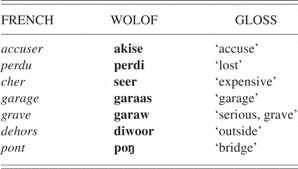
When speakers who do not know French use French borrowings in their Wolof, these words undergo some modification to conform to Wolof phonology. The most salient substitutions are the unrounding of the high front rounded French vowel from [y] to [i], as in the words for ‘accuse’ and ‘lost’ in Table 2, the substitution of [s] for the French fricatives [ʃ] and [ʒ] as in the words for ‘expensive’ and ‘garage’, and the glide [w] for the voiced fricative [v] as in the word for ‘serious’. French nasal vowels can also be pronounced as a sequence of a vowel plus a velar nasal stop as in the word for ‘bridge’.
Pronunciation of French loans in Wolof.

These substitutions constitute one end of the continuum of loanword pronunciation, but the vast majority of speakers do not consistently use all the substitutions. Nasal vowels, for example, are frequently maintained in borrowings, even though they do not form part of the Wolof inventory of sounds. Hypercorrection can also occur, especially with regard to the alveolar fricatives [s] and [z] which are sometimes hypercorrected to the alveoplatals [ʃ] and [ʒ] respectively. With regard to syllable structure, complex onsets and codas are broken up by epenthesis that exhibits vowel harmony, as in the word for ‘serious’ in Table 2, and since Wolof does not permit onsetless syllables, the glides [j] and [w] or the glottal stop [ʔ] are inserted as onsets in vowel-initial French words, as in the word for ‘outside’. Stress, which in French falls on the final syllable, is often translated into a long vowel in Wolof, as in the words for ‘garage’ and ‘outside’, although alternatively it may shift to the first syllable to conform to Wolof stress patterns.
In transcribing the French borrowings in 19th-century Saint-Louisien Wolof, Descemet often indicated phonological changes that conform to Wolof pronunciation through his spelling of the words. For example, the high front rounded French vowel [y] is unrounded to [i] in Wolof, as in the word tirbinal ‘tribunal’. Most consistent among his transcriptions is the recording of the nasal vowels, which he writes as a vowel followed by the sequence ng, as in maçong ‘mason’, sambong ‘ham’, and leçong ‘lesson’, which we can safely assume represents the velar nasal stop [ŋ]. These transcriptions seem to indicate a widespread use of the velar nasal stop, a native Wolof sound, as opposed to the French nasal vowels, which today are more widespread in urban Wolof even though the stop is also maintained by many speakers.
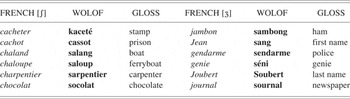
Among the consonantal substitutions of Wolof phonemes for French ones in Descemet's data, the most obvious one is [s] for the French voiced and voiceless alveopalatal fricatives [ʃ] and [ʒ]. This substitution is typical of the phrase book and occurs consistently, even in proper names. Table 3 gives a list of these substitutions found in the phrase book. While this substitution is still heard in urban Wolof, there is a tendency to use [z], a phoneme that is not native to Wolof, to substitute for the voiced alveopalatal fricative [ʃ].
Substitution of [s] for ʃ and ʒ in Descemet's phrase book.

Given the limitations of French orthography it is impossible to distinguish between the French uvular trill [ʁ] and the Wolof apical tap [r], but we may safely assume that the latter was generally used in French borrowings, although we cannot rule out the possibility that a certain class of bilinguals such as Descemet could have maintained the uvular trill in their French loans. However, unless future research uncovers commentary that directly addresses this issue, we will never know.
In sum, the French borrowings in Descemet's Wolof conform more to Wolof phonology than today's loans do, and there is little evidence of French sounds such as nasal vowels and certain fricatives having entered this part of the lexicon the way they have in contemporary urban Wolof.
Borrowed nouns and their noun classes
Wolof has a noun class system consisting of eight singular and two plural classes, but, unlike in most Niger-Congo languages, no class morpheme surfaces on the noun itself, occurring only on nominal determiners and certain anaphora. There, it surfaces as a single consonant that, in the tradition of scholarship on Wolof, also gives its name to the noun class. Singular noun classes include the following set of consonants: b, g, j, k, l, m, s and w, while the two plural noun classes are y and ñ. Number is encoded in the noun class system but shows up only in determiners and not on the noun, as in the NPs (N DET) xale bi ‘the child’ and xale yi ‘the children’. This lack of inflectional morphology facilitates the borrowing of nouns, but they must still be assigned to a noun class because the determiner must show agreement with the head noun.
The history of the Wolof noun class system shows three distinct strategies for assigning borrowings to a class, only one of which is productive today. The first, evidenced only in a few of the oldest loans, has a semantic basis. For example, liquids tend to fall into the m-class (e.g., ndox mi ‘the water’, meew mi ‘the milk’), and the old Portuguese borrowing biiñ ‘wine’ is assigned by the most conservative speakers to the m-class. A second strategy, and one that is no longer productive in the language, involves copying the initial consonant of the noun as a class marker on determiners as long as it falls within the set of possible class markers. Many borrowings from Arabic exhibit this strategy, such as malaaka mi ‘the angel’, jumaa ji ‘the mosque’, and seytaane si ‘the devil’. This strategy is no longer productive in Wolof and no new borrowings conform to it. Forms such as the Arabic borrowings cited above that exhibit this strategy must now be considered lexicalized (Mc Laughlin Reference Mc Laughlin1997) and reflect an earlier, once productive means of assigning nouns to a class. Today, almost all new loans are assigned to the b-class, which is the default class in Wolof, and many native Wolof words that occur in other classes in non-urban varieties are also assigned to the b-class in urban Wolof.Footnote 12
From the evidence in Descemet's phrase book it seems that the strategy of assigning nouns to a class based on their initial consonant was no longer productive in Saint-Louis even by 1864, and that French loans were assigned, as they are in contemporary Wolof, to the default b-class. Of the 30 borrowed nouns that occur in NPs where it is possible to determine their class, only three follow the alternate strategy of consonant harmony. These are given in the phrases in (6)–(8).
(6)
(7)
(8)


In the examples of canot and café in (6) and (7), the k-class is ruled out because it is a highly restricted closed class that does not admit borrowings. Instead, the voiced velar stop, [g], serves as a class marker, an example of approximate consonant harmony that is attested in the literature on Wolof noun classification (Mc Laughlin Reference Mc Laughlin1997).
A brief look at the nominal borrowings that are assigned to the b-class shows them to be cultural borrowings that fall into a variety of semantic fields. These include school items such as fey (< feuille) ‘sheet of paper’, bang (< banc) ‘bench’, and the word for school itself, l'école (< école); items related to dining habits such as tas (< tasse) ‘cup’, soucoupe (< soucoupe) ‘saucer’, and assette (< assiette) ‘plate’; and administrative terms such as poste (< poste) ‘post office’, casso (< cachot) ‘prison’, and marine (< marine) ‘navy’. These, however, are only the nouns whose noun class is apparent in the phrase book; there are many other nominal borrowings that cover additional semantic fields such as food, military, administrative, and commercial terms.
Finally, it should be noted that vowel-initial nouns in French are usually borrowed into Wolof with the definite article because it forms a needed onset, as in the word for ‘school’, l'école. The French article is reanalyzed as part of the noun and can form an NP with a Wolof determiner, as in example (9).
(9)

Other examples found in the phrase book of vowel-initial French words that occur as borrowings with the definite article include lartinguerie ‘artillery’, l'hôpital ‘hospital’, l'abbé ‘priest’, and lordonator ‘fiscal administrator’. Descemet shows two ways of writing these words, as if they were French sequences of article plus noun and as integrated nouns with [l] onsets. Most likely there is no significance to the difference, but we cannot be completely sure.
Borrowed verbs
While nouns are generally borrowed as such into Wolof, the most accommodating word category is that of verb. This is due partly to the fact that adjectives in Wolof do not constitute a separate lexical class but are subsumed into the class of verbs, for example xònq ‘to be red’, xiif ‘to be hungry’, tuuti ‘to be small’ (Mc Laughlin Reference Mc Laughlin, Dixon and Aikhenvald2004); thus French adjectives come into Wolof as verbs (Meechan & Poplack Reference Meechan and Poplack1995). A brief look at borrowed verbs in contemporary urban Wolof reveals that the origin of these verbs can be other lexical categories in French, or even larger syntactic constituents such as prepositional phrases. Examples are given in (10)–(13).
(10)
(11)
(12)
(13)


Finally, the syntactic changes that have gone on as the result of contact between Wolof and French over the course of several centuries have been primarily in the direction of Wolof to French. This is to say that the Senegalese variety of French has been more influenced by Wolof syntax than the other way around. The changes in Wolof syntax under the influence of French are quite subtle, and a thorough discussion of them is well beyond the scope of this essay, but they involve a tendency toward analytic construction at the expense of derivational and inflectional morphology, especially in the form of verbal extensions. The use of French encore ‘again’, for example, can lead to the omission of the Wolof iterative verb suffix /-aat/, although in many cases the two are used together for double marking of the concept.
While Descemet's 19th-century urban Wolof does not show as extensive a range of French lexical classes and syntactic constituents that become verbs in Wolof as the contemporary urban variety does, it nevertheless exhibits verbs that have both verbal and adjectival sources in French. In contemporary urban Wolof, French verbs of the class ending in the infinitival marker /-er/ are generally borrowed in what is arguably their infinitival form, although it could also be the past participle form which ends in /-é/, since the two endings are homophonous. These verbs constitute the majority of French borrowings and the largest class of French verbs in general. I suggest that the French infinitival marker, /-er/, which is pronounced [e], has been reanalyzed as a verbal extension in urban Wolof. There are at least seven verbal extensions in Wolof that have the same phonological form as the French infinitival marker, and they encode a multiplicity of meanings and grammatical functions, from locative to applicative to detransitive. Consequently, the infinitive marker in French often overlaps with the verbal extension and has been reinterpreted as such. This is evidenced in Descemet's Wolof as well. Example (14) shows the verb monter ‘to assemble’ in its negative form, but the ambiguous ending [e] has been retained
(14)

Descemet writes it as a French past participle, monté, but this could simply be the influence of the French phrase, which presumably preceded the Wolof. The structure of the two is very different. Wolof has no true passives, so the equivalent is literally ‘They did not assemble it’ rather than ‘It is not assembled’. Since the two languages do not coincide in their morphosyntactic structure and there is no infinitival marker in Wolof, verbs such as this become quite problematic, and it is probably best to interpret them as new verbs in Wolof.
A similar situation occurs in example (15) with regard to the verb punir ‘to punish’. Here the French infinitive marker is /-ir/ rather than /-er/. In this case the infinitive and the past participle are not homophonous, and it is the past participial form, pini, that surfaces in the Wolof phrase. While this might lend support to the past participle hypothesis as opposed to the infinitive hypothesis favored above, the French phrase that precedes the Wolof one in the phrase book – and presumably in Descemet's mind as well – is a passive one that requires the past participle.
(15)

Finally, example (16) simply shows the French adjective fort ‘strong’ surfacing as a verb in Wolof.
(16)

The class of verbal borrowings is more complex than the class of nominal borrowings in both contemporary and 19th-century urban Wolof, and the topic merits considerably more elaboration, but for the purposes of this essay these three examples illustrate the main issues involved.
THE LINGUISTIC LEGACY OF SAINT-LOUIS
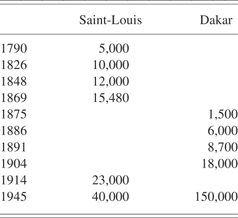
Comparing the demographics of Saint-Louis and Dakar over time,Footnote 13 as seen in Table 4, it is clear that around the time of Louis Descemet's death in 1921 the erstwhile capital of French West Africa started to be eclipsed by Dakar. The transfer of the capital of the AOF from Saint-Louis to Dakar in 1904 also entailed a movement of certain segments of the population from one city to the other, although Saint-Louis remained the capital of Senegal and Mauritania into the 1950s. This in itself is not enough reason why the urban variety of Wolof characterized by French borrowings should also become the dialect of Dakar. Those reasons lie elsewhere, probably in the fact that the variety of Wolof used as a coastal lingua franca emanating from Saint-Louis was the variety that Dakarois had used since the founding of their city in 1857.
Populations of Saint-Louis & Dakar across time (compiled from Sinou Reference Sinou1993).

Given the evidence that we have from urban languages all over Africa that liberally incorporate borrowings from now locally official European languages spoken by their former colonial overlords without the benefit of such a long history of linguistic contact, it is clear that languages of this sort can and have come into being within a relatively short period and fairly recently, as has been assumed by certain scholars for urban Wolof. Even without the added history of Saint-Louis, an urban variety of Wolof could easily have come into being much more recently as the result of Senegal's colonial heritage and increased urbanization since the mid-20th century. In this final section, however, I would like to argue that the more important links between contemporary Dakar Wolof and the 19th-century (and earlier) varieties of Wolof that emerged in Saint-Louis are not so much those of direct transmission, although there is obviously an important element of that, as of paving the way for acceptance of urban Wolof as an unmarked norm.
To speak urban Wolof is to articulate an urban identity. Urban Wolof is not a youth language. There are youth varieties of urban Wolof that nowadays incorporate many English borrowings, especially since the frontiers of Wolof migration have moved beyond Europe to the United States and to other places where English is the lingua franca. Young people are also fascinated by American hip-hop culture and freely borrow English expressions from it, as they did earlier from reggae music. But urban Wolof is also spoken, in its non-youth variety, by people in all walks of life and of all ages. Attitudes toward urban Wolof show that older people in particular are much less judgmental about French borrowings in their Wolof and do not seem to feel the anxiety that many younger people do that they are becoming “inauthentic” and “deracinated.” “It is the best way to communicate and the way we've always spoken,” a 68-year-old male teacher in a 2005 sociolinguistic interview opined of Dakar Wolof. Attitudes such as this reveal a climate of longstanding tolerance for the urban variety of Wolof that, I contend, has much to do with the status and prestige of Saint-Louis that lingers in the Senegalese popular imagination.Footnote 14
Commenting on the recent resurgence of academic interest in French colonial history by historians of France, Mann (Reference Mann2005:409) “register(s) a plea that the specificities of particular places be brought to the fore” in this research. Colonial histories, he continues, “deserve the kind of local analysis that has the potential to illuminate the emergence of singular social forms or particular politics.” To this we might add the potential to illuminate the emergence of particular language varieties, a task that I have attempted to undertake in this essay with regard to Saint-Louis du Sénégal. While the importance of different styles of colonization for the outcome of language contact has been highlighted by Mufwene Reference Mufwene2001, Reference Mufwene2002, there has been relatively little focus within the discipline of sociolinguistics on the individual locales that give rise to new language varieties. In the case of Saint-Louis, even though it was a French colonial city like so many other cities in West Africa, it was also the first comptoir and the eventual capital of French West Africa. Saint-Louis was also the place where new social groups such as the signares and the métis emerged over the course of more than a century as the direct consequence of European and African contact. As bilinguals, they were agents of linguistic change who contributed to the formation of an urban dialect of Wolof, a dialect that Descemet's phrase book gives us a glimpse of. As Diouf (Reference Diouf1998:672) states, Saint-Louis was the site of “a profound cultural reconstruction that expresses a hybrid culture no less distinct from autochthonous Senegambian traditions than it is from the prescriptive lessons of the colonial civilizing mission,” and this hybrid culture has left an indelible imprint on the Senegalese sociolinguistic landscape. The more we can delve into the history of locales such as Saint-Louis and understand the societies in which linguistic brokers mediated between languages, the better our understanding of new language varieties will be.
APPENDIX: ABBREVIATIONS