1. Introduction
The global wave of liberalization in the past few decades has brought about the rise of “big gambling,” or the state-industry gambling complex. Gambling is no longer a local vice but hailed as a legitimate, global business that provides entertainment for individual consumers, employment for communities, and revenue for private enterprises and governments around the world. Scholars have documented how the growth of legalized gambling brought quick economic “goods” such as increased employment and funding for public services but also the need to regulate “bads” like problem gambling, crime, and the subtle erosion of democratic processes (Adams, Reference Adams2007; Cosgrave & Klassen, Reference Cosgrave and Klassen2009). The focus of extant socio-legal literature on commercial gambling is mainly concerned with its regulation, specifically the formation of different regulatory frameworks and governance practices (Bedford, Casey & Flynn, Reference Bedford, Casey and Flynn2018).
In this study, we depart from the existing legal and political framings of gambling regulation to focus instead on how gambling proliferation may affect public institutions like the police. We examine the peculiar yet fascinating case of Macao, an autonomous Chinese city synonymous with casinos, and its police force under the rapid proliferation of gambling enterprises. An “invisible city” on almost every front, Macao is dwarfed by its neighbour Hong Kong and other cities in the Great Bay Area in terms of population, landmass, and its insignificant role in the international political economy. However, in one regard, Macao stands out from the rest of the world. It is the largest market for casino gambling in the world; at its peak, its profits were nearly seven times those of Las Vegas (Riley, Reference Riley2014). As the gambling capital of the world, Macao serves as a paragon to study the various social, economic, and political consequences of unbridled gambling liberalization.
The casino has fundamentally transformed Macao over the past two decades—a phenomenon that could be reasonably termed as the casinoization of Macao (Hao, Sheng, & Pan, Reference Hao, Sheng and Pan2017). Casinos are the lifeblood of Macao’s economy. Two-thirds of Macao’s Gross Domestic Product (GDP) and 80% of public revenues were derived from gambling taxes before the COVID-19 pandemic’s devastating effects on the city’s tourism industry. The casino boom has catapulted the region to become among the richest in the world. Macao’s unemployment rate has dropped to remarkably low levels, and the newfound wealth generously funded public infrastructure projects and social services. Nonetheless, the runaway success of Macao’s casinoization experiment was not without its dilemmas. The economy’s over-dependence on tourist gambling dollars makes it extremely vulnerable to external shocks beyond the city’s control, as demonstrated over the past three years under the influence of the COVID-19 pandemic. Economic diversification remains at a rudimentary stage due to the lack of land resources, human capital, economic exigency, and the side effect of its very success (Hao, Sheng, & Pan, Reference Hao, Sheng and Pan2017).
In this paper, we explore how casinoization of Macao affects its largest public workforce—the police. More specifically, using data collected from in-depth interviews, official statistics, and other published materials, we illustrate how casinos transformed the institutional logic and individual mindset of Macao’s police and citizens at large. We find that during the early liberalization of casinos, the police force suffered from a brain drain when many youths and even some police officers were drawn towards the casino industry. With further development of casinos, it provided the government with exorbitant amounts of tax revenue, which enabled the government to significantly improve the salary and welfare package for the police. The casino tax benefitted the police by pushing forward its professionalization and facilitating the positive transformation of police image from “licensed thugs” to “winners of life.” However, we further reveal that the casinoization may have contributed to a swollen police force and reduced the incentive for institutional reform. Lastly, we argue that the ongoing decline of the casino industry contributes to the “police fever” among the youth in Macao.
This study contributes to the existing literature in the following two ways. On the one hand, it enriches the concept of casinoization. Although the pervasive impacts of casino development on Macao society have been widely observed, little research has explored how it affects the police. By exploring both positive and negative consequences on police caused by the development of casinos in Macao, we expand the connotation of the concept of casinoization. On the other hand, we provide one piece of the very limited empirical evidence on the development of Macao police, contributing to the study of global comparative policing studies.
2. The concept of “casinoization”
The concept of casinoization refers to social, economic, cultural, and political consequences of the booming gambling industry in a specific society (Hao, Sheng, & Pan, Reference Hao, Sheng and Pan2017). Before applying this concept to the development of the police in Macao, we explore three key components of casinoization: (1) the mentality of quick money; (2) laissez-faire regulation; and (3) the paradox of plenty.
2.1 The mentality of quick money
The first key component of casinoization is the mentality of quick money. Such a mentality affects not only individual gamblers, but also the governments that promote the casino industry. Over the past decades, gambling has become one of the fastest-growing industries in the world; it has been estimated to have generated up to USD 398 billion of revenue globally in 2019 (Sulkunen et al., Reference Sulkunen2021). The progressive liberalization and commercialization of gambling markets created more intensive and continuous forms of gambling, along with the ubiquitous promotion of gambling in countless cities, whether in the form of lotteries, sports betting, or more addictive types of gambling like electronic gaming machines (EGM) and especially casinos (both physical and virtual) (Cosgrave & Klassen, Reference Cosgrave and Klassen2009). With their vested interest in the liberalization of gambling markets, the providers of gambling and governments are driven by a common pursuit of revenue generation (Adams, Reference Adams2007; Cosgrave & Klassen, Reference Cosgrave and Klassen2009; Seelig & Seelig, Reference Seelig and Seelig1998). While the casino operators wish to maximize private profits by swaying regulations in favour of creating new lucrative markets, the governments are tempted by the possibility of gaining an easy and abundant source of public revenue offered by gambling monies (Adams, Reference Adams2007; Calcagno, Walker & Jackson, Reference Calcagno, Walker and Jackson2010). As a result, the mentality of quick money permeates society; governments, local communities, and individuals are more likely to become ingrained with a mentality of quick money.
First, governments are motivated by the quick money from casino tax. Liberalization of gambling markets is often construed as a “normal and enlightened approach, part of an improving free-market economy” (Adams, Reference Adams2007, p. 29). Jurisdictions that enjoy a monopoly status in legalized gambling in its periphery are highly successful as revenue is mostly composed of tourist dollars while social costs such as addiction, debt, and other adverse effects of gambling are “exported” to the tourists’ own jurisdictions. In the early stage of liberalization, legalized gambling is pushed as a quick nostrum for revitalizing socioeconomic development with minimal capital and social expenditure, with the public assuming that their best interests are protected without truly recognizing the long-term socioeconomic costs. As liberalization takes off, many may find it difficult to stay impervious to the influence of gambling revenue interests (Adams, Reference Adams2007).
Second, like the state, communities may benefit from the economic stimulus brought by the new market in gambling. As gambling gains a foothold in the economy, community organizations may become financially dependent on the funding it provides (Adams, Reference Adams2007, p. 50). Some state-funded studies found that commercial gambling, specifically in the form of casinos, can contribute positively to employment by increasing employment and income in “economically depressed” communities (National Gambling Impact and Policy Commission, 1999, p. 5). Supposedly, casinos and their peripheral businesses (e.g. hotels and restaurants) create readily available positions with relatively loose requirements and a more generous pay package compared with other jobs in the service industry. Despite some concerns (Adams, Reference Adams2007; Seelig & Seelig, Reference Seelig and Seelig1998), the introduction of casinos has generally proved to lower unemployment rates while raising the average income for many jurisdictions in the short term, especially in tourist-dependent economies (Austrin & West, Reference Austrin and West2005; Figart & Mutari, Reference Figart and Mutari2014; Garrett, Reference Garrett2004; Geisler & Nichols, Reference Geisler and Nichols2016). In short, in addition to work within the gambling industry itself, several businesses may also capitalize on the influx of moneyed tourists, venturing in legally and morally questionable activities to turn a quick profit (Varese, Wang & Wong, Reference Varese, Wang and Wong2019; Wong, Reference Wong2020; Zabielskis, Reference Zabielskis2015).
Third, not only gamblers, but also ordinary individuals who live in a casino society could be “polluted” by the quick-money mentality. In prominent casino hubs like Macao, Las Vegas, and Atlantic City, it was not uncommon for young people to forfeit their education to pursue a job in the casino that offered good wages and low entry requirements (Shi & Liu, Reference Shi and Liu2014). Although the appeal of casino jobs may fluctuate from structural changes in market conditions and the wider political economy, the relatively high pay, especially during the early phases of casino proliferation, remains the prevailing reason for those who chose to embrace the risks of job instability, addiction, and physical and emotional labour associated with casino jobs (Mutari & Figart, Reference Mutari and Figart2015; Shi & Liu, Reference Shi and Liu2014). In their pursuit of a quick and easy source of revenue, most governments embark on a bold, risky experiment while ignoring the long-term consequences (Adams, Reference Adams2007; Cosgrave & Klassen, Reference Cosgrave and Klassen2009). In this context, society at large is susceptible to the mentality of quick money; individuals are reconstructed as “free-choosing subjects” driven by materialistic motivations (Shi & Liu, Reference Shi and Liu2014, p. 936).
2.2 Laissez-faire regulation
The second key component of casinoization is laissez-faire regulation. Casino gambling is often seen as legalized vice. While a certain level of regulation is necessary for the successful operation of casinos, overregulation may destroy the business (Cosgrave & Klassen, Reference Cosgrave and Klassen2009). As a result, the strategy of laissez-faire regulation has been widely adopted in the casino industry. Laissez-faire is broadly defined as the attitude of letting matters run their course without much interference from the state.
The laissez-faire regulation in casinoization derives from governments’ role conflict. To ensure the success of gambling liberalization, governments tend to pursue a lax approach to setting the rules and their enforcement. However, due to the governments’ existing roles in controlling crime and other social harms, the introduction of legalized gambling creates role conflicts for institutions and moral jeopardy for those who work in it (Adams, Reference Adams2007). The juggling of multiple identities increases the risk of role conflict (Adams, Reference Adams2007). A common observation is that governments experience a conflicted role of simultaneously regulating and benefiting from legalized gambling, like a “fox watching the chicken coop” (Seelig & Seelig, Reference Seelig and Seelig1998, p. 93).
More specifically, once revenue generation becomes the prime interest of all stakeholders, institutions and individuals foster a culture of permissiveness that may shape their actions (and inactions) towards the regulation of the gambling industry. Casino liberalization presents politicians, civil servants, and other individuals involved with regulating the industry with moral jeopardy. Not only may such dispositions create opportunities for an unmonitored conflict of interests, but they may also increase risks of corruption and graft (Adams, Reference Adams2007). For law enforcement agencies to invest in fighting crimes and illegal activities related to gambling, there is a large potential for a conflict of interest since these organizations derive their funding from gambling revenues. Laissez-faire attitudes can result in passive law enforcement or even an active promotion of gambling by government agencies; the lax oversight “discouraged any processes that might involve questioning or challenging their procedures” (Adams, Reference Adams2007, p. 41). A clear example is the inchoate regulatory framework surrounding the practice of soliciting gamblers through the use of complimentary gifts, tours, transportation, and other incentives by casinos and junkets (Cosgrave & Klassen, Reference Cosgrave and Klassen2009; Lo & Kwok, Reference Lo and Kwok2017).Footnote 1 The lax oversight of such activity is highly prone to infiltration by organized crime (Lo & Kwok, Reference Lo and Kwok2017). In Macao, despite side-betting and money-laundering activities being widely known to take place (Zabielskis, Reference Zabielskis2015), these activities were officially “unrecognized” until changes in political ecology called for its regulation.Footnote 2 A permissive attitude towards negative risks and the maintenance of the status quo is therefore a defining feature of laissez-faire regulation under casinoization.
2.3 The paradox of plenty: resource curse
The third component of casinoization is the paradox of plenty, sometimes termed as the resource curse. This concept comes from the research of “Dutch disease,” which describes that a resource boom may have a negative impact on other sectors (Corden & Neary, Reference Corden and Neary1982).
Initially, the concept was used to explain how the discovery of natural resources harms the broader economy in the long term since the over-dependence on the resource extraction industry reduces competitiveness and increases vulnerability to resource-specific shocks. In recent years, this concept has also been applied to economies that experience a large influx of foreign investment, such as the foreign investment-driven tourism industry, which absorbs skilled workers and capable managers from other sectors, driving up wages (Hao, Sheng, & Pan, Reference Hao, Sheng and Pan2017). Additionally, property prices are driven up while favourable policies allow the tourism industry to expand at the same time as other industries, particularly the manufacturing sector, shrink in the process (Hao, Sheng, & Pan, Reference Hao, Sheng and Pan2017). This apparent correlation between the rise of one industry and the fall of another is pertinent to the process of casinoization in which the gambling industry develops at the cost of all other sectors in the economy.
The effects of the paradox of plenty are not limited to the private sector. Empirical research suggests that public employment is significantly higher in resource-rich countries resulting in lower economic productivity. More recent studies of natural-resource-rich countries in sub-Saharan Africa and the Persian Gulf observed a novel mechanism in the paradox of plenty: a natural-resource boom creates a public-sector boom (Cust, Devarajan & Mandon, Reference Cust, Devarajan and Mandon2022; Kabbani & Mimoune, Reference Kabbani and Mimoune2021; Radwan & Malik, Reference Radwan and Malik2021). Such a public-sector boom is argued to further weaken competitiveness by pulling labour away from the private sector into economically unproductive government jobs. In the Gulf region, government workers are paid 50–100% more than their private-sector counterparts, with some countries’ public sector employing over 90% of the local labour force (Dudley, Reference Dudley2021; Kabbani & Mimoune, Reference Kabbani and Mimoune2021). These public-sector booms typically result in a disproportionately large public wage bill and a sizeable increase in public expenditure (Dudley, Reference Dudley2021). The state’s distribution of resource rents through the mass provision of well-paid public-sector employment and generous welfare benefits such as free health care and education, subsidies for living costs, and little to no tax for the general population in exchange for political security is understood as part of a long-standing social contract in autocratic regimes (Akhremenko & Shulika, Reference Akhremenko and Shulika2019; Dudley, Reference Dudley2021).
For Macao, the casino boom works in a similar way to what has been described as a resource curse. The paradox of plenty becomes an integral part of the casinoization of Macao society.
3. Casinoization of Macao
Legalized gambling in Macao dates to 1847 when the Portuguese colonial regime embraced gambling as a new source of revenue after losing its primacy as an important trading port to the newly established British colony of Hong Kong. In 1962, the first casino concession was granted to a local operator (Godinho, Reference Godinho2014). With a monopoly of legalized gambling, the licence holder only had to pay a fixed rate of tax to the government and was left freely to “regulate itself” since there was neither a legal framework nor the political will displayed by the colonial government to extend its involvement in gambling beyond the collection of taxes (Hao, Sheng, & Pan, Reference Hao, Sheng and Pan2017). The lack of a comprehensive regulatory framework also made casinos a breeding ground for criminal involvement in casinos, as was made evident by the wave of violent triad gang wars in the final years of colonial rule (Hao, Sheng, & Pan, Reference Hao, Sheng and Pan2017).
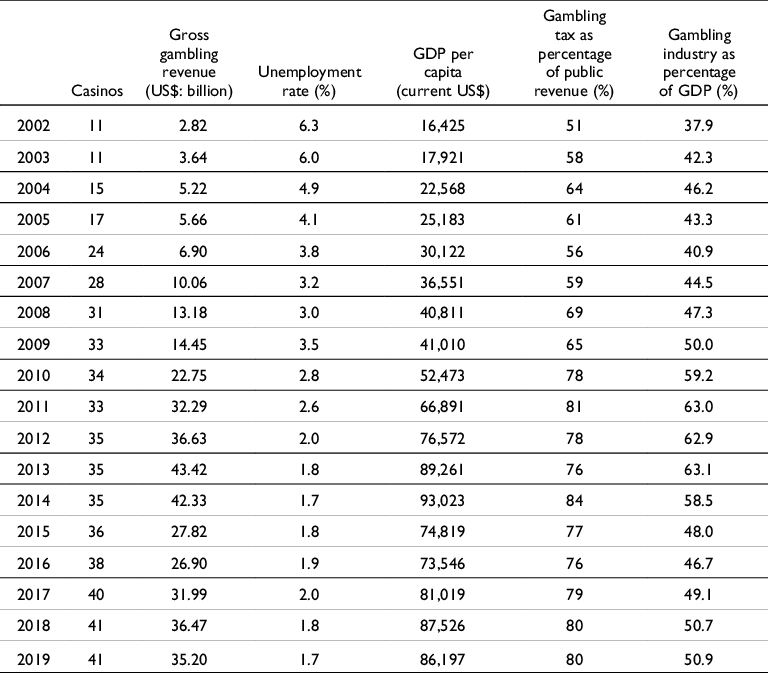
Three years after the return to Chinese sovereignty in 1999, the newly established Macao Special Administrative Region (MSAR) government sought to stimulate the sluggish economy by liberalizing the gambling industry, welcoming foreign investment, and easing regulations to promote the free movement of capital. Instead of renewing the expired monopoly licence, the MSAR government granted three gambling concessions to local, Hong Kong, and American enterprises. The three concessions were further divided into six and mega-casino projects began to set up shop in Macao, strategically emulating the innovative “Vegas style” of marketing and management methods. Liberalization was further supported by the Chinese central government’s loosening travel visa restrictions for mainland residents to enter Macao, bringing tens of millions of tourists to the city each year. As a result, the past two decades have witnessed Macao’s meteoric rise to becoming the world’s gambling capital (Figures 1–3). Macao has become heavily dependent on casinos, including its GDP, government revenue, and employment opportunities.
A glimpse from outside one casino area. Photo by Haozheng Wu.

Street scene of casinos in Macao. Photo by Haozheng Wu.

The famed “Cotai Strip,” a district of reclaimed land sold to operators to build mega-integrated resorts. Photo by Yan Zhang.

3.1 Casinoization of GDP: becoming the world’s gambling capital
The various casino operators’ wager on Macao turned out to be a huge success; their significant capital investments yielded quick profits unseen anywhere else in the world. By 2008, Macao had eclipsed the US state of Nevada to become the world’s largest gambling market, making it the most lucrative casino gambling market in the world. In the year of “opening gambling rights,” the gross gambling revenue was only USD 2.8 billion. After only 11 years, the city’s gross gambling revenue peaked at USD 46.25 billion, which is four times that of Las Vegas, Atlantic City, and Singapore combined.Footnote 3 The proliferation of casinos in Macao has produced a strong economy; for over a decade, the region has been heralded as the fastest-growing economy and most successful gambling market in the world, transforming the former colonial backwater into the gambling capital of the world (Schuman, Reference Schuman2005).
Today, the gambling and tourism industry still serves as the backbone of the city’s economy and, like other “export monopoly” jurisdictions that pursued gambling liberalization, the growth of casinos created jobs and an immediate net positive impact on the city’s economy. Prior to the liberalization, there were only 11 casinos in Macao, all owned by the gambling tycoon Stanley Ho. In less than two decades, 41 casinos spread across the small enclave, amounting to 1.3 casinos per square kilometre of land mass. Between 1999 and 2019, Macao’s GDP soared from USD 6.55 billion to USD 55.2 billion, reflecting an annualized growth rate of 11%Footnote 4 (World Bank, 2022). Half of Macao’s GDP was derived from the gambling industry (see Table 1). Thanks to its relatively small population of less than 700,000 residents, Macao’s nominal GDP per capita reached USD 93,023 in 2014, which was the sixth highest globallyFootnote 5 (World Bank, 2022). Prior to the COVID-19 pandemic, Macao was even projected to become the world’s wealthiest region.Footnote 6

3.2 Casinoization of government revenue
Beyond these impressive macroeconomic indicators, casinos also contribute significantly to the tax base in Macao, aiding the region’s development and stability by funding projects and creating work opportunities. Despite the scarcity of land resources in Macao, the post-colonial government granted massive estates to operators for casino development and invested in the necessary infrastructure to ensure the success of its pillar industry. Casinos, hotels, massage parlours, pawn shops, and restaurants catering to tourists from mainland China became a quotidian feature of the urban landscape (Zandonai, Reference Zandonai2015). While governments around the world turn to austerity measures due to shrinking tax bases, Macao’s coffers were well endowed by the hefty returns of gambling taxes. Public revenue rose from USD 1.89 billion in 2002 to USD 16.6 billion in 2019, allowing the government to accumulate billions of dollars in reserves from the growing tax surplus each year. Since gambling tax accounts for over 80% of all public revenues, individuals and non-casino businesses enjoy a relatively low tax rate, while the government is empowered to generously fund social welfare programmes and public works.
3.3 Casinoization of employment
Macao’s employment situation since the liberalization of casino concessions has also improved significantly. Since 2004, Macao’s unemployment rate remained at less than 5% (which most economists would consider being full employment) and dropped to under 2% from 2012 to 2019 (MSAR Statistics and Census Service, 2022). The casinos dominated the labour market in Macao, employing up to one-fifth of the local workforce in 2019—a large increase compared with only 12% in 1999 (MSAR Statistics and Census Service, 2022). Thousands of residents lined up for the “easy work and quick money” offered by the new casinos. Since casinos are reframed as a legitimate provider of leisure and entertainment services, working as a card dealer no longer carries the stigma it used to in Macao (Shi & Liu, Reference Shi and Liu2014). In fact, migrants are barred from card-dealer jobs to protect the employment of the local labour force. The sudden demand for mass, relatively low-skilled labour with competitive wages proved to be very attractive for the local workforce. Individuals from different backgrounds, including professionals working in banks, hospitals, schools, and government agencies, flocked to the casinos in the hope of making quick money (Shi & Liu, Reference Shi and Liu2014). Such a drastic shift in the economic environment also had a profound impact on youth, with many forgoing their education to work as relatively well-paid card dealers or junket operators (Hao, Sheng, & Pan, Reference Hao, Sheng and Pan2017).
4. Research questions, data, and methods
The overall goal of this article is to examine how casinoization affects the police in Macao. More specifically, four questions are explored: (1) how did the early casino boom affect the recruitment of police; (2) how did the newfound wealth from casinos benefit the police force; (3) how did the casino wealth affect the police reform; and (4) how did the decline of the casino industry create “police fever” among the youth? In addressing these questions, three components of casinoization, namely the mentality of quick money, laissez-faire regulation, and the paradox of plenty, will be used to guide the analysis.
All data were collected in Macao. Macao has a population of nearly 700,000 people but only 33 square kilometres of landmass, making it the most densely populated city in the world. Multiple strategies were employed when collecting data.
The first set of data comes from 27 semi-structural in-depth interviews with current police officers (nine), retired police officers (nine), and young people who were applying for police jobs (nine). Interviewing police officers with different statuses will enable us to understand both historical development and the current status of Macao police work as well as how casinoization has affected the transformation of police over the past two decades. All interviewees were recruited through the researchers’ network with a snowball sampling strategy and participated in the interviews voluntarily. The research follows the guideline of research ethics at the University of Macau.
The second set of data comes from official statistics, legal statutes, and public documents obtained from various government offices.Footnote 7 These sources provide key information on socioeconomic indicators; the development of the casino industry; crime rates; the staffing, expenditure, and bureaucratic structure of the police; the competitiveness of police recruitment; and policy discourses (legislative meeting minutes). To better understand and contextualize the casinoization of Macao society, the third set of data includes content analyses of newspaper articles, academic literature, relevant legal statutes, and online media published in Chinese and English.
5. Casinoization and the police in Macao
The casino industry has profoundly changed Macao society in all respects. The police, as the largest public sector in Macao, have also experienced clear impacts of casinoization in their recruitment, legitimacy, and institutional reforms.
5.1 Brain drain: citizens prefer casino jobs over the police
The first impact of the development of the casino industry on the police was that the early casino boom caused a brain drain from police to casinos.
Shortly after the liberalization of casino rights in 2002, the development of multiple mega-casino projects demanded a massive amount of labour resources, which quickly created an imbalance in the labour market of Macao (Hao, Sheng, & Pan, Reference Hao, Sheng and Pan2017). In 2004, two years after the “opening of gambling rights,” less than 10% of the labour force worked in casinos. In 2019, the number rose to 22% (MSAR Statistics and Census Service, 2022). The casino boom created more employment opportunities with few requirements for prior experience and educational attainment for the local population. As a result, professionals and students quit their jobs or studies to work as relatively well-compensated dealers in casinos (Shi & Liu, Reference Shi and Liu2014).
At the structural level, the paradox of plenty can be aptly ascribed to explain the early stages of the casino boom and its adverse impact on human capital in Macao’s non-gambling industries, where skilled labourers and management are drawn towards working in the casinos. The police, accounting for the largest proportion among all civil servants, were also affected by the casino boom. To enlist in the police force, the requirements included a middle-school education and 18 years of age, much like the various positions offered during the period of casino expansion,Footnote 8 bar the fact that the police vetting process was comparatively tedious, involving various physical and cognitive aptitude examinations. While the salaries of gambling industry employees and rank-and-file police officers were similar, the radiating glamour from the new casino complexes indubitably made for a better career outlook for some youth. The inability to attract sufficient young, competent applicants thereby became a problem for police recruitment in the early 2000s. For many, the quicker path to employment, the lack of an arduous training process, a higher salary, a more comfortable working environment, and a more positive social reputation were all compelling reasons for young people to work for casinos rather than pursue a career in law enforcement.
Such a phenomenon was clearly reflected in the official statistics, as the competitiveness of the annual recruitment exercise for police and firefighters coincided closely with the hiring cycles of casinos; when there were more job openings available in the gambling industry, the government saw a smaller pool of candidates to choose from. Figure 4 illustrates the profound impact that the opening of the casinos had on police recruitment: the line chart represents the acceptance rate of police recruitment while the bar chart shows the volume of casino jobs available in the market. During the financial crisis of 2008 and 2009, many casinos laid off workers or reduced their salaries, brewing uncertainty and instability within the employment environment of Macao. As a result, the sharp drop in the number of employment opportunities coincided with a jolting increase in the competitiveness of police recruitment, as marked by the admission rate of one-third compared with 2007. A news report highlighted the phenomenon, describing how police recruitment became twice as competitive in only a few months of the financial crisis, presenting a stark contrast compared with early days of casino liberalization (Liu, Reference Liu2008).

Moreover, some police officers quit their jobs to join the casinos. Multiple officers retired early or resigned in the hope of capitalizing on the opportunity to make quick money offered by the new casino. “It was a beginning of a new era,” said Peter, a retired officer in his sixties. “Many resigned, even without a pension … they all wanted to strike it big.”Footnote 9 What jobs could police officers take up in the casino? Part of the appeal of casino work is that it did not demand professional skills or experience. Positions like dealers, pit clerks, and cage cashiers were open to virtually anyone,Footnote 10 police officers included. Since law enforcement work mirrors many of the security responsibilities within hotels and casinos, it was a popular choice for former officers to job hop to work in casino/hotel security, since “many of the management in the security departments were ex-cops, not only from Macao but also Hong Kong too.”Footnote 11
For certain policemen, their possession of a licensed firearm in a city with strict gun controls helped them take on jobs as security details for VIPs in the casinos (Macao Daily, 2019).Footnote 12 More entrepreneurial individuals opted to venture into VIP-room business as junket operators—a trade unique to Macao’s casinos where “junkets” solicit and issue loans for high-rollers to gamble in the VIP rooms within casinos. Behind closed doors, these VIP rooms were alleged to launder billions of dollars through illegal gambling activityFootnote 13 and were heavily infiltrated by organized crime networks (Lo & Kwok, Reference Lo and Kwok2017; Zabielskis, Reference Zabielskis2015). The mentality of quick money, although not endemic to Macao’s casinoization, was exemplified within the Chinese “casino city” as policemen abandoned a profession synonymous with stability for the prospect of making more money by taking up the roles of armed bodyguards, heads of casino security, entrepreneurs, or even as junket operators, notorious for its triad ties.
Although there are no recorded data on the turnover rate in the police workforce, the recruitment frequency, legal staffing structure, meeting minutes from the legislative assembly proceedings, and the corroboration of multiple interviewees provide a clear picture of the impact of casinoization on the police workforce. In 2008, a Bill to increase compensation for police officers was proposed to the legislative assembly, and one of the legislators made this statement in the meeting:
Since the gambling industry’s liberalization, labour drainage towards the casinos has caused great pressure on the police, even causing turnover within the forces. To prevent turnover and boost morale … the government should increase the salary point and expand the staffing structure as soon as possible. I hope that by doing so, in combination with improving training and discipline, we can improve the quality of service of the security force personnel.Footnote 14
The severe impact of casino growth on police manpower was made apparent by the fact that the government had to take the initiative in finding ways of retaining and attracting new blood for its workforce. The following section explains how such a decision helped to professionalize the police in Macao.
5.2 Transformation of police image from licenced thugs to winners of life: the blessing of casinoization
While previous studies tend to focus on the negative aspects of casino development on Macao society, in this section we will demonstrate how casinoization “blessed” the government by enabling their response to labour competition by the casinos. Such endowments came in the form of significant improvements to police compensation, which subsequently helped the professionalization and positive change in the image of the force.
5.2.1 The “licensed thugs” of colonial policing
As faces of the government, Macao’s police not only enjoyed a significant pay raise but also a positive change in their public image. Once compared to “licensed thugs,” the colonial police were distant from the mainstream Chinese community and played a secondary role to the informal social control mechanisms facilitated by pro-China clan associations and trade unions (Ho & Lam, Reference Ho and Lam2014). Institutional corruption was a defining feature of the colonial police force; officers’ involvement in extortion, bribery, physical and sexual assault, theft, shakedowns, and protecting illegal businesses was prevalent within the various law enforcement agencies.Footnote 15 Segregation was not limited to the police and community, but also within the forces themselves. The in-built racial discrimination within the larger colonial bureaucracy (Hao, Sheng, & Pan, Reference Hao, Sheng and Pan2017) was also to be found in the police force, where there was a communication gap between expatriate Portuguese military and legal commanders and the local rank-and-file (Ho & Lam, Reference Ho and Lam2014). Such arrangements created conditions ripe for corruption, as a former officer James recalled: “The Portuguese were willing to turn a blind eye if they got a share … the Macanese in the middle management were the masterminds behind the rackets because they could speak both languages and appease both groups.”Footnote 16
Lax vetting procedures also failed to ensure the quality of the police workforce; background checks were relatively loose allowing delinquents with triad connections to enter the police force. As the deadline for the handover approached, the “lame-duck colonial government” (Hung & Choi, Reference Hung and Choi2012) was blamed for its negligence in the notorious triad turf wars in the late 1990s and the failure to curb the crime wave was pinned on the law enforcement agencies.Footnote 17 The colonial police force was described as incompetent, inefficient, and infested with corruption:
Many of the Portuguese commanders, believed it was not their responsibility to fix Macao … the triads [had] already infiltrated deep in the police forces, there were not enough resources, and the overseas media kept exaggerating the situation and smeared our efforts, which made triads even more arrogant.Footnote 18
With the police bereft of the professional capacity to maintain order and segregated from the community, the citizens of Macao yearned for a return to Chinese sovereignty and celebrated the arrival of the People’s Liberation Army troops (Chandler, Reference Chandler1999).
5.2.2 Winners of life in the casino era
Today, Macao’s police enjoy a far more positive public image, with the help of resources provided by casinoization. In 2008, the MSAR government passed a monumental piece of legislation by raising the educational attainment requirement to senior high schoolFootnote 19 for police entrants and consequentially the compensation for new police recruits, citing the need to improve the quality of its personnel and compete with the private market.
The raised educational requirement coincided with the city’s rising educational attainment, early school dropouts are now nowhere to be found, and most high-school students enrol in tertiary studies, with 81.4% of all police officers possessing a post-secondary education (MSAR Public Security Police Force, 2021). The professionalization of Macao’s police contributes to the gradual improvement of public perceptions of law enforcement, as the police were transformed into a service-oriented institution in which the needs of the citizen “customers” are prioritized. Nick, a retired officer, said that:
In the past, people pretend to respect you, but really, they are afraid and resentful. Since the handover, police have become service-oriented; citizens don’t “respect” you; they “demand” you to serve them; as taxpayers, they view themselves as customers, and police are just public servants, so it is only natural that they demand more from the police.Footnote 20
Given that the tourist city saw an average of 30 million visitors annually before the COVID-19 pandemic, public order is well under control, especially considering the remarkably low level of violent crime (Xu et al., Reference Xu, Lao, Sun and Yao2021). It is all a stark contrast compared with the twilight years of colonial rule. Although casino-related and white-collar crimes remain rampant, the perpetrators and victims are often part of the “transient population of [illegal immigrants], workers, gamblers and tourists” (O’Regan, Reference O’Regan2019, para. 20), who were not the main “auditors” of Macao’s police.
The absence of visible police corruption also helped improve the forces’ public image. Like many citizens, Quentin, a retired columnist witnessed the palpable change in perception: “Long time ago, cops were widely known as ‘licensed thugs’ in Macao streets. They are much better now; they are professional and well-mannered.”Footnote 21
While rotten apples are still exposed from time to time, the predisposition for graft is far weaker:
Nowadays, there is no reason to risk losing this job, not only because it’s easier to get caught, but the price to pay is way too high. Back then, [the police] were paid very little, and it was a way to help make ends meet. Today, they are very well paid. No one in their right mind would risk losing such a good job and even going to prison for a little bit of quick money.Footnote 22
This rationale is not limited to police officers themselves; the idea that the police occupation is a “good job” is the belief of many Macao youth who find themselves trapped in a deteriorating job market—a phenomenon we will explore in later section.
5.3 Bloated bureaucracy: the curse of casinoization
Casinoization pressured the post-colonial government to find ways to boost the morale of its bureaucracy. However, the government did not have its hands tied for long, as they were able to remedy this situation with the newfound fiscal surplus, at least in terms of invigorating its public workforce. Such developments created one of the largest police forces in the world.
5.3.1 Swollen forces
Improved compensation increased the quantity and quality of applicants seeking law enforcement careers. While the police forces’ human resource problems were mitigated quickly, the reforms did not stop at raising the pay rates of officers. The inherited bureaucracy, already bloated before the handover, continued its expansion of both personnel size and organizational structure with the help of casino capital.
In its last year of Portuguese rule, Macao had a police strength of 776 officers per 100,000 population (Ho & Lam, Reference Ho and Lam2014). In two decades, the ratio rose to 938 officers per 100,000 population. More specifically, in 2020, Macao had 6,406 police officers, including 5,147 public security officers and 1,259 judiciary police officers. To put this into context, Macao’s police strength is twice that of its neighbour Hong Kong, three times that of Taiwan, and six times that of mainland China, where there were 2 million officers and 141 officers per 100,000 population, respectively (Figure 5) (MSAR Information Bureau, 2021; Hong Kong Police Force, 2022; Gender Equality Committee—EY, 2022; Scoggins, Reference Scoggins2021).Footnote 23 On an international level, Macao’s police presence in terms of the officers-to-population ratio falls short compared with city-states with a smaller population and landmass like Vatican City and Monaco, but leads most jurisdictions by a significant margin.
Macao’s police per 100,000 compared with other regions.
Sources: MSAR Information Bureau (2021); Hong Kong Police Force (2022); Singapore Police Force (2020); Gender Equality Committee—EY (2022); Scoggins (Reference Scoggins2021).

The sizeable police presence in Macao was inherited from colonial governance, which has long been defined by its “laissez-faire” philosophy. The post-colonial government faced several challenges in the early years of the handover: (1) a lack of co-operation between two separate police bureaux (administrative and judicial);Footnote 24 (2) a lack of police-community interaction with the expatriate leadership; and (3) a lack of professionalism among officers that undermined the public trust in the police (Ho & Lam, Reference Ho and Lam2014). Another feature of Macao’s police was the incomplete institutional reform of the “unnecessarily swollen” police bureaucracy shortly after the handover of sovereignty. As stated by public administration scholar Kwong: “it should have been inconceivable to find so many police forces existing in a tiny place like Macau” (Kwong, Reference Kwong2014). An institutional merger of police forces failed shortly after the handover, allowing an organizational fragmentation inherited from the colonial legacy to remain to this date.
5.3.2 Large public wage bill
The casinoization of Macao’s police has cemented its inherited laissez-faire attitudes towards administrative reforms; the government continued to expand the staffing and organizational structure of its polyarchical web of policing, all the while raising the compensation for the police force. Police expenditure has increased from USD 170 million to USD 680 million in the past two decades, while police per capita only increased by 15%. At the peak of the casino boom, Macao’s fiscal reserves stood at USD 20.88 billion. Prior to the COVID-19 pandemic in 2019, the number grew to USD 72 billion. Despite the swollen bureaucracy presented in this chapter, police spending is only a meagre 5–10% of the total public expenditure throughout the years (Figure 6).
Public expenditure and police spending (2001–19).
Source: MSAR Printing Bureau (2022).

Unsurprisingly, such decisions were met with no resistance from society, since refunding the police was hardly a burden on the public finances of Macao nor a cause of concern to society, given the fact that the public coffers amassed such enormous amounts of fiscal surplus from the once unremitting growth in gambling tax revenues over the years. For instance, the government spent USD 10 billion in 2019, while its fiscal reserve stood at USD 72 billion.
6. Decasinoization and police in Macao
Since 2014, Macao’s economy has entered a phase of continuing decline after the nationwide corruption crackdown led by the central Chinese government. As gambling revenues dwindle year by year, the once-beaming optimism surrounding casino-driven prosperity has been gradually replaced by a brooding despair for many who are caught in the increasingly volatile and unstable economic environment. With the decline of casinos, a career in the police has become the quintessential recourse for Macao’s new generation of youth who seek to minimize risk and pursue stability in the face of elevated uncertainty in the political economy.
6.1 Fall of the casinos
Since 2020, Macao’s casinos have suffered from two unprecedented “killers” (Scott, Reference Scott2022). The first is the sudden outbreak of the COVID-19 pandemic. Despite the government’s initial success in keeping the virus at bay with the help of resources accrued during the casino boom (Lou, Reference Lou2021), the outlook for Macao’s economy remains gloomy as the gross gambling revenue plummeted from 2019’s USD 36.5 billion to USD 7.5 billion in 2020, reflecting a decline of 80%. After a slight recovery to USD 10.9 billion in 2021, the first half of 2022 saw only USD 3.3 billion, less than a fifth of pre-pandemic levels in 2019 (Figure 7).
Monthly gross gambling revenue in Macao (January 2019–July 2022).
Source: MSAR Gaming Inspection and Coordination Bureau (2022).

The casino economy’s fall from grace was even more dramatic than its rise. In less than three years, it has lost its once prized crown of gambling capital to Nevada, which surpassed Macao in gross gambling revenue in March of 2022. Smaller gambling markets such as Singapore, Philippines, and Australia were expected to exceed Macao’s gambling output in the last quarter of 2022.
Why is Macao the only gambling market not showing any signs of recovery during the pandemic? Despite being one of two regions in China with its own immigration and border control measures, Macao is handicapped in many areas of policy-making due to its over-dependence on the tourism and gambling industry. One of these areas is the strict adherence to the Covid-zero approach to public health policy, which is the pursuit of a complete absence of community cases by means of border restrictions, mass testing, quarantines, and lockdowns. Such an approach has been championed and adopted by mainland China to this date (November 2022), while many other countries either eased multiple restrictions or removed all measures, adopting the “living with Covid” attitude that prevailed with the rise of less virulent variants in late 2021. Since nearly 70% of all tourists and 90% of gross gaming revenue come from mainland China, Macao’s alignment to the policies of its largest market is not only a political consideration but also a practical, economic calculation. Since the beginning of the pandemic, Macao has been effectively shut off from the world and maintained open borders with mainland China on the precondition that it would sustain zero community cases—a goal that could be achieved only with strict quarantine measures and the prohibition of non-Chinese nationals from entering the city from non-mainland routes. While Covid-zero helped Macao to accomplish an exceptionally low infection and death rate, economic activity slumped to an all-time low.
The second killer is the new casino legislation and the corresponding tightening of regulations since 2021. Gambling has always been strictly controlled in China; the only legal forms of gambling in mainland China are the two government-operated lotteries. Since its return to Chinese sovereignty, Macao’s liberalization was essentially an experiment to capture potential revenue while pushing this legalized vice to the geographical and political margins of the nation (Zabielskis, Reference Zabielskis2015). However, the “culture of permissiveness” did not last long. Once Macao’s casinos became a major channel for money laundering while creating a population of problem gamblers, it has increasingly been seen by policy-makers as exporting Chinese wealth overseas while importing social problems for the nation. In addition, half of the casino concessions in Macao are owned by US companies that introduced the Las Vegas-style business model behind the success of the industry’s boom, further complicating their status amidst the rising tensions in the geopolitical climate. The nationwide crackdown on corruption in 2013 and 2021’s campaign targeting online casinos and cross-border gambling have essentially vanquished the VIP industry (Scott, Reference Scott2022), which accounted for nearly 70% of casino revenue at its peak (Bloomberg News, 2021).
Under the impact of those two “casino killers,” some analysts argued that “Macao has fallen” and predicted that casino revenue might only reach one-third of its level in 2019 (Scott, Reference Scott2022), for which we coin this trend as the “decasinoization” of Macao, although it remains unknown how long the decasinoization will last.
6.2 Police “fever”
Facing the decasinoization of Macao, young people flocked in droves to pursue what they consider an “iron rice bowl”Footnote 25 : a job in the civil service. According to an official survey conducted in 2019, working within the public sector has become the most desirable career path for Macao’s university graduates. With a high ratio of one civil servant for every six in the local working force,Footnote 26 the government is one of the largest employers in Macao, falling only behind the gambling, real estate, retail, and hospitality industries. Working in the public sector guarantees a stable income with fringe benefits regardless of the market conditions, fewer working hours, as well as a clear career path without much uncertainty. This is especially the case for the police, who are tenured with permanent contracts that make it very difficult to terminate without sufficient legal grounds. The relatively lower entry requirement and the frequent recruitment make a career in the police a very attractive option for young people, made evident by the increasing competitiveness of the recruitment process (Figure 8).
Police recruitment applicants, recruits and admission rate (2001–21).
Source: MSAR Public Security Forces Affairs Bureau (2021). Note: The year 2011 was when educational requirement was raised to high school and consequently the wages were increased significantly.

The well-compensated police jobs also make wages in the private sector pale in comparison: the minimum income for a police officer is more than twice the median income of the larger labour force and outperforms 93.7% of fresh university graduates. The discrepancy between wages of entry-level casino employees and police officers began to widen ever since its divergence in 2012, as the civil service salary index continued its year-on-year growth (Figure 9).
Average monthly income of casino clerks compared with entry-level police officers (2005–20).
Sources: MSAR Statistics and Census Service (2021); MSAR Printing Bureau (2021).

In addition, entry into both officer and subcommissioner programmes requires only a high-school education. As a result, it has become quite common for newly graduated high-school students to apply for police recruitment, withdrawing from their undergraduate studies once they are accepted for cadet training.
Not unlike the earlier days of casinoization, many of Macao’s youth are now abandoning opportunities for higher educational attainment to chase a relatively “easier” path to financial stability:
It’s very hard to get a nice job after you graduate anyways … without the right connections, you cannot make it far in Macao. Right now, my salary is still higher than most of my high school graduating class, and I am the only one who didn’t go to college.Footnote 27
The notion is that education is not a prerequisite to success, as material gains and financial status are valued above all else in Macao society (Shi & Liu, Reference Shi and Liu2014, p. 936). For those who decide to pursue success through more conventional ways, they are faced with the obstacle of a monolithic employment structure dominated by casinos. Despite policy directives and support from the central government, Macao’s economic diversification remains slow, especially given the fact that Macao’s scarce land and labour resources and its history of tremendous returns from property and gambling investments have meant that there is lack of incentive for investors to invest in other less profitable and more resource-intensive industries (Hao et al., Reference Hao, Sheng and Pan2017, pp. 43–4).
Simply put, apart from its gambling and hospitality industry, the underdeveloped private market provides little space for professionals to operate in Macao. With such in mind, it is unsurprising to see that many young people who had career aspirations to become professionals end up in the civil service, since “there is not much to choose from anyways.”Footnote 28 Within the police force, cases of graduates from prestigious universities joining the police are no longer unheard of, as young people who could have been engineers, doctors, and lawyers traded their ambitions for a blue uniform and badge that shield the wearer from the instability and uncertainty of casino capitalism.
For many youngsters wishing to join the force, becoming a police officer is likened to a “winner in life.” With casino capitalism weakened for the time being, the lingering memories of Macao’s heyday show that there are no true winners and losers in casinoization—only an ever-changing mindset constantly moulded by the “corporeally present, but simultaneously opaque and mysterious” (O’Regan, Reference O’Regan2019, para. 29), forces of casinoization.
7. Concluding remarks
Casinoization refers to a society that has been profoundly and broadly affected by high-octane gambling in the form of casinos. No place in the world is more heavily affected by casinos than Macao. Using data collected from interviewing former and current police officers, as well as police applicants and various government statistics, this paper aims to examine how the casinoization of Macao society has affected its police force. Three features of casinoization, namely the quick-money mentality, laissez-faire attitude towards regulation, and the paradox of plenty, are examined particularly for their influences on Macao’s police force.
We found that casinoization has generated four important impacts on the police in Macao. First, the initial booming casino economy caused a brain drain from all sectors, police included, to the casinos. Many young people preferred to work in casinos rather than join the police due to the allure of a seemingly exciting working environment and appealing income. Some police officers even quit their jobs to work in the casinos. Second, with the support of huge public revenue generated from the booming casino economy, the government quickly increased its compensation for police officers to a level that out-shadowed that of casino employees, allowing the police jobs to become more attractive to young people. With better income, increased educational attainment, and professional capacity, the police’s image has been successfully transformed from “licensed thugs” to “winners in life.” Third, due to the paradox of plenty, the police continued to adopt a laissez-faire attitude in its post-colonial reform. Such an approach created one of the largest police presences in the world and a fragmented policing framework for such a small city. Due to the government revenue from casino economy, there was no fiscal nor public pressure to pursue institutional reforms, allowing the police bureaucracy to grow rather freely in both size and spending. Lastly, with the decline of the casino economy, Macao society enters a phase of decasinoization in which the young working population flock to secure a job in the public sector and police recruitment has become the most competitive in decades.
The concept of casinoization is proposed to understand the unique developmental path of Macao’s police. This study is one of the very first attempts in policing research to study the effects of the gambling industry on the police. Several issues could be further explored. On the one hand, when facing the decasinoization, should the government ever decide to downsize its police force or reduce the wage bill, how can the different interests of the various stakeholders in Macao’s police be feasibly reconciled? Although Macao’s police are subject to strict labour discipline, any major blow to their interests could negatively impact police morale, which may further hamper the administration’s goals for increased efficiency. In addition, will Macao pick up its unfinished police reform to integrate the current fragmented force to the pressure of decasinoization? Where does the political will come from and how can the government reconcile the differences between the stakeholders and overcome the obstacles faced in its earlier unsuccessful attempts of merging the police forces? On the other hand, to what extent can the concept of casinoization be applied to explain various social issues in Macao? For instance, how has casinoization affected crime and specifically organized crime in over the past three decades in Macao? Future studies could further explore these questions.
Acknowledgements
This research is supported by the Education Fund of the Macao SAR Government (HSS-UMAC-2021–04). The authors are grateful to Prof. Paul Rock, Prof. Sida Liu, and members of the weekly research meetings at the Department of Sociology, University of Macau, for their constructive suggestions on earlier drafts of the paper.