1. Introduction
Given the unprecedented growth in global electronic commerce (e-commerce) over the last two decades and its impact on the existing international trade rules, there is a broad consensus that e-commerce needs a new World Trade Organization (WTO) trade rules agreement. However, the WTO members, both developed and developing countries, are divided over the proposed rules that must govern global e-commerce (Primo Braga, Reference Primo Braga2007; Wu, Reference Wu2017; Hufbauer and Lu, Reference Hufbauer and Lu2019). For this paper, e-commerce and digital trade will be used interchangeably. The selected issues to be discussed in this paper are: cross-border data and information flow, consumer protection and privacy, customs duties on e-commerce services, data Localization, source/software codes/intellectual property (IP), internet taxes, and open internet access (South Centre, 2017a; Kelsey, Reference Kelsey2018; Hufbauer and Lu, Reference Hufbauer and Lu2019; Ido, Reference Ido2019; James, Reference James2019). This study's scope is limited to these issues because the WTO member countries have agreed on less contentious issues, such as prohibition on unsolicited commercial electronic messages, recognizing electronic authorization and electronic signatures, and online users’ protection from fraudulent commercial activities. The various submissions by China, Japan, the EU, and the US to the WTO on e-commerce trade rules suggest convergence on these issues. However, leading members, including China, Japan, the EU, and the US, have considerable differences in approaching the issues under consideration in this study.
The WTO's ability to reconcile the EU, the US, China, and Japan positions is an essential ingredient for the prospects of reaching an agreement. Reconciling these powerful digital behemoths’ positions means winning their trading partners’ support, including developed, emerging, and developing economies in the negotiations. This argument is valid because the US, EU, China, and Japan have successfully gone beyond the WTO multilateral framework and inserted e-commerce regulations chapters on these contentious issues under discussion in their free trade agreements (FTAs) with developing and emerging economies. For instance, in 2001, the US–Jordan FTA included an e-commerce clause, which requires members of the agreement to refrain from imposing customs duties and needless obstacles to electronic delivery, such as digitized goods. Moreover, in 2004 the US incorporated an entire e-commerce regulation chapter into the US–Singapore and the US–Chile FTAs (Huang, Reference Huang2017).
The Regional Comprehensive Economic Partnership (RCEP), with ten developing countries and China and Japan as leading members, has successfully made e-commerce provisions on these contentious issues. This implies that putting China and Japan on the same page regarding these issues at the WTO would influence developing countries’ positions and those of the other members of the RCEP, Australia, New Zealand, and South Korea. The RCEP allows members to alter the regulations on customs duties for electronic transmissions based on the WTO work program outcome.Footnote 1 The EU–Japan free trade agreement dedicates a whole chapter to e-commerce regulations on this paper's contentious issues. Although the EU–Japan FTA does have formal regulations regarding data localization, the General Data Protection Regulation (GDPR) adequacy ruling, which requires no specific authorization to transfer data from the EU to Japan and vice versa, still applies. Also, the EU–Viet Nam FTA made provisions on e-commerce regulation. The Trans-Pacific Partnership (TPP) (signed in 2016), of which the US and Japan are members, includes comprehensive regulations on e-commerce that ensure the free flow of information, bans policies on data localization and consumer protection rules even though the remaining members agreed on a revised deal after the United States withdrew in 2017 (Hufbauer and Cimino-Isaacs, Reference Hufbauer and Cimino-Isaacs2015).Footnote 2
Interestingly, studies find that these issues are significant barriers to international digital trade. The lack of WTO level rules to govern digital trade activities have created gaps for members to implement data localization requirements, restrictions on data transfers, forced transfer of source codes, internet taxes, custom duties on digital products, among others, as a precondition for multinational corporations (MNCs) seeking to operate in their countries (Hufbauer et al., Reference Hufbauer, Jung, Clyde and Jones2016).
According to Hufbauer and Lu (Reference Hufbauer and (Lucy) Lu2018), international e-commerce has evolved quicker than the rules to govern it. Global e-commerce trade was estimated to be $29 trillion in 2017, about a 50% increase from the $19.3 trillion in 2012 estimates of global trading via the internet.Footnote 3 The efforts to reduce international e-commerce trade barriers raised concerns for the WTO, trade diplomats, lawyers, economists, and policymakers after the collapse of the Doha Round multilateral negotiations a decade ago (Bhandari, Reference Bhandari2012). Economists are very much concerned about the impact of digital trade on economic growth. For instance, a study conducted by Zhang and Chen (Reference Zhang and Chen2019) found that a 1% increase in the digitalization of an economy would lead to a 0.3% growth in GDP with a two-year-lag. Using the computable general equilibrium model, the United States International Trade Commission (USITC)Footnote 4 reported that digital trade had increased the United States’ real GDP from the estimated $517.1 billion to $710.7 billion (from 3.4% to 4.8%) using 2011 as a baseline. They further indicated that eliminating the digital trade barriers in digitally intensive industries would raise the US real GDP from 0.1% to 0.3% in 2011. As shown by Wang et al. (Reference Wang, Wang and Lee2017), a 1% increase in e-commerce activities leads to an approximately 0.7% increase in China's international trade volume.
Similarly, evidence found for the European Union shows that e-commerce has a combined effect of 0.14% on EU GDP. The argument has also spurred interest in e-commerce rules that may impact real wages and countries’ total employment. The United States International Trade Commission (USITC)Footnote 5 states in its special report ‘Digital Trade in the US and Global Economies, Part 2’ that US real wages would be 0.7% to 1.4% higher and total employment would increase by 0.4 million if foreign barriers to digital trade in digitally intensive industries were removed.
Regardless of the importance of global e-commerce to economic growth, employment, and international trade of countries worldwide, to the present day there is no WTO multilateral trade agreement for it. Nevertheless, in recent years, WTO members have realized the implications of not having trade rules for the fast-growing digital trade in their respective economies. Scholars such as Neeraj (Reference Neeraj2017) and Zhang and Chen (Reference Zhang and Chen2019) posit that the absence of a legal framework to regulate digital trade has created anti-competitive digital market and is overwhelmingly dominated by a few firms, noticeably Amazon, Apple, Facebook, Alibaba, and Microsoft. The oligopolistic power of these firms in the digital economy has impeded entry of new firms, mostly the small and medium-sized enterprises from developing countries. Most noticeably, the US, supported by other WTO members, the EU, Japan, and China in early 2016 brought to life the issues of international e-commerce trade and made moves that intended to secure the mandate to open negotiations on e-commerce trade-related related issues at the 11th Ministerial Conference (MC11) in 2017 at Buenos Aires in Argentina. The purpose of this mandate is to examine the various trade-related issues of e-commerce (Smith, Reference Smith2017b). The US submitted the first proposal in 2016, intended for the WTO to begin negotiations on new e-commerce trade rules. Since then, the WTO has received several proposals from members, including the EU, Japan, and China, suggesting possible elements for a multilateral rule book on trade-related aspects of e-commerce (Neeraj, Reference Neeraj2017). A recent work by Banga (Reference Banga2019) suggests that in November 2011 just before the MC11 in December, there were three-way splits on the e-commerce issues between the WTO member countries. Most developed economies sought digital trade liberalization, while the developing economies are divided into two groups. The first group of developing countries fought for a standstill on opening up new negotiations for e-commerce issues at the WTO until the 1998 Work Program's main issues had been considered. The second set of countries demanded the WTO assist them in understanding the opportunities presented by e-commerce and digital trade.
The 1998 declaration on e-commerce included a two-year moratorium specifying that ‘Members would maintain their existing practice of not enforcing customs duty on electronic transmissions’. Since 1998, the moratorium on customs duties has only received regular renewals every two years at the Ministerial Conference without reaching any consensus more than 20 years after the declaration. Three critical issues that have been continually discussed are: (a) the classification of electronic transmissions as goods, services, or intellectual property; (b) the revenue implications of the moratorium; and (c) the technological feasibility of levying customs duties on electronic transmissions (South Centre, 2017a; Garcia-Israel and Grollier, Reference Garcia-Israel and Grollier2019b). The developing countries group demands that these issues are resolved before opening negotiations on e-commerce.
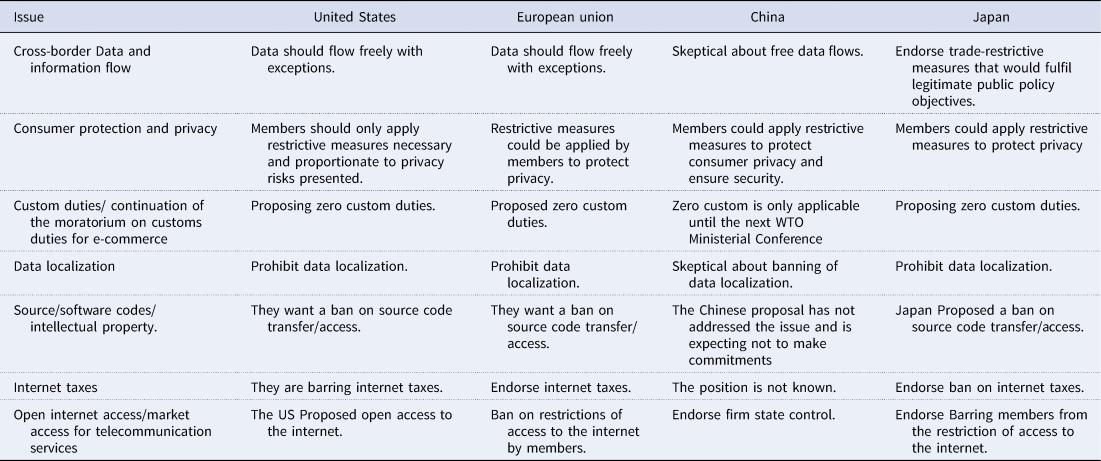
Nevertheless, at the MC11, the first joint statement was released with 71 signatory members announcing their intentions to have an initial meeting in the early part of 2018 open for all members on e-commerce. In 2018, they held nine meetings. The first meeting was held on 14 March 2018 and discussed approaches to the negotiations and expectations for the future. At the second meeting held on 18 April 2018, ten proposals were tabled on issues to be included in the negotiations. The third to the ninth meetings continued through to April 2019, and discussions on the proposed negotiations ran from 13 to 15 May 2019, with members from both developed and developing countries expressing differing opinions on the critical issues, as shown in Table 1 in Appendix 1.
This paper focuses on the United States, the European Union, Japan, and China's positions concerning the selected issues on global e-commerce trade rules (see Table 1). The paper also discusses the gaps between these countries’ positions, mentioned above, on the contentious issues in e-commerce and whether the differing viewpoints will hinder the prospects of a WTO e-commerce agreement. The remainder of this paper is structured as follows. Section 2 sets out the historical background of e-commerce trade rule negotiations in the WTO. In Section 3, we present the positions of the US, EU, Japan, and China on e-commerce negotiation issues. Finally, section 4 concludes by examining the implications of the differences in the positions on the e-commerce multilateral trade rules negotiation issues and suggesting how WTO can reconcile the differing positions.
2. Review of E-Commerce Discussions at WTO from 1998 to 2019
The WTO first introduced global e-commerce as a topic back in 1998 at a Ministerial Conference Declaration of a Work Program on Electronic Commerce (Wu, Reference Wu2017). The purpose of the Work Programme was to enable discussions on all trade-related issues on e-commerce. The relevant bodies given the task by the WTO to take charge of the discussions of the trade-related issues on e-commerce include: the Council for Trade in Services, the Council for Trade in Goods, the Council for Agreement on Trade-Related Aspects of Intellectual Property Rights (TRIPS), and the Committee for Trade and Development. Moreover, the General Council was tasked to play an oversight role. Since then, issues on e-commerce have regularly been highlighted at each of the WTO Ministerial Conference meetings but agreement has not been reached on multilateral trade rules on e-commerce, and the only significant outcome is the decision not to tax electronically transmitted products. E-commerce's latest appearance on the Ministerial Conference agenda was the MC11 (Ido, Reference Ido2019).
After the collapse of the Seattle Ministerial Conference in 1999, discussions on e-commerce trade issues were suspended. However, the growing demand across the globe for trade liberalization and rules to govern the rapid growth in e-commerce trade, led the General Council of the WTO to resume discussion on the Work Programme on Electronic Commerce in July 2000. Between 2000 and 2001, proposals from Switzerland, Australia, the European Union, and the United States on e-commerce issues were discussed. Switzerland's proposal captured the rights of an author on the internet. Australia's proposal included e-commerce issues such as the patentability of new technology business methods, harmonization of copyrights, internet domain names, and intellectual property (IP) enforcement. Moreover, the EU proposal asked for further studies to be conducted on e-commerce trade challenges and potential in the future. Finally, the United States discussed IP and copyright protection issues, asking for reinforcement.
At the fourth WTO Ministerial Conference held in 2001 in Doha, the Doha Development Round was launched. The Doha Round approved the joining of China to the WTO membership. Also, at this conference, WTO members made a Ministerial Declaration continuing the moratorium on digital transmissions till the 5th Ministerial Conference scheduled to be held in Cancún, Mexico from 10 to 14 September 2003. Discussions on e-commerce issues continued after the Doha round but were primarily under the WTO General Council. From 2002, the discussions on e-commerce issues were centered on development, fiscal implications, and the moratorium's continuation of custom duties until the Nairobi Ministerial Conference in 2015. The Nairobi Ministerial Conference was held from 15 to 19 December 2015, during which WTO members adopted the decision not to impose customs duties on electronic transmission of digital products by members until MC11 and to continue the work program in line with the existing mandate and guidelines (Hufbauer and Lu, Reference Hufbauer and (Lucy) Lu2018).
The Buenos Aires conference, which took place from 10 to 13 December 2017, was the 11th WTO Ministerial Conference. Before this conference, in 2016 and 2017, several submissions had been made to the WTO by member states to open negotiations on trade rules for e-commerce. Many seminars and workshops were also organized to share the experiences through groups such as ‘Friends of E-commerce for Development’ (Argentina, Chile, China, Colombia, Costa Rica, Kazakhstan, Kenya, Mexico, Moldova, Montenegro, Nigeria, Pakistan, Sri Lanka, and Uruguay, and the MIKTA (Mexico, Indonesia, Korea, Turkey, and Australia) group. At the moment, the WTO mandate is limited to the examination of various issues in e-commerce. However, in 2016, WTO member countries, including the US, EU, and Japan, brought to life the e-commerce issues and initiatives intended to secure a formal mandate for negotiations at the 2017 WTO 11th Ministerial Conference (MC11) Buenos Aires, Argentina (Gupta, Reference Gupta2017; Kelsey, Reference Kelsey2017, Reference Kelsey2018; James, Reference James2019).
However, WTO developing member countries, such as India, the Africa Group, and some Latin America political heads with support from civil society, the proponents of new negotiations for e-commerce rules could not obtain the required mandate to open up negotiations at the WTO 11th Ministerial Conference held in Buenos Aires in December 2017 (James, Reference James2019). The developing and the Least Developed Countries (LDCs) called on the WTO to focus the negotiations on the Doha Development Agenda (DDA) unresolved issues and to continue discussing e-commerce issues within the current mandate of the Electronic Commerce Work Programme. Other developing countries, including China, have taken the middle approach. The Chinese agreed to join the initiative for e-commerce negotiations because the discussions prioritized developing countries’ needs (Mukherjee and Kapoor, Reference Mukherjee and Kapoor2018). WTO members at the General Council meeting held on 10 December 2019, agreed to continue the current practice of not imposing customs duties on electronic transmissions and instructed the General Council of the WTO to continue the discussions and periodic review of the e-commerce issue under the current mandate of the 1998 Work Programme till the 12th Ministerial Conference (MC12) in Nur-Sultan, Kazakhstan, scheduled for 8–11 June 2020.Footnote 6
3. United States, European Union, Japan and China Position on E-Commerce Discussion Issues
This section provides detailed discussions of the United States, European Union, China, and Japan's different opinions on e-commerce trade-related issues. A taxonomy of these issues is reported in the Appendix, Table 1.
3.1 Cross-Border Data and Information Flow
Data are the lifeblood of international trade in the digital age. Global e-commerce trade is characterized by the exchange of data across borders. Data flow enables international trade, connecting individuals and economies. Data are a significant factor in driving the global economy. It has been argued that the current valuable resource in the world now is longer oil but data. Companies such as Facebook, Google, Alibaba, and other tech giants generate billions of dollars from the new resource data (Smith, Reference Smith2017a). For instance, in 2016, Facebook generated $62.23 per user in the United States and Canada and $7.29 per user in the Asia-Pacific region. The global exchange of data through e-commerce has raised many concerns by governments and their citizens about the impacts of the enormous information being collected and used, often without the data subjects’ knowledge. As a result, many countries have restricted cross-border transfer of data, which has affected e-commerce trade in the process (Casalini and López-González, Reference Casalini and López-González2019). It has been argued that cross-border data flow has created more value for economies in the world than the traditional trade flows in goods. In 2015, cross-border data flow contributed about 10% to the global gross domestic product (GDP), which in value terms is about US$8 trillion and roughly US$5.7 trillion higher than the 2014 figure of US$2.3 trillion (Bughin and Lund, Reference Bughin and Lund2017). In this context, this section of the article considers the cross-border data and information flow stances of the United States, the European Union, China, and Japan in negotiations on multilateral e-commerce trade rules at the WTO.
The Chinese position on cross-border data transfer does not tackle the issue. However, the Chinese are skeptical of the proposed free transfer of data across borders. Beijing believes that more consultations and discussions on the issue are needed before bringing it to the WTO e-commerce negotiation. Beijing added that rules on free data flows must reflect members’ security needs (Hufbauer and Lu, Reference Hufbauer and Lu2019). According to China's cybersecurity law, effective in June 2017, article 37 states that operators of critical information infrastructure (CII) must store personal information and other vital data collected locally. Article 37 further required that transmitting information and data abroad must pass through security assessment by China's cyberspace administration bodies and the relevant departments under the State Council.Footnote 7 Article 66 of China's cybersecurity law spelled out the punishment for violators of the law. It states that the operator of critical information infrastructure who violates article 37 is punishable by monetary fines and may have their operating license revoked. China's cybersecurity law article 31 defined critical information infrastructure to mean important sectors such as; ‘public communications and information services, energy, transportation, water conservancy, finance, public services, e-government, and other critical information infrastructure. If damaged, lost, or leaked, data could adversely affect the national economy, the people's livelihood, and the public interest and the national security’.Footnote 8 Also, a publication by the Cyberspace Administration of China (CAC) in May and June 2019, article 28 of the data security management measures, restrict cross-border transfer or flow of important data. The Chinese believed that if important data leaked, it could seriously jeopardize national security, economic security, social stability, public health and security, and personal information.Footnote 9 From the above analysis, it is evident that Beijing's restrictions on the free flow of cross-border data are widely covered. Hence, Beijing can only commit to the proposed cross-border data flows if China is ready to reduce the existing and draft laws on cross-border data flows.
In contrast, the US, EU, and Japan endorsed free cross-border data flow for global e-commerce trade, with exceptions that could restrict cross-border data flow. The Japanese proposal on WTO e-commerce issues is explicitly seeking free cross-border flow of data and other e-commerce related information. Japan argued that the WTO must ensure members reached e-agreements that would promote the free flow of data and information among members. The expectations are that Japan would make commitments on free cross-border flows in its local e-commerce regulations and at the WTO at large. In its proposal, Japan said government policies limiting the cross-border transfer of data could endanger international business activities and negatively impact digital business development.Footnote 10 They further argued that limiting cross-border data flow would hinder Micro, Small, and Medium Enterprises (MSMEs) in developed and developing economies from participating in the global value chains (GVCs). However, Japan notes that members should be allowed to apply minimal restrictions on cross-border data flows in line with legitimate public policy objectives such as personal data protection and cybersecurity.
The US position on WTO e-commerce negotiations seeks to ensure no restrictions on cross-border data flows. The Americans’ seven-page proposal indicates that they are committed to respecting cross-border restrictions by members if it is necessary to achieve public policy objectives. This includes measures that allow intelligence agencies to uncover terrorists and hackers, provided that the measures have not been applied (a) arbitrarily and (b) higher than is necessary to achieve the objective.Footnote 11 The US proposal on e-commerce to the WTO had similar exceptions on cross-border data flow as in the Comprehensive and Progressive Agreement for Trans-Pacific Partnership (CPTPP). The Progressive Agreement for Trans-Pacific Partnership is a free trade agreement the US considered joining. The predecessor to the CPTPP is the Trans-Pacific Partnership (TPP). The TPP is touted as the most ambitious trade initiative in scope and the number of countries participating since the collapse of the Doha Round Negotiations. All the provisions on digital trade in the CPTPP were derived from its predecessor. Although the US withdrew its participation in late January 2017, the TPP has been a US-led effort after Washington officially entered the negotiation phase in 2009, which is generally viewed as a core component of the current US ‘pivot’ towards Asia (Gajdos and Bendini, Reference Gajdos and Bendini2013; Dasgupta and Mukhopadhyay, Reference Dasgupta and Mukhopadhyay2017). Similarly, the European Union also proposed free data flow. The European Union respect member states restrictions on cross-border transfer of personal data in the interest of privacy provided the restrictions do not:
a) ‘require the use of computing facilities or network elements in the Member's territory for processing, including by imposing the use of computing facilities or network elements that are certified or approved in the territory of the Member;
b) requiring the localization of data in the Member's territory for storage or processing;
c) prohibiting storage or processing in the territory of other Members;
d) making the cross-border transfer of data contingent upon use of computing facilities or network elements in the Member's territory or upon data localization requirements in the Member's territory’.Footnote 12
Based on the interpretation of US and EU exceptions on cross-border transfer of data, there could be significant restrictions – in some cases, as extensive as the Chinese protection or privacy controls. Technically, the positions of the WTO behemoths (US, EU, China, and Japan) of e-commerce negotiations on data transfer suggest that the talks will not yield rules that will take away the sovereignty of member countries in deciding which data are of national security importance and must not be transferred to foreign countries without proper assessment. Therefore, the WTO must reconcile the different positions on global e-commerce rules among the US, EU, China, and Japan, and failure to do so will jeopardize the digital economy's future development.
3.2 Consumer Privacy and Data Protection
Consumer privacy is another global e-commerce trade rule on which the proponents for new negotiations on e-commerce are hoping an agreement can be reached among members. Consumer privacy and personal data protection are recognized hot issues in law, policy development, and international trade regulations. Most international agreements and individual countries’ jurisdictions recognized data protection as a fundamental human right and are found in almost all international agreements and relations. In international trade, stakeholders have also recognized that data protection regulations facilitate trade and development in technological innovations.Footnote 13 Several multinational and local organizations are developing multiparty data protection agreements in their business dealings with other parties worldwide. Many courts worldwide have data protection and privacy cases as high-profile cases. These are some of the reasons why consumer privacy and data protection are seen as the issues in the e-commerce rules negotiations at the WTO with the highest diverse positions, even among the developed members. All WTO members have recognized that governments may implement safeguards deemed necessary to protect their citizens’ data and privacy.Footnote 14 On the political agenda, several governments have started drafting new data protection laws and regulations or reviewing the existing ones to ensure that they are up to date with the fast expansion of the digital/information economy. For instance, the US and the EU have re-negotiated a long-standing data protection agreement to ensure they are up to date with the digital economy's current development. Also, the EU, in 2018, replaced their twenty-five-year-old Data Protection Directive with a new regulation known as the General Data Protection Regulation (GDPR) (Hufbauer et al., Reference Hufbauer, Jung, Clyde and Jones2016).
At present, the US and the EU have different positions when interpreting data protection and privacy rules. The EU's position is that data protection and privacy are fundamental human rights, and restrictive measures could be applied to protect personal information crossing borders. The EU's new General Data Protection Regulation (GDPR) is the privacy and data protection rules for all companies operating in the region. Article 2 of the GDPR defined personal data as ‘any information relating to an identified or identifiable natural person’ and defines an identifiable person as ‘one who can be identified, directly or indirectly, in particular by reference to an identification number or one or more specific factors specific to his physical, physiological, mental, economic, cultural or social identity’.Footnote 15 The EU has the most uncompromising stands on privacy and personal information handling. For instance, in 2018, after the GDPR was implemented, the US tech giant Google was fined €50 million by the French data protection authority for failing to disclose to the users of their services how data were collected across its search engine, Google Maps, and YouTube, to present personalized advertisements (Satariano, Reference Satariano2019). This indicates the extent to which the European Union values its citizens’ privacy and personal data information. The United States’ approach to consumer privacy and data protection is different from the EU, Japan, and China. The US has traditionally used the industry self-regulatory style to protect e-commerce customer privacy and personal data information, such as health records. The US is seeking WTO members to apply restrictive measures on privacy and data protection when necessary and proportionate to privacy risks. Scholars, including Guo (Reference Guo2012), Hufbauer and Lu (Reference Hufbauer and Lu2019), and James (Reference James2019) having argued that the US approach to protecting people using e-commerce and the internet favors tech giants’ commercial interests such as Apple, Facebook, Google, and Amazon. In the EU, the GDPR clearly states the regulations on consumer data; however, that same cannot be found in the US. In the US, privacy and data protection varies from state to state (Gregersen, Reference Gregersen2019).
The Chinese position seems to fall in line with the European Union's position on consumer privacy and data protection. Here China has addressed privacy and data protection on e-commerce activities and wants the WTO to reach an agreement among members that would allow for stringent regulations on the mishandling of personal information by e-commerce and internet firms. The Chinese have set their e-commerce rules on privacy and data protection of consumers to include stringent measures, arguing that member countries can implement restrictive measures to protect their citizens’ privacy and national security (Hufbauer and Lu, Reference Hufbauer and Lu2019). Even though the Chinese are in the early stages of data protection regulation systems, companies are beginning to realize the days of collecting consumers personal information without their knowledge are fading, and many Chinese are beginning to put personal checks on privacy and personal information (Sacks and Laskai, Reference Sacks and Laskai2019). While the EU data protection and consumer privacy are seen as human rights issues, the Chinese focus on the security of their citizens. All companies in China providing services worldwide are to abide by the cybersecurity law on data protection and privacy provisions. According to the cybersecurity law, personal data means ‘information that identifies a natural person either by itself or in combination with other information’. The law requires that companies collecting personal information to disclose to the ‘individual of the purpose, means, and scope of the collection and use of their data, and obtain their consent for the collection’ (Bird, Reference Bird2019).
The Japanese seem to side with the EU and China in the case of privacy data protection. Japan is seeking the WTO to reach an agreement and develop rules that protect consumers’ data information and privacy under the global e-commerce multilateral trade rules pact. The Japanese quest for protecting the personal information of the users of e-commerce dates back to the early 1980s when a research group known as the Private Life Protection group was set up to research into the issues of consumers’ right to privacy. Japan's focus is the processing of personal data information. In 1982, the Japanese government enacted privacy and data protection policies governing personal data collection, disclosure, and processing without e-commerce users’ consent. The new law formulated four sets of principles for personal data handling that companies in the Japanese jurisdiction were expected to abide by (Guo, Reference Guo2012; Wu, Reference Wu2017). The first principle exerts restrictions on private data collection. It requires that firms disclose to e-commerce consumers the data collection methods, and complaints lodging procedures.
Moreover, the second principle addresses the issue of firms taking undue advantage of the processing of the data. This principle requires that e-commerce consumers’ data, collected by firms, should not be used for any purpose other than that for which the data was collected. The third principle is the concern of personal participation. Firms are required to ensure that appropriate measures are in place to make the data owners aware of the existence of the data, its content, and that they are allowed to modify the data when deemed necessary. The final principle is about the proper management of personal data. This principle deems it appropriate for companies to ensure that private personal data are adequately managed and protected from theft, damage, alterations, and unauthorized circulation (Guo, Reference Guo2012). The Japan Times’ (2019) publication suggested that the Japanese Personal Information Protection Commission had plans to revise its private information protection law in 2020.
Given the above divergent positions of the US, EU, Japan, and China on e-commerce rules, the WTO must reach an agreement that reconciles the different interpretations of privacy and data protection among these e-commerce giant economies. There is a big gap concerning consumer privacy between the EU, China, Japan, and the US. The EU, China, and Japan want measures to be put in place to allow members to impose restrictions on the usage of personal data collected by companies in their jurisdictions to protect citizens’ privacy. The US wants members only to apply restrictions on usage proportionate to the risks presented. Given these differing positions in approach to customer privacy, an agreement is as yet far out of reach.
3.3 Continuation of the Moratorium on Customs Duties for Electronic Transmissions
Electronic transmissions refer to the online trade of digitizable products. Technological progress has made it possible for products that were once delivered only in physical form can now to be delivered online. For instance, digital content such as music that used to be provided on floppy disks and CD-ROMs are now provided online. This made it difficult for many customs agencies to impose custom duties. Hence, at the WTO Ministerial Conference held in 1998, many governments supported establishing an international agreement not to impose customs duties on online transactions. Members continued to renew the zero custom duties commitment in subsequent WTO Ministerial Conferences with the most recent one in December 2017 in Buenos Aires. In recent times, members have debated whether the moratorium is still relevant to their economic interests, considering the tax revenue generated from tariffs on electronic transmissions (Lee-Makiyama and Narayanan, Reference Lee-Makiyama and Narayanan2019). All the four WTO behemoths of e-commerce, the US, EU, Japan, and China, favor zero custom duties or tariffs on electronic transmissions.
However, the Chinese only committed to zero tariffs until the WTO's 12th Ministerial Conference in Nur Sultan, Kazakhstan in June 2020. Many scholars interpreted the Chinese position to mean that China would be levying custom duties on electronic transmission unless the WTO Declaration is renewed (Hufbauer and Lu, Reference Hufbauer and Lu2019; James, Reference James2019; Lee-Makiyama and Narayanan, Reference Lee-Makiyama and Narayanan2019). Noticeably, developing countries, including India and South Africa, have argued against the zero tariffs on digital transmissions and viewed the tariffs on digital products and services as a possible source of tax revenue that could be used to support the development needs of developing countries.Footnote 16 A study conducted by Banga (Reference Banga2019) on the moratorium's revenue implications on electronic transmissions found that developing countries’ potential tariff revenue loss from the moratorium is $10 billion. The Sub-Saharan African countries’ tariff revenue loss is around $2.6 billion, and that of WTO Least Developed Countries (LDCs) is $1.5 billion in 2017. Besides, the study found that developed countries lose only $289 million in tariff revenue in 2017.
Interestingly, the tariff revenue loss to Sub-Saharan countries has doubled the potential tariff loss to the WTO highly developed members, resulting in the suspension of tariffs imposed on digital transmissions. The LDCs’ potential revenue loss from the moratorium of electronic transmissions is more than WTO high-income countries. However, a study by Lee-Makiyama and Narayanan (Reference Lee-Makiyama and Narayanan2019) found that countries would experience negative economic impacts such as higher prices and reduced consumption, which would, in turn, slow GDP growth and shrink tax revenues if they upheld imposing customs duties on electronic transmissions of products and services. They further argued that the opportunity costs of not imposing customs duties would be minimal compared to the economic damages resulting from import tariffs on electronic transmissions. As for the customs duty's moratorium, the gaps between the US, EU, and Japan are very narrow and can easily be breached. However, the Chinese advocated zero tariffs on digital transmissions until the next Ministerial Conference in June 2020. The outlook for e-commerce negotiations is not promising because the Chinese can impede this rule's outcome with other developing countries’ support.
3.4 A Ban on Data Localization
One of the critical issues in e-commerce negotiations WTO members are seeking to address is data localization. According to an increasing body of empirical evidence, data localization requirements may inflict substantial economic costs on multinational firms in the ICT industry. Many empirical studies suggest that data localization diminished productivity, and that the costs outweighed the benefits to the local ICT industry (Cory, Reference Cory2017). With data localization, the Chinese are also skeptical about banning firms’ restrictions on storing data locally. Nonetheless, the Chinese proposal to the WTO on e-commerce negotiations concerning data localization do not address the issue of foreign-owned firms' server location. By contrast, the United States wants e-commerce trade rules that would not require companies, that rely on cloud computing for delivering products and services via the internet, to establish physical infrastructure and centers in the countries they seek to operate. The US argument is that this would create unnecessary, avoidable costs for the companies and the consumers alike. The European Union takes an identical position; however, a paragraph in the European Union proposal further elaborated beyond server localization: Building on existing WTO obligations, disciplines addressing all forms of data localization, including local presence, localization of computer servers, and local content requirements, subject to appropriate public policy exceptions.
Furthermore, contrary to China's position, the Japanese seek to put a ban on data localization as a precondition that must be met in order to conduct business in WTO member states. Japan argues that data are an essential part of business activities, and they need to make strategic decisions, effect considering costs, risks, and efficiency of operations. Hence, a mandatory requirement for server localization would hinder companies from entering the WTO member state market due to the increased cost and risk. Therefore, the Japanese encourage the WTO to reach an agreement requiring data server localization if it is to achieve a legitimate public policy objective.Footnote 17 In the current negotiation for new rules on e-commerce at the WTO, the Chinese position is shared by developing countries such as Brazil, India, Indonesia, and Russia, and the developed member countries also support the US, EU, and Japan position. Reconciling the divide between the positions of the developed and developing countries on data localization is not promising. Countries in favor of data localization advanced their argument on three basic arguments. The first argument concerns sovereignty and government functions; storing personal and economic data of their citizens in another country will cause them to lose their sovereignty. They argue that data are a resource that can promote economic development and state functions. The second argument points out that data localization would help local industries profit economically from local infrastructure construction. Finally, countries that support data localization believe that local data hosting can improve privacy and protection by ensuring that local regulations apply to the company's data collection and use.
3.5 A Ban on Source/Software Codes Transfer
Before looking at the US, EU, China, and Japan's various positions concerning source codes, we must discuss the basic concepts to understand source codes. These concepts include open-source software (OSS) and proprietary software. The term source code represents a set of instructions written by a programmer in creating software using a programming language. These instructions are usually both human-readable instructions and computer-readable (Singh et al., Reference Singh, Bansal and Jha2015). Open-source software is the type of software where parties other than the software developers can access the software's source code. The programmer releases the source code and the software that runs with the binary files on the buyer's computers to other parties to use and modify them freely. On the other hand, proprietary software source codes are only accessible to the software developers and are not freely accessible to buyers. These source codes are sometimes considered as trade secrets of the software developers (Neeraj, Reference Neeraj2017). Therefore, the open-source software comes with minimal expense to the user, while proprietary software is associated with huge costs. Also, another difference between the two is the administration. Proprietary software has reasonable administrative assistance to the users by providing regular updates, while the open-source software provides administrative services through blogs and discussion forums. Several scholars have associated the transfer of source codes with the US–China trade frictions in which firms, especially the tech behemoth from the US, have accused the Chinese of forcefully requiring them to transfer technology as a precondition in order to operate in the Chinese market (Cory, Reference Cory2019; James, Reference James2019).
Prohibiting transfer of source codes is another proposed e-commerce trade rule on which the WTO must reach a consensus among its members. Again, the Chinese proposal has not addressed this issue and China is not expected to make commitments. However, the United States, the European Union, and Japan advocate for a total prohibition of forced transfer of source codes from companies as a precondition for conducting e-commerce business in WTO member states (Stelly, Reference Stelly2019). Nonetheless, the US, EU, and Japan have exceptions to the prohibition of forced transfer of source codes but which differ slightly. The US recognizes the significance of compliance with regulatory body requirements, which could lead to company concern regarding loss of trade secrets through unauthorized disclosure. On the other, the EU gave out three exceptions to the prohibition of forced transfer of codes, including: (1) as a remedy to violation of competition law, (2) to protect and enforce intellectual property rights, and (3) to address security concerns.Footnote 18 The Japanese advocate for an exception to comply with disclosure of a software source code to member governments if it is necessary to achieve a public policy objective but not a precondition to conduct business in WTO member economies. The gap between the US, EU, and Japan are easy to be bridged, but the Chinese have a divergent position from the US, EU, and Japan, which is not a good outlook for e-commerce talks.
3.6 Internet Taxes
Digital taxes are among the prevalent issues of importance that WTO members seek to address as part of the e-commerce negotiations. Digital taxes form an important part of many WTO members’ development agendas. In the past few years, member countries have raised many concerns about foreign firms practices of tax avoidance and creating unfair competitions operating in the digital economy. Thus, based on these concerns, over 40 WTO member economies, including the European Union, have taken measures to prevent tax avoidance practices and have collected more revenue from a vast array of multinational corporations (MNCs) from the US operating in the various EU member countries (Cheng and Brandi, Reference Cheng and Brandi2019). For instance, in 2016, the European Union ordered an American company (Apple) to pay huge sums of dollars in back taxes to Ireland, which suggested as part of the EU initiatives to curb the practice of using low-tax countries of foreign corporations to cover full disclosure of income to avoid taxes (Hufbauer and Lu, Reference Hufbauer and (Lucy) Lu2018). Also, aside from the tax avoidance practices of the US MNC's, the EU has, over the years, complained of anti-competitive practices of US tech giants such as Facebook and Google, among others. As a result, on 20 March 2019, the EU fined the tech giant Google €1.49 million for breaching anti-trust rules by using abusive online advertizing in the bloc.Footnote 19 Tax avoidance practices of MNCs has become an issue of great importance, and international organizations, including the Organization for Economic Cooperation and Development (OECD), in response to a call from the both developed and developing member countries of WTO, launched a project called Base Erosion and Profit Shifting (BEPS) aiming to combat tax avoidance and to better the standards of the global tax rules (Hufbauer and Lu, Reference Hufbauer and Lu2019).
For digital taxes, there is a big gap between the positions of the US and the EU. However, China's position on digital taxation is unknown, and China has also not shown commitment. In the same way, the Japanese propose a ban on internet taxes. The US opposes digital taxation. The US is hoping that the WTO will reach an agreement that would restrain members from taxing digital products. However, the EU proposed for fair taxation of the digital economy. Following the OECD project, in March 2018, the EU proposed two digital taxes, namely: the digital services tax (DST) and the digital profits tax (DPT). The taxes apply only to tech firms with worldwide revenue totaling €750 million and EU revenues of €50 million (Jessop, Reference Jessop2018). Scholars have argued that DST and the DPT tax laws that target the revenue and profits of large technology firms that are arguably attributable to European Union countries and could damage the growth ability of these digital companies (Bunn, Reference Bunn2018; Hufbauer and Lu, Reference Hufbauer and (Lucy) Lu2018). Bunn (Reference Bunn2018) argued that the DST tax is inefficient and anti-growth for digital companies because it is taxed on revenue generated from online interactions within the EU member states. Thus, the tax ignores transaction costs associated with revenue generation, and digital companies would be taxed whether they were making profits or losses.
Similarly, Hufbauer and Lu (Reference Hufbauer and (Lucy) Lu2018) suggested that the revenue thresholds would significantly discriminate against US MNCs, such as Google and Facebook, while failing to capture many local EU firms into the proposed 3% digital services tax. The digital profits tax is another issue that industry experts suggest is a bad idea for the European Union because of the belief that it is ultimately the final consumer of the digital products that would be liable to tax. Many authors argued that, in the long run, the digital tax targeting a particular sector of the economy would have consequences on the entire economy because it is not feasible to separate the digital economy from the rest of the economy for tax purposes (Bunn, Reference Bunn2018; Hufbauer and Lu, Reference Hufbauer and (Lucy) Lu2018; Jessop, Reference Jessop2018). According to the International Monetary Fund (IMF) (2019), it is imperative to have trade rules for e-commerce activities and they must be done at the multilateral stage rather than through unilateral legislation, and described the tax as a duplicative of the OECD digital tax discussions expected to conclude in mid-2021. The United States has since opposed the EU digital proposal and argued that it is a violation of tax treaties and other EU agreements as a WTO member. The US has also taken internal measures against the unilateral EU proposed digital tax by activating Section 301 on 10 July 2019 to investigate the tax (Hufbauer and Lu, Reference Hufbauer and (Lucy) Lu2018).
There is a considerable gap between the US and the EU positions concerning internet taxation. The US demands rules that ban WTO members from imposing taxes on internet usage, while the EU seeks to reach an agreement that allows for internet taxation. The Chinese position is unknown and they are not ready to make commitments, while the Japanese are also seeking a ban on internet taxation. This is a challenging gap to reconcile, and the prospects of reaching a consensus at the current e-commerce talk are not promising.
3.7 Open Internet Access
Open internet access is another crucial area of e-commerce trade rule negotiation on which WTO member economies seek to reach an agreement. The internet is a core tool for e-commerce activities. E-commerce needs the internet to operate; hence, without the internet, e-commerce will not exist. Many WTO member states, particularly the US, have raised concerns about China's internet access restrictions. Against this background, this section of the paper discusses the US, EU, Japan, and China proposals on open internet access.
The EU is pushing for multilateral rules at the WTO on the trade-related aspects of e-commerce that ensure members’ legal systems adhere to open internet access. The EU believes that the internet should be open and accessible for any legitimate business activities and that members should not block a website for economic and/or political gains (South Centre, 2017b). A systematic review by South Centre (2017a) of the proposed rules of the US, EU, and Japan on promoting open internet access, suggests there should be no gap between the three proposals. The US also advocates for the WTO to reach agreement that would ban unlawful internet accessibility restrictions on legitimate commercial activities. However, both the US and the EU advocate against websites that promote hate, pornographic, or terrorist activities and have encouraged websites hosts such as Google, YouTube, and Facebook to block a website with such content in the public interest (South Centre, 2017a).
On the other hand, China advocates for state control and internet sovereignty, citing internal security. The Chinese believe that the virtual world and the real world co-exist. and to that end the same political values, ideals, and standards should be applied. As a result, the Chinese government has invested significant sums of money into technological development to monitor the internet. They illustrated this by launching the Great Firewall (GFW). The GFW's critical role is to regulate the domestic internet, by filtering content and removing pages with sensitive content, and block websites that publish sensitive issues. The GFW is just like a physical wall that creates barriers to hinder movement and the exchange of information. Internet content providers Google, Facebook, Twitter, and Dropbox, among others, are all inaccessible to a Chinese internet user. However, the Chinese government supports domestic tech giants such as Baidu, the Chinese version of Google, WeChat, a Chinese version of social media platforms that fully cooperate with the government authorities (Maags, Reference Maags2019). Reaching an agreement on open internet access is far out of reach even though the US, EU, and Japan are advocating for free access to the internet; in reality, there is shadow regulation by big companies that own critical social media platforms that often work with these prominent WTO members.
4. Concluding Remarks
Different stakeholders have widely accepted the need for new trade rules for e-commerce. This paper reviewed the positions of the four big powers, the US, EU, Japan, and China, on the global e-commerce issues discussed at the WTO. Analysis of the US, EU, Japanese, and Chinese positions on the main e-commerce issues, indicates that the likelihood of attaining a WTO e-commerce treaty is unfavorable. Even though a recent trade treaty between the United States and Japan incorporates e-commerce provisions to ensure the US and Japan are on the same page concerning e-commerce issues, there is still a significant differing position on e-commerce issues with the other powers. As with internet taxation and privacy issues, the US and the EU have significantly different positions. The Chinese are not prepared to make commitments on data localization, data flows, and source code transfers. Even though China and the European Union are on the same page concerning privacy and information protection, China has a diverging position from the European Union and the United States. Also, public pressure is increasing and consumer advocates for the privacy of e-commerce consumers are emerging, and as a result, the US is becoming more security conscious. These varying opinions on the issue of privacy further impede global e-commerce negotiations. The positions of most WTO developing members supported by China complicate members’ commitments to e-commerce negotiations. The call for trade rules that ban technology transfer would not lead to developing and least-developed countries (LDCs) commitment as they see technology transfer as a useful tool to bridge the digital divide.
Furthermore, trade rules prohibiting technology transfer challenges the commitments already taken by WTO Members under the GATS Annex on Telecommunications that requires developed members to support the development of LDCs telecommunication infrastructure. The United States wants to include audiovisual products into the negotiation while the EU wants it excluded. For internet service provider (ISP), the European Union, Japan, and China, positions are unknown, but the United States advocates for a ceiling to be put on internet service provider liability.
To obtain an agreement at the WTO level for digital commerce, the WTO and its members must take the following actions:
1. The scope of e-commerce trade-related issues must be scaled down to remove the contentious issues from the negotiations to focus issues such as a ban on unsolicited commercial messages, electronic contract validation, access to Online Payment Solutions, protection against fraudulent and dishonest practices.
2. Issues with controversial opinions such as free data flows, data localization, internet taxation, open access to the internet, transfer of source code should be allowed for bilateral, plurilateral/regional agreements instead of WTO level negotiations.
3. Members should reaffirm that discussion on issues in the 1998 work program would be included in the current WTO e-commerce discussions to support the developing countries on the proposed e-commerce negotiations.
4. The WTO must play a neutral role in that all members should believe the negotiation processes are transparent, and that favour is not given to a particular member country. Multi-stakeholder consultations, nationally and internationally, should be ensured.
5. The US requests limited constraints on data flow and data protection, as expressed in the CPTPP. China supports the absence of any WTO obligations on some issues or the undisputed right to take security interest steps expressed in the RCEP. As the plurilateral talks have already alienated many developing economies LDCs, it could be in the interests of members to reach a common ground on data concerns to advance towards a potential e-commerce framework at the WTO level.
6. The positions of EU and Japan point to convergence as reflected in the EU–Japan FTA. The approach taken by the CPTPP represents the highest level of liberalisation, especially in terms of data localisation and data privacy that might not be acceptable to countries such as china, which has long pushed for regulatory flexibility on these matters. In the other hand, due to weaker agreements on issues such as customs duties, data flow, and a totally absent requirement on source code, the US or the EU can never adhere to an RCEP solution. The EU–Japan FTA represents a balanced approach as it insists on collaborating with Member States’ domestic legislative strategies on data flow and data security. China for example, could be more likely to negotiate on those terms. Although there may be some initial problems, especially for developing countries that lack strong local data protection regulations, this may be an acceptable solution for most members.
Appendix 1
Taxonomy of argumentative E-commerce issues