Introduction
Maize (Zea mays L. [Poaceae]) is the most important cereal food crop in sub-Saharan Africa (SSA) and an important source of energy and protein (Zia-Ur-Rehman, Reference Zia-Ur-Rehman2006). Yields are low in SSA, and there have been no significant increases over the last 50 years (PACN, 2010). Maize yields are being affected by multiple abiotic and biotic stresses, such as low soil fertility, water stress, weeds, diseases and insects. In some cases, losses due to pests and diseases, both pre- and post-harvest, far outweigh any reasonable hope for increases in productivity through improved germplasm and pre-harvest management (Chabi-Olaye et al., 2005). The most damaging maize pests in SSA are lepidopterous stem and cob borers, post-harvest weevils and the larger grain borer. Losses as high as 36% have been recorded on stored maize in Benin, due principally to infestation with Prostephanus truncatus (Horn) (Coleoptera: Bostrichidae) (Lamboni and Hell, Reference Lamboni and Hell2009). These losses have an impact on food security and income generation and contribute to high food prices by removing part of the supply from the market (Abebe et al., Reference Abebe, Tefera, Mugo, Beyene and Vidal2009; Yuya et al., Reference Yuya, Tadesse, Azerefegne and Tefera2009).
In recent years, maize production and storage systems have undergone several changes. Higher yielding, improved varieties were introduced, but these varieties also proved to be more susceptible to post-harvest insect pests, when stored in traditional stores used by West African farmers (Meikle et al., Reference Meikle, Adda, Azoma, Borgemeister, Degbey, Djomamou and Markham1998). Extension agents and private sector pesticide input dealers have promoted the use of storage insecticides, but often these inputs are not available at the right time, leaving farmers no option than to treat with pesticides that are available, but not recommended for use on food crops (Meikle et al., 1999). Likewise, access to insecticides in SSA is not always simple and its use has an impact on the environment and human health (Obeng-Ofori and Reichmuth, Reference Obeng-Ofori and Reichmuth1999). Biological control of P. truncatus based on the use of Teretrius nigrescens Lewis (Coleoptera: Histeridae), the most effective natural antagonist of this pest, has been used in Africa as well as alternative control methods (Golob, Reference Golob2002). However, the conclusions of the various studies (pheromone trapping, field experiments, gut analysis grain store surveys, simulation modelling, statistical and economic analysis) carried out by different research groups to measure the effect of the natural enemy on P. truncatus have been largely equivocal (Meikle et al., Reference Meikle, Rees and Markham2002). Therefore, the use of complementary alternative control methods, which are economically viable, safe to humans and the environment and can minimize qualitative and quantitative maize grain losses in storage, is needed. Hermetic grain bag (HGB) storage technology seems to have a great potential. The bags have a low air permeability, so that after 1 week to 10 days at room temperature, oxygen levels are modified by the respiration and metabolism of insects, fungi and the grain itself to a level of 1–2% O2 while the CO2 levels rise substantially, causing the death of insects and microorganisms by asphyxiation (Varnava et al., Reference Varnava, Navarro and Donahaye1995; Murdock et al., Reference Murdock, Margam, Baoua, Balfe and Shade2012).
Based on this principle, simple hermetic storage technologies have been developed, and include triple-layer bag storage (Purdue Improved Cowpea Storage (PICS) bags) mainly used for cowpea storage (Murdock et al., Reference Murdock, Seck, Ntoukam, Kitch and Shade2003) and the International Institute of Tropical Agriculture (IRRI) Super bag used to control post-harvest problems on rice in Asia (Rickman and Aquino, Reference Rickman, Aquino, Donahaye, Navarro, Bell, Jayas, Noyes and Phillips2007). Because of its effectiveness and ease of use, small-scale farmers and other organizations have quickly adopted the PICS technology (Baributsa et al., Reference Baributsa, Lowenberg-DeBoer, Murdock and Moussa2010). This technology offers three advantages: (i) reducing direct losses from attack by cowpea weevils, (ii) farmers are not obliged to sell at harvest when prices are generally low and can sell later at a much higher price and (iii) farmers avoid price discount for cowpea grain damaged by weevils (NGI, 2009). Studies carried out with the PICS technology for the control of stored pests on rice in Asia have shown its effectiveness (Ben et al., Reference Ben, Liem, Dao, Gummert and Rickman2006; Rickman and Aquino, Reference Rickman, Aquino, Donahaye, Navarro, Bell, Jayas, Noyes and Phillips2007). In Vietnam, no change in moisture content was observed on rice grains stored in the IRRI Super bag and the number of live insects was reduced to 1 per kg, while in traditional storage, living insect levels increased to an average of 53 per kg (Ben et al., Reference Ben, Liem, Dao, Gummert and Rickman2006). This simple hermetic technology might be attractive for transfer to Africa, but the effect of this technology on the main stored maize insect pests Sitophilus zeamais (Motschulsky) (Coleoptera: Curculionidae) and P. truncatus needs to be tested prior to its use. Prostephanus truncatus is a wood-boring insect, which has been known to bore through plastics (Nansen and Meikle, Reference Nansen and Meikle2002), so testing whether hermetic storage is effective in controlling this pest is especially pertinent.
Materials and methods
Maize and moisture content
Maize grains of the downy mildew-resistant improved variety were sorted to eliminate damaged grains and impurities, and then kept at − 18.5°C for 2 weeks to destroy any insect infestation before bagging. Moisture content was determined initially and at each sampling date according to the ISO 712:1979 routine method. From 20 samples of 50 g each, three separate subsamples of about 10 g of maize grains were drawn, milled and transferred into metal containers, and weighed and dried in an oven for 2 h 15 min at 130°C and then reweighed. Moisture content was calculated by the following formula:
 $$\begin{eqnarray} \end{eqnarray}$$
where mc is the moisture content; W i, the initial weight; and W d, the dry weight.
S. zeamais and P. truncatus rearing
Adults of S. zeamais and P. truncatus were obtained from a laboratory culture. Fifty unsexed adults of each species were reared on 250 g of maize in 1-litre glass jars closed with a lid covered with a fine wire mesh (150 mm) at 27.26 ± 0.68 °C and 80.66 ± 1.32% relative humidity and a day length of 12:12 h. After 2 weeks of incubation, the adult insects were removed from jars by sieving. At the end of 5 weeks, the newly emerged generation was used in the experiments.
Storage bags
A HGB (27 cm long × 20 cm wide) and a woven polypropylene bag (WPB) of about 25 μm in thickness, commonly used by farmers and merchants in Benin, were used for maize storage. The WPB was cut the same size as the HGB, but the edges were sewn to close.
Storage, sampling and data collection
Maize storage started on 16 December 2008 and ended 21 May 2009; and the trial overlapped two seasons in Benin: the long dry season (November to mid-April) and the long rainy season (mid-April to mid-July). The experiment was set up in a split-plot design with three replications per experimental unit. The whole-plot factor was the storage technology (HGB and WPB) and subplot factors were as follows: infestation level (10 and 25), type of insects (P. truncatus, S. zeamais and mixture (P. truncatus+S. zeamais)) and storage duration (60, 90, 120 and 150 days). Each bag was filled with 1 kg of grain and artificially infested with either 10 or 25 sexed S. zeamais or P. truncatus adults or with a mixture of S. zeamais+P. truncatus with the two density levels. After filling, the bags were compressed to remove excess air and tightly sealed. All bags were stored in a room at ambient temperature and relative humidity, and monitored with destructive sampling at 60, 90, 120 and 150 days. Weekly mean temperatures and relative humidity were recorded. At each sampling, bags were opened, grains sieved and dead and living P. truncatus or S. zeamais adults counted. After this, 30 g of grains were drawn for moisture content determination according to the ISO (1980) method described above. Number and weight of damaged and undamaged grains on the basis of three random samples of 1000 grains and the number of holes on the bags were also recorded. Grain weight losses were determined by the count and weight method described by Boxall (Reference Boxall1986):
 $$\begin{eqnarray} \end{eqnarray}$$
where W u is the weight of undamaged grains; N u, the number of undamaged grains; W d, the weight of damaged grains; and N d, the number of damaged grains.
Data analysis
SPSS for Windows version 16.0 (SPSS Inc., Chicago, IL) was used for statistical analysis using the general linear model (SPSS, 2007). The number of insects and holes was log(x+l)-transformed. Mortality rate, losses and moisture content were arcsine square root (x/100)-transformed to normalize the data. Analysis of variance was used to compare means between the two storage technologies. The Student–Newman–Keuls test was used to separate averages at 5%. Correlations were computed for the HGB technology to establish the interactions between the number of holes and insect density, mortality rate and losses.
Results
Temperature and relative humidity during storage
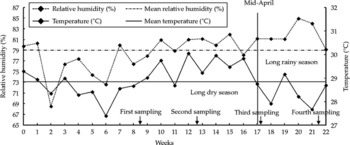
The weekly mean temperatures and relative humidity in the storage room during the trial were 28.90 ± 0.69 °C and 79.44 ± 3.63% (Fig. 1). The highest temperatures were recorded in March/April and the highest relative humidity at the end of the trial in May.
Weekly average relative humidity and temperature in storage during the trial (16 December 2008 to 21 May 2009)

Grain moisture content
Moisture content in HGB showed the same trend irrespective of the level of infestation and species of insect. The average initial moisture content was 12.05 ± 0.16%.
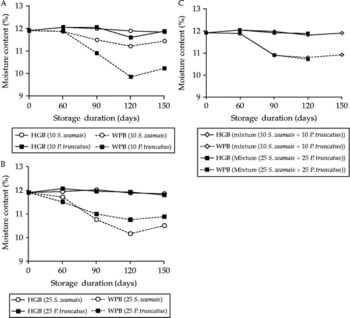
In bags infested with S. zeamais, significant differences were obtained between maize stored in HGB and WPB after 120 days when infested with 10 S. zeamais and after 90 days in maize infested with 25 S. zeamais (Fig. 2A and B). In HGB, moisture content did not vary significantly during the whole storage period (P= 0.350 (10 S. zeamais); P= 0.408 (25 S. zeamais); Fig. 2A and B). In WPB, moisture content was significantly different at 120 days of storage in bags infested with 10 S. zeamais (P= 0.0001; Fig. 2A) and after 60 days of storage in bags infested with 25 S. zeamais (P< 0.0001; Fig. 2B).
Evolution of moisture content in hermetic grain bag (HGB) and in woven polypropylene bags (WPB) during storage

In bags infested with P. truncatus (Fig. 2A and B), moisture content differed between the HGB and WPB after 60 days with 10 individuals and at all sampling dates with 25 individuals. No significant differences were observed for moisture content in HGB (P= 0.206 (10 P. truncatus); P= 0.060 (25 P. truncatus)).
Under mixed infestations (Fig. 2C), significant differences were observed between the HGB and WPB after 60 days of storage in both levels of infestation. In HGB, no significant differences regarding moisture content were observed, while in WPB, significant differences were observed at 60 days of storage in both the levels of infestation (P< 0.0001).
Number of holes on storage bags
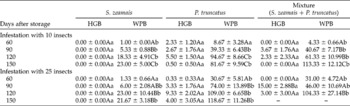
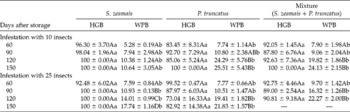
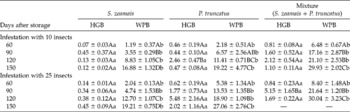
No holes were observed on HGB during the whole experimental period, when only S. zeamais was present. Significant differences were observed for the number of holes on WPB compared with HGB, except for the infestation level of 25 S. zeamais at 60 days of storage (Table 1). The number of holes increased significantly until 120 days of storage in WPB under both infestation levels (P< 0.0001 (10 S. zeamais); P= 0.006 (25 S. zeamais)).
Number (mean±SE, n=3) of holes caused by Sitophilus zeamais, Prostephanus truncatus and mixture of insects (S. zeamais+P. truncatus) on hermetic grain bag (HGB) and woven polypropylene bag (WPB)

Mean ( ± SE) values within a column (row) followed by the same uppercase letter (lowercase) are not significantly different from each other at the 5% probability level.
When P. truncatus was present, the number of holes was lower in HGB than in WPB (Table 1). For 10 P. truncatus, significant differences were observed between the number of holes in HGB and WPB after 60 days of storage. When bags were infested with 25 P. truncates, significant differences between the HGB and WPB were observed during the whole storage period. No significant differences were obtained between the different sampling dates for the number of holes observed in HGB (P= 0.387 (10 P. truncatus); P= 0.092 (25 P. truncatus)). The number of holes increased significantly in WPB up to 120 days of storage when infested with 10 P. truncatus (P< 0.0001), but with 25 P. truncatus, a significantly lower number of holes were only observed up to 60 days of storage (P= 0.001).
Under mixed infestation (S. zeamais+P. truncatus), the number of holes recorded in HGB was significantly lower than those recorded in WPB at both levels of infestation (Table 1). In HGB infested with 10 insects, no significant differences between the sampling dates were obtained for the number of holes (P= 0.173) independent of insect species. However, at higher levels of infestation, the number of holes at 120 days was significantly higher than the numbers recorded at 90 and 60 days (P= 0.009). In WPB, the number of holes increased significantly with storage duration with 10 S. zeamais+10 P. truncatus (P< 0.0001) and at higher infestation levels (P= 0.033).
Population growth of S. zeamais and P. truncatus in HGB
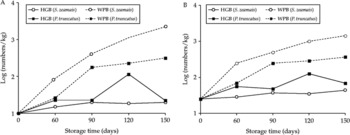
The population growth of S. zeamais in HGB and WPB is presented in Fig. 3A and B. The number of S. zeamais recorded was higher in WPB than in HGB with both infestation levels. The Sitophilus zeamais population in WPB increased significantly with storage time (P< 0.0001), while no significant difference was observed in HGB.
Population growth of Sitophilus zeamais and Prostephanus truncatus adults in HGB and WPB during storage (n= 3). A, infestation with 10 S. zeamais or 10 P. truncatus. B, infestation with 25 S. zeamais or 25 P. truncatus.

Significant differences between the HGB and WPB for P. truncatus were observed at 90, 120 and 150 days, but not at 60 days of storage (P= 0.835 (10 insects); P= 0.596 (25 insects); Fig. 3A and B). The number of P. truncatus was lower in HGB than in WPB and increased in WPB with storage duration. In HGB, significant differences were only observed at 120 days of storage (P= 0.028 (10 insects); P< 0.0001 (25 insects)) for the two levels of infestation.
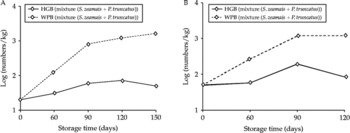
In the mixture of S. zeamais+P. truncatus, the total number of both insects was significantly higher in WPB compared with HGB at both levels of infestation (Fig. 4A and B). In HGB, infested with 10 S. zeamais+10 P. truncatus, the total number of insects at 60 days of storage was significantly lower than the levels on the other sampling dates (P= 0.009). In maize infested with 25 S. zeamais+25 P. truncatus and stored in HGB, significant differences for the number of insects were only observed between 60 and 90 days (P= 0.041). In WPB, the total number of insects increased significantly with storage duration for the two levels of infestation (P< 0.0001).
Growth of the mixture of insects (Prostephanus truncatus+Sitophilus zeamais) in HGB and WPB during storage (n= 3). A, infestation with 10 P. truncatus+10 S. zeamais. B, infestation with 25 P. truncatus+25 S. zeamais.

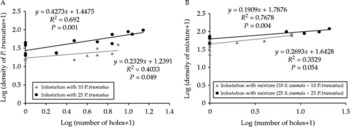
The number of holes increased with the number of P. truncatus in HGB (r= 0.64, P= 0.049 (10 P. truncatus); r= 0.83, P= 0.001 (25 P. truncatus); Fig. 5A). In HGB infested with 10 S. zeamais+10 P. truncatus, the number of holes did not increase with the number of insects (r= 0.594, P= 0.054), while under higher infestation levels, the number of holes increased with the number of insects (r= 0.876, P= 0.004) (Fig. 5B).
Relationship between insect numbers and the number of holes made in HGB. A, relationship between Prostephanus truncatus numbers and the number of holes. B, relationship between mixture (P. truncatus+Sitophilus zeamais) density and the number of holes.

Effect of HGB on the mortality rate of S. zeamais and P. truncatus
The mortality rate of S. zeamais was significantly higher in HGB than in WPB during the whole storage period under both levels of infestation (Table 2). In HGB, no living S. zeamais was recorded from 120 days of storage with 10 S. zeamais and from 90 days of storage with 25 S. zeamais. In WPB infested with 10 S. zeamais, no significant differences existed for mortalities (P= 0.254) but with 25 S. zeamais, mortality rate increased significantly with storage time (P< 0.0001) to reach 17.74 ± 1.16 at 150 days.
Per cent mortality (mean±SE, n=3) of Sitophilus zeamais, Prostephanus truncatus and mixture of insects (S. zeamais+P. truncatus) stored in hermetic grain bag (HGB)

Mean ( ± SE) values within a column (row) followed by the same uppercase letter (lowercase) are not significantly different from each other at the 5% probability level.
The mortality rate of P. truncatus was significantly higher in HGB than in WPB (Table 2). The mortality rates of P. truncatus in HGB did not differ significantly with the level of infestation (P= 0.382 (10 P. truncatus); P= 0.460 (25 P. truncatus)). In WPB, the mortality rate increased significantly with storage time (P= 0.022 (10 P. truncatus); P< 0.0001 (25 P. truncatus)); however, this mortality rate did not reach one-third of the mortality rates detected in HGB infested with 10 P. truncatus and a fourth of the rates in HGB infested with 25 P. truncatus.
When infested with S. zeamais+P. truncatus, the mortality rate was significantly higher in HGB than in the control under both levels of infestation (Table 2). In HGB, the mortality rate remained practically the same during the whole storage period for both levels of infestation (P= 0.443 (10 S. zeamais+10 P. truncatus); P =0.740 (25 S. zeamais+25 P. truncatus)), while it increased in WPB (P= 0.002 (10 S. zeamais+10 P. truncatus); P= 0.004 (25 S. zeamais+25 P. truncatus)).
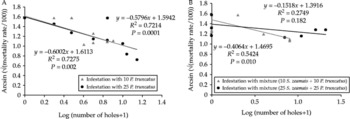
Insect mortality in HGB infested with P. truncatus decreased when the number of holes increased (r= − 0.85, P= 0.002 (10 P. truncatus); r= − 0.84, P< 0.0001 (25 P. truncatus); Fig. 6A). The same was obtained with 10 S. zeamais+10 P. truncatus (r= − 0.73, P= 0.010), whereas with 25 S. zeamais+25 P. truncatus, the number of holes did not significantly influence mortality (r= − 0.52, P= 0.182) (Fig. 6B).
Relationship between the mortality of insects and the number of holes made in HGB. A, relationship between Prostephanus truncatus mortality and the number of holes. B, relationship between the mortality of the mixture of insects (P. truncatus+Sitophilus zeamais) and the number of holes.

Effect of HGB on grain losses caused by S. zeamais and P. truncatus
Losses lower than 0.5% were observed in HGB during the whole storage period, compared with WPB, where losses of 16.88 ± 1.32 and 19.21 ± 0.75% were observed when infested with 10 S. zeamais and 25 S. zeamais, respectively (Table 3). Losses were significantly higher in WPB than in HGB and remained practically the same in HGB during the whole period of storage (P= 0.610 (10 S. zeamais); P= 0.105 (25 S. zeamais)). In WPB, losses increased significantly with storage duration under both levels of infestation (P< 0.0001).
Percentage of grain losses (mean±SE, n=3) in hermetic grain bag (HGB) caused by Sitophilus zeamais, Prostephanus truncatus and mixture of insects (S. zeamais+P. truncatus)

Mean ( ± SE) values within a column (row) followed by the same uppercase letter (lowercase) are not significantly different from each other at the 5% probability level.
In bags infested with P. truncatus, losses were significantly higher in WPB than in HGB (Table 3). At 90 days, losses in WPB were practically three times higher than in HGB. Losses in HGB infested with 25 P. truncatus did not differ significantly during the whole storage period, whereas in bags infested with 10 P. truncatus, losses were significantly higher at 120 days of storage. In WPB, losses increased with storage time (P= 0.004 (10 P. truncatus); P< 0.0001 (25 P. truncatus)).
In bags infested with a mixture of S. zeamais and P. truncatus, losses in WPB at 60 days of storage were practically double that of the highest losses recorded in HGB (Table 3). In HGB infested with 10 S. zeamais+10 P. truncatus, no significant difference was observed during the whole storage period (P= 0.152), but at higher infestation levels, a significant difference was observed at 90 days of storage (P= 0.044). Losses in WPB increased significantly with storage duration.
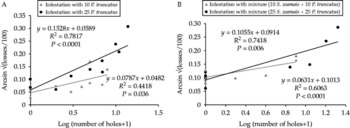
Grain losses in HGB infested with P. truncatus increased with the number of holes in the bags (r= 0.66, P= 0.036 (10 P. truncatus); r= 0.88, P< 0.0001 (25 P. truncatus); Fig. 7A). This was also observed under both levels of mixed infestation (r= 0.77, P= 0.010 (10 S. zeamais+10 P. truncatus); r= 0.86, P= 0.006 (25 S. zeamais+25 P. truncatus); Fig. 7B).
Relationship between maize losses and the number of holes made in HGB. A, relationship between losses caused by Prostephanus truncatus and the number of holes. B, relationship between losses caused by mixture of insects (P. truncatus+Sitophilus zeamais) and the number of holes.

Discussion
This study demonstrated a major reduction of progeny number, grain weight loss and a high mortality of S. zeamais or P. truncatus when maize was stored in hermetic storage bags (HGB). Temperature and relative humidity in storage during our trial were close to those favourable for optimum development of S. zeamais and P. truncatus, but in HGB, low insect development rates and high mortalities were observed compared with the normal farmer practice, e.g. storage in WPB. These effects could be due to the low oxygen permeability of HGB, and its function as a hermetic storage system when properly sealed (Rickman and Aquino, Reference Rickman, Aquino, Donahaye, Navarro, Bell, Jayas, Noyes and Phillips2007). In such an environment, oxygen levels drop sharply while CO2 accumulates via the respiration of pests, microorganisms and grains (Varnava et al., Reference Varnava, Navarro and Donahaye1995; Moreno et al., Reference Moreno, Jimenez and Vazquez2000).
High insect mortality rates were observed in HGB compared with WPB. As with all aerobic organisms, development and survival of insects is strongly correlated with oxygen concentration, so that in hermetic storage, all insect development ceases (Donahaye and Navarro, Reference Donahaye and Navarro2000) and insects perish if levels fall below 2–3% (Oxley and Wickenden, Reference Oxley and Wickenden1963; Moreno et al., Reference Moreno, Jimenez and Vazquez2000). Bailey and Banks (Reference Bailey, Banks and Shejbal1980) stated that hermetic condition delayed insect development, impaired metamorphosis and altered fecundity.
The impact of insect pest destruction on stored grain is commonly expressed in terms of the percentage of grains damaged or the percentage of grain weight loss (Boxall, Reference Boxall2002). However, crop storage efficiency depends on storage duration and losses during storage (including quality deterioration; Thamaga-Chitja et al., Reference Thamaga-Chitja, Hendriks, Ortmann and Green2004). Losses observed in the bags are linked to the infestation level and mortality rate of insects in the bag. Storage of maize in HGB minimized grain weight losses to less than 1% when infested only with S. zeamais and less than 6% for infestation with P. truncatus or the mixed insect population. These levels were much lower than those reported by Boxall (Reference Boxall2002) who observed losses of 5–10% when maize was only infested with Sitophilus spp., while losses in P. truncatus-damaged maize ranged from 15 to 45%.
According to Compton et al. (Reference Compton, Floyd, Magrath, Addo, Gbedevi, Agbo, Bokor, Amekupe, Motey, Penni and Kumi1998), insect damage has virtually no effect on price at levels below 5–6% damaged grains, but above this, the percentage of damaged grains has a strong, quasi-linear relationship with price. For every 1% increase in grain damage, the expected mean price decreased by between approximately 0.6 and 1%, so that any increase in grain losses would directly reduce the retail price. If maize can be kept nearly insect-free through the use of HGB, such grains would retail for the highest price.
Higher numbers of S. zeamais than P. truncatus were observed during the whole storage period in control bags; this could be due to S. zeamais increasing more on maize grain, while P. truncatus proliferating more easily on maize cobs than on grains. Cowley et al. (Reference Cowley, Howard and Smith1980) reported that P. truncatus development in maize grains was much slower than on cobs, but Sitophilus spp. had a higher development rate on maize grains than on cobs. In mixed populations, the number of individual insects tends to be much lower than the number of insects in single-species populations, which could be due to inter-specific competition limiting population size. Several authors (Cowley et al., Reference Cowley, Howard and Smith1980; Giga and Canhao, Reference Giga and Canhao1993; Meikle et al., Reference Meikle, Adda, Azoma, Borgemeister, Degbey, Djomamou and Markham1998; Danho et al., Reference Danho, Haubruge, Gaspar and Lognay2000) have reported that the presence of S. zeamais negatively influences the development of P. truncatus. Traditional farmers' storage ecosystems are usually infested with numerous species, so that the mixed infestation with S. zeamais and P. truncatus illustrated more closely their challenges.
There was a strong correlation between the number of holes observed on HGB and insect numbers, mortality rate and losses, so that the conclusion was drawn that holes negatively affected the efficiency of HGB. Since P. truncatus is a wood-boring insect, this species has a remarkable ability to tunnel through all kinds of material including plastics (Borgemeister et al., Reference Borgemeister, Holst, Hodges, Neuenschwander, Borgemeister and Langewald2003). The higher the number of holes, the higher the number of insects, grain weight losses and the lower the mortality rate. These results suggest that holes created by perforation would favour gas exchange and eventually HGB would no more be a hermetic storage system. However, HGB offers a superior resistance to insect damage than WPB, which is probably related to its layer structure.
In this trial, it was observed that P. truncatus makes more holes on the bags than S. zeamais, allowing the larger grain borer to exit easily from the bags. Sitophilus zeamais apparently did not make any holes on HGB and a much lower number of holes were observed on the control bag when infested only with this species, than with P. truncatus. Li (1988) reported that P. truncatus has a remarkable ability to tunnel through hard materials and was found to have penetrated plastic of 35 mm in thickness. HGBs are only 0.078 mm thick. The possibility of perforation of hermetic storage plastics such as HGB by some insects such as Rhyzopertha dominica (Coleoptera: Bostrichidae) has been reported by De Dios et al. (Reference De Dios, Cosico, Julian, Dator, Martinez, Tiongson, Donahaye, Navarro and Leesch2001) and Rickman and Aquino (Reference Rickman, Aquino, Donahaye, Navarro, Bell, Jayas, Noyes and Phillips2007), while Baoua et al. (Reference Baoua, Margam, Amadou and Murdock2012) stated that Callosobruchus maculatus Fabricius (Coleoptera: Chrysomelidae) was able to perforate HGB used for cowpea storage in Niger. Most of the holes were located near the seams of the plastic (De Dios et al., Reference De Dios, Cosico, Julian, Dator, Martinez, Tiongson, Donahaye, Navarro and Leesch2001). Also, intermittent opening and closing for sampling had led to reinfestation, and the insects were then able to pierce the polyvinyl chloride (PVC) liner, causing the system to fail (Rickman and Aquino, Reference Rickman, Aquino, Donahaye, Navarro, Bell, Jayas, Noyes and Phillips2007).
When maize was stored in HGB, moisture content remained practically the same during the whole storage period, inferring that exchanges between HGB and the external environment were limited since the bags were hermetic. However, this also means that no further drying is possible within this structure, so that grains have to be well dried prior to storage. On the contrary, grain moisture in polypropylene bags followed the evolution of the ambient relative humidity due to the permeability of these bags. This confirms that in hermetic bags, initial moisture content remains largely unchanged during storage.
Conclusion
Minimizing post-harvest losses and extending shelf-life through the use of improved storage structures are not only very effective ways of improving farm income through crop storage and sale at premium prices when demand outstrips supply later in the post-harvest period, but also offer the opportunity to smooth hunger between staple crop harvests. The results obtained in this study show that HGB potentially promises to be one of the key technologies for effective, safe post-harvest management of maize grains, and improving food security of small-scale farmers. The tested technology does seem to be very promising, especially as it was done using small-sized bags that have a much bigger surface area-to-volume ratio, making it more difficult to attain hermetic conditions. Bigger bags would be much more effective. We observed holes bored by P. truncatus on the bag; however, this did not affect the hermetic storage principle of the bags when maize was stored for 150 days. Further studies are needed (1) to assess the potential of P. truncatus for entering bags and (2) for the reuse potential of bags, e.g. for how many seasons and also the economics.
Acknowledgements
We thank Joe Rickman from IRRI Mozambique for supplying us with the IRRI Super bags for this trial.