Introduction
The proportion of older people described as coming from black and minority ethnic (BME) groups in the United Kingdom (UK) population is small, but increasing steadily as the population ages (Katbamna and Matthews, Reference Katbamna and Matthews2007). (For convenience, this paper uses the term BME for black and minority ethnic: this does not imply that the population is homogeneous.) An “experimental” data release from the Office for National Statistics (ONS, 2011) shows that the “non-white” British population has grown from 6.6 million in 2001 to 9.1 million in 2009; increasing to nearly one in six of the population with a million mixed-race people in England and Wales, i.e. a growth of 4.1% a year to a total of 2.5 million over the whole period, giving an overall rate of 37.4%. (The term “non-white” is used by the ONS to refer to all ethnic groups other than white British.) Meanwhile the white British population has stayed the same. As a result of this changing demography, the mental health of BME elders will become increasingly important over the coming years.
Definitions
To define the term BME (black and minority ethnic) elders requires agreed criteria for both older age and ethnicity. Most old age mental health services across the UK historically have used an age cut-off of 65 years. This criterion is arbitrary: increasing longevity, better quality of life for adults, and increasing pension ages have led to a rethink on the interface between services for younger and older adults (Royal College of Psychiatrists, 2011). However, new mental disorder arising above the age of 65 is likely to lead to referral to an older adult service with the assumption being that the cause of referral may be related to problems of later life.
It is more difficult to define ethnicity. The terms “black and minority ethnic” (BME), “ethnic minority” (ME), and “ethnic groups” are often used interchangeably, causing much confusion and debate. The Royal College of Psychiatrists’ report on services for BME elders (Royal College of Psychiatrists, 2009) accepts a working definition of BME individuals as “those with a cultural heritage distinct from the majority population” (Manthorpe and Hettiaratchy, Reference Manthorpe and Hettiaratchy1993). The definition of BME groups used in the government document Delivering Race Equality in Mental Health Care (Department of Health, 2005) is: “all people of minority ethnic status in England. It does not only refer to skin colour but to people of all groups who may experience discrimination and disadvantage, such as those of Irish origin, those of Mediterranean origin and East European migrants.” (p. 11)
Although a working definition is necessary, everyone belongs to an ethnic group, each of us is unique, and we all have differing needs (Lane and Hearsum, Reference Lane and Hearsum2007). BME groups refer to many different heterogeneous ethnic groups (Scheppers et al., Reference Scheppers, van Dongen, Dekker, Geertzen and Dekker2006). Shah notes that “BME elders constitute heterogeneous ethnic groups with unique experiences, and they should not be amalgamated into one group” (Shah, Reference Shah2007). Thus, whilst recognising the diversity of BME older people's experience and mental health needs, it is important to avoid talking about “BME communities” as if they are a homogeneous group and to recognise the differences within and between communities as well as within and between individuals. This paper uses the term BME elders to cover all minority ethnic groups but, in doing so, does not imply that BME elders constitute a homogeneous population.
Mental illness, socio-economic factors, and BME elders
Research shows that depression and dementia are two of the most common disorders in old age. Dementia is a growing global and political issue as well as a challenge for health and social care systems (Ferri et al., Reference Ferri2005). In the UK, research has estimated that there are approximately 700,000 people with dementia, and the total is predicted to rise to almost 1 million by 2021 (Alzheimer's Society, 2007). The prevalence of dementia and depression among BME elders from different groups in the UK is generally similar to, or higher than, the prevalence in indigenous white British elders (Lindesay et al., Reference Lindesay, Jagger, Hibbett, Peet and Moledina1997a; Reference Lindesay, Jagger, Mlynik-Szmid, Sinorwala, Peet and Moledina1997b; McCracken et al., Reference McCracken1997; Shah et al., Reference Shah, Lindesay and Jagger1998; Silveira and Ebrahim, Reference Silveira and Ebrahim1998; Livingston et al., Reference Livingston, Leavey, Kitchen, Manela, Sembhi and Katona2001; Shah, Reference Shah2008). The absolute number of cases of dementia in the BME population was estimated at 11,860 in the UK in 2004 (Alzheimer's Society, 2007). Similarly, the number of older people from BME communities with depression has been estimated to lie between 33,559 and 52,980 (Shah, Reference Shah2008).
Lane and Hearsum comment that while many elders will live into a healthy old age, research suggests that BME elders consistently experience poorer health, especially mental ill health (Lane and Hearsum, Reference Lane and Hearsum2007). Several factors have already been identified as being associated with depression and dementia in BME elders such as chronic health problems (Jang et al., Reference Jang, Chiriboga, Kim and Phillips2008), lower socioeconomic status, and poor fluency in English (McCracken et al., Reference McCracken1997; Livingston et al., Reference Livingston, Leavey, Kitchen, Manela, Sembhi and Katona2001). Social factors may have a considerable impact on health over a person's lifetime, and it has been suggested that ethnic elders face a “triple whammy” in terms of age, ethnicity, and socioeconomic deprivation (Rait et al., Reference Rait, Burns and Chew1996).
Barriers to health care
The World Health Organization's objective of “Health for all by the year 2000” suggests that we should ensure that all BME communities have equal access to health services, regardless of their standing in society (Blais and Maïga, Reference Blais and Maïga1999). Equal access to health care is a fundamental human right (Vulpiani et al., Reference Vulpiani, Comelles and van Dongen2000).
The mental health needs of older people from BME groups are less often recognised by both families and services than those of the white population (Barker, Reference Barker1984; Manthorpe and Hettiaratchy, Reference Manthorpe and Hettiaratchy1993; Shah and MacKenzie, Reference Shah, MacKenzie and Bhugra2006; Shah and Oommen, Reference Shah, Oommen, Moodley and Williams2006). Limited knowledge of dementia among families of South Asian and African/Caribbean descent (Adamson, Reference Adamson2001), lack of understanding of mental illness in some communities (Mukadam et al., Reference Mukadam, Cooper and Livingston2011), and stigma (Mukadam et al., Reference Mukadam, Cooper and Livingston2011) are important factors. It has been suggested that generational differences in BME families leading to conflicts between more traditional older people and their British born younger family members (Yu, Reference Yu2000) may hinder service provision. There is also evidence that people from BME groups in the UK and other English-speaking countries access dementia services later than people from the majority population (Cooper et al., Reference Cooper, Tandy, Balamurali and Livingston2010).
Hierarchies and caste systems in some BME communities might also impede a therapeutic relationship. Blakey and colleagues support this view and write: “the South Asian community in Bradford is a culturally and socially fragmented community. These divisions reflect caste, status, gender and generational hierarchies which derive from place of origin and which have been reproduced in place of settlement.” Other factors which can impede a therapeutic relationship from developing between service provider and patient may include education, rural-urban origins, and respect for elders (Blakey et al., Reference Blakey, Pearce and Chesters2006).
Once people get into contact with services, other factors come into play, including difficulties in diagnosing dementia (Parker and Philp, Reference Parker and Philp2004) and other conditions. Service design can itself act as a barrier (including how far services within the mainstream are appropriate and how far special services might be preferable; Royal College of Psychiatrists, 2009): care providers are often oblivious to these barriers, although they may share the burden of responsibility for them (Scheppers et al., Reference Scheppers, van Dongen, Dekker, Geertzen and Dekker2006). Most of their attention is often directed towards language discordance and cultural differences. Although language issues (Ramsey et al., Reference Ramsey, Stevens, Bryan, Binder and Cockle-Heame2009) can constitute a barrier, this narrow focus can lead to biased or misleading conclusions. Shah has suggested that, although BME elders have high rates of general practice registration and consultation, rates of contact with dementia services are low due to several factors, including communication difficulties, taboo and stigma attached to mental illness, bias and prejudice of clinicians, institutional racism, unfamiliarity of symptoms of dementia to patients and relatives, and paucity of diagnostic and screening instruments (Shah, Reference Shah2007).
Several policy documents in the UK including the National Service Framework (NSF) for Mental Health (Department of Health, 1999), NSF for Older People (Department of Health, 2001), and Everybody's business (Department of Health/Care Services Improvement Partnership, 2005), together with other influential publications including the Dementia UK Report (Alzheimer's Society, 2007) and the Audit Commission Report (National Audit Office, 2007), have highlighted gaps in services for BME elders and/or the need to develop appropriate services. Some of these policy documents and reports date back over 10 years, but the consistent message is that, despite the increasing ethnic population, services are not adapting to meet the needs of this group and barriers persist. Some authors argue that culturally appropriate services are needed to prevent people from BME communities from becoming socially excluded and finding services hard to access (Koehn, Reference Koehn2009), but what is a culturally appropriate service? These issues need to be addressed if BME elders with dementia and other mental health problems are to enjoy access to appropriate services in future.
Scheppers and colleagues (Scheppers et al., Reference Scheppers, van Dongen, Dekker, Geertzen and Dekker2006) identified potential barriers to accessing health care by BME groups using Andersen's behavioural model of access to health services (Andersen and Newman, Reference Andersen and Newman1973; Andersen, Reference Andersen1995). In the Andersen model, the use of health services is related to four main components: (i) population characteristics; (ii) environment; (iii) health behaviour; and (iv) health outcomes. Andersen states that utilization behaviour is associated with socio-demographic factors, and that socio-demographic variables account for a significant part of the variation in utilization behaviour because of their effects on important intervening variables such as need, recognition of, and response to, symptoms, knowledge about disease, perceived threat of disease, motivation to get well, and choice of health services (Suchman, Reference Suchman1965; Bice et al., Reference Bice, Eichhorn and Fox1972; Andersen, Reference Andersen1973; Andersen and Newman, Reference Andersen and Newman1973; Mechanic, Reference Mechanic1978). Scheppers and colleagues concluded that potential barriers occurred at three different levels: patient level, provider level, and system level. Barriers at the patient level were related to patient characteristics, demographic variables, social structure variables, health beliefs and attitudes, personal enabling resources, community enabling resources, perceived illness, and personal health practices. Barriers at the provider level were related to provider characteristics, skills and attitudes. Barriers at the system level were related to system characteristics, the organisation of the health care system, policies, and structure. This offers a useful way of conceptualising the barriers BME elders face in accessing services.
Despite all these challenges, innovative services for BME elders have developed in some areas of the country: these not only offer learning but also the possibility of replication elsewhere in the country. This paper reports a literature search with the aim of identifying innovative service models for BME elders and the learning that can be drawn from them.
Method
A systematic review of the literature was undertaken to identify service models for BME elders in published papers, reports, and websites between the years 1971 and 2011. The search terms “BME” and “innovative services” were combined in Pubmed and Medline using the OR operand with the terms “ethnic*,” “black,” “Asian,” “Alzheimer* disease,” “mental health”, “depression”, and innovative service, “service models”, “programs” and “dementia” and “carer*” and “family.” Searches were limited to the UK and to English language publications. Broader conceptual headings were generated by means of reading the relevant papers and further text terms were generated from these where appropriate. A Google Scholar search was also carried out to identify any additional material. One author (SB) reviewed the titles and abstracts of identified papers, and those that met one of two criteria were read in their entirety by both authors (SB and SMB). The criteria used were:
1. a service development aimed at BME elders
2. an initiative relevant to services for BME elders e.g. a service aimed at younger people from BME communities which could be extrapolated to BME elders.
A total of 49 papers were identified on a search of Pubmed and Medline, and an additional 36 papers and reports were identified on a Google Scholar search, giving a total of 85 papers. Review of the abstracts identified 16 papers as meeting one of the two criteria. These papers were obtained and read independently by both authors who generated lists of service characteristics and learning points separately. Their lists were discussed, developed further in discussion, and agreed. Since local initiatives are likely to be written up in grey literature, it is unlikely that all published models have been identified: this is a limitation of the study and highlights the difficulty of accessing grey literature.
Results
This review has identified 13 initiatives in a total of 16 papers. These appear to have developed sporadically in areas of high BME population and in response to locally identified needs. They offer examples of good practice and have often been initiated by partnership working, involving leadership from teams and individuals keen on developing services for BME elders, initiated by, or in partnership with, local voluntary sector organisations. Inevitably this has resulted in services that vary across geographic areas.
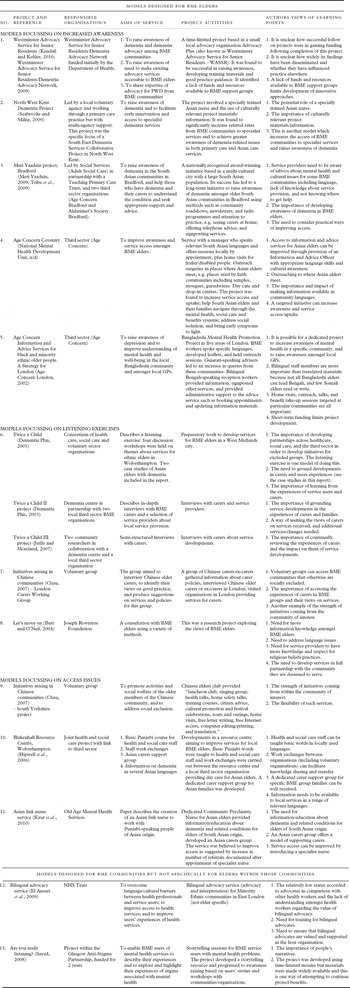
Table 1 sets out the 13 identified initiatives. Those designed for BME elders are divided into three broad categories: models focusing on increased awareness (5), models focusing on listening exercises (3), and models focusing on access issues (3). There are also two initiatives which were designed for BME communities but not specifically for elders within those communities. The Twice a Child project comprised three separate stages, which are listed together as one model, and two projects aimed at elders in Chinese communities are listed separately as two models, but are described in the same report. The learning points are based on discussion and debate between the authors and are not absolute: others may draw different learning and conclusions from the projects.
Summary of projects identified, their characteristics, and learning points arising

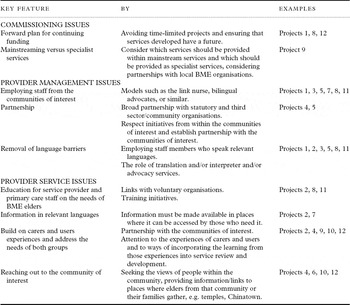
Table 2 sets out some of the key general points that can be drawn from the initiatives which are relevant to future service commissioners, reviewers and developers. A number of the models identified were developed as projects using time-limited monies and, although the intention was probably to mainstream the work and incorporate the learning into standard practice, there is no guarantee that this has been done. Nevertheless, these models could inform service developments elsewhere.
Learning points arising from the identified projects

Access to people who can speak relevant languages is an underpinning service principle, demonstrated in the two advocacy projects (El Ansari et al., Reference El Ansari, Newbigging, Roth and Malik2009; Kendall and Kohler, Reference Kendall and Kohler2010), the initiatives which employed a specialist nurse (Seabrooke and Milne, Reference Seabrooke and Milne2009; Kaur et al., Reference Kaur, Jutlla, Read and Moreland2010) and a project where Punjabi classes were made available to health and social care staff (Hipwell et al., Reference Hipwell, Hicks, Juttla, Pearson and Benbow2006). One project also identified that using a bilingual worker was more successful than information leaflets in different languages for raising awareness (Age Concern London, 2002).
For several of the identified initiatives, a major strength is a close relationship with one or more community organisations, e.g. the Twice a Child projects were developed as partnership projects: the Bradford project illustrates close working between the social care sector, third sector and National Health Service (NHS), a characteristic which has helped the initiative develop into a long-term resource for South Asian elders in the area. Linking to this theme is the strength of basing service developments on the experiences of service users and carers. The Twice a Child projects (Dementia Plus, 2001; 2003; Jutlla and Moreland, Reference Jutlla and Moreland2007), the Scottish project “Are you really listening?” (Sayed, Reference Sayed2008), and the London Carers Working Group (Chau, Reference Chau2007) demonstrate attention to the experiences of carers and service users and an endeavour to use those experiences to influence services and service developments.
Discussion
One of the limitations of this review is that it is confined to the UK. However, the themes identified are applicable more broadly to contexts elsewhere in the world where services need to address the particular cultural needs of groups within their populations. Further limitations are that the criteria for inclusion in the review were broad and that the authors extracted and agreed learning points by discussion and consensus: this method (as opposed to use of a formal tool) was selected in an attempt to maximise learning.
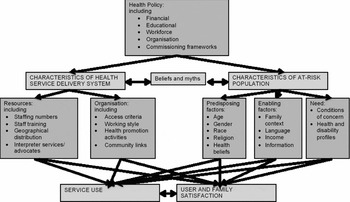
Aday and Andersen's framework for access to services offers a useful model for structuring understanding of the underutilisation/lack of access to services by BME elders (see Figure 1; Aday and Andersen, Reference Aday and Andersen1975). This divides factors involved into two main themes, characteristics of the health service delivery system and characteristics of the at-risk population, with health policy issues overarching. However, it is important to note that these two main themes often overlap.
A model for structuring understanding of the underutilisation/lack of access to services by BME elders, based on Aday and Andersen's Framework for access to services (Aday and Andersen, Reference Aday and Andersen1975).

Characteristics of at-risk BME population
Predisposing factors to consider here include race, religion, and health beliefs. Acknowledging these factors opens up options for service development: reaching out to the community of interest was a theme in a number of the developments identified and this involved services being prepared to go out to places where communities and families gather, e.g. religious buildings. Enabling factors include family context, language, and access to information. Information provision in a range of relevant languages was a provider theme (see Table 2) and ways to remove language barriers was a provider management issue. Reaching out to the community of interest might involve being open to closer working with families and respectfully seeking their views on services. Sensitivity to need requires understanding the evidence base and how it is relevant to the population of interest, e.g. some populations are at greater risk of vascular dementia (Richards et al., Reference Richards2000; Adelman, Reference Adelman2010) and other research suggest that the prevalence of severe learning disabilities in some BME communities may be higher than that of the white population (Faculty of the Psychiatry of Learning Disability Working Group, 2011).
In Figure 1 we have added beliefs and myths to the model with bidirectional influence between the health service delivery system and the at-risk population. Myths about BME communities persist amongst service commissioners and providers. One myth is that BME families invariably look after their elders (Shah and Elanchenny, Reference Shah, Elanchenny and Benson2002). Evidence does not support this; instead, it suggests that the extended family is becoming more fragile and experiencing greater tensions and burdens of care (Silveira and Ebrahim, Reference Silveira and Ebrahim1995; Redelinghuys and Shah, Reference Redelinghuys and Shah1997). Another myth is that ethnicity is a stable characteristic: Iliffe and Manthorpe note that migration leads to acculturation, so that responses attributed to a presumed stable ethnic group may be cohort effects, confined to one or two generations only (Iliffe and Manthorpe, Reference Iliffe and Manthorpe2004). A third myth is that language is the main barrier to providing services for BME communities. The use of interpreters in small communities does raise concerns about confidentiality in such communities. It is therefore important that interpreters fully understand the need to be careful in ensuring confidentiality and that service users are fully apprised of the confidentiality policies of services they are accessing. Often interpreters have no training in mental health (Cambridge et al., Reference Cambridge, Singh and Johnson2012) and mental health staff have no training in working with interpreters (Tribe, Reference Tribe2009). Bilingual advocacy services offer a useful model (El Ansari et al., Reference El Ansari, Newbigging, Roth and Malik2009), but lead to concerns regarding the differing perspectives of advocate, patient, and service. Myths operate in the other direction too and BME elders may believe inappropriately that healthcare services are not flexible, will not respect their culture and religion, and will not have access to language services.
A number of services have translated leaflets into several BME languages, but these are not always helpful as a significant number of BME older people are unable to read their mother tongue: amongst some Asian women elders’ literacy is a hindrance and other means of communication might be more appropriate. The Royal College of Psychiatrists’ report (Royal College of Psychiatrists, 2009) notes that there is little evidence of information for BME older people and their carers being made available in audio (cassette or CD) format. The report notes that innovative multidisciplinary staff members in old age psychiatry services and residential/nursing homes have improved communication on day-to-day matters by asking relatives or visiting interpreters to write down commonly used phrases and questions in the patient's mother tongue for staff to read out if the patient cannot read his or her mother tongue. This may offer a way of integrating BME elders within mainstream services. Chau noted that, although language may be a major hurdle, Chinese elders may be suspicious of Chinese people who act as links between the Chinese community and English-speaking organisations (Chau, Reference Chau2007).
A narrow focus on personal characteristics largely ignores the organizational context in which health and illness behaviour occurs (Gibson, Reference Gibson1972) and results in intervention strategies that rely heavily on public education in order to reduce the discrepancies between the expectations of patients and the health service system, while failing to take into account the need for changes in the health service delivery system itself. Asian elders have been shown to consider they have specific needs, rather than special needs, and services should aim to meet the specific needs that Asian elders themselves identity (SubCo Trust Ltd, 2007).
An additional consideration here is that there may well be differences between generations: second-generation BME elders may be better versed with, and more comfortable with, the local culture and community, and therefore more likely to use generic health services. If this is the case, any specialist BME services may be a time-limited requirement, but that does not imply that appropriate services are less necessary.
Characteristics of the health service delivery system
While developing a cultural understanding is important for providing good care for BME elders, a number of structural and organisational issues that go beyond language or culture can affect health and access to care (Tribe et al., Reference Tribe, Lane and Heasum2009). The Royal College of Psychiatrists report CR156 identifies some organisational examples of good practice, including the employment of bilingual healthcare workers and community psychiatric nurses, ready availability of professional interpreters, staffing composition reflecting local demography, and close collaboration with local voluntary sector organisations.
A major organisational issue in planning and developing services is whether BME communities should be served by separate services or as part of mainstream services with some additional accommodation being made to allow for their specific needs. There appears to be a conflict between providing a specialist service focussing on ethnicity (with some generalisation about what is appropriate to “BME communities”) and delivering person-centred care within a mainstream non-ethnically specialist service. For example, mainstream services might employ specialist workers or teach language skills to their staff. Whilst it would be unrealistic to expect staff to learn, and become proficient in, a range of languages, basic language skills (for example, knowledge of a few key words which are useful on an everyday basis) indicate to patients and their families that staff are making an effort and are interested in them as people. The projects identified were specialist in their focus but, by virtue of addressing language, spirituality, and religion, they could be described as providing person-centred care. However, language, spirituality, religion, diet, sexuality, and other characteristics are all foundations of person-centred care and hence should be applicable to all people in all services, irrespective of age, sex, gender, and ethnicity. Some groups which are not traditionally recognised as constituting ethnic minorities are known to be disadvantaged in terms of healthcare: gypsies and travellers have been shown to have poorer health than the general population, plus poor access to healthcare services (Matthews, Reference Matthews2008). Other white minorities have also been highlighted as having difficulty in accessing services and needing culturally appropriate care (Horn et al., Reference Horn, Markey and Bracher2007; Centre for Community Mental Health, 2008). In learning disability services, there has been a suggestion that the key issue lies in the perceived quality (or lack of quality) of mainstream services (Mir et al., Reference Mir, Nocon, Ahmad and Jones2001). Perhaps the same is true of services for BME elders’ mental health.
Other organisational issues might include healthcare organisations establishing community links to large local organisations at the expense of smaller organisations; working style, which perhaps unwittingly excludes people from particular communities; and gatekeeping systems which differentially exclude some groups more than others. The role of the third sector is another big issue. Voluntary sector organisations play a key role in developing culturally appropriate mental health promotion services for BME elders, perhaps due to the stronger local links between local population groups and third sector organisations – is there a learning point for commissioners and the statutory sector in engaging this sector to work more closely with mainstream services to develop person-centred services? Partnership between a range of key organisations is probably key to success in developing services for BME (and non-BME) elders.
Resource issues can affect staff numbers and training, the employment of specialist workers, use of interpreter services, and cultural advocates. Pressure of work is itself a resource issue, which can limit the time staff have available to deal with service users at greater need.
Health policy
Services for BME elders’ mental health are dependent on a number of policy issues, including educational policy and practice, workforce recruitment policy, financial constraints, and resource availability. The issue of whether services should be retained within the mainstream or developed as separate specialist provision will be influenced by commissioning practice and finances. The Royal College of Psychiatrists report (Royal College of Psychiatrists, 2009) states that “acute psychiatric services involving assessment and treatment should remain within mainstream psychiatric services, with ethnic awareness and sensitivity emphasised by training staff in culturally sensitive issues” (p. 5). It comments that services providing continuing care in the community should be developed specifically for the appropriate user group, that efforts should be made to recruit an ethnic mix of multidisciplinary staff members reflecting the population served, and recommends increased involvement and commitment by all interested stakeholders to involve general practitioners (GPs) and other key players in establishing good practice for this group of service users.
Lane and Hearsum (Reference Lane and Hearsum2007) observed that, while there is a substantive amount of national policy promoting the rights of BME elders in respect of mental health care, there is a notable absence of national data on the mental health of BME elders. Innovative services for BME elders have developed in areas where there is a higher immigrant population: this is probably to be expected. How does local demography influence service development? It will be interesting to see if such services are replicated for BME elders in areas where the BME population is low: in an area with a small BME population is there a risk of people failing to access services, or will services concentrate on providing person-centred care tailored to the individual rather than separate specialist developments?
Applying learning to practice
A big issue in applying learning to practice is to avoid tokenistic involvement of BME communities: “the only time [BME communities] get involved is when people want to do consultation events and tokenistic gestures, and I think it's about time we moved away from that and the community played more of an active role in the design and delivery of services” (Blakey et al., Reference Blakey, Pearce and Chesters2006, p. 33). There are models of service user participation, which could offer a helpful structure (Benbow, Reference Benbow2012).
The Royal College of Psychiatrists Report (2009) identified several areas of good practice, and recommended that “a means to share information would be to set up a website linked to the College's website” (p. 5). Unfortunately this was not done. A means of identifying and sharing good practice would have two major benefits, preventing duplication of effort and assisting in replicating established and tested service models elsewhere. Literature available only on the internet tends to be impermanent and unstable: it can also be difficult to locate. A way to capture and ensure access to documents which otherwise would be lost over time would prevent learning being lost and efforts being reduplicated. In addition, a number of the projects identified here were started with time-limited funding and it is difficult to know how many have continued. This observation highlights the importance of ensuring continuing funding in order to avoid withdrawing initiatives, letting people down, and alienating already socially excluded groups.
Conclusion
Despite the existence of a number of models for developing services to BME elders, the learning from them has not become disseminated across the UK and mental health services for BME elders across the UK vary in approach and design. There is a need for ongoing high-quality research and service evaluation using appropriate standardised instruments. However, the main emphasis in future should be on ensuring that learning is shared, retained, and disseminated, and that ways are found to apply it consistently in practice to the benefit of all communities across the whole of the UK. Person-centred care benefits everyone who uses services and an emphasis on delivering holistic person-centred mental health services for all would meet the needs of BME elders across the UK.
Conflict of interest
None.
Description of authors’ roles
S. Bhattacharyya designed the study, carried out the literature search, and reviewed the titles and abstracts of identified papers. Both authors read the papers meeting the required criteria, and learning points were developed by both authors in partnership. Both authors contributed to writing of the paper.