Typhoon Haiyan, a category 5 tropical cyclone, made landfall in the Philippines on November 8, 2013, killing more than 7000,Reference Guha-Sapir, Hoyois and Below1 mainly on the island of Leyte. During that time, Ormoc City, the second-biggest city on the island, had 1 government hospital (Ormoc District Hospital [ODH]) and 4 private ones. In the weeks after Haiyan, ODH was the only functional public hospital. ODH was supported by different international nongovernmental organizations, including Mercy Malaysia (MM), which arrived a few days after Haiyan and established a field hospital.
In previous floods and typhoons, the main communicable diseases reported through medical consultations were water-borne diseases, vector-borne diseases, and acute respiratory tract infections. Other health risks in floods include drowning and injuries or trauma.2
Still, to understand which are the main medical problems after disasters and who is more affected, a comparison with a control period is needed in a standardized way.Reference Jafar, Norton and Lecky3 The lack of uniform standards to collect symptoms and diagnoses often makes comparison with the predisaster situation challenging.
The objective of our study was to describe the reasons for medical consultation in the field hospital operated by MM after typhoon Haiyan. Because the local surveillance reporting system was used to classify consultations, this allowed for comparison to a control period as well as to other disaster events.
METHODS
Study Setting
We conducted an observational study based on routinely collected data from the outpatient consultations within the field hospital managed by MM. This field hospital became operational 12 days after Haiyan. The field hospital replaced the outpatient consultations of ODH during that period, because their outpatient department was not operational. All consultations were performed for free. The target population included Ormoc City and the 110 barangays in the Ormoc City area. We included 5 weeks of consultations, from the first operational day on November 20 to December 24, 2013.
Data Collection
The consultations were carried out daily by 3 to 4 MM certified medical doctors. All consultations were registered by a local administrative person in a logbook. Data were entered by the research team using Epidata v4.2.0.0. The variables collected for each consultation were date of birth, sex, name, date of consultation, diagnoses registered by the doctor, diagnoses recoded according to the Surveillance in Post-Extreme Emergencies and Disasters (SPEED) classification. SPEED is an early warning system designed to detect early unusual increases or occurrences of events, monitor them, and enable the identification of an appropriate response.Reference Tante, Villa and Pacho4 It captures events on 21 diseases with case definitions. SPEED was activated in response to Haiyan in Ormoc. Patients could have several diagnoses within 1 consultation. We excluded consultations without information related to sex, age, and diagnosis. In addition, we excluded consultations that could not be classified under 1 of the SPEED categories.
We compared the diagnoses with the number and proportion of upper respiratory tract infections (URTIs) in ODH with a similar period in 2014 (the control period, exactly 1 year after the typhoon).
Data Description
We categorized the 21 SPEED diagnoses in 3 groups: communicable diseases (CDs), noncommunicable diseases (NCDs), and injuries. Injuries included open wounds, bruises, and fractures.
Acute respiratory infections were classified into acute upper respiratory tract infections if the main organs affected were nose, sinuses, middle ear, larynx and pharynx, and acute lower respiratory tract infections (LRTIs) if trachea, bronchi, and lungs.
Data Analysis
We estimated the proportion of each type of diagnosis by sex and age group. We also calculated the proportion of each diagnosis by sex, and the types of consultation for each of the 5 weeks. We used Pearson chi-square tests to test whether differences between groups were statistically significant. A P-value of < 0.05 was considered to be statistically significant based on 2-sided tests. Data were analyzed using Stata 14.
We calculated the share of URTI consultations by dividing the number of daily consultations reported by the number of days at the field hospital. We did similar calculations for the control period in November and December 2014.
Ethical Considerations
As this study used data already collected during the MM response and our objective was part of a regular evaluation of the intervention, the approval of an Ethical Review Board was not required. Patient data were used anonymously.
RESULTS
Demographic Characteristics of Patients
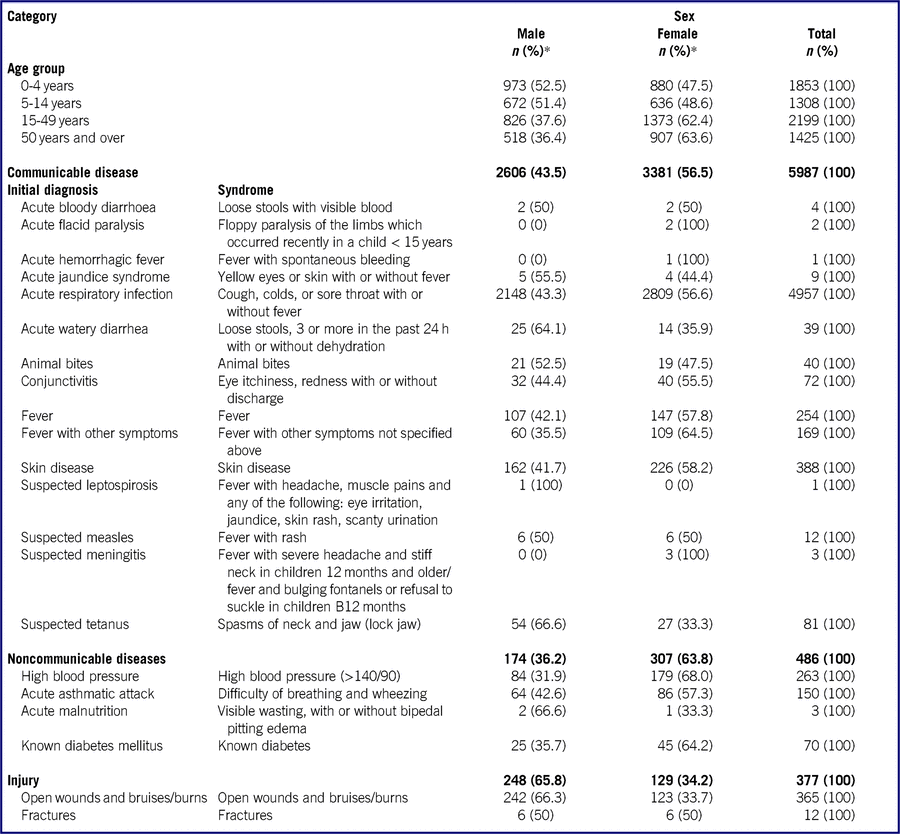
A total of 6785 consultations, matching the inclusion criteria of our study, were performed during the 5-week period. There were 117 patients who received 2 SPEED diagnoses within a single consultation, and 1 patient who received 3. The average age of the patients was 26.6 years old (SD 23.0). Women attended more frequently than men (55.9% vs. 44.1%, respectively). However, this was not the case in younger patients, where the proportion of male consultations was slightly higher (Table 1).
Number of Consultations by Sex, Age Group, and Type of Consultation, November 20 to December 24, 2013, Ormoc Field Hospital, the Philippines

* Proportions by age group add up to 100%.
Clinical Characteristics of Consultations
The proportion of patients diagnosed with 1 or more CDs was 88.2%, followed by NCDs (7.1%) and injuries (5.6%). Males suffered more often from injuries than women (65.8% vs 34.2%), while women were more often affected by NCDs (63.8% vs 36.2%) (Table 1).
The top 5 diagnoses were acute respiratory infections (ARIs) (73.1% of patients), skin diseases (5.7%), open wounds and bruises/burns (5.4%), high blood pressure (3.9%), and fever (3.7%). In children aged 0-4 years, ARIs, acute watery diarrhea, and skin diseases were more prevalent than in other age groups (Table 1). Animal bites and tetanus diagnoses were relatively high in 5 to 14-year-olds compared with other age groups. In patients aged 50 or higher, high blood pressure and known diabetes mellitus were more prevalent than in other age groups. Of the total number of injuries (377), 211 diagnoses had further clinical details, of which 60 were puncture wounds, 37 were infected wounds, and 20 were lacerated wounds. Only 12 consultations were due to fractures.
Consultations Over Time
We analyzed the consultations matching our inclusion criteria by week. The proportion of consultations decreased from the first week (29.8%, 2019 consultations) to the fourth and fifth (15.4%; 1047 consultations in week 5) (Figure 1).
Number of consultations by study week, from 20 November to 24 December 2013, Ormoc field Hospital, the Philippines.

The proportion of communicable disease diagnoses was high overall, but lowest in the first and the last study weeks. In contrast, diagnoses for noncommunicable diseases were proportionally highest in those weeks. Consultations due to injuries decreased from 10.0% in the first week to 2.9% in the last week.
ARIs
The proportion of patients diagnosed with an ARI differed significantly according to sex (71.9% male and 74.0% female; P = 0.049). With respect to age, 83.0% of children aged 0-4 years were diagnosed with ARIs, while this proportion decreased with an increase in age. The proportion of patients above 50 years old diagnosed with an ARI was 63.6%. This difference between age groups was also statistically significant (P < 0.001). Most of the ARIs (93.8%) were upper ARIs whereas 6.1% were lower ARI. Patients above 50 years old were more often affected by lower ARIs as compared with other age categories. The proportion of lower respiratory tract infections increased over time from 1.2% in the first week to 9.3% in week 5 (data not shown).
The number and share of upper ARI consultations per day in the field hospital (n = 107 URTI consultations per day) were higher than in the control period (n = 53).
DISCUSSION
Our study described the demographic and clinical characteristics of a field hospital established in response to Typhoon Haiyan in Ormoc. It showed a high proportion of CDs, in particular ARIs, compared with NCD and injuries, and a relatively high incidence of certain types of wounds shortly after the typhoon, particularly among men.
ARIs were the main diagnosis during this period. This is in line with the reasons for consultation in the ODH in the control period, where respiratory infections were also the most prevalent pathology. Nonetheless, we observed rates twice as high during the field hospital compared with the control period in 2014. Literature from conflict and natural disaster settings, such as refugee camps, suggests very high excess morbidity and mortality (20–35% case fatality due to ARIs). Another study from our group on hospital admissions due to Haiyan found a relative increase in respiratory diseases, in particular pneumonia, after the typhoon compared with before, in line with our results.Reference van Loenhout, Gil Cuesta and Abello5 Humanitarian agencies should, therefore, prioritize ARI prevention and control, particularly among infants, but also among children and adults during the response.Reference Bellos, Mulholland and O’Brien6 We showed a peak in the proportion of ARIs during the second week. This may be due to a worsening in the living conditions due to Haiyan during the following weeks. Basic material losses, such as living in houses without a roof or isolation, exposure to flood waters and rain, and lack of food were repeatedly reported after Haiyan.2 This situation could have exposed individuals to an increased vulnerability toward respiratory infections. A previous study conducted in the aftermath of Haiyan recommended the use of rapid diagnostic tests for the surveillance of ARIs.Reference Saito-Obata, Saito and Tan7 Our results emphasize the need of being prepared to manage and treat a large number of ARI patients after typhoons. For patients on antibiotics, a complete treatment should be ensured, because anecdotal evidence from ODH after Haiyan showed that free antibiotic treatment was provided only for the first 2-3 days, potentially compromising adherence to treatment.
Our study showed a higher proportion of injuries during the first week of operations, which decreased in the weeks following. This is in line with studies on typhoons, where injuries have been attributed to flying debris and falling infrastructure. Wounds were much more frequent than fractures. This supports the results from another study, describing minor injuries to predominate over fractures after Haiyan.Reference Salazar, Law and Pesigan8 Because many people died directly during Haiyan due to drowning, injuries observed at the field hospitals were mostly minor. In addition, the field hospital started functioning 12 days after Haiyan, therefore, some of the fractures and other severe injuries caused by the typhoon might not have been attended here. The number of injury diagnoses was higher among men than among women. Wounds’ most frequent presentation was as puncture wounds, such as lesions due to nail pricks. Literature shows that minor trauma in typhoons is due to clean-up activities.Reference Smith and Graffeo9 This could explain the wounds distribution the first week of consultations (2 weeks after Haiyan) in our study. This is the period after which clean-up and reconstruction generally begin, and men are on average more involved than women. We recommend to prevent and prepare to manage these injuries during the early stage and target individuals involved in these activities, generally adult men.
Limitations
Our period of study is limited to the period from 12 to 46 days after Haiyan when the field hospital was operational. This means that we were not able to describe the health-care needs for the first days after the typhoon. However, because the ODH was not functional during that period, we are actually including all the data available.
Literature has shown there was a dip in consultations, until 10 days after Haiyan,Reference van Loenhout, Gil Cuesta and Abello5, Reference Salazar, Pesigan and Law10 and this trend was also visible in our data from the second study week onward. Further analysis should look at why requests for health care decreased during that specific time frame and how accessibility impacted consultations and health outcomes.
We classified consultations as communicable or noncommunicable, according to the described symptoms, which was uncertain in some cases due to the scarcity of information collected.
CONCLUSIONS
Our study showed that there was a high number of consultations matching 1 of the SPEED diagnoses at the field hospital during the period after Typhoon Haiyan. The clinical characteristics of diagnoses showed a similar profile to other disaster settings, where communicable diseases were the most prevalent. ARIs showed much higher rates compared with the control period during 2014. We recommend that ARI treatments are fully prioritized after such a disaster event. Due to a high initial load of injuries, effective management of this is essential during the weeks following a typhoon. Its prevention should be focused on persons involved in clean-up activities, in particular adult men. Research conducted in the aftermath of natural disasters should include the use of control periods as a methodological approach. This is useful to better understand the burden and pattern of diseases and, therefore, improve the prioritization implemented by humanitarian actors in natural disasters.
Acknowledgments
We thank the ODH and Mercy Malaysia teams for their work responding during the emergency, and for the extra effort of collecting the data used for this study. Thanks to Ruth Poliquit for her support on the implementation of the study and to Alieza Socorro and Simone Gloria M’Bala for their support during the data validation process. Thanks to Chiara Altare for her involvement during the conception of the study.
Author Contributions Statement
J.G.C., J.A.F.V.L., M.M., and D.G. conceived the study. J.G.C., J.A.F.V.L., M.M., and M.L.L.B. collected and revised the data. J.G.C. and J.A.F.V.L. analyzed the data. J.G.C., M.M., and J.A.F.V.L. interpreted the data. J.G.C. wrote the manuscript. All authors revised the manuscript and approved the final version.
Funding Statement
This study is part of the EM-DAT project and has been financed by the United States Agency for International Development (USAID), Office of U.S. Disaster Assistance (OFDA), agreement no. AID-OFDA-A-15-00036. The funder had no role in study design, data collection and analysis, decision to publish, or preparation of the manuscript. CRED funded the research expenses related to open access publishing fee.
Conflict of Interest Statement
The authors declare that they have no competing interests.