Do election outcomes reflect the extent to which current government policy is liberal or conservative? A set of existing studies implies so. Wlezien (Reference Wlezien1995, Reference Wlezien1996) argues public opinion works as a thermostat in the sense that policy preferences respond negatively to policy change. Thus, liberal policies, for example, result in a less liberal public (see also Erikson, MacKuen, and Stimson Reference Erikson, MacKuen and Stimson2002). Related studies further argue public opinion influences election outcomes, as less liberal preferences translate into fewer liberal votes (Erikson, MacKuen, and Stimson Reference Erikson, MacKuen and Stimson2002; Stimson Reference Stimson1999b). Although these studies imply that current government policy shapes election outcomes through public opinion, this implication has not been subjected to direct empirical inquiry, nor has it received thorough theoretical discussion.
The implication that votes reflect current policy is referred to in this article as “thermostatic voting:” More liberal policy satisfies the demands of a liberal few, and with less demand for additional liberal policies, liberal candidates receive fewer votes. The following paradox presents itself: Political actors elected with the help of a particular public mood, and who in turn respond to the public's demands as promised, may diminish their own electoral prospects. Thus, politicians may have an incentive to withhold promised changes to avoid satisfying the demands that got them elected into office. This incentive would conflict with the model of electoral accountability, which assumes it is rational for politicians to respond to public demands in an accurate way to avoid electoral defeat. The tension between these two models poses a challenge to the theoretical framework, as this framework contains them both (Erikson, MacKuen, and Stimson Reference Erikson, MacKuen and Stimson2002; Stimson, MacKuen, and Erikson Reference Stimson, MacKuen and Erikson1995; see also Soroka and Wlezien Reference Soroka and Wlezien2004, Reference Soroka and Wlezien2005, Reference Soroka and Wlezien2010; Stimson Reference Stimson, Przeworski, Stokes and Manin1999a, Reference Stimson2004; Wlezien Reference Wlezien2004).
Although the existing literature rests on a sound empirical foundation, the analyses rely on a limited number of observations with respect to presidential elections. This article therefore provides new data that expand an existing time series of American policy liberalism so that it covers the period from 1947 to 2008, which encompasses fifteen presidencies. The new data test the hypothesis of thermostatic voting, and the hypothesis does receive support. Given the tension between the models of thermostatic voting and electoral accountability, the article concludes with a discussion of how certain features of the empirical results may allow for the presence of both.
BACKGROUND
Whereas voters long appeared disappointingly uninformed about politics, and their policy preferences seemed random and incoherent,Footnote 1 Stimson's Public Opinion in America demonstrates that the preferences of American citizens conform to a coherent overall pattern, referred to as their public policy mood (Stimson Reference Stimson1991, Reference Stimson1999b; Stimson, MacKuen, and Erikson Reference Stimson, MacKuen and Erikson1994). Stimson further argues the single dimension of liberalism versus conservatism suffices to capture the mood of the American public.Footnote 2 Because the items that make up this dimension tend to be issues of more or less government, Stimson's measure of mood captures policy preferences that are relative to current policy.
Classic system theories of democracy suggest that such relative policy preferences respond to policy outputs and generate feedback in the political system (Deutsch Reference Deutsch1963; Easton Reference Easton1953, Reference Easton1965). This view is supported by Wlezien (Reference Wlezien1995, Reference Wlezien1996), who argues the public works like a thermostat: The public adjusts its calls for more or less spending in a policy area according to what it gets. In general terms, “the public's preference for more [or less] policy—its relative preference […]—represents the difference between the public's preferred level of policy […] and policy […] itself” (Wlezien Reference Wlezien1995, 985–986, see also Erikson, MacKuen, and Stimson Reference Erikson, MacKuen and Stimson2002; Franklin and Wlezien Reference Franklin and Wlezien1997; Soroka and Wlezien Reference Soroka and Wlezien2010). Whereas Wlezien applies this model to spending in specific policy areas, this model has also been applied to the liberal-conservative dimension (Erikson, MacKuen, and Stimson Reference Erikson, MacKuen and Stimson2002, 325–382). The public's preferred level of policy along this dimension is referred to in this article as its Preference, and its relative preference as Mood. Thus, Wlezien's model can be expressed as:

where the subscript t refers to time and λ is the appropriate lag of policy (depending on how quickly the public takes notice of new policies). This model implies that mood will be positively affected by an increase in the public's preference and negatively affected by an increase in policy.Footnote 3
Looking at the effect of mood on policy, Stimson, MacKuen, and Erikson (Reference Stimson, MacKuen and Erikson1995) argue “dynamic representation” takes place in the United States (see also Erikson, MacKuen, and Stimson Reference Erikson, MacKuen and Stimson2002). In other words, policy changes when mood changes, so that the former tracks the latter over time. For example, a more liberal public mood results in more liberal policies. Two mechanisms are said to account for this relationship. One is that of “rational anticipation”—the notion that politicians adapt to changes in mood to avoid electoral defeat. The other is the “turnover” mechanism—the notion that mood influences election outcomes, putting new politicians in power and, thus, indirectly affecting policy. More specifically, a liberal mood is expected to translate into a larger liberal (i.e., Democratic) vote share, and ultimately to more liberal policies. Accordingly, a few studies attempt to explain presidential elections by the current mood (Erikson, MacKuen, and Stimson Reference Erikson, MacKuen and Stimson2002, 237–283; Stimson Reference Stimson1999b, 97–120).Footnote 4
Although both the effect of policy on mood and the effect of mood on presidential elections have received empirical support, neither is as firmly established as one might expect. Looking at the impact of mood on presidential elections, Stimson (Reference Stimson1999b) analyses 11 observations of the national vote. Erikson, MacKuen, and Stimson (Reference Erikson, MacKuen and Stimson2002, 243) regret that “between 1952 and 1996,” they “have a scant 12 observations of presidential elections for statistical analysis,” and state “any statistical results must remain tentative and open to rival interpretation.” This article adds to policy data presented in current literature and focuses on the hypothesis of thermostatic voting, which is presented in the following text. This approach allows more elections to be included in the analysis, and a positive result will increase confidence in earlier findings.
THERMOSTATIC VOTING AND ELECTORAL ACCOUNTABILITY
Taken together, the earlier studies imply that election outcomes, in terms of support for one party rather than the other, react to policy. If elections are influenced by mood and mood is influenced by policy, then elections must be influenced by policy. The effect of policy on elections is referred to here as thermostatic voting. If the liberal end of the liberal-conservative dimension is given higher values on each variable, thermostatic voting can be modeled by this equation:

where α is a constant, β is a coefficient, ɛ is an error term capturing all other influences, and equation 1 is used to replace mood in the last part. In terms of change we have:

The negative feedback of policy in this model is rather paradoxical. For example, it suggests a Democratic incumbent will lose votes by enacting liberal policies, as the public's mood will grow more conservative.Footnote 5 In other words, political actors elected with the help of a public mood, and who subsequently respond to the public's demands as promised, may diminish their own electoral prospects. This electoral reaction could give politicians an incentive to constrain the fulfillment of public demands to avoid satisfying the mood that helped elect them into office.
Thus, the model of thermostatic voting stands in notable contrast to that of electoral accountability, which instead requires voters to punish poor representation of voter preferences (e.g., Maravall and Sánchez-Cuenca Reference Maravall and Sánchez-Cuenca2007; Przeworski, Stokes, and Manin Reference Przeworski, Stokes and Manin1999). According to the latter model, a Democratic incumbent should not be losing votes by satisfying a liberal policy mood, but rather by failing to do so. This idea is also reflected in the theory of dynamic representation, as the mechanism of rational anticipation assumes it is rational for politicians to please the electorate in terms of policy (Erikson, MacKuen, and Stimson Reference Erikson, MacKuen and Stimson2002; Stimson, MacKuen, and Erikson Reference Stimson, MacKuen and Erikson1995). The idea of electoral accountability suggests the incumbent will gain votes if the gap between policy and the public's preference is decreased, and lose votes if the gap grows. In other words, the incumbent will be rewarded for reducing the absolute value of mood, and punished for increasing it, as expressed by this model:

In the case of a Democratic incumbent, for whom the model is more easily compared to the preceding models, we have:

In other words, for a Democratic incumbent, the models of thermostatic voting (equation 3) and electoral accountability (equation 5) overlap when policy is more liberal than the public's preference, so that mood is conservative. A Democratic incumbent enacting liberal policies will then lose votes according to both models. The models conflict, however, when the public's preference is more liberal than current policy so that mood is liberal, which is a likely situation for a newly elected Democrat. In this situation, electoral accountability suggests that satisfying the liberal mood by enacting liberal policies will be rewarded, whereas thermostatic voting suggests the opposite. To test the hypothesis of thermostatic voting and to facilitate further research on these topics, this article provides new policy data through a brief review of recent American political history.
MEASURING CURRENT POLICY
Erikson, MacKuen, and Stimson (Reference Erikson, MacKuen and Stimson2002, 328–336, 374–380) construct a measure of policy that works well in relation to mood, and it is used here as well. They code the ideological content of enactments seen as important at the time, as listed by Mayhew (Reference Mayhew1991). Their data cover the period from 1953 to 1996, which would only allow the analysis of 10 presidential elections (given the appropriate lag).Footnote 6 However, this is an unnecessarily short series. Mayhew's first investigation starts with 1947, and he continues to make available lists of more recent enactments (the more recent sources of relevance are: Mayhew Reference Mayhew2005, Reference Mayhew2008, Reference Mayhew2009a, Reference Mayhew2009b). To strengthen the analysis, this article provides new policy data for the years from 1947 to 1952 and from 1997 to 2008. This means that 5 additional elections can be included in the analysis.
The data have been produced in accordance with Erikson, MacKuen, and Stimson's procedures which means that enactments relating to agriculture or foreign or defense policy, and those with a predominantly local impact, have been excluded. Erikson, MacKuen, and Stimson's strategy of coding the content based on their own judgment of “whether the law was seen by contemporary observers as moving policy in a conservative or a liberal direction” has also been pursued here (Erikson, MacKuen, and Stimson Reference Erikson, MacKuen and Stimson2002, 330). Such coding inevitably relies on subjective judgment, and it involves many tough decisions, some of which are discussed in the text that follows. Several enactments have been omitted because they were trade-offs or had an ambiguous content. Scholars who disagree with particular coding decisions, but who would like to use these data, are invited to revise the coding.
A few additional coding decisions are worth mentioning. Enactments with a “triggering cause more or less external to American national politics” (Mayhew Reference Mayhew2005, 136) have not been excluded automatically. Such enactments have often been perceived as involving important policy changes, and they reflect the political environment of their time. Enactments with sunset clauses have neither necessarily been excluded, as their enactment often has been seen as (at least signaling) important policy changes, in contrast to their termination.
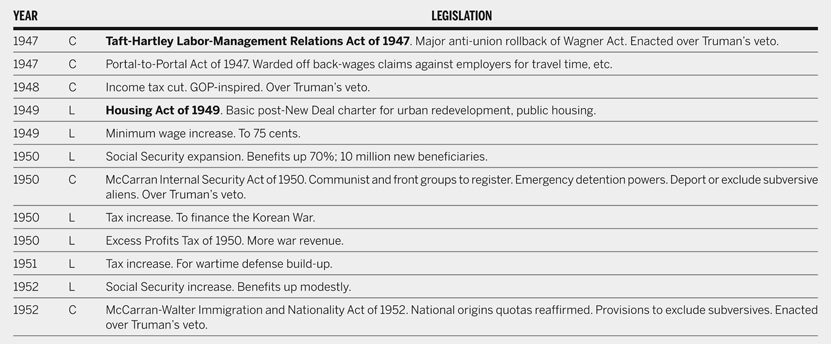
Table 1 reports the enactments coded from 1947 to 1952. Enactments judged by Mayhew to have been exceptionally important at the time are in bold. The most difficult cases in this period are the three temporary tax increases made to finance the Korean War. Because the war could have been financed in other ways, and in accordance with the procedures laid out earlier, these bills have all been counted as liberal.
Important Enactments, 1947–1952, Scored for Ideological Content and Importance

Note : L represents a liberal change in policy, and C a conservative one. Exceptionally important enactments (according to Mayhew) are in bold.
Source : Mayhew (Reference Mayhew2005).
From 1991 to 1996, Erikson, MacKuen, and Stimson's data were not based on Mayhew, but generated using similar procedures.Footnote 7 Comparison with a coding of Mayhew's later published data suggests a high level of reliability. Nevertheless, there are a few disagreements, and, in these cases, the measure used in this article follows Mayhew. Note, however, that this adjustment is so marginal it has no notable effect on the results. Mayhew's coding is preferred for consistency—it now serves as basis for the whole dataset. The relevant disagreements are the following: Erikson, MacKuen, and Stimson do not count the Omnibus Energy Act of 1991, which here is scored as liberal. In 1996 they count as conservative a bill regarding same sex marriages that is not counted by Mayhew, and therefore is disregarded here. In the same year, they leave out an overhaul of pesticides regulation that is counted by Mayhew, and in this article it is coded as liberal.
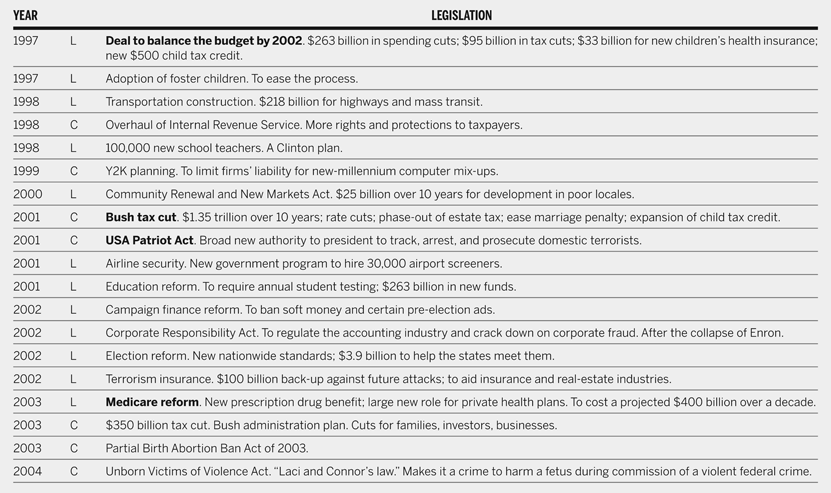
Table 2 reports the coded enactments from 1997 to 2004.Footnote 8 A dominant feature of this period was the terrorist attacks of September 11, 2001. Eight enactments could be identified as triggered by these events. Assessing their ideological content and deciding whether to count these enactments is often hard. After consideration of each, in light of the generally applied criteria, only three remain in the table: the 2001 Patriot Act, the airline security bill of the same year, and the 2002 terrorism insurance bill. The first and the last of these enactments have been counted as liberal. This coding may seem to place the threshold too low, but excluding these enactments would seem too restrictive compared to Erikson, MacKuen, and Stimson.Footnote 9 Another hard case in this period is the 2003 reform of Medicare, which was criticized both for being too expensive and for assigning the private sector too large a role. This reform could have been excluded as an ideological trade-off, but it has been kept on the list as a mainly welfare-expanding (liberal) measure.
Important Enactments, 1997–2004, Scored for Ideological Content and Importance

Note : L represents a liberal change in policy, and C a conservative one. Exceptionally important enactments (according to Mayhew) are in bold.
Sources : Mayhew (Reference Mayhew2005, Reference Mayhew2008).
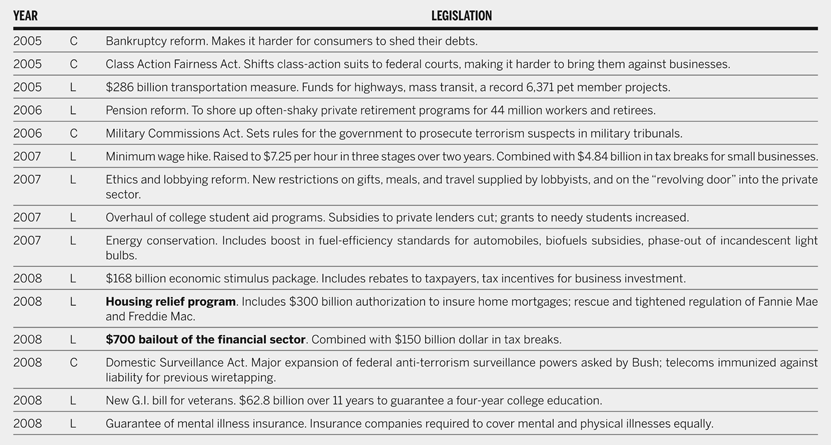
Table 3 reports the coded enactments from 2005 to 2008. In this period, another four enactments can be seen as triggered by September 11. Two of these have been kept as conservative measures: the 2006 Military Commissions Act and the 2008 Domestic Surveillance Act. In 2008, the financial crisis triggered three major enactments: the $168 billion stimulus package, the housing relief program, and the $700 billion financial sector bailout. Although these enactments were in part criticized for being too supportive of business, they all have been counted as liberal measures, involving greater governmental intervention in the economy.
Important Enactments, 2005–2008, Scored for Ideological Content and Importance

Note : L represents a liberal change in policy, and C a conservative one. Exceptionally important enactments (according to Mayhew) are in bold.
Sources : Mayhew (Reference Mayhew2009a, Reference Mayhew2009b).
Based on the enactments listed in tables 1, 2, and 3, and the slightly revised version of Erikson, MacKuen, and Stimson's list for the years in between, a measure of current policy liberalism has been created. Liberal enactments have been coded as 1 and conservative enactments as −1. In addition, enactments listed as exceptionally important by Mayhew have been given double weight. Then, for each year, all bills enacted into law by the end of the year have been cumulated to produce a measure of cumulative policy liberalism. However, as Erikson, MacKuen, and Stimson note, most enactments are liberal, and political battles can be seen as mainly revolving around the pace of liberal legislation. This observation can be taken into account by using the overall trend as a base from which to view the status quo. To achieve this, the cumulative measure has been regressed on time. The set of residuals obtained from this regression measure cumulative policy liberalism with the linear trend removed and is referred to as Policy. Erikson, MacKuen, and Stimson (Reference Erikson, MacKuen and Stimson2002, 348) lag policy by two years when they predict mood, while they use the current mood to predict election outcomes. As their analyses thus imply a two-year lag for the effect of policy on elections, a two-year lag is used here as well.
ANALYSIS
As mentioned, the main hypothesis presented is that when current policy is more liberal, the Democratic candidate receives fewer votes, and vice versa. The number of variables in the analysis is kept to a minimum due to the limited number of observations. Along with policy, only a variable representing the incumbency advantage is included. This variable, which has proven relevant in prior studies (e.g., Stimson Reference Stimson1999b, 97–120), is included because of its theoretical importance, which will be discussed in the text that follows. Thus, the main equation to be estimated is this:

where β is expected to be negative, γ is expected to be positive, and variation in the public's non-relative policy preference is captured by the error term.
Leaving policy aside, the operationalization of the variables is straightforward. The dependent variable is the Democratic presidential candidate's share of the combined Democratic and Republican votes. The data are from the US Census Bureau (2008) and Federal Election Commission (2009). Although imperfect, the two-party vote share is a convenient expression of the support for one major party relative to the other, leaving out third-party candidates. The incumbency advantage is represented by a variable referred to as Incumbency. It has been scored 1 when a Democratic president is seeking re-election, 0 when a Republican is, and .5 otherwise.Footnote 10 As a final step, the policy variable has been recoded so that it takes on a maximum of 1 and minimum of 0, making the magnitude of its effect more readily interpretable and comparable.
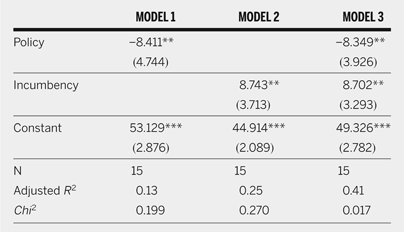
The results of the analyses are reported in table 4. Model 1 includes only policy and shows a sizeable coefficient for this variable. The coefficient has the expected sign and it is significant at the 5% level. Measured by the adjusted R 2, it explains 13% of the variance. Model 2 contains only the incumbency variable. This variable also has a sizeable and significant coefficient with the expected sign, explaining a fourth of the variance. Model 3 includes both variables, which increases the explained variance to 41%. The two estimates are hardly changed, while their standard errors are reduced, underlining that this is a better-specified model.Footnote 11
Models of Democratic Two-Party Vote Shares in American Presidential Elections, 1952–2008

Note:
*** p < .01,
** p < .05,
* p < .10, in one-tailed tests.
Standard errors are reported in parentheses. Chi 2-entries refer to Breusch-Godfrey (LM) tests for first-order autocorrelation.
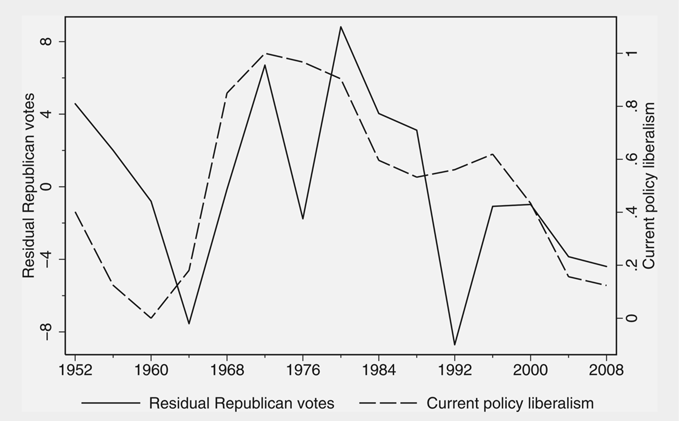
The identified feedback from policy to election outcomes is not only statistically significant, but also of a considerable magnitude. When policy is at its most liberal, as opposed to most conservative, support for the Democratic candidate in terms of the two-party vote is lower by more than eight percentage points.Footnote 12 The corresponding standardized regression coefficient is −0.44. Figure 1 illustrates the effect of policy, plotting it over time together with residual vote shares, taken from model 2, which only includes the incumbency advantage. As the effect of policy is negative, the residuals have been reversed to ease interpretation. Thus, the residuals refer to Republican votes, while liberalism still scores high with regard to policy. The policy measure used here is the same as noted earlier, except it is not lagged. Thus, not surprisingly, the plot appears to show a lagged effect of policy, in accordance with earlier studies.
Policy Liberalism and Votes over Time
Note: The vote residuals have been obtained from a regression only including the incumbency advantage.

DISCUSSION
The analysis supports the notion that thermostatic voting takes place in American presidential elections. When policy is more liberal, the Democratic candidate receives fewer votes, and vice versa. On closer inspection, however, the results not only support the hypothesis derived from the literature, but also do so in a way that seems compatible with the model of electoral accountability. The empirical model has two features that may reduce the possible incentive for presidents to withhold policy changes.
The first feature is the lag with which the public responds to policy change. Although it is hard to ascertain its exact form, it is clear that policy changes tend to have a weaker effect on the first election following them than they do on later elections. This lag may thus shield first-term presidents from some of the feedback they would otherwise have faced in their second election.
The second feature is the incumbency advantage. Given the amount of policy change during an average presidency and the size of the incumbency advantage, the latter should generally overshadow the negative feedback of policy for presidents seeking re-election. This is important, as these presidents are exactly the ones who might otherwise have had the most reason to be concerned. Moreover, in the analysis presented in this article, as in earlier studies, the effects of incumbency and policy have been modeled as independent of each other, although it is possible that policy change contributes to the incumbency advantage, or at least is required to retain it.Footnote 13 Incumbent presidents may partly gain their advantage by delivering popular policies. Several of the mechanisms proposed to explain the incumbency advantage, such as “credit claiming,”Footnote 14 might allow for such a link to policy change. This possible link could remove any short-term incentive to constrain the fulfillment of public demands.
Together, the lag and the incumbency advantage suggest thermostatic voting is more strongly felt in the long run and in elections in which the incumbent president is not running. The latter is almost exclusively the case when a president has reached the term limit, and thus has had a significant chance to influence policy. Accordingly, presidents' successor candidates tend to be greatly disadvantaged. The only apparent exception to this rule would be if these candidates could share in the incumbency advantage—a possibility illustrated by the widely held belief that Al Gore could have won the 2000 election had he been willing to run on his predecessor's record. This also illustrates there is more to learn about the incumbency advantage, as well as thermostatic voting, and the data provided in this article should facilitate further research.