The population of patients with congenital heart defects is increasing steadily as many children born with this illness now survive into adulthood.Reference Sable, Foster and Uzark 1 – Reference Kovacs and Verstappen 3 Individuals born with congenital heart disease require lifelong specialist medical care, as they may develop cardiac sequelae despite surgical or invasive procedures for their heart defect. Young patients with congenital heart disease face many challenges en route to adult medicine.Reference Dore, de Guise and Mercier 4 , Reference Tong, Sparacino and Messias 5
An important aspect of the patients’ development is taking responsibility for their own health, which helps them make a successful shift to adult care. Gaps in knowledge and problems encountered during the transition phase, that is, the process of gradually transferring the youngster from paediatric to adult cardiology, lead to 50–75% of affected patients neglecting to attend follow-up examinations.Reference Mackie, Ionescu-Ittu and Therrien 6 – Reference Moons, Hilderson and Van Deyk 8 This puts them at increased risk of – potentially – irreversible complications and increased morbidity.Reference Bauersfeld 9 – Reference Somerville 11 Experts believe that it is essential that young people with congenital heart disease be given support and be adequately informed throughout the transition phase.Reference Hudsmith and Thorne 12 , Reference Clarizia, Chahal and Manlhiot 13 Our motivation was to provide information about the patients’ information preferences in order to develop patient-centred education programmes.
A few studies have been performed on disease-specific knowledge in either children, adolescents, or adults with congenital heart disease, showing substantial information gaps.Reference Veldtman, Matley and Kendall 14 – Reference Chessa, De Rosa and Pardeo 18 However, these studies focused on knowledge gaps in one age group only and most studies involved rather small numbers of patients.
Many patients reach adulthood almost completely uninformed about their illness.Reference Dore, de Guise and Mercier 4 Therefore, the present study's aim was to investigate the level of disease-specific knowledge, to identify information preferences – met and unmet – and to assess sources of information, in a large national sample of patients, from childhood and into young adulthood, using a standardised procedure.
The innovative nature and surplus value of this study is that data are gathered from patients’ perspectives, at three developmental phases. To our knowledge, this is the first study to assess in three different age groups those particular areas in which disease-specific information is lacking or needed and what kind of information sources are used. Thus, it can be identified where patient education interventions are necessary attuned to age-specific needs. In this way, self-management and quality of life can be improved.
Methods
Participants were recruited from the German National Register for Congenital Heart Defects. The National Register is a research database that contains biographical and medical data of 40,000 patients throughout Germany. The Ethics Committee at the Charité University Hospital, Berlin, has approved the study design. Patients meeting the following inclusion criteria were eligible: informed consent obtained – in the case of minors, consent was granted by a parent or guardian; patient's personal and medical data had to be available from the National Register; age range between 10 and 30 years at time of inclusion; and with the following cardiac diagnoses, classified in three categories of disease severity: (a) mild – surgically corrected atrial septal defect,Reference Roos-Hesselink, Meijboom and Spitaels 19 , Reference Warnes, Liberthson and Danielson 20 (b) moderate – transposition of the great arteries, surgically corrected during childhood, and (c) severe: double-inlet ventricle, hypoplastic left heart syndrome, and common arterial trunk.
Of 1372 eligible patients identified, 232 persons were not eligible – death, no address – or incapable of completing the questionnaire. Patients with syndromes leading to mental impairments were excluded. Of the remaining 1140 patients, 596 persons participated in this study; the response rate corrected for persons lost to follow-up was 52.3%. The numbers for age groups and disease severity classifications were: 10–13 years: n = 174, 14–17 years: n = 147, and 18–30 years: n = 275; mild congenital heart defect: n = 371, moderate: n = 149, and severe: n = 76.
No significant differences were found between respondents and non-respondents with regard to age, gender, and disease severity.
Respondents could access the online questionnaire on a password-protected area of the website maintained by the German Competence Network for Congenital Heart Defects. By using pseudonyms, patients’ responses were linked to each individual patient's cardiac diagnosis coded in the Register. In the case of non-completion of the questionnaire, patients received a written reminder. If patients requested this, paper copies of the questionnaire were sent to them.
The study was designed as follows: age, gender, and cardiac diagnoses were extracted from the German National Register for Congenital Heart Defects. A disease-specific semi-structured questionnaire was designed, covering six areas, that is, level of disease-specific knowledge, information preferences expressed, information preferences unmet, sources of information, the doctor–patient relationship, and socio-demographic characteristics. The child version (<18 years) contained 39 items and the parallel adult version (>18 years) 45 items – extra socio-demographic items. The questionnaire was designed and tested by the study group because there is no validated questionnaire available covering these areas of interest.
The questionnaire was developed using targeted sampling. For each of the three age groups – 10–13, 14–17, and 18–30 years – nine patients were asked – cognitive debriefing – to test the items, the acceptability, comprehensibility, and time to complete the questionnaire. Interviews with patients were conducted using the cognitive techniques of probing and think-aloud. After these tests, the questionnaire was modified according to the test results. Medical aspects of the questionnaire were checked by a medical expert; for details, please contact the first author.
Accuracy of answers to an open question, asking respondents to describe their specific heart defect, was checked against the individuals’ medical data from the database by a medical specialist. Answers to other open questions were coded by two independent raters. On average, it took 15–20 minutes to complete the questionnaire.
For the statistical analysis, descriptive analyses – frequencies, percentages – were executed in a first step.
Contingency table analysis was used to test the difference between the age groups, gender groups, and severity of heart defect groups with regard to disease-specific knowledge, information preferences, and sources of information, with Pearson's χ 2 test being applied – alternatively Fisher's exact test.
Non-parametric tests, that is Kruskal–Wallis and Mann–Whitney-U-test, were used to compare the group differences, that is, age, gender, and severity, in ordinally scaled variables (value range: 1–10). Dichotomic variables relating to patients’ information preferences and coverage thereof by their doctors were compared with the McNemar χ 2 test.
The significance level was set at p = 0.05. SPSS for Windows [Computer programme]. Version 17.0. Chicago, Illinois, USA: SPSS Inc 1989–2008; 2007 was used.
Results
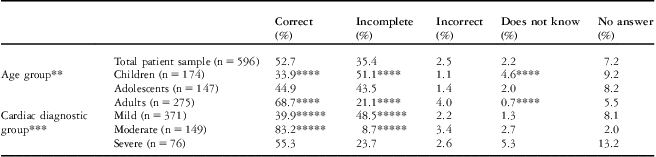
First, the knowledge about the individual heart defect was assessed. Overall, 52.7% of the study sample could correctly name the heart defect or describe it in their own words (see Table 1). Children gave significantly fewer correct answers than adult patients (p < 0.001). Patients with mild congenital heart defect gave significantly less correct answers compared with patients with moderate congenital heart defect (p < 0.001).
Accuracy of patients’ answers on the item: “When you were born, your heart was not healthy. Please describe what was wrong with it”.Footnote *

* Numbers in cells indicate percentages of patients giving this type of answer
** Age groups: children (10–13 years), adolescents (14–17 years), and adults (18–30 years)
*** Cardiac diagnostic groups: mild – only patients with simple atrial septal defects, closure by surgery or catheter intervention, and without pulmonary hypertension; moderate – only transposition of the great arteries, cardiac surgery on anatomic (Switch) or functional (Senning/Mustard) level; severe – complex heart defects after palliative surgery such as shunt, Fontan, etc., as well as those without surgery
**** Significant (p < 0.001) difference between these age groups
***** Significant (p < 0.001) difference between these severity groups
On one item asking patients to rate their own level of knowledge about their heart defect (response range: 1 = “very poor” to 10 = “very well”), the mean score of the total patient sample was 6.92. A near-significant trend was found that patients with moderate heart defects felt themselves better informed (mean = 7.2) than patients with severe (mean = 6.4) and mild (mean = 6.9) heart defects (Mann–Whitney U test, p = 0.051). No age differences were found on this item.
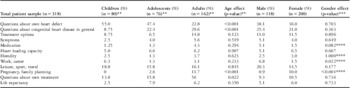
Furthermore, the information preferences of the patients were investigated. Of the total of 596 patients, 318 answered the open-ended question: “When you recently asked for information about your heart defect, what exactly did you want to know?” A significant age difference was found (see Table 2): 55.0%, 47.4%, and 22.8% of the children, adolescents, and adults, respectively, indicated that – as a main topic of interest – they had asked a question about their own heart defect – for example “I wanted to know exactly what kind of heart defect I have”. The second most frequently asked question referred to heart defects in general – for example “How often do the different types of defect occur, and what effect do they have?” Significant age differences were found with regard to congenital heart disease in general, treatment option, and family planning, indicating that adults with congenital heart defects had more questions regarding these topics.
Answers of patients to the question “When you recently asked for information about your heart defect, what exactly did you want to know?”.Footnote *

* Numbers in cells indicate percentages of patients giving this type of answer
** Age groups: children (10–13 years), adolescents (14–17 years), and adults (18–30 years)
*** Pearson's χ 2 test, alternatively
**** Fisher's exact test
On only two topics significant gender differences were found: affected male patients (n = 118) expressed more information needs regarding work and career issues, whereas female patients with congenital heart disease (n = 200) were significantly more likely than their male counterparts to ask about pregnancy and family planning.
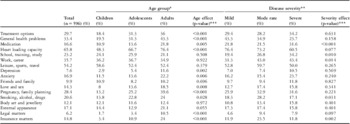
Table 3 shows that children's information preferences were comparable to those of adolescents and adults with regard to school, training and study, work/career, leisure sports and travel, friends and family matters, body art and jewellery, and external appearance.
Medical and general information needs according to age group and disease severity.

*Age groups: children (10–13 years), adolescents (14–17 years), and adults (18–30 years)
**Cardiac diagnostic groups: mild – surgically corrected atrial septal defect; moderate – transposition of the great arteries, surgically corrected during childhood; severe – double-inlet ventricle, hypoplastic left heart syndrome, common arterial trunk
***Pearson's χ 2 test
Furthermore, information preferences tend to differ according to age, rather than severity of heart defect. Children had significantly fewer information needs than adults regarding treatment options, general health, medication, heart loading capacity, depression, anxiety, love and sex matters, pregnancy and family planning, smoking, alcohol and drugs, legal matters, and insurance matters.
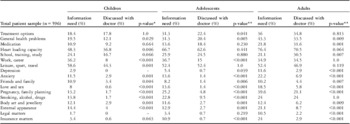
The data indicate that, overall, patients’ information needs were unmet. Table 4 shows that on all 17 items assessing patients’ stated information preferences and whether these topics were discussed by doctors with patients, a significant difference (p < 0.05) was found. For all three age groups, patients’ information preferences were unmet on eight of 17 topics. This is reflected by significant differences between patients’ information needs and topics discussed by doctors with regard to general health problems, anxiety, friends/family matters, love/sex, pregnancy and family planning, body art, external appearance, and insurance matters. Only on two topics did affected adults indicate that these topics were significantly more often discussed by doctors compared with their need: medication and school/training and study.
Comparison of medical and general information needs and level of coverage by doctors, according to age group.Footnote *

* Age groups: children (10–13 years), adolescents (14–17 years), and adults (18–30 years)
** χ 2 test: McNemar's test
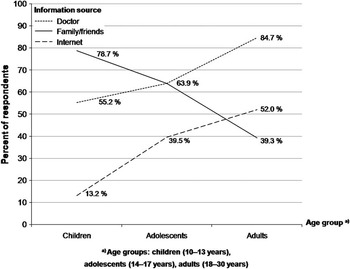
According to the total sample (n = 596), the most important sources of information were: doctors (71.0%), family and friends (58.2%), and the Internet (37.5%). Only 0.8% turned to self-help groups for information. Female patients were significantly more likely to use the Internet than male patients (p < 0.001). Figure 1 shows that the importance of the family as a source of information decreases significantly with age (p < 0.001), whereas the importance of the doctor and the Internet increases (p < 0.001).
Sources of information.

Of the children, adolescents, and adults, 59.8%, 35.4%, and 12.4%, respectively, reported that their parents were the main discussion partner in the doctor–patient relationship: their doctor talked primarily to their parents and not directly to them.
When asked whether they could understand the explanations provided by their doctor, 40.8% of the children, 41.5% of the adolescents, and 57.5% of the adults chose the answer: “Yes, my doctor explains everything in such a way that I understand it well”. The older the patients, the more likely they were to understand the explanations well (p < 0.001); 21.3%, 34%, and 26.2% of the children, adolescents, and adults, respectively, responded that they could only understand part of what was explained.
On average, respondents rated their satisfaction about their consultations with their doctor as 8.2 (on a 10-point rating scale, from 1 = “very unhappy” to 10 = “very happy”).
Significant differences were neither found between the three age groups nor between the different cardiac diagnostic groups with regard to satisfaction with doctor's consultations. Of the total sample, 77.5% said that they trusted their doctor.
Discussion
This study was the first to focus on the level of disease-specific knowledge, information preferences, and sources of information in a nationwide sample of patients with congenital heart disease across three age groups, covering the transition phase: from childhood through adolescence to young adulthood. Thus, level of knowledge and information preferences could be compared across developmental phases, whereas previous research on disease-specific knowledge mainly focused on one particular age cohort.Reference Moons, De Volder and Budts 15 , Reference Chessa, De Rosa and Pardeo 18 , Reference Kantoch, Collins-Nakai and Medwid 21 , Reference Cetta and Warnes 22 The present findings demonstrated a substantial disease-specific knowledge gap for the total sample.
Level of disease-specific knowledge in children, adolescents, and adults with congenital heart disease
Only 34–68% of our patients were able to define their heart defect. These findings confirm those of previous studies, which showed that patients with congenital heart disease have insufficient understanding of their condition.Reference Moons, Hilderson and Van Deyk 8 , Reference Veldtman, Matley and Kendall 14 , Reference Kamphuis, Verloove-Vanhorick and Vogels 23 , Reference Dearani, Connolly and Martinez 24 Children in our study were significantly less able to define their heart defect than adult patients. In this context, a previous small, qualitative study in a sample of children and adolescents with congenital heart disease showed that children's levels of disease-specific knowledge were not related to age.Reference Veldtman, Matley and Kendall 14
It is remarkable that patients with mild defects gave less correct answers and felt less well informed than patients with moderate defects. An explanation could be that paediatric cardiologists may underestimate the information needs of these “relatively simple” patients – and their parents – compared with those of more complex patients.Reference Garson, Benson and Ivler 25
Given that previous studies on the transition phase have shown that a significant proportion of adult patients fail to attend follow-up medical examinations,Reference Mackie, Ionescu-Ittu and Therrien 6 , Reference Wacker, Kaemmerer and Hollweck 7 it is essential that youngsters with congenital heart disease be educated by medical specialists regarding their illness already during childhood. Previous studies have found that young patients believe information to be the key to assuming responsibility for their condition.Reference Kendall, Parsons and Sloper 26 – Reference Rönning, Nielsen and Swahn 28
(Unmet) Information needs in children, adolescents, and adults with congenital heart disease
Our study revealed a significant lack of information among all three-age cohorts. Patients are particularly keen to discuss psychosocial topics such as sport/leisure/travel, work/career, and pregnancy/family planning, but their doctors seem not to meet their information preferences, according to our patients’ reports.
Remarkably, children's information preferences were comparable to those of adolescents and adults concerning several important psychosocial topics such as education, work/career, leisure sports and travel, friends and family matters, indicating the early need for knowledge in children. Unfortunately, these information preferences were not met by the doctors, from the children's perspective. As this study showed, a reason for this might be that during medical consultations doctors rather address the parents than the children and adolescents themselves.
Furthermore, information preferences tend to differ according to age, rather than severity of heart defect. Regarding medical topics, such as treatment options, general health problems, and heart loading capacity, children expressed fewer information needs than adolescents and adults.
The finding that children and adolescents, in general, showed less interest in health information than adults is in line with international literature, describing that children and adolescents do not want to be treated any differently from their peers and therefore may even go as far as denying their illness.Reference Taddeo, Egedy and Frappier 29 , Reference Kendall, Sloper and Lewin 30 Female patients requested information on family planning significantly more often than their male counterparts, whereas male patients asked more about work and career than female patients.
On average, respondents rated their state of knowledge as better than average (average value: 6.92), despite the fact that for almost all of them the study revealed major information gaps. Therefore, the extent to which the patients overestimated or underestimated their knowledge is not known. This discrepancy could be explained by the phenomenon of social desirability or overcompensation. Van RijenReference van Rijen, Utens and Roos-Hesselink 31 has previously described these patterns for adults with ConHD. These findings are also in line with the discrepancy noted in a previous study between individuals’ actual disease-specific knowledge and their subjective assessment of their state of knowledge.Reference Kamphuis, Verloove-Vanhorick and Vogels 23
Sources of information
Our findings show that the information sources differed significantly across age groups: with increasing age, the doctor and the Internet became more important, whereas the importance of the family decreased. Female patients are more likely to use the Internet than male patients.
One-third of the adolescents and 12.4% of the adult respondents reported that their parents are the primary discussion partner in doctor–patient consultations. This is in line with literature indicating that patients with congenital heart disease, like chronically ill children in general, tend to continue relying on their parents instead of assuming responsibility for themselves.Reference Kendall, Sloper and Lewin 30 , Reference van Staa 32
Furthermore, patients in our study often only partly understood what their doctor explained to them (20–30%). In line, previous studies have highlighted communication problems between doctors and patientsReference Veldtman, Matley and Kendall 14 , Reference Birks, Sloper and Lewin 33 and emphasised the importance of an effective doctor–patient communication.Reference Cooper, Booth and Gill 34 , Reference DiMatteo 35 Despite this, the participants of the present study are generally very satisfied with the advice provided by their doctors and place great trust in them. In this respect, our findings are in line with those of Moons et al.Reference Moons, De Volder and Budts 15
Only 0.8% of the respondents reported turning to self-help groups to meet their psychosocial needs; thus, this potential source of information is unable to compensate for the existing information deficit.
Limitations
The study was performed among patients listed in a national registry, which is based on voluntary enrolment. This could have resulted in a selection bias. However, comparing medical results of responders versus non-responders, no significant differences were found with regard to disease severity, age, and gender, reducing the risk for selection bias. Owing to the fact that only patients with a selection of cardiac diagnoses were included, results cannot be generalised to patients with other diagnoses. The extent to which the level of non-cardiac comorbidity has influenced the present results is not known, as data on comorbidity were not available.
Conclusion
The present study is the first to demonstrate a clear gap in disease-specific knowledge regarding congenital heart disease across three age groups: affected children, adolescents, and young adults. A disease-specific knowledge gap can be dangerous. Neglecting endocarditis prophylaxis, using the wrong type of contraception or non-adherence to medical treatment are examples of how an information deficit can lead directly to a life-threatening situation. Our study revealed a list of educational topics of interest for different age and gender groups that can be considered in order to develop patient-centred education programmes.
The present findings give young patients with congenital heart disease a voice and reveal a clear need for multidisciplinary patient-centred education programmes. These should start as early as during childhood to raise patients’ awareness about their condition and encourage them to take personal responsibility for managing their illness and dealing with it in daily life. The patient-centred education programmes could make the transition phase run smoothly and support the doctor–patient relationship. In order to optimise transfer of this disease-specific knowledge, future research should test what type of information should be delivered, in what format and dose, at what moment in time, and by whom.
Acknowledgements
The authors thank the employees of the National Register for Congenital Heart Defects for their contribution to this study.
Funding
This work was supported by the Competence Network for Congenital Heart Defects, which is funded by the German Federal Ministry of Education and Research [FKZ 01GI0601].
Financial Support
None.
Conflict of Interest
None.
Ethical Standards
The authors assert that all procedures contributing to this work comply with the ethical standards of the Helsinki Declaration of 1975, as revised in 2008, and has been approved by the Ethics Committee of the Carité University Hospital, Berlin.