Introduction
Outpatient parenteral antimicrobial therapy (OPAT) has been used successfully for children since the 1970s.Reference Rucker and Harrison 1 Relative to prolonged hospitalization, OPAT has advantages including lower cost and earlier return to normal home activities.Reference Rathore 2 However, complications from OPAT are commonReference Barrier, Williams, Connelly and Creech 3 and there is increasing evidence that OPAT is overused.Reference Conant, Erdman and Osterholzer 4 – Reference Sharma, Loomis and Brown 6 For conditions such as osteomyelitis, early conversion to oral therapy may be considered instead of OPAT. Recent studies in adult patients indicate that when discharge plans for OPAT are reviewed by infectious disease (ID) specialists before hospital discharge, OPAT courses are often modified, including discontinuation of therapy altogether or conversion to oral therapy.Reference Conant, Erdman and Osterholzer 4 – Reference Shrestha, Bhaskaran, Scalera, Schmitt, Rehm and Gordon 7 Despite recommendations from the Infectious Diseases Society of America advising ID consultation for OPAT,Reference Tice, Rehm and Dalovisio 8 pediatric OPAT courses are not universally reviewed or monitored by ID specialists.Reference Banerjee, Beekmann, Doby, Polgreen, Rathore and Hersh 9 Our objective was to determine the extent to which OPAT use without ID consultation was modifiable or overused at a large tertiary care children’s hospital. These data could be used to assess and justify the value of expanding antimicrobial stewardship activities to include OPAT. To our knowledge, the potential impact of OPAT stewardship in pediatrics has not been examined.
Methods
Study Design and Patient Population
We conducted a retrospective cohort study of OPAT for patients discharged from Primary Children’s Hospital in Salt Lake City, Utah, from March 1, 2011 through March 31, 2012. Primary Children’s Hospital is a 289-bed freestanding children’s hospital with approximately 14,000 discharges annually. This study was reviewed and approved by the University of Utah Institutional Review Board and the Intermountain Healthcare Privacy Board.
An OPAT episode was defined as treatment with an intravenous antimicrobial agent initiated following discharge from the hospital. OPAT episodes were identified through pharmacy records from Intermountain Homecare, the home care agency that provides home care services to approximately 60% of patients discharged from Primary Children’s Hospital. OPAT episodes initiated for outpatients (eg, in the emergency department) and patients discharged from the hematology-oncology service were excluded since many of these episodes were for empirical treatment of fever and neutropenia per a standard protocol. We reviewed the electronic medical record to determine whether ID consultation was performed either during the hospitalization or with an outpatient follow-up visit. We then randomly selected 100 episodes where ID consultation was not obtained for detailed review to determine the indication for OPAT, antimicrobial(s) used, discharging clinical service, and potential for OPAT modification, including whether or not central catheter placement may have occurred unnecessarily. We excluded cases with ID consultation because our antimicrobial stewardship program (ASP) pharmacist was already providing input for these cases.
OPAT Modification
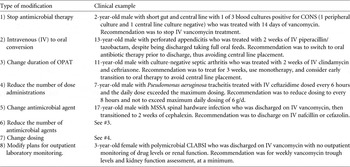
The unit of analysis was an OPAT episode. We established 8 independent categories of potential modification to OPAT care and assessed these for each OPAT episode through detailed medical chart review. Three pediatric ID physicians (E.D.K., C.R.D., A.L.H.) reviewed all charts using predetermined definitions for potential modification. The categories were (1) stop antimicrobial therapy altogether, (2) intravenous to oral conversion, (3) change duration of OPAT, (4) reduce the number of dose administrations, (5) change antimicrobial agent, (6) reduce the number of antimicrobial agents, (7) change dosing, and (8) modify plans for outpatient laboratory monitoring. For each of the 8 categories, the OPAT episode was rated as no modification, consider modification, or modification definitely recommended. Additionally, we determined whether a new central line was placed solely for the purpose of OPAT.
Results
We identified 410 unique OPAT episodes among 321 individual patients during the study period. ID consultation was obtained for 184 (45%) of 410 OPAT episodes. Among the 100 OPAT episodes that did not have ID consultation in the sample reviewed, the most common antimicrobials prescribed were third-generation cephalosporins (33%), antipseudomonal penicillins (24%), and carbapenems (15%). The most common indications were intra-abdominal infections (29%), central line infections/bacteremia (28%), cystic fibrosis exacerbations (9%), and urinary tract infection/pyelonephritis (7%). The most common discharging services were hospital medicine (43%), surgery (26%), and gastroenterology (26%).
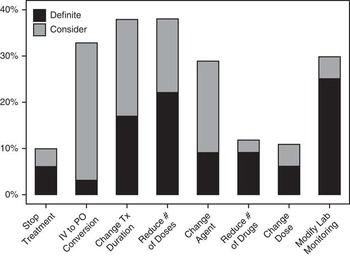
At least one modification definitely or possibly would have been recommended for 78% of the 100 OPAT episodes (56% definite, 22% consider; Figure 1 and Appendix Table A). For more than 40% of episodes, OPAT was potentially not indicated (10% stop therapy, 33% intravenous to oral recommended). Of the 41 episodes where OPAT was potentially not indicated, 33 (80%) had central lines placed during the index hospitalization primarily for the purposes of OPAT.
Outpatient parenteral antimicrobial therapy episodes with definite or possible modifications to therapy following review of the medical records. Seventy-eight percent of the episodes had at least one recommendation. Totals sum to greater than 100% because some episodes had more than 1 recommendation. IV, intravenous; PO, oral; Tx, treatment.

Discussion
Our study has 3 main findings. First, OPAT is used commonly at our institution, occurring in at least 3% of hospital discharges. Second, fewer than 50% of OPAT courses involved ID consultation. Third, among episodes where ID consultation was not obtained, we found evidence suggesting substantial over- and misuse of OPAT.
Although OPAT use has been well described for specific conditions, studies documenting overall patterns of OPAT use for pediatric patients are limited. We found that at least 3% of our hospital discharges received OPAT, which is similar to a previous pediatric study.Reference Madigan and Banerjee 10 A recent survey of the pediatric members of the Emerging Infections Network found that more than 80% of respondents regularly managed OPAT, indicating that this is an important part of pediatric ID practice.Reference Banerjee, Beekmann, Doby, Polgreen, Rathore and Hersh 9
Mandatory ASP review or ID consultation has been investigated in adult patients.Reference Conant, Erdman and Osterholzer 4 – Reference Shrestha, Bhaskaran, Scalera, Schmitt, Rehm and Gordon 7 Data from these studies show that ASP or ID involvement results in more judicious OPAT prescribing, including stopping therapy, intravenous to oral conversion, or optimization of the regimen. From 10% to 39% of OPAT cases were avoided through ASP or ID intervention, and Heintz et alReference Heintz, Halilovic and Christensen 5 reported that 8.4% of central line placements were avoided.
Similar to adult reports, our study suggests that mandatory ASP or ID involvement for pediatric OPAT would result in decreased OPAT utilization because more than 40% of all OPAT cases reviewed were potentially not indicated. We also found that ID involvement may have optimized or improved the safety of pediatric OPAT courses, including shortening duration, reducing doses and/or number of drugs administered, dose/drug optimization, and improving laboratory monitoring.
The economic impact of mandatory ASP or ID consultation for OPAT is potentially significant. Although OPAT is cost-effective compared with inpatient administration of parenteral antimicrobials, avoiding OPAT when medically appropriate alternatives exist can result in substantial cost savings. One recent study estimated cost avoidance of $3847 per OPAT review.Reference Conant, Erdman and Osterholzer 4 The estimated potential savings among children at our institution appear similar. The cost of peripherally inserted central catheter line placement is approximately $1500 and the weekly cost for OPAT administration with Intermountain Homecare is $800 to $1000 excluding drug costs.
We acknowledge limitations to our study. OPAT care was reviewed retrospectively and we cannot be certain that modifications we identified actually would have been recommended and implemented. We excluded some patients, including the oncology service where most OPAT discharges are protocol driven for fever and neutropenia. Nonetheless, on the basis of these preliminary findings, our hospital has begun an intervention in which mandatory review of OPAT occurs before discharge by our ASP (with formal ID consultation for selected patients), which will allow us to prospectively determine the clinical and economic value of OPAT stewardship.
In conclusion, mandatory ASP or ID review for OPAT could potentially reduce OPAT overuse, lower costs, and improve the quality and safety of OPAT care in pediatrics.
Acknowledgments
Financial support. A.T.P reports that he has received research funding from the Centers for Disease Control and Prevention, and the National Institutes of Health. A.L.H. reports that he has received research funding from the Centers for Disease Control and Prevention, Primary Children’s Foundation, Pfizer, and the Agency for Healthcare Research and Quality (grant K08HS023320). The content is solely the responsibility of the authors and does not necessarily represent the official view of the Agency for Healthcare Research and Quality.
Potential conflicts of interest. All authors report no conflicts of interest relevant to this article.
Eight Types of Potential Modifications to Outpatient Parenteral Antimicrobial Therapy (OPAT) With Clinical Examples