Introduction
‘Maturing out’ of risky alcohol use, most simply understood as a decline in the prevalence of risky alcohol use during the twenties, has been broadly accepted by many in the alcohol research field (Zucker, Reference Zucker and Rivers1986; Vergés et al. Reference Vergés, Jackson, Bucholz, Grant, Trull, Wood and Sher2012; Powers et al. Reference Powers, Anderson, Byles, Mishra and Loxton2015). Two theories have come to articulate the ‘maturing-out’ phenomenon. Role incompatibility proposes that, as individuals age, their roles change to reflect the current stage of development, reducing their involvement in previous roles now in conflict with the newly gained responsibilities of adulthood (Yamaguchi & Kandel, Reference Yamaguchi and Kandel1985). Social control theory proposes two mechanisms by which stable relationships promote health behaviours. As an individual adopts behaviours of responsibility towards a spouse or offspring they may internalize these norms thereby controlling their own health behaviours, while explicit sanctions for deviations from these norms add a second incentive to adopt conventional behaviours (Umberson, Reference Umberson1987). In Australia, alcohol-related road accidents, acute hospitalizations, injury from violence and unwanted sexual activity disproportionately affect young people (Midford et al. Reference Midford, Mitchell, Lester, Cahill, Foxcroft, Ramsden, Venning and Pose2014). This has led not only to a concentration of prevention strategies which target young drinkers, but has also seen prevention programmes aimed at future drinkers embedded in high school curriculums (Howard et al. Reference Howard, Gordon and Jones2014).
Although such efforts are essential, the notion of a ‘developmentally limited’ period of risky alcohol use, beginning during adolescence and ending in the late twenties, is in need of further clarification. A smaller body of research suggests maturing out is relevant only to a severe subgroup (Lee et al. Reference Lee, Chassin and Villalta2013) and may not be due to the maturational processes of adulthood (Vergés et al. Reference Vergés, Jackson, Bucholz, Grant, Trull, Wood and Sher2012, Reference Vergés, Haeny, Jackson, Bucholz, Grant, Trull, Wood and Sher2013). Such inconsistencies may be an artefact of statistical or methodological limitations. Studies supporting a maturing-out process have commonly employed methodologies incapable of identifying potentially important subgroups (Zucker, Reference Zucker and Rivers1986; Patrick & Schulenberg, Reference Patrick and Schulenberg2011; Meier et al. Reference Meier, Caspi, Houts, Slutske, Harrington, Jackson, Belsky, Poulton and Moffitt2013; Powers et al. Reference Powers, Anderson, Byles, Mishra and Loxton2015).
Few studies have followed participants until the mid-twenties, utilized multiple indices of alcohol use (Thompson et al. Reference Thompson, Stockwell, Leadbeater and Homel2014) or extracted multiple trajectories of alcohol use via latent variable approaches (Maggs & Schulenberg, Reference Maggs and Schulenberg2004; Jackson et al. Reference Jackson, Sher and Schulenberg2005). Of these studies, Thompson et al. (Reference Thompson, Stockwell, Leadbeater and Homel2014) found that all indicators of alcohol involvement (i.e. frequency, quantity, volume and episode) increased until 21 years before declining thereafter, while Jackson et al. (Reference Jackson, Sher and Schulenberg2005) identified large heterogeneity in alcohol and tobacco use despite an overall decline after the transition to adulthood. Furthermore, studies have often employed definitions of alcohol use which emphasize associated harms rather than actual consumption. High levels of alcohol consumption are important regardless of perceived concurrent harms, given that long-term risky drinking is associated with a range of negative health outcomes (Rehm et al. Reference Rehm, Mathers, Popova, Thavorncharoensap, Teerawattananon and Patra2009).
The purpose of this study was to investigate trajectories of heavy episodic drinking (HED) and associated harms (i.e. trouble at school/work, regretted sexual activities, subject to injury or violence) in a cohort of young people from age 16 to 28 years who were participants in the Australian Temperament Project (ATP), a large community-based study of psychosocial development. Building on previous research on alcohol use and related harms in this cohort (Little et al. Reference Little, Hawkins, Sanson, Toumbourou, Smart, Vassallo and O'Connor2012, Reference Little, Hawkins, Sanson, O'Connor, Toumbourou, Smart and Vassallo2013), we use latent class growth analysis to examine potential trajectories of risky alcohol use that do not fit the maturing-out profile. Identification of such trajectories may suggest the need to rethink prevention strategies with a new aim of preventing escalation through young adulthood.
Method
Sample
Participants were from the ATP, a large multi-wave longitudinal study following the psychosocial development of young people from infancy to adulthood (Prior et al. Reference Prior, Sanson, Smart and Oberklaid2000). The baseline sample consisted of 2443 infants aged between 4 and 8 months and their mothers recruited from infant welfare centres across the state of Victoria, Australia in 1983. Centres were selected to reflect the urban/rural population balance, and provided a sample representative of the Victorian general population (Prior et al. Reference Prior, Sanson, Smart and Oberklaid2000). A total of 15 assessments across the subsequent 27-year period ascertained a range of factors including psychological and behavioural problems, substance use as well as familial, social and environmental indicators. Further information regarding the sample characteristics and procedures of the ATP are available elsewhere (Sanson et al. Reference Sanson, Prior and Oberklaid1985). In this study we used self-reported measures of alcohol use and alcohol-related harms from five successive waves of follow-up when participants were aged 16, 18, 20, 24 and 28 years old. To be included in the study participants needed to have survey responses relating to alcohol use and harms from at least three of the five measurement occasions resulting in a sample size of 1156 (497 male; 659 female) (number of responders per follow-up: n = 1288 age 16 years; n = 1254 age 18 years; n = 1138 age 20 years; n = 995 age 24 years; n = 1012 age 28 years).
Measures of HED and alcohol-related harms
At each adolescent and young adult follow-up, HED was measured as the number of times in the past month a participant had consumed five or more ‘drinks’ of alcohol in quick succession on a single occasion, with responses recoded as a four-level ordinal variable (1 = never; 2 = monthly; 3 = < weekly; 4 = weekly or more). At each follow-up participants were also asked whether their alcohol use had resulted in the occurrence of one or more of five alcohol-related harms over the past year using items adapted from the Victorian Adolescent Health Survey (Hibbert et al. Reference Hibbert, Caust, Patton, Rosier and Bowes1996; Little et al. Reference Little, Hawkins, Sanson, O'Connor, Toumbourou, Smart and Vassallo2013). Items were coded yes/no and combined into a four-level ordinal variable (1 = none of these events; 2 = one of these events; 3 = two of these events; 4 = three or more of these events). The five events included: (i) had trouble at school or work the following day; (ii) got injured or had an accident; (iii) became violent or got into a fight; (iv) had sex with someone and later regretted; and (v) got into trouble with the police. Some minor age-appropriate adjustments were made: (i) at age 15 years the question about trouble at school did not include work, and trouble with police was instead trouble with your family; and (ii) from age 19 years school was replaced with university/TAFE (technical and further education).
Latent class growth analysis (LCGA)
We used dual processes LCGA to derive correlated trajectories of alcohol use and alcohol-related harms (i.e. modelled as separate processes but allowing processes to be correlated) using the robust maximum likelihood estimator (MLR) available in Mplus version 6 (Muthén, Reference Muthén and Muthén1998–2010), and using full information maximum likelihood (FIML) to account for missing data (Muthén, Reference Muthén and Muthén1998–2010; Byrne, Reference Byrne2012). We explored the suitability of quadratic and piecewise linear LCGA to account for non-linear trends. Piecewise linear LCGA refers to the addition of an extra slope without an additional intercept, and is an alternative approach to introducing a quadratic term. This model essentially consists of two straight lines meeting at a change-point at age 20 years (the midpoint of our study period), with one capturing the change from age 16 to 20 years, and another capturing the change from age 20 to 28 years.
Next we assessed a number of different models separately by sex, including linear, quadratic and piecewise linear, LCGA over two to six classes (i.e. trajectories). To assess which model best summarized the data, we used a combination of the Bayesian information criterion (BIC), the sample size-adjusted BIC, in addition to using the bootstrap likelihood ratio test (BLRT) to evaluate fit between nested models (Nylund et al. Reference Nylund, Asparouhov and Muthén2007). Lastly, to better understand which specific harms were driving the trajectories, we undertook a descriptive analysis comparing the proportions of specific harms across time for both male and female trajectories.
Missing data
We explored how loss to follow-up may have biased our results using two methods. First we reran the structural equation modelling using the default Mplus FIML setting, by which a participant is included in the analyses so long as they have a measure at any single time point, resulting in a sample size of 1603 (799 males; 804 female). In addition, we conducted a logistic regression analysis in which the probability of not being included in the final analysis was calculated depending on a number of baseline variables as one way to assess whether or not attrition may have biased our findings.
Ethics
Research ethics approval for data collection within the ATP is currently approved and held by the Ethics in Human Research Committee, The Royal Children's Hospital Melbourne, Australia.
Results
At baseline (age 16 years) 81.3% of the sample came from households in which parents were married and living together, while the majority of those in a single parent household resided with the biological mother (10.3%). Almost half of the fathers (48.7%) were employed in professional or managerial positions while the number for mothers was 36.6%, and only 13.3% of the participants had a parent who had experienced unemployment in the last 12 months. Lastly, 23.9% and 19.8% of fathers and mothers had completed post-secondary education, respectively.
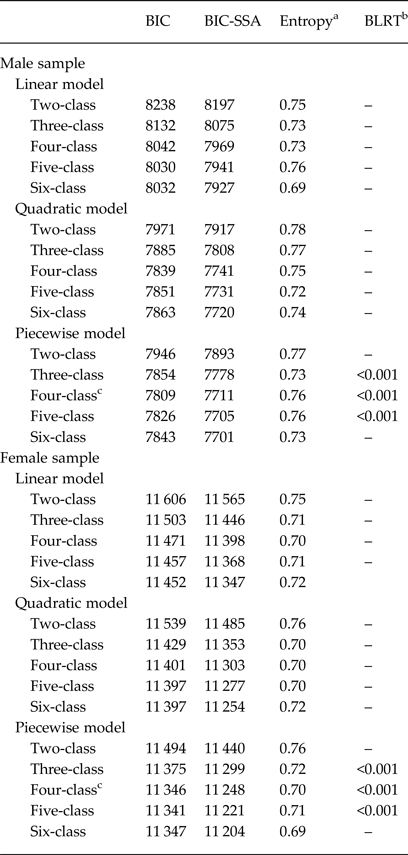
Results from the LCGA suggested that in both the male and female samples, models incorporating piecewise trajectories provided a superior fit to the data when compared with either linear or quadratic trajectories (Table 1). The optimal number of classes (i.e. trajectories), according to the BIC, adjusted BIC and the BLRT, was determined to be four in both samples. The five-class solution presented as a suitable choice in the female sample; however, as the BIC did not make meaningful improvements after the four-class solution we chose the more parsimonious representation of the data.
Fit indices of latent class growth analysis separately in males (n = 497) and females (n = 659)

BIC, Bayesian information criterion; BIC-SSA, Bayesian information criterion – sample size adjusted; BLRT, bootstrap likelihood ratio test.
a Entropy is a measure of how well individuals have been assigned to their respective classes.
b The BLRT was calculated to compare between the models for which the difference in BIC was not large.
c Optimal number of classes.
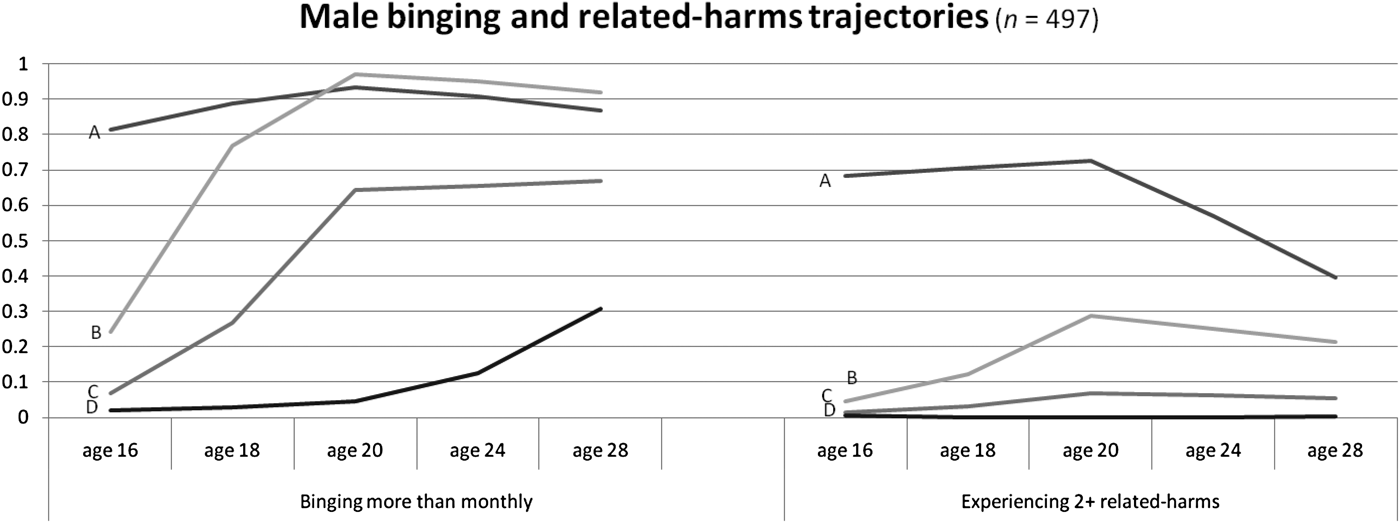
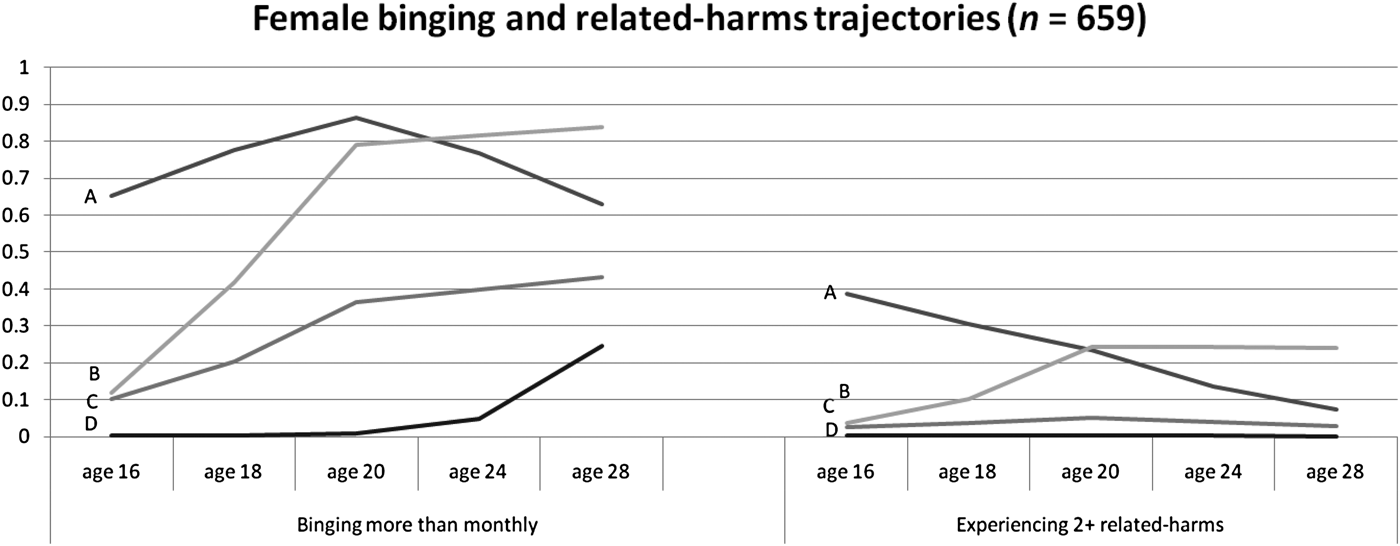
Figs 1 and 2 show the trajectories of HED and associated harms in males and females, respectively, which are interpreted as the estimated proportions of participants within each trajectory at each time point who had binged more than monthly and experienced two or more associated harms (trajectories showing the higher threshold of binging at least weekly and experiencing three or more associated harms are shown in the online Supplementary Figs S1 and S2). Importantly, the alcohol consumption and harms variables were modelled in their ordinal forms, but to aid interpretation we present the probabilities of exceeding certain levels separately.
Trajectories A to D of male binging (left-hand side) and alcohol-related harms (right-hand side), showing the estimated proportions of participants drinking five or more drinks in a single occasion at a frequency of more than monthly and the number of different types of alcohol-related harms experienced at a frequency of two or more out of five, for four classes. A, Early starters (class prevalence 6.1%); B, late starters (class prevalence 35.0%); C, normative (class prevalence 41.0%); D, infrequent heavy episodic drinking (class prevalence 17.9%).

Trajectories A to D of female binging (left-hand side) and alcohol-related harms (right-hand side), showing the estimated proportions of participants drinking five or more drinks in a single occasion at a frequency of more than monthly and the number of different types of alcohol-related harms experienced at a frequency of two or more out of five, for four classes. A, Early starters (class prevalence 18.7%); B, late starters (class prevalence 17.1%); C, normative (class prevalence 43.9%); D, infrequent heavy episodic drinking (class prevalence 20.2%).

In males, we observed two trajectories consistent with the idea of ‘maturing out’ of alcohol-related harms but not HED. These were characterized by rising alcohol-related harms during adolescence which later fell during early adulthood and were labelled ‘early starters’ and ‘late starters’ (prevalence = 6.1% and 35%, respectively). In addition to an earlier onset, early starters exhibited the greatest levels of related harms, while late starters had the highest level of binging by age 20 years. Importantly, with regards to binging, despite minor attenuation from the peak exhibited at age 20 years, neither group saw an attenuation in binging that could be interpreted as having matured out, with relatively high levels of binging sustained throughout the study period.
In females, we observed a single trajectory consistent with the ‘maturing-out’ profile with regard to harms only, labelled the ‘early starters’ trajectory (18.7%). Like the male trajectories, the female trajectory was associated with the greatest level of associated harms which had decreased by age 28 years. However, despite more clearly exhibiting a decreasing trend in binging by age 28 years compared with their male counterparts, binging also remained prevalent among this group throughout the study period.
In addition, we identified a number of different trajectories suggestive of a more heterogeneous natural history than commonly considered in the current literature. Specifically, in males, we identified a very common trajectory (capturing 40% of male participants) that initially exhibited a less severe binging profile but which increased rapidly during adolescence and more steadily in early adulthood, and had a relatively low probability of associated harms, which we labelled the ‘normative’ trajectory. We also identified a male trajectory that consisted of participants (17.9%) who had a 5% or lower probability of binging more than monthly before age 24 years, with a minor increase thereafter, and who experienced virtually no related harms over the study period. This was labelled the ‘infrequent HED’ trajectory.
In females we identified a trajectory that demonstrably contradicted the maturing-out profile, representing a pattern of both binging and associated harms that increased across the study period. This trajectory, labelled ‘late starters’ (17.1%), exhibited the highest level of binging and associated harms by age 23 years. Lastly, ‘normative’ (43.9%) and ‘infrequent HED’ (20.2%) trajectories were also identified among females, which largely conformed to the trajectories of their male counterparts.
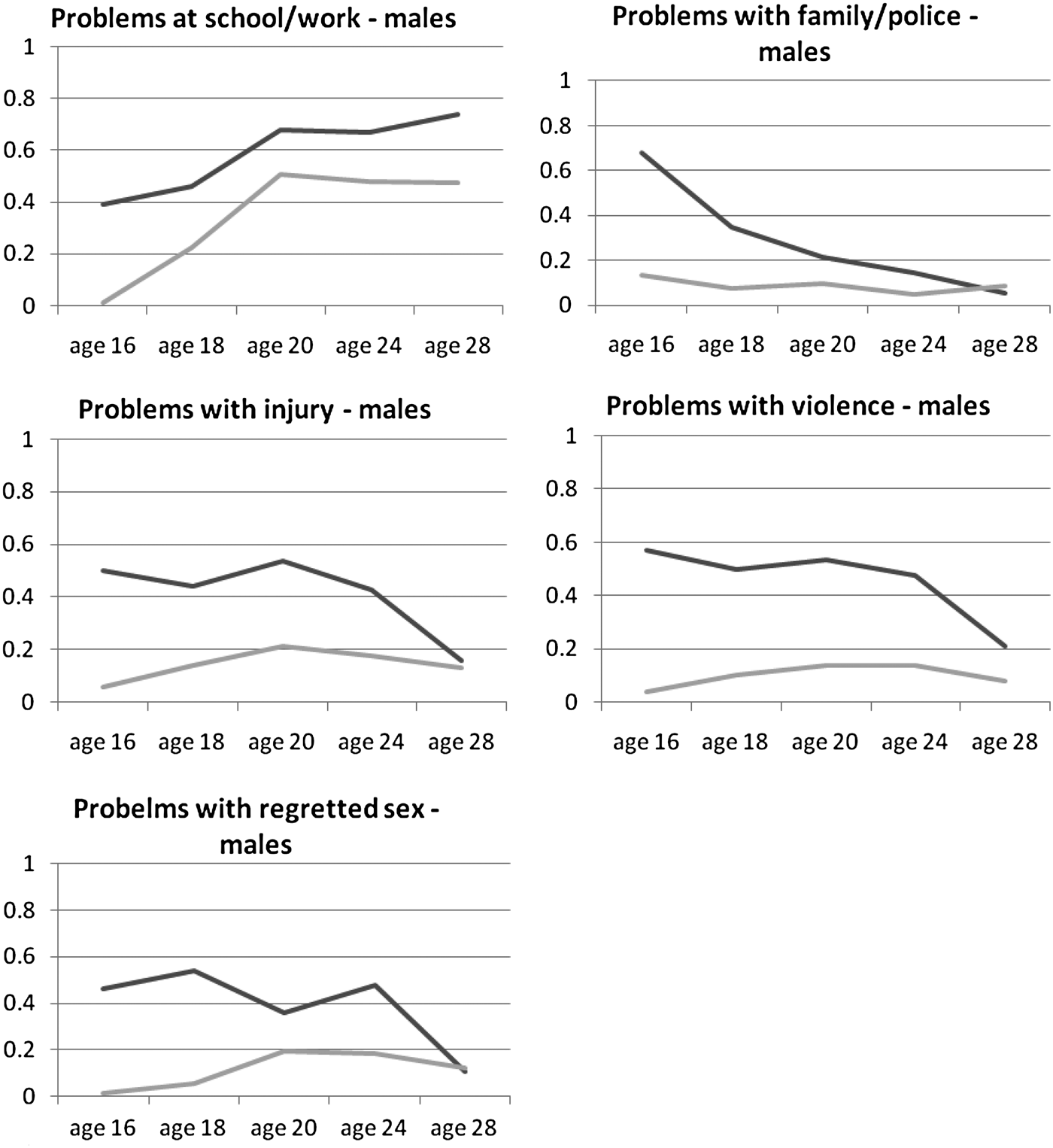
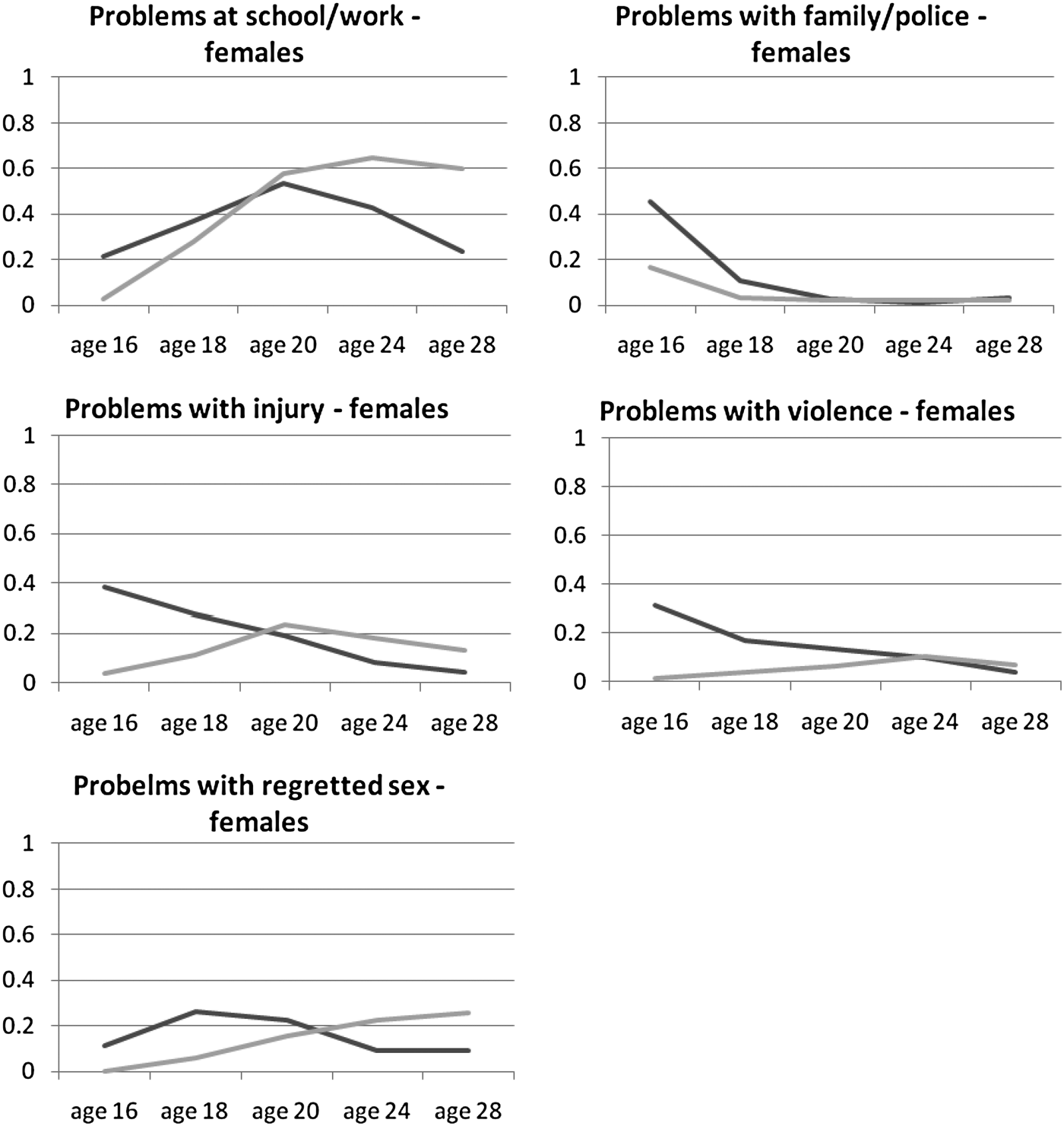
The descriptive analyses showing the probabilities of experiencing the specific alcohol-related harms are shown in Figs 3 and 4 for males and females, respectively (including in each case only the two trajectories exhibiting substantial amounts of harms). For males, Fig. 3 shows that when comparing the early and late starters, most types of harms had converged by age 28 years except for problems at school/work and violence, which therefore probably account for the increased probability of experiencing harms in the former group at age 28 years. In females, Fig. 4 shows that when comparing the early and late starters, problems at school/work among the latter group at age 28 years surpassed the level exhibited by the former group at age 16 years.
Probability of specific alcohol-related harms between two groups of males: (1) the early starters (─) and (2) the late starters (─). Proportions were estimated according to each individual's most likely class membership (n = 30 and n = 172, respectively). The other two groups of males were not included due to having a low probability of any harms.

Probability of specific alcohol-related harms between two groups of females: (1) The early starters (─) and (2) the late starters (─). Proportions were estimated according to each individual's most likely class membership (n = 127 and n = 98, respectively). The other two groups of females were not included due to having a low probability of any harms.

When we reran the LCGA including all participants with at least one observation on any alcohol indicator (n = 1603), the resulting four-class solution was practically identical to the main findings in both the shape and prevalence of the trajectories among the male and female samples (online Supplementary Figs S3 and S4). Lastly, the logistic regression attrition analysis (online Supplementary Table S1) showed that those lost to follow-up were twice as likely to be male and more likely to come from a low-socio-economic (SES) background, but maternal age did not predict attrition.
Discussion
The results of this study suggest that although alcohol-related harms moderated across the twenties, alcohol consumption did not, with high levels of binging persisting across the twenties (increasing in the case of females). A sizeable 41% of the male sample showed a pattern of a steady increase in binging, and 17% of the female sample showed a sharp increase in both binging and associated harms across the twenties. Further research in cohorts with carefully specified definitions of alcohol use which combine consumption and harms is needed to inform more refined approaches to preventing alcohol-related harms at their time of peak prevalence in young adulthood.
Overall, our findings support the studies of Vergés et al. (Reference Vergés, Jackson, Bucholz, Grant, Trull, Wood and Sher2012, Reference Vergés, Haeny, Jackson, Bucholz, Grant, Trull, Wood and Sher2013) and Lee et al. (Reference Lee, Chassin and Villalta2013), and add to these by demonstrating that the maturing-out hypothesis has relevance only to a minority of drinkers and primarily with regard to alcohol-related harms. Substantial amounts of HED persist even as these harms decline. For other groups, HED emerges later in early adulthood and is accompanied by only a very low probability of associated harms. In addition, it is important to note that since the first discussions of a ‘developmentally limited alcoholism’ appeared in the literature (Zucker, Reference Zucker and Rivers1986), the maturation processes of early adulthood (i.e. child rearing, full-time employment, serious relationship) have shifted and now occur later on average. Thus, the maturing-out process may have likewise shifted to a new peak closer to age 30 years, for which further investigation is necessary. A recent study examining men's and women's drinking from adolescence to middle age suggested that these patterns are likely to have changed in more recently born cohorts due to shifting norms regarding family role responsibilities and attitude towards alcohol use, particularly among women (Staff et al. Reference Staff, Greene, Maggs and Schoon2014).
Regardless of the applicability of maturing out, the risk of allowing alcohol-related harms to dominate our understanding of alcohol use trends among young people obscures the ongoing and, for some, increasing trend towards binging. Excessive alcohol use in the absence of perceived harms may have adverse short- and long-term consequences for individuals and place high costs on medical and mental health services. Our data may suggest that among young people increasing age is associated with an increased ability to utilize harm-reduction strategies which mitigate the potential harms of alcohol use despite ongoing high levels of use. However, it is possible that some individuals reporting low or decreasing levels of alcohol-related harms in the presence of higher levels of drinking have become accustomed to and/or are experiencing denial regarding harmful consequences. The inclusion of multiple informants and objective assessments of health, legal and social consequences of alcohol use could help to address this concern in future studies.
In addition to the main findings, we noted a previously unidentified pattern of considerable public health concern in females, in which binging continued to increase rapidly from adolescence to adulthood and was accompanied by increasing levels of alcohol-related harms. Although the proportion of males found to exhibit a similar HED profile was far greater than that found among females (40% – normative males v. 17% – late starter females), this group of males also exhibited a very slow increase which did not appear to be nearing the peak levels observed in males with a maturing-out profile, in addition to being associated with a very low level of alcohol-related harms. Conversely in females, by age 28 years this group had practically matched the peak levels of binging exhibited by the early starters at age 20 years, and were likewise approaching the peak levels of related harms exhibited by the early starters group at age 20 years.
Increasing rates of alcohol use in females during adolescence and the early twenties have been previously demonstrated (Roche & Deehan, Reference Roche and Deehan2002; Chikritzhs et al. Reference Chikritzhs, Catalano, Stockwell, Donath, Ngo, Young and Matthews2003; Goddard, Reference Goddard2008; Keyes et al. Reference Keyes, Li and Hasin2011; Geels et al. Reference Geels, Bartels, van Beijsterveldt, Willemsen, van der Aa, Boomsma and Vink2012; Keyes & Miech, Reference Keyes and Miech2013). This phenomenon is thought to result from a growing equality in gender roles wherein alcohol use is no longer regarded as a largely masculine pastime (Holmila & Raitasalo, Reference Holmila and Raitasalo2005). Findings from our team using prospective intergenerational cohort data (the Mater University Study of Pregnancy) similarly found that young Australian women were more than five times as likely to drink at the highest recorded level of alcohol use compared with their mothers at a similar age when measured 20 years earlier (Alati et al. Reference Alati, Betts, Williams, Najman and Hall2014). Lastly, in the present study we used the same definition of HED in males and females (5+ drinks), rather than the sex-specific definitions (5+ for males; 4+ for females) defined by the National Institutes of Health (2016). Thus it is important to consider that by using a ‘relatively higher’ cut-off in women we have probably identified more severe non-normative groups among females than males. Importantly, however, this would not account for the increasing trend of binging found in one group of females and in fact serves to increase the importance of identifying strategies capable of reducing this drinking profile.
The present study's strengths include the availability of prospective data spanning 12 years through adolescence to adulthood from a large-scale longitudinal community study of Australian youth. The growth-mixture modelling approach allowed us to explore the notion of maturing out by identifying subgroups of individuals in the community with different profiles of alcohol use and alcohol-related harms. It is, however, important to consider our findings within the permissive youth drinking context of Australia (legal age limit of 18 years and a cultural acceptability to drink), which may mean that we observed relatively elevated level of drinking by international standards. Replication in other datasets collected in different countries characterized by less permissive drinking cultures is thus important to ascertain the generalizability of the findings.
Our study also had a number of important limitations. First, our indices of alcohol frequency/quantity and associated harms were not drawn from a diagnostic interview, meaning the clinical utility of the thresholds presented in our study are somewhat uncertain. However, previous research has established that the five-drink threshold for HED is meaningful (Wechsler & Austin, Reference Wechsler and Austin1998) and shows moderate agreement with alternative measures of alcohol including alcohol use disorders (Jackson et al. Reference Jackson, Sher and Schulenberg2005). Second, our survey question did not define the term ‘drink’, leaving the precise quantity of five drinks open to respondents’ subjective interpretation and we encourage further studies with objective definitions of ‘drink’ to replicate our findings. Third, our interest in broad-ranging alcohol harms led to the use of a harms variable including a number of heterogeneous events; however, we did separate out these events into separate trajectories in supplementary analyses. Finally, as with all prospective research, biased attrition presents a concern for the generalizability of results. Importantly, the attrition analyses showed that we disproportionately lost participants who were male and from a lower-SES background, suggesting the more problematic trajectories in the male sample may have had a higher prevalence had we been able to retain the entire sample. However, when we reran the analyses including participants with at least a single measure the results did not vary substantively.
In conclusion, our findings suggest that the concept of maturing out of alcohol use across early adulthood is largely a misnomer. While increasing age in early adulthood appears to have a positive impact on alcohol-related harms, substantial amounts of HED persist and emerge separately in early adulthood. Notably, among one group of females (17% of the sample) these patterns of HED are also accompanied by related harms, particularly in the school/work domain. Considering the long-term health consequences of persistent intoxication, the present findings suggest that intervention needs to shift in emphasis from preventing alcohol-related harms in adolescence and early adulthood, to include a focus on building strategies to decrease the high levels of alcohol consumption which continue after the mid-twenties.
Supplementary material
The supplementary material for this article can be found at https://doi.org/10.1017/S0033291717000654
Acknowledgements
The ATP study is located at The Royal Children's Hospital Melbourne and is a collaboration between Deakin University, The University of Melbourne, the Australian Institute of Family Studies, The University of New South Wales, The University of Otago (New Zealand), and the Royal Children's Hospital (further information available at www.aifs.gov.au/atp). The views expressed in this paper are those of the authors and may not reflect those of their organizational affiliations, nor of other collaborating individuals or organizations. We acknowledge all collaborators who have contributed to the ATP, especially Professors Ann Sanson, Margot Prior, Frank Oberklaid, John Toumbourou and Ms Diana Smart. We would also like to sincerely thank the participating families for their time and invaluable contribution to the study.
R.A. is funded by a National Health and Medical Research Council (NHMRC) Career Development Award Level 2 in Population Health (APP1012485). C.A.O. is supported by an Australian Research Council Senior Research Fellowship (DORA: DP 130101459).
K.S.B. has been designated principal author and was responsible for the bulk of the literature review, drafting, statistical analysis and discussion. C.A.O. provided significant guidance in the study conception and design, in addition to drafting and writing. P.B. provided expert statistical and analytical advice, and helped draft the Method section. D.H. and G.Y. provided expert psychological opinion, and were key to interpreting the results from a clinical viewpoint. R.A. provided expertise in lifecourse and longitudinal epidemiology and helped with redrafting. P.L. oversaw data collection over multiple waves and provided expert knowledge in the ATP study and assistance with redrafting.
K.S.B. had access to the complete dataset used in the study and takes responsibility for the integrity of the data and accuracy of the data analyses.
Declaration of Interest
None.