The coronavirus disease 2019 (COVID-19) pandemic has posed huge problems and threats to human lives and health systems globally. Reference Abbas, Wang and Su1,Reference Mas-Coma, Jones and Marty2 COVID-19 is highly contagious, prompting prophylactic public health measures that have included lockdowns (the closing of businesses and schools to prevent most social contact), social distancing, mask-wearing, and immunizations, once they were available. Reference Thu, Ngoc and Hai3 Over 258 million COVID-19 cases have been reported worldwide and more than 5 million COVID-19 related deaths have been reported globally. According to the World Health Organization (WHO), a total of over 10 million cases and more than 120 thousand deaths had been reported in the Middle East and North African Region (MENA) (as of March 7, 2022). 4 Jordan is considered one of the MENA countries with over 1.6 million cases documented in Jordan and more, with over 13,000 deaths in Jordan (on March 7, 2022). 4 One of the most important instruments for reducing the impact of infectious illnesses on mortality, morbidity, and socioeconomic health status is the development of vaccines. Reference Andre, Booy and Bock5 Vaccination of even a small number of people in a community can help to prevent the spread of disease, although much higher vaccination rates are thought to be needed to produce herd immunity for COVID19, 70% or more, Reference Kwok, Lai and Wei6 greatly lowering the incidence and spread of the disease, and speeding up eradication. Herd immunity is dependent on a high vaccination coverage rate, Reference Clemente-Suárez, Hormeño-Holgado and Jiménez7 and thus, highly dependent on the public’s acceptance of the vaccine. Vaccines from Pfizer BioNTech, Moderna, and Oxford AstraZeneca, among others, have been approved and distributed worldwide. Reference Costanzo, De Giglio and Roviello8 The main distinction between vaccines is whether they are manufactured from the entire virus (SARS-CoV-2 or a viral vector), the virus’s genetic material (DNA or mRNA), or portions of the virus (protein subunit). Reference Dong, Dai and Wei9 Until now, there have been no direct vaccination comparisons in clinical trials, and comparing vaccine efficacy based on individual placebo-controlled trials is not appropriate. Even among trials of the same vaccination, differences in study populations, circulating variant strains at study sites, outcomes evaluated, and evaluation timing could all lead to differing degrees of vaccine efficacy. Overall vaccination efficacy in phase 3 trials published in peer-reviewed publications ranges from 70% to 95%, with each vaccine tested preventing severe disease and COVID-19-related death. Reference Sissoko, Healy and Katile10,Reference De Serres, Skowronski and Wu11
Despite the fact that 4.37 million Jordanians have been fully vaccinated against COVID-19 up to March 7, 2022, which represents approximately 36% of the total population, there are still pockets of skepticism. Reference Al-Qerem and Jarab12 “The main hurdle to getting a COVID-19 vaccine into enough people’s arms won’t be scientific, technical, or logistical; it will come from a lack of faith,” said Tom Frieden, former Director of the Centers for Disease Control and Prevention. Public trust will be determined by whether the vaccine works, is safe, and is widely available to the general public, Reference Kreps, Goldfarb and Brownstein13 but also by the extent to which the public understands and accepts these facts about the vaccine. Simply being effective, safe, and accessible is vital, but not sufficient for gaining public trust. The general population must believe that the immunizations meet those requirements. Reference Fisher, Bloomstone and Walder14 Moreover, disinformation regarding the virus has been rampant since the outbreak began, posing a threat to mass immunization. Reference Kouzy, Abi Jaoude and Kraitem15,Reference Hammad, Hamed and Al-Qerem16 Similar disinformation problems also plague vaccination efforts. Indeed, exposing people to COVID-19 vaccination disinformation reduces self-reported vaccine willingness. Reference Loomba, de Figueiredo and Piatek17
Individuals being exposed to disinformation may unwittingly be persuaded to believe misinformation, lowering vaccination acceptance. Reference Lee, Kang and Wang18 As a result, and after an extensive review of publicly available information from a range of sources, the main misconceptions that might be associated with the COVID-19 vaccine were categorized into 5 categories according to the nature of the misconception. These misconceptions were categorized as related to vaccine manufacturing, effectiveness, side effects, or importance, as well as those that would be categorized as conspiracy theory beliefs. 19–22 It was vital to assess these misconceptions because they impede the effectiveness of health-care organizations in Jordan, and around the world, to vaccinate the population, achieve herd immunity, and thereby halt the continued spread of the disease. We believe that by assessing the extent and nature of public misconceptions about the COVID-19 vaccine, targeted information campaigns can be developed to improve public understanding of the vaccine and awareness of the necessary public health actions that will help to reduce COVID-19’s impact.
To the best of our knowledge, this is the first study to investigate the misconceptions surrounding COVID-19 vaccine among Jordanians. Similar beliefs are expected to exist around the world, and many of the factors that drive the frequency of these myths will have an impact on people everywhere, maybe even more so in nations like the United States that have had substantial resistance from some parts of the population about COVID19 measures, including vaccine. Reference Kricorian, Civen and Equils23 Indeed, a previous study that was conducted in several nations, including the United Kingdom, Ireland, the United States, Spain, and Mexico, found that increased exposure to disinformation has a negative impact on people’s self-reported compliance with COVID-19 public health guidelines, as well as their willingness to get vaccinated against the virus and promote it to vulnerable friends and relatives. Reference Roozenbeek, Schneider and Dryhurst24 Moreover, another study listed one of the possible reasons for COVID-19 vaccine hesitancy in Africa was the theories on social and traditional media that the African continent was “immune” to COVID-19 due to the climatic conditions present. Reference Afolabi and Ilesanmi25 In this study, we aim to measure the magnitude of misconceptions toward COVID-19 vaccine within the Jordanian population. Furthermore, the impact of misinformation on receiving the vaccine as well as the willingness to receive the vaccine. A further aim of this study is to investigate how exposure to misinformation differentially impacts individuals according to their sociodemographic characteristics (age, gender, social status, presence of children, home residence, and highest education level) as well as attending a lecture concerning COVID-19 vaccines.
Methods
Design and Ethics
This was a Web-based cross-sectional survey of the Jordanian population. Only people aged 18 years and over were included in the study. The goal of this study was to look at common misconceptions about COVID-19 vaccines.
Survey
The survey consisted of 2 sections. The first section consisted of 11 multiple-choice questions that asked for anonymous demographic information about the respondents. The second section included 29 questions measuring the respondents’ views of different misconceptions about COVID-19 vaccines. These questions were created based on extensive review of online information about the vaccines, including official sources such as the World Health Organization (WHO) 22 and the United States Center for Disease Control and Prevention (CDC) (19), as well as falsehoods that have been spread about COVID-19 vaccines in news reports, in social media reports, and identified in fact-checking efforts about the myths surrounded COVID-19 vaccines. 20,21 The misperceptions that we considered fit broadly into 5 categories: (1) Vaccine manufacturing, (2) Effectiveness, (3) Side effects, (4) Importance, as well as (5) Conspiracy theory beliefs (see Table 2) as shown in a previous study with some modifications. Reference Abbas, Mangrio and Myths26 Participants were asked to rate their opinions on a 5-point Likert scale, from 1 (strongly disagree) to 5 (strongly agree), when the question involved agreeing with a correct statement. This represented the score for each question. The mean of the questions in each misconception category represented the category score. The final misconception score was the mean of the 29 questions included in the questionnaire. The survey took approximately 5-10 min to complete. Reliability was assessed for total misconceptions using Cronbach’s α.
Procedure
The survey was formulated on Google Forms, and the participant information sheet was hosted on an online platform. Questions were formulated in Arabic as it is the main language for Jordan. Face validity was tested in a pilot study with 25 participants who evaluated the questionnaire’s clarity, and no substantial changes were necessary. The results of the pilot study were not included in the final analyzed data. The link to the survey was distributed through different social media sites, including different Jordanian all-purpose Facebook groups that included thousands of members, including coronavirus “COVID-19”/Jordan. There was no maximum enrollment on the Google Form. To ensure the fulfillment of the inclusion criteria, questions about age and area of residence were included in the questionnaire. No financial incentives were offered. The survey was distributed, and data were collected, between May 2021 and August 2021.
Data Analysis
The data were analyzed using SPSS version 22. Frequencies and percentages (%) were used to represent categorical variables, while means and standard deviations (SDs) were used to represent continuous variables. Duplicate cases were examined by SPSS duplicate cases tools and by visual examination, and confirmed duplicates were deleted. Reliability analysis was conducting to evaluate internal consistency and Cronbach’s α was computed for each domain in the questionnaire. The ceiling and floor effects were evaluated by measuring the frequencies of participants who scored the maximum possible or lowest possible scores, the acceptable percentage is less than 15%. Reference McHorney and Tarlov27 The independent variables included in the model were age group (18-29, 30-39, ≥40), sex (male, female), social status (single, married), education level (high education [bachelor certificate and post graduate], low education), type of workplace (medical, nonmedical), home residence (village, city), “Did you attend a lecture about the COVID-19 vaccination?” and “Did you receive vaccination for COVID-19?”
Results
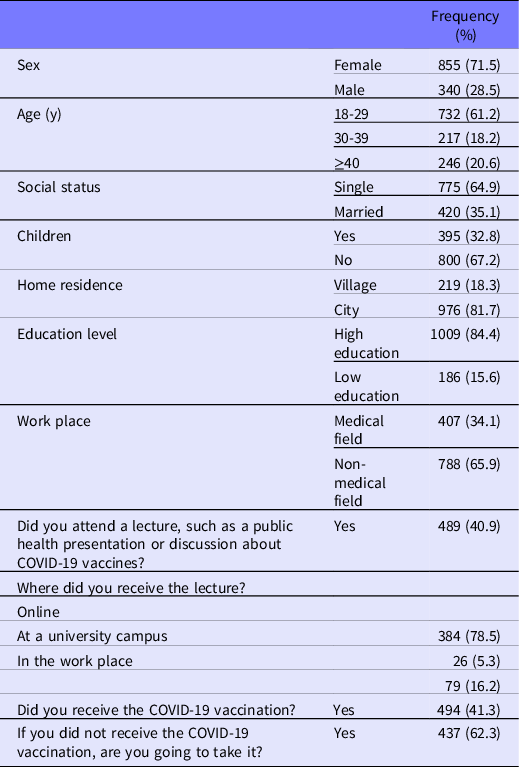
A total of 1195 subjects participated in the study. As shown in Table 1, 60.8% of the sample were between 18 and 29 y of age, and the majority were female (71.5%). More than half of the participants had high educational level (84.4%) and most of them were working in a nonmedical field (65.9%). The percentage of participants who had received the COVID-19 vaccine was 41.3%.
Demographics of participants (N = 1195)

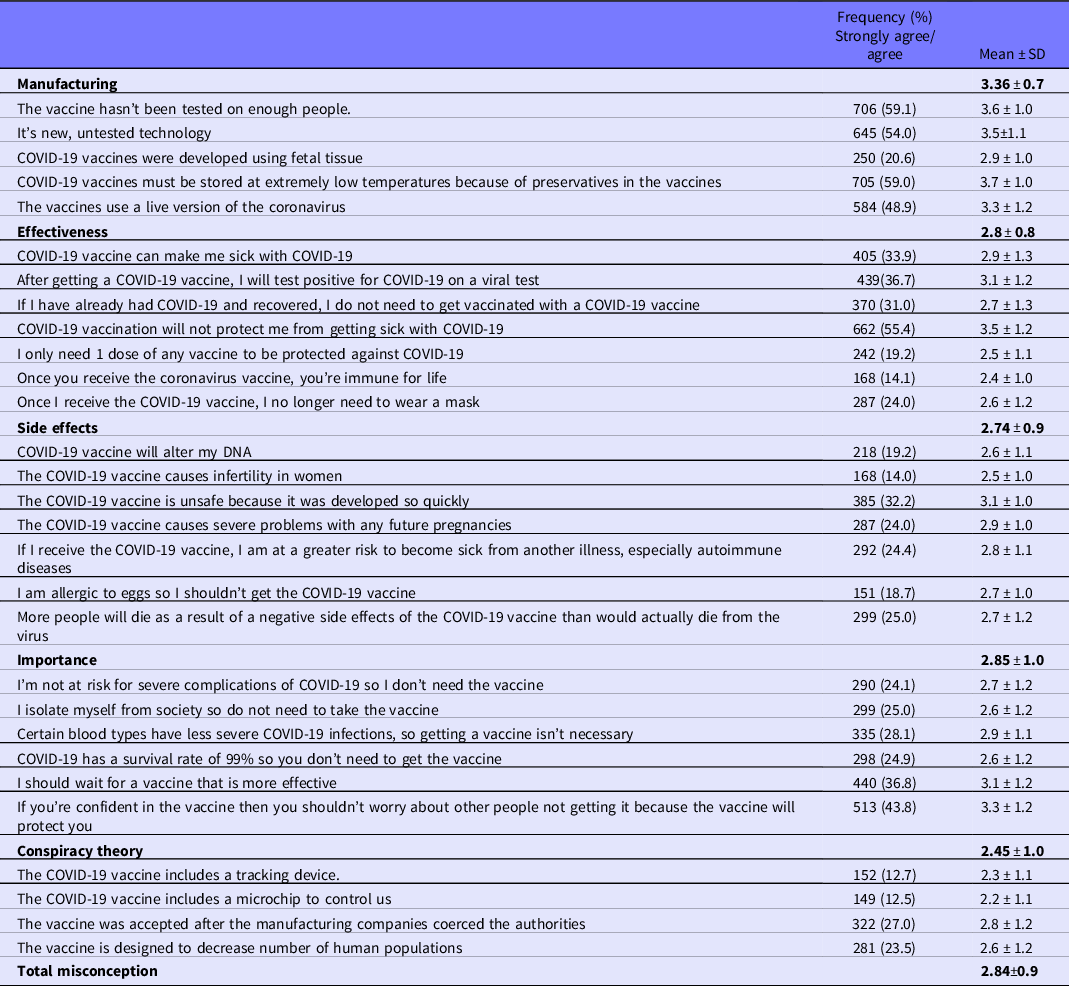
Misconception question and category mean scores

Note: Strongly disagree = 1; disagree = 2; neutral = 3; agree = 4; strongly agree = 5.
Table 2 shows the frequencies of agreement (agreement or strong agreement) with the statement and the mean scores for each question in the survey, was well as the means for each sub-section. The overall misconception score mean was (60.0 ± 19.1). The frequency of agreement varied with the type of statement, as well as with individual questions. Overall, there was more acceptance of misconceptions surrounding vaccine manufacturing than the other categories (mean overall score: 3.36), but there were high levels of acceptance of misconceptions regarding vaccine side effects (mean overall score: 2.74), effectiveness (mean overall score: 2.8), and importance (mean overall score: 2.85) as well. Although the level of acceptance of conspiracy theory beliefs were lower overall (mean overall score: 2.45), they were still common. In terms of the frequency of agreement (agreement or strong agreement), the range for the manufacturing subsection was 20.6 to 59.1%. Although somewhat lower, similar ranges were observed for the other subsections: importance (24.1 to 43.8%), effectiveness (14.1 to 55.4%), side effects (14.0 to 32.2%), and conspiracy theory beliefs (12.5 to 27.0%).
Table 2 also shows the frequencies of agreement (agreement or strong agreement) for each individual question and the mean scores for each question in the survey. For the vaccine manufacturing portion of the survey, the statement with the highest frequency of agreement (59.1%) was “The vaccine hasn’t been tested on enough people” (mean score: 3.6 ± 1.0), while the statement with lowest frequency of agreement (20.6%) was “COVID-19 vaccines were developed using fetal tissue” (mean score: 2.9 ± 1.0). In the vaccine effectiveness portion of the survey, the statement occurring with the highest frequency of agreement (55.4%) was “COVID-19 vaccination will not protect me from getting sick with COVID-19” (mean score: 3.5 ± 1.2), while the statement occurring with the lowest frequency of agreement (14.1%) was, “Once you receive the coronavirus vaccine, you’re immune for life” (mean score: 2.4 ± 1.0). In the vaccine side effects portion of the survey, the statement occurring with the highest frequency of agreement (32.2%) was “The COVID-19 vaccine is unsafe because it was developed so quickly” (mean score: 3.1 ± 1.0), while the statement occurring with the lowest frequency (14.0%) was “The COVID-19 vaccine causes infertility in women” (mean score: 2.5 ± 1.0). In the vaccine importance part of the survey, the statement occurring with the highest frequency of agreement (43.8%) was “If you’re confident in the vaccine then you shouldn’t worry about other people not getting it because the vaccine will protect you” (mean score: 3.3 ± 1.2), while the statement occurring with the lowest frequency of agreement (24.1%) was “I’m not at risk for severe complications of COVID-19 so I don’t need the vaccine” (mean score: 2.7). In the conspiracy theory portion of the survey the statement with the highest frequency of agreement (27.0%) was “The vaccine was approved after the manufacturing companies coerced the authorities” (mean score: 2.8 ± 1.2), while the statement occurring with the lowest frequency of agreement (12.5%) was “The COVID-19 vaccine includes a microchip to control us” (mean score: 2.2 ± 1.1).
Reliability for misconception questions in each subsection (manufacturing, effectiveness, side effects, importance, and conspiracy theory beliefs) were evaluated using Cronbach’s α, and the results indicated good reliability (0.96, 0.71, 0.84, 0.91, 0.90, and 0.91, respectively). The results indicated that none of the questionnaire domains violated the floor and ceiling effect, as the percentage of participants who scored the maximum possible and lowest possible scores for manufacturing, effectiveness, side effects, importance, conspiracy theory, and total misconception were (0.07%, 2.6%), (1.2%,1.5%), (2.2%, 1.7%), (2.7, 4.2), (12.9, 3.2%), and (0%, 0%), respectively.
For additional analysis, the sample was divided into sub-groups with low overall misconception levels and high overall misconception levels. The low misconception level group included participants who had scores less than the score’s mean, while the high misconception level group included participants who scored above and equal to the mean. A total of 635 (53.1%) participants were included in the low misconception level group.
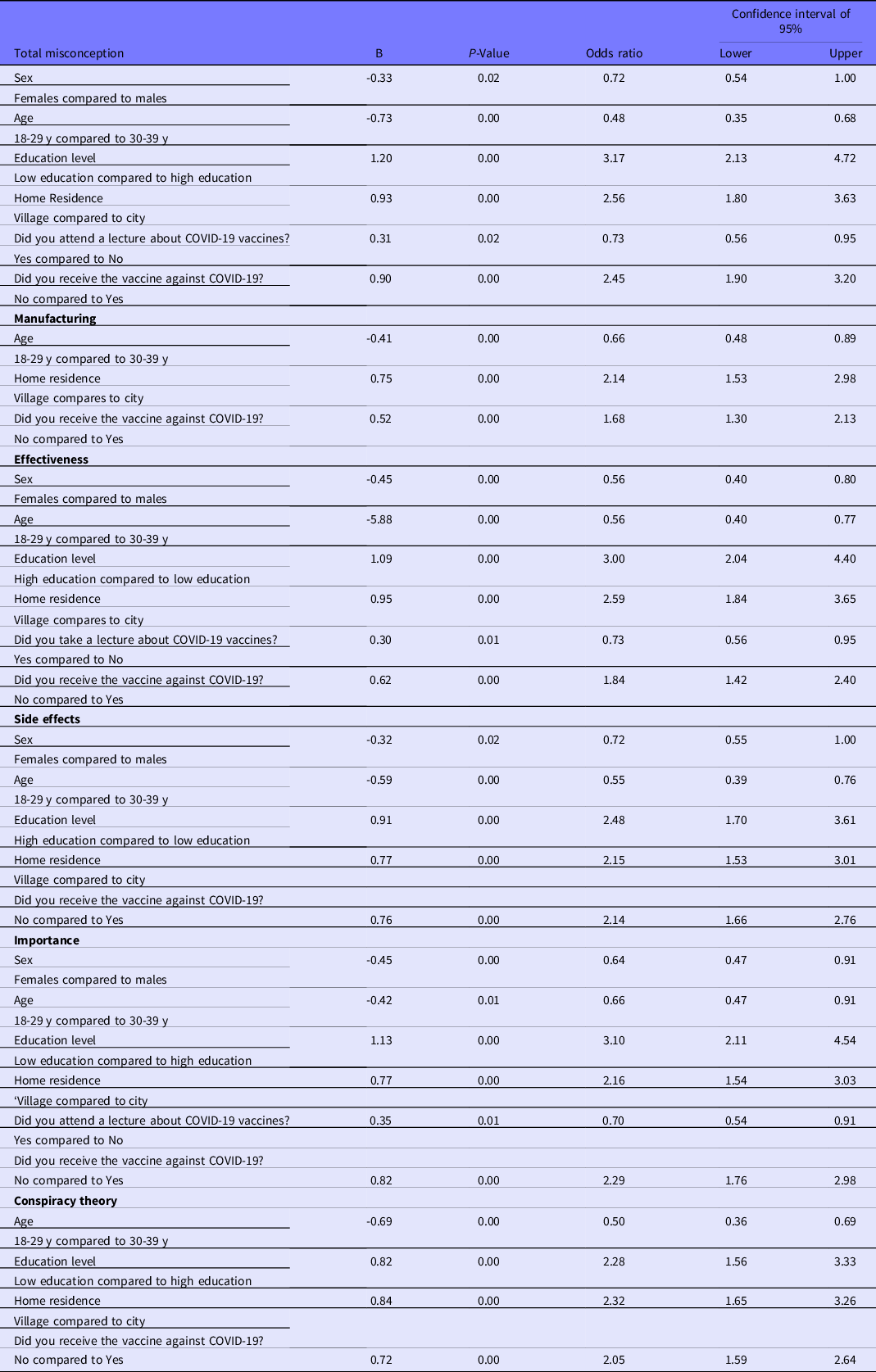
Stepwise binary logistic regression (Forward: conditional) was conducted to assess the association between the misconception level and different participant’s characteristics. As shown in Table 3, females had significantly higher odds of being in the low misconception level group when compared with male participants (odds ratio [OR] = 0.72; P value = 0.02). Participants in the 18- to 29-age group had significantly higher odds of being in the low misconception level group when compared with the participants in the age group, and higher educational level increased the odds of having low misconceptions (OR = 3.17; P value < 0.001). Participants who lived in a city had significantly higher odds of having low misconceptions when compared with those who lived in villages (OR = 2.56; P value = 0.00). The participants who took lectures about the COVID-19 vaccine had significantly higher odds of having low misconceptions (OR = 0.31; P value = 0.02), and the participants who were vaccinated had significantly higher odds of having low misconceptions (OR = 2.45; P value = 0.00).
Multiple predictor analysis of variables associated with level of COVID19 vaccine misconceptions

Table 3 also shows analyses for each subsection of the survey, which shows similar results to the overall scores.
Discussion
Despite the fact that vaccines help in improving public health worldwide, vaccine hesitancy to COVID-19 from the public in different ethnic groups remains 1 of the major barriers to achieve herd immunity. The achievement of herd immunity has long been thought to be the primary solution for ending the COVID-19 pandemic. Reference Altmann, Douek and Boyton28,Reference Ilesanmi, Akande and Afolabi29 Herd immunity is not expected to be achieved until 66.7% or more of the overall population receives the COVID-19 vaccine. Reference Altmann, Douek and Boyton28 In Jordan, around 42.5% of the population is fully vaccinated against COVID-19. By contrast, it is around 2 times lower in the MENA region, that is, around 20% is fully vaccinated. There are significant vaccine discrepancies across the MENA area, with immunization rates ranging from 68.8% in Saudi Arabia and 63.1% in Morocco to fewer than 2% in Yemen and 7% in Syria, 16.9% in Iraq, and 29.3% in Egypt. 4 In this study, we created a questionnaire to assess and highlight the most common misconceptions about the COVID-19 vaccine among Jordanians. According to the nature of the misconceptions, we categorized them into 5 categories: manufacturing, effectiveness, side effects, importance, and conspiracy theory beliefs. The high reliability score evaluated by Cronbach’s α was used to include all items in the study, which did not change if any individual question was removed. Our results showed that misconceptions regarding vaccine manufacturing were connected with the highest overall mean was of COVID-19 vaccine misconceptions, this may refer to that many Jordanians consistently underestimate the extent of the COVID-19 vaccination research trials and lack the necessary knowledge of the manufacturing aspects of the vaccines, making them open to accepting common misperceptions about the safety, efficacy, and quality of vaccines. A previous study conducted among university students in Lebanon reported high vaccine acceptance rate (87%) and that vaccine hesitancy was significantly associated with nationality, residency status, and university rank. Moreover, Participants who believed the vaccine was safe and had high knowledge about COVID-19 disease and in agreement with their personal views were less likely to be hesitant. Reference Hamdan, Singh and Polavarapu30 However, a study that was conducted in Jordan showed only (36.8%) vaccine acceptance rate and that the main reasons for the participants’ vaccination hesitancy were concerns regarding the use of vaccines and a lack of trust in them. Reference Al-Qerem and Jarab12 Furthermore, another study conducted in Jordan reported that only one-fifth of the participants (19.9%) were prepared to take the COVID-19 vaccine and that higher score in COVID-19 disease and vaccine knowledge increased the chance of vaccine acceptance. Reference Al-Qerem, Jarab and Qarqaz31 In addition, the overall mean of vaccine importance was the highest, followed by vaccine effectiveness, vaccine side effect, and lastly with conspiracy theory beliefs, which were associated with the lowest mean value of misconceptions.
Overall, the demographic analysis is consistent with previous observations of the relationship of many of these variables to these types of beliefs, such as we previously determined for misconceptions surround COVID-19 that impeded the acceptance of public health measures. Reference Hammad, Hamed and Al-Qerem16 We found that many Jordanians consistently underestimate the extent of the COVID-19 vaccination research trials and lack the necessary knowledge of the manufacturing aspects of the vaccines, making them open to accepting common misperceptions about the safety, efficacy, and quality of vaccines. Previous research has found that Emergency Use Authorization (EUA), which is a system that makes medicinal countermeasures, such as vaccines, more accessible and usable during public health emergencies like the present COVID-19 pandemic, reduces vaccine willingness, Reference Kreps, Prasad and Brownstein32,Reference Quinn, Jamison and Freimuth33 with the magnitude of this effect perhaps increasing over time, Reference Kreps, Dasgupta and Brownstein34 apparently due to the perception that an “emergency” measure means that standards were lowered to produce the vaccine more quickly. Our data suggest that negative opinions toward the quickly developed COVID-19 vaccines influence immunization willingness. Education activities that stress the scale of the trials, and perhaps increase understanding of the nature of vaccines and the processes involved in their development, may alleviate worries, particularly among those who are less educated in general and unfamiliar with the specifics of the clinical trials, and might, therefore, believe that the trials were too small to find potentially major side effects of vaccination. Reference Kreps, Goldfarb and Brownstein13
For instance, according to estimates from a study conducted in the West African sub-region, herd immunity would require 261 billion cases and approximately 5 million deaths (at a case fatality rate of 2%). Reference Loomba, de Figueiredo and Piatek17 If herd immunity from disease exposure alone is pursued, the worldwide proportion of cases and deaths cannot be controlled. COVID-19 vaccine research has been done to combat the rising morbidity and mortality caused by the virus, and COVID-19 vaccinations are already available in most countries, Reference Afolabi and Ilesanmi25 although not at the necessary rates in many less-wealthy countries. Despite the potential benefits of the COVID-19 vaccination, anecdotal information suggests that many people are unwilling to accept the vaccine, reducing the efficiency of COVID-19 vaccination efforts as a public health response to the pandemic. Thus, campaigns toward the education of the benefits, safety, and efficacy of the vaccine should be an important part of public health efforts.
Testing, border closures, school closures, recommendations for physical separation, use of face masks, hand hygiene in public areas, and public health advertising on the existence of COVID-19 have all been part of public health efforts so far. Reference Pregowska, Masztalerz and Garlińska35 Despite public health initiatives, many people continue to deny the existence of COVID-19, while others deny its reality and see it as a political ploy. Reference Hammad, Hamed and Al-Qerem16 Following knowledge of the COVID-19 vaccine’s availability in various nations, COVID-19 vaccine hesitancy has been affected by many people’s rejection of COVID-19. Reference Al-Qerem and Jarab12,Reference Pogue, Jensen and Stancil36 Furthermore, many individuals are convinced that the COVID-19 vaccination is political and have lack of faith in the pharmaceutical industry. Reference Young37 As a result, these misconceptions may stymie the potential of COVID-19 vaccination efforts to achieve the ultimate result of ending the pandemic. Efforts to counter COVID-19 vaccine hesitancy must be implemented to address the misconceptions that may impede vaccination efforts.
Misconceptions about COVID-19 are known to be influenced by several societal factors. Gender is 1 of the most important effects. According to a recent study, women are more prone to regard COVID-19 as a very significant health problem, and to endorse and acquiesce to restrictive public health measures enacted in reaction to it. Reference Galasso, Pons and Profeta38 We discovered gender variations in vaccine misconceptions between men and women in our study, with women having fewer misconceptions overall, as well as specifically regarding vaccine effectiveness, vaccine side effects, and vaccine importance. This last finding is consistent with a previous study that showed men are more likely to have vaccine hesitancy due to complacency. Reference Liu and Li39 Gender disparities in COVID-19 vaccine attitudes and behavior could have a significant impact on the pandemic, as well as contribute to gender differences in COVID-19 vulnerability. These findings are consistent with prior studies that have found gender differences in similar traits. Women, for example, have been discovered to be more acquiescent Reference Bouchard and Genes40 and obedient with rules. Reference Torgler41
This study also found that individuals in the age category (30-39), have lower educational level or have not taken the vaccine have higher likelihood of misconception about COVID-19 vaccine. The same factors that contribute to misconceptions about COVID1916 likely paly a similar role in misconceptions surrounding vaccination. Of interest, individuals who attended a lecture on COVID-19 vaccines, such as a public health presentation or discussion, had a lower chance of misconceptions. When investigating the place where the lecture was taken, most of the participants took the lecture online. Better monitoring should be done on the content of the lectures about COVID-19 vaccine. Moreover, this clearly demonstrates that misleading information concerning COVID-19 vaccine is widely disseminated online. This prompted the WHO to step up its communication efforts to provide accurate responses to quickly spreading falsehoods spread through online channels. The WHO online search optimization directs people who have queries about the epidemic to reliable sites. Reference Zarocostas42 Unfortunately, social media and other Internet companies do not effectively direct queries to accurate information; indeed, the whole issue of how to do so is quite contentious. Nonetheless, while searching for information on COVID-19 vaccine and other health-related issues, social media sites are beginning to issue notifications or “warnings” that include connections to trustworthy sources and fact-checkers, Reference Xue, Chen and Hu43 although the effectiveness of such efforts to combat this problem remains to be seen.
The main limitation of this study is that the results of this study are prone to recall and selection biases because it was based on an online questionnaire. Previous study has proven, however, that Web-based research is a cost-effective approach for generating a sample that is representative of the entire population for a fraction of the expense. Reference Fenner, Garland and Moore44 When compared with face-to-face interviews, it can reach people who would otherwise be unreachable and provides a safe and confidential space for respondents to answer questions accurately and honestly. Reference Cantrell and Lupinacci45
In conclusion, despite the thousands of people that have been vaccinated in Jordan, we still have a substantial number of individuals with misconceptions toward COVID-19 vaccination, which is likely a major contributor to vaccine hesitancy. At the time of the study, the cases of COVID 19 are rising, especially among the individuals who did not receive the COVID-19 vaccine or who are reluctant to take the third dose (booster dose) for COVID-19. 46 Thus, the present findings emphasize the importance of targeted campaigns to combat misconceptions, and given the rates of vaccine hesitancy, indicate that additional efforts are needed in Jordan. Furthermore, vaccine safety information should be part of a broader health education campaign to alleviate vaccination safety concerns. Various sectors, particularly health authorities, should undertake persistent education programs for nonpandemic infectious diseases such as influenza to enhance general vaccine uptake and public compliance in the event of future pandemics. Reference Fenner, Garland and Moore44 To combat vaccine hesitancy, the community should be included as much as possible in the structure and delivery of vaccines. To enhance community acceptance of the COVID-19 vaccination, feedback methods for acknowledging community efforts in past health programs should be improved. Furthermore, increased multi-sectoral collaboration would boost COVID-19 vaccination acceptability by providing additional resources to solve COVID-19 vaccine hesitancy. In addition, incorporating the potential COVID-19 vaccine into the standard immunization schedule would strengthen the health system and increase COVID-19 vaccination rates. Reference Ilesanmi and Afolabi47
Acknowledgments
The authors thank AlZaytoonah University of Jordan for funding this work through fund number (26/12/2019-2020).
Author Contributions
A.H. participated in study design and conceptualization, drafted and revised the manuscript and approved the final version of the manuscript. W.Q. performed data analysis and revised the manuscript and approved the final version of the manuscript. A.Z. helped in collecting data, writing the manuscript and revised the manuscript and approved the final version of the manuscript. S.K. helped in collecting data, writing the manuscript and revised the manuscript and approved the final version of the manuscript. F.H. conceptualized and designed the study, critically revised the manuscript for intellectual content, and approved the final version of the manuscript.
Funding statement
The work was supported by fund provided by AlZaytoonah University of Jordan number (26/12/2019-2020).
Conflicts of interest
The authors declare no conflict of interest.