Introduction
Longitudinal studies have shown that individuals who are diagnosed with attention deficit hyperactivity disorder (ADHD) in childhood have an increased risk for problematic alcohol use in adolescence (Friedrichs et al. Reference Friedrichs, Igl, Larsson and Larsson2012) and adulthood (Knop et al. Reference Knop, Penick, Nickel, Mortensen, Sullivan, Murtaza, Jensen, Manzardo and Gabrielli2009). Cross-sectional studies in adults also report a positive association between ADHD symptoms and alcohol dependence (Kessler et al. Reference Kessler, Adler, Barkley, Biederman, Conners, Demler, Faraone, Greenhill, Howes, Secnik, Spencer, Ustun, Walters and Zaslavsky2006; Friedrichs et al. Reference Friedrichs, Igl, Larsson and Larsson2012; Tuithof et al. Reference Tuithof, ten Have, van den Brink, Vollebergh and de Graaf2012). These findings may represent the presence of a common underlying process influencing the risk of both ADHD and alcohol dependence, possibly related to neurobehavioural deficiencies in behavioural disinhibition and reward sensitivity (Volkow et al. Reference Volkow, Wang, Kollins, Wigal, Newcorn, Telang, Fowler, Zhu, Logan, Ma, Pradhan, Wong and Swanson2009). The aim of the current study was to investigate the association between ADHD symptoms and problem drinking in a large representative sample of adult Dutch twins. We also wanted to determine to what extent the phenotypic association is explained by shared genetic or environmental factors.
Predictors of alcohol initiation include genetic factors (Poelen et al. Reference Poelen, Derks, Engels, van Leeuwe, Scholte, Willemsen and Boomsma2008), environmental factors shared by siblings, such as parental rule setting (van der Zwaluw et al. Reference van der Zwaluw, Scholte, Vermulst, Buitelaar, Verkes and Engels2008), and other environmental factors, for example having friends who drink alcohol (Geels et al. Reference Geels, Vink, van Beijsterveldt, Bartels and Boomsma2013). A review of six large population-based studies showed that externalizing problems, including aggression and behavioural inhibition, increase the risk of problematic alcohol use in adulthood (Zucker, Reference Zucker2008). Other risk factors that were identified by Zucker (Reference Zucker2008) include early drinking, and, to a lesser extent, internalizing problems. A developmentally sensitive study by Kendler et al. (Reference Kendler, Gardner and Dick2011) investigated the effects of specific alcohol-related genetic risk factors, that is based on the history of alcohol abuse and dependence in the relatives, and non-specific externalizing genetic risk factors, that is based on a composite measure of the co-twin's symptoms of conduct disorder (CD) and antisocial personality disorder, on alcohol consumption. The study included retrospective assessments collected over the ages 12–33 years. The authors showed that the genetic risk for externalizing behaviour on alcohol consumption was strongest at ages 15–17 years and then declined whereas genetic risk factors specific for alcohol consumption did not reach their maximum impact until ages 30–33 years. They further showed that the influence of genetic risk factors was mediated by environmental factors (e.g. prosocial behaviour), and this mediation was stronger for externalizing factors than for alcohol-specific factors (Kendler et al. Reference Kendler, Gardner and Dick2011). Geels et al. (Reference Geels, Vink, van Beijsterveldt, Bartels and Boomsma2013) aimed to investigate whether externalizing problems and the risk of early alcohol initiation are directly related or whether the association is mediated by other factors. In line with the findings of Kendler et al. (Reference Kendler, Gardner and Dick2011), they report that the effect of externalizing problems is moderated by smoking initiation and peer alcohol use.
Evidence from twin studies indicates that genetic factors explain 50–70% of the variation in alcohol addiction (Agrawal & Lynskey, Reference Agrawal and Lynskey2008). Molecular genetic studies support the role of several candidate genes in alcohol use disorder. However, these genetic polymorphisms explain only a small proportion of the total genetic variation and the search for genetic risk factors for alcohol dependence is ongoing. At present, several genome-wide association studies (GWAS) have been performed (reviewed in Rietschel & Treutlein, Reference Rietschel and Treutlein2013). These studies provide additional evidence for genes involved in the metabolism of alcohol [alcohol dehydrogenase 1B (ADH1B) and the aldehyde dehydrogenase 2 family (ALDH2)] and have pointed to novel risk factors, including polymorphisms in the autism susceptibility candidate 2 gene AUTS2 (Schumann et al. Reference Schumann, Coin, Lourdusamy, Charoen, Berger, Stacey, Desrivieres, Aliev, Khan, Amin, Aulchenko, Bakalkin, Bakker, Balkau, Beulens, Bilbao, de Boer, Beury, Bots, Breetvelt, Cauchi, Cavalcanti-Proenca, Chambers, Clarke, Dahmen, De Geus, Dick, Ducci, Easton, Edenberg, Esko, Fernandez-Medarde, Foroud, Freimer, Girault, Grobbee, Guarrera, Gudbjartsson, Hartikainen, Heath, Hesselbrock, Hofman, Hottenga, Isohanni, Kaprio, Khaw, Kuehnel, Laitinen, Lobbens, Luan, Mangino, Maroteaux, Matullo, McCarthy, Mueller, Navis, Numans, Nunez, Nyholt, Onland-Moret, Oostra, O'Reilly, Palkovits, Penninx, Polidoro, Pouta, Prokopenko, Ricceri, Santos, Smit, Soranzo, Song, Sovio, Stumvoll, Surakk, Thorgeirsson, Thorsteinsdottir, Troakes, Tyrfingsson, Tonjes, Uiterwaal, Uitterlinden, van der Harst, van der Schouw, Staehlin, Vogelzangs, Vollenweider, Waeber, Wareham, Waterworth, Whitfield, Wichmann, Willemsen, Witteman, Yuan, Zhai, Zhao, Zhang, Martin, Metspalu, Doering, Scott, Spector, Loos, Boomsma, Mooser, Peltonen, Stefansson, van Duijn, Vineis, Sommer, Kooner, Spanagel, Heberlein, Jarvelin and Elliott2011).
Although it was previously assumed that ADHD is a psychiatric disorder that is present only in children, a recent interest in adult ADHD has emerged. A meta-analysis reported a pooled prevalence of 2.5% for DSM-IV-diagnosed ADHD in adults (Simon et al. Reference Simon, Czobor, Balint, Meszaros and Bitter2009). Twin studies show that individual differences in ADHD symptoms in adulthood are explained by genetic factors for 30–40% of adults with ADHD (van den Berg et al. Reference van den Berg, Willemsen, de Geus and Boomsma2006; Boomsma et al. Reference Boomsma, Saviouk, Hottenga, Distel, de Moor, Vink, Geels, van Beek, Bartels, De Geus and Willemsen2010). Although the heritability is lower than the estimated heritability of 71–73% in children (Nikolas & Burt, Reference Nikolas and Burt2010), it is still substantial. The findings of a large longitudinal study, including data for 44 607 twins from the Netherlands Twin Register (NTR), suggest that the decrease in heritability coincides with a switch from parental to self-ratings, and that an increase in occasion-specific environmental variance is the main explanation for the decrease in heritability (Kan et al. Reference Kan, Dolan, Nivard, Middeldorp, van Beijsterveldt, Willemsen and Boomsma2013). Molecular genetic studies support the role of several candidate genes in ADHD (reviewed in Gizer et al. Reference Gizer, Ficks and Waldman2009), but again, these explain only a small proportion of the variation. GWAS have so far yielded no novel significantly associated genetic variants for ADHD (Neale et al. Reference Neale, Medland, Ripke, Asherson, Franke, Lesch, Faraone, Nguyen, Schafer, Holmans, Daly, Steinhausen, Freitag, Reif, Renner, Romanos, Romanos, Walitza, Warnke, Meyer, Palmason, Buitelaar, Vasquez, Lambregts-Rommelse, Gill, Anney, Langely, O'Donovan, Williams, Owen, Thapar, Kent, Sergeant, Roeyers, Mick, Biederman, Doyle, Smalley, Loo, Hakonarson, Elia, Todorov, Miranda, Mulas, Ebstein, Rothenberger, Banaschewski, Oades, Sonuga-Barke, McGough, Nisenbaum, Middleton, Hu and Nelson2010). Relatively few studies have aimed to identify causal genetic variants in adult ADHD (see Franke et al. Reference Franke, Faraone, Asherson, Buitelaar, Bau, Ramos-Quiroga, Mick, Grevet, Johansson, Haavik, Lesch, Cormand and Reif2012 for a review). Thus far, a variable number tandem repeat (VNTR) polymorphism in the 3′-untranslated region of the SCL6A3/DAT1 gene is the only finding that was confirmed in a large meta-analysis including 1440 adult cases and 1769 controls (Franke et al. Reference Franke, Vasquez, Johansson, Hoogman, Romanos, Boreatti-Hummer, Heine, Jacob, Lesch, Casas, Ribases, Bosch, Sanchez-Mora, Gomez-Barros, Fernandez-Castillo, Bayes, Halmoy, Halleland, Landaas, Fasmer, Knappskog, Heister, Kiemeney, Kooij, Boonstra, Kan, Asherson, Faraone, Buitelaar, Haavik, Cormand, Ramos-Quiroga and Reif2010). Strikingly, although the 9/9 genotype tends to be associated with ADHD in children, it was the 10/10 genotype that was associated with ADHD in adults. This developmentally sensitive effect of a genetic polymorphism highlights the importance of genetic studies being conducted in both children and adults.
If ADHD and problematic alcohol use are associated in epidemiological studies, this raises important questions regarding the aetiological nature of this association. To what extent do genetic and environmental influences contribute to the covariation between these disorders? Relatively few studies have investigated this question. In a children-of-twins design including 536 twin mothers and 922 children, Knopik et al. (Reference Knopik, Heath, Jacob, Slutske, Bucholz, Madden, Waldron and Martin2006) showed that the association between maternal alcohol use disorder and ADHD in offspring was consistent with a genetic explanation. Genetic and environmental contributions to the observed correlations among DSM-IV ADHD symptoms, conduct problems and alcohol problems in 2892 female twins assessed in late adolescence were also investigated (Knopik et al. Reference Knopik, Heath, Bucholz, Madden and Waldron2009a ). However, in this sample no significant correlation between ADHD symptoms and alcohol problems was found, possibly because only females were included, emphasizing the important role of gender in the study of these behaviours. A more recent study conducted by Edwards & Kendler (Reference Edwards and Kendler2012) investigated to what extent genetic and environmental factors explain the phenotypic associations of adolescent CD and ADHD phenotypes with adult alcohol dependence in 1774 male adult twins. The authors showed that the majority of the genetic liability shared between ADHD and alcohol dependence was also shared with the genetic liability for CD whereas 13% of the covariance between hyperactivity/impulsivity and alcohol dependence was explained by a shared genetic liability that is unique to these disorders. By contrast, the genetic covariance between inattention and alcohol dependence was entirely explained by a genetic factor that is shared across inattention, CD and alcohol dependence. In the three studies reported above, ADHD was assessed in childhood or (retrospectively) in adolescence. Therefore, the question remains to what extent the association between ADHD symptoms and alcohol problems in adulthood is explained by genetic and environmental risk factors and whether this is similar for males and females. While addressing these questions it may be important to make a distinction between inattentive and hyperactive symptoms because adolescent data indicate that hyperactivity is more strongly associated with substance initiation and substance dependence than inattentiveness (Elkins et al. Reference Elkins, McGue and Iacono2007).
Here, we report findings from a large population-based twin-family study. All participants completed the questionnaire of the seventh wave of the NTR, including self-reported ADHD symptoms and items related to problematic alcohol use. We address the following questions, while differentiating between hyperactive symptoms, inattentive symptoms and the ADHD index (ADHD-I): a scale designed specifically to identify adults who are likely to be diagnosed with ADHD. First, what is the association between adult ADHD symptoms and adult problem drinking, and does the association differ between men and women? Second, to what extent is the association between ADHD symptoms and problem drinking explained by shared genetic or environmental factors?
Method
Participants and procedure
Phenotype data were collected in participants from the NTR by survey in 2004–2005 (survey 7; Distel et al. Reference Distel, Ligthart, Willemsen, Nyholt, Trull and Boomsma2007). Participants were invited by mail to complete a survey on health, lifestyle, personality and psychopathology.
The study was approved by the Medical Ethics Committee at VU University Medical Centre, Amsterdam, an Institutional Review Board certified by the US Office of Human Research Protections (IRB number IRB-2991 under Federal-wide Assurance-3703; IRB/institute codes, NTR 03–180). All procedures contributing to this work comply with the ethical standards of the relevant national and institutional committees on human experimentation and with the Declaration of Helsinki of 1975, as revised in 2008.
For this study, we included data collected in 6024 twins from 3784 families for whom data on problem drinking and/or ADHD symptom scores were available. Problem drinking was assessed in 97.4% of the participants and ADHD scores were obtained in 97.6% of the participants. The sample of 6024 twins included 892 monozygotic (MZ) male twins (321 complete pairs), 438 dizygotic (DZ) male twins (125 complete pairs), 2370 MZ female twins (962 complete pairs), 1093 DZ female twins (381 complete pairs) and 1231 opposite-sex twins (381 complete pairs). Zygosity of same-sex twins was based on DNA polymorphisms or validated survey questions. For 71% of the complete twin pairs and for 37% of the incomplete pairs, zygosity information was available from DNA testing.
Measures
Problem drinking
Problematic alcohol use was assessed using the CAGE questionnaire, the name of which is an acronym of its four questions. The CAGE is a widely used screening instrument for problem drinking (Bisson et al. Reference Bisson, Nadeau and Demers1999). The CAGE questionnaire consists of four dichotomous items assessing the experience of alcohol-related problems: (1) Have you felt the need to Cut down on your drinking? (2) Do you feel Annoyed by people complaining about your drinking? (3) Do you ever feel Guilty about your drinking? and (4) Do you ever drink an Eye-opener in the morning to relieve shakes? Problem drinking was defined as two or more positive items on the CAGE.
ADHD symptom scores
ADHD symptoms were assessed with the self-report screening version of Conners' Adult ADHD Rating Scales (CAARS-S:SV; Conners et al. Reference Conners, Erhardt and Sparrow1999). The CAARS scale consists of 30 items about the presence of ADHD symptoms, including a quantitative assessment of the inattentive symptoms (inattention) using a nine-item subscale, hyperactive-impulsive symptoms (hyperactivity) using a nine-item subscale, and the total ADHD symptom subscale with 12 items, the ADHD-I. There are no overlapping items among the three subscales. The items on the inattention and hyperactivity scales correspond to the symptoms that represent the diagnostic criteria of adult ADHD as outlined in DSM-IV-TR. All items were rated on a four-point Likert scale and missing items were handled according to the CAARS manual recommendations (Conners et al. Reference Conners, Erhardt and Sparrow1999; Boomsma et al. Reference Boomsma, Saviouk, Hottenga, Distel, de Moor, Vink, Geels, van Beek, Bartels, De Geus and Willemsen2010). The sum scores of the three scales were normally distributed.
Statistical analyses
All model fitting was performed on raw data, using data from both complete and incomplete twin pairs. Because modelling of categorical and continuous twin data is computationally demanding, ADHD scores were recoded into four severity categories with similar endorsement probabilities. We have previously shown that categorizing data has only a minimal effect on the statistical power of genetic modelling analyses (Derks et al. Reference Derks, Dolan and Boomsma2004).
Phenotypic association and twin correlations
Effects of age and gender on ordinal ADHD scores and problem drinking were assessed with Mx (Neale et al. Reference Neale, Booker, Xie and Maes2003), a statistical software package designed for genetic analyses, allowing for correction of dependency of the data due to familial relatedness, in a so-called saturated model, that allowed data from twins to be correlated. Age was standardized to a normal distribution with a mean of 0 and a standard deviation (s.d.) of 1, and gender was recoded as −0.5 for females and 0.5 for males. Effects of age and gender were estimated separately for the three ADHD subscales and problem drinking, but the effects were equated for the three thresholds of the ADHD severity categories. Therefore, in each analysis, four covariate effects were estimated. The associations among the ADHD phenotypes and problem drinking were also estimated in the saturated model.
Twin correlations of ADHD scores and problem drinking within and across traits were allowed to be different for female and male MZ and DZ twins and twins of opposite sex. Next, we tested whether correlations were similar in men and women by comparing the fit of a model in which these correlations were constrained to be equal with the fit of the full model.
Genetic modelling
Genetic and environmental influences on ADHD and problem drinking scores were also estimated in Mx. The influence of the relative contributions of genetic and environmental factors to individual differences in ADHD and problem drinking can be inferred from the different levels of genetic relatedness of MZ and DZ twins (Plomin et al. Reference Plomin, DeFries, McClearn and McGuffin2008). Based on inspection of the twin correlations, we considered models including additive genetic (A), common environment (C) and unique environment (E); effects of genetic dominance were not suggested based on the comparison of MZ and DZ correlations. Quantitative sex differences in genetic architecture were evaluated by testing whether the magnitude of genetic and environmental influences was similar in males and females and qualitative sex differences were assessed by testing whether the genetic correlation in opposite-sex twins was equal to the genetic correlation in same-sex twins. The proportion of the variance accounted for by heritability was calculated by obtaining the ratio of genetic variance to total phenotypic variance. For the bivariate analyses, a Cholesky decomposition was used with the first set of latent factors (i.e. A, C and E) loading on both observed variables (ADHD severity scores and problem drinking) and the second set of factors loading on a single variable (in this instance, problem drinking).
Standardizing the genetic and environmental covariance matrices provides the correlation matrices where the correlations indicate the overlap of genetic effects across the two measures. To take into account the ordinal nature of the data, we fitted a liability threshold model (Lynch & Walsh, Reference Lynch and Walsh1998).
In the current study, three thresholds divide the ADHD scores into four categories and one threshold sets problem drinking as a dichotomous variable. All statistical analyses were adjusted for age and gender by allowing the thresholds to vary as a function of these variables. The effects of age and gender were assumed to be equal across the different levels of ADHD scores (i.e. the covariate effects were equated for the three threshold dividing ADHD scores into categories). Statistical tests were performed at a type-I error rate of 0.05.
Results
Descriptive statistics
The mean age of the twins was 35.07 years (s.d. = 12.14) and 1823 (30.3%) of the participants were male. Analysis of ordinal ADHD scores showed no significant differences between males and females with respect to ADHD-I and hyperactivity scores (ADHD-I: χ2 1 = 2.76, p = 0.10; hyperactivity: χ2 1 = 0.11, p = 0.74), whereas inattentive scores were somewhat lower in males than in females (χ2 1 = 5.13, p = 0.02). Problem drinking was more frequent in males than in females (12.2% v. 7.3%; χ2 1 = 40.62, p < 0.001). Age was positively correlated with ADHD scores (ADHD-I: β = 0.15, χ2 1 = 60.65, p < 0.001; hyperactivity: β = 0.13, χ2 1 = 48.02, p < 0.001; inattentive: β = 0.07, χ2 1 = 12.18, p < 0.001) and negatively associated with the risk of problem drinking (β = −0.10, χ2 1 = 12.48, p < 0.001).
Twin correlations
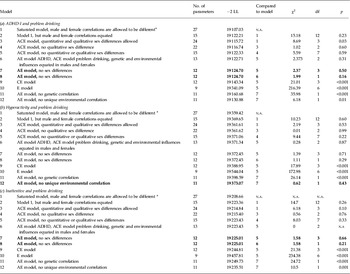
The correlation between ADHD scores and problem drinking could be equated in males and females without significant deterioration of model fit (see Table 1). The phenotypic correlations of ADHD symptom scores and problem drinking within individuals were 0.20 (hyperactivity), 0.28 (inattentive) and 0.30 (ADHD-I). Supplementary Tables S1–S3 show the full contingency tables of the categorized ADHD scores and problem drinking by gender.
Model-fitting results of genetic model-fitting analyses of (a) ADHD-I, (b) hyperactivity and (c) inattentive scores and self-reported problem drinking

ADHD-I, Attention deficit hyperactivity disorder index; LL, log likelihood; df, degrees of freedom; n.a., not applicable.
a In the saturated model, we estimate four thresholds (one for problem drinking and three for (a) ADHD-I, (b) hyperactivity or (c) inattentive scores); four covariate effects (two for age and two for gender); one within-subject cross-trait correlation; and three correlations (cross-twin ADHD, cross-twin problem drinking and cross-twin cross-trait) in monozygotic (MZ) males, dizygotic (DZ) males, MZ females, DZ females, opposite-sex twins male–female, and opposite-sex twins female–male.
The best fitting model is printed in bold.
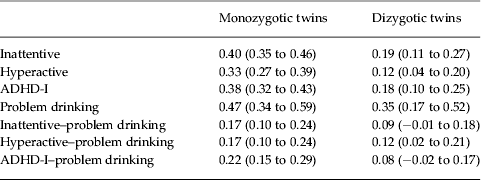
Table 2 shows the correlations for ADHD symptom scores, problem drinking and the cross-trait correlations across twins. Correlations in MZ twin pairs are consistently higher than correlations in DZ twin pairs, indicating genetic influences on ADHD symptom scores and problem drinking. For problem drinking, MZ correlations were less than twice the DZ correlations, which indicates possible shared environmental influences. Cross-trait correlations were higher in MZ twins (0.17–0.22) than in DZ twins (0.08–0.12), suggesting that the correlation between these traits is mediated by genetic effects.
Twin correlations (95% CI) of inattentiveness, hyperactive and ADHD-I scores with self-reported problem drinking

ADHD-I, Attention deficit hyperactivity disorder index; CI, confidence interval.
Genetic modelling
Because the twin correlations of ADHD symptom scores and problem drinking are suggestive of shared environmental effects, we first fitted a full ACE model to the multivariate data. The results of the genetic modelling analyses are summarized in Table 1. The ACE models provided an adequate fit compared to the saturated model. Next, we fitted the more constrained AE models, allowing only for additive genetic and non-shared environmental influences. Compared to the ACE model, the fit of this simpler model was not significantly worse, suggesting that shared environmental influences do not significantly contribute to the variances or covariance of ADHD symptom scores and problem drinking. The E model, which does not allow for genetic influences, did not fit the data well.
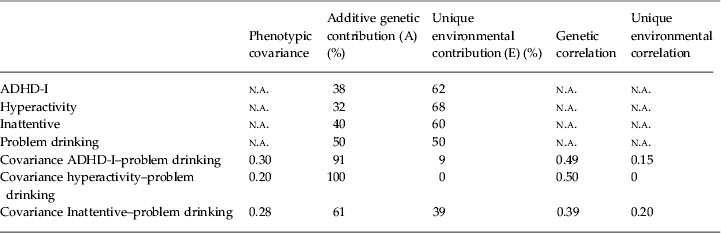
Next, we investigated whether the covariance between ADHD symptom scores and problem drinking was influenced by genetic or non-shared environmental influences. These analyses showed that the genetic and non-shared environmental correlations were significantly greater than zero. The final model of ADHD-I and inattentive problems included genetic and non-shared environmental influences on the variances and on the covariance of ADHD scores and problem drinking. The covariance between hyperactivity and problem drinking was only influenced by genetic effects and not by unique environmental effects. The parameter estimates of the genetic models are summarized in Table 3. In Supplementary Table S4, we show the parameter estimates of the full ACE model.
Estimates of genetic and environmental influences of the (co)variation of ADHD symptoms and problem drinking

ADHD-I, Attention deficit hyperactivity disorder index; n.a., not applicable.
Contributions of genetic and non-shared environmental influences
Our data show that the heritabilities of ADHD symptom scores varied from 32% (hyperactivity) to 38% (ADHD-I) to 40% (inattentive), with the remaining variance being explained by non-shared environmental influences (see Table 3). Problem drinking was explained by genetic factors (50%) and non-shared environmental influences (50%). The correlations between ADHD symptom scores and problem drinking (ranging from 0.20 to 0.30) were primarily explained by genetic factors, with the remaining covariance being explained by non-shared environmental influences. The genetic correlations between ADHD symptom categories and problem drinking ranged between 0.39 and 0.50.
Discussion
Adult ADHD symptoms and adult problem drinking were found to be moderately associated in a large general population sample including data from 6024 adult twins, with correlations ranging between 0.20 and 0.30 depending on the ADHD subscale. There are relatively few previous studies on the co-morbidity between ADHD and alcohol abuse in adulthood. Shekim et al. (Reference Shekim, Asarnow, Hess, Zaucha and Wheeler1990) investigated 48 men and eight women (aged 19–65 years) with adult ADHD and showed that 34% were also diagnosed with alcohol abuse or dependence. Biederman et al. (Reference Biederman, Wilens, Mick, Milberger, Spencer and Faraone1995) compared the lifetime risk for psychoactive substance and alcohol use disorders between 120 adults with a clinical diagnosis of ADHD and 268 comparison subjects without ADHD. The rate of alcohol abuse or dependence did not differ significantly between the adults with and without ADHD. By contrast, the risk of drug and polysubstance (drug plus alcohol) use was increased in subjects with ADHD. Finally, Tuithof et al. (Reference Tuithof, ten Have, van den Brink, Vollebergh and de Graaf2012) found that the risk of alcohol use disorder was increased about threefold in 74 Dutch subjects with ADHD compared to 3235 subjects without ADHD and this association was mediated by a diagnosis of CD. In agreement with these studies, we have shown a positive association between the number of ADHD symptoms and problematic alcohol use in adults.
In contrast with the paucity of data in adults, an extensive literature exists on the association between ADHD and problematic alcohol/substance use in adolescents (for a review, see Shaw et al. Reference Shaw, Hodgkins, Caci, Young, Kahle, Woods and Arnold2012). A significant cross-sectional association between ADHD and alcohol/drug use has been reported in most of these studies (Disney et al. Reference Disney, Elkins, McGue and Iacono1999; Wilens et al. Reference Wilens, Martelon, Joshi, Bateman, Fried, Petty and Biederman2011), but no significant association was reported in a female twin study (Knopik et al. Reference Knopik, Heath, Bucholz, Madden and Waldron2009a ). Moreover, in an at-risk sample of 223 boys with an alcoholic father and 106 matched controls, Knop et al. (Reference Knop, Penick, Nickel, Mortensen, Sullivan, Murtaza, Jensen, Manzardo and Gabrielli2009) showed that the presence of teacher-rated ADHD symptoms assessed at age 16 was a significant predictor of alcohol severity at age 40 (r = 0.35). As this study was performed in subjects with a positive family history for alcohol dependence, this suggests that correlations between ADHD and alcohol-related problems are particularly strong in genetically vulnerable subjects.
Genetic and environmental influences on ADHD symptoms and alcohol problems
Genetic modelling confirms previous findings by showing that both ADHD symptom scores and problem drinking in adults are heritable traits. The heritabilities of ADHD symptoms range from 32% to 40%, showing little variation between the different dimensions of ADHD (e.g. hyperactivity versus inattention). These estimates are very close to the previously estimated heritability of 33% using overlapping data in combination with data from other relatives (Boomsma et al. Reference Boomsma, Saviouk, Hottenga, Distel, de Moor, Vink, Geels, van Beek, Bartels, De Geus and Willemsen2010) and the heritability estimates of 37% (inattention) and 38% (hyperactivity/impulsivity) obtained in 15 198 adult Swedish twins (Larsson et al. Reference Larsson, Asherson, Chang, Ljung, Friedrichs, Larsson and Lichtenstein2013). Our data further show a substantial heritability (50%) of problem drinking, in line with previous estimates for alcohol dependence that range between 50% and 70% (Agrawal & Lynskey, Reference Agrawal and Lynskey2008). Even though we did not formally assess the DSM-IV diagnosis for alcohol dependence, the high heritability of problem drinking suggests that this is a reliably assessed phenomenon that has heritability similar compared to a formal alcohol dependence diagnosis.
The main aim of the current study was to investigate the aetiological nature of the covariation among ADHD symptom severity and problem drinking. The current genetic analyses show that the phenotypic association between ADHD symptom categories and problem drinking is due to genetic influences for 61–100%. In other words, the phenotypic correlations are primarily attributable to genes that contribute to the risk of both ADHD and problem drinking. The genetic correlations, that is the extent to which genes contributing to individual differences in ADHD symptoms overlap with those contributing to variation in problem drinking, are substantial (r = 0.39–0.50). This is in line with the findings of Edwards & Kendler (Reference Edwards and Kendler2012), who showed similar genetic correlations (range 0.44–0.65) between adolescent ADHD factors (forgetfulness, inattention and hyperactivity/impulsivity) and adult alcohol dependence. These authors further showed that hyperactivity/impulsivity is the only dimension that remains significantly associated with alcohol dependence at a genetic level after controlling for conduct problems. A study in 12–18-year-old twins supports a genetic aetiology of the co-morbidity between problematic alcohol use and ADHD (Young et al. Reference Young, Stallings, Corley, Krauter and Hewitt2000) whereas a large study in female adolescent twins reports no significant genetic, or phenotypic, correlation between these traits (Knopik et al. Reference Knopik, Heath, Bucholz, Madden and Waldron2009a ). The inconsistency in adolescent data may be due to a relatively weak influence of genetic factors on drinking behaviour during this life stage (Young et al. Reference Young, Stallings, Corley, Krauter and Hewitt2000). Kendler et al. (Reference Kendler, Schmitt, Aggen and Prescott2008) show that environmental influences (e.g. peer interactions) are primarily important for problematic drinking behaviours in adolescents whereas genetic influences become more prominent in adulthood. Supporting the hypothesis that ADHD symptoms in children and adolescents are genetically correlated with alcohol use disorder in adulthood, Knopik et al. (Reference Knopik, Jacob, Haber, Swenson and Howell2009b ) used the children-of-twins design and found that genetic influences contribute to the association between alcohol use disorder in mothers and ADHD in their offspring.
Gender differences in heritability
This is the first large-scale study to formally address gender differences in the aetiological influences on the co-morbidity between ADHD and problem drinking. Previous genetically informative studies have focused on either males or females (Knopik et al. Reference Knopik, Heath, Bucholz, Madden and Waldron2009a ; Edwards & Kendler, Reference Edwards and Kendler2012) or were too small to reliably address this question (Young et al. Reference Young, Stallings, Corley, Krauter and Hewitt2000). The study by Edwards & Kendler (Reference Edwards and Kendler2012), conducted in male twins, showed that adolescent hyperactivity is significantly associated with adult alcohol dependence at a genetic level whereas the study by Knopik et al. (Reference Knopik, Heath, Bucholz, Madden and Waldron2009a ), conducted in adolescent female twins, showed no significant association between ADHD symptoms and alcohol problems. These findings are suggestive of sex differences in the association between ADHD and problem drinking, although these studies differ also in a variety of other factors (e.g. inclusion of confounders, mean age of the subjects). Supporting the findings of earlier co-morbidity studies (Disney et al. Reference Disney, Elkins, McGue and Iacono1999; Friedrichs et al. Reference Friedrichs, Igl, Larsson and Larsson2012), gender-specific tests reveal similar correlations between ADHD and problem drinking in males and females in our study. We have tested for quantitative and qualitative sex differences and shown that genetic and environmental influences do not differ as a function of gender. Our findings indicate that genetic and environmental influences contributing to individual differences in these traits are equally important in males and females and that the same genes play a role.
Strengths and limitations
This study reports on a large sample (n = 6024) of adult twins in The Netherlands. The size of this study allows reliable estimation of the influence of genetic and environmental factors on the association between self-reported ADHD symptoms and problem drinking in males and females.
The results of this study should be interpreted in view of the following limitations. First, in this large general-population sample, problem drinking and ADHD symptoms were assessed by self-report and we did not obtain formal clinical diagnoses based on DSM-IV. However, it is reassuring that the positive association between self-reported problem drinking and ADHD symptoms is in line with the findings of earlier studies using clinical diagnosis. Second, individuals self-rated on both their level of ADHD symptoms and problem drinking. We cannot rule out the possibility that part of the association between ADHD and problem drinking is explained by shared rater variance. Third, problem drinking was defined based on the report of problems that participants experienced in relation to alcohol use. This definition did not include the actual amount of alcoholic drinks that the participant used at the time of assessment. Fourth, we did not investigate to what extent the association between ADHD symptom scores and problem drinking was mediated by CD because CD was not assessed at this time-point. It is therefore difficult to draw conclusions about the direction of causality of the reported association.
Clinical implications
In line with the findings of previous studies (Tuithof et al. Reference Tuithof, ten Have, van den Brink, Vollebergh and de Graaf2012; van Emmerik-van Oortmerssen et al. Reference van Emmerik-van Oortmerssen, Vedel, Koeter, de Bruijn, Dekker, van den Brink and Schoevers2013), our study provides further evidence for an increased risk of problematic alcohol use in adults with persisting ADHD symptoms. Our results show that this phenotypic association is primarily explained by overlapping genetic risk factors. A genetic vulnerability that is shared between ADHD and problem drinking implies that adolescents diagnosed with ADHD may have an increased risk of developing alcohol-related problems and early interventions may be applied to decrease this risk. Our results further suggest that clinicians who treat alcohol-dependent patients should be aware of the possibility that the patient may have a co-morbid condition of ADHD. Treatment of alcohol-dependent patients with co-morbid ADHD requires integrated interventions (Murthy & Chand, Reference Murthy and Chand2012; van Emmerik-van Oortmerssen et al. Reference van Emmerik-van Oortmerssen, Vedel, Koeter, de Bruijn, Dekker, van den Brink and Schoevers2013). Finally, the lack of gender differences in the association between ADHD and self-reported problem drinking indicates that females with ADHD are at equally high risk for alcohol-related problems compared to males with ADHD. As males are more often referred to treatment for ADHD than females (Derks et al. Reference Derks, Hudziak and Boomsma2007), clinicians should be especially aware of co-morbidity with (undiagnosed) ADHD in females with alcohol-related problems.
Supplementary material
For supplementary material accompanying this paper visit http://dx.doi.org/10.1017/S0033291714000361.
Acknowledgements
We thank all of the twins who participated in this study. This work was supported by the following funding agencies: ZonMw (Addiction:31160008) project: Genetic determinants of risk behaviour in relation to alcohol use and alcohol use disorder: a developmental perspective (D.I.B.); Beyond the Genetics of Addiction (ERC-284167) and Genetics of Mental Illness (ERC-230374). E.M.D. is supported by the Volksbond Rotterdam Foundation.
Declaration of Interest
None