The first language (L1) is often claimed to be responsible for second language (L2) learners’ (in)ability to process particular sounds in the target language. However, the conditions under which the L1 facilitates or inhibits the learning of new sounds are unclear, especially in the suprasegmental domain. Theoretical models such as Flege's (Reference Flege and Strange1995) speech learning model and Best's (Reference Best and Strange1995) perceptual assimilation model predict L2 learners’ performance based on the phonetic similarity between L1 and L2 sounds. However, most of the evidence in support of these (and other) L2 speech perception models comes from studies that focus on consonants (e.g., Best, McRoberts, & Goodell, Reference Best, McRoberts and Goodell2001; Best, McRoberts, & Sithole, Reference Best, McRoberts and Sithole1988; Flege & Hillenbrand, Reference Flege and Hillenbrand1986; Flege, Munro, & Mackay, Reference Flege, Munro and MacKay1995; Flege, Takagi, & Mann, Reference Flege, Takagi and Mann1996) and vowels (e.g., Flege, Reference Flege1987; Flege, Bohn, & Jang, Reference Flege, Bohn and Jang1997; Flege, Munro, & Fox, Reference Flege, Munro and Fox1994; Fox, Flege, & Munro, Reference Fox, Flege and Munro1995). L2 learners’ processing of suprasegmental information has been the focus of less research, and it is therefore less well understood.
Studies have shown that whether suprasegmental cues contribute to distinguishing among words in the L1, and how they do so, influences L2 learners’ use of these cues in the L2 (for discussion, see Cutler, Reference Cutler2012). Existing L2 studies on lexical tones have shown that how different aspects of fundamental frequency (F0; e.g., pitch direction and pitch height) signal lexical identity in the L1 largely determines how L2 learners perceive and process tones in the target language (e.g., Francis, Ciocca, Ma, & Fenn, Reference Francis, Ciocca, Ma and Fenn2008; Hallé, Chang, & Best, Reference Hallé, Chang and Best2004; Leather, Reference Leather, James and Leather1987; Lee, Vakock, & Wurm; Reference Lee, Vakoch and Wurm1996; Stagray & Downs, Reference Stagray and Downs1993; Wang, Spence, Jongman, & Sereno, Reference Wang, Spence, Jongman and Sereno1999; Wayland & Guion, Reference Wayland and Guion2004). By contrast, previous research on the perception and processing of stress has focused on the degree of similarity or difference between the L1 and L2 stress systems (i.e., whether or not stress falls on the same syllable vs. on different syllables across words; Dupoux, Pallier, Sebastián, & Mehler, Reference Dupoux, Pallier, Sebastián and Mehler1997; Dupoux, Peperkamp, & Sebastián-Gallés, Reference Dupoux, Peperkamp and Sebastián-Gallés2001; Dupoux, Sebastián-Gallés, Navarrete, & Peperkamp, Reference Dupoux, Sebastián-Gallés, Navarrete and Peperkamp2008; Peperkamp & Dupoux, Reference Peperkamp, Dupoux, Gussenhoven and Warner2002; Peperkamp, Vendelin, & Dupoux, Reference Peperkamp, Vendelin and Dupoux2010; Tremblay, Reference Tremblay2008, Reference Tremblay2009), and not so much on the specific suprasegmental cues (e.g., F0, duration, and intensity) that instantiate stress in the L1 versus the L2 (but see Cooper, Cutler, & Wales, Reference Cooper, Cutler and Wales2002; Lin, Wang, Idsardi, & Xu, Reference Lin, Wang, Idsardi and Xu2014; Ortega-Llebaria, Hong, & Fan, Reference Ortega-Llebaria, Hong and Fan2013; Zhang & Francis, Reference Zhang and Francis2010). Hence, it is unclear whether the L2 processing of word-level stress is determined by how suprasegmental cues contribute to lexical identity in the L1.
The present study sheds further light on this question by investigating L2 learners’ use of F0 and duration cues in the processing of word-level stress. More specifically, this study examines whether a cue-weighting theory of speech perception (e.g., Francis & Nusbaum, Reference Francis and Nusbaum2002; Holt & Lotto, Reference Holt and Lotto2006; Ingvalson, Holt, & McClelland, Reference Ingvalson, Holt and McClelland2011; Zhang & Francis, Reference Zhang and Francis2010) can explain L2 learners’ ability to process word-level stress. It does so by comparing the processing of stress in L2 learners of English who speak Standard Mandarin (SM) or Taiwan Mandarin (TM) as L1 dialects and who are at a similar proficiency in English. As will be shown below, SM, but not TM, instantiates word-level stress with the use of duration. This study investigates whether native SM and native TM listeners who have learned English as L2 differ in their ability to use duration as a cue to stress. An additional contribution of this study is that it investigates the effect of the L1 dialect on L2 learners’ use of suprasegmental cues to stress.
L2 PERCEPTION AND PROCESSING OF WORD-LEVEL STRESS
Stress is lexically contrastive in languages such as English, Dutch, and Spanish. For instance, in English, record (noun) and record (verb) form a minimal pair with respect to stress placement. By contrast, languages such as French or Finnish do not have word-level stress. To illustrate, in French, the final syllable of the last word in a phrase is accented, with this accent functioning as a boundary marker for words or phrases (e.g., Jun & Fougeron, Reference Jun, Fougeron and Botinis2000, Reference Jun and Fougeron2002; Vaissière, Reference Vaissière, Sundberg and Carlson1991; Welby, Reference Welby2006) but not distinguishing among segmentally identical words. Languages thus differ in whether or not stress contributes to lexical identity.
Native speakers of languages that have contrastive stress have little difficulty encoding stress in L2 words or in nonwords. Using four cross-modal priming experiments and two forced-choice identification experiments, Cooper et al. (Reference Cooper, Cutler and Wales2002) showed that Dutch-speaking L2 learners of English, who use stress to recognize Dutch words, were quite successful at using the suprasegmental cues of English stress to recognize English words. Similarly, Dupoux and colleagues have shown that native Spanish listeners are successful in distinguishing and recalling nonwords that differ in stress (Dupoux et al., Reference Dupoux, Peperkamp and Sebastián-Gallés2001, Reference Dupoux, Sebastián-Gallés, Navarrete and Peperkamp2008; Peperkamp et al., Reference Peperkamp, Vendelin and Dupoux2010).
In contrast, native speakers of languages that do not have contrastive stress have difficulty processing word-level stress. Using a sequence-recall task, Dupoux and colleagues showed that native French-speaking listeners, but not native Spanish-speaking listeners, had difficulty encoding stress when listening to nonwords (Dupoux et al., Reference Dupoux, Peperkamp and Sebastián-Gallés2001; Peperkamp & Dupoux, Reference Peperkamp, Dupoux, Gussenhoven and Warner2002). To explain these findings, they proposed that listeners’ (in)ability to distinguish stress contrast is determined by whether, within the first 2 years of life, they set the stress parameter to encode stress in their phonological representation of lexical words (Peperkamp, Reference Peperkamp2004; Peperkamp & Dupoux, Reference Peperkamp, Dupoux, Gussenhoven and Warner2002). For languages without contrastive stress (e.g., French), infants are predicted to observe stress regularity across words and thus not encode stress in their mental lexicon, which was considered the cause of their so-called stress deafness. This stress deafness was observed not only in native French-speaking listeners but also in proficient French-speaking L2 learners of Spanish (Dupoux et al., Reference Dupoux, Sebastián-Gallés, Navarrete and Peperkamp2008) and in simultaneous French–Spanish bilinguals who were French dominant (Dupoux, Peperkamp, & Sebastián-Gallés, Reference Dupoux, Peperkamp and Sebastián-Gallés2010). This suggests that for L2 learners who do not have contrastive stress in their dominant language, the difficulty in processing word-level stress is very robust.
Recent studies indicate that the mechanism underlying stress processing may not operate in an all or none fashion. Subtle differences between L1 and L2 prosodic systems can also influence L2 learners’ processing of stress (e.g., Tremblay, Reference Tremblay2008, Reference Tremblay2009). For instance, Tremblay (Reference Tremblay2008) found that not all French-speaking L2 learners were “stress-deaf”; in her study, several French Canadian L2 learners of English were able to use the stress contrast to distinguish between competing L2 word candidates. One possible explanation for the discrepancy between the findings of Tremblay and those of Dupoux and colleagues, in addition to methodological differences between the two sets of studies, is that speakers of Canadian French may have less difficulty than speakers of European French in using stress contrast for L2 lexical access because of the greater contrast between strong and weak syllables in Canadian French as compared to European French (for a discussion, see Tremblay, Reference Tremblay2008, Reference Tremblay2009). Another possible explanation is that speakers of Canadian French may have less difficulty using stress contrast for L2 lexical access because the specific suprasegmental cues that signal English stress (e.g., F0, duration, and intensity) may be used more in Canadian French than in European French.
In the realm of L2 speech perception, empirical research has demonstrated that surface phonetic details can play an important role in determining the difficulties that L2 learners may experience in L2 speech perception. The cue-weighting theory of speech perception (e.g., Francis et al., Reference Francis, Ciocca, Ma and Fenn2008; Francis & Nusbaum, Reference Francis and Nusbaum2002; Gandour, Reference Gandour1983; Holt & Lotto, Reference Holt and Lotto2006; Ingvalson et al., Reference Ingvalson, Holt and McClelland2011; Zhang & Francis, Reference Zhang and Francis2010) highlights the importance of these phonetic details, as it is concerned with how acoustic cues that signal a specific contrast are weighed in different languages and how differences in this weighting affect L2 speech perception and processing. According to this theory, speech perception is multidimensional, and acoustic cues are weighed differently across categories and across languages. Although multiple cues are simultaneously available to listeners, these cues are not weighed equally, and they often have “trading relations” (e.g., Repp, Reference Repp1982), with increased sensitivity to one cue being accompanied by decreased sensitivity to another cue. Listeners from different language backgrounds tune in to different acoustic cues in the same stimuli depending on how these cues are used to signal a contrast in the L1.
A clear example of the relevance of cue weighting exists for the perception of /l/ and /ɹ/ by Japanese L2 learners of English, as illustrated in Iverson, Kuhl, Akahane-Yamada, Diesch, Tohkura, Kettermann, and Siebert (Reference Iverson, Kuhl, Akahane-Yamada, Diesch, Tohkura, Kettermann and Siebert2003). Prior studies had found that Japanese listeners had great difficulty distinguishing between English /l/ and /ɹ/ (Bradlow, Pisoni, Yamada, & Tohkura, Reference Bradlow, Pisoni, Yamada and Tohkura1997; Lively, Logan, & Pisoni, Reference Lively, Logan and Pisoni1993; Logan, Lively, & Pisoni, Reference Logan, Lively and Pisoni1991; Yamada, Reference Yamada and Strange1995). In their comparison of native English listeners and Japanese- and German-speaking L2 learners of English, Iverson et al. (Reference Iverson, Kuhl, Akahane-Yamada, Diesch, Tohkura, Kettermann and Siebert2003) showed that English listeners discriminated the native /l/–/ɹ/ contrast using the third formant (F3). In contrast, Japanese listeners were more sensitive to the second formant (F2) than to F3, probably because the Japanese liquid is perceptually more similar to English /l/, which is often cued by a low F2, than to English /ɹ/, which is often cued by a low F3 (e.g., Aoyama, Flege, Guion, Yamada, & Akahane-Yamada, Reference Aoyama, Flege, Guion, Yamada and Akahane-Yamada2004). Because Japanese listeners did not pay sufficient attention to F3, they found it difficult to perceive the English contrast. Although German /ʁ/ differs from English /ɹ/, German listeners, unlike Japanese listeners, were able to distinguish English /l/ and /ɹ/ because of their sensitivity to F3. Japanese listeners’ perceptual difficulty was attributed to their sensitivity to unhelpful F2 information, whereas German listeners’ perceptual sensitivity was attributed to their sufficient attention to F3, a critical cue for distinguishing English /l/ and /ɹ/ (for a model that similarly predicts L2 learners’ perception of L2 categories on the basis of the mapping between L1 phonetic cues and the corresponding L1 categories, see Escudero, Reference Escudero2005, Reference Escudero, Boersma and Hamann2009; Escudero & Boersma, Reference Escudero and Boersma2004).
Like segments, multiple suprasegmental cues (i.e., F0, duration, and intensity) contribute to the realization of word-level stress (e.g., Beckman, Reference Beckman1986; Fry, Reference Fry1955; Lieberman, Reference Lieberman1961) and more generally to lexical identity (e.g., in lexical tones; Chao, Reference Chao1968; Duanmu, Reference Duanmu2007). Moreover, languages with word-level stress differ in the extent to which suprasegmental cues contribute relevant information for lexical access. For instance, native English listeners have been shown to make limited use of suprasegmental cues to stress, as English stress is also signaled by segmental information (full vs. reduced vowels); as a result, English listeners’ word recognition is not inhibited by errors in stress placement unless these errors result in segmental (i.e., vowel quality) changes in the word (Braun, Lemhöfer, & Mani, Reference Braun, Lemhöfer and Mani2011; Cutler, Reference Cutler1986; Cutler & Clifton, Reference Cutler, Clifton, Bouma and Bouwhuis1984; Cutler, Wales, Cooper, & Janssen, Reference Cutler, Wales, Cooper, Janssen, Trouvain and Barry2007; Fear, Cutler, & Butterfield, Reference Fear, Cutler and Butterfield1995; Small, Simon, & Goldberg, Reference Small, Simon and Goldberg1988). Likewise, native English listeners rely less on suprasegmental cues to English stress than do Dutch-speaking L2 learners of English, because vowel reduction is more frequent in English than in Dutch (Cooper et al., Reference Cooper, Cutler and Wales2002; Cutler et al., Reference Cutler, Wales, Cooper, Janssen, Trouvain and Barry2007). This suggests that the language-specific weighting of cues to English stress affects how listeners from different language backgrounds process it.
THE PRESENT STUDY
The present study further investigates whether the L2 learners’ processing of stress is determined by the degree to which individual suprasegmental cues contribute to lexical identity in the L1. It does so by focusing on an L1-L2 pairing that has been the object of relatively little research: Mandarin-speaking L2 learners of English (but see Chrabaszcz, Win, Lin, & Idsardi, Reference Chrabaszcz, Winn, Lin and Idsardi2014; Lin et al., Reference Lin, Wang, Idsardi and Xu2014; Wang, Reference Wang2008; Zhang & Francis, Reference Zhang and Francis2010). Suprasegmental cues have a greater functional load in Mandarin than in English, because Mandarin words with different lexical tones (signaled primarily by F0 cues) have different meanings (e.g., [mā] “mother,” [má] “hemp,” [mǎ] “horse,” and [mà] “scold”; Chao, Reference Chao1968; Duanmu, Reference Duanmu2007)Footnote 1 ; although English has word-level stress, it has few words that can be distinguished only in the suprasegmental cues to stress (e.g., trusty vs. trustee; Cutler, Reference Cutler1986; Cutler & Clifton, Reference Cutler, Clifton, Bouma and Bouwhuis1984).
Two target Mandarin varieties, SM and TM, are the focus of the present study. SM is based on the Beijing dialect (i.e., Putonghua) and spoken by the people of Mainland China, whereas TM is spoken by the people of Taiwan and, thus, influenced by Taiwanese (i.e., Southern Min). Because SM and TM share the above tonal system, they both use F0 as the primary suprasegmental cue to lexical identity (e.g., Howie, Reference Howie1976; Liu & Samuel, Reference Liu and Samuel2004). Although duration is a secondary cue to lexical tones in Mandarin, it is much less reliable than F0 to signal word identity, because the duration of the tone is affected by its position in the word and in the sentence (e.g., Howie, Reference Howie1976; Lai, Sui, & Yuan, Reference Lai, Sui and Yuan2010; Liu & Samuel, Reference Liu and Samuel2004; Nordenhake & Svantesson, Reference Nordenhake and Svantesson1983; Shen, Reference Shen1993). For instance, tones have shorter durations in non–word-final than in word-final positions, and they have shorter durations in non–phrase-final than in phrase-final positions (Nordenhake & Svantesson, Reference Nordenhake and Svantesson1983; Shen, Reference Shen1993); yet Chinese listeners recognize them despite this variability in duration.
It is important to note that SM and TM differ in the extent to which duration signals lexical identity, because only SM has word-level stress, and the primary suprasegmental cue to stress contrasts is precisely duration. SM has a stress pattern that contrasts stressed–stressed and stressed–unstressed disyllabic words (e.g., respectively, ['t
 ŋ'ɕī] “west and east” vs. ['t
ŋɕi] “stuff,” both written as 东西; Chao, Reference Chao1968; Duanmu, Reference Duanmu2007). The second syllable of stressed–unstressed words (e.g., ['t
ŋɕi]) is consistently shorter than the second syllable of stressed–stressed words (e.g., ['t
ŋ'ɕī]; Chen & Xu, Reference Chen and Xu2006; Lee & Zee, Reference Lee and Zee2010; Lin, Reference Lin and Hu1985; Lin & Yan, Reference Lin and Yan1980). Duration is thus a robust cue, hence the primary perceptual cue, to this stress contrast (e.g., Lin, Reference Lin and Hu1985). The second syllable of stressed–unstressed words also carries a neutral tone that can vary in F0 depending on the lexical tone carried by the preceding syllable: the F0 contour of the neutral tone can be characterized as midfalling after a high-level tone, high falling after a rising tone, midlevel after a dipping tone, and low falling after a high falling tone (Lee & Zee, Reference Lee and Zee2010). F0 is thus a secondary cue to this stress contrast (Lin, Reference Lin and Hu1985). Although unstressed syllables in Standard Mandarin are also reduced, vowel reduction has not been deemed important as a cue to Mandarin stress, at least as compared to English stress (e.g., Lin, Reference Lin and Hu1985; Zhang & Francis, Reference Zhang and Francis2010).
By contrast, TM does not have this stress distinction: disyllabic words have the stressed–stressed pattern, and the second syllable of disyllabic words is not reduced (e.g., ['t
ŋ'ɕī] “west and east” vs. ['t
ŋ'ɕī] “stuff,” both written as 東西; Kubler, Reference Kubler1985; Swihart, Reference Swihart2003). Unlike in SM, the second syllable of ['t
ŋ'ɕī] “stuff” is not shorter than the second syllable of ['t
ŋ'ɕī] “west and east” in TM, and the second syllable of the two words do not differ in intensity either (Huang, Reference Huang2011, Reference Huang2012). As the second syllable of disyllabic words in TM is not reduced, the neutral tone carried by this second syllable does not vary in F0 depending on the lexical tone carried by the preceding syllable; this neutral tone often has a low F0 regardless of the preceding tone (Huang, Reference Huang2011, Reference Huang2012). Hence, given the absence of stressed–unstressed words in TM, duration appears to be a relatively less important cue to lexical identity in TM than it is in SM.
Existing L2 studies on Mandarin listeners’ processing of English stress have yielded mixed findings. Using a forced-choice word class identification task (e.g., DEsert as noun vs. deSERT as verb), Zhang and Francis (Reference Zhang and Francis2010) found that Mandarin-speaking L2 learners of English from Mainland China but tested in the United States, who were a middle to high proficiency level (i.e., 7 as an average self-evaluation score in a 10-point scale), relied more on vowel quality (i.e., F1–F3) than on suprasegmental cues to English stress and did not differ from native English listeners in their use of F0 and duration cues. However, using a forced-choice English stress identification task (i.e., stress on first syllable vs. second syllable), Wang (Reference Wang2008) found that Mandarin-speaking L2 learners of English from Mainland China and tested in China (whose English proficiency was not reported) did not rely on segmental cues and used only F0 as a cue to English stress. These inconsistent findings may stem in part from the potentially different proficiencies of the L2 learners that were tested. Specifically, the L2 learners who lived in the United States (Zhang & Francis, Reference Zhang and Francis2010) may have been more proficient than those who lived in China (Wang, Reference Wang2008).
Lin et al. (Reference Lin, Wang, Idsardi and Xu2014) remedied this problem by examining the processing of English stress in proficiency-matched SM- and Korean-speaking L2 learners of English. Unlike English and SM, Korean does not have word-level stress (Jun, Reference Jun and Jun2005; Sohn, Reference Sohn1999). Participants completed a sequence-recall task (Experiment 1) and a lexical decision task (Experiment 2); in the latter, words were selected such that their incorrect stress placement affected (humane as /'hjumən/ vs. /hjə'me jn/) or did not affect (e.g., enough as /'ɪnʌf/ vs. /ɪ'nʌf/) vowel quality. The results of Experiment 1 revealed that the Mandarin group had an advantage over the Korean group in encoding stress in English nonwords. The results of Experiment 2 showed that vowel quality did not affect stress processing in either L2 group. These results suggest that suprasegmental cues to stress (including F0 and duration, which were not isolated in this study) enhanced stress processing only in the group for which these cues signaled lexical identity in the L1 (e.g., the SM group).
However, no research (to our knowledge) to date has investigated whether L2 learners whose L1 does not have word-level stress (e.g., TM) can transfer the use of a suprasegmental cue (here, F0) from a different phonological category (i.e., lexical tones) to word-level stress in the L2. Furthermore, it is unclear whether L2 learners differ in their ability to use a particular suprasegmental cue to stress (here, duration) as a function of the relative weight of that cue in the L1 (e.g., SM vs. TM). The present study examines these issues by investigating SM and TM listeners’ use of F0 and duration to encode English stress. In doing so, and following recent studies investigating how L1 dialect affects the L2 perception of segments (e.g., Chládková & Podlipský, Reference Chládková and Podlipský2011; Colantoni, Steele, & Escudero, Reference Colantoni, Steele and Escudero2015; Escudero, Simon, & Mitterer, Reference Escudero, Simon and Mitterer2012; Escudero & Williams, Reference Escudero, Simon and Mitterer2012; Mayr & Escudero, Reference Mayr and Escudero2010), this study also sheds light on whether the L1 dialect can modulate L2 learners’ encoding of English stress.
Following previous research on the processing of stress (Dupoux et al., Reference Dupoux, Peperkamp and Sebastián-Gallés2001, Reference Dupoux, Sebastián-Gallés, Navarrete and Peperkamp2008), this study uses sequence-recall experiments in which listeners listen to and encode sequences of words that differed in stress pattern. Dupoux et al. (Reference Dupoux, Peperkamp and Sebastián-Gallés2001) have proposed that the sequence-recall task provides a more robust method to study the processing of stress, because it requires listeners to encode stress in acoustically variable stimuli and discourages response strategies given the memory load it imposes on listeners. In the task, participants first learn to encode a stress distinction (e.g., 'numi = 1; nu'mi = 2); then they hear sequences of nonwords that vary in stress pattern and must accurately encode the stress pattern of each nonsense word in the sequence (e.g., 'numi, nu'mi, 'numi, nu'mi = 1212). Sequence-recall tasks can thus assess whether nonnative listeners can encode acoustically variable word-level stress together with the segmental content of the words.
Our participants completed two such tasks. The first sequence-recall task contained naturally recorded English nonwords (Experiment 1), and the second sequence recall task contained resynthesized English nonwords (Experiment 2). Experiment 1 served to establish a baseline in listeners’ processing of word-level stress when F0 and duration cues naturally co-occurred.Footnote 2 Experiment 2 examined how listeners use F0 and duration cues when these cues are isolated or pitted against each other.
METHOD
The two experiments took place consecutively, with a short break (approximately 5 min) in between. Experiment 1 was conducted before Experiment 2 in order to establish baseline results with natural stimuli and because the former was easier (F0 and duration cues converged) than the latter (F0 and duration converged in only one of four conditions). The same participants completed both Experiments 1 and 2.
Participants
Thirty L2 learners of English who spoke either SM (n = 15) or TM (n = 15) as their L1 and 15 native English listeners participated in this study. The English- and SM-speaking participants were undergraduate and graduate students who studied at a Midwestern American university. Because it was difficult to find enough TM-speaking participants at the institution where the present research took place, 9 of the 15 TM-speaking learners were recruited and tested in Taiwan.
A questionnaire was used to collect biographical and language experience information about the participants. This questionnaire revealed that the great majority of our SM-speaking and TM-speaking participants did not know other Chinese languages.Footnote 3 All of the SM-speaking participants and 8 of the 15 TM-speaking participants had spent at least 1 month in an English-speaking country. No participant reported having any speech or hearing impairment.
A cloze (i.e., fill in the blank) test (Brown, Reference Brown1980) was used to assess the L2 learners’ proficiency in English. One advantage of using a written cloze test rather than an aural/oral proficiency test is that it avoids potentially circular argumentation by tapping into a set of language skills that are known to be highly predictive of general proficiency but that differ from the skills used in the present phonological processing experiment (e.g., performance on an aural/oral comprehension experiment is likely to be influenced by listeners’ ability to perceive and produce English stress). The particular cloze test that the L2 learners completed (Brown, Reference Brown1980) was administered for a few years as part of the Guangzhou English Language Test at the Guangzhou English Language Center (Guangdong, China), and later as part of the English Language Institute Placement Test at the University of Hawai‘i (J. D. Brown, personal communication, April 28, 2007). Because it has been the object of much research (for details, see Brown, Reference Brown1980), the test is regarded as a valid and reliable measure of global English proficiency. The maximum number of correct responses on the test was 50. The L2 learners’ responses on the test were considered accurate so long as they were acceptable, as determined by a list of answers that were considered acceptable when the test was administered as part of the English Language Institute Placement Test at the University of Hawai‘i.
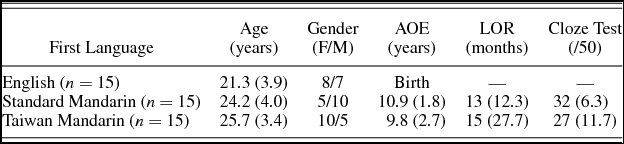
The participants’ biographical, language background, and proficiency information is provided in Table 1. Analyses of the L2 learners’ cloze test scores and length of residence in English-speaking countries revealed a significant positive correlation (r = .472, n = 30, p < .008), indicating that the L2 learners were more proficient in English if they spent a longer amount of time in English-speaking countries. Comparisons of the two groups of L2 learners revealed no significant difference between them in their age of acquisition of English, t (28) = 1.362, p > .1, length of residence in English-speaking countries, t (19.3) = –0.255, p > .1, or proficiency in English, t (21.5) = 1.464, p > .1.Footnote 4 Despite this lack of difference, the fact that some of the TM listeners lived in Taiwan at the time of testing may raise concerns as to whether the TM listeners were as proficient in English as the SM listeners. To factor out possible proficiency effects in our results, we included L2 learners’ proficiency as a continuous variable in the statistical analyses.Footnote 5
Participants’ language background information

Note: Values are means (standard deviations), except for gender. AOE, Age of first exposure to English; LOR, length of residence in English-speaking countries.
Experiment 1
Materials
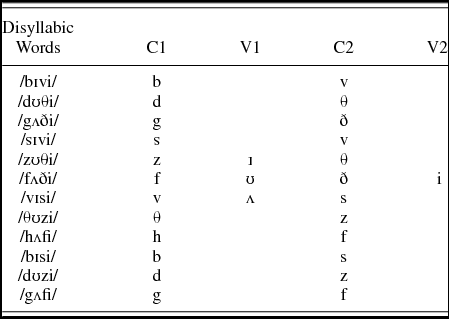
The stimuli were minimal pairs of English nonwords that differed in stress pattern (e.g., ['fʌði] vs. [fʌ'ði]). The nonwords were created such that they would have a consonant–vowel (CV) C1V1C2V2 structure. To ensure that the stress stimuli would not have vowel reduction cues to stress and still sound like English words, /ɪ/, /ʊ/, and /ʌ/ were used in V1 position and [i] was used in V2 position, because these sounds would not be reduced to schwas as a function of stress placement in English words. To ensure that the consonants would similarly not provide segmental cues to stress, only fricatives and voiced stops were used in positions of C1 and C2 (e.g., Cho & Keating, Reference Cho and Keating2001; Tremblay, Reference Tremblay2009). Twelve experimental nonwords were used (for a complete list, see Table A.1 in Appendix A).
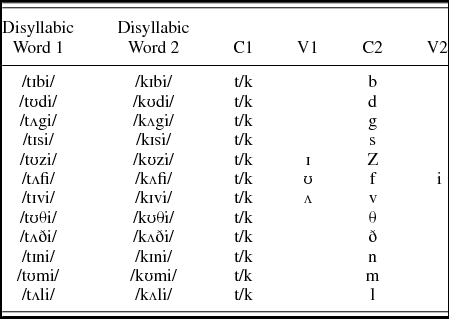
The experiment also included filler stimuli that differed in their word-initial consonant (e.g., [tɪvi] vs. [kɪvi]) to prevent participants from developing stress-specific processing strategies. The filler stimuli always contrasted in the sounds /t/ and /k/, and they matched the stress contrast stimuli in their phonological structure, with /ɪ/, /ʊ/, and /ʌ/ being used in V1 position and [i] in V2 position. To increase the phonetic variability in the stimuli, fricatives (/f/, /v/, /θ/, and /ð/), voiced stops (/b/, /d/, and /g/), or sonorants (/m/, /n/, and /l/) were used for the sound in C2 position. A total of 12 nonwords were used for the fillers (for a complete list, see Table A.2 in Appendix A).Footnote 6 The inclusion of these filler items in the experiment encouraged participants to attend to both suprasegmental and segmental information, and allowed us to rule out any effect of L1 dialect on their encoding of segmental words.
The nonwords were produced by a female native speaker of American English with a Midwestern accent. She read each nonword four times in the carrier sentence “Say ___ again.” Two tokens were selected from the four repetitions of each stress pattern. The stimuli included a total of 96 tokens: 48 experimental tokens (12 nonwords × 2 stress patterns × 2 tokens) and 48 filler tokens (12 nonwords × 2 segmental contrasts × 2 tokens). Any given sequence (described in the next section) never contained the same token twice.
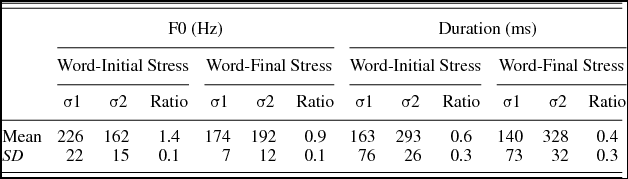
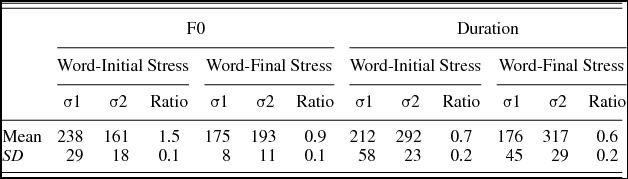
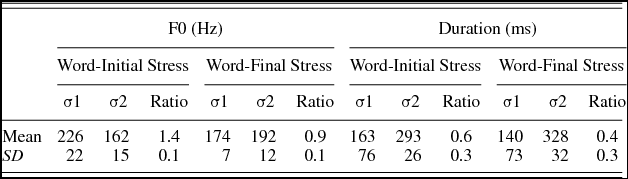
Acoustic measurements of the stress stimuli, provided in Table 2, revealed that the nonwords with initial and final stress differed significantly in the F0 and duration ratios of the first syllable to the second syllable, F0: t (23) = 17.1, p < .01; duration: t (23) = 5.58, p < .01. It can be noted that both nonwords with initial stress and nonwords with final stress have a shorter initial syllable than final syllable due to word-final lengthening. The intensity of all the stimuli was normalized at 70 dB.
Acoustic characteristics of nonwords in Experiment 1
Note: σ1, First syllable; σ2, second syllable.
Procedures
The task was conducted using Paradigm software (Perception Research Systems, Reference Systems2007). The experimental stimuli were heard together in the same block, and the filler stimuli were heard together in a separate block. The sequence-recall task had two main phases: a familiarization (or association) phase and a testing phase. In the familiarization phase, participants were trained to associate 1 and 2 (on a keyboard) with word-initial and word-final stress (experimental stimuli) or with “t” and “k” (filler stimuli). This was done using real words (trusty vs. trustee, table vs. cable). Participants received feedback on whether or not their responses were correct. After 18 trials, an association test was conducted in which participants were required to correctly identify the stress pattern or initial consonant they heard (as 1 or 2). The participants were invited to complete the testing phase only after receiving an accuracy score equal to or higher than 95% on the association test. If the participants did not achieve 95% accuracy, they were required to take the familiarization task again, up to two more times. Given the transparency of the familiarization phase, 40 of the 45 participants reached the accuracy criterion in their first attempt, and the 5 participants who were required to take the task again reached the accuracy criterion within three attempts. The training took 10–20 min depending on whether the participants reached the accuracy criterion on their first attempt.
In the testing phase, participants were asked to recall sequences of four tokens by pressing 1 and 2 in the correct order. For the experimental stimuli, each sequence included two tokens with word-initial stress and two tokens with word-final stress (e.g., [fʌ'ði] ['fʌði] ['fʌði] [fʌ'ði]). For the filler stimuli, each sequence included two tokens with word-initial /t/ and two tokens with word-initial /k/ (e.g., [tɪvi] [kɪvi] [kɪvi] [tɪvi]). Six different token orders (i.e., [1122], [2211], [1212], [1221], [2121], [2112]) were used for the sequences of nonwords. The six orders were used to counterbalance the number of nonwords with initial and final stress or with initial /t/ and /k/ within a sequence. Sequences with identical stress patterns or initial consonants (i.e., [1111], [2222]) were not used because there was no change in the sequences; thus, such trials might be much easier than other trials (Dupoux et al., Reference Dupoux, Peperkamp and Sebastián-Gallés2001). Sequences with three identical stress patterns or initial consonants (i.e., [1112], [1121], [1211], [2111], [1222], [2122], [2212], [2221]) were also not used to keep the task relatively short. As will be shown in the Results section, despite the limited number of patterns to be recalled, listeners did not perform well on the task, indicating that the task was difficult. The order of sequences and of tokens within each sequence was randomized across participants. The experiment included a total of 72 experimental trials (12 nonwords × 6 orders) and 72 filler trials (12 nonwords × 6 orders). The experimental and filler trials were heard in different blocks.
At the beginning of each trial, participants saw the visual prompt “next trial.” Then they heard the four nonwords, each separated by an interstimulus interval of 50 ms, as in previous research (e.g., Dupoux et al., Reference Dupoux, Peperkamp and Sebastián-Gallés2001, Reference Dupoux, Sebastián-Gallés, Navarrete and Peperkamp2008). The last interstimulus interval in the sequence was followed by the auditory prompt “OK” in another female voice to prevent participants from using echoic memory to recall the sequences. The intertrial interval was 1500 ms. Participants completed a practice session of 12 sequences to ensure that they understood how to carry out the task before the actual experiment. The experiment took 20–30 min to complete.
Data analysis and predictions
Logit mixed-effects models were conducted on the participants’ sequence-encoding accuracy. The models were fitted in R using the lmer function from the lme4 package for mixed-effects models (for discussion, see Baayen, Reference Baayen2008).
The first two analyses focused on participants’ accuracy with stimuli that differed in stress. A first model analyzed the sequence-encoding accuracy of the three groups, with L1 (English, SM, and TM; baseline = English) as fixed effect and with participant, test item, trial order, and sequence order (e.g., [1122], [2211]) as crossed random effects. A second model analyzed the sequence-encoding accuracy of only the L2 groups, with L1 dialect (SM and TM; baseline = SM), L2 proficiency (centered cloze test scores, obtained by subtracting the cloze test mean [across participants] from the raw cloze test score, to reduce multicollinearity in the model), and their interaction as fixed effects, and with participant, test item, trial order, and sequence order as crossed random effects. The last two analyses were identical to the first two, but they were instead performed on participants’ sequence-encoding accuracy on test items that differed in their initial consonant (i.e., the filler items). For each analysis, fixed effects were removed from the initial (i.e., most complex) model one at a time, and model comparisons were run in pairwise fashion to determine if the more complex model accounted for significantly more of the variance, as determined by log-likelihood ratio tests. We report the simplest model that accounted for significantly more of the variance than simpler models.
Whether TM listeners differ from SM listeners in their ability to process English stress in Experiment 1, where the F0 and duration cues coincide, depends on whether or not these cues are additive in the processing of English stress. If they are, TM-speaking L2 learners of English should be less accurate than SM-speaking L2 learners of English at encoding English stress, because TM listeners are expected to be less reliant on duration as a cue to lexical identity as compared to SM listeners. If, in contrast, cues to stress are not additive, and if TM listeners can transfer the use of F0 cues to word identity from the lexical tones in TM to word-level stress in English, then TM and SM listeners should perform similarly on the task, because F0 is the primary cue to lexical tones and thus signals lexical identity in both languages.
Results
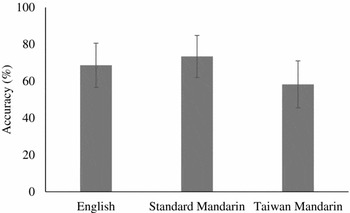
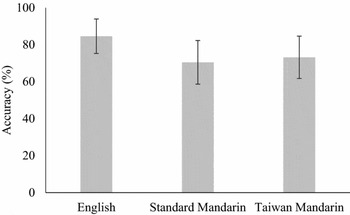
The accuracy of the participants’ sequence encoding for stimuli that differed in stress pattern is shown in Figure 1.
Participants’ sequence-encoding accuracy (standard errors) in the experimental stimuli in Experiment 1.

The best logit mixed-effects model on all the participants’ accuracy was a model that did not include any fixed effect (i.e., adding L1 to the model did not improve it). This indicates that neither the SM group nor the TM group differed from the English group in their encoding of stress in English nonwords.
Similarly, the best logit mixed-effect models on the L2 learners’ accuracy did not include any fixed effect (i.e., adding L1 dialect and/or L2 proficiency to the model did not improve it). This indicates that SM and TM listeners did not differ from each other in their processing of stress, and L2 proficiency (as measured by the cloze test) did not influence their performance on the task. Hence, all three groups patterned similarly in the processing stress in English nonwords.Footnote 7
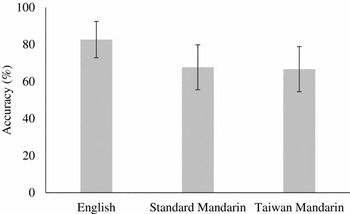
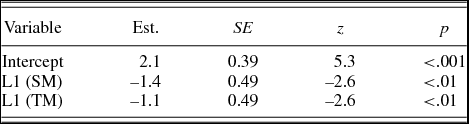
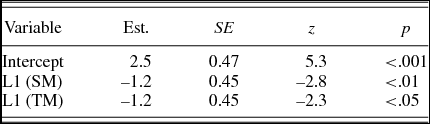
The accuracy of the participants’ sequence encoding for stimuli that differed in their initial consonant is shown in Figure 2. The best logit mixed-effects model on all the participants’ accuracy included L1 as fixed effect. This model is summarized in Table 3. The results of this analysis suggests that the English group outperformed the SM and TM groups in their encoding of /t/ and /k/ in English nonwords. However, the best logit mixed-effect model on the L2 learners’ accuracy did not include any effect, indicating that SM and TM listeners did not differ from each other in their processing of /t/ and /k/ in English nonwords.
Participants’ sequence-encoding accuracy (standard errors) in the filler stimuli in Experiment 1.

Logit mixed-effects model on all participants’ accuracy on filler stimuli for Experiment 1
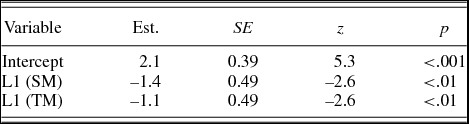
Note: The English group's performance was the baseline; df = 3015. L1, First language; SM, Standard Mandarin; TM, Taiwan Mandarin.
Discussion
The results revealed no significant difference in performance between any of the groups in their encoding of stress in English nonwords. This indicates that the TM-speaking L2 learners of English encoded English stress as well as did native English listeners and SM-speaking L2 learners of English, both of whom have word-level stress in their L1. The results also showed that the SM and TM listeners did not differ from each other but performed less accurately than English listeners when encoding word-initial /t/ and /k/. The lower segmental accuracy of the L2 groups as compared to native English listeners may be due to differences between English and Mandarin in their phonetic realizations of the target segments (e.g., English /t/ is alveolar whereas Mandarin /t/ is dental) and possibly in their phonotactics (e.g., the lax vowels following /t/ and /k/ in the stimuli are not permitted in Mandarin).
The lack of significant difference between TM listeners and SM (and English) listeners in the experimental condition indicates that TM listeners were not at a disadvantage as compared to SM listeners when processing English stress. If TM listeners are less reliant on duration cues to lexical identity than SM listeners, as we predicted from the weighting of suprasegmental cues in their L1, then these results might suggest that the F0 cues were sufficient for TM listeners to be able to process English stress. Listeners’ independent use of F0 and duration cannot, however, be assessed without isolating these cues in experimental stimuli.
Experiment 2 used resynthesized stimuli in which F0 and duration were manipulated in order to determine whether TM and SM listeners differ from each other in their use of F0 and duration cues to English stress.
Experiment 2
Materials
As in Experiment 1, the experimental stimuli were minimal pairs of English nonwords that differed only in suprasegmental cues to stress (e.g., ['fʌði] vs. [fʌ'ði]). Because voiced stops and fricatives might behave differently in cueing stress, only nonwords containing fricative consonants were used in Experiment 2 to control for the cues provided by the initial consonant. Four nonwords (/sɪvi/, /zʊθi/, /fʌði/, and /hʌfi/) were selected for resynthesis from the nonwords used in Experiment 1. The experimental stimuli included a total of 16 tokens (4 segmental nonwords × 2 stress patterns × 2 repetitions). As in Experiment 1, four nonwords differing in their word-initial consonant (e.g., [tɪvi] vs. [kɪvi]) were also selected from Experiment 1 as fillers to prevent participants from developing stress-specific processing strategies. The filler stimuli included a total of 16 tokens (4 segmental nonword pairs × 2 initial consonants × 2 repetitions). Any given sequence (described in the next section) never contained the same token twice.
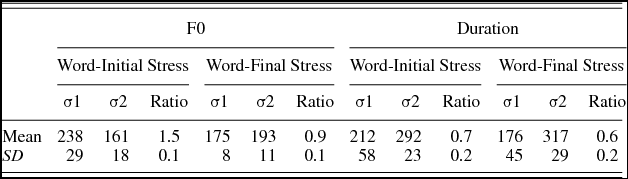
As shown in Table 4, the experimental nonwords with initial and final stress differed significantly in the F0 and duration ratios of the first syllable to the second syllable, F0: t (7) = 24.6, p < .01; duration: t (7) = 7.01, p < .01. The values in Table 4 are similar to those presented in Table 2, but slightly different in that only a subset of the nonwords were included in Experiment 2. The resynthesis of the experimental stimuli was done based on the average values reported in Table 4.
Acoustic characteristics of nonwords in Experiment 2
Note: σ1, First syllable; σ2, second syllable.
The experimental stimuli were resynthesized such that stress would be conveyed by both F0 and duration (“F0 + duration cues” condition), by F0 alone (“F0 cue” condition), by duration alone (“duration cue” condition), or by conflicting F0 and duration (“conflicting cues” condition). The F0 + duration cues condition serves as the baseline, in that it contains two suprasegmental cues that signal stress in English nonwords. The F0 cue condition and the duration cue condition serve as experimental conditions, with the understanding that their comparison to the F0 + duration cues condition reflects the degree to which performance becomes more impaired upon the removal of, respectively, duration cue or F0 cue. Finally, in the conflicting cues condition, the F0 and duration cues contradict each other, such that a syllable with higher F0 is shorter and a syllable with lower F0 is longer. This last condition makes it possible to determine whether listeners weigh one cue more than the other when encoding stress patterns. Thus, the conflicting cues condition specifies the relative importance of F0 and duration cues in listeners’ encoding of English stress.
Recall that all the stimuli had first been normalized for intensity at 70 dB. The F0 and duration cues were then manipulated with PSOLA in Praat (Boersma & Weenink, Reference Boersma and Weenink2012) such that the nonwords had the average F0 and/or duration of the natural stimuli reported in Table 4. Thus, in the condition where F0 was the only cue to stress, the duration of each syllable corresponded to the average duration across both syllables and stress patterns (i.e., 249 ms) in Table 4.Footnote 8 In the condition where duration was the only cue to stress, the F0 of each syllable corresponded to the average F0 across both syllables and stress patterns (i.e., 189 Hz) in Table 4. In the condition where both F0 and duration converged, the resynthesized stimuli had the exact values reported in Table 4. In the condition where F0 and duration conflicted, F0 and duration measurements were swapped across stress patterns such that the stimuli could be considered as having initial or final stress depending on whether listeners attended to F0 or duration.
Procedures
The sequence-recall task in Experiment 2 had only a testing phase, as the participants completed the familiarization (or association) test in Experiment 1 and completed Experiment 2 approximately 5 min after Experiment 1. In the testing phase, participants were asked to recall sequences of four tokens by pressing 1 and 2 in the correct order. Each test trial began with the auditory presentation of a sequence that included two stress-initial tokens and two stress-final tokens with the same segments (e.g., [fʌ'ði] ['fʌði] ['fʌði] [fʌ'ði]) or two /t/-initial and two /k/-final tokens (e.g., [tɪvi] [kɪvi] [kɪvi] [tɪvi]). For the experimental stimuli, each sequence consisted of four different tokens from the same cue condition (F0 + duration cues, F0 cue, duration cue, or conflicting cues). To shorten the duration of the experiment, for both experimental and filler stimuli, three of the six possible sequences (i.e., [1122], [2211], [1212], [1221], [2121], [2112]) were used for two nonwords, and the other three possibilities were used for the other two nonwords. The order of sequences and of tokens within each sequence was randomized across participants. The experiment included 48 experimental sequences (4 segmental nonwords × 4 conditions × 3 orders) and 48 filler sequences (4 segmental nonword pairs × 4 repetitions × 3 orders). The experimental and filler trials were presented in different blocks. The rest of the procedures were identical to those of Experiment 1. The experiment took 20–25 min to complete.
Data analysis and predictions
The first two analyses focused on participants’ accuracy with stimuli that differed in stress. Logit mixed-effects models were conducted on the participants’ sequence-encoding accuracy in the first three experimental conditions. A first model analyzed the accuracy of the three groups, with cue condition (F0 + duration cues, F0 cue, and duration cue; baseline = F0 + duration cues), L1 (English, SM, and TM; baseline = English), and the interaction between the two as fixed effects and with participant, test item, trial order, and sequence order (e.g., [1122], [2211], etc.) as crossed random effects. A second model analyzed only the L2 learners’ accuracy, with cue condition (F0 + duration cues, F0 cue, and duration cue; baseline = F0 + duration cues), L1 dialect (SM and TM; baseline = SM), proficiency (centered cloze-test scores, as obtained for Experiment 1), and all interactions as fixed effects, and with participant, test item, trial order, and sequence order as crossed random effects.
The results in the conflicting cues condition were analyzed separately because they did not yield the same dependent variable as the previous three conditions. In this condition, because F0 and duration cues conflicted, the stress pattern of each word in the sequence could not be unequivocally identified. Participants’ responses were therefore coded based on the use of F0 or duration cues to identify the stress patterns. For the use of F0, the recalled stress patterns were deemed to be “accurate” if the word for which the initial syllable had a higher F0 was identified as 1 and if the word for which the final syllable had a higher F0 was identified as 2. For the use of duration, the recalled stress patterns were deemed to be “accurate” if the word with a longer initial syllable was identified as 1 and if the word with a longer final syllable was identified as 2. The sequence “accuracy” computed on the basis of these two different coding thus reflect listeners’ consistent use of F0 versus duration cues to English stress when these two cues are pitted against each other.Footnote 9
Logit mixed-effects models were conducted on the participants’ accuracy in the conflicting cues condition. A first model analyzed all participants’ accuracy in their use of F0, with L1 (English, SM, and TM; baseline = English) as fixed effect, and with participant, test item, trial order, and sequence order as crossed random effects. A second model analyzed L2 learners’ accuracy in their use of F0, with L1 dialect (SM and TM; baseline = SM), proficiency (centered cloze-test scores), and their interaction as fixed effects, and with participant, test item, trial order, and sequence order as crossed random effects. A third model analyzed all participants’ accuracy in their use of duration, with L1 (English, SM, and TM; baseline = English) as fixed effect, and with participant, test item, trial order, and sequence order as crossed random effects. Finally, a fourth model analyzed L2 learners’ accuracy in their use of duration, with L1 dialect (SM and TM; baseline = SM), proficiency (centered cloze-test scores), and their interaction as fixed effects, and with participant, test item, trial order, and sequence order as crossed random effects.Footnote 10 The last two mixed-effects models analyzed participants’ sequence-encoding accuracy on the test items that differed in their initial consonant (i.e., the filler items), with either L1 (all participants) or L1 dialect (L2 learners) as fixed effect.
For each analysis, fixed effects were removed from the initial (i.e., most complex) model one at a time, and model comparisons were run in pairwise fashion to determine if the more complex model accounted for significantly more of the variance, as determined by log-likelihood ratio tests. We report the simplest model that accounted for significantly more of the variance than simpler models. Whenever L1 or L1 dialect interacted with cue conditions (in the first set of analyses), subsequent models were performed separately on the native speakers’ and L2 learners’ accuracy within each cue condition. For all post hoc comparisons, we adjusted the alpha level using the Bonferroni correction.
Given the results of Experiment 1, TM listeners are predicted to transfer their use of F0 cues from lexical tones in TM to stress in English, even if TM does not have word-level stress. If they do so, in the first set of analyses, we should not find significant interactions between the effect of the F0 cue (as compared to the F0 + duration baseline) and the effects of L1 dialect, because F0 is a cue to lexical identity in both TM and SM (due to lexical tones). However, if TM listeners are less reliant on duration as a cue to lexical identity than SM listeners are, in the first set of analyses, we should find significant interactions between the effect of the duration cue (as compared to the F0 + duration baseline) and the effect L1 dialect, with TM-speaking L2 learners of English showing a larger difference between the duration cue condition and the baseline condition than SM-speaking L2 learners of English. Furthermore, we may find in the second set of results that TM listeners make weaker use of duration and stronger use of F0 than SM listeners when duration is pitted against F0.
Results
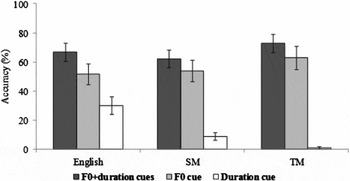
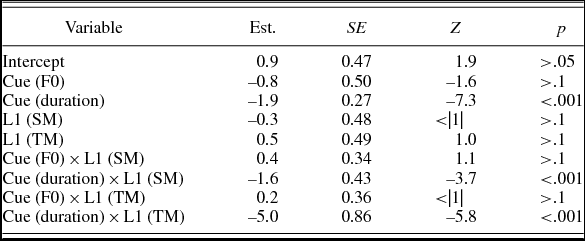
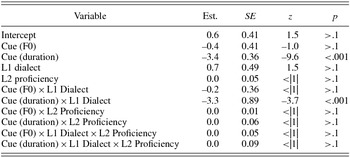
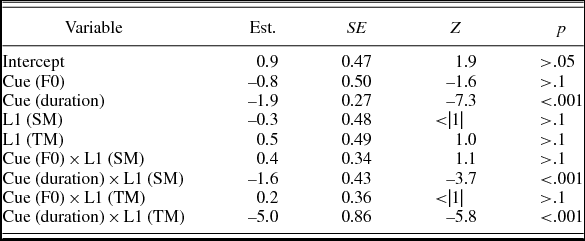
The accuracy of participants’ sequence encoding in the F0 + duration, F0, and duration cue conditions is shown for the three groups in Figure 3. The best logit mixed-effects model of all three groups’ accuracy in the first three prosodic cue conditions included L1, cue condition, and their interaction as fixed effects. Table 5 summarizes the results of this model. The model revealed significant effects of suprasegmental cue for the duration cue condition (as compared to the F0 + duration cues condition), as well as significant interactions between duration cue condition and L1 for both the SM and TM groups. This interaction indicates that both the SM-speaking and the TM-speaking L2 learners of English showed a larger difference between the F0 + duration cues condition and the duration cue condition as compared to the English group. In other words, both L2 groups showed greater difficulty than English listeners in encoding stress when stress was realized only with duration. The model did not reveal a significant effect of suprasegmental cue for the F0 cue condition or a significant interaction between the F0 cue condition and L1 for either the SM group or the TM group. These results indicate that both groups of L2 learners differ from native English listeners in their use of duration, but not in their use of F0, to encode stress in English nonwords.
Participants’ sequence-encoding accuracy (standard errors) in the first three cue conditions in Experiment 2.

Logit mixed-effects model on all participants’ accuracy on the experimental stimuli for Experiment 2
Note: The English group's performance in the F0 + duration cue condition was baseline; df = 1612. L1, First language; SM, Standard Mandarin; TM, Taiwan Mandarin.
The best logit mixed-effect model on L2 learners’ accuracy included L1, cue condition, L2 proficiency, and all interactions as fixed effects. Table 6 summarizes the results of this model. The results revealed a significant effect of suprasegmental cue for the duration cue condition (as compared to the F0 + duration cues condition), as well as a significant interaction between suprasegmental cue for the duration cue condition and L1 dialect. This interaction indicates that the TM-speaking L2 learners of English showed a larger difference between the F0 + duration cues condition and the duration cue condition than did the SM-speaking L2 learners of English. The model did not reveal a significant effect of suprasegmental cue for the F0 cue condition or a significant interaction between the F0 cue condition and L1 dialect. Furthermore, none of the fixed effects involving L2 proficiency were significant, suggesting that L2 proficiency did not influence L2 learners’ performance on the task. These results indicate that both groups of L2 learners differ from each other in their use of duration, but not in their use of F0, to encode stress in English nonwords.
Logit mixed-effects model on the L2 learners’ sequence-encoding accuracy on the experimental stimuli, with the SM group's performance in the F0 + duration cues condition as baseline for Experiment 2

Note: df = 1069. L2, Second language; SM, Standard Mandarin; L1, first language.
Given the significant interaction effects in the previous two models, post hoc analyses were conducted to investigate the effects of L1 and L1 dialect separately for the F0 + duration cues condition and the duration cue condition. While the three groups did not differ from each other in the F0 + duration cues condition (z < |1|), they did in the duration cue condition: the native English listeners outperformed both the SM listeners, z (538) = –3.3, p < .001, and the TM listeners, z (538) = –4.8, p < .001, and the SM listeners outperformed the TM listeners, z (359) = –2.8, p < .01.
In summary, the SM-speaking and TM-speaking L2 learners of English patterned similarly in the use of the F0 to encode stress in English nonwords. However, in the condition where only duration signaled stress, the two L2 groups differed statistically. Overall, these results suggest that the TM-speaking L2 learners of English had more difficulty using duration as a cue to stress than the SM-speaking L2 learners of English.
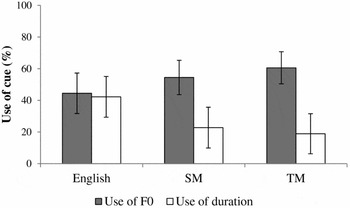
The participants’ responses in the conflicting cues condition were also analyzed to investigate the relative importance of F0 and duration for each group. Figure 4 shows participants’ accuracy when using F0 or duration as a cue to stress.
Participants’ use (and standard errors) of fundamental frequency and duration in the conflicting cues condition in Experiment 2.

The best logit mixed-effects model on all three groups’ accuracy in the use of F0 in conflicting cues condition did not include L1 as fixed effect (i.e., L1 did not significantly improve the model). This means that the English listeners did not differ from either the SM-speaking L2 learners or the TM-speaking L2 learners in their reliance on F0. The best logit mixed-effects model on L2 learners’ accuracy in their use of F0 in the cue-conflicting condition included L2 proficiency, but not L1 dialect, as fixed effect (i.e., L1 dialect did not significantly improve the model). However, the results of this model did not reveal a significant effect of L2 proficiency, z (359) = 1.2, p > .05. This suggests that the two groups of L2 learners did not differ from each other in their use of F0, and L2 proficiency did not affect L2 learners’ performance in their use of F0 when it conflicted with duration in signaling stress.
The best logit mixed-effects model on all three groups’ accuracy in their use of duration cue in the conflicting cues condition included L1 as fixed effect. The results revealed that the English listeners differed from both the SM-speaking L2 learners, z (538) = –2.0, p < .05, and the TM-speaking L2 learners, z (538) = –2.7, p < .01, in their use of duration. The best logit mixed-effects model on L2 learners’ accuracy in their use of duration in the conflicting cues condition did not include any fixed effect (i.e., neither L1 dialect nor L2 proficiency significantly improved the model). This means that the two groups of L2 learners did not differ from each other in their use of duration cue, and L2 proficiency did not affect L2 learners’ performance in their use of duration when it conflicted with F0 in signaling stress.
These results suggest that in the presence of conflicting suprasegmental cues, both L2 groups prioritized F0 over duration, and did so similarly. This suggests that F0 is a stronger cue to lexical identity in both SM and TM, to such a degree that differences between the two L2 groups in their relative reliance on duration cues did not emerge in the conflicting cues condition.Footnote 11
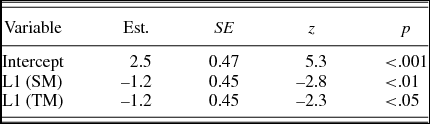
Finally, the accuracy of the participants’ sequence encoding for stimuli that differed in initial consonant is shown in Figure 5. A logit mixed-effects model was conducted on all participants’ sequence encoding accuracy with stimuli that differed in their initial consonant. This model is summarized in Table 7. The results of this analysis suggest that English listeners outperformed SM and TM listeners in their encoding of segments (i.e., /t/ vs. /k/) in English nonwords. However, the best logit mixed-effect models on L2 learners’ accuracy did not include any fixed effect, indicating that SM and TM listeners did not differ from each other in their processing of initial /t/ vs. /k/ in English nonwords.
Participants’ sequence-encoding accuracy (and standard errors) in the filler stimuli in Experiment 2.

Logit mixed-effects model on all participants’ accuracy on the filler stimuli, with the English group's performance as baseline for Experiment 2
Note: df = 2028. L1, First language; SM, Standard Mandarin; TM, Taiwan Mandarin.
Discussion
The results of the second experiment shed important light on how suprasegmental cues to lexical identity in the L1 modulate listeners’ encoding of stress in the L2. When stress was signaled with F0 cues (both in the F0 condition and in the conflicting cues condition), the SM- and TM-speaking L2 learners of English did not differ from each other (or from native English listeners). This suggests that TM listeners, who do not have word-level stress in their L1 dialect, were successful at transferring the use of F0 cues from lexical tones in the L1 to stress in the L2. We hypothesize that TM listeners did not differ from SM listeners because both Mandarin dialects have lexical tones, which are signaled primarily by F0 and play an important role in Mandarin lexical access.
However, when stress was signaled only with duration cues, TM-speaking L2 learners of English performed less accurately on the task than SM-speaking L2 learners of English. These results indicate that when cues to stress do not conflict, L2 learners differ in their ability to use these cues as a function of their relative weight in the L1. In SM but not in TM, duration is used to encode a stress distinction (i.e., stressed–stressed vs. stressed–unstressed); we hypothesize that this use of duration in SM is what allows SM-speaking L2 learners of English to encode English stress in the duration condition.
At the same time, both groups of L2 learners performed less accurately than native English listeners in the use of duration both when duration cues were isolated (duration condition) and when they conflicted with F0 cues (conflicting cues condition). One possibility is that the greater occurrence of vowel reduction in English than in Mandarin as well as the use of duration as one of the cues that contrasts tense and lax vowels (e.g., /i/ vs. /ɪ/) in English may have led English listeners to be generally more sensitive to duration as a cue to stress as compared to Mandarin listeners (Lin et al., Reference Lin, Wang, Idsardi and Xu2014, p. 334). Alternatively, SM may have fewer words that contrast in stress placement as compared to English (Duanmu, Reference Duanmu2007), thus potentially leading SM-speaking L2 learners of English to rely less on duration cue as a cue to stress as compared to native English listeners.
It is interesting that TM listeners did not differ statistically from SM listeners when duration conflicted with F0 in the experimental stimuli. We hypothesize that L2 learners’ weaker reliance on duration (where they differed from native listeners) than on F0 (where they did not differ from native listeners) may have prevented any effect of L1 dialect from emerging when F0 and duration conflicted in signaling stress. In other words, in the presence of conflicting suprasegmental information, both groups of L2 learners tuned it primarily to F0, because F0 is a more important cue to lexical identity in both SM and TM.
It is important that, when encoding English nonwords that contrasted in word-initial /t/ and /k/, SM and TM listeners did not differ from each other but performed less accurately than English listeners. As in Experiment 1, we attribute these results to differences between English and Mandarin in their phonetic realizations of the target segments (e.g., English /t/ is alveolar whereas Mandarin /t/ is dental) and in their phonotactics (e.g., the lax vowels following /t/ and /k/ in the stimuli are not permitted in Mandarin).
GENERAL DISCUSSION
This study investigated whether the suprasegmental cues to prominence that convey lexical identity in the L1 transfer to the encoding of stress in L2 processing. The results of the first experiment, which used natural stimuli where F0 and duration cues co-occurred, showed that native English listeners and SM-speaking L2 learners of English did not have an advantage over TM-speaking L2 learners in processing stress in English nonwords. By contrast, the results of the second experiment, which used resynthesized stimuli where F0 and duration cues were isolated, revealed an advantage for the SM-speaking L2 learners (and native English listeners) over the TM-speaking L2 learners when duration was the only cue signaling stress, but not when F0 signaled stress.
These results are important, because they suggest that L2 learners whose L1 does not have word-level stress (e.g., TM) can transfer the use of a suprasegmental cue (here, F0) from a different phonological category (i.e., lexical tones) to word-level stress in the L2. Furthermore, these results suggest that L2 learners differ in their ability to use a particular suprasegmental cue to stress (here, duration) as a function of the relative weight of that cue in the L1 (e.g., SM vs. TM). From an L2 learning perspective, the difficulty that L2 learners face thus appears to be complex, with L2 learners needing to associate specific suprasegmental cues to prominence (e.g., F0, duration, and intensity) with lexical representations (e.g., word stress) and use this information to encode and access words (e.g., Cooper et al., Reference Cooper, Cutler and Wales2002; Cutler, Reference Cutler2012; Zhang & Francis, Reference Zhang and Francis2010).
Our results can be interpreted within a cue-weighting theory of speech perception (e.g., Francis & Nusbaum, Reference Francis and Nusbaum2002; Holt & Lotto, Reference Holt and Lotto2006; Invalgson et al., Reference Ingvalson, Holt and McClelland2011; Zhang & Francis, Reference Zhang and Francis2010). According to this theory, the contribution of individual acoustic cues to distinguish among lexical items in the L1 determines the weight of these cues in the L2. This means that if a particular suprasegmental cue plays an important role in L1 lexical access, it could be used to encode stress in the L2, even if the L1 does not have word-level stress; by the same token, if a particular suprasegmental cue plays a limited role in L1 lexical access, then L2 learners should have difficulty using this cue in the L2. This suggests that the mechanisms underlying stress processing do not operate strictly as a function of whether or not the L1 has word-level stress (for discussions, see also Lin et al., Reference Lin, Wang, Idsardi and Xu2014; Tremblay, Reference Tremblay2008, Reference Tremblay2009). A cue-weighting theory of speech perception also assumes that the more important a cue is in the L1, the more it is used in L2 processing (e.g., Francis & Nusbaum, Reference Francis and Nusbaum2002; Holt & Lotto, Reference Holt and Lotto2006; Iverson et al., Reference Iverson, Kuhl, Akahane-Yamada, Diesch, Tohkura, Kettermann and Siebert2003; McAllister, Flege, & Piske, Reference McAllister, Flege and Piske2002). Hence, this theory can explain not only the circumstances under which L2 learners can or cannot encode L2 English word stress but also how they encode L2 English word stress for the purpose of recognizing L2 words. Our results show that the two groups of Mandarin-speaking L2 learners differed from native English listeners only in their use of duration cues to English stress. These results are consistent with the predictions of the cue-weighting account in that F0 is an important cue to lexical identity in Mandarin, arguably more than the stress–unstressed contrast signaled by duration in SM; consequently, F0 cues are used more than duration cues in the processing of English no-words.
Another significant contribution of this study is in showing that not only the L1 but also the L1 dialect plays a crucial role in determining whether or not L2 learners can use specific suprasegmental cues to encode stress in English nonwords. Many studies have investigated how the L1 influences the processing of L2 stress (e.g., Cutler, Reference Cutler2012; Dupoux et al., Reference Dupoux, Peperkamp and Sebastián-Gallés2001, Reference Dupoux, Sebastián-Gallés, Navarrete and Peperkamp2008; Zhang & Francis, Reference Zhang and Francis2010), and a growing number of studies have investigated how the L1 dialect modulates the perception of L2 segments (e.g., Chládková & Podlipský, Reference Chládková and Podlipský2011; Colantoni et al., Reference Colantoni, Steele and Escudero2015; Escudero et al., Reference Escudero, Simon and Mitterer2012; Escudero & Williams, Reference Escudero and Williams2011; Mayr & Escudero, Reference Mayr and Escudero2010). To date, however, little work had been devoted to the influence of L1 dialects on L2 speech perception at the suprasegmental level. The present study fills this gap, and its results suggest that L2 speech processing models should consider the influence of L1 dialect, as it may impact how suprasegmental cues are weighed in L2 processing. Other studies have raised the possibility that the L1 dialect may be a factor to consider in the perception of L2 stress (e.g., Tremblay, Reference Tremblay2008, Reference Tremblay2009). In our study, the influence of the L1 dialect is assumed to be caused by the specific suprasegmental characteristics of the two languages (i.e., SM and TM). Further research should attempt to replicate the present findings with other L1 dialect–L2 pairings.
It should be emphasized that the effect of L1 dialect does not imply that TM listeners are not capable of using duration as a cue to stress, but rather that they will be less reliant on duration than SM listeners because of the weaker role of duration in TM as compared to SM (e.g., TM listeners may still make weak use of this cue in the recognition of Mandarin words; Liu & Samuel, Reference Liu and Samuel2004). What is crucial here is that unlike SM, TM does not have a stress contrast cued by duration cues; as a result, TM and SM differ in the extent to which duration signals lexical identity. Accordingly, TM listeners will be less reliant than SM listeners on the use of duration as a cue in the processing of English stress.
Given the methodology used in this study, one question that arises is whether our results would be generalizable to real words. Because English does not have many minimal pairs that differ only in the suprasegmental cues to stress (for discussion, see Cutler, Reference Cutler1986), using nonwords was the only possible option for the present experimental design (and doing so also made it possible to avoid the potentially confounding effects of word frequency and word familiarity). It may be easier to test the processing of L2 stress with (frequency-matched) real words in target languages that do not have vowel reduction (e.g., Spanish), unlike English. Further research should attempt to replicate our findings in such languages using real words.
Conclusion
In summary, this study examined how English listeners and proficiency-matched SM- and TM-speaking L2 learners of English encode stress in English nonwords. The results indicated that all three groups performed similarly when processing nonwords that contained F0 cues. However, when stress was signaled only with duration, TM listeners had more difficulty than SM listeners (and native English listeners) in encoding stress. Furthermore, both L2 groups relied less on duration cues than native English listeners did, a finding that was attributed to L2 learners’ greater reliance on F0 due to the importance of lexical tones for lexical access in Mandarin. These results were interpreted within a cue-weighting theory of speech perception, which can provide a straightforward explanation of whether and how L2 learners encode English stress.
APPENDIX A
Experimental stimuli

Filler stimuli

ACKNOWLEDGMENTS
For their insightful comments on this research, we are very grateful to Dr. Allard Jongman, Dr. Joan Sereno, and Dr. Jie Zhang; the student members of LING 850 at the University of Kansas; Dr. Isabelle Darcy; and two anonymous reviewers. Any misunderstandings are of course our own.