Participation in a cardiac rehabilitation (CR) program is usually offered to patients who have suffered a coronary artery event, such as an acute myocardial infarction. The aim of such programs is to optimize psychological and physical recovery and to minimize the risk of a future cardiac event. A comprehensive CR program involves a variety of activities such as patient education, counseling, risk management, and physical exercise training. The benefits of CR programs have been well documented, and a large body of evidence exists on the relationship between positive health effects and CR (e.g., 12;15;16;26;31). Main outcome measures include physical performance, quality of life, and morbidity/mortality. A few full economic evaluations have been published (22). Yu et al. (36) found CR (exercise training) to be a cost-saving and health-improving alternative relative to no rehabilitation, whereas Oldridge et al. (21) found the cost-utility ratio to be $9,200 per quality-adjusted life year (QALY) gained.
Common to the studies referred to above is that the implicit aim is to maximize the individual's health (subject to a budget constraint), which suggests that the valuation and decision rule is based solely on the realization of health outcomes. However, the individual may also value other characteristics of the program, such as convenience factors, time constraints, and beliefs. This finding suggests that the patient might consider not attending a rehabilitation activity even it has a positive effect on his health. Patients' preferences for CR, therefore, should be taken into consideration when designing rehabilitation programs. It is a well-known problem that patients—particularly women and elderly patients—often fail to access and continue use of CR. To attain satisfactory participation and adherence rates, knowledge of patients' preferences and whether they differ among subgroups is crucial. Previous studies have addressed some of the aspects of patients' preferences for CR and reasons for nonattendance and drop-outs (e.g., 3;5–7;13;20;23;26;30). These studies' results present several reasons for nonattendance and nonadherence, including health, time constraints, transport difficulties, scheduling, care of dependents, and of course, personal preferences for the CR activities (including beliefs). Attendance was also found to differ across sociodemographics such as age, gender, and socioeconomic status. The analysis of preferences for CR program activities indicated preference heterogeneity according to parameters such as age and gender and whether patients had any experience with CR. Two studies by Filip et al. (7) and Moore et al. (20) analyzed preferences for specific CR features using a rating experiment in which patients were asked to rate each of the features on a Likert scale according to importance. Although such a method seems convenient to use, the interpretation of results is nontrivial as the method lacks theoretical foundation (17). Rating is generally seen as a difficult exercise to perform, because it does not relate to how we are normally asked to value goods. In our everyday life in the supermarket—or in relation to healthcare services—we are generally asked to make choices of the “take it or leave it” kind. Hence, we may perform better when facing choices rather than rating exercises. In the present study, we have chosen to present respondents with a rating exercise as well as discrete choices.
The objective of this study was to analyze preferences for various activities comprised in comprehensive CR programs among former cardiac patients from three different hospitals in Copenhagen County, Denmark. Of special interest was the relative valuation of two types of cardiac counsel meetings. Gender, age, and experience with a CR program were included in the analysis to identify any differences in preferences among subgroups. A rating exercise as well as a discrete choice experiment was used to elicit preferences.
MATERIALS AND METHODS
The discrete choice study presented here was part of a larger study performed in cooperation between Research Centre for Prevention and Health, Copenhagen County, and the three cardiology departments in the university hospitals of Copenhagen County. The three county hospitals offered very different rehabilitation programs. The purpose of the main study was to compare the effects and costs the three different rehabilitation programs (35):
- Hospital 1 (Gentofte University Hospital): The hospital had a nurse-led, individual comprehensive rehabilitation program, including physical training, smoking cessation, and nutritional counseling, based primarily on individual patient contacts and with a focus on control.
- Hospital 2 (Glostrup University Hospital): The hospital had a multidisciplinary, group-based rehabilitation program, including physical training, smoking cessation, nutritional counseling, lectures on the disease, and psychosocial support in groups, with a focus on the patient being confident being a cardiac patient.
- Hospital 3 (Herlev University Hospital): The hospital basically offered no rehabilitation after discharge. Patients and relatives could participate in one group meeting, which was nurse-led and focused on psychosocial support.
During 1 year (2001–2002), patients with acute coronary syndrome (ICD 10: I20.0, I21, I22) were included. Patients were invited to a follow-up consultation in the hospital after 1 year. At baseline and follow-up, the following data were registered on patient, disease, and treatment: lifestyle, comorbidity, social status, health-related quality of life (SF 36), satisfaction with hospital, and use of rehabilitation program. At the end of the follow-up period, the discrete choice questionnaire was sent to 742 former cardiac patients from the three reported hospitals in Denmark.
Discrete Choice Experiment
The discrete choice experiment (DCE) provides a method for the elicitation of preferences for healthcare services such as the CR program. The DCE belongs to the class of stated preference methods and is consistent with economic theory. In the DCE, respondents are presented with a series of alternatives and asked to choose their most preferred. The alternatives are characterized by a given number of attributes that are assigned a given number of levels. The attribute levels are varied systematically over the alternatives, which makes it possible to extract information of the relative weighting of each of the attributes and estimate the benefits associated with a given alternative (1;17). The DCE has been applied to a wide variety of healthcare issues, including the valuation of therapies, health services, healthcare systems, and issues on priority settings and distribution of resources (e.g., 2;8;10;27–29;34). For a recent review of DCE in health care, see Ryan and Gerard (25).
Econometric Specification of the Discrete Choice Experiment
Economic theory assumes that individuals are utility-maximizing individuals and that an individual's utility is determined by their relative consumption of different bundles of goods (comprising different attributes). Additionally, it is assumed that individuals perform “compensatory decision making”, which means that they trade off reductions in one good characteristic with increases in another good characteristic (33). Compared with other preference-elicitation techniques, such as ranking and rating exercises, the DCE triggers the use of compensatory decision making, hence forcing individuals to recognize that there are trade-offs in making decisions. As consumption of goods is not actually undertaken in hypothetical valuation methods such as the DCE, it is assumed that individual choices can reveal subjective values and that choices signal true behavior and reflect what the individual actually would do if faced with the same choices in a real-life setting. In accordance with economic theory, it is assumed that the individual uses compensatory decision making and chooses the alternative with the highest level of utility. In reality, the individuals do not always make the optimal choice and/or their choice is based on factors other than those explanatory variables included in our regression model; therefore, the researcher will never be able to predict preferences perfectly. Hence, the problem is inherently stochastic from the observer's view, which leads to the formulation of expressions for the probability of choice and the application of logistic models for analyzing the choice data (18).
The RUT approach, introduced by Thurstone in 1927 (32) and further extended to the modeling framework by McFadden (19), is based on the differentiation between what is known by the decision maker and what is know by the researcher. RUT states that the decision-maker's true utility function is known only by the decision maker himself and not by the researcher. Hence, the true but unobservable latent utility (Ui) for alternative i of individual n consists of two components,

where Vin=V(Xin,Zn) is the systematic component of utility depending upon some attributes of the alternatives (Xin) faced by individual n and individual characteristics (Zn); εin is unobservable to the researcher and treated as a random component (11). Thereby Vin becomes the explainable proportion of the variance in choice and εin the nonexplainable. Compared to standard utility theory (i.e., neoclassical economic theory) the RUT approach has one big advantage and one big disadvantage—both of which are related to the random component: RUT can be said to be a more realistic representation of preferences, however, distributional assumptions about the random component are required to make any predictions from the theory.
In the present study, we analyze the discrete choice data using a binary logit model, that is, we assume that the random component is extreme value type I distributed. The model is estimated to disclose the relative importance of rehabilitation activities in patients' choices of preferred CR. Stata software version 8 is used for the estimation. For a detailed econometric specification and description of the binary logit model, see Greene (9).
Questionnaire Design
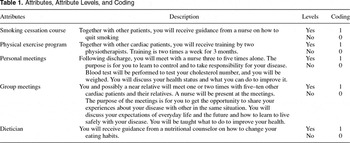
Through the application of a DCE, we elicited patients' preferences for CR programs and patients' valuation of the relative importance of the CR activities offered in these programs. The CR programs in the choice task were described by way of five possible activities (also termed program attributes): smoking cessation course, physical exercise program, personal meetings with a cardiac nurse, group meetings managed by cardiac nurses, and/or nutritional counseling. See Table 1 for an overview of attributes.

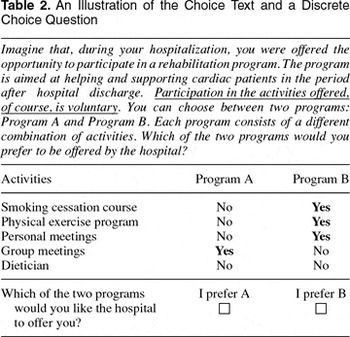
The five attributes produced a full factorial design of 32 (hypothetical) alternative rehabilitation programs. The alternatives were paired using an experimental SAS design that maximizes D-efficiency (constituting level balance, orthogonality, and minimal overlap) (14). Six dominant/dominated and unrealistic alternatives were removed from the design matrix before the design procedure. The applied design gave rise to eight choice sets, each with two alternatives, and a D-efficiency of 95.6 percent. Each respondent was given the eight choice sets and asked to choose the preferred rehabilitation programs. In the introductory text, it was emphasized that participation in any of the activities on offer was optional. (Consequently, choice probabilities for attendance cannot be estimated.) This finding suggests that respondents were not required to participate in all the activities included in the program. In effect, we are measuring respondents' preferences for the program invitation. The questionnaire was designed in collaboration with health professionals from the three hospitals. Two focus groups meetings (cardiac patients from University Hospital Glostrup and University Hospital Gentofte were invited) were conducted with the aim of testing and adjusting the questionnaire format before the study. See Table 2 for an illustration of the final choice text and one of the eight choice sets.

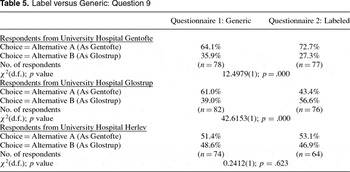
An additional choice set (choice question 9) was included in each questionnaire to test the effect of hospital labeling of the alternatives. Such an effect signifies a general tendency among patients to value CR at their familiar hospital irrespective of the content of the CR program. The sample was split into two subsamples in which one received a generic choice set similar to the eight other choice questions (questionnaire 1) and the other received a labeled choice set (questionnaire 2). In the labeled choice set, program A was identified as the rehabilitation program at University Hospital Gentofte, whereas program B was identified as the rehabilitation program at University Hospital Glostrup. Apart from the labeling, the two choice sets were identical with respect to the assigned attribute levels. The attribute levels were chosen such that they resembled the actual CR programs for the two hospitals. In addition to the choice questions, a simple ranking exercise was included in the survey in which the respondents were asked to place each activity on a Likert scale from 1 to 5 according to importance (1 was assigned to the most important attribute, 2 to the second most important, and so forth).
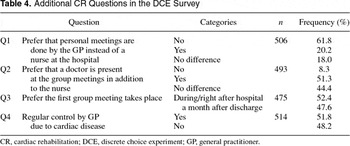
Four questions related to the CR program were included in the DCE questionnaire as to obtain further information on factors influencing patients' utility of CR activities. Three of the four questions concerned organizational issues of CR meetings, including the time frame for group meetings, whether a doctor should be present at the group meetings in addition to a nurse, and the setting of personal meetings. Moreover, respondents were asked to specify if they, as a consequence of their heart disease, visited their general practitioner (GP) for regular controls. The latter question was included to test for substitution effect, that is, whether patients with regular GP visits obtain less utility from CR meetings than other patients.
RESULTS
A total of 551 respondents returned the questionnaire of which 512 respondents had answered at least one of the choice questions leading to a response rate of 69 percent (unbalanced sample).
We compared the person characteristics of the study sample and the unbalanced DCE sample. (Summary statistics are available by request to the authors.) Only information on gender, age and hospital is available for the entire study sample and so the representativeness of the DCE respondents was only tested against these three characteristics1
Gender: Fisher's test (p=0.000); Hospital: Fisher's test (p=0.000); Age: un-paired t-test (p=0.000).
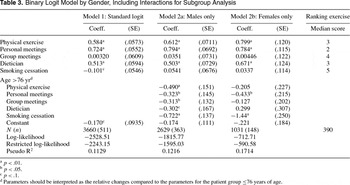
Three models were estimated: a standard binary logit model (Model 1) with attribute means only, and two binary logit models (Model 2a+2b)—one for each gender—with age interactions to allow for subgroup analysis. The age variable is a dummy variable coded 1 for the group of respondents older than 76 years (the oldest 25 percent percentile of the sample), and 0 otherwise. The regressions results are reported in Table 3.

Model 1 in Table 3 reveals the mean patient preferences for the offer of participation in the five CR activities. The results demonstrate that personal meetings noticeably are ranked highest, followed by physical exercise, and nutritional counseling. (We have not tested whether the coefficients are significantly different from each other.) All three activities are significant at a 0.01 significance level. Contrary, the mean coefficient for group meetings is statistically insignificant. The interpretation of the smoking cessation course variable is not straightforward, as the coefficient is affected by nonsmokers choice of CR program (who obviously are not offered smoking cessation course). To isolate smokers' valuation of a smoking cessation course, we consequently ran a model containing smokers only (regression results available upon request to the authors). The results reveal that a smoking cessation course is valued positively among smokers, however, less than, for example, personal meetings. The regressions results from the subgroup analyses (i.e., Model 2a and Model 2b) show that younger males and females (under 76 years of age) rank the program activities fairly similar. Comparing the relative size of the coefficients for each model, we observe that the coefficients associated with personal meetings, physical exercise, and nutritional counseling are closer in range for younger women than for younger men, suggesting that women tend to value these activities more equally than men (this is especially pronounced for personal meetings and physical exercise). (Parameter estimates in the logit model are confounded with the variance [i.e., the scale factor]. As a consequence, it is not possible to compare the magnitude of coefficients across gender directly.) Group meeting is ranked lowest of the four activities and has no impact on choice of CR for both genders. It applies for both genders that older patients value personal meetings lower than the younger counterpart. For elderly men, physical exercise is not valued highly, nor is nutritional counseling. In contrast, elderly women value these activities as highly as younger women. For those 76 years if age, the value of the smoking cessation program is much less. The difference in the valuation of the smoking cessation program among the two age groups may well be driven by elder smokers valuing the smoking cessation program less than younger smokers. (If this were the case, it indicates that older smokers do not like to be offered smoking cessation courses. We cannot verify this finding, however, as we were not able to model smokers separately because of few older smokers in the study sample.)
The last column in Table 3 displays the results of the simple ranking exercise. The results reveal that personal heart meetings are ranked the highest (median rank of 2), followed by physical exercise program and nutritional counselings (both having a median rank of 3), group heart meetings (median rank of 4), and smoking cessation course (median rank of 5). The results from the ranking exercise are comparable and correspond to the regression results obtained from the standard binary logit model.
Table 4 presents the answers to the four additional questions related to CR included in the DCE questionnaire. The majority of patients prefer personal meetings with cardiac nurses rather than with their GP, and the presence of a doctor at group meetings in addition to a nurse. Additionally, more than 50 percent of the respondents report attending regular control visits at their GP. We tested for a substitution effect between GP visits and cardiac meetings (group as well as personal meetings) and found no effect, indicating that GP visits do not influence patients' preferences for CR programs. Results are available upon request to the corresponding author.)

Table 5 displays the results of hospital labeling across patients from the three hospitals. Results show that labeling has a significant effect on choice. When faced with the labeled choice set, the share of the patients from University Hospital Gentofte and University Hospital Glostrup choosing their respective hospital increases significantly. In contrast, there is no statistical difference in choice behavior for patients from the hospital not present in the choice, that is, patients from University Hospital Herlev. This finding suggests that choice behavior only changes for patients from the two hospitals named in the choice.

DISCUSSION
Our results show that the simple ranking exercise produced the same rankings as did the choice experiment. (The correspondence between the ranking exercise and the DCE was expected due to the nature of the attribute [either the attributes were present or absent]. However, when attributes take up multiple levels, this might not be the case, as the value of a given attribute in this situation is influenced by the levels. See Bech (2) for a discussion on this issue.) Hence, one can conclude that, in the present context, the rating exercise amply reflects those relative valuations that individuals indirectly express through their choice behavior. The result that personal meetings as well as physical exercise program are highly valued among the average rehabilitation patient is, thus, a robust finding. In contrast, the offer of participation in group meetings—as it is described in the present study—is ranked very low. The two varieties of CR meetings differ not only with respect to whether they are individual or in groups but also with respect to content. The descriptions of these meetings were formulated in accordance with the actual goals of such meetings held in Copenhagen County. In the description of the personal meetings, control of risk factors was emphasized, whereas the description of group meetings emphasized psychosomatic issues. Therefore, it is not possible to conclude whether it is the individual setting or the risk factor focus that triggers the favored valuation of personal meetings. More generally, it can be concluded that rehabilitation patients have stable preferences for CR and that these preferences remain unaffected by mode of elicitation.
In the analysis of the discrete choice data, we found more detailed information regarding the preferences of men/women, smokers/nonsmokers, and those over and under 76 years of age. Our findings support previous studies that gender and age influence the valuation of CR activities. Older men were found to derive less utility from rehabilitation activities than younger patients and elder women. Younger women were found to value personal meetings and physical exercise equally, compared to men who highly favor personal meetings.
The additional CR questions had the aim of providing further information on patients' preferences for CR meetings—information that can be used to improve CR programs (and, thus, potentially CR participation and adherence). The three questions that concerned the settings of the CR meetings showed a high degree of preference heterogeneity. Furthermore, a question was included concerning regular control visits at GPs. The answer revealed that half of the respondents visited their GP regularly for control. Further analyses revealed that regular GP visits do not influence patients' preferences for CR programs and that patients do not see GP visits as an alternative to the CR program.
The labeling of the CR programs by hospital produced a change in choice behavior toward an increased proportion of patients from the two named hospitals choosing their hospital. This result suggests that patients tend to have a preference for their hospital independently of the rehabilitation program offered to them. The reasons for such positive preferences are manifold and most likely include arguments such as experience, familiarity, and convenience (e.g., travel time). The result suggests that some patients, if given the choice between CR at their nearest hospital and another hospital, would choose CR at the hospital they are familiar with, even though the content of the CR program at the other hospital was preferred.
The literature on CR programs reports a tendency for low participation rates, in particular among certain subgroups. The policy implications of the present study relate primarily to this problem of low CR participation: For subgroups where low participation rates conflict with the signaled preferences—that is, where participation rates are low for specific CR activities despite an expressed interest in the activity—effort toward an increase in participation can be considered valuable. In this case, low participation is likely to be caused by conditions such as convenience, CR content, and time constraints. Effort to improve these conditions, thus, is expected to have a positive effect on participation rates and consequently on welfare. We found an indication of such a discrepancy among older women for a wide range of the CR program activities. Contrary, for subgroups where low participation rates are in accordance with the signaled preferences—that is, where participation rates are low and disclosed preferences reveal lack of or modest interest—effort toward an increase in participation is not valuable. In this case, increased effort is likely to have no effect on participation, as these patients do not value the CR activity and, thus, have no incentive to attend the given activity no matter the conditions under which it is conducted. Our results indicate that this is likely to be the case for some of the CR activities among older men.
CONCLUSIONS
We elicited preferences for rehabilitation programs using two elicitation techniques: rating and discrete choice experiment. The two techniques produced a similar rating, suggesting that rehabilitation patients have stable preferences that are unaffected by mode of elicitation.
This study focused on the elicitation of the offer of preferences for various CR activities applied at the hospitals in Copenhagen County: smoking cessation course, physical exercise program, personal meetings with cardiac nurse, group meetings managed by cardiac nurses, and nutritional counseling guidance. Our findings indicate some gender difference in preferences among the younger age group and that the offer of participation in cardiac rehabilitation activities is not highly valued by older patients—in particular by older men.
The preference structure elicited in the present study may be specific to the Danish setting and should be wary of extrapolation to other settings. The problems of attendance and adherence to CR programs, especially among certain supgroups, however, is not a Danish phenomenon (see e.g., 3;5;13;23). A main aim of the presented analysis was to present a tool for extracting information on preferences and to highlight that patients' preferences for CR programs may not always be coincident with health outcomes. This finding leads us to conclude that a better understanding of context-specific patients' preferences for CR programs may increase the success of offering such interventions.
POLICY IMPLICATIONS
This study provides important information on patients' preferences for CR and, thus, is of relevance for healthcare professionals as well as healthcare decision makers. Our results signify the importance of taking patients' preferences into account in the understanding of low participation rates and in the discussion on how to increase participation.
CONTACT INFORMATION
Trine Kjaer, MSc(Econ) (tkj@sam.sdu.dk), PhD Student, Department of Health Economics/Centre for Applied Health Services Research and Technology Assessment, Dorte Gyrd-Hansen, PhD, M.Sc.(Econ) (dgh@sam.sdu.dk), Professor, Department of Health Economics, Institute of Public Health, University of Southern Denmark, Winsløwsvej 9, 2, 5000 Odense C, Denmark
Ingrid Willaing, MPH, RN, SD (iw@muusmann-as.dk), Research Centre for Prevention and Health, Copenhagen County, Nordre Ringvej, 2600 Glostrup, Denmark