Introduction
In most developing countries, the large amounts of trash or solid waste generated by human populations are mainly disposed of in sanitary landfills, because it is the simplest, cheapest and most cost-effective method of waste disposal (Barrett & Lawlor, Reference Barrett and Lawlor1995). The standard operating procedures at most sanitary landfills involve spreading and compacting the newly deposited solid waste layer by layer into small areas allocated within the landfill, known as daily cells or sometimes referred to as the ‘daily workface’, which contain only a day's worth of waste (Goulson et al., Reference Goulson, Hughes and Chapman1999; Panagiotakopoulos & Dokas, Reference Panagiotakopoulos and Dokas2001; Government Engineering, 2006). This procedure is usually followed by a daily application of cover material, usually soil, at a depth of about 15 cm or more over the active workface (Querio & Lundell, Reference Querio and Lundell1992; Goulson et al., Reference Goulson, Hughes and Chapman1999).
The purpose of applying daily cover soil over the solid waste deposited in landfills is to prevent the access of pests such as flies, birds and rodents to the waste, to reduce odours that can attract more of these pests to breed in the waste and to prevent further development of fly larvae already present within the refuse (Boase, Reference Boase, Robinson, Rettich and Rambo1999; Amano, Reference Amano2005). However, economic constraints often limit the feasibility of daily applications of cover soil. This is a common problem, particularly in developing countries (Taylor & Allen, Reference Taylor, Allen, Schmoll, Howard, Chilton and Chorus2006), and Toyama (Reference Toyama1988) has also observed similar lax procedures in landfills in Hawaii. The delay in application of cover soil is often due to the high cost of purchasing and transporting soil from distant sites. Municipal sanitary landfill operations in Malaysia also suffer from the same economic constraints, and as a result the procedure of applying cover soil on a daily basis is rarely followed. The solid waste deposited in these landfills is often left exposed for weeks and months until sufficient cover material is available for application. This raises the question of how much of an impact the delay in cover soil application has on filth fly population numbers in these landfills.
The high organic waste and moisture content of solid waste in Malaysia (Consumers’ Association of Penang, 2001; Goh, Reference Goh2007), combined with the country's equatorial climate, makes landfills optimal breeding grounds for filth flies. The adult, egg, larval and pupal stages of filth flies are also transported to landfills in household waste (Dhillon et al., Reference Dhillon, Mandeville and Challet1983), and the sites themselves are strongly attractive to these flies (Crosskey & Lane, Reference Crosskey, Lane, Lane and Crosskey1993; Ellis, Reference Ellis1998). There are wide varieties of Diptera with different biological traits that breed within organic matter and are regarded as pestiferous (Ferriera & Lacerda, Reference Ferriera and Lacerda1993) or synanthropic in nature (living in close association with humans) and are thus likely to be problematic in terms of human health (Graczyk et al., Reference Graczyk, Knight, Gilman and Cranfield2001). This is particularly problematic in states going through rapid urbanisation and development but with limited land, as this causes landfills to be located incrementally closer to towns and cities. Therefore, it is important to identify the species of flies that are directly associated with solid wastes in landfills in order to develop better pest-control programmes.
It is essential that local landfill administrators or operators be made aware of the importance of solid waste as a mass breeding medium for filth flies and the impact that landfills can have on surrounding human habitations if solid waste is not managed appropriately. However, little information is available on the species that are directly associated with municipal solid waste (MSW) in landfills. It is also unclear whether the main source of prevalent filth fly species in landfills is incoming waste or onsite breeding. Therefore, this study was conducted to identify the species of filth flies directly associated with MSW and to determine whether the prevalent filth flies in landfills are a direct result of import to the landfill in incoming waste or from onsite breeding. This study also compares the emergence rates of filth flies from newly arrived and 2-week-old uncovered waste and determines the impact of delayed application of cover soil on filth fly populations.
Materials and methods
Waste sample collection
The Pulau Burung sanitary landfill (5°24′N, 100°24′E) in Pulau Pinang, Malaysia, is a level 3 semi-aerobic landfill that employs controlled tipping and cover soil applications and utilises the Fukuoka gas ventilation and leachate recirculation system (Chong et al., Reference Chong, Matsufuji and Hassan2005; Goh, Reference Goh2007; Rosie & Shaharin, Reference Rosie and Shaharin2009). The landfill has an area of 62.4 hectares and is capable of holding up to 16,000 tonnes of MSW per day for the whole state of Pulau Pinang (Idaman Bersih Sdn. Bhd., 2007). MSW in Malaysia consists mainly of 45–69% organic waste (usually food waste) and other materials such as plastic, paper, glass, metal, textiles and wood (Isa et al., Reference Isa, Asaari, Ramli, Ahmad and Siew2005; Goh, Reference Goh2007; Saeed et al., Reference Saeed, Hassan and Abdul Mujeebu2008; United Nations Environment Programme, 2010).
Samples of two categories of solid waste were collected from daily cells within the Pulau Burung landfill once every 2 weeks at 09:30–10:30 h, over a period of 24 weeks from March 2009 to August 2009. A daily cell is a small area within a landfill that is allocated for a day's worth of incoming waste (Panagiotakopoulos & Dokas, Reference Panagiotakopoulos and Dokas2001; Government Engineering, 2006). The solid waste samples were separated into two age categories, newly arrived waste and 2-week-old waste, based on the length of time since its arrival at the landfill. The newly arrived waste category consisted of waste collected from a daily cell containing waste that had been newly deposited at the landfill on the same day as the sampling date, and the 2-week-old waste category was waste collected from a cell that contained waste deposited 2 weeks prior to the sampling date. Two-week-old waste was chosen as the second waste category based on the life cycle of common filth flies found in solid waste. It was assumed that this was sufficient time to allow female flies already present within the landfill to oviposit and a new generation of flies to develop within the solid waste. In a preliminary study, attempts to include 1-month-old waste as a third waste category proved to be impossible because we could not predict which cell would be covered with soil over a span of 1 month, as the landfill operators would sometimes unpredictably apply cover soil after 2–3 weeks.
A daily cell was identified as new by observing areas in which garbage trucks were actively depositing waste and heavy machinery such as tractors were spreading the waste in compacted layers. Two-week-old daily cells were selected by observing the landfill 2 weeks prior to the next sampling date and selecting the active daily cell of that day, which would be inactive by the time sampling commenced.
Ten 4-kg samples of each type of waste (newly arrived and 2 weeks old) were collected from within their respective cells along the outer surface of the cells, at ten locations approximately 3 m apart, by using a long-handled digging shovel. Each 4-kg sample was weighed using a mechanical scale (10-kg capacity mild steel housing mechanical scale), placed into separate plastic garbage bags and transported back to the laboratory for subsequent processing and experimentation under sheltered field conditions.
Emergence trap and experimental methods
The waste samples that were collected from the landfill were immediately processed upon arriving at the laboratory. The samples were removed from the plastic garbage bags and placed in plastic containers (cylindrical, 30 cm in height and 20 cm in diameter). A space of about 3 cm was left between the waste surface and the modified container cover to allow the flies space to emerge. The container cover was modified by cutting two 4-cm holes at opposite ends of the outer edge of the cover. A muslin cloth square (5 × 5 cm) was placed over one of the holes in the cover and an emergence trap was placed over the other. The emergence traps were constructed out of 500-ml plastic water bottles, which measured 22 cm in height and 5.5 cm in diameter. Figure 1 shows the components of the emergence trap and the completed emergence trap. The bottles were cut crosswise into two sections, 7 cm from the top of the bottle (fig. 1). A hole measuring about 1 cm was cut into the bottle cap, to allow the emerging flies to enter the trap and stop them from returning to the solid waste in the container. The cut section measuring 15 cm (the bottom half of the bottle) was then placed inverted, without any adhesive, over the 7-cm section (fig. 1).
The emergence trap. (A) Components of the trap: (a) 7-cm cut section; (b) bottle cap with 1-cm hole; (c) 15-cm cut section. (B) Completed trap.

Once the solid waste samples were placed into the containers and covered with the modified covers, the completed emergence trap was secured over the 4-cm hole with adhesive tape. The outer surface of the body of the containers and the inner surface of the cover was spray-painted black a week prior to use. The containers were painted black in order to force the emerging flies to move up towards the daylight penetrating through the hole over which the emergence trapped had been placed and get trapped within the larger 15-cm section of the trap.
The containers with the solid waste samples were placed outdoors under sheltered field conditions with a mean daily temperature of 28.3 °C (95% CI: 28.0–28.4 °C) and relative humidity of 82.1% (95% CI: 81.2–83.1%). Emergence traps were inspected daily for trapped flies over a period of 14 days and trapped flies were removed in the evenings at 18:00 h. After 2 weeks, the solid waste samples were discarded and the containers washed and reused for the next batch of samples. All the trapped flies were identified to genus level and some were identified to species level using several standard taxonomic keys (Kurahashi et al., Reference Kurahashi, Benjaphong and Omar1997; Greenberg & Kunich, Reference Greenberg and Kunich2002; Triplehorn et al., Reference Triplehorn, Johnson and Borror2005; de Carvalho & de Mello-Patiu, Reference de Carvalho and de Mello-Patiu2008; Couri, Reference Couri2010).
Data analysis
A Shapiro–Wilk test determined that the data was normally distributed. Therefore, the independent samples t-test was used to test for statistical differences between the emergence rates of the two different categories of solid waste. Filth fly emergence rate was indicated by the mean number of flies emerging per kilogram of solid waste (mean ± SE). All statistical analyses with the exception of effect size calculations were performed using the Statistical Packages for the Social Sciences (SPSS) version 17.0 (SPSS Inc., 2008).
Effect size was calculated after each t-test by converting the t-value into the r-value using the formula given by Rosnow and Rosenthal (Reference Rosnow and Rosenthal2005) as cited in Field (Reference Field2005). An effect size is an objective and standardized measure of the strength of an observed effect and is useful because it provides an objective measure of the importance of an effect regardless of the significance of the test statistic (Field, Reference Field2005). The widely accepted guidelines of Cohen (as cited by Field, Reference Field2005), where r = 0.10 is a small effect, r = 0.30 is a medium effect and r = 0.50 is a large effect, was used to assess the importance of the variables compared in this study.
Results
In total, 8834 filth flies emerged from a total of 960 kg of solid waste collected in a fortnightly interval from March 2009 to August 2009, which equates to 9.2 ± 0.5 flies emerging per kilogram of solid waste. Out of this total, 4694 flies emerged from 480 kg of newly arrived waste and 4140 flies emerged from 480 kg of 2-week-old waste. This equates to 9.8 ± 0.4 flies and 8.6 ± 0.4 flies emerging per kilogram of newly arrived and 2-week-old waste, respectively.
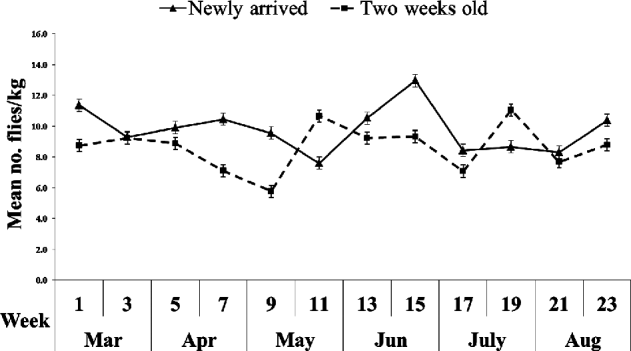
Figure 2 shows the comparison of weekly emergence rates (mean number of flies per kilogram of waste) between the two categories of waste throughout the sampling period. Overall, mean fly emergence rates between the two types of waste were comparable to each other, as the t-test showed that the difference in weekly emergence rates (mean number of flies per kilogram waste) was not significant (t 22 = 1.899, P > 0.05). The weekly emergence rate ranged from 7.6 to 13 and 5.8 to 11.1 mean number of flies per kilogram for the newly arrived waste and 2-week-old waste, respectively (fig. 2).
Comparison of filth fly mean emergence rate between newly arrived and 2-week-old waste from March to August 2009. Error bars are standard error (SE).

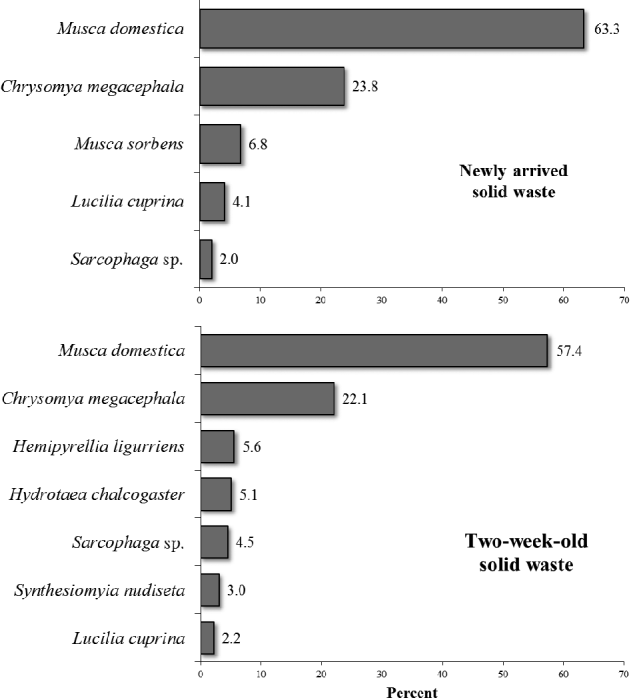
Collectively, eight species of filth flies emerged from the two types of waste collected from the landfill. Out of the eight species, four (M. domestica, M. sorbens, Hydrotaea chalcogaster and Synthesiomyia nudiseta) were from the family Muscidae, three (C. megacephala, L. cupina and Hemipyrellia ligurriens) were from the family Calliphoridae, and one (Sarcophaga sp.) was from the family Sarcophagidae.
Figure 3 shows the species composition of filth flies emerging from newly arrived and 2-week-old waste. Five filth fly species emerged from newly arrived waste compared with seven species from 2-week-old waste. Only four species, M. domestica, C. megacephala, L. cuprina and Sarcophaga sp., were common to both types of solid waste. The most predominant species was M. domestica, accounting for 63.3 and 57.4% of the filth flies emerging from newly arrived and 2-week-old waste, respectively (fig. 3). The species was prevalent in all the emergence traps throughout the study period. The second most prevalent species in both types of waste was C. megacephala, equating to 23.8 and 22.1% of the filth flies emerging from the newly arrived and 2-week-old waste, respectively. Sarcophaga sp. (2.0%) and L. cuprina (2.2%) were the least dominant species of the newly arrived and 2-week-old waste, respectively. Musca sorbens, which accounted for 6.8% of the flies emerging from newly arrived waste, was surprisingly absent from 2-week-old waste. In comparison, the 2-week-old waste had three species that were not found in the newly arrived waste: namely, Hemipyrellia ligurriens (5.6%), Hydrotaea chalcogaster (5.1%) and Synthesiomyia nudiseta (3.0%) (fig. 3).
Species composition of filth flies emerging from newly arrived and 2-week-old waste.

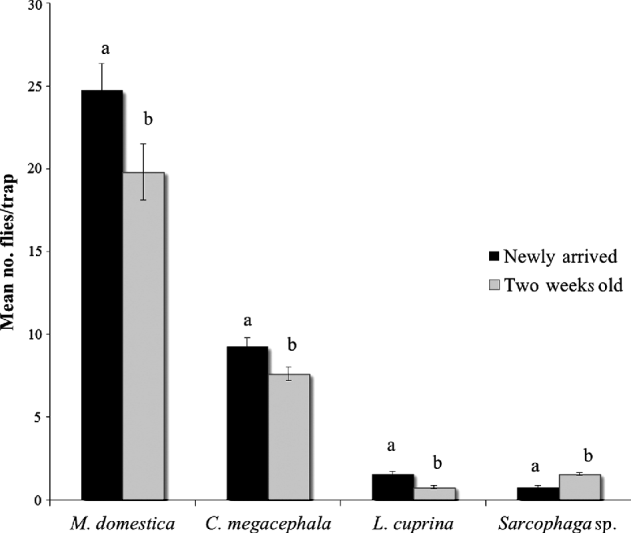
Figure 4 shows a comparison of the mean numbers of different species of filth flies emerging from newly arrived waste and 2-week-old waste. In comparison to 2-week-old waste, newly arrived waste produced higher mean numbers of M. domestica (24.8 ± 1.6 flies/trap), C. megacephala (9.3 ± 0.5 flies per trap) and L. cuprina (1.6 ± 0.1 flies/trap) but a lower mean number of Sarcophaga sp. (0.8 ± 0.1 flies/trap). There was a significant difference in mean emergence of L. cuprina (t 22 = 5.145, P < 0.05) and Sarcophaga sp. (t 22 = –5.393, P < 0.05) between the newly arrived and 2-week-old waste (fig. 4). Although the difference was significant, the two types of waste only had small-sized statistical effects of r = 0.19 for L. cuprina and r = 0.18 for Sarcophaga sp. In comparison, the significant differences in the mean emergence of M. domestica (t 22 = 2.114, P < 0.05) and C. megacephala (t 22 = 2.706, P < 0.05) from the two types of waste produced medium-sized effects of r = 0.32 and r = 0.33, respectively. Only four of the eight filth fly species were compared in the t-tests, as they were the only species that were common for both types of waste.
Comparison of the mean numbers of different species of filth flies emerging from newly arrived waste and 2-week-old waste. Error bars are standard error (SE). Bars with different letters, within the same species, are significantly different (P < 0.05).

Discussion
According to a case study by Syarifah Nor Farihah and Abdul Yamin (Reference Syarifah Nor Farihah and Abdul Yamin2009), the Pulau Burung landfill currently receives 2200 tonnes of waste a day. In the current study, it was discovered that one kilogram (0.001 tonnes) of solid waste is able to produce 9.2 ± 0.5 flies, and therefore an estimated 20.2 million flies can emerge from the 2200 tonnes of waste that the landfill receives daily, assuming that the distribution of the immature fly population within a given cell was fairly uniform. This estimate should be serious cause for concern, especially when solid waste management procedures in many landfills in Malaysia have been known to be relatively inadequate or disorganised (Nesadurai, Reference Nesadurai1999). A study by Abdel-Gawaad and Stein (Reference Abdel-Gawaad and Stein1978) in aerobic refuse tips showed that 1 hectare of uncovered waste in landfills can become mass breeding sites for synanthropic flies, producing up to 10 million flies per hectare per year. These estimates show that landfills can be a major source of fly infestations in neighbouring areas, and landfill companies should improve their waste management practices to avoid creating friction between themselves and members of the public. The large numbers of flies breeding in the landfill have the potential to disperse to neighbouring areas, where they not only become a nuisance but a threat to public health (Ferriera & Lacerda, Reference Ferriera and Lacerda1993). Filth flies are efficient vectors of disease-causing organisms and are capable of transmitting gastrointestinal diseases such as myiasis, dysentery, diarrhoea, cholera, salmonellosis and various other diseases such as tuberculosis, trachoma and certain skin infections (WHO, 1991; Goddard, Reference Goddard1996; Olsen et al., Reference Olsen, Gecan, Ziobro and Bryce2001; Banjo et al., Reference Banjo, Lawal and Adeduji2005).
A level 3 semi-aerobic landfill is a sanitary landfill that should be complete with clearly defined cells with liner system, leachate collection and recirculation system, surface water drainage and daily soil cover (Nadzri, Reference Nadzri2009). However, despite being a level 3 semi-aerobic landfill, our observations showed that the solid waste that arrives at the Pulau Burung sanitary landfill is often left exposed without soil cover for more than a week and occasionally even up to 1 month. This is largely due to financial constraints and the lack of access to sufficient amounts of cover soil rather than ignorance of correct sanitary procedures. This can cause significant increases in fly numbers in the landfill, because solid waste is still suitable for filth fly breeding even 2 weeks after arrival at landfill, especially in Malaysia's equatorial climate with uniform temperatures, high humidity and copious rainfall throughout the year. Dispersal of filth flies to neighbouring areas will inevitably ensue, especially for the house fly M. domestica, because they have been known to disperse 1 to 30 km away from their breeding site, especially when there is overpopulation of the site (Pickens et al., Reference Pickens, Morgan, Hartsock and Smith1967; Keiding, Reference Keiding1986; Nazni et al., Reference Nazni, Luke, Wan Rozita, Abdullah, Sa'diyah, Azahari, Zamree, Tan, Lee and Sofian2005; Stafford, Reference Stafford2008; Chakrabarti et al., Reference Chakrabarti, Kambhampati and Zurek2010).
The higher numbers of M. domestica, C. megacephala and L. cuprina emerging from newly arrived waste suggests that this waste is a major source of these species of flies in the landfill. By contrast, 2-week-old waste had higher numbers of Sarcophaga sp., indicating that this species needs a permanent and stable environment to establish a population, which newly arrived waste cannot provide. Waste age, whether newly arrived or 2 weeks old, had a medium effect on the number of M. domestica and C. megacephala flies that can emerge from the wastes. This suggests that other factors, such as internal solid waste temperature, moisture and humidity, might have an influence on the number of emerging flies of these two species.
The differing level of synanthropy of various fly species could explain the difference in filth fly species composition of the two types of waste. Eusynanthropic flies are totally dependant on the human environment to survive, whereas hemisynanthropic flies are those that take advantage of the human population to flourish but are not totally dependant on it for survival (Graczyk et al., Reference Graczyk, Knight, Gilman and Cranfield2001). Musca domestica, C. megacephala and L. cuprina are hemisynanthropic (Harwood & James, Reference Harwood and James1979; Baharudin et al., Reference Baharudin, Abdullah and Azliza2003), which could explain their prevalence in newly arrived waste, because it is largely collected from highly populated urban areas of Pulau Pinang. Labud et al. (Reference Labud, Semenas and Laos2003) categorised M. domestica as both hemisynanthropic and eusynanthropic, thus explaining why it was the most predominant fly in newly arrived municipal solid waste. However, it is unclear why the eusynanthropic Synthesiomyia nudiseta and hemisynanthropic Hemipyrellia ligurriens (Baharudin et al., Reference Baharudin, Abdullah and Azliza2003) were found only in 2-week-old waste. Presumably these species are less hardy and need a more stable or permanent environment to flourish.
The presence of M. sorbens in newly arrived waste was expected, as this species has been found in urban areas near garbage bins and has been known to feed on garbage (Prendergast et al., Reference Prendergast, Rosales and Evans2001; Nurita et al., Reference Nurita, Abu Hassan and Nur Aida2008). However, the absence of M. sorbens from 2-week-old waste was surprising, given that it was present in newly arrived waste. This suggests that this species was able to survive in waste prior to arrival in the landfill and survive transportation to the landfill but failed to survive the conditions that it was subjected to in the landfill.
Hydrotaea chalcogaster, Hemipyrellia ligurriens and Synthesiomyia nudiseta were found only in 2-week-old waste, which indicates that they were not imported into the landfill with the solid waste. It is highly probable that flies from the surrounding areas or pre-existing flies within the landfill itself are the source for the presence of these three species in the solid waste. The larvae of Hydrotaea sp. (formerly Ophyra sp.) are facultative predators of other dipteran larvae, especially the larvae of M. domestica (Geden et al., Reference Geden, Stinner and Axtell1988; Farkas et al., Reference Farkas, Hogsette and Börzsönyi1998; Hogsette et al., Reference Hogsette, Farkas and Coler2002), and were probably found exclusively in 2-week-old waste due to the abundance of their prey. Gravid female houseflies have been known to release chemical signals (semiochemicals) that attract other females to oviposit in common egg-laying sites (Jiang et al., Reference Jiang, Lei, Niu, Fang, Xiao and Zhang2002). It is possible that chemical signals such as this could also attract females of Hydrotaea sp. to oviposit in the same location to provide their larval offspring with enough prey to sustain them to adulthood. In addition, the transitory nature of solid waste before it reaches the landfill might make it difficult for the species to establish itself in the waste before it reaches the landfill.
The current study showed that uncovered waste that had been in the landfill for 2 weeks could still produce flies for a further 2 weeks. Furthermore, the two types of waste collected in this study had flies emerging within 12 h after collection. This indicates that there were already pupae present within the waste and that fly development had started from when the waste was first placed into garbage bins until arrival at landfill. Many species of flies are able to complete development within 1 week under favourable conditions (Skidmore, Reference Skidmore1985; Crosskey & Lane, Reference Crosskey, Lane, Lane and Crosskey1993; Stafford, Reference Stafford2008). Therefore, it is clear that delays in applications of cover soil can cause significant increases in numbers of filth flies, because fly breeding still continues for 2 weeks to up to a month after waste is deposited in the landfill. If landfills are not managed appropriately, they can be an important source of filth fly infestation in neighbouring areas and cause serious public health concerns.
It is highly probable that the number of flies capable of emerging from solid waste in landfills will increase along with waste production, as a result of a growing urban human population in Malaysia. An estimation of waste production in Asian countries in 2025 reported by the World Bank (Hoornweg & Thomas, Reference Hoornweg and Thomas1999) predicts that Malaysia will be one of the countries with the highest waste production rates but with a higher economic growth rate and therefore more resources to further improve waste management. The improvements to waste management should include programmes for the control of filth flies directly associated with solid waste in landfills and strict monitoring of landfills to ensure adherence to proper procedures.
Acknowledgements
We would like to thank the Dean of the School of Biological Sciences for the facilities provided and the landfill management company Idaman Bersih Sdn. Bhd. for their cooperation throughout the duration of the study. Funding support for this study was provided by the National Science Fellowship Scheme from the Ministry of Science, Technology & Innovation, Malaysia and the Research University Postgraduate Research Grant Scheme (USM-RU-PRGS) from Universiti Sains Malaysia (USM).