Introduction
In insect field populations, the relative strength of gene flow may be affected by a variety of factors, including dispersal ability, dietary specialization, habitat persistence and spatial structure of habitat within the landscape (Peterson & Denno, Reference Peterson and Denno1998; Keyghobadi et al., Reference Keyghobadi, Roland and Strobeck2005). Hence, intrinsic insect characteristics such as adult flight capacity, as well as ecological factors related to habitat (i.e. host plant isolation and geographical isolation), shape the genetic architecture of traits in insect populations. In agroecosystems particularly, anthropogenic factors, for example, pest management (Dorn et al., Reference Dorn, Schumacher, Abivardi and Meyhöfer1999), can further contribute to insect population dislocation.
Several studies have documented that increased levels of gene flow are associated with improved dispersal ability (Peterson & Denno, Reference Peterson and Denno1998; Bohonak, Reference Bohonak1999) and that limited gene flow is associated with relatively sedentary characteristics of the organism concerned (Keyghobadi et al., Reference Keyghobadi, Roland and Strobeck2005). While most studies focus on herbivore insects feeding on wild plants, there is increasing interest in insect movement patterns and population studies of economically-important insect herbivores within agroecosystems (Endersby et al., Reference Endersby, Mckechnie, Ridland and Weeks2006; Tsagkarakou et al., Reference Tsagkarakou, Tsigenopoulos, Gorman, Lagnel and Bedford2007). In the diamondback moth, Plutella xylostella (L.) (Lepidoptera: Plutellidae), one of the major insect pests of Brassica crops worldwide, population structure appears lacking, as demonstrated for Australian populations using microsatellite markers (Endersby et al., Reference Endersby, Mckechnie, Ridland and Weeks2006). Whilst previous reports on localized insecticide resistance (Tabashnik et al., Reference Tabashnik, Cushing and Johnson1987) or insecticide resistance found within populations on non-treated wild host plants (Endersby et al., Reference Endersby, Ridland, Zhang, Endersby and Ridland2004) were somewhat contradictory, population genetic analysis using largely selectively-neutral markers, such as microsatellites, strongly indicated that migratory characteristics in this species prevail under the conditions so far investigated (Li et al., Reference Li, Korol, Fahima, Beiles and Nevo2002; Endersby et al., Reference Endersby, Mckechnie, Ridland and Weeks2006).
Generally, insect species are classified as sedentary, such as the Adonis blue butterfly, Polyommatus bellargus (Rottemburg) (Lepidoptera: Lycaenidae) (Harper et al., Reference Harper, Maclean and Goulson2003), or as mobile or migratory, like the aforementioned diamondback moth. Some species have evolved distinct morphs that are either sedentary or migratory (e.g. Rankin & Burchsted, Reference Rankin and Burchsted1992). Genetic variation in dispersal characteristics can also occur in insect species that lack discrete dispersal morphs, as has been detected in the codling moth, Cydia pomonella L. (Lepidoptera: Tortricidae) (Schumacher et al., Reference Schumacher, Weber, Hagger and Dorn1997a; Dorn et al., Reference Dorn, Schumacher, Abivardi and Meyhöfer1999; see below), but implications on gene flow in the field remain largely unknown. Laboratory-selected lines with high and low activity levels have been released in the field in mark-release-recapture studies, and a significant positive laboratory-field correlation was found between laboratory-measured mobility and dispersal (Keil et al., Reference Keil, Gu and Dorn2001). All codling moth strains investigated, which either originated from orchards in Switzerland or from laboratory colonies, consisted of a small proportion of long-distance flyers (mobile individuals) and a larger proportion of short flyers (sedentary individuals) (Dorn et al., Reference Dorn, Schumacher, Abivardi and Meyhöfer1999). After selecting for activity levels in adult insects, correlated responses in life history traits were found. There was a trade-off between mobility and fitness (Gu et al., Reference Gu, Hughes and Dorn2006). These characteristics are likely to influence population structure in the field.
The codling moth is the key pest of deciduous tree crops in most fruit-growing regions worldwide (Barnes, Reference Barnes, van der Geest and Evenhuis1991). It infests pome fruits (apple and pear), stone fruits (apricot, plum, peach, nectarine and cherry) and quince, as well as walnut (Bovey, Reference Bovey1979; Barnes, Reference Barnes, van der Geest and Evenhuis1991). There are one to five codling moth generations per year depending on climatic conditions and the length of the growing season. In northern Switzerland, there are one or two generations on apple. In southern Switzerland, there are two generations on apple, but only one on apricot, as fruits are mature much earlier (Bovey, Reference Bovey1979). Neonate larvae penetrate the fruits or nuts and can damage a high percentage of crops if not managed, leading to substantial economic losses ($ millions) (Phillips & Barnes, Reference Phillips and Barnes1975; Barnes, Reference Barnes, van der Geest and Evenhuis1991; Pasquier & Charmillot, Reference Pasquier and Charmillot2003; Reuveny & Cohen, Reference Reuveny and Cohen2004).
Studies on genetic differentiation of insect populations can provide sound baseline information for Integrated Pest Management (IPM) (Denholm & Rowland, Reference Denholm and Rowland1992; Miller et al., Reference Miller, Birley, Overall and Tatchell2003; Endersby et al., Reference Endersby, Mckechnie, Ridland and Weeks2006), whilst studies on gene flow can, for example, reveal the distance over which members of a given species typically disperse and determine the spatial scales at which pest forecasting techniques might operate (Loxdale & Lushai, Reference Loxdale, Lushai, Woiwod, Reynolds and Thomas2001; Miller et al., Reference Miller, Birley, Overall and Tatchell2003). In pest control, it is important to know to which degree an insect species migrates between different host plants, such as between walnut trees (that typically remain unmanaged in Switzerland as the produce is only used for on-farm consumption) and commercial apple orchards. Some control methods, in particular the mating disruption technique and sterile insect technique, require that immigration of gravid adult female moths into the treated agroecosystem be kept to a minimum (Dorn et al., Reference Dorn, Schumacher, Abivardi and Meyhöfer1999). Knowledge on the genetic differentiation between geographically separated populations is also of importance, as moths released in sterile insect technique programs should be capable of mating with females from different geographic regions (Timm et al., Reference Timm, Geertsema and Warnich2006).
The existence of host-associated races very often affects the gene flow and genetic differentiation of insects (Miller et al., Reference Miller, Birley, Overall and Tatchell2003). In some cases, insects can adapt well to new host plants and be reproductively isolated from ancestral host races (Singer et al., Reference Singer, Thomas and Parmesan1993; Hendry et al., Reference Hendry, Nosil and Rieseberg2007). So far, reports on host differentiation in the codling moth are not conclusive. Using physiological and behavioural studies on populations from California in the USA, clear differences were noted between codling moths from pome fruit, stone fruit and walnut (Phillips & Barnes, Reference Phillips and Barnes1975). It was concluded that there are well-defined host-determined races, the apple race giving rise to the walnut race and the walnut race to the plum race (Phillips & Barnes, Reference Phillips and Barnes1975; Barnes, Reference Barnes, van der Geest and Evenhuis1991). Following amplified fragment length polymorphism (AFLP) analysis of populations from South Africa, no significant substructuring was noted among codling moth from the two pome fruits species, apple and pear. Few samples from stone fruit were also included (Timm et al., Reference Timm, Geertsema and Warnich2006). Using allozyme analysis of populations, mainly from France, a sizable number of samples was investigated from pome fruit (ten apple, four pear) and nut (three walnut) orchards. Results indicated a high degree of similarity between the populations from the different host plants in this particular country (Buès & Toubon, Reference Buès and Toubon1992; Buès et al., Reference Buès, Toubon and Poitout1995). To test for possible host race differentiation, it is advisable to cover a broad host range (i.e. to compare C. pomonella from a pome fruit species, a stone fruit species and from walnut), thus avoiding comparison of the pome fruit apple and pear only.
Geographical distance may create barriers to gene flow and be an effective factor that influences population structure (Peterson & Denno, Reference Peterson and Denno1998; Bailly et al., Reference Bailly, Migeon and Navajas2004; Keyghobadi et al., Reference Keyghobadi, Roland and Strobeck2005). There are few reports on the genetic differentiation of different geographical populations of C. pomonella. In South Africa and Italy, gene flow among local C. pomonella populations may be limited (Timm et al., Reference Timm, Geertsema and Warnich2006; Thaler et al., Reference Thaler, Brandstätter, Meraner, Chabicovski, Parson, Zelger, Dalla Via and Dallinger2008), but French and Chilean populations sampled from different geographic locations within these countries had no significant genetic structure (Buès & Toubon, Reference Buès and Toubon1992; Buès et al., Reference Buès, Toubon and Poitout1995; Franck et al., Reference Franck, Reyes, Olivares and Sauphanor2007; Fuentes-Contreras et al., Reference Fuentes-Contreras, Espinoza, Lavandero and Bamírez2008).
Microsatellites have, in recent years, been successfully used in the research of genetic differentiation and gene flow of insects and other animals (Loxdale & Lushai, Reference Loxdale and Lushai1998; Simard et al., Reference Simard, Lehmann, Lemasson, Diatta and Fontenille2000; Bailly et al., Reference Bailly, Migeon and Navajas2004; Keyghobadi et al., Reference Keyghobadi, Roland and Strobeck2005; Endersby et al., Reference Endersby, Mckechnie, Ridland and Weeks2006; Franck et al., Reference Franck, Reyes, Olivares and Sauphanor2007; Fuentes-Contreras et al., Reference Fuentes-Contreras, Espinoza, Lavandero and Bamírez2008). In the present study, we used nine microsatellites to investigate the genetic differentiation and gene flow among different populations of C. pomonella from Switzerland. To study the possible influence of host plant on genetic differentiation, samples were taken from apple, apricot and walnut within the same region with intensive crop tree cultivation. To assess the potential influence of geographic distance, sampling from apple, the major host in Switzerland, was expanded to regions throughout the country. In line with the aforementioned dispersal-related studies, we postulated that the genetic differentiation of the field populations should mainly show characteristics reflecting sedentary behaviour and, to a lesser degree, characteristics known for migratory species. The findings are potentially of interest for a more complete understanding of evolutionary ecology, as well as for rational pest management strategies (i.e. IPM) based on a sound knowledge of the insect's biology.
Materials and methods
Sampling
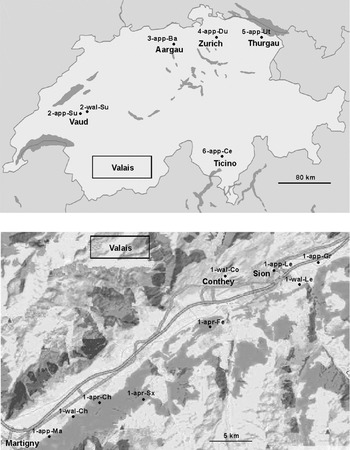
Here we use the term ‘population’ for C. pomonella specimens sampled from the same orchard (sampling unit), comprising trees of the same host plant species. In July 2006, C. pomonella samples were collected from 15 apple, apricot and walnut orchards in different regions and locations in Switzerland (table 1). An infested fruit was collected from each fruit tree per orchard and one larva per fruit used (most often, only one larva penetrates a given fruit). Samples were taken from different host plant species (apple, apricot and walnut) at the same location where possible (table 1). As apricot orchards do not occur in northern Switzerland, sampling on this host was confined to the Valais region (fig. 1), a fertile valley with intense fruit growing, where C. pomonella is found on pome fruit, such as apple, on stone fruit, particularly apricot, and on walnut. In contrast to apricot, apple cultivation is widely distributed over many regions of Switzerland; thus, apple orchards were sampled in the different regions. Walnut orchards are rare, and more typical are scattered unmanaged walnut trees as exemplified by the location Suchy (fig. 1). All orchards were commercially treated with IPM-compatible insecticides (including insect growth regulators, as non-neurotoxic insecticides are prevailing in lepidopteran management) except the four walnut orchards (1-wal-Ch, 1-wal-Co, 1-wal-Le and 2-wal-Su) that were left untreated. Infested fruits were collected and brought to the laboratory, whereupon the second or third instar larvae were recovered from the fruits and then stored at −80°C prior to testing.
Location of sample sites. Three orchards each with apple, apricot and walnut were sampled in the Valais, and five further apple and one walnut orchard in five other regions of Switzerland. The codes for the C. pomonella populations are explained in table 1.

Sampling of C. pomonella larvae in July 2006. Orchards in the same region are indicated by the same numbers, orchards from the same location with the same two letters at the end. Host trees were apple (app), apricot (apr) and walnut (wal).

(1) Scattered walnut trees surrounding an apple orchard.
Amplification of microsatellite loci and genotype scoring
Genomic DNA was extracted from 25 mg of larval material using the DNeasy Tissue Kit (QIAGEN, Basel, Switzerland). Based on the primary testing of the microsatellites described previously, nine loci (AY640592, AY640594, AY640595, AY640598, AY640599, AY640606, AY640608, AY640610 (Franck et al., Reference Franck, Guérin, Loiseau and Sauphanor2005), AY688624 (Zhou et al., Reference Zhou, Gu and Dorn2005)) were selected for this study, and each sample was genotyped at the selected various loci. PCR was performed with a Flexigene Thermocycler (TECHNE, deputed by WITEC, Littau, Switzerland) in a total volume of 25 μl, containing 2.5 μl 10× buffer, 0.2 mM dNTP (Invitrogen, Basel, Switzerland), 2 μl 10 μM primer, 2 μl genomic DNA and 2.5 U Taq polymerase (New England BioLabs, deputed by BioConcept, Allschwil, Switzerland). Reaction conditions were: 94°C pre-denaturing for 4 min; 37 cycles of the temperature cycle regimes consisting of 94°C for 30 s; 30 s at the primer-specific annealing temperature, 72°C for 30 s; finally, extension at 72°C for 10 min. An Elchrom SEA 2000® Electrophoresis Apparatus (Elchrom Scientific, Cham, Switzerland) was used to separate the alleles on Spreadex EL 500 Gels (Elchrom Scientific, Cham, Switzerland), selected on the basis of size range of the respective PCR products, with electrophoresis performed at 55°C according to the SEA 2000® standard conditions. Microsatellite genotypes were recorded using AlphaDigDoc (Version 2.03, Alpha Innotech Corporation, deputed by WITEC, Littau, Switzerland).
Data analysis
Genepop (version 1.2; http://genepop.curtin.edu.au/Raymond & Rousset, Reference Raymond and Rousset1995) was used to test for genotypic linkage disequilibrium using Fisher's exact test under the hypothesis of non-association between genotypes at pairs of loci, along with basic statistics of genetic variability, viz. the average number of alleles per locus (N A), the observed (H o) and expected (H e) heterozygosity, multilocus estimates of F IS, deviations from Hardy-Weinberg equilibrium (HWE) and HWE P-values by Markov chain method. The frequency of null alleles was calculated as per Chapuis & Estoup (Reference Chapuis and Estoup2007) and is based on the algorithm presented by Dempster et al. (Reference Dempster, Laird and Rubin1977). Analysis of molecular variance was performed using AMOVA (Bailly et al., Reference Bailly, Migeon and Navajas2004; Endersby et al., Reference Endersby, Mckechnie, Ridland and Weeks2006; Scott et al., Reference Scott, Lawrence, Lange, Graham, Hardwick, Rossiter, Dillon and Scott2006) and cluster analysis was performed using UPGMA (i.e. the unweighted pair group method with arithmetic averages) (Timm et al., Reference Timm, Geertsema and Warnich2006; Subramanian & Mohankumar, Reference Subramanian and Mohankumar2006).
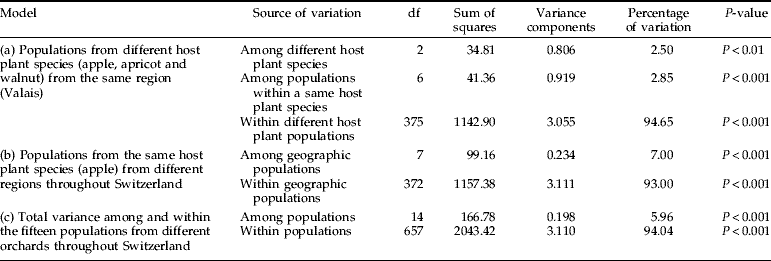
AMOVA was performed using the Arlequin 3.0 software (Excoffier et al., Reference Excoffier, Laval and Schneider2005) to test for genetic differentiation within and among groups, sorted according to three model structures: (a) ‘comparison of variance among populations from different host plant species (apple, apricot and walnut) from the same region (Valais)’. In this model, nine C. pomonella populations from the Valais were divided into three groups by host plants: (i) apple (1-app-Gr, 1-app-Le and 1-app-Ma); (ii) apricot (1-apr-Fe, 1-apr-Ch and 1-apr-Sx); and (iii) walnut (1-wal-Ch, 1-wal-Co and 1-wal-Le). (b) ‘comparison of variance among populations from the same host plant species (apple) from different regions throughout Switzerland’. In this model, genetic differentiation of eight apple populations from different locations of Switzerland was analyzed. (c) ‘total variance among and within the 15 populations from different orchards throughout Switzerland’. In this model, all the 15 populations surveyed were counted as one group. To assess the amount of population differentiation, further pairwise F ST were estimated using Arlequin 3.0 software (Excoffier et al., Reference Excoffier, Laval and Schneider2005). Significance was tested by 4620 permutations among populations.
UPGMA cluster analysis of Nei's (Reference Nei1972) genetic distance index, the mostly wide used statistical parameter for estimating genetic dissimilarities among populations, was performed using TFPGA 1.3 software (Miller, Reference Miller1997).
Results
Microsatellite markers
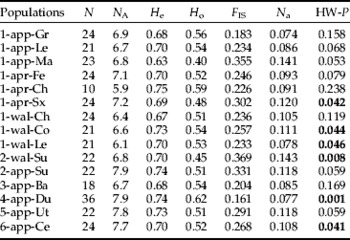
The PCR primers previously described by Franck et al. (Reference Franck, Guérin, Loiseau and Sauphanor2005) and Zhou et al. (Reference Zhou, Gu and Dorn2005) successfully amplified in total 99 alleles over nine loci, all of which were polymorphic in all 15 populations sampled, whilst the detected number of alleles ranged from five to 15 over nine loci for all 15 populations (seven alleles at AY640592; five at AY640594; 13 at AY640595; 11 at AY640598; 15 at AY640599; 15 at AY640606; seven at AY640608; 11 at AY640610; 15 at AY688624). Null allele frequencies were estimated for each of the nine loci and found to be in the range between 0.0001 and 0.271 for individuals, and mean values for populations were between 0.074 and 0.143 (table 2), hence, similar to other insect species (Simard et al., Reference Simard, Lehmann, Lemasson, Diatta and Fontenille2000; Endersby et al., Reference Buès and Toubon2006). Thus, we used the data from all the nine loci for further analysis. Linkage disequilibrium analysis failed to show significant associations between pairs of loci, so that the nine loci likely represented independent information across the samples.
Population statistics for C. pomonella, screened with nine microsatellites.

N, number of moths successfully genotyped; N A, mean number of alleles per locus; H e, expected heterozygosity; H o, observed heterozygosity; F IS, multilocus estimate of inbreeding coefficient, N a, null alleles frequency by the method of Chapuis & Estoup (Reference Chapuis and Estoup2007). HW-P are Hardy-Weinberg equilibrium P-values (significant departures from HW equilibrium are given in bold, P<0.05). H e, H o, F IS, N a and HW-P are all indicated by mean values over nine loci.
Hardy-Weinberg test and genetic diversity analysis
Of the 15 C. pomonella populations, a total of 336 individuals were successfully genotyped. The mean number of alleles per locus ranged from 5.9 to 7.9. The mean value of H e was between 0.63 and 0.74, whilst the H o and H e values were similar among all populations (table 2). Nine of 15 populations showed significant departure from HWE. Mean F IS ranged from 0.161 to 0.369. No significant heterozygote excess was found (data not shown). Thus, heterozygote deficiency contributed to the departures from HWE observed.
AMOVA and population genetic differentiation analysis
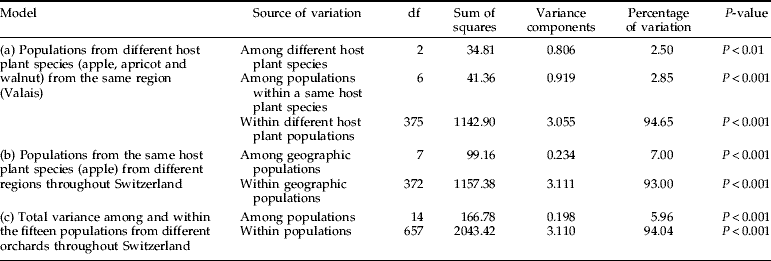
AMOVA results for the three models are shown in table 3. (i) In the analysis of the larvae collected from the same major fruit growing valley in the south of Switzerland (Valais), ~2.5% of the overall molecular variation was explained by host plant species. Although the proportion of explained variance was low, a significant genetic differentiation existed among different host plant populations; (ii) AMOVA analysis among the eight C. pomonella populations from apple orchards revealed that ~7.0% of the overall molecular variation was explained by geographic differences, revealing that significant variances existed among the eight populations from apple orchards in different geographic locations of Switzerland; (iii) Further estimates of hierarchical genetic differentiation among all the fifteen C. pomonella populations from different host plants and geographic locations revealed significant genetic differentiation among these populations. In all three models, the majority of variances were found among individual larvae tested.
Hierarchical analysis of molecular variance (AMOVA) to compare the genetic variation in microsatellite data from C. pomonella using 3 models. (a) Populations from different host plant species (apple, apricot and apple) from the same region (Valais). (b) Populations from the same host plant species (apple) from different orchards throughout Switzerland. (c) Total variance among and within the fifteen populations from different orchards throughout Switzerland.
The percentage of the total variance contributed by each component and the probability test P-value was calculated by 1000 permutations.
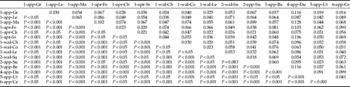
Pairwise F ST analysis was calculated for each pair of populations over nine loci. Values ranged from 0.016 to 0.128 with a mean of 0.064 for samples from apple. Pairwise F ST significance was determined with a Markov chain analysis. The results showed significant differentiation between all pairs of populations except one pair (2-app-Su and 2-wal-Su) (table 4).
Pairwise population differentiation estimates (F ST) averaged over nine loci between 15 populations of C. pomonella from Switzerland (above the diagonal) and P-values (below diagonal).

Cluster analysis
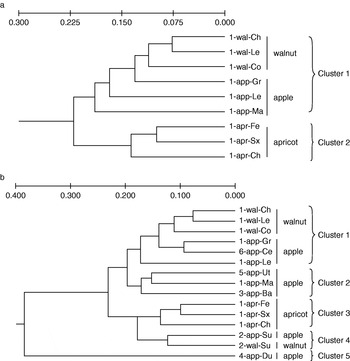
The result of the UPGMA cluster analysis is shown in fig. 2. In the dendrogram of nine populations sampled from different host plant species in the Valais (fig. 2a), populations were divided into two main clusters. All three populations sampled from apricot (1-apr-Fe, 1-apr-Ch and 1-apr-Sx) made up one cluster, the three populations from walnut plus all the three populations from apples, made up another cluster. In the dendrogram of all 15 C. pomonella populations sampled throughout Switzerland (fig. 2b), five clusters are apparent. The population from an apple orchard in Dubendorf (Zurich) (4-app-Du) constituted one cluster (cluster 5). All the three populations from apricot (1-apr-Fe, 1-apr-Ch and 1-apr-Sx) were in the same cluster (cluster 3), whilst three of the four populations from walnut (1-wal-Ch, 1-wal-Co and 1-wal-Le) belonged to another cluster (cluster 1). The two populations from the location Suchy in the region Vaud collected from an apple orchard with single walnut trees surrounding it (2-app-Su and 2-wal-Su), formed a separate cluster (cluster 4). Except for the population from this apple orchard and a population from an orchard at Dubendorf, near Zurich (4-app-Du), all populations from apple are found in adjacent clusters. Both dendrograms indicate a clustering according to host plant species.
Dendrogram representing the genetic distance among populations of C. pomonella, generated by unweighted pair-group mean analysis (UPGMA). (a) All populations from different host tree species sampled in the region Valais. (b) All fifteen populations sampled in Switzerland.

Discussion
We investigated the genetic variation at nine microsatellite loci in 336 individuals of C. pomonella sampled from three different host plant species, mainly in one region, as well as in individuals sampled from the insect's major host plant (apple) throughout Switzerland. Genetic variation among populations from different host plant species was significant, as was the variation among the populations sampled from apple throughout the country.
Genetic diversity, Hardy-Weinberg equilibrium and null alleles
Overall, the 15 populations of C. pomonella sampled from fruit and nut orchards in Switzerland showed high genetic diversity, as indicated by a relatively high mean number of alleles per locus (~6–8). We observed significant departures from HWE in six of these populations. While no population showed significant departures over all nine loci, there was a significant heterozygote deficiency at all nine loci.
In most microsatellite studies on Lepidoptera, the presence of null alleles is manifest in significant departures from the HWE due to heterozygote deficiency (Meglécz & Solignac, Reference Meglécz and Solignac1998; Keyghobadi et al., Reference Keyghobadi, Roland and Strobeck1999, Reference Keyghobadi, Unger, Weintraub and Fonseca2006; Simard et al., Reference Simard, Lehmann, Lemasson, Diatta and Fontenille2000; Meglécz et al., Reference Meglécz, Petenian, Danchin, D'Acier, Rasplus and Faure2004; Orsini et al., Reference Orsini, Corander, Alasentie and Hanski2008). Values of null alleles determined in the current study ranged from 0.074 to 0.143, indicative of the probable existence of null alleles. The significant heterozygote deficiency observed in our research may result from null alleles. Although microsatellite null alleles have been found in a wide range of taxa, some taxa have a particularly high frequency of such alleles, examples include insects (Lepidoptera and Orthoptera) (Meglécz et al., Reference Meglécz, Petenian, Danchin, D'Acier, Rasplus and Faure2004; Chapuis et al., Reference Chapuis, Loiseau, Michalakis, Lecoq and Estoup2005), mollusks and corals (Li et al., Reference Li, Hubert, Bucklin, Ribes and Hedgecock2003; Chapuis & Estoup, Reference Chapuis and Estoup2007; Costantini et al., Reference Costantini, Fauvelot and Abbiati2007). The frequency of null alleles in microsatellite loci isolated from Lepidoptera appears to be greater than in other insect orders and is attributed to a high rate of mutation in the regions immediately adjacent to microsatellites (Meglécz & Solignac, Reference Meglécz and Solignac1998; Keyghobadi et al., Reference Keyghobadi, Roland and Strobeck1999; Ji et al., Reference Ji, Zhang, Hewitt, Kang and Li2003). We have used the same suite of microsatellite loci in all 15 populations; and all the nine loci revealed high polymorphisms in all 15 populations, whilst null allele frequencies were similar among all populations examined (table 2), thus supporting the validity of the data presented (Keyghobadi et al., Reference Keyghobadi, Roland and Strobeck2005). A recent paper published after completion of our study confirms the existence of null alleles for C. pomonella (Franck et al., Reference Franck, Reyes, Olivares and Sauphanor2007).
Genetic differentiation among different host plant species
Prior to our study, information on the host differentiation of C. pomonella has never been particularly conclusive, despite an attempt for clarification more than 30 years ago (Phillips & Barnes, Reference Phillips and Barnes1975, see below). We detected significant genetic differentiation in the analysis of the moths collected from apple, apricot and walnut in a major fruit growing valley (Valais) in Switzerland. Cluster analysis of C. pomonella populations from this region showed one single cluster for apricot and one sub-cluster each for walnut and apple. These findings consistently indicate an influence of the host plants on genetic differentiation of C. pomonella populations. Coincidently, genetic differentiation has recently been noted between two neighbouring codling moth populations sampled from apple and walnut trees in Italy (Thaler et al., Reference Thaler, Brandstätter, Meraner, Chabicovski, Parson, Zelger, Dalla Via and Dallinger2008).
Some genetic differentiation among host plant species has been suggested by Phillips & Barnes (Reference Phillips and Barnes1975), based on behavioural and physiological studies with C. pomonella sampled from apple, a stone fruit species (plum) and walnut in California. However, while oviposition preference of the apple population was clearly for apple, the plum population oviposited on walnut, with only a minor proportion of the population choosing the original host. Similarly, the behavioural response of the walnut population was mixed, as females chose either apple or walnut for oviposition. Early diapause termination suggests, however, a particularly high adaption of the plum population to the phenology of its host plant that develops earlier in spring than apple and walnut (Phillips & Barnes, Reference Phillips and Barnes1975). Similarly, an earlier emergence in spring was noted for a C. pomonella population from the apricot than from apple in the Valais region of Switzerland (Barnes, Reference Barnes, van der Geest and Evenhuis1991). Using molecular genetic marker analysis, our study documents a clear genetic differentiation of C. pomonella among the three host plants, with the stone fruit population being least related to those populations from the other two hosts investigated, suggesting a genetic basis for the above mentioned phenological differences between apricot and apple populations. Genetic differentiation may still be ongoing, particularly between C. pomonella populations on apple and walnut.
Two exceptions from the general conclusion were, however, noted. These relate to the locations Suchy and Dubendorf. In the first case, C. pomonella individuals were collected from single walnut trees surrounding an apple orchard and from the apple trees (2-wal-Su, 2-app-Su). These two populations clustered together in our analysis (cluster 4; fig. 2). Pairwise F ST analysis also showed that there was no significant genetic differentiation between these two populations. Barnes (Reference Barnes, van der Geest and Evenhuis1991) postulated for C. pomonella that only in an orchard of ‘sufficient area or dominance’ could a host-determined race or population evolve. In the second unusual case, the sampled apple orchard was close to a motorway, some ≪5 km from the international airport at Zurich (4-app-Du), rendering accidental introduction of alien genetic material possible. In fact, this population formed a separate cluster (cluster 5; fig. 2) in the analysis.
Using different methods, two further studies addressed possible differentiation between host plant populations. They were based on AFLP analysis (Timm et al., Reference Timm, Geertsema and Warnich2006) and on allozyme polymorphism analysis (Buès & Toubon, Reference Buès and Toubon1992; Buès et al., Reference Buès, Toubon and Poitout1995); both failed to show such differentiation. Microsatellite markers as used here are non-coding fragments scattered throughout the genome, and are often much more polymorphic than allozyme markers (Beaumont & Bruford, Reference Beaumont, Bruford, Goldstein and Schlötterer1999) as used over a decade ago to compare French populations from different host plant species, including apple and walnut (Buès & Toubon, Reference Buès and Toubon1992; Buès et al., Reference Buès, Toubon and Poitout1995). Small sample sizes, in many instances not exceeding two to five individuals per host plant species and location, might have limited the detection of genetic variation in South Africa, particularly between apple and stone fruits (Timm et al., Reference Timm, Geertsema and Warnich2006).
Genetic differentiation among different geographic populations
Results on the genetic differentiation of C. pomonella among different populations appeared, with one exception (Timm et al., Reference Timm, Geertsema and Warnich2006), after completion of our investigations (Franck et al., Reference Franck, Reyes, Olivares and Sauphanor2007; Fuentes-Contreras et al., Reference Fuentes-Contreras, Espinoza, Lavandero and Bamírez2008; Thaler et al., Reference Thaler, Brandstätter, Meraner, Chabicovski, Parson, Zelger, Dalla Via and Dallinger2008), and they are inconsistent. In our study, AMOVA analysis among the eight populations from apple showed significant genetic differentiation among locations, even between two populations in the same valley (Valais), ≪10 km apart (1-app-Le and 1-app-Gr). These results are consistent with findings from South Africa (Timm et al., Reference Timm, Geertsema and Warnich2006) and from Italy (Thaler et al., Reference Thaler, Brandstätter, Meraner, Chabicovski, Parson, Zelger, Dalla Via and Dallinger2008). These three studies provide significant evidence for C. pomonella population differentiation at small spatial scales, allowing discrimination of populations collected from apple, even within the same region. This suggests a limited gene flow among such C. pomonella populations. We observed no significant correlation (P=0.566, r=−0.034) between genetic distance and geographic distance in the eight populations from apple collected throughout the country. Topographic aspects in mountainous Switzerland cannot alone account for this result, as we also found no significant correlation between genetic distance and geographic distance within the same valley (Valais), analyzing populations from each host plant species (apple P=0.297, r=0.877; apricot P=0.156, r=0.807; walnut P=0.998, r=−0.749) (data not shown). However, the population studies from France and Chile (Franck et al., Reference Franck, Reyes, Olivares and Sauphanor2007; Fuentes-Contreras et al., Reference Fuentes-Contreras, Espinoza, Lavandero and Bamírez2008) led to different conclusions as, in both these studies, Mantel's tests revealed significant positive correlations between genetic and geographical distance among all of the samples tested. This complex situation might be related to innate dispersal capacity of individuals in this species and/or to anthropogenic influence on the orchard agroecosystem.
Geographic populations: influence of intrinsic flight capacity
In C. pomonella, within-population variability of flight capacity is high, with only a small proportion of the population being capable of long distance flights, while the large proportion of the population is sedentary (Schumacher et al., Reference Schumacher, Weyeneth, Weber and Dorn1997b; Dorn et al., Reference Dorn, Schumacher, Abivardi and Meyhöfer1999). Mobility characteristics in this species are heritable (Schumacher et al., Reference Schumacher, Weber, Hagger and Dorn1997a; Keil et al., Reference Keil, Gu and Dorn2001), and laboratory-assessed mobility was positively correlated with dispersal capacity in the field (Keil et al., Reference Keil, Gu and Dorn2001). The trade-off between mobility and fecundity indicates being mobile involves fitness costs (Gu et al., Reference Gu, Hughes and Dorn2006). Thus, the two types of behavioural observations that labelled C. pomonella either as ‘sedentary’ (Geier et al., Reference Geier1963) or as ‘capable of considerable flight in the field of up to 11 km’ (Mani & Wildbolz, Reference Mani and Wildbolz1977) could be a consequence of this species' within-population variability in flight performance. The finding presented in the current molecular study underlines the significance of the sedentary characteristics of a large fraction of moths within the local C. pomonella populations in Switzerland. The lack of correlation between genetic and geographic distance, even in the same valley, further suggests that dispersal flights to new habitats, which are likely to occur in spring (Vallat & Dorn, Reference Vallat and Dorn2005), are not regular events occurring to a similar extent at all locations.
This variability in C. pomonella dispersal capacity may be adaptive in the context of its life history and habitat characteristics (Schumacher et al., Reference Schumacher, Weber, Hagger and Dorn1997a). The host trees do not offer a reliable perennial habitat for this fruit-feeding insect. Indeed, yearly fluctuation in the production of fruit often occurs, due to destruction of blossoms by unfavourable weather conditions and pest damage in the early season (Gu et al., Reference Gu, Hughes and Dorn2006). Genetic variability in dispersal propensity may be maintained by a balance between selection for dispersal and reproductive advantages accruing to the sedentary phenotypes (Gu et al., Reference Gu, Hughes and Dorn2006).
In other insects such as aphids, the limited dispersal capacities of some species give rise to isolation by distance effects (Loxdale et al., Reference Loxdale, Hardie, Halbert, Foottit, Kidd and Carter1993; Miller et al., Reference Miller, Birley, Overall and Tatchell2003). In Lepidoptera, microsatellite studies have revealed a significant correlation between genetic and geographic distance at the regional level for the Adonis blue butterfly, P. bellargus (Lepidoptera: Lycaenidae) (Harper et al., Reference Harper, Maclean and Goulson2003). The overall estimates of genetic differentiation (F ST) among populations of this butterfly and another relatively sedentary butterfly species, the clouded Apollo, Parnassius mnemosyne L., was between 0.127 (Harper et al., Reference Harper, Maclean and Goulson2003) and 0.070 (Meglécz & Solignac, Reference Meglécz and Solignac1998), respectively, thus within the range for C. pomonella from apple in our study (0.064). However, while P. bellargus populations sampled in close proximity to one another were typically more comparable with each other than populations from separate geographic regions, such a relationship does not appear to exist for the C. pomonella populations as here investigated. In fact, the codling moth in middle Europe lives in an environment that is largely shaped by human actions.
Geographic populations: relevance of anthropogenic measures
Anthropogenic influences on the orchard agroecosystem can contribute to the genetic structure of herbivore insects. Firstly, accidental introduction of ‘alien’ C. pomonella of different geno/phenotype by human agency, especially by travelers, by commercial transport or by transported empty fruit collection bins (Hansen et al., Reference Hansen, Heidt and Anderson2006) can considerably influence the genetic differentiation measured. For example, high genetic differentiation (F ST value) was noted for every pairwise comparison, except that between the population sampled near the international airport (4-app-Du) and the other populations sampled from apple. Secondly, pest management techniques can affect the structure of C. pomonella populations (Franck et al., Reference Franck, Reyes, Olivares and Sauphanor2007), including direct stimulation of adult mobility (Dorn et al., Reference Dorn, Schumacher, Abivardi and Meyhöfer1999). Low dosages of the organophosphate (OP), azinphosmethyl, a neurotoxic insecticide widely used to control C. pomonella, significantly increased locomotor activity of adults in the laboratory (Dorn & Gu, Reference Dorn and Gu1999). Whilst this product was replaced in the 1980s in Switzerland and northern Italy (Ioriatti et al., Reference Ioriatti, Tasin, Charmillot, Reyes and Sauphanor2007) by other control agents, e.g. the insect growth regulator fenoxycarb, devoid of such behavioural effects (Keil et al., Reference Keil, Gu and Dorn2001), OPs are still commonly used in France and Chile. Two-thirds of the recently studied orchards in France were sprayed one to ten times with OPs per season (Franck et al., Reference Franck, Reyes, Olivares and Sauphanor2007), and OPs are the most widely used insecticides in apple orchards in Chile (Fuentes-Contreras et al., Reference Fuentes-Contreras, Reyes, Barros and Sauphanor2007). It remains open to what extent the mentioned behavioural effects contribute to low or missing structure in French and Chilean codling moth populations as reported using allozyme (Buès et al., Reference Buès, Toubon and Poitout1995), or most recently, microsatellite in both countries (Franck et al., Reference Franck, Reyes, Olivares and Sauphanor2007). Insecticide application is, though, a potentially crucial factor regulating the local dynamics of French codling moth populations (Franck et al., Reference Franck, Reyes, Olivares and Sauphanor2007); and, similarly, a major anthropogenic influence was suggested on Chilean codling moth populations (Fuentes-Contreras et al., Reference Fuentes-Contreras, Espinoza, Lavandero and Bamírez2008).
As mentioned earlier, coincident with our results, differentiation was found in northern Italy codling moth populations based on AFLP analysis (Thaler et al., Reference Thaler, Brandstätter, Meraner, Chabicovski, Parson, Zelger, Dalla Via and Dallinger2008). Similarly, significant differences have been reported between codling moth populations along a north-south transect covering two valleys in northern Italy close to the Swiss border (Ioriatti et al., Reference Ioriatti, Tasin, Charmillot, Reyes and Sauphanor2007). Enzymatic bioassays were used to quantify resistance ratios underlying reduced efficacy of the commonly applied insect growth regulators, tebufenozide. Remarkably, significant differences in resistance ratios were noted (Ioriatti et al., Reference Ioriatti, Tasin, Charmillot, Reyes and Sauphanor2007) between samples collected approximately 20 km apart, again suggesting a limited amount of gene flow at the regional scale. The postulate that few moths undertake inter-habitat flights is supported by the finding that resistance ratios were not significantly different between the moth populations from the last orchard sampled in the northern and the first orchard sampled in the southern valley that were some 7 km apart and separated by a hill (distance measured based on Ioriatti et al., Reference Ioriatti, Tasin, Charmillot, Reyes and Sauphanor2007).
Conclusions
An appreciation of the level of genetic diversity and the manner in which it is structured is of value in developing pest management strategies (Miller et al., Reference Miller, Birley, Overall and Tatchell2003). We have shown, based on microsatellite variation, that populations of C. pomonella are genetically differentiated within Switzerland, reflecting patterns of relatively limited inter-population gene flow. Generally, genetic differences were also noted between C. pomonella from pome and stone fruit, as well as nut tree hosts, although one exception suggests that immigration from (typically unmanaged) walnut trees into (usually commercial) fruit orchards can also occur. Hence, the observed patterns are consistent with expectations based on current knowledge of flight capacity of individuals within codling moth populations. Our results and comparisons with other recent studies indicate that the role of gene flow may vary among groups of populations depending on the interplay between the propensity of individual movement and anthropogenic effects such as the insect control programme used.
Acknowledgements
We thank Mauro Genini, Jaime Piñero, Silke Hein, Johanna Häckermann, Christophe Praz, Sibylle Stöckli, Hans Brunner and Baptiste Schmid for collecting insect samples in the field. Thanks to Silke Hein, Dominique Mazzi and Kathrin Tschudi-Rein and two anonymous reviewers for helpful comments on earlier versions of the manuscript.