Introduction
Since the 1930s British turkey production has been transformed from a seasonal sideline activity, often as an adjunct to farming, undertaken by a multitude of primarily small scale producers traditionally catering almost exclusively for the Christmas market, to a large sale integrated activity dominated by a small number of specialist producers who are able to exploit economies of scale. Production encompassed the selective breeding of different strains of turkey for specific markets and the sale of oven ready birds, including joints and processed turkey products. This transformation has involved the enhancement of nutritional understanding, improved methods of disease control, and the development of new breeds of turkeys. These changes have ensured that the turkey, once a Christmas luxury, has now developed a strong year round market for meat that is very competitive in price terms, even when compared to other forms of white meat such as intensively reared broiler chickens. Its success in this respect is illustrated by the fact that, in 2006, turkeys accounted for some 10.7 per cent of the total contribution of the United Kingdom poultry sector.Footnote 1
This commercialisation process has received scant attention in the annals of agrarian history. Turkeys merit barely a mention in K. A. H. Murray's magisterial official history of the wartime food production campaign Agriculture. Footnote 2 B. A. Holderness’ British Agriculture since 1945 and J. Martin's The Development of Modern Agriculture: British Farming since 1931 have largely ignored this specialist sector.Footnote 3 Instead the rudiments of turkey production are merely covered in an annual crop of newspaper and magazine articles which are produced in the run up to the festive season
I
America was the original home of the wild turkey, where they were domesticated by the Aztecs in Mexico and exported to Spain around 1500, from whence a consignment was sent to England about 1524. The American turkey industry was developed not from native domesticated stock but from importations of birds from Europe. The credit for the introduction of turkeys into Britain has been widely attributed to a Yorkshire man, William Strickland, who acquired six birds from American Indian traders and sold them for two pence on his return to Bristol.Footnote 4 His family crest, granted about 1550, depicts a turkey cock. The sixteenth century saw a rapid expansion in the number of turkeys and by the seventeenth century the birds were common throughout the country and rapidly becoming the traditional Christmas dish for the wealthier sections of society. Turkey production was concentrated in traditional arable areas such as East Anglia, from where the birds were driven to the thriving and rapidly expanding Metropolitan London market. In order to prevent damage on the roads, their feet were tarred and they were often fitted with special shoes. These turkeys were reared and fattened by specialist producers who had developed breeds such as the Norfolk Black or Cambridge Bronze, denoting feather colour and the area in which they were predominantly bred.Footnote 5
Throughout the nineteenth century the number of turkeys continued to increase, reaching about 700,000 by 1913, and rising to more than 1.1million birds in the late 1930s. Although these figures were supplemented by a number of imported birds,Footnote 6 it is evident that fewer than ten per cent of households had turkey for their Christmas dinner. As A.W. Ashby and A. L. Evans noted, among consumers there was in this period ‘a growing refinement of taste, amounting . . . to almost snobbery’ which ensured that turkeys were at ‘a substantial premium in price and status terms’.Footnote 7 This preference for turkey was particularly marked in the more affluent southern counties of England. Indeed, as Dorothy Hartley noted in her seminal book Food in England, being a North Country woman she had ‘no enthusiasm’ for turkey.Footnote 8 The depressed economic conditions and mass unemployment of the interwar period meant that turkeys continued to be restricted to a luxury niche market, ensuring that lower priced beef and goose continued to be the main Christmas fare.
In spite of the increase in total numbers, the expansion of the turkey sector prior to the Second World War was inhibited by a number of factors. Firstly it required much greater skill, technical expertise and experience to breed and rear turkeys than chickens, geese or ducks, which could hatch their own young with a minimal amount of assistance. In addition they could largely fend for themselves by scavenging in the farmyard. In contrast the hen turkey was widely regarded as a poor mother, being clumsy and prone to trampling on her offspring. Moreover, even when turkeys were hatched artificially in incubators, mortality rates were considerably higher than with other types of poultry.
Until the 1950s relatively little was known about the bird's digestive system or about which foods could be readily assimilated, or the need for balanced rations. Experimental work consisted of trial and error tests by individual turkey farmers. Unlike poultry production where knowledge was widely disseminated by official bodies, turkey production remained a relatively closed activity to outsiders, particularly in respect of pure bred birds for exhibition purposes.Footnote 9 The successful artificial rearing of turkeys was confined to the small number of specialist producers who appreciated the need for a well-ventilated building without draughts, and a wholesome litter that was kept dry but never got dusty in order to prevent outbreaks of a disease which veterinary science eventually defined as coccidiosis.
Successful turkey breeders had recognised the need for a high protein diet in the early stages of the life. It was not until 1911, when the Animal Nutrition Research Institute attached to Cambridge University was established, that a tentative attempt was finally made to investigate the protein, fat and carbohydrate requirements of animals. Initial studies focused on improving the performance of cattle. Research into poultry nutrition, which was undertaken in conjunction with the Ministry of Agriculture funded National Institute of Poultry Husbandry, was in its infancy, with only limited attention being devoted to turkeys.Footnote 10 Compared with other types of poultry, turkeys were more susceptible to a number of ailments and diseases. One of the most prevalent of these was commonly known as blackhead after the symptoms which included drowsiness, ruffled feathers, weakness, with some turkeys becoming cyanosed. Although turkeys of any age could be affected by the disease the highest levels of mortality were amongst poults of four to eight weeks. This disease was particularly prevalent when turkeys were allowed access to land that had been used by chickens. The disease was eventually diagnosed as an entero-hepatitis, an infectious disease of the intestines and other parts caused by micro-organisms which are only able to survive for a few hours outside the body of their hosts. It was, however, passed encased within the ova of caecal worms, in which form it could survive in the soil for over four years. Another infectious disease common among poultry was intestinal coccidiosis caused by a single celled parasite which lived in the gut wall of its host, which was often fatal in turkeys.
Unlike chickens, there had been very little systematic development of turkey breeds with the exception of exhibition birds for poultry shows. These were selected primarily according to their non-commercial characteristics such as form and consistency of plumage colour as defined by criteria specified by Breed Standards, rather than by their growth rate and breeding ability.Footnote 11 Under conventional conditions, the laying season for the turkey was confined to late spring and early summer, with the vast majority of the eggs being produced from late March to the end of May. As hatchability declined rapidly towards the end of the laying season, the vast majority of birds were produced from eggs laid in the first half of the season. These early hatched poults reached maturity well before the lucrative Christmas market when their feed conversion rate began to decline rapidly. Consequently they were more costly to produce as they consumed considerably more food than turkeys hatched later in the season.
Traditional breeds of turkey and, in particular, the Norfolk Black which, as its name implies, had black feathers, tended to produce an unsightly bird when plucked because of the many small or immature feathers that were retained under the skin. Black pin feathers gave the bird a very poor finish when they were marketed prior to full maturity. This was compounded by them appearing to have ‘black backs’ when the quill feathers on the backs of birds were broken and the pigment tended to impregnate the skin. Such dressed turkeys were not always attractive to consumers. In contrast Bronze turkeys, which were derived from what contemporary accounts denoted as the American Mammoth Bronze, were not only more attractive when plucked, but also, more importantly, had better conformation than the Norfolk Black, and had a much higher proportion of breast meat.Footnote 12 They were, however, considerably larger than the Norfolk Black turkeys which meant than the finished birds were too big for smaller families which were the norm during the depression of the interwar period.
This combination of factors ensured that until the 1950s turkey production generally remained a seasonal activity for specialist producers who had acquired relatively high levels of expertise in breeding and rearing turkeys and were reluctant to divulge methods and ideas to potential competitors.Footnote 13 A detailed perusal of livestock advertisements prior to the Second World War in the Farmers Weekly and Farmer and Stockbreeder reveals that there were a considerable number of turkey breeders selling day old poults. These supplied a geographically wide market where the day old poults would be despatched to customers in specially insulated cardboard containers using the overnight rail carriage services.Footnote 14 Apart from a number of instances of buying in day old poults, turkey producers frequently carried out the whole operation including hatching, brooding, rearing, fattening and plucking the birds prior to sale at Christmas.
By the 1930s East Anglia, with its light soils, low rainfall and extensive cereal acreage was Britain's main turkey producing region. Significant expansion was also taking place in other arable counties such as Suffolk and Hampshire, as well as in the West Riding and Yorkshire, areas which were either adjacent to or in close proximity to urban conurbations. During this period it was usual for the birds to be killed and plucked on the farm before being despatched as ‘New York dressed’ to urban based retailers who gutted the birds before selling them on to the public. Without refrigeration or a period of cold weather, the keeping quality of the eviscerated birds was only a few days. This was considerably shorter than for other meats such as beef or lamb. Prior to the Second World War this accounted for the reluctance of many butchers to become retailers of poultry on an extensive scale.
It was not until the 1930s that methods of intensive rearing of turkeys began to be more widely disseminated. Initial experiments were undertaken by the National Institute of Poultry Husbandry which was funded by the Ministry of Agriculture.Footnote 15 Considerable work was also undertaken by poultry instructors who were employed by a number of County Councils to popularise more productive methods of poultry husbandry. By working at farm institutes and institutions such as the Midland Agricultural College, later to become Nottingham University School of Agriculture,Footnote 16 these instructors were able to show that turkeys could be bred and reared inside, without access to pasture land which might be contaminated with organisms such as blackhead.
Research also revealed that blackhead was caused by an organism that could survive in the soil for a considerable period of time. A partial solution to these problems was by improvements in standards of hygiene and rotating the land used for rearing. Nevertheless it would be easy to exaggerate the significance of these innovations in disease control. Even as late as 1938 the Poultry Technical Committee was still able to remark on the heavy mortality among poultry of all descriptions and the adverse impact of this on the industry. In spite of detailed investigations into the relationship between particular methods of husbandry and mortality it rather dismally concluded that it had not been possible to identify ‘any one system or combination of systems which could be regarded as a factor influencing the extent of disease’.Footnote 17
Hand in hand with the shift to intensive rearing, where the birds were raised in more controlled environments, there was a growing awareness of the need for balanced nutrition and, in particular, a high protein diet in the initial stages of the poult's life. This was an issue of which few farmers were aware. Given the existing level of nutritional knowledge it was difficult for them to appreciate whether the inability of birds to thrive was the result of poor nutrition, disease, or other factors. Breeders of exhibition turkeys, however, recognised the need to feed additional ingredients such as chopped up boiled eggs, or wet mash fixed with milk, to their poults in the early stages of their life.
II
One of the leading proponents of the intensive controlled environment for commercial turkey production was Ernest Stevens, the Poultry Officer for Buckinghamshire County Council. Stevens was charged with the task of improving standards and productivity of all aspects of poultry husbandry. His experiments conducted in the early 1930s revealed that 3,000 turkeys a year could be reared on one acre using buildings which could be constructed by farm labour.Footnote 18 He played a key role in disseminating the benefits of intensive methods of production to both existing and potential turkey farmers.
The best documented pre-war pioneer of commercial turkey production was William Motley of Oliver Wallop near Stockbridge, Hampshire, whose imagination, adaptability, hard work and experience demonstrated that intensive methods could be used for the keeping of large numbers of birds for table meat production.Footnote 19 In 1934 he produced more than 5,000 turkeys for the Christmas market. His birds were housed from an early age in verandas. These specially constructed buildings stood several feet off the ground, with either wire netting or wooden slatted floors to allow the droppings to fall directly on to the ground. This innovation substantially reduced the incidence of blackhead. Keeping the birds in self contained units of less than fifty birds also allowed infected birds to be rapidly quarantined or culled. Another aim of his veranda system was to reduce labour requirements by the use of specially designed houses and equipment which allowed the birds to be fed from outside the units.Footnote 20 However the veranda system had a number of drawbacks; notably it was considerably more expensive in terms of initial cost of construction and, in spite of the improvements in design pioneered by Motley, was more labour intensive than conventional free range housing systems. Intensive confinement, where the birds depended for their every need on the person looking after them, also demanded much higher levels of management. Under such conditions turkeys, particularly the male birds, were susceptible to outbreaks of cannibalism, which resulted in serious injuries or even death. Motley discovered that feeding greenstuffs such as kales or cabbages to the intensively housed birds tended to distract them and reduce the incidence of such attacks. He also popularised an artificial incubation system based on the use of small, hot-air oil-heated incubators. These machines were arranged in rows of eight, with the first six machines in the row being used for incubation. Eggs were transferred to the remaining two incubators immediately prior to hatching. This saved a considerable amount of time as only the machines used for hatching required heavy cleaning.
Another significant innovation for breeding turkeys was the development of saddles consisting of specially designed canvas covers which could be attached to the female turkeys in order to prevent aggressive stag turkeys from ripping their backs and sides during mating. These were initially developed by Mrs M. K. Smith of Kent in cooperation with J. Amey of Canterbury, and provided an important way of reducing damage to breeding stock.
III
The Second World War proved to be a major setback for the sector. Along with other types of poultry, turkeys were deemed to be a luxury, non-essential type of livestock, consuming vast quantities of feedstuffs at a time when the emphasis was on feeding the population, as far as possible, on calories of vegetable origin. In order to curtail production, the Ministry of Agriculture imposed general restrictions on the availability of feedstuffs for all types of livestock. Turkeys along with all other types of poultry were at the bottom of the scale of priorities for the allocation of scarce animal feedstuffs.Footnote 21
In order to deal with the impending shortages of commodities such as meat, the newly reconvened Ministry of Food implemented a dietetically adequate rationing system for the civilian population. Maximum price orders were introduced for turkeys, a policy which was rapidly extended to encompass other types of poultry.Footnote 22 The effects of these restrictions were substantial, with the number of British Christmas turkeys declining from over 1.1 million to less than 800,000 by 1943–44, while imports, with the exception of those from Ireland, all but ceased.Footnote 23
Specialist turkey breeders such as Motley were directed by the War Agricultural Executive Committees to reduce the size of their flock.Footnote 24 However he continued to experiment with breeding turkeys indoors and, from 1943 onwards, was increasingly successful.Footnote 25 Small pen mating with one stag for every ten to twelve females was shown to provide the best results. These achievements were partly attributed to the large quantities of green food which he fed to birds of all ages.Footnote 26
Whilst the government's wartime initiatives encouraged householders to keep their own chickens for eggs and meat and to rear rabbits for eating in an effort to compensate for the depleted supply of meat and eggs, there was no comparable campaign with turkeys.Footnote 27 Turkeys were considered too difficult to rear successfully and there was concern that if such a policy was officially advocated, wartime failures would have adversely affected civilian morale.Footnote 28 In order to alleviate the possibility of an extensive black market in Christmas turkeys, the Ministry of Food sought to popularise suitable alternatives. The Kitchen Front wireless programme ‘Gert and Daisy’ bemoaned the fact that customers were unable to purchase a turkey for Christmas. An appropriate response, they advocated, was to ask the butcher to bone a leg of lamb which could be cooked as turkey, and which they christened ‘murkey mutton’Footnote 29 done up as lamb. The wartime turkey shortage was even noted in an episode of Dad's Army, in which the platoon secured an illicit turkey and decided to cook it as a special treat for the senior citizens.Footnote 30
IV
The government's commitment to ‘stability and efficiency’ for the agricultural sector enshrined in the 1947 Agriculture Act provided guaranteed prices or support for virtually all agricultural commodities, with the notable exceptions of pigs and poultry including turkeys.Footnote 31 In these sectors, intervention in Britain focused on veterinary regulation and import controls as opposed to direct involvement in farming practices. This approach was in stark contrast to that of the United States Department of Agriculture, which played a key role in commissioning research, disseminating information on new feed innovations, farming practices and determining the structure of the industry
However diets during this period were considerably more frugal than during the war due to the termination of lend-lease, a succession of poor harvests, and world shortages of feedstuffs of all description. Freed from wartime restrictions in terms of maximum prices, the demand for fresh, oven ready turkeys continued to exceed supply, with instances recorded of birds being sold for over one pound per pound in the highly lucrative Christmas market.Footnote 32 Having a turkey for the festive season became an important status symbol to which an increasing number of families aspired. It was this almost insatiable demand for fresh turkeys that prompted radical changes in production methods. At this stage, however, even pioneers such as Motley continued to experience high losses among their intensively reared birds which could not be accounted for. Post mortems undertaken by the Ministry of Agriculture at Weybridge reported ‘no visible cause of death’.Footnote 33 It was not until 1950, through the assistance of Baron Mann, a bacteriologist at Bristol University, that the cause was eventually diagnosed as excess animal protein in the diet.Footnote 34
Motley was a leading pioneer in the development of closely in-bred lines followed by test crossing, which included the progeny testing of stags. In the case of female lines, egg production was improved by a rigorous process of selection of the breeding stock, based on the use of trap nesting of individual birds in order to assess egg productivity, coupled with detailed recording of individual families. By the late 1950s Motley's enterprise consisted of more than 10,000 head of breeding stock located on his three farms.Footnote 35
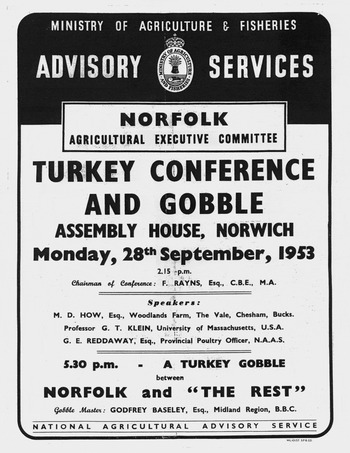
The Ministry of Agriculture produced leaflets disseminating the most effective ways of rearing turkeys.Footnote 36 In addition, the National Agricultural Advisory Service, which had been established in 1946 to provide technical assistance to farmers, played a key role in disseminating more productive methods by organising talks.Footnote 37 As Figure 1 shows, as well as local dignitaries, speakers at these conferences included Professor G.T. Klein, an internationally renowned expert on poultry Husbandry.Footnote 38 An important role in prompting more productive methods was undertaken by National Agricultural Advisory Service staff member Ray Feltwell, who was a prolific writer on all types of poultry husbandry, producing a series of articles popularising new methods of turkey rearing.Footnote 39 Feltwell was particular keen to stress not only the pioneering work of the National Institute of Poultry Husbandry but also the contribution of William Motley. Motley's assessment of his own achievements was far more modest,Footnote 40 but this did not prevent Feltwell's subsequent book on turkey farming from containing numerous references to Motley throughout the text, as well as a whole chapter devoted to the Motley system.Footnote 41 The dissemination of more productive methods and the coordination of turkey marketing were also facilitated by the establishment of the British Turkey Federation in 1951. This was an important forum linking the major turkey producers, enabling them to influence directly the development of the industry. This privately funded initiative was in stark contrast to the other state directed livestock sectors such as beef and lamb production where, in spite of a guaranteed price system, there were few attempts by leading producers to formalise a coordinated strategy to intervene in the development of the industry.
Turkey conference and gobble poster. Reproduced by kind permission of Norfolk Record Office, catalogue reference BR73/334.

One of the main factors which facilitated the expansion of turkey production in the immediate post war period was the low level of consumption and the high level of imports. In 1951 consumption only amounted to 0.8 pound per head per year, of which forty-seven per cent was imported mainly from the Irish Republic and to a lesser extent Denmark. By 1961 per capita consumption had increased to 1.2 pounds, and self sufficiency had increased to ninety per cent.Footnote 42
A leading pioneer of turkey production in the period was the Norfolk entrepreneur Bernard Matthews who, from humble origins, rapidly became an iconic figure in the British Turkey industry. Matthews left school in 1946 without any formal qualifications when he was sixteen. In 1950, in order to supplement his meagre income, he purchased a second hand incubator and twenty turkey eggs. After three years he relinquished his insurance job and embarked upon turkey farming full time. In 1955 he purchased Great Witchingham Hall near Norwich and thirty-six acres of land. Utilising the dining room as the hatchery he embarked upon an expansion programme that was to make his name synonymous with turkeys. In 1958 he became a registered company operating as Bernard Matthews Ltd. By 1968 he entered the Guinness Book of Records as the biggest turkey producer in Europe. The company was publicly listed in 1971, by which time he was operating a complex breeding programme involving the development of new, more productive strains of turkey with distinct male and female lines which could be crossed in accordance with changes in market demand.Footnote 43
Feed companies played a vitally important role in this initiative with the development of high quality, scientifically balanced rations of a declared nutritional content. Resolving nutritional problems enabled a rapid expansion in the number of turkeys produced. Improvements in nutritional understanding pioneered by the National Institute of Poultry Husbandry, and compounding companies such as BOCM and Spillers, which sold specially formulated turkey crumbs and growers pellets, transformed turkey management. Purchasing ready prepared meals, coupled with enhanced nutritional understanding of the turkey's metabolic requirements, enabled farmers fully to exploit the genetic potential of the new strains of turkey as efficient converters of food. Synthetic vitamin supplements contributed to increasing egg production, improving hatchability of eggs and the health of the young birds.
The most profound development revolutionising turkey production was the use of antibiotics in the feed which enabled diseases, particularly blackhead, to be finally controlled. Coccidiostatics were used as an integrated feed supplement for preventative treatment and as a water supplement in cases where a coccidiosis outbreak was confirmed. In addition, the development of blood testing of breeding birds enabled carriers of a number of infectious diseases to be culled. As John Jones noted in 1961, these developments have enabled turkeys to survive in what would have been ‘quite unsuitable environments twenty or thirty years ago’.Footnote 44
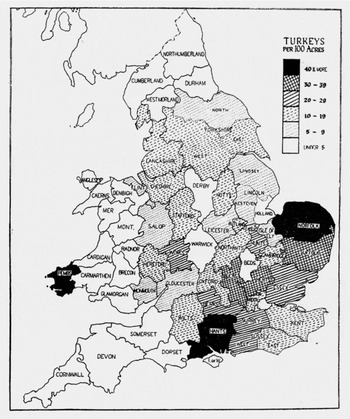
There was a marked geographical diversification of turkey production. As Map 1 shows, this was particularly evident in counties such as Surrey, Buckinghamshire, Essex and Lancashire. One of the most striking increases took place in Pembrokeshire where the rearing of turkeys for Christmas dovetailed well with arable farming, as in the run up to the festive season little field work was possible. The prevailing system of early potato production and yarded cattle meant that suitable buildings were also available.Footnote 45
Density of Stocking with Turkeys per 100 acres agricultural land, June 1963. Source: W. D. Jones, Turkeys: Production and Marketing Problems (1966), p. 6.

V
New improved varieties of turkeys were introduced after the Second World War. Pilot importations of hatching eggs of improved strains of Bronze turkey commenced in the late 1940s and reached commercial proportions in 1950–51. The Bronze turkey or, as it was eventually denoted, the Standard or unimproved Bronze turkey, was, through a programme of selective breeding, refined to become the Broad Breasted Bronze, which had a considerably higher proportion of breast meat than its predecessor.Footnote 46 By the mid 1950s the superior fleshing characteristics and conformation of the Broad Breasted Bronze ensured that it had almost completely replaced the Standard Bronze.
One of the main disadvantages of these improved strains was their low levels of fertility and hatchability. This problem was compounded by the selection process which increasingly concentrated on the use of parent stocks with wide breasts and short legs, rendering natural mating problematic. It was increasingly recognised that reproductive fitness, and in particular addressing infertility problems, was a matter of concern.Footnote 47 In order to enhance fertility commercial turkey breeders began to resort to the use of artificial insemination.Footnote 48 This technique was particularly useful in the latter part of the egg laying season when natural mating fertility rates were declining rapidly.
The 1950s also witnessed the shift to white breeds of turkeys which, because of their colour, did not have the disadvantage of unsightly pin feathers.Footnote 49 More importantly their fertility and hatchability levels were superior to those of the Broad Breasted Bronze, and they had the added advantage of good conformation and a high volume of breast meat.Footnote 50
These developments were accompanied by the rigorous selection of breeding stock based on individual pedigree records, coupled with measurements of breast and keel. As with the Broad Breasted Bronze, selective breeding for broader breast and shorter legs, compounded by cross breeding with other coloured breeds for hybrid vigour, gave rise in the longer term to serious infertility problems. Artificial insemination, either as a complement or substitute for natural mating, was increasingly used. Eliminating the need for natural mating allowed the use of even larger and broader breasted strains of stag birds.
While not reaching such high weights as the Broad Breasted Bronze, white turkeys were often too large for the average family. If turkeys were killed at a relatively young age when they were immature, they did not have the appropriate level of finish on the dressed carcase, a factor which was affected almost entirely by the amount of subcutaneous fat on the bird. Immature birds had a higher proportion of bone to flesh than older birds, with higher breasts, and lacked the colour to make them attractive to consumers. In order to address these issue efforts were made to breed smaller, distinct strains of white turkeys which matured at lower weights.
In the 1940s, in response to consumer preference studies carried out at retail stores in America, the production of a small strain of turkey was pioneered by the Agricultural Research Centre, Beltsville, Maryland, America, which became known as the Beltsville Small White.Footnote 51 This strain, unlike its predecessors, had been selected primarily on economic considerations which focused on conformation, weight and performance.Footnote 52 In addition it was also claimed that the flesh of the Beltsville White was of better flavour as a result of wild turkeys being bred into its makeup. Other named strains of smaller white turkeys were subsequently developed such as Roly Poly, Pumpie and Wrolsrad.
Developing distinct blood lines and new strains of turkey was beyond the financial resources of most breeders.Footnote 53 As a result the plethora of small turkey breeders, who had traditionally produced their own strains of poult for sale to rearers, or for fattening on their farms, was gradually replaced by a small number of specialist breeders of international repute, who were able to supply male and female lines of performance tested, foundation breeding stock. Only breeders operating on a large scale, who were able to exploit economies of scale, could expend the resources and have sufficiently large populations to undertake the rigorous selection necessary to achieve significant and rapid inter-generational improvements in the quality of their breeding stock.Footnote 54
Their activities included the acquisition, testing and development of new strains which, if they proved superior, could replace the existing strains. Large scale breeders were also able to test their birds under developing commercial conditions such as controlled environment intensive production systems. Breeders had to have their own abattoir facilities and processing plant for the evaluation of the finished birds and for disposal of surplus or culled breeding stock, in order to prevent them being acquired by a competitor.Footnote 55
One of the most successful of the large scale breeders was British United Turkeys, which was established in 1962 in an effort to deal with the challenge of Britain's possible entry into the Common Market. This was a joint venture by Britain's five leading turkey producers, which included Bernard Matthews. Its aim was to produce at a competitive rate turkey poults which could be reared to produce ‘tailor-made’ birds for different markets. Male strains were selected for their growth rate, feed conversion efficiency, conformation and carcase quality. Series of male lines were each developed for a particular specific market. Female lines were selected for fecundity in terms of not only their egg laying ability but also the number of poults which were reared.Footnote 56
In spite of the fact that Britain's entry into the Common Market did not materialise, British United Turkeys rapidly became both nationally and internationally famous for its strains, which were distributed through franchise breeders.Footnote 57 By 1972 it was supplying about thirty per cent of the foundation stock used to breed turkeys in Europe.Footnote 58 In 1973 its achievements were formally recognised when it won the Queen's Award to Industry Export Performance.Footnote 59
By the 1990s British United Turkeys strains T9, T8, and T5 were the most popular designated strains used among commercial producers, while British United Turkeys 6 dominated the European market. Pedigree stock for these strains was retained on high level Biosecure units, and their offspring used to breed great grandparents and grandparents to produce parent foundation breeding stock. These birds were subject to a rigorous system of culling, with only one in every hundred stags and ten per cent of hen birds produced being retained as breeding stock.Footnote 60 In September 2005 the company was acquired by Aviagen, the world's largest poultry breeder, which also produced the Nicolas 300 and 700 strains of breeding stock, representing more than one third of the world's commercial turkeys.Footnote 61 The company was committed to developing and marketing both brands throughout not only America but also the rest of the world
VI
As a consequence of the supply side revolution, it was evident by the mid 1950s that the supply of turkeys at Christmas was exceeding demand. The trade for turkeys was particularly depressed in 1956 when the downturn in consumer spending was accentuated by the post Suez crisis recession. Serious concerns about oversupply continued to be voiced by the Turkey Federation. These reached a crescendo at their Annual Conference held at Eastbourne in 1963. Following the cessation of the Fowl Pest Slaughter policy in March, which had previously reduced the turkey population, it was anticipated that this would lead to an extra four million birds on the market.Footnote 62 As Bernard Matthews explained, the problem could be solved if one third of the estimated crop of ten to eleven million birds were consumed out of season.Footnote 63
There was an overwhelming need to create a year round demand not only for fresh turkeys but also, more importantly, for frozen turkeys, as these could be killed when they were at their optimum weight. All the year round production also enabled the birds to be slaughtered in large purpose built slaughterhouses which catered specifically for poultry. Significant cost savings were also achieved by the machine plucking of birds, which reduced labour requirements.Footnote 64 The post war revolution in food retailing pioneered by self service supermarkets favoured the expansion of frozen turkeys as the labour intensive task of evisceration could now take place in centralised units adjacent to the turkey production units. The birds were frozen on site and stored until they were required by the retail distributors. This shift to frozen turkeys was particularly beneficial to the large integrated supermarket chains who could now sell frozen and processed turkeys in the same way as other items on their shelves. This shift to year round production resulted in significant economies of scale in the fattening process, making it possible to spread the fixed costs of equipment of hatching, rearing and fattening of the bird over a much larger number of birds.
While frozen turkeys purchased out of season were considerably cheaper than fresh turkeys, they were still more expensive than other types of white meat, notably broiler chickens. The forty per cent price differential which existed in the early 1960s was the result of the advent of intensive controlled environment methods of broiler production and rapidly growing strains of chicken which had transformed the industry. Broiler production had increased from about ten million birds in 1955 to one hundred million by 1961, and to well over one hundred and fifty million by 1965.Footnote 65 The increased production of broilers was accompanied by a thirty per cent fall in the price of broilers in the same period, compared with a twenty to thirty per cent increase in pork and lamb and a forty per cent plus rise in the price of beef.Footnote 66 In an effort to give turkeys a competitive edge over broilers, the British Turkey Federation conducted a national advertising campaign to popularise turkey as a luxury meat that was superior to the humble chicken and that was readily available throughout the year.Footnote 67
This switch among the large, more cost conscious producers to all year long production of turkeys had significant repercussions for turkey breeders, in particular making it necessary to produce hatching eggs throughout the year. In order to achieve this, breeding birds had to be reared in a controlled environment, in windowless houses with regulated lighting patterns, ensuring that they started laying eggs outside the usual late spring, early summer period. As a result the large turkey producers increasingly developed integrated breeding units.
In spite of the expansion of the turkey industry, this was also a period of rationalisation. In 1960, for example, 13.7 per cent of all turkeys were on holdings with between 100 and 499 birds whereas a mere three years later this had declined to 6.7 per cent. In contrast units with more than ten thousand turkeys, which had accounted for 21.5 per cent of total production in 1960, had increased to 51.9 per cent of total production by 1963.Footnote 68 By 1972 more than seventy per cent of turkeys were produced by eight major producers who catered primarily for the frozen market.Footnote 69 By this time the production of fresh turkeys was confined primarily to small seasonal producers who sold the birds to locally based retailers and butchers. However at this stage it was still possible for ‘New York’ dressed birds to be sent to customers by post.
VII
The 1970s proved to be a challenging time for the turkey sector, enduring a cost price squeeze in an increasingly competitive and saturated Christmas market.Footnote 70 On the one hand, there were unprecedented increases in world prices of all agricultural commodities, but particularly for feedstuffs which constituted the most important item of expenditure in producing turkeys. On the other hand the international recession of 1973 to 1974 led to a slowing down in the growth of turkey consumption, which exacerbated the existing problem of surplus capacity among producers. This was compounded by Britain's entry into the European Community which enabled low cost European turkey farmers to compete in the British market as part of the Common Agricultural Policy. Along with poultry, turkeys were one of the few agricultural commodities excluded from the price support system of the Common Agricultural Policy. British turkey producers were forced to search for new outlets for their birds. Larger, more commercially oriented turkey producers continued to switch to all year round production of whole birds and also focused on adding value to their end products by selling processed meat and joints in a variety of cuts.
During this period the mass production of turkeys took place in purpose built controlled environment units which held up to 25,000 birds. Mechanical feeding and drinking systems reduced the demand for labour while ambient temperatures and ventilation ensured optimum growth rates. Research undertaken by the Agricultural Development and Advisory Service confirmed an economic optimum temperature of about 160 C for turkeys sold fresh in the United Kingdom market, and 190 C or 200 C for those for the frozen trade.Footnote 71
Intensive production necessitated the use of beak trimming of the young chicks, i.e. the cutting off with a special surgical implement of the tip of the upper mandible in order to lessen aggressive pecking. Birds were slaughtered and processed ready for market in large specialist units, with the birds or portions being sold through multiple retail outlets and wholesale markets. Of the eight to nine million frozen turkeys sold each year, the vast majority originated from all year producers.Footnote 72
One of the leading pioneers of this diversification was Bernard Matthews. His company made strenuous efforts to expand into the European market and, by 1976, the Great Witchingham factory had secured a licence to export turkeys to Common Market countries.Footnote 73 Two years later overseas sales of their products accounted for fifteen per cent of turnover.Footnote 74 The group refocused its activities on turkey meat products which, by 1980, accounted for more than sixty per cent of the group's sales.Footnote 75
European competition adversely affected the demand for British turkeys. In spite of intense lobbying by senior officers of the British Turkey Federation, which included Bernard Matthews and Mr Raymond Twiddle (Director of the second largest turkey firm in Britain), Peter Walker, the Conservative Minister of Agriculture, refused to ban imports of cut price turkeys. Instead, he tried to pacify producers with assurances that he would seek redress through European Economic Community institutions.Footnote 76 In the early 1980s Matthew's company pioneered a series of TV commercials featuring the turkey breast roast, with Matthews himself voicing, in his thick Norfolk accent, his famous ‘Bootiful’ catchphrase, which was later to become part of the ‘national consciousness’.Footnote 77 The cost of the campaign was quite substantial, being in excess of five million pounds a year by 1984.Footnote 78
By 2005 Bernard Matthews Foods Limited was producing eight million turkeys a year, or more than seven times the number of birds consumed each year prior to the Second World War, as well as processing a variety of fish and poultry products. With an annual turnover of over four hundred million pounds per annum, it was the biggest and most successful turkey producer in Europe.Footnote 79 The company now managed all stages of production from the breeding of parent stock, through hatching and growing of commercial birds, to the processing of finished products on its fifty-seven farms throughout Norfolk, Suffolk and Lincolnshire.Footnote 80 Turkey production units were also established in low cost countries such as Hungary.
Another outstanding large producer was Cranberry Foods, which was established in 2003 as a result of an amalgamation of Sun Valley's turkey division with Moorlands Poultry and Brandons Poultry. The company processed 5.5 million birds from seventy farms in Northern England, the Midlands, Hertfordshire and South Wales.Footnote 81 Together with Bernard Matthews Ltd, by 2006 they were responsible for about ninety per cent of the seventeen million turkeys produced in the United Kingdom.Footnote 82
In 2006 Cherry Ridge was the third largest all year turkey producer, processing about 15,000 birds each week, in addition to selling more than 350,000 birds at Christmas. However, by the following year, Christmas sales had declined to less than 250,000 birds and margins were insufficient to keep the factory operating. The company attributed the decision to suspend operations on the low prices being paid by supermarkets which had been exacerbated by the market disruption caused by cheap European imports and by the avian flu outbreak on the continent. Towards the end of 2006 Bernard Matthews acquired the organic and free range production facilities of Cherry Ridge poultry.
VIII
One of the big challenges faced by large scale producers was overseas competition. During the 1980s the number of imported turkeys from low cost producers with lower wage rates and cheaper feed costs continued to increase, rising rapidly after 2000. Imports from South America and Eastern Europe rose to an estimated fifteen million birds by 2007, whilst imports from non-European Union countries also rose as they did not have to cope with the additional costs of complying with environmental legislation that was imposed on United Kingdom producers. Of these imports, only 9.5 per cent were fresh whole birds, 5.7 per cent frozen whole birds, the rest being prepared and preserved turkeys, frozen cuts or fresh proportions.Footnote 83 Throughout the period successive governments continued to reject import bans.Footnote 84
Imports contributed to the decline in the numbers of turkeys slaughtered in the United Kingdom, falling from 21.22 million in 2004 to 17.28 million on 2006. The influx particularly affected all year production which was halved. By 2007 there were less than ten all year round commercial producers. One of the principal ways in which producers attempted overcome overseas competition was to differentiate their products by advertising farm fresh turkeys reared according to environmental standards. Concerns about the intensive rearing of livestock, which had become more prominent in the 1990s, encouraged a revival in less intensive methods of production. Semi-intensive pole barn houses as well as some free range and organic systems proliferated. By 2005 there were approximately six hundred producers of seasonal turkeys rearing about 1.1 million turkeys which were sold fresh predominantly for the Christmas market. While many of these were small scale producers, income from turkeys was often an important source of revenue for these individuals. Many of these seasonal or traditional farm fresh systems of production tended to be small family run concerns, which purchased poults as either day olds or at four to five weeks old, when they were able to survive without supplementary heating.
IX
Standards of production were regulated by the Traditional Farm Fresh Turkey Association which was established in 1984. By 2007 it had more than fifty farmer members producing over 150,000 turkeys which were sold under the Golden Promise brand. In order to qualify for membership farmers had to ascribe to a twelve point Quality Assurance Code, which covered the conditions of rearing and description of the product. Members’ premises were inspected annually, with random checks being carried out in order to ensure that they complied with the Golden Promise guarantee. Slower growing breeds were generally chosen and reared to full maturity. Birds were housed in buildings which provided natural light and ventilation, while providing essential weather protection. Free range stock had open access to grazing for at least eleven weeks. The birds were dry plucked and hung like a game bird for at least seven days in order to improve the taste, then sold through independent butchers, farm shops and direct from the farm.
Regional associations such as the Norfolk Turkey Association and the Anglian Turkey Federation offered advice to producers in their local area. The latter also organised annual trips to Europe to enable its members to see production methods, and coordinated an exchange system for Anglian producers to swap turkeys of different weights with each other. During the run up to Christmas 2006 over ninety producers exchanged 17,000 birds.Footnote 85
The revival of more natural methods of rearing was accompanied by the rearing of Bronze turkeys, which were widely regarded as having a fuller flavour and a firmer texture of meat. Bronze turkeys were regarded as a more natural breed and consequently attracted a substantial price premium. Ironically the existence of dark stub feathers was now regarded as proof that it was a Bronze variety. With slower growing breeds, maximum weight gain per day was no longer the overriding priority, as it was recognised that exercise undertaken as part of a free range system improved the texture of the muscles, making the meat tastier. Inevitably this adversely affected the feed conversion ratio.
A number of turkey breeders such as Farmgate Hatchery, Holly Berry Hatcheries, Cyril Bason (Stokesay), Highline Hatcheries, Pennine Poultry and SCF Turkeys supplied day old and young turkey poults specifically for the Christmas trade. Kelly Turkeys in Essex which produced the Kellybronze is one of the best known of these specialist breeders. Proprietor Derek Kelly's interest in reviving these traditional breeds started in 1981, when he supplied his local butcher with a few bronze and black turkeys from his rare breeds collection, and was overwhelmed by the positive response to the quality of their meat. In addition to the Kellybronze, the company produced a number of smaller strains of bronze and white turkeys. In 2005 Kelly's Farmgate hatchery hatched about 1.2 million eggs, ninety per cent of which were sold as day old poults to the independent turkey producers, while 40,000 were sold as live birds to processors at sixteen to twenty weeks, and 400,00 reared and marketed as dry plucked for the Christmas trade.Footnote 86 The company's position as the largest single supplier to the seasonal market was further enhanced by its distinct breeds, and the franchise and management packages that it was able to provide to potential producers.Footnote 87
In July 1999 the Animal Welfare Minister, Elliot Morley, launched the industry funded British Quality Turkey Standard which was run by the British Turkey Federation (part of the British Poultry Council). This covered turkey production from the initial sourcing of the breeding stock, to all aspects of rearing including competency, housing, husbandry, nutrition and hygiene, to the final processing.Footnote 88 The National Farmers’ Union launched a campaign to ensure that consumers knew when they were buying British turkey. The United Kingdom turkey logo was used to denote source of origin, because research had indicated that many people naively assumed that if whole turkeys or cuts of turkey meat were on sale in their local butcher's shop, then it must have been produced in this country.
Organic production remained a very small market, regulated by one of the acknowledged organic organisations. Production involved the use of slow growing strains of turkeys, low stocking density, and a greater age at slaughter. The conservation of traditional breeds of turkeys such as the Norfolk Black, Bronze, Pied (Crollwitzer), Blue, Buff and Bourbon Red have been coordinated by their respective Breed Societies with which the breeders of pedigree birds can be registered. In 2001 the Turkey Club was also established as a means of helping to preserve the rarer strains of turkeys and maintaining breed standards.Footnote 89 It provided an invaluable service for those exhibiting traditional breeds of turkey, and for the increasing number of non commercial or back yard producers who hatched and reared a small number of birds for their own consumption. However this revival of small scale production, using traditional breeds was, in terms of the number of birds reared, only a very minor aspect.
Conclusion
Since the 1930s the turkey sector has been transformed from a niche Christmas market to one of all year round production. By 2007 the British turkey industry contributed £365 million (measured at retail level) to the United Kingdom economy, which equated to 10.7 per cent of the contribution of the poultry industry. The vast majority of this increase, even for the Christmas market, was due to frozen birds which were reared by a small number of large, all year round producers. Revolutionary changes in production and breeding techniques significantly reduced the cost of breeding and rearing turkeys. The transformation also reflected the efforts of official bodies and enterprising individuals of whom Bernard Matthews is the most iconic figure. While the industry was increasingly subject to competition from cheap imports, British producers made strenuous effort to brand their produce in an effort to ensure customer loyalty and to diversify into new markets such as turkey processing. The rapid expansion of the industry was accompanied by an unprecedented rationalisation in the number of producers and subsequent diversification was achieved without a guaranteed price system or the extensive price support which, since the Second World War, has characterised most other sectors of British agriculture. As such this case study of the development of the turkey sector in this period casts doubts on the conventional wisdom that state intervention, direction and guaranteed prices were essential prerequisites for agricultural modernisation to take place successfully.