In recent years pre-electoral coalitions (PECs) have become increasingly common in both Western advanced democracies (Golder Reference Golder2005) and in their younger counterparts in Central and Eastern Europe (CEE) (Ibenskas Reference Ibenskas2011; Kitschelt et al. Reference Kitschelt, Mansfeldova, Markowski and Toka1999; Rose and Munro Reference Rose and Munro2009). Nevertheless, the amount of academic interest received by the phenomenon has remained modest, especially regarding the relationship between these electoral alliances and the formation and life cycle of cabinets taking office afterwards. As Müller et al. (Reference Müller, Bergman and Strøm2008: 25) put it in their thorough review of coalition theory: ‘The potential gains from inter-party coordination in the electoral arena have not received much attention in coalition research.’
The limited comparative research carried out up until now on pre-electoral coalitions has focused mostly on the logic behind the formation of such alliances, either at the party system level – testing the disproportionality and signalling hypotheses (Golder Reference Golder2005) – or in relation to the parties’ individual and combined characteristics (Golder Reference Golder2006a). Albeit less extensively, pre-electoral coalitions were also studied as a source for governing coalition agreements (Strøm and Müller Reference Strøm and Müller2000) and as a mediating factor for proportional portfolio allocation (Carroll and Cox Reference Carroll and Cox2007). A different direction of study was the experimental investigation of voters’ reactions to such alliances (Gschwend and Hooghe Reference Gschwend and Hooghe2008; Hooghe et al. Reference Hooghe, Marien and Gschwend2011). Beyond that, there are a vast number of country studies that analyse the context and political consequences of specific pre-electoral coalitions (Allern and Aylott Reference Allern and Aylott2009; Andeweg Reference Andeweg1989; Hanley Reference Hanley1999; Mitchell Reference Mitchell1999; Saalfeld Reference Saalfeld2000).
In her influential article, Sona Golder (Reference Golder2005: 645–6) identified three main reasons why pre-electoral coalitions are significant for students of government politics: they affect the composition and policies of the cabinet; they can make the government formation process more transparent and thus provide a stronger policy mandate; and they are quite common in post-industrial democracies. Beyond these revealing rationales, I argue that the existence of pre-electoral coalitions modifies fundamentally the bargaining environment in which potential cabinet formulas are negotiated and that the survival chances of cabinets which include them follow predictable, yet different patterns to those of regular coalition governments. Consequently, the central research question addressed by this study asks: What is the impact of pre-electoral coalitions on government survival rates in Europe? Secondary questions are: Does it make a difference to government durability whether the member parties of the pre-electoral coalition had governed together in the previous electoral cycle? Is the relationship different for Central and Eastern European cabinets? In order to answer these questions I analyse the composition, structural attributes, institutional covariates and survival rates of 534 Western and Central and Eastern European cabinets, the oldest of which was formed in June 1944, while the most recent started governing in December 2008.
The introduction is followed by a review of the reasons for pre-electoral coalitions influencing governmental survival rates. Next, I present the main coordinates of the research design: data, methods and the logic behind the control variables employed. The third section introduces a number of descriptive statistics and visual representations of the incidence of cabinets including pre-electoral coalitions. The main analytical section includes the presentation and discussion of the findings of the ‘competing risks’ survival models. These are run first on the pooled sample, and then separately on the Western subsample in order to check more robustly the main effects, as the Western data set allowed for a larger number of control variables. The conclusion synthesizes the main findings of the study and points to further possible avenues of research.
Why Do Pre-Electoral Coalitions Matter For Cabinet Durability?
The methodological advances that literature on government durability has made in the last decades (see the Methods section below) have been complemented by the development of more comprehensive theoretical accounts based primarily on formal models that incorporate the voluntary termination assumption (Lupia and Strøm Reference Lupia and Strøm1995, Reference Lupia and Strøm2008) or search for governmental equilibriums (Laver and Shepsle Reference Laver and Shepsle1998). However, the vast majorityFootnote 1 of the empirical-centred work and all theoretical models of cabinet durability have failed to differentiate between cabinets based on pre-electoral coalitions and the rest. Then, why should such a distinction be important? Pre-electoral coalitions modify fundamentally the bargaining environment in which potential cabinet formulas are negotiated. Thinking in terms of the bargaining model proposed by Lupia and Strøm (Reference Lupia and Strøm2008), pre-electoral coalitions have the potential to increase the bargaining power of their members relative to outside partners or opponents, beyond the sum of the influences of their component parties, because they reduce both uncertainty (for voters and other political competitors) and transaction costs.
Pre-electoral coalitions should contribute to the reduction of uncertainty since many of them are essentially devised for signalling purposes: that member parties are able to form an effective government; that member parties wish to empower voters in choosing the coalition government; and to signal to the voters the identity of a potential future government (Golder Reference Golder2005: 649–50). Reduced uncertainty implies that a substantial popular vote allowing the pre-electoral coalition to form the government provides the new cabinet with both higher legitimacy and a stronger policy mandate (Golder Reference Golder2005: 645–6) than coalitions formed after the announcement of electoral results. Both elements could prevent or moderate the scale of radical negative swings in public opinion that sometimes bring down cabinets.
The first type of signalling argument is common in those systems dominated by a major party that manages to govern alone for extended periods of time (for example, the Social Democratic Party in Sweden). When the other parties coalesce in a pre-electoral coalition and receive from voters the opportunity to replace the dominant party in power, a stable government lacking serious conflicts becomes a direct measure of their viability as alternatives to the ‘usual’ party in charge of administering the country.
The other two types of signalling could make cabinets founded on pre-electoral agreements and announcements more credible and better able to gather outside support, from voters and from financial markets. Although exogenous to the cabinet itself, this confidence, or at least the feeling of predictability that pre-electoral coalitions transmit, could help the executive fulfil its mandate better and resist challenges that appear later on.
Unlike coalition cabinets formed after elections, governments based exclusively on pre-electoral coalitions can most likely draw on a number of institutional mechanisms that have already been developed to enforce and supervise the ‘contract’ enforcement between the partners. An example of such mechanisms is represented by coalition coordination boards that decide on disputed candidatures at regional or national level and are used afterwards to solve conflicts between members of the component parties arising in local and regional elected or appointed bodies, or at the level of governmental agencies.
Moreover, pre-electoral coalition governments might last longer because they cooperate much more strongly in the legislative arena. One form of such cooperation is the majoritarian allocation of legislative offices among the pre-electoral coalition member parties. Whereas post-electoral coalition governments even distribute legislative offices to opposition parties in order to increase monitoring capacity and to limit abuses of power by the partners, pre-electoral coalition-based cabinets were shown to ‘concentrate the distribution of offices within the coalition’ (Carroll Reference Carroll2007: 15). As a consequence, pre-electoral coalition cabinets have greater control over legislative policies – a fact which, in turn, is likely to help them survive for longer.
Another reason why pre-electoral coalitions might influence governmental durability concerns the fact that in most of these cases partners negotiate and agree well in advance on the major policy dimensions that would form the backbone of the governmental programme. The agreement on policies is extended in some cases even to portfolio allocation (Carroll Reference Carroll2007). Because of these arrangements and their early timing, the likelihood that the pre-electoral coalition member parties will make credible commitments (Laver and Shepsle Reference Laver and Shepsle1990; Lupia and Strøm Reference Lupia and Strøm2008) is higher and, consequently, disagreements appearing later on can be solved much more easily. Additionally, in a study of coalitions in 27 young and consolidated democracies, Carroll and Cox (Reference Carroll and Cox2007: 310) have illustrated that the plausible norm of fairness that is expected to govern the distribution of offices in such a situation does occur more often and more extensively than for other cabinets: ‘[p]re-election pacts that commit their signatories to enter government together introduce a strong Gamsonian element into portfolio allocations.’
The logic implying a longer duration for cabinets composed only of pre-electoral coalitions, compared with those that lack a pre-electoral coalition or include additional parties, can also be linked to the cooperation that some pre-electoral coalitions entail at all party organizational levels during the campaign. Thus, because their activists and mid-level party elites have fought elections together, there is a higher likelihood that they will develop an increased mutual understanding of the needs and priorities of their partners once in government. This understanding could further translate into less pressure from party leaders and the rank and file on the parties’ cabinet members to discard the others’ concerns and embark on zero-sum games. For all these reasons I hypothesize that:
Hypothesis 1: Cabinets that replicate completely pre-electoral coalitions are less likely to terminate discretionarily than other coalitions.
The durability of pre-electoral coalition-based cabinets should be more visible in early election terminations. In the case of a pre-electoral coalition cabinet, dissolution and early elections would mean rethinking an entire electoral strategy, and more precisely, taking decisions on whether to keep the old pre-electoral coalition label, and whether and how to reposition the party vis-à-vis pre-electoral coalition partners (Carroll Reference Carroll2007: 5). Such decisions might prove costly, especially because of the uncertainty regarding how former voters of the pre-electoral coalition would perceive the failure of the government, who is to blame for it and whether the pre-electoral coalition or its component parties separately are worthy of a new mandate. For these reasons, leaders of pre-electoral coalition cabinets are more likely to prefer non-electoral discretionary terminations – that is, replacements instead of early elections.
Hypothesis 2: Cabinets that replicate completely pre-electoral coalitions diminish the risk of government termination by early election.
This article will also analyse the durability of cabinets including pre-electoral coalitions formed between the governing parties that had been in power during the term before the election. Such a situation is not uncommon, with many Western (for example, the ‘Purple Coalition’ in the Netherlands) and some Eastern coalitions (for example, Mikulas Dzurinda’s cabinets in Slovakia) asking voters for a mandate to continue their programme and actually receiving it. For these incumbent pre-electoral coalition-based cabinets, the prospect of their durability is rather ambivalent. On the one hand, they should enjoy all the positive advantages discussed above. On the other hand, the new cabinet could carry a legacy of unresolved conflicts and personal frictions that had not exploded in the first mandate. Moreover, later in the term, party leaders might become worried that their brand or label identities become blurred after so many years of cooperation with the other parties, and thus decide for an abrupt exit. Therefore I hypothesize that:
Hypothesis 3: Incumbent pre-electoral coalition-based cabinets are more likely to terminate discretionarily than other coalitions.
There are a number of reasons why the relationship between pre-electoral coalitions and government durability might work differently for cabinets in Central and Eastern Europe. On the one hand, the argument that pre-electoral coalition-based governments are more stable because they receive a stronger policy mandate from voters should apply to a lesser extent in the post-communist systems. There is generally little mandate responsiveness in the region; parties are somewhat unable to differentiate themselves clearly ideologically or to follow policy promises that they have made during campaigns (Roberts Reference Roberts2009: 79–88).
On the other hand, Central and Eastern European politics are characterized by ‘hyper-accountability’ (Roberts Reference Roberts2009: 72) – that is, incumbents are punished quite severely at the polls. This can in turn increase significantly the electoral costs of being perceived responsible for the dissolution of a cabinet that people have (almost) voted for directly.
Unlike their Central and Eastern European counterparts (Tavits Reference Tavits2008), Western European parties still enjoy relatively stable electorates (Mair et al. Reference Mair, Müller and Plasser2004), which alleviates the risk of complete parliamentary extinction following governmental underperformance in pre-electoral coalition-based cabinets. The disastrous experiences of the Solidarity Electoral Action (Akcja Wyborcza Solidarność – AWS) in Poland (2001) or the Christian Democratic National Peasants’ Party (Partidul Național Țărănesc Creștin Democrat – PNTCD) in Romania (2000), who were faced with this situation only four years after they had come into power on waves of hope and enthusiastic support, are significant lessons that could influence the strategic behaviour of actors forming pre-electoral coalitions and cabinets based on them in Central and Eastern Europe.
Last but not least, another difference relevant for our comparison is that most Western European parties have developed and maintained strong programmatic links with voters, whereas a large number of parties in Central and Eastern Europe rely more on the leaders’ charisma and clientelist appeal (Kitschelt Reference Kitschelt2011). This matters because policy-motivated voters are likely to value policy responsiveness over cabinet stability if conflict between the coalition partners revolves around key policy promises, whereas the reverse scenario is more likely in Central and Eastern Europe.
Hypothesis 4: The survival rates of pre-electoral coalition-based cabinets should be higher in Central and Eastern Europe.
Unlike Golder (Reference Golder2006b), I argue that the relationship between pre-electoral coalitions and cabinet durability should also apply to replacement governments, not only to those taking office immediately after elections. This is because the common pledges made during the campaign and the corresponding expectations they raise in voters are unlikely to be forgotten when a reshuffle takes place or a new party is admitted in the coalition. In other words, even if the bargaining environment changes after the election, it is difficult to believe that the component parties can free themselves completely and credibly from the commitments made through the pre-electoral pact, and the constraints established by it. Moreover, limiting the analysis only to post-electoral cabinets could hide effects that might take longer to materialize.
Control Variables
Despite the fact that there is ‘no baseline model of government duration well accepted in the literature’ (Golder Reference Golder2006b: 128), there is a certain agreement on the building blocks that must be included in such models. These blocks relate to government structural attributes, legislative characteristics and attributes of the political system (Laver Reference Laver2003; Saalfeld Reference Saalfeld2008; Strøm and Swindle Reference Strøm and Swindle2002; Warwick Reference Warwick1994).
Government structural attributes
The controls pertaining to this category that I introduce in the pooled model are: single-party majority cabinet, single-party minority cabinet, minority coalition, minimum-winning coalition, caretaker and maximum government duration. The Western European models also analyse whether the government is an ideologically connected cabinet and whether the maximum bargaining power party is included or not.
As Damgaard (Reference Damgaard2008: 314) puts it, ‘single-party governments or minimal-winning coalitions are simply better equipped than others to avoid conflicts and survive’. On the other hand, single-party majority cabinets are also more likely to use the dissolution and early elections option strategically (Strøm and Swindle Reference Strøm and Swindle2002). A higher risk of discretionary termination was also associated with minority governments, a fact generally explained by their limited capacity to generate effective policy (Strøm and Swindle Reference Strøm and Swindle2002), an inability that usually translates into heavy electoral loss. Caretaker governments should not last for very long, given their provisional nature (Golder Reference Golder2006b: 128). Maximum government duration is important because cabinets that are invested only shortly before the regular elections generally have little authority to implement significant policy changes and they are also less likely to be able to enjoy the benefits of such changes. Moreover, such cabinets appear more inclined to call early elections (Lupia and Strøm Reference Lupia and Strøm1995).
It has been argued that coalition cabinets formed between policy-compatible parties – that is, parties with common or similar stances on various ideological dimensions – perform better and have a higher durability (de Swaan 1973; Warwick Reference Warwick1994). Since pre-electoral coalitions are themselves more likely to appear between ideologically proximate parties, it can be legitimately questioned whether the policy connection is not the cause of the hypothesized relationship between pre-electoral coalitions and government survival rates. This is why I control for ideologically connected cabinets. Finally, the inclusion of the maximum bargaining power party in the cabinet was shown to increase the government’s chances of surviving (Damgaard Reference Damgaard2008: 318).
Parliamentary attributes
In the pooled model I control for legislative fragmentation using the effective number of parliamentary parties (ENPP). For the Western subsample it was also possible to control for ideological polarization, parliamentary preference range and duration of formation negotiations. All these variables account for the complexity of the bargaining environment, and previous comparative work has emphasized that they augment the risk of discretionary terminations (King et al. Reference King, Alt, Burns and Laver1990; Warwick Reference Warwick1994). A somewhat different control variable pertaining to the parliamentary attributes block is the extremist party seat share, which is generally believed to influence government survival negatively, particularly for those minority cabinets that depend on some cooperation with the opposition (King et al. Reference King, Alt, Burns and Laver1990: 858; Warwick Reference Warwick1994: 63).
Political system attributes
In the pooled model I control for bicameralism, positive parliamentarism, semipresidentialism, the constructive no-confidence vote, the length of the constitutional inter-election period and the age of democracy. Bicameralism and semipresidentialism introduce additional veto players in the legislative game, which potentially decreases the value of governing and implicitly affects governmental stability (Druckman and Thies Reference Druckman and Thies2002; Schleiter and Morgan-Jones Reference Schleiter and Morgan-Jones2009). Positive parliamentarism, whether a vote of investiture is required or not, is believed to diminish average cabinet duration (Warwick Reference Warwick1994), although some scholars think that the governments that fail to be invested ought to be excluded from the analysis and that this additional obstacle to formation should actually positively influence survival chances (Golder Reference Golder2006b). Another important institution which needs to be accounted for is the constructive no-confidence vote, which is known to increase government durability. Many scholars consider that constitutional inter-election periods of more than four years are associated with higher risks of early elections (Strøm and Swindle Reference Strøm and Swindle2002). Last but not least, I control in all models for the age of democracy, because previous research (Schleiter and Morgan-Jones Reference Schleiter and Morgan-Jones2009: 505) has shown that cabinets in younger democracies face increased risks of both replacement and dissolution terminations. This variable is particularly important for testing whether there are substantive differences between Western and Central Eastern European cabinets.
Two other institutional controls were added for the models analysing Western European cabinets: prime ministerial powers and the existence of junior ministers. Formally powerful prime ministers usually have a negative impact on government survival (Damgaard Reference Damgaard2008: 317), not least because they can decide unilaterally in favour of dissolution. On the other hand, the existence of the institution of junior ministers has the potential to prevent intra-coalition conflicts from escalating, particularly when they play a watchdog function (Strøm et al. Reference Strøm, Müller and Smith2010).
Research Design
Case Selection
With one exception (Schleiter and Morgan-Jones Reference Schleiter and Morgan-Jones2009), the vast literature on cabinet survival has failed to compare Western and Central Eastern European governments. In most cases, authors have limited themselves to underlining the much lower duration rates of cabinets in the latter region (Conrad and Golder Reference Conrad and Golder2010; Somer-Topcu and Williams Reference Somer-Topcu and Williams2008; Tzelgov Reference Tzelgov2011). Although data on some covariates of government durability are still missing for Central and Eastern European countries, an integrated test is nevertheless welcome, particularly given the high occurrence of pre-electoral coalitions in the region. My case selection includes all 10Footnote 2 post-communist countries which joined the European Union up to 2008, the date of the last cabinet in my sample. Their level of democratic consolidation and similar transitions make them more suitable candidates for such comparative analyses than other young post-communist democracies, such as those in the western Balkans, which suffered important disruptions throughout the 1990s and later on.
Data
Because the original goal was to have fully comparable samples for Western and Central and Eastern Europe tests I adopted Sona Golder’s definition of pre-electoral coalition, and coded electoral coalitions in Central and Eastern Europe accordingly:
A pre-electoral coalition exists when multiple parties choose to co-ordinate their electoral strategies rather than run for office alone . . . party leaders may announce to the electorate that they plan to form a government together if successful at the polls or they may simply agree to run under a single name with joint lists or nomination agreements. The common link, though . . . is that (i) parties never compete in elections as truly independent entities and (ii) the co-ordination of party strategies is made public. (Golder Reference Golder2006a: 195)
Data of the duration and various characteristics of Western European cabinets are taken from the Comparative Parliamentary Democracy Data Archive (CPDDA)Footnote 3 which was assembled for the volume edited by Strøm et al. (Reference Strøm, Müller and Bergman2008). Cabinet duration data for the 10 Central and Eastern European countries were retrieved mainly from Conrad and Golder (Reference Conrad and Golder2010).
The information on the cabinets from the 17 Western European countries was matched with data on pre-electoral coalitions established in these polities in the same period, retrieved from Golder (Reference Golder2006a). I gathered the information on the pre-electoral coalitions in the post-communist democracies, mainly using online sources such as the ParlGov database (Döring and Manow Reference Döring and Manow2011), the PARLINE databaseFootnote 4 and the ‘Project on Political Transformation and the Electoral Process in Post-Communist Europe’ (Popescu and Hannavy Reference Popescu and Hannavy2001). Additional information was taken from the contributions in the volume edited by Blondel and Müller-Rommel (Reference Blondel and Müller-Rommel2001) and the article by Conrad and Golder (Reference Conrad and Golder2010).
In addition, I collected data on the control variables for the institutional environment in which the Central and Eastern European cabinets operated. All of the 10 Central and Eastern European countries can be included in Bergman’s (Reference Bergman1993) positive parliamentarism category, due to their constitutional provisions regulating cabinet investiture votes. Moreover, in four of them (Bulgaria, Hungary, Latvia and Slovenia), cabinets need an absolute majority in order to be sworn into office (Ismayr Reference Ismayr2010). The effective number of parliamentary parties for each of the Central and Eastern European legislatures was taken from Gallagher and Mitchell (Reference Gallagher and Mitchell2008). Finally, I follow Robert Elgie’s definition (Reference Elgie1998: 223) of semi-presidentialism.
Methods
The literature on government durability has advanced considerably on a methodological level since the late 1980s debate between the scholars who argued that the cabinet’s structural attributes mattered (the so-called ‘deterministic approach’ – Strøm Reference Strøm1988) and those who believed that governments end because of random critical events (the ‘stochastic approach’ – Browne et al. Reference Browne, Frendreis and Gleiber1988). The synthesis between the two approaches proposed by King and his colleagues (1990) became the new paradigm: survival analysis techniques with hazard rates as functions of, mainly, cabinet attribute variables, provided for more robust and methodologically sound estimations; and since then they have become the standard techniques (Laver Reference Laver2003; Saalfeld Reference Saalfeld2008).
I use the Cox Proportional Hazards (PH) model (Cox Reference Cox1972), which is particularly suitable for government durability data since it does not force the researcher to make any assumption about the distribution of the hazard function. Proportional hazard is a survival analysis regression used to assess net effects of covariates on the ‘time to’ a termination event – in our case, a cabinet leaving office. I also use robust standard errors clustered by country to correct for the eventual statistical assumption violations (for example, non-independence of cases) and the particular distortion resulting from the absence of pre-electoral coalitions in five of the Western European systems.
As the different types of pre-electoral coalition-based cabinets could produce distinct effects corresponding to the kind of termination they had, I used Diermeier and Stevenson’s ‘competing risks’ design (Reference Diermeier and Stevenson1999) and the censoring regime associated with it. Thus, I estimate three survival analyses, the first corresponding to the general risk of discretionary cabinet termination (pooled hazards; see also Saalfeld Reference Saalfeld2008). For this model all cabinets that terminated due to technical reasons (such as the death of the prime minister; regular elections) were treated as if the time of their failure was unknown and, more importantly, as if their ‘“real duration” . . . is at least the observed duration but quite possibly longer’ (Laver Reference Laver2003: 31).Footnote 5 The second regression estimates the risk of replacement terminationsFootnote 6 by applying the above-mentioned treatment not only to all cabinets terminated due to technical reasons but also to those which ended with the dissolution of parliament and early elections. Finally, the risk of termination for early elections is estimated by considering that the failure time was unknown for all governments that ended either naturally or through falling victim to changes in party composition, portfolio distribution, through the replacement of the prime minister or reshuffles.
When, Where And What Type of Pre-Electoral Coalitions Form Cabinets?
Overall, there are 125 pre-electoral coalitions included in the government in the analysed period.Footnote 7 In the 17 Western European countries investigated, 18.1 per cent of all cabinets were based on such a coalition (74 out of 409). No pre-electoral coalition formed the government in Greece, Finland, Luxemburg, Spain or Great Britain. The corresponding proportion of pre-electoral coalition cabinets is almost three times higher in the 10 Central and Eastern European countries: 45.1 per cent (51 out of 113), all of them experiencing the situation at least once.
More than half (69) of the pre-electoral coalition-based cabinets included in the data set managed to govern alone, without having to distribute ministerial portfolios to other parties. As can be seen from the plotted mean values in Figure 1, the vast majority of these cases (57) were registered in Western Europe.
National Variation in Pre-electoral Coalition-based Cabinets and Pre-electoral Coalitions Governing Alone

Roughly two-thirds (43 out of 74) of all the pre-electoral coalitions included in Western cabinets were part of the previous governing coalition – that is, the cabinet in place before the last legislative election. This phenomenon hardly ever happens in Central and Eastern Europe, where only five (about 10 per cent) of all pre-electoral coalitions were made up of incumbent parties.
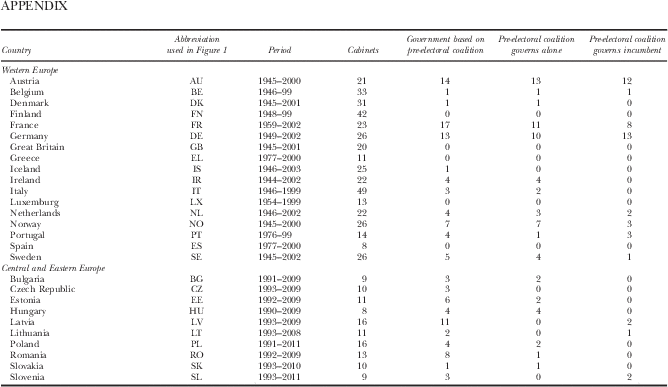
Figure 2 illustrates the general increase in recent decades in the number of cabinets that include pre-electoral coalitions. In Western Europe this upward trend applies also to the pre-electoral coalitions that managed to govern without other partners. In contrast, the average number of pre-electoral coalition cabinets resulting from incumbent governing coalitions seems fairly constant after the small boost registered in the 1950s. With the addition of the data from Central and Eastern European cabinets (the right-hand graph in Figure 2), the overall increase in frequency of pre-electoral coalition cabinets becomes even more visible. The complete list, including the number of cabinets, analysed period and type of cabinets including pre-electoral coalitions is available in the Appendix.
The Frequency of Pre-electoral Coalition Cabinets by the Decade in which they Came to Power
Types of Pre-Electoral Coalition Cabinets and Their Survival: A Competing Risks Design
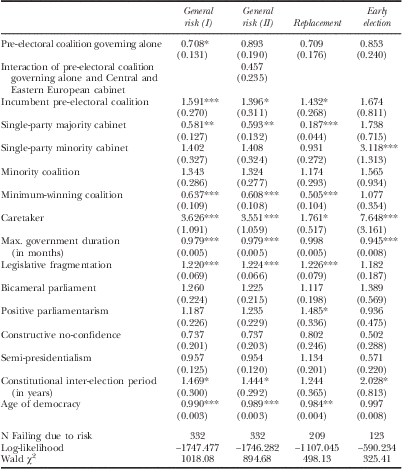
The results of the proportional hazard estimatesFootnote 8 on the pooled sample are presented in Table 1.
Survival of Pre-electoral Coalitions Governing Alone (Pooled Model – Cox Proportional Hazard Regressions)
Notes: Significance at *p<0.10; **p<0.05; ***p<0.01.
Cell entries are hazard ratios; robust, country-clustered standard errors in parentheses.
The findings generally illustrate the importance of the two types of pre-electoral coalitions for cabinet survival. The goodness of fit is comparable with that of most models of government durability.
To start with the pooled hazards model, the hazard ratio for cabinets which replicate electoral alliances perfectly indicates that they have a 30 per centFootnote 9 smaller rate of discretionary terminations. Conversely, pre-electoral coalitions that had governed in the previous legislative cycle exhibit a 60 per cent higher risk of discretionary termination. The latter finding cannot be completely attributed to the fact that coalition formulas that have survived for a longer period are simply more prone to die. This is because the ‘incumbent pre-electoral coalition’ variable also includes cabinets that have an enlarged composition – that is, other parties as well as those which made up the previous governing coalition.
The second pooled hazards modelFootnote 10 includes the interaction term accounting for the effect of pre-electoral coalitions that exclusively formed cabinets in Central and Eastern Europe. Although the hazard ratio is smaller, as expected, the interaction is not statistically significant. At the same time, the ‘age of democracy’ variable has a robust effect in both models.
The main effects in the replacement regression are relatively similar to those in the regression assessing the general risk of discretionary termination. The most important difference is that our indicator of pre-electoral coalition cabinets, despite pointing in the expected direction, failed to acquire statistical significance. This finding corroborates our expectation that the positive effect of pre-electoral coalitions on government durability is less likely to concern replacement terminations. Holding the other variables constant, cabinets including pre-electoral coalitions that had governed previously are 43 per cent more vulnerable to end with replacements compared with the rest.
Last but not least, the results of the early election risk regression differ from those of the previous analyses, mainly through the lack of statistical significance of both pre-electoral coalition variables. For all three models (pooled hazards, replacements and dissolution hazards) the substantive effects of the pre-electoral coalition variables remain unaltered when country dummies are included in the model. Overall, these mixed findings emphasize once again the importance of evaluating separately the hazards associated with the different types of discretionary termination.
In an alternative modelFootnote 11 not shown here, the interaction between Central and Eastern European cabinets and the variable capturing the effect of all pre-electoral coalition-based cabinets (that is, pre-electoral coalitions that governed alone and ‘pre-electoral coalition + others’ formulas) indicated a significant reduction in the risk of early elections – a reduction of 65 per cent. However, given the mixed evidence, we cannot corroborate the fourth hypothesis.
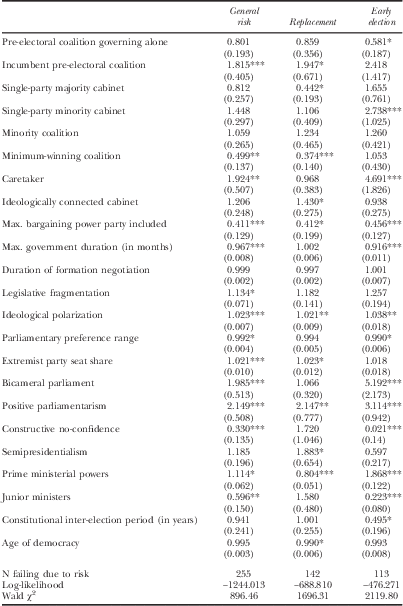
Table 2 presents the Cox proportional hazard regression on the Western European sample, including a larger number of covariates for each of the three categories of control variables. The pooled hazards regression illustrates that cabinets based on pre-electoral coalitions which had governed in the previous cycle have an 81.5 per cent higher chance of suffering from a discretionary termination. This happens despite the fact that the dummy variable capturing cabinets based exclusively on pre-electoral coalitions seems to have a mild positive effect on government durability, although not significant at conventional levels.
Pre-electoral Coalitions and Government Survival in Western Europe (Cox Proportional Hazard Regressions)
Notes: Significance at *p<0.10; **p<0.05; ***p<0.01.
Cell entries are hazard ratios; robust, country-clustered standard errors in parentheses.
The main effects tell virtually the same story for the replacement regression. Thus, incumbent pre-electoral coalition cabinets appear twice as likely as the rest to end with changes in party composition, portfolio distribution or reshuffles. The other variable, pointing to the pre-electoral coalitions which govern alone, does not make a significant difference.
The most spectacular finding of the last regression is that for pre-electoral coalition cabinets the risk of early election termination is 42 per cent smaller than that of other cabinets, all other things being equal. This very large positive effect is not reversed for cabinets including incumbent electoral coalitions, with the corresponding variable failing to reach statistical significance.Footnote 12
The substantive findings regarding pre-electoral coalition cabinets presented in Table 2 are not modified significantly by the introduction of country dummies. Moreover, these results are also robust to the omission of cabinets from countries that never experienced a pre-electoral coalition-based cabinet. Similarly, rerunning the models without the observations from the earlier decades (when pre-electoral coalitions were not too common) did not change much.
Controlling for ideologically connected cabinets or leaving out this variable does not make a difference for the effects of the pre-electoral coalition variables. Consequently, at least for the Western European data, we can safely conclude that the relationship between pre-electoral coalitions and government durability is not a spurious one – that is, it is not caused by the degree of ideological compatibility between the member parties.
Conclusion
This article makes a double contribution to the literature on coalition cabinets. At a theoretical level I present a number of novel arguments for why empirical and formal models of government durability should integrate information on pre-electoral alliances. At an empirical level, the study illustrates the substantial risk-reducing effect that pre-electoral coalitions governing alone have on discretionary terminations (that is, pooled hazards) in both Western and Central and Eastern Europe. This positive relationship is most of the time reversed for the incumbent pre-electoral coalition cabinets. Moreover, it seems that Western cabinets based exclusively on pre-electoral coalitions have a much smaller chance of ending through an early election.
For the Western European cabinets, it could be safely concluded that the relationship between pre-electoral coalitions and government durability is not a spurious one, and is not caused by the degree of ideological compatibility between the member parties. Further studies should aim at replicating the same test for Central and Eastern European governments – provided that they are able to gather reliable information about policy preferences of member parties. Nevertheless, the chances that the policy connection drives the results are extremely small, given the ideological fuzziness of the region’s parties (van Biezen Reference van Biezen2003; Enyedi and Toka Reference Enyedi and Toka2007).
The findings presented in this study would greatly benefit from triangulation with more qualitative analyses of the mechanisms through which pre-electoral coalitions are replicated into government coalitions (for example, institutional adaptation of electoral coordination committees) and also of the actors’ (party leaders, ministers) perceptions regarding these transformations and their impact on cabinet life.
Acknowledgement
The author is grateful to Professor Rudy Andeweg and the two anonymous reviewers for their valuable comments and suggestions on earlier drafts of the article.
The author’s work was supported by a grant of the Romanian Ministry of National Education, CNCS-UEFISCDI, project number PN-II-ID-PCE-2012-4-0644: ‘Re-thinking Individual Representation: Campaign Personalization and Legislative Behaviour’ (2013–15).
APPENDIX
Governments and Pre-electoral Coalitions in Europe